Modelos de orientación e intervención psicopedagógica (p. 363-374). barcelona: praxis, 1998.
repetto, e. (2002). Modelos de Orientación e Intervención Psicopedagógica. Vol. i. madrid: uned.
repetto, e. et al. (2000). Tareas y formación de los Orientadores en la Unión Europa. madrid: uned.
santana, l. (2003). Orientación Educativa e Intervención Psicopedagógica. Cambian los tiempos, cambian las responsabilidades profesionales. madrid: pirámide.
sobrado, l. m., & ceinos, c. (2010). diseño de un mapa de competencias de las tic integradas en la actuación de los profesionales de la orientación. Bordón, vol. 61 (3), p. 137-149.
sobrado, l. m., & ceinos, c. (2011). Tecnologías de la Información y Comunicación: Uso en Orientación Profesional y en la Formación. madrid: biblioteca nueva.
sobrado, l. m. (2004). utilización das tecnoloxías da información e comunicación (tic) polos profesionais da orientación. Revista Galega do Ensino, no. 43, p. 89-106.
sobrado, l. m. (2006). las competencias de los orientadores en el ámbito de las tic. Revista de Estudios sobre Educación, no. 11, p. 27-43.
sobrado, l. m. et al. (2002). desafíos das novas tecnoloxías na orientación educativa e profesional. paper presented at IV Congreso Internacional de Galicia e Norte de Portugal de Formación para o Traballo. o porto, portugal, 2002 [cd-rom].
sobrado, l. m. et al. (2010). planificación y desarrollo de un mapa de habilidades tic en orientación. Revista Comunicar, no. 35, vol. XViii, p. 167-174.
Advised by Elena Fernández Rey, University of Santiago de Compostela, Santiago de Compostela, Spain
received: September 29, 2011 accepted: October 29, 2011
Luis Martín Sobrado PhD, Main Professor, University of Santiago de Compostela, Faculty of Sci�� ences Education, Department of Methods in Research and Education Diag�� nostic, Campus �ida, ������� Santiago de Compostela ��� Coru�a�, Spain��Campus �ida, ������� Santiago de Compostela ��� Coru�a�, Spain�� E��mail: luismartin��sobrado@usc��es
Website: http://www��usc��es
Cristina Ceinos PhD, PhD, Professor ��ssistant, University of Santiago de Compostela, Faculty of Sciences Education, Department of Methods in Research and Education Diagnostic, Campus �ida, ������� Santiago de Compostela ���Campus �ida, ������� Santiago de Compostela ��� Coru�a�, Spain��
E��mail: cristina��ceinos@usc��es Website: http://www��usc��es
Rebeca García Graduate in Psychopedagogy, Professor ��ssistant, University of Santiago de Compostela, Faculty of Sciences Education, Department of Methods in Research and Education Diagnostic, Campus �ida, ������� Santiago deCampus �ida, ������� Santiago de Compostela ��� Coru�a�, Spain��
E��mail: rebeca��garcia@usc��es Website: http://www��usc��es
LEARNING ENVIRONMENT EFFECT AND
USE OF TECHNOLOGY IN THE STUDY OF
ENGLISH LANGUAGE
Valbona Softa
Wisdom University, Tirana University, Tirana, Albania E-mail: [email protected]
Abstract
The aim of this study is to investigate scientifically the impact that the learning environment has in learning foreign languages, with the main focus English language. This study was based on both qualitative and quantitative techniques of research, by using as instruments of research the case study in a non public language institution and the application of a questionnaire for a number of 230 students. The results revealed that the learning environment in the form of language labs rather traditional classrooms affected the student cooperative skills, interpersonal attitudes of the respondents and also the level of motivation in learning English.
The results revealed that for each of two scales measured in the motivation test, the average score isfor each of two scales measured in the motivation test, the average score is approximately 56 out 70, which stands for the fifth alternative in answer choices, a moderate agreement to the statements of importance for use of technology and motivation from learning environment (LE). The students reflected a more positive attitude and a feeling of relief while performing in a technologically advanced environment, like not getting emotional or anxious when expressing in English or making a, like not getting emotional or anxious when expressing in English or making a question in English to the teacher. They would often look around the classroom to find hints for what they had to perform in class or check computers, play the CDs as practical means of operating in the English class.
Key words: enhanced learning classrooms, feeling of relief positive attitudes, language learning, motivation of language learning, technologically advanced environment.
Introduction
the term learning environment is perceived by stevenson and bunting as “a traditional classroom, which is suggested to disappear and replaced by holistic study labs and exploratory centres” (bunting a. 2004; Keep G. 2002, stevenson 2007:3). relatively embryonic studies in the world about the learning spaces have fostered the academic and institutional attention on the issue of the impact that learning environment has on language acquisition and pedagogy.
Volume 35, 2011
128 Problem of Research
considering the aura of changes in education system and the great importance given to english language nowadays, it is estimated that the learning environment where lessons take place, affects language acquisition and motivation. if there is an enhanced learning environment with optimal visual and study conditions, well organized classrooms and learning spaces, effects will tend to be positive in regards to student motivation and the level of acquisition.
the questions for consideration in this research are:
• What effect does learning environment and use of technology have in interpersonal relations and students attitudes in english class?
• does learning environment motivate studying foreign language and in this case, to what extent?
• What is level of importance of technology facilities in the place where the english lessons take place?
Research Focus
in this study will be taken for references the most recent studies in this field of research, however this research itself does not attempt to prove analogy theories; it only tries to adopt and view theories in albanian context, isolated from the evidences and comparative results abroad. Great names of researchers in the studies for the effect of learning environment will be mentioned such as bunting a., ellis J., ellis J., hiemstra r. etc. one of these studies comes from d. christopher brooks, who carried out a research in minnesota university, usa, in 2008, with a participation of 1131 students on the topic “ space issues : the effect of formal learning environment in acquisition” (British Journal of Educational Technology, 2010). the study shows thatthe students who attend classes in enhanced learning environment in terms of technology and which are optimal for active techniques in learning had better results than their peers who followed same courses but in more traditional classrooms. (brooks c.2010, British Journal of Educational Technology, 2010).
The Situation in Albanian Schools
many teachers plan the students learning strategies which are appropriate to the type of lesson they intend to explain. one of these methods of teaching languages, at least in albanian schools, is teaching for the whole class, which mostly works for public schools, where the teacher at the beginning of the class checks home work, explains lesson by elaborating concepts and linguistic phrases, and in the end of the class assigns home task.
“as an advantage to this strategy is the consideration for massive teaching at a time. our secondary and high public schools have classes of 40-50 pupils/students in one group. this is a disadvantage because teachers typically tend to interact only with a very small number of students. (tafani, V. 2003: 180-181).
secondly, the physical and spatial organization affects the collaboration at work. if students in foreign languages classes intend to collaborate in groups, then activities should be structured in ways that students collaborate and talk to each other. they need to communicate face to face. “the case of albanian school does not offer such an opportunity, but let’s try” (tafani, V. 2003:180, language teaching and learning methodology).
129 albania as a national priority, or taking international exams such as toefl, ielts, fce etc, is the necessity to construct english language labs, rearrange the sitting position in classrooms, lead the students to independent skills of language learning, enhancing cooperative methods of group work, etc.
cooperative learning as a theory dates back from 20th century by John dewey and it was later developed during 70’-80’ in usa, in order to improve traditional models of classroom learning. one of the general objectives in language learning through this method is to enhance cooperation rather than competition it aims at developing critical skills, communication competency through structured social interactive activities (richards and rogers, 2003, Approaches and methods in Language Teaching, cup).
michael long states that “the key to cooperative learning is the task assignment in group, which is accomplished by the classroom reorganization, by imposing responsibility at students and sharing the joint activities in lesson, as well as making joint evaluation”
Methodology of Research
General Background of Research
two theories for learning foreign language 1. behaviourist theory
the behaviourist theory supports the operant conditioning idea, which has as a model the chain stimulus - answer – action, and stands for the fact that babies are naturally used to learning a foreign language. this method uses some stable exercises and repeated by students, followed by positive or negative practice.
2. cognitive theory
the term cognitive is often used to describe methods through which students are asked to think rather than repeat. founder of this theory is noam chomsky. in language learning, he supports the model of competence and performance, but not the learned behaviour, that is behaviourist theory.
“one important aspect of diversity in teaching aspects, perhaps the most important ones is the use of materials for knowledge acquisition, the classroom setting by making good use of its space, and placing on the walls students projects and study works. classroom environment and its sight help in diversity of teaching ways. consequently, it later affects students` results, their involvement in the process of acquisition etc” (musai 2003: 20). other scholars who have made research in learning and teaching methods have quite briefly commented on the topic of learning environment, mainly in the field of foreign languages. tafani V. claims in her book Language Teaching and Learning Methodology states that “students, who learn foreign languages, need to discuss through face to face method, and they can not participate in a foreign language discourse if they are turning backs to each other. in the case of foreign languages the le affects not only the communicative skills, but it also has an impact on the level of motivation. physical learning conditions have a great impact on motivation; they can drive motivation trend positively and negatively. poorly lit and overcrowded classrooms are discouraging” tafani V. (2003:102).
Volume 35, 2011
130 Sample of Research
as a sample to this research were taken two groups of 15 students of various ages,of 15 students of various ages, in total 30 students for the method of case study. the case study was developed at Wisdom school, foreign languages institution. these groups were randomly selected, despite their english level, age, or background and they were surveyed in natural conditions for four weeks in a period of two months, may - June. the students were in natural english class conditions and were surveyed on routine lessons times three times a week. for two weeks during the first month and for two other weeks the following month. no change in classroom setting was made and there were no newcomers to the english class to become part of the study. the times of research were set in the afternoon, in the times students were having english lessons.
in quantitative perspective it was applied a questionnaire about motivation on a sample of 230 students, the total number of students in this school. another reason for taking this sample is that the study has an action research character, applicable only to ‘Wisdom” institution, consequently an overall number of all registered students is required. the sample was taken from the names record list at school database at the same institution. the questionnaire was composed based on the theories of motivation and emotion and language learning and partly in Gardner, 2003, test of motivation, considerably moderated concerning the scales, which was adopted for the european countries. it comprised two likert scales, first, importance of technology use in english class with 8 positively worded items and motivation from learning environment, with 12 positively items. there are six alternatives of choice for the respondents, from the least level of agreement (strongly disagree) to the highest level of agreement (strongly agree).
the test went through a pilot age in the first phase of the study to achieve the reliability coefficient and to prove if it was appropriate for the studies in albania. it resulted with high coefficient of reliability, 0.74 alpha cronbach, which made possible the ongoing of the study for the sample of 230 students at the same institution.
Table 1. Reliability of test application in the pilot age, first stage of the stu
-dents.
Cronbach’s Alpha Cronbach’s Alpha Based on Standardized Items N of Items N of scales
0���40 0��99� �0 �
Instruments and Procedures
this study is based on two strategies of research, qualitative and quantitative. in the qualitative perspective the method of case study was selected, where as instrument of measurement served the technique of observation. two groups of 15 students of various ages were the focus of this case study, which was applied at “Wisdom”, a foreign languages institution. this procedure was selected because the study has the character of an action research, which will serve for inside school application. the two groups were having lessons in natural conditions, at the due time they usually take their english course. they were surveyed and clinically observed systematically for a two month period of time, three times a week on normal day course by routine longitude of classes ninety minutes each. the classes were not fully attended though, during the two last weeks of the research due to sufficient data gathering.
131 of motivation. it was applied in 230 students and it took two months to administer. this was a sample with probability, taken from the names record list at school database. the scope of the study was introduced to the students for ethical reasons and the students were free to participate or not in it. the group of people who administered the test were previously trained for the practice and they were teachers of english language. first the test went on pilot age with 100 students randomly chosen, and it was fully developed for the study after it was validated with the alpha chronbach 0.74, a valid coefficient for the full operation of the research.
Data Analysis and results of the research
the following data was gathered after testing the level of motivation for two scales. for practical use and easy interpretation of data, the first scale has been recoded into a subscale to provide data for the whole scale in a better organized way. this subscale is “importance of technology in class recoded”. (see the following table)
Table 2. Importance of technology use in the English class.
Values respondentsNumber of Percentages Mean St. Dev.
4 �6 3��6 ���3� 0���6�
� �4� 63 ���3� 0���6�
6 �� 33��4 ���3� 0���6�
Total �30 �00
the results in table 1 reveal that the importance of use of technology at class is moderately high at Wisdom school for the sample of 230 students participating at it.
As it can be noted from the frequency table, the mean (σ = 5.31) for the recoded variable
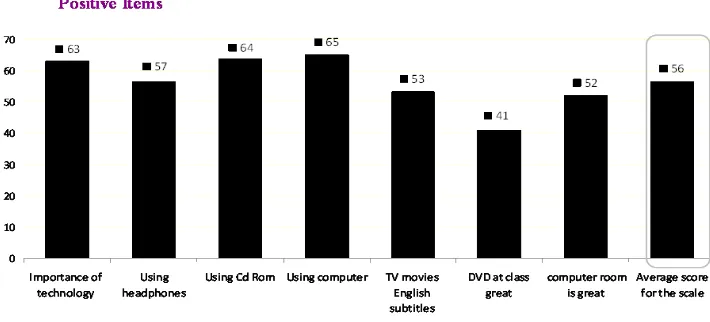
“importance of technology in class” corresponds to alternative 5, (moderately agree) for the likert scale used in this test and also corresponds to the average score 56 out 70 (see figure 1). this value is the average score for the whole scale. Value 5 shows that the majority of students (147) have more frequently chosen alternative 5 in the test, moderately agree. 63 % of them have answered that they moderately agree with the statement that technology is important in language learning, 33.4 % or 77 students have stated that absolutely agree that use of technology is important in class. only 3.6% have slightly agreed to the idea that using technology is important in an english class. the standard deviation is 0.165, which shows that
the values are dispersed in a homogeneous way round the mean =5.31. This means that almost
all the students have moderately agreed that they feel excited about the idea of using technology when learning english, though this is not exclusive to 100%. this data is equalized to the average score of 8 individual items in the score list (table 3 & figure 1), where is noted an average score of 56 out of 70, a value which stands for the mean result in the frequencies table
Volume 35, 2011
132 Table 3. Importance of technology use in the English class (��.��..
��� High technology use in the English class will improve my language skills 63 2. I find it useful listening with headphones the passages in English �� 3�� My English class is more interesting when we practice with CD ROMS 63���4 4�� Using computers in the English class is very motivating 6���� ��� When I watch a movie at the English class I would rather it is in English subtitles �3��34 6�� Watching D�D��s in the English class is so great 4���0� ��� It creates a pleasant feeling when we have English lessons in the English lab ����94
��� ��verage score �6
table 3 shows the scores of the scale for the importance of technology in english class. all items are positively keyed, they are each measured based on a general score of 70. these scores stand for individual items, and are based on descriptive statistics for each item.
in the questionnaire applied at Wisdom resulted that students highly appreciated the use of technology at school and felt excited and motivated about it at a score of 63 % and the using computers in the english class is very motivating at a score of 65.1 %.
the following figure shows the results:
Figure 1: Importance of technology use in the English class.
133 the lower scores 41 and a rather smaller number of students (16) at 3.6% stand for thecores 41 and a rather smaller number of students (16) at 3.6% stand for the importance of watching english movies in dVd at the english class. Generally the respondents think that watching movies in english subtitles is slightly important, as well as the classes in the language lab or computer rooms. they only slightly agree with the fact that classes in the computer room are great.
Table 4. Importance of classroom arrangement and learning en�ironment inImportance of classroom arrangement and learning en�ironment in the English class.
Values Number of respondents Percentages Mean St. Dev.
� �90 �� ���� 0���6�
6 40 �� ���� 0���6�
6 �� 33��4 ���� 0���6�
Total �30 �00
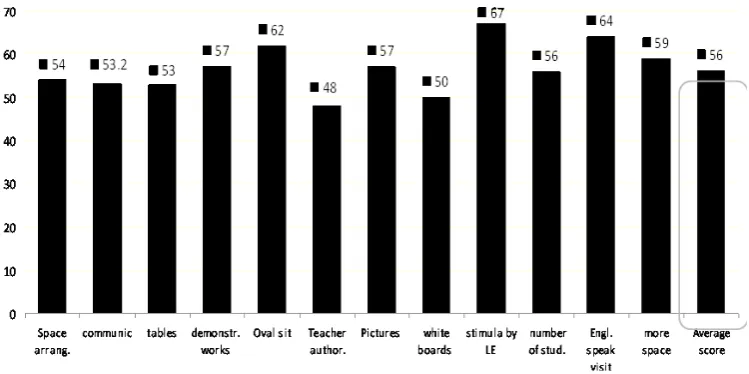
the subscale in this table is “motivation from le recoded scale recoded”. the major part of the students or 82 % of them or 190 students have answered that they moderately agree with the statement that they are motivated from le in language learning, 18% or 40 students have stated that absolutely agree with this statement. there is no other value chosen for this scale other than 5 and 6. the standard deviation is 0.265 which shows that the values are homogeneously distributed round the average value 5.5, this means that almost all the students find they are more than moderately motivated from learning environment, but not exclusively by it nor absolutely agree with it. other factors also affect the language learning, except from the individual items included in this scale. these scores stand for individual item, and are based on descriptive statistics for the recoded subscale described above. the average
score is 56 which corresponds to σ = 5.5 for the motivation scale from LE.
the scores for each item are out 70, general score for the whole scale are given in table 5.
Table 5. Importance of classroom arrangement and learning en�ironment in the English class (��.
� Space arrangement is important to me �4
� �� face to face communication is more successful �3���
3 Boards with English language content on the walls inspire me in the classroom �3 4 Demonstrating individual works in English at class is encouraging �� � I like sitting in desks arranged in an oval shape in the English class 6� 6 The teacher` s authority is less obvious in round desk sitting 4� � The pictures in the classroom simulate my imagination to speak in English language �� � The use of white boards versus blackboards is stimulating to me �0 9 The learning environment in the English class is very important to me 6� �0 English speaking visitors in the class encourage me speaking English 64 �� The bigger the classrooms, the more I perform in English language �9
�� ��verage score �6
Volume 35, 2011 134
Figure 2: Importance of classroom arrangement and learning en�ironment inImportance of classroom arrangement and learning en�ironment in the English class.
as it can be seen in this figure, the average value for the scale of motivation from the learning environment (le) stands with a moderately high result, a score of 56 out 70, which reveals that the students at Wisdom school are moderately motivated from the learning environment. the highest score for this scale (67) stands for the stimulation that comes in general from the learning environment in the english class, 88 students have absolutely agreed to the fact that learning environment is very important and they feel highly motivated by it. What contributes to the learning environment is also the presence of native english speaking people in the classroom, at a score of 64. 50 students have stated they feel encouraged to communicate when a native english speaking person comes to class. the students also commented that a foreigner presence in an english class brings comfort to their le. another very indicative role is the sitting arrangement, at a score of 62. 48 students really felt at ease and stimulated because of sitting in round desks, because this enabled them to see one another whilst speaking and raised the level of communication among them. this choice was very closely related to their belief that such a way of sitting brings social connection and interaction to one another and the teacher s authority is milder compared when he is sitting in front of the classroom. however teacher authority in class has the lowest score in the graph at the level of 48 out 70. only a small percentage of students were affected by his role at class. the rest of the students 24 % of them related motivation in lower scores varying from 50 for the fact they were inspired from the white boards versus black boards they use in public schools to 59 for they needed more spaceboards versus black boards they use in public schools to 59 for they needed more spaceto 59 for they needed more space in the classroom for their performance connected to english kinaesthetic exercises.
Case Study in a Non Public, Foreign Language School in Albania
135 in the language lab. furthermore, each classroom is a mini lab, fully equipped with adequate language instruments like cd players for the listening skills, tV and dVd for watching movies in english and learning language culture, pictures and boards in english language, round chair sitting etc.
in this case study two groups of 15 students of various ages each, participated. they were in natural english class conditions and lessons times. during the first week students were rather reluctant and not very comfortable at the presence of newcomer to class, despite the fact that i had introduced the objective of my participation to that class. the second week of the first month paved a path of communication among all the participants in the room. the programme on both courses attended, required that students reflect a lot of willingness to fulfil the task given by the teacher, in a group work by the strategy of collaborative learning. at Wisdom english classrooms students were sitting opposite one another, since the chairs are set in a round way, and not back to back. furthermore, they felt relaxed and at ease because of the technological equipment they could use at class. they felt optimistic about playing and replaying the cds themselves, looking at the wall posters and finding out the missing words in the “fill in the gaps’ exercise. they would use encouraging words to each other and expressions of joy like “come on, let`s do it, we are the best, they will not beat us etc” meantime they resulted to be creative by suggesting many resolution options to the exercises they had to make in groups. When andres, 14 years old boy, pre intermediate english student was asked “do you feel like this at the same subject at the public school?” he said:
“i can not even compare this to it”.
during the second month it was observed behaviour and attitude. the students were fast moving, had high expectation to the subject by working hard on finding back up information and doing individual research, they would frequently raise questions in english by making good use of vocabulary tables on the walls or putting them into classroom games, they showed feeling of relief, like not getting emotional when expressing in english or making a question in english to the teacher. they would often look around the classroom to find hints for what they had to perform in class or check computers, play the cds as practical means of operating in class. they yawned and stretched limbs very rarely, and did not ask for frequent permissions to leave the room as students generally do in long lasting classes and school programmes. they were not distracted by their mobiles phones, considering that in this school there is no rule for students to switch them off. the concentration was at high levels along this two month period of time.
blerina, 35 years old expressed herself freely when talking about her feeling to english class at Wisdom. she said:
“i feel like home here, i like the classroom, the colour in the walls, the boards on the walls, the class arrangement where we sit like in the living room, the technological tools around for linguistic use…there is one difference though. i am not at home where i have to face a lot of responsibilities, and this makes enjoy the english class a lot actually”.
Discussion
Volume 35, 2011
136 technology and motivation from le, the first comprising 8 items and the second 12 items. the descriptive result shows that for each scale the average score is approximately 56 out 70, which makes the dominant part of the sample reflecting that they are moderately motivated from the enhanced classroom conditions and use of technology is moderately important. both scales in the test measure statistically the effects of le, what is noted is that they both have same average scores. the result of this study stands for the experiment occurring in one environment only and excludes comparative data. it is usually performed this kind of test in more massive samples, like thousands of people, like in brook study with a participation of 1131 students with a participation of 1131 students in 2008, where the application was made for two different samples tested in separate learning 2008, where the application was made for two different samples tested in separate learning environments, one traditional and one more sophisticated on the topic “space issues”: the effectthe topic “space issues”: the effect of formal learning environment in acquisition” (British Journal of Educational Technology, 2010). in this study are not discussed correlative relations, nor regression among scales orin this study are not discussed correlative relations, nor regression among scales or variables, considering that the aim of this study is to reveal only the scores for the factors affecting the language learning in one institution only. further experiments through comparative or correlative analysis may be made in the future, based on this data or a more thorough relevant research. What the study reveals is an open question for discussion whether the results would be the same applicable beyond this case study through comparative data or experimenting on two different learning environments, as previously made in other studies. on the other hand, it is disputable the average score for each scale, which is almost equal in value for both scales (56 out of 70) , in addition considering the small value of standard deviation for each scale, (0.165 and 0.265) , the respondents have given nearly homogeneous answers in the test, approaching value 5 out of 6 in the likert scale used in this test, which means that they are moderately agreeing with the use of technology in english class and they are at the same degree motivated from the learning environment.
this means that the results of students feeling at ease and relieved of emotions and anxiety in an enhanced technological english class are not to be generalized for all cases alike, out of the case study. typology is excluded and it is to be noted that the classroom conditions, spatial organization vary from one school to another. the students were in natural englishthe students were in natural english class conditions and were surveyed on routine lessons times three times a week. for two weeks during the first month for two more weeks in the following month. no change in classroom setting was made and there were no newcomers to the english class to become part of the study. the times of research were set in the afternoon, in the times students were having english lessons. it remains to be studied if the behaviour and attitude would change in public schools for example, where the number of students varies from 40 to 50, and there is hardly an enhanced learning condition. it can be also considered variables in future studies the gender, age or fees at school, factors which are not studied in this research.
Conclusions
the statistics showed that for each scale the average score is approximately 56 out of 70,for each scale the average score is approximately 56 out of 70, which stands for the fifth alternative in answer choices, a moderate agreement to the statements of importance and motivation from learning environment (le). the minimum and maximum values in the study for the first scale varied from 41- 65 out of 70, and for the second scale the extreme score values were 67-48. for the first scale these values stood for the variable labeled ‘importance of dVd watching’ and maximum for ‘using computers at class’, whereas in the second scale they represented at maximum score variable labeled ‘stimulation from le’ 67 and the minimum variable labeled ‘teacher authority’.
137 sympathetic listeners and active interlocutors. in most of the times they switched attention to environment by making good use of it, such as by looking at the boards on the wall and making statements or dialogues with the words written in them. most of the cases they would use technical equipments during the class such as cd player, dVd, or electronic vocabulary for instant help in practice.
References
bunting, a. (2004). secondary schools designed for a purpose: but which one?’ Teacher, no.154, p. 10-13. available on the internet at: http://www.vit.vic.edu.au/standardsandlearning/ (retrieved on 2.20.2011).
brooks, d. c. (2010). space matters: the impact of formal learning environments on student learning. British Journal of Educational Technology, Vol. 42, issue 5,p. 719-726. doi:10.1111/j.1467-8535.2010.01098.x.
decision no: 14 of ministry of science and education in albania, on 3.28.2011. accessed on internet at www.mash.gov.al, retrieved on 07.30.2011.
educause (minnesota university, scale-up, student centre of north carolina for massive registration in bachelor programmes accessed on internet at www.educause.edu/resources/ scaleupproject
Keep, G. (2002). buildings that teach. The Educational Facilities Planner, Vol. 37, no. 2. accessed on internet at http://sbw.cefpifoundation.org/pdf/buildingsteach.pdf, retrieved on 4.19.2011.
long, m. h, & richards, J. c. (eds.) (1987). Methodology in TESOL: a reader. rowley, mass.: newbury house.
musai, b. (2003). Teaching Methodology. tirana: peGi publishing house.
richards, J. c., rodgers, t. s. (2003). Approaches and methods in Language Teaching. cambridge: cup.
stevenson, K. r. (2007). Educational trends shaping school planning and design. Washington, dc, national clearinghouse for educational facilities. accessed from http://www.edfacilities.org/pubs/ trends2007.pdf (retrieved on 4.18.2011).
tafani, V. (2003). Language Teaching and Learning Methodology. tirana: shblu.
Advised by Elona Hasko, Wisdom University, Tirana, Albania
received: July 13, 2011 accepted: October 29, 2011
Valbona Softa Post M.Sc, PhD Candidate, Lecturer of `English for Specific Purposes` Wisdom University and `Evaluation in Education` subject at Tirana Univer�� sity, Universiteti ‘Wisdom”, Qendra Kondor, Rruga e Kavajës, Ish Parku i ��utobuzave, Kati II, Tiranë, ��lbania��