Pharmacophore 2011, Vol. 2 (2), 113-118
ISSN 2229 – 5402
Pharmacophore
(An International Research Journal)Available online at http://www.pharmacophorejournal.com/
Original Research Paper
VALIDATED RP - HPLC METHOD FOR THE
ESTIMATION OF ZOLMITRIPTAN IN FORMULATION
Danavena Rambabu
1*
, B.Bhoomaiah
2,
Phani.R.S.Ch
3, K Balamurali Krishna
41
*
Symed Laboratories Limited, Hydrabad, A.P., India
2
Aurobindo Pharma, Hydrabad, A.P., India
3R.V. Labs, Guntur, A.P., India
4Dept of Chemistry, Acharyanagarjuna University,
Nagarjuna Nagar, Guntur, A.P., India
ABSTRACT
A simple, selective, linear, precise and accurate RP-HPLC method was developed and validated for rapid assay of Zolmitriptan in tablet dosage form. Isocratic elution at a flow rate of 1.0ml/min was employed on symmetry C18 (250 x 4.6 mm, 5 µm in particle size) at ambient temperature. The mobile phase consisted of 0.01% triethylamine : acetonitrile : 0.02M NH4H2PO4; 28.2:25:46.8 (V/V/V). The UV detection
wavelength was 225 nm and 20µl sample was injected. The retention time for Zolmitriptan was 3.705 min. The percentage RSD for precision and accuracy of the method was found to be less than 2%. The method was validated as per the ICH guidelines. The method was successfully applied for routine analysis of Zolmitriptan in tablet dosage form.
Keywords: Zolmitriptan, RP-HPLC, UV detection, Recovery, Precise.
INTRODUCTION
Zolmitriptan molecular formula C16H21N3O2 and
weight 287.357 g/mol and IUPAC name (S)-4- ({3 - [2-(dimethylamino) ethyl]- 1H- indol - 5- yl}methyl)-1,3-oxazolidin-2-one. Zolmitriptan is a selective serotonin receptor agonist of the 1B and 1D subtype. It is a triptan, used in the acute treatment of migraine attacks with or without aura and cluster headaches.1,2 Zolmitriptan is marketed by AstraZeneca with the brand names Zomig, Zomigon. Zolmitriptan may increase blood pressure; it should not be given to patients
with uncontrolled hypertension, should not be used within 24 hours of treatment with another 5-HT1 agonist, or an ergotamine-containing or ergot-type medication like dihydroergotamine or methysergide, and should not be administered to patients with hemiplegic or basilar migraine.3-7
MATERIALS AND METHODS
Chemicals and Reagents
Danavena Rambabu et al. / Pharmacophore 2011, Vol. 2 (2), 150-155 Instrumentation and Analytical Conditions
The analysis of drug was carried out on a PEAK HPLC system equipped with a reverse phase C18 column (250x4.6mm, 5µm in particle size), a LC-P7000 isocratic pump, a 20µl injection loop and a LC-UV7000 absorbance detector and running on PEAK Chromatographic Software version 1.06. Isocratic elution with 0.01% tri ethyl amine: acetonitrile: 0.02M NH4H2PO4
28.2:25:46.8 (V/V) (PH-3.2) was used at a flow rate of 1.0ml/min. The mobile phase was prepared freshly and degassed by sonicating for 5 min before use.
Stock and Working Standard Solutions
Accurately weigh and transfer 10mg of Zolmitriptan working standard into a 10ml volumetric flask add diluent and sonicate to dissolve it completely and make volume up to the mark with the same solvent. Further pipette 1ml of the above stock solution into a 10ml volumetric flask and dilute up to the mark with diluent. Mix well and filter through 0.45µm nylon filter paper and finally11ppm were prepared. The calibration curve was plotted with the five concentrations of the 3ppm – 11ppm working standard solutions. Calibration solutions were prepared daily and analyzed immediately after preparation.
Assay of Zolmitriptan Tablets
Weigh 20 Zolmitriptan (ZOMIG - 5mg) tablets and calculate the average weight. Accurately weigh and transfer the sample equivalent to 10mg of Zolmitriptan in to a 10ml volumetric flask. Add diluent and sonicate to dissolve it completely and make volume up to the mark with diluents. Mix well and filter through 0.45um filter. Further pipette 1ml of the above stock solution into a 10ml volumetric flask and dilute up to mark with diluents and finally 11ppm were prepared. Mix well and filter through 0.45um filter. An aliquot of this solution was injected into HPLC system. Peak area of Zolmitriptan was measured for the
determination. The results are furnished in Table 3.
Validation Procedure
The objective of the method validation is to demonstrate that the method is suitable for its intended purpose as it is stated in ICH guidelines. The method was validated for linearity, precision (repeatability and intermediate precision), accuracy, specificity, stability and system suitability. Standard plots were constructed with five concentrations in the range of 3ppm to 11ppm prepared in triplicates to test linearity. The peak area of Zolmitriptan was plotted against the concentration to obtain the calibration graph. The linearity was evaluated by linear regression analysis that was calculated by the least square regression method. The precision of the assay was studied with respect to both repeatability and intermediate precision. Repeatability was calculated from six replicate injections of freshly prepared Zolmitriptan test solution in the same equipment at a concentration value of 100% (11ppm) of the intended test concentration value on the same day. The experiment was repeated by assaying freshly prepared solution at the same concentration additionally on two consecutive days to determine intermediate precision. Peak area of the Zolmitriptan was determined and precision was reported as %RSD.
Danavena Rambabu et al. / Pharmacophore 2011, Vol. 2 (2), 150-155
RESULTS AND DISCUSSION
Optimization of Chromatographic Conditions Proper selection of the stationary phase depends up on the nature of the sample, molecular weight and solubility. The drug Zolmitriptan is nonpolar. Non-polar compounds preferably analyzed by reverse phase columns. Among C8 and C18, C18 column was selected. Non-polar compound is very attractive with reverse phase columns. So the elution of the compound from the column was influenced by polar mobile phase. Mixture of tri ethyl amine, acetonitrile and 0.02M NH4H2PO4 was selected as mobile
phase and the effect of composition of mobile phase on the retention time of Zolmitriptan was thoroughly investigated. The concentration of the triethylamine, acetonitrile and 0.02M NH4H2PO4 were optimized to give symmetric
peak with short run time (Fig.3).
Validation of Method
Linearity
Five points graphs was constructed covering a concentration range 3-11ppm (Three independent determinations were performed at each concentration). Linear relationships between the peak area signals of Zolmitriptan the corresponding drug concentration was observed. The standard deviation of the slope and intercept were low. The statistical analysis of calibration is shown in Table 1.
Precision
The validated method was applied for the assay of commercial tablets containing Zolmitriptan. Sample was analyzed for five times after extracting the drug as mentioned in assay sample preparation of the experimental section. The results presented good agreement with the labeled content. Low values of standard deviation denoted very good repeatability of the measurement. Thus it was showing that the equipment used for the study was correctly and
hence the developed analytical method is highly repetitive. For the intermediate precision a study carried out by the same analyst working on the same day on two consecutive days indicated a RSD of 0.895. This indicates good method precision.
Stability
The stability of Zolmitriptan in standard and sample solutions containing determined by storing the solutions at ambient temperature (20±100C). The solutions were checked in triplicate after three successive days of storage and the data were compared with freshly prepared samples. In each case, it could be noticed that solutions were stable for 48 hrs, as during this time the results did not decrease below 98%. This denotes that Zolmitriptan is stable and standard and sample solutions for at least 2 days at ambient temperature.
System suitability
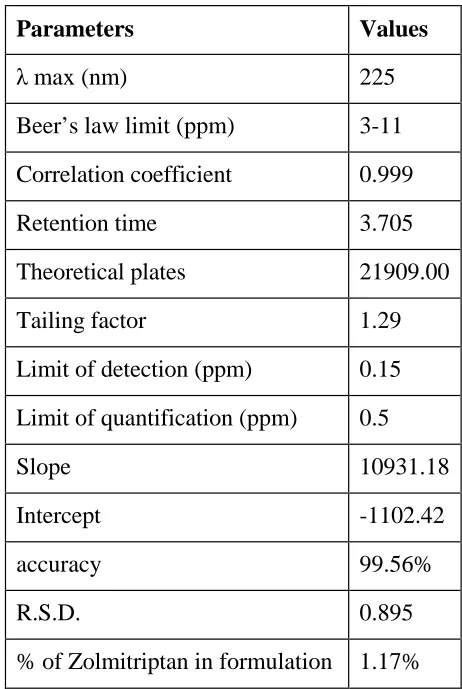
The system suitability parameter like capacity factor, asymmetry factor, tailing factor and number of theoretical plates were also calculated. It was observed that all the values are within the limits (Table3). The statistical evaluation of the proposed method was revealed its good linearity, reproducibility and its validation for different parameters and let us to the conclusion that it could be used for the rapid and reliable determination of Zolmitriptan in tablet formulation. The results are furnished in Table 3.
CONCLUSION
Danavena Rambabu et al. / Pharmacophore 2011, Vol. 2 (2), 150-155
Figure1: Chemical Structure of Zolmitriptan
Danavena Rambabu et al. / Pharmacophore 2011, Vol. 2 (2), 150-155
Table 1: Linearity of Zolmitriptan
S.No. Linearity level Concentration Area
1 I 3ppm 30487.5
2 II 5ppm 55101.7
3 III 7ppm 76517.3
4 IV 9ppm 95245.1
5 V 11ppm 119727.6
Table 2: Recovery studies of Zolmitriptan
% Concentration % Recovery Mean Recovery
50% 98.22%
100% 99.01% 98.62%
150% 98.65%
Table 3: System stability parameters
Parameters Values
λ max (nm) 225
Beer’s law limit (ppm) 3-11
Correlation coefficient 0.999
Retention time 3.705
Theoretical plates 21909.00
Tailing factor 1.29
Limit of detection (ppm) 0.15
Limit of quantification (ppm) 0.5
Slope 10931.18
Intercept -1102.42
accuracy 99.56%
R.S.D. 0.895
Danavena Rambabu et al. / Pharmacophore 2011, Vol. 2 (2), 150-155
Table 4: Assay
Formulation Label claim (mg) % Amount found
Zomig 5mg 1.17%
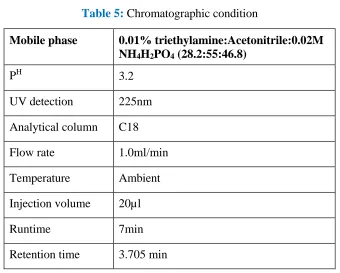
Table 5: Chromatographic condition
Mobile phase 0.01% triethylamine:Acetonitrile:0.02M NH4H2PO4 (28.2:55:46.8)
PH 3.2
UV detection 225nm
Analytical column C18
Flow rate 1.0ml/min
Temperature Ambient
Injection volume 20µl
Runtime 7min
Retention time 3.705 min
REFERENCES
1. Top 200 generic drugs by retail dollars (2009), Drug Topics.
2. Newman, LC and Lipton, RB (2001), “Migraine MLT-Down: An unusual presentation of migraine in patients with aspartame-triggered headaches”, Headache:
the Journal of Head and Face Pain, 41 (9),
899-901.
3. MacGregor, EA (1998), “Zolmitriptan clinical studies”, Drugs Today, 34 (12), 1027-33. 4. Oldman, AD; Smith, LA; McQuay, HJ and
Moore, RA (2002), “A systematic review of treatments for acute migraine”, Pain,
PubMed, 97,247-57
5. Yates, R; Nairn, K and Dixon, R (2002), “Preliminary studies of the pharmacokinetics and tolerability of zolmitriptan nasal spray in
healthy volunteers”, J. Clin. Pharmacol., 42, 1237-43.
6. Yates, R; Nairn, K and Dixon, R (2002), “Pharmacokinetics dose proportionality and tolerability of single and repeat doses of a nasal spray formulation of zolmitriptan in healthy volunteers”, J. Clin. Pharmacol, 42, 1244-50.
7. Chen, X; Liu, D; Luan, Y; Jin, F and Zhong, D (2006), “Determination of zolmitriptan in human plasma by liquid chromatography- tandem mass spectrometry method: Application to a pharmacokinetic study”, J