ORIGINAL ARTICLE
Volume 9 Issue 3 2017DOI: 10.21315/eimj2017.9.3.5 ARTICLE INFO
Submitted: 21-05-2017 Accepted: 11-08-2017 Online: 30-09-2017
Coaching as a Tool for Personal and Professional
Development in a Problem-Based Learning
(PBL) Medical Curriculum: A Qualitative Study
Amira Farghaly1,2, Adel Abdelaziz1,2
1Medical Education Department, Faculty of Medicine, Suez Canal University, EGYPT
2Medical Education Unit, Faculty of Medicine, Prince Sattam Bin Abdulaziz University, SAUDI ARABIA
To cite this article: Farghaly A, Abdelaziz A. Coaching as a tool for personal and professional development in a problem-based learning (PBL) medical curriculum: a qualitative study. Education in Medicine Journal. 2017;9(3): 45–53 https://doi.org/10.21315/eimj2017.9.3.5
To link to this article: https://doi.org/10.21315/eimj2017.9.3.5
ABSTRACT
Background: Coaching is a form of supervision which is about unlocking a person’s potential
to maximise own performance. Recently, medical education has been bringing such one-to-one developmental activities to the fore. Objective: Is to explore opinions of experts and leaders in a Problem-Based learning (PBL) medical school about coaching as a method for students and faculty development. Methods: This is a qualitative study conducted in the Faculty of Medicine, Suez Canal University (FOM-SCU); a PBL college in Egypt. A focus group discussion was conducted with 10 faculty members in the Medical Education Department. In addition, interviews were held with five faculty members in leadership positions. All sessions were audio recorded then transcribed verbatim. Data were organised around the themes: applications of coaching in medical education, potential benefits, expected outcomes and challenges. Results: Coaching is perceived as applicable within context of the PBL curriculum of FOM-SCU. To institute coaching as an efficient developmental tool, a lot of efforts are still indicated. Furthermore, coaching can comprise a set of other already existing developmental activities in the PBL curriculum. Resistance to change and lack of resources are anticipated challenges. Conclusion: Innovative curricula more receptive for coaching. The major against developing a coaching culture are resistance to change and shortage of financial resources.
Keywords: Coaching, Professional development, Personal development
INTRODUCTION
Supervision is currently being introduced to variety of medical education encounters. These encounters include undergraduate tutorials, bedside teaching, training and appraisal of doctors, research activities and academic advising activities. This has been the result of many changes that took place in medical education, namely the shift to adult learning principles, the need for lifelong learning, and the culture of interprofessional education (1).
Coaching is a form of supervision targeting unlocking a person’s potential to maximise his performance (2). Through coaching, a person called a coach helps a learner or a client in fulfilling a specific personal or professional goal. Sometimes, the concept of coaching is attributed to an informal relationship between two people, of whom one has more experience and expertise than the other and offers advice and guidance as the latter learns (3). Coaching differs from mentoring in focusing on specific tasks or objectives rather than general goals or overall development (4). It is the most widely used technique for improving performance (5). According to the Tayside Centre for Organizational Effectiveness (TCOE), coaching culture is one where coaching is the predominant style of leading, managing and working together and where there is a commitment to grow both the organisation and the people within (6).
Approaches to teaching and learning of health professionals are undergoing continuous transformation. Kinds of encounters that are currently taking place in medical education and training of doctors differ from the way they used to be in the past. Accordingly, there is more space for organised and rigorous one-to-one
Medical students need challenges, support and feedback to become autonomous and self-directed learners (7). The increasing emphasis on student’s autonomy has moved the center of gravity away from the teacher to the student and from teaching to supervision or facilitation of learning (8).
On the other side, teachers are also encouraged to be engaged in relevant training and developmental activities to enable them support their students and facilitate their learning. They also indicated to seek feedback on own performance from their peers as well as their learners (9, 10). Among the 12 roles of medical teachers, four of these roles are in favour of one-to-one encounters, such as teaching role modeling, facilitation of learning, mentoring and assessment (8). Teachers can be trained on these roles through peer coaching (co-teaching); a model of supervision by peers aiming at improvement of competency in teaching, facilitation, reflection as well as coaching of students (11, 12).
Innovative teaching strategies in medical education like PBL require ongoing developmental activities for the students as well as their teachers. Feedback either by students to their teachers or by peer teachers should be an integral part of these activities. Coaching and PBL can mutually serve the purpose of each other; they both aim at fostering development, independence, and lifelong learning. Formative assessment in PBL relies mainly on feedback by supervisors and peers. It is becoming increasingly recognised that ongoing coaching or mentoring improves the efficacy of this type of feedback. This is particularly true for a comprehensive or multidimensional (360-degree) feedback (9).
care, has been seen as an effective toolkit for increasing the caliber and quality of personnel which reduce turnover and help fulfill the organisation’s strategic priorities (15).
Since its establishment in the 1970s, The Faculty of Medicine, Suez Canal University (FOM-SCU) is adopting an integrated community-oriented/based curriculum where PBL is the main educational strategy. The curriculum comprises a six-year program which is consisted of a set of system-based modules. All the educational activities are revolving around problem scenarios that are addressed in small-group tutorials. Implementation, sustainability, quality assurance and reform of this curriculum as well as training of faculty and postgraduate students all indicate utilisation of such one-to-one developmental methods on daily bases and on a wider scale (16).
This study aims at exploring the views of the medical education experts and leadership of FOM-SCU about introducing coaching as a method of personal and professional development for students and academic staff members and whether the environment would be receptive for creating a coaching culture.
METHODS
This is a qualitative study to explore views and opinions relevant to coaching culture and possibility for adopting this culture and practices in FOM-SCU. A focus group and semi-structured interviews were conducted with a purposive sample of 15 faculty staff members. Participants were invited to participate in this study by means of electronic communication.
A focus group discussion was conducted with 10 faculty members in the medical education department. They all are academic staff members; all are holders of a PhD in medical education; with an average of 10 years’ experience in development and implementation of the PBL curriculum. Semi-structured interviews were conducted with five faculty members who are currently in educational leadership positions. Both the focus group and interviews were conducted between October and December 2015.
In the beginning of the focus group session, objectives as well as definitions of coaching, coaching culture and practices all were explained to the participants. Issues relevant to implementation of coaching as a developmental tool were also addressed through these sessions. These issues are: indicated resources, anticipated barriers as well as recommendations to overcome these barriers.
Five semi-structured interviews were conducted with leaders of the educational sectors in the college; undergraduate education, postgraduate studies or quality assurance unit. Questions of the interviews were alike those introduced in the focus group in addition to other probing questions whenever needed. Both focus group discussion and interviews evolved around the questions listed in Table 1.
Table 1: Main questions of the focus group and interviews on coaching
y Is coaching applicable to the context of FOM-SCU curriculum?
y What are the appropriate curricular areas to introduce coaching?
y What are the existing resources that could facilitate the introduction of coaching?
y What outcomes could result from having a coaching culture and practice?
y What are the challenges that could face the introduction of coaching?
y How to face these challenges?
RESULTS
The key themes that emerged from the analysis are shown in Table 2. These themes were identified through analysis of both focus group and interviews’ transcripts.
Table 2: Themes resulted from analysis of the transcribed focus group and interviews’ audio
recordings
y Application of coaching in medical education
y Potentials for introducing coaching in a PBL school
y Expected outcomes of introducing a coaching culture and practice
y Anticipated challenges to the introduction of coaching
y Recommendations to face challenges
Applications of Coaching in Medical
Education
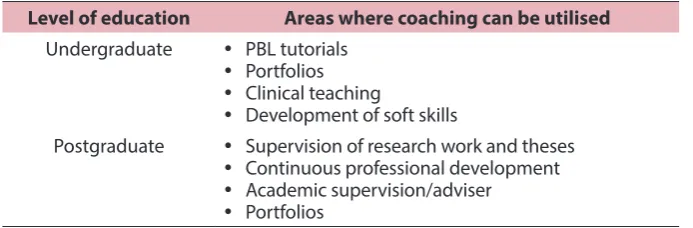
The responses of the study participants suggested that coaching could be applicable to the context of medical education. They stated that unstructured coaching opportunities are already adopted in the undergraduate and postgraduate education of SCU. Different areas within FOM-SCU program eligible to introduce coaching
be effective for the development of skills, especially study, clinical, and professional skills. From the point of view of many respondents, coaching would benefit clinical teaching either in the clinical phase or in some other clinical settings of the preclinical phase. It could increase students’ motivation and help them develop scaffolding needed for building up their professional skills. They also indicated that PBL tutorials are convenient media for introducing coaching as a developmental method. The idea of group coaching was found to be appealing to the respondents as it will be in harmony with the prevailing learning in small groups.
According to the respondents, activities other than PBL tutorials that could be conducted using coaching are: teaching communication, presentation, as well as some other soft skills as time management and moderation of meetings. Team-based learning, leadership development and peer-assisted learning are other suggested media for utilisation of coaching.
Another field that seemed to be appealing for implementation of coaching as indicated by the respondents was the research field, specifically the supervision of research work by senior staff.
As regards postgraduate education, coaching seemed to have a lot of potential benefits as perceived by the respondents. They suggested introducing coaching in: career choice, faculty development activities, on-job training, and continuing professional development. Coaching was also perceived to be effective in development of management and leadership skills for junior faculty.
Table 3: Suggested areas suitable for introduction of coaching in the PBL curriculum of FOM-SCU
Level of education Areas where coaching can be utilised
Undergraduate y PBL tutorials
y Portfolios
y Clinical teaching
y Development of soft skills
Postgraduate y Supervision of research work and theses
y Continuous professional development
y Academic supervision/adviser
y Portfolios
Conditions in Favour of Introducing
Coaching to the Curriculum of FOM-SCU
According to the participants’ perceptions, the curriculum of FOM-SCU is receptive to coaching due to the innovative nature of the educational strategies adopted by this curriculum, either for teaching/learning or assessment. Examples of these innovative strategies are PBL and Portfolios. The participants stated that integration of coaching techniques to these innovative strategies could improve their efficacy.
From the point of view of the study participants on the other hand, the accreditation wave which is going too fast in the region including Egypt stands as an opportunity for introducing coaching to the college’s curriculum. The requirements of accreditation are always considered as institutional priorities and are included in its strategic plans. The accreditation standards usually focus on using innovative approaches to teaching and learning, as well as continuous professional development of staff.
The participants agreed that at FOM-SCU there is luxury of human resources essential for implementation of coaching on a wide scale. The staff to student ratio is adequate and would allow that every student, either undergraduate or postgraduate, can have a staff coach.
Expected Outcomes of Introducing a
Coaching Culture and Practice
The perceived outcomes of the participants on creating a coaching culture were many. Increased students’ motivation and development of reflective practitioners were the most prominent. Coaching culture was perceived by respondents as a leap that might lead to transparency, sense of sharing and belonging, and finally organisational development.
Coaching culture was also believed to improve communication at all levels of the institution, and might also lead to truly share the vision and motivate everyone to work towards achieving that vision. It can also improve team-working skills, morals of faculty, and enhance openness and transparency. Finally it could help qualification of “change agents” which in turn could improve quality of the health care services.
Anticipated Challenges to the Introduction
of Coaching
Table 4: Expected challenges that might face potential implementation of coaching
y Resistance to change by the staff
y Lack of motivation of staff and students
y Unfamiliarity of staff and students with the concepts and practices of coaching
y Overwhelmed staff and students by work and study duties
y Lack of indicated resources for hiring external coaches.
As perceived by most of the participants of this study, resistance to change by the staff will represent a big obstacle in the way of developing a coaching culture. The idea of hiring external coaches did not seem plausible to the study participants because additional resources are indicated in this case.
One of the main obstacles to develop a coaching culture was that both staff and students are not yet familiar with the concepts of coaching and not experiencing it either on ad hoc basis or as a structured activity. Spreading a coaching culture needs knowledge about and practice until it becomes a part of the system, then the culture could spread naturally.
Respondents thought that staff members would need a lot of motivation in order to be involved in coaching, either as coaches or as coachees. The source of motivation would probably be extrinsic at first until coaching becomes common practices in the institution.
An additional challenge to introducing coaching in postgraduate education is that postgraduate students are usually overwhelmed with work and study. Adding coaching as an elective activity will not guarantee that they will use it. On the other hand, adding coaching as a compulsory activity would make them perceive it more
and to be included in strategic plan of the school. The next step would be increasing the awareness of students, staff, and leadership concerning coaching and how it could lead to personal, professional and organisational development.
Increasing the awareness of different stakeholders would minimise resistance to change and render the environment more receptive to a coaching culture as perceived by the study participants. Although coaching was suggested to begin top down, some respondents thought it should not be forced into the program and should start on elective basis. A core team of early adopters of coaching principles can spread the culture and act as change agents. Implementation of coaching was suggested to be gradual and piece meal.
Many of the respondents also focused on the role of rewarding in the process of introducing coaching. Monetary incentives have been suggested, in addition to recognition, and the possible relation between being a coach and getting privileges such as promotion. Some suggested that coaching becomes an integral part of faculty performance appraisal. Motivation was thought to play a major role in the introduction of coaching. Recognition was found to be the best motivator as perceived by respondents. Some respondents also suggested that coaching should be part of the job description of every faculty and that they receive regular training until becoming certified coaches.
DISCUSSION
Many benefits for introducing a coaching culture to the curriculum of FOM-SCU are identified through this study. Motivation of students and staff was believed to be increased if a coaching culture exists. The presence of a coaching culture would improve the qualities of the graduates, turning them into reflective practitioners and possible change agents. Ultimately, the quality of the health care services would be improved. These findings conform to the literature where the focus of coaching is believed to expand from individual focus to include contribution of coaching to organisational change initiatives (17). The participants clearly expressed the necessity for applying extrinsic motivation first, and then when coaching becomes instituted in the system, the role of intrinsic motivation would ensue.
Recognition and moral rewarding in motivating staff to practice coaching and spread the culture were also indicated. Ting and Scisco (18) explained that the first and most essential way to create a coaching culture is to establish the value and impart effective coaching skills to as many supervisors, managers, and leaders as possible. Increasing the awareness of different stakeholders including staff and students would allow for discussions, negotiations, and elaborations on the benefits of having a coaching culture.
The foundational pillars of Hawkins’ model (19) also came in line with the results of the inquiry, where the respondents said there is a need for a core group, represented in Hawkins’ model as the coaching infrastructure (a strong steering group), and that the approach should be top down, with integration of coaching culture in the strategic plan (Pillar 1 Hawkins Coaching Strategy), and aligning the coaching culture with the organisational culture. The community of practice seems practical and feasible also as evidenced in the inquiry. Starting with a nucleus of early adopters and
expanding the focus, sharing the vision, and creating a community of practice.
Among the major challenges to developing a coaching culture was the resistance to change that might arise from the staff members, as they will be expected to assume different roles, which they might consider as a burden. Also, the idea of hiring external coaches would represent exposing vulnerabilities to strangers and would also represent additional financial burdens to the institution. If coaching is to be implemented as in professional coaching, an additional financial challenge would appear due to the sponsor, client, coach relation that should be established and the need to certify internal coaches, with the provision of training and auditing by certifying bodies. This aspect of coaching has been addressed in the literature, in which expense and commitment has been identified as limiting factors. Therefore, it was suggested that executive coaching should be reserved for more senior individuals in whom the organisation has made significant investments, or in individuals who will soon serve as leaders (20).
The seven steps of Hawkin’s model also conform to the opinions of the participants of the inquiry who thought that beginning with awareness for all parties, introducing coaching in many activities, and creating a core group of internal coaches is the way to institute coaching as a method for development of a coaching culture.
performance appraisal were recommended by the participants of the inquiry and they are also similar to TCOE’s guidelines.
CONCLUSION
Coaching is an applicable method for personal and professional development for both undergraduate and postgraduate medical students. Innovative educational strategies, which enhance self-regulated and self-directed learning, could be receptive for coaching when compared to other classic strategies. In undergraduate education, coaching can be integrated to: clinical teaching, PBL, as well as acquisition of study and soft skills. In postgraduate education; coaching can be part of faculty development and continuing professional development activities.
Resistance to change and shortage of financial resources are the main anticipated challenges for utilisation of coaching in medical education.
ACKNOWLEDGEMENTS
We would like to acknowledge the support of the administration of the Faculty of Medicine, Suez Canal University and the members of the Medical Education Department.
REFERENCES
1. Bowden R, Schofield J. Work based learning and poor performance. In: Burton J, Jackson N, editors. Work based learning in primary care. Oxford: Radcliffe Publishing; 2004.
2. Swanwick T. Understanding medical
4. Pradeep C. The difference between coaching and mentoring. 2011 [cited 2016 June 18]. Available from: http://www.forbes.com/sites/ infosys/2011/12/20/business-leadership-for-smarter-org-2/#3b53731d406f.
5. Durbin AJ. Essentials of management. 9th ed. Boston, Massachusetts, USA: South-Western Cengage Learning; 2012.
6. Tayside Centre for Organizational Effectiveness (TCOE). 2015 [cited 2015 July 3]. Available from: http://www.t-coe.org.uk/_ page.php?id=142.
7. Sile´na C, Uhlinb L. Self-directed learning: a learning issue for students and faculty. Teaching in Higher Education. 2006;13(4):461–75. https://doi.org/10.1080/ 13562510802169756.
8. Harden RM, Crosby J R. AMEE education guide no. 20: the good teacher is more than a lecturer – the twelve roles of the teacher. Medical Teacher. 2000;22(4):334–347. https://doi.org/10.1080/014215900409429.
9. Luthans F, Peterson SJ. 360-degree feedback with systematic coaching: empirical analysis suggests a winning combination. Journal of Human Resource Management. 2004;42:243–56. https://doi.org/10.1002/ hrm.10083.
10. Ramani S, Leinster S. AMEE guide no. 34: teaching in the clinical environment. Medical Teacher. 2008;30:347–64. https://doi. org/10.1080/01421590802061613.
11. Orlander JD, Gupta M, Fincke BG, Manning ME, Hershman W. Co-teaching: a faculty development strategy. Med Educ. 2000;34:257–65. https://doi.org/10.1046/j.13 65-2923.2000.00494.x.
13. Runy LA. Developing tomorrow’s leaders. Hospitals & Health Networks. 2009;83:24– 29.
14. Institute of Medicine (US) Committee on the Health Professions Education Summit. Health professions education: a bridge to quality. Chapter 3, the Core Competencies Needed for Health Care Professionals. Washington (DC): National Academies Press (US); 2003. [cited 2016 August 31] Available from: https://www.ncbi.nlm.nih. gov/books/NBK221519/
15. McAlearney A. Using leadership development programs to improve quality and efficiency in healthcare. Journal of Healthcare Management. 2008;55:319–32.
16. Hosny S, El-Wazir Y, El-Kalioby M, Farouk O, Ghaly M. Role of Suez Canal University, Faculty of Medicine in Egyptian Medical Education. Reform Journal of Health Professions Education. 2016; 2(1):44–50. https://doi.org/10.1016/j.hpe.2016.01.007.
17. Grant AM. It takes time: stages of change perspective on the adoption of workplace coaching skills. Journal of Change Management. 2010;10(1):61–77. https://doi. org/10.1080/14697010903549440.
18. Ting S, Scisco P. The CCl handbook of coaching. San Francisco, CA: Jossey Bass; 2006.
19. Hawkins P. Creating a coaching culture. Maidenhead: Open University Press; 2012.