http: // www.gjaets.com/ © Global Journal of Advance Engineering Technology and Sciences
[26]
of stabilized soils found to be higher for more stabilizer content. The stabilized granular soil in Nizwa area provides a ready to use pavement and airport courses with a potentialof improvement of soil characteristics used for design.
KEYWORDS: Granular soil, Compressive strength, Cement, Maximum dry density, Moisture content.
INTRODUCTION
Soil stabilization is an a chemical or mechanical treatment of soil for alteration of one or more properties. It is designed to increase or maintain the stability of soil mass and to create improved soil materials possessing the desired engineering performance. The main properties considered in soil stabilization are strength characteristics, durability, compaction characteristics, volume change and the tendency to water sensitivity.
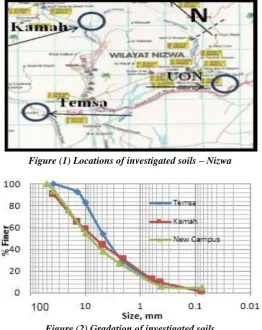
In the interest of feasibility; using locally available materials is one of the major requirements in minimizing the construction cost. Natural granular soil is available in many locations and over a large area in Nizwa city (170 kM north of Muscat- Oman). It is usually used as pavement courses of filling materials regardless of the lack of engineering information and studies concerning its properties and behaviors under loading systems. The material is a granular soil in nature contains very little fine materials (minus # 200 sieve) ranging from 1.5-2.8%. The properties of stabilized granular soil depend on many factors such as grain size distribution, type of stabilizer, stabilizer content, compaction method and effort and curing conditions [1-9]. In general, the strength and compaction characteristics are remarkably improved with stabilizer content, curing period and temperature [1, 6, 9, 10-12]
In this study the granular soil taken from three locations in Nizwa area stabilized with various percentage of cement are investigated. Effects of cement content and curing period for soil of different locations are evaluated considering the strength and compaction characteristics of stabilized soils.
MATERIALS AND METHODS
MaterialsGranular soil
http: // www.gjaets.com/ © Global Journal of Advance Engineering Technology and Sciences
[27]
Figure (1) Locations of investigated soils – Nizwa
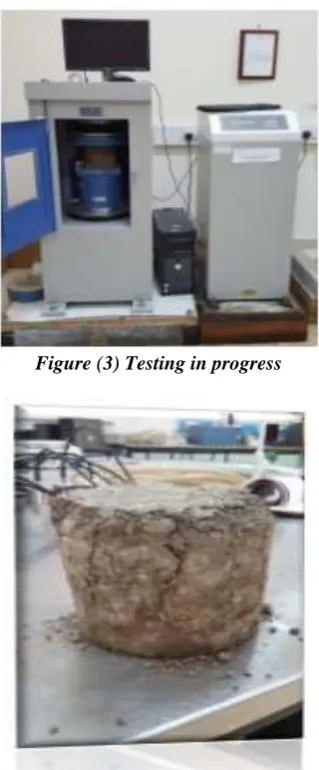
Figure (2) Gradation of investigated soils
Table (1) Index properties of investigated soils Characteristics UoN Kamah Temsa
Weighted average of Sp. Gr. 2.60 2.59 2.63 L.L, % P.I, % 30 1 33 3 33 3 Passing # 200 sieve, % 1.5 2.8 2.3
Organic matter Nil Nil 0.05
Sulphate content, % Nil Nil Nil Unified Classification System GP GP SW Coefficient of Uniformity, Cu 16.25 26.66 10.16
Coefficient of Curvature, Cc 0.75 0.72 1.63
Wearing percentage 34 29 33
Cement
Ordinary Portland Cement is used for stabilization of all selected materials.
Water
A potable water is used for soil compaction and stabilization processes.
Preparation of stabilized specimens
D558-http: // www.gjaets.com/ © Global Journal of Advance Engineering Technology and Sciences
[28]
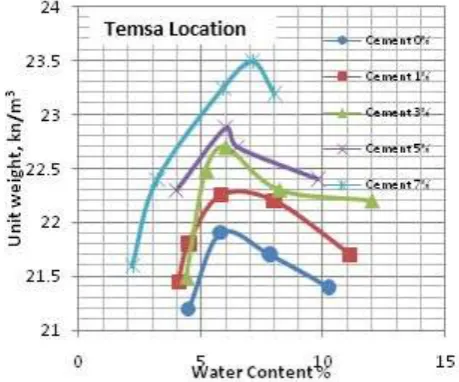
Figure (3) Testing in progress
Figure (4) failed specimen showing failure mode
RESLTS AND DISSCUSION OF RESULTS
Index PropertiesThe soils index properties and the gradation curves of the three locations which are shown in Table (1) and Figure (2) indicated that all soils are of a granular cohesionless nature having low percentages of fine materials ranging from 1.5-2.8%.The soils are classified according to Unified Classification System as GP, GP, and SW for UoN new campus location, Kamah and Temsa respectively.
Compaction Characteristics
http: // www.gjaets.com/ © Global Journal of Advance Engineering Technology and Sciences
[29]
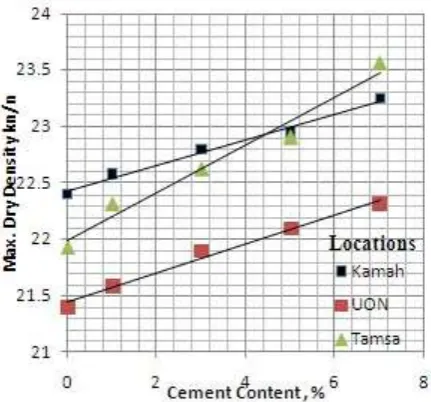
Figure (5) Compaction curves for various cement content
Figure (6) Compaction curves for various cement content
http: // www.gjaets.com/ © Global Journal of Advance Engineering Technology and Sciences
[30]
proportional to the amount of added cement.
Figure (8) Maximum dry density Vs. cement content
Figure (9) Optimum moisture content Vs. cement content
Compressive strength of stabilized soils
http: // www.gjaets.com/ © Global Journal of Advance Engineering Technology and Sciences
[31]
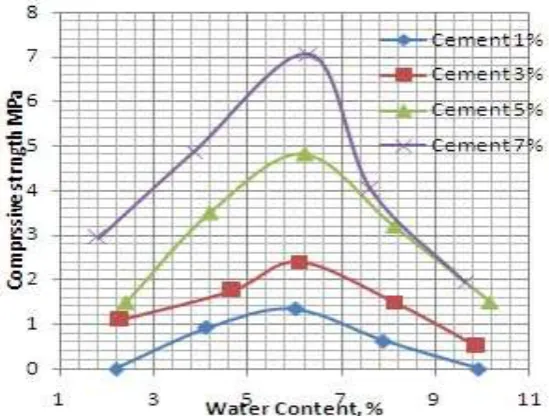
In general all the relations are identical indicating an increase in strength with increasing water content up to a maximum value after which starts to decrease for further increase of water content. This is due to the fact that the dry density of the stabilized soils was found to increase with water content up to maximum value followed be a reduction in values for higher water content. In addition, water required for cement hydration happened at a proper water cement ratio which much less than that required for compaction at maximum dry density.
Figure (10) Strength Vs. Water content at 3 days For UoN New campus
Figure (11) Strength Vs. water content at 7 days for UoN new campus
http: // www.gjaets.com/ © Global Journal of Advance Engineering Technology and Sciences
[32]
Figure (13) Strength Vs water content at 7 days for Kamah location
Figure (14) Strength Vs water content at 7 days for Temsa location
http: // www.gjaets.com/ © Global Journal of Advance Engineering Technology and Sciences
[33]
Figure (16) Maximum strength - water content relations for Kamah location
Figure (17) Maximum strength – water content relation for Temsa
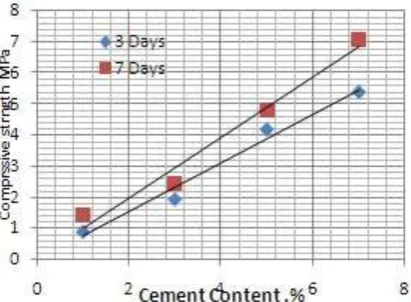
Figures (15), (16) and (17) show the effect of cement content on compressive strength of stabilized soils selected from UoN new campus location, Kamah and Temsa respectively. In genera these relations indicate an increase in strength with cement content in a linear behavior.
Effect of curing time can be shown as an improving the compressive strength as the time be longer. The rate of strength increase seen to be higher for 7 days than 3 days.
CONCLUSIONS
The maximum dry unit weight of stabilized soil increases with increasing cement content.
The optimum water content of stabilized soil becomes higher as cement content increases.
Maximum compressive strength of stabilized soils improved many folds by cement stabilization.
Compressive strength of stabilized soil becomes higher for longer curing time.
ACKNOWLEDGEMENTS
This paper was created with the support of UoN- University of Nizwa – Sultanate of Oman.
REFERENCES
[1] Kwon, H. M, Le, A. T. and Nguyen, N. T. "Influence of soil grading on properties of compressedcement – soil," KSCE, journal of Civil engineering, 14(6), 845-853, 2010.
[2] Mohmedzein, Y. E. and Rawas, A. A. "Cement stabilization of Sabkha soils from Al-AuzaybaSultanateof Oman," Geotechnical and Geological Engineering, 29(11). 999-1008, 2011. [3] Kalkan, E. " Effect of west material-lime additive mixtures on mechanical properties of granular soils,"
Bulletin of Engineering Geology and Environment, 7(1), 99-103, 2012.
http: // www.gjaets.com/ © Global Journal of Advance Engineering Technology and Sciences
[34]
Mississippi and Mississippi Dept. of Transportation and Portland Cement Association,2006.
[13]ASTM D1557-2000, American society of Testing Material, " laboratory compaction characteristics of soil using modified effort 2700 kN-m/m3" , 2000.
[14]ASTM D558-2011, American Society of Testing Material, " Standard test methods for moisture – density ( unit weight) relation of soil – cement mixture,"2011.
[15]Yoon,S. and Abu-Farsakh, M, " Laboratory investigation on the strength characteristics of cement – sand as base material," Journal of Civil engineering, 13(1), 15-22, 2009.