
ENHANCING SOLUBILITY AND DISSOLUTION OF CELECOXIB BY SPRAY DRYING TECHNIQUE
5
0
0
Full text
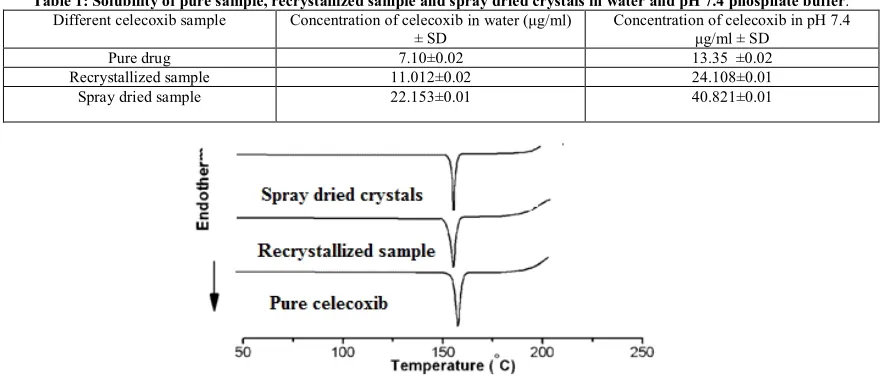
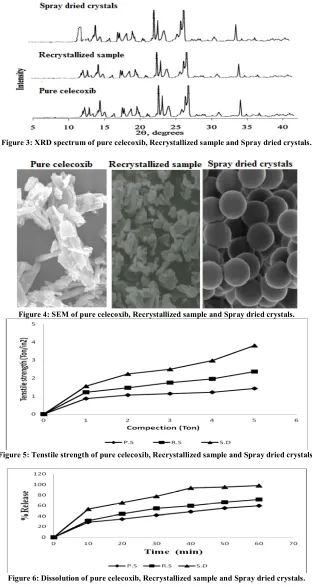
(2) Kulkarni Parthasarathi Keshavarao et al. IRJP 2012, 3 (2) Preparation of spray dried crystals of Celecoxib Spray dried particles consisted of Celecoxib was prepared by dissolving the 2 gm drug in the mixture of TBA/water (50:50 (v/v) ratio) solution. The solution was spray dried using Mini Spray Dryer LSD -48; (Jay instrument & systems Pvt. Ltd. Mumbai) at a Feed rate of 12%, an vacuum in the system -65 MM WC, Atomization pressure rate 1 kg/cm2 , Aspirator level at 35%, inlet temperature at 115 ±2°C and outlet temperature at 45 ±1°C. The formed microsphere were separated using cyclone separator, collected and stored in a desiccators at ambient temperature until ready to be used. Recrystallization of Celecoxib (RS) Celecoxib (2 gm) was dissolved in 50 ml TBA and water cosolvent systems and heated at 450C and the above resulted solution 200C with occasional stirring. The crystals of Celecoxib were collected by filtration and were dried at 450C for 12 hours. Evaluation of crystals Differential scanning calorimetry (DSC) A DSC study was carried out to detect possible polymorphic transition during the crystallization process. DSC measurements were performed on a DSC DuPont 9900, differential scanning calorimeter with a thermal analyzer. Fourier transforms infrared spectroscopy (FTIR) The FTIR spectral measurements were taken at ambient temperature using a Shimadzu, Model 8033 (USA). Samples were dispersed in KBr powder and the pellets were made by applying 5 ton pressure. FTIR spectra were obtained by powder diffuse reflectance on FTIR spectrophotometer. X-ray diffraction analysis (XRD) X-Ray powder diffraction patterns were obtained at room temperature using a Philips X’ Pert MPD diffractometer, with Cu as anode material and graphite monochromator, operated at a voltage of 40 mA, 45 kV.The process parameters used were set as scan step size of 0.0170 (2q). Scanning electron microscopy (SEM) Scanning electron microscopic (Joel- LV-5600, USA, with magnification of 250x) photographs were obtained to identify and confirm spherical nature and Surface topography of the crystals. Mechanical Properties Tensile strength of crystals was determined by compressing 500 mg of crystals using hydraulic press at different ton/cm2 for 1 min. The compacts were stored in desiccator overnight to allow elastic recovery. The thickness and diameter were measured for each compact. The hardness of each compact was then measured using Pfizer hardness tester. The tensile strength (σ) of the compact (ton/cm2) was calculated using following equation. σ = 2F/π Dt where, F, D and t are hardness (ton), compact diameter (cm) and thickness (cm), respectively. Determination of solubility Drug solubility was determined by adding excess amounts of pure celecoxib, their recrystallized sample and crystals to water and pH 7.4 phosphate buffer at 37 ± 0.5°C, respectively. The solution formed were equilibrated under continuous agitation for 24 h and passed through a 0.8 μm membrane filter to obtain a clear solution. The absorption of samples was measured using UV spectrophotometric method (UV 1601 A Shimadzu, Japan) at 251 nm and the. concentrations in μg/ml were determined. Each sample was determined in triplicate. Dissolution studies of crystals The dissolution of pure celecoxib, their recrystallized sample and crystals sample was determined by using USP dissolution apparatus XXIV-Type II (Electro Lab, Mumbai). Dissolution medium was 900 ml pH 7.4 Phosphate buffer. The amount of dissolved drug was determined using UV spectrophotometric method (UV 1601 A Shimadzu, Japan) at 251 nm. Each sample was determined in triplicate. RESULT A solvent system involved a TBA and water for a drug. The selection of these solvent depends on the miscibility of the solvents and solubility of the drug in individual solvents. TBA is miscible in any proportion with water. The low level of TBA in the spray dried crystals results from its ability to form high surface area crystals and from the fact that the intermolecular forces of TBA molecules are not as strong as those of water. This allows both TBA and water to sublime more completely. DSC curves obtained for pure material, physical mixtures and crystals are showed Fig. 1. In DSC curve, pure celecoxib had a sharp endothermic peak at 160°C that corresponded to the melting point of celecoxib. In DSC spectra of recrystallized sample and crystals were showed peaks in the range of 156 to 160 °C for celecoxib. The FTIR spectrum’s of pure celecoxib, their recrystallized sample and spray dried crystals are shown in Fig 2. FTIR spectroscopy has been successfully used for exploring the differences in molecular conformations, crystal packing and hydrogen bonding arrangements for different solid-state forms of an organic compound. Spectral variations originate due to alteration in bonds that exhibit characteristic vibrational frequencies, leading to frequency shifts and splitting in absorption peaks. X-Ray diffraction was used to analyze potential changes in the inner structure of celecoxib nanocrystal during the formulation. The extent of such changes depends on the chemical nature and physical hardness of the active ingredient. Crystals exhibited superior compressibility characteristics compared to recrystallized sample and pure sample of celecoxib drug crystals (Fig. 5). The solubility result of pure celecoxib, their recrystallized sample and prepared crystals in water and in pH 7.4 phosphate buffer shown in Table 1. The dissolution of pure celecoxib, recrystallized sample and prepared spray dried crystals in pH 7.4 phosphate buffer shown in Fig. 6. DISCUSION Based upon high solubility of Celecoxib in TBA, high viscosity and crystal morphology, TBA determined to be suitable spray drying medium for Celecoxib because of its high solubility in TBA (0.75gm/10ml). The controlling of residual TBA was needed though. TBA is a toxic organic solvent based on their concentration and has little detriment to human body. Therefore, the low level of TBA in the spray dried crystals should not be harmful to both animal and human18. Recrystallization of Celecoxib was done to find out the changes in crystal lattice, being induced by solvents, can influence the physicochemical properties of the substance. Hence the mechanical and dissolution properties of spray Page 207.
(3) Kulkarni Parthasarathi Keshavarao et al. IRJP 2012, 3 (2) dried crystals were compared with pure sample and recrystallized sample. Recrystallization of Celecoxib was carried out using same solvent composition as was used for spray drying8. It was found that celecoxib was in a crystalline state in the crystals. In case of spray dried crystals, the endothermic peak of celecoxib was observed at 156 °C which is lower than the pure celecoxib (160°C), which indicate that decreased in crystallite of celecoxib in spray dried crystals. This could be because of pure celecoxib was could be molecularly or amorphously change in the phases and the melting endotherm was shorten on the DSC thermogram of crystals then the recrystallized sample and pure sample of celecoxib, suggesting absence or reducing crystallinity and presence of amorphous state of drug. On the other hand the recrystallized sample of celecoxib showed an apparent endothermic peak of celecoxib at 159.88°C. The FTIR spectra of celecoxib (Fig. 2) showed a characteristic S=O symmetric and asymmetric stretching at 1164 and 1347 cm−1, respectively. Medium intensity bands at 3338 and 3232 cm−1 were seen as a doublet, which are attributed to the N–H stretching vibration of –SO2NH2 group. The C–N stretching band observed at 1397 and 1388 cm−1 for prepared crystals (Fig. 2), but in case of recrystallized sample these same bonds were shifted to lower frequencies at 1374 and 1379 cm−1 respectively. The shifts in frequencies indicate the possibility hydrogen bonding between the –C=O group of solvents and –NH2 group of sulfonamide moiety present in celecoxib. This hydrogen bonding leads to increase in negative charge over oxygen atom caused by shift of electrons of –C=O group, resulting in the weakening of its double bond character. Hydrogen bonding alters the force constant of C=O as well as C–N, thus altering the frequency of stretching and bending vibrations. The bands corresponding to N–H stretching of –NH2 group became diffused and broadened in case of crystals and also a shift to lower frequency (1339 cm−1) was observed in asymmetric stretching of –SO2 group. This clearly indicates the participation of –NH2 and –SO2 groups in intermolecular hydrogen bonding between celecoxib molecules. The spatial arrangement of celecoxib molecules in crystal lattice does not allow intermolecular hydrogen bonding which starts to occur once the orderliness of crystalline lattice is disturbed by formation of amorphous form. Hence above result reveal that there were no significant changes in IR spectra of celecoxib samples. The powder X-ray diffraction patterns of the unprocessed celecoxib, their recrystallized sample and spray dried crystals formed by spray drying are presented in Fig. 3. The characteristic peak of the celecoxib appeared in the 2θ range of 10–300, indicating that the unprocessed celecoxib was a crystalline material. In XRD thermograph of pure celecoxib powder, their recrystallized sample and prepared crystals showed that crystallinity of celecoxib in the formulations was not affected significantly. The SEM image of the celecoxib, their recrystallized sample and spray dried crystals are shown in Fig. 4. The celecoxib particles in the recrystallized sample were broken into much smaller ones and irregular size (19-37 µm) and the shape of prepared crystals are uniform and irregular in shape with small in size (0.80-2 µm). It could be due to the fact that during the process of compression fresh surfaces are formed by fracturing crystals.. Surface freshly prepared by fracture enhanced the plastic inter particle bonding, resulting in a lower compression force required for compressing the crystals under plastic deformation compared to that of single crystal. Tensile strength of the spray dried crystals and recrystallized sample showed that tensile strength of spray dried crystals higher than recrystallized sample as well as pure sample. But tensile strength of spray dried crystals show much higher than recrystallized sample and pure sample this may be due to the increasing in the plastic inter particle bonding of crystals. The solubility of pure celecoxib in water and pH 7.4 at 37°C was found to be 7.10μg/ml and 13.35μg/ml respectively. The solubility of celecoxib from the spray dried crystals was significantly higher than that from it is recrystallized sample and pure celecoxib, when the spray dried crystals and recrystallized sample. It was found that the solubility of celecoxib from the spray dried crystals almost threefold high than compared to its pure sample in water and pH 7.4 respectively. The higher solubility of celecoxib from crystals may be due to the increased in surface area, wettability of crystals. The dissolution rate profiles were plotted as the % release from the different crystals, recrystallized sample and pure celecoxib versus time in minute. The rate of dissolution of pure celecoxib was slow compared with celecoxib from its recrystallized sample in 60 min. The % release of celecoxib from spray dried crystals showed more release compared to recrystallized sample and pure drug. There was a significant difference in the drug release between the spray dried crystals and pure drug. The increase in dissolution from the crystals and recrystallized sample was probably due to the wetting, which could reduce the interfacial tension between the celecoxib and the dissolution medium, thus leading to a higher dissolution rate then pure celecoxib. The large surface area of the resulting crystals should result in an enhanced dissolution rate and thereby improve the bioavailability. CONCLUSION In this present study, an increased solubility and dissolution rate of celecoxib were achieved by preparing crystals by spray drying technique. DSC, FT-IR and XRD studies showed that there is no change in the crystal structure of celecoxib during the spray drying process and showed that Spray dried crystals exhibited decreased crystallinity. The solubility and dissolution of the spray dried crystals was improved significantly compared with its recrystallized sample and pure sample of celecoxib. The celecoxib spray dried crystals showed highest % of drug release and solubility compare to recrystallized sample and pure sample of celecoxib. Hence this spray drying technique can be used for formulation of tablets of celecoxib cam by direct compression without further process like (mixing, granulation) with directly compressible tablet excipients. Thus the required drug concentration in the tablet or capsule will be reduced. ACKNOWLEDGMENT The authors are thankful to Micro labs, Bangalore, India for the gift sample of celecoxib and Principal, J.S.S. College of Pharmacy, Mysore for providing facilities to carry out this work.. Page 208.
(4) Kulkarni Parthasarathi Keshavarao et al. IRJP 2012, 3 (2) REFERENCES 1. Clemett D, Goa, KL. Celecoxib a review of its use in osteoarthritis, rheumatoid arthritis and acute pain. Drugs. 2000; 59: 957–980. 2. Anonymous. 50 top selling drugs ranked by worldwide sales for 2000, Patent scan—a monthly proactive patents bulletin for pharmaceutical industry. Med. Ad News; 2001; 2: (12). 3. Cook TC, Karim A. Pharmacokinetics of celecoxib after oral administration in dogs and humans: effect of food and site of absorption. J. Pharmacol. Exp. Ther. 2001; 297: 638–645. 4. Dev RV, Rekha KS, Vyas K, Mohanti SB, Kumar PR, Reddy GO. Celecoxib, a COX-II inhibitor. Acta Cryst., 1999; 55: 173-182. 5. Kakumanu V, Bansal A. Enthalpy relaxation studies of celecoxib amorphous mixtures. Pharm. Res.2002; 19: 1873–1878. 6. Leonard F, Patricia M. Polymorphic crystalline forms of celecoxib. WO 01/42222 A1; 2001. 7. Dressman JB, Amidon G, Reppas C, Shah VP. Dissolution testing as a prognostic tool for oral drug absorption: immediate release dosage forms. Pharm. Res.1998; 15: 11 -22. 8. Dressman J, Butler J, Hempenstall J. The BCS: where do we go from here? Pharm. Tec; 2001; 25: 68-76. 9. Kapsi SG, Ayres JW. Processing factors in development of solid solution formation of celecoxib for enhancement of drug dissolution and bioavailability. Int. J. Pharm.2001; 229:193-203.. 10. Leuner C, Dressman J. Improving drug solubility for oral delivery using solid dispersions. Eur. J. Pharm. Biopharm; 2000; 50: 47-60. 11. Juppo AM, Boissier C, Khoo C. Evaluation of solid dispersion particles prepared with SEDS. Int. J. Pharm., 2003; 250: 385-401. 12. Serajuddin ATM. Solid dispersion of poorly watersoluble drugs: early promises, subsequent problems, and recent breakthroughs. J. Pharm. Sci.1999; 88: 1058-1066. 13. Sekiguchi K, Obi N. Studies on absorption of eutectic mixture. I. A comparison of the behavior of eutectic mixture of sulfathiazole and that of ordinary sulfathiazole in man. Chem. Pharm. Bull.1961; 9: 866-872. 14. Chiou WL, Riegelman S. Pharmaceutical applications of solid dispersion systems. J. Pharm. Sci.1971; 60: 1281- 1302. 15. Maury M, Murphy K, Kumar S, Shi L, Lee G. Effects of process variables on the powder yield of spray-dried trehalose on a laboratory spray-dryer. Eur. J. Pharm. Biopharm., 2005; 59: 565-573. 16. Amal AE, Ebtessam AE. Dissolution of ibuprofen from spray dried and spray cooled particles pak. j. pharm. sci., 2010; 23(3): .284-290. 17. Maa YF, Nguyen PA, Sit K, Hsu CC. Spray drying performance of bench-top spray dryer for protein aerosol powder preparation. Biotech. Bioeng. 1998; 60: 301-309. 18. Ni N, Tesconi M, Tabibi SE, Gupta S, Yalkowsky SH. Use of pure tbutanol as a solvent for spray drying: a case study, Int. J. Pharm. 2001; 226: 39–46.. Table 1: Solubility of pure sample, recrystallized sample and spray dried crystals in water and pH 7.4 phosphate buffer. Different celecoxib sample Concentration of celecoxib in water (μg/ml) Concentration of celecoxib in pH 7.4 ± SD μg/ml ± SD 7.10±0.02 13.35 ±0.02 Pure drug Recrystallized sample 11.012±0.02 24.108±0.01 Spray dried sample 22.153±0.01 40.821±0.01. Figure 1: DSC spectrum of pure celecoxib, Recrystallized sample and Spray dried crystals.. Figure 2: FT-IT spectrum of pure celecoxib, Recrystallized sample and Spray dried crystals.. Page 209.
(5) Kulkarni Parthasarathi Keshavarao et al. IRJP 2012, 3 (2). Figure 3: XRD spectrum of pure celecoxib, Recrystallized sample and Spray dried crystals.. Figure 4: SEM of pure celecoxib, Recrystallized sample and Spray dried crystals.. Figure 5: Tenstile strength of pure celecoxib, Recrystallized sample and Spray dried crystals.. Figure 6: Dissolution of pure celecoxib, Recrystallized sample and Spray dried crystals.. Source of support: Nil, Conflict of interest: None Declared. Page 210.
(6)
Figure
Related documents
Discussion: Strategies that support IPCPs in developing their writing skills may encourage more IPCPs to disseminate evidence to support best practice by publishing their work in
Application of Parametric L-Systems to Generate the Figures of Two Series of Spherical FullerenesM.
The Magnitude and Predictors of Socially Concealed Behaviors (Violence) among Adolescents Visiting Primary Health Care Centers in Jeddah City, Kingdom of Saudi
Emodin treatment protects rats against AP-associated lung injury by inhibiting NLRP3 in fl ammasome activation via Nrf2/HO-1 signaling pathway.. Nrf2 may become a potential
Figure 2 shows typical numerical modelling results illustrating the temperature fields and current functions of the solution area under different Reynolds numbers (heat flux q
In vitro cell testing on these materials using human chondrocytes provided direct evidence that chondrocyte density and protein production were increased on nanoembossed
Thus the cost –sharing policy of the 1980’s and 1990’s which pushed responsibility for construction of physical facilities and provision of learning and teaching materials to
idea was to search the available experimental data for a peak at expected solar axion. energies of 6.4 keV and
