University of Pennsylvania
ScholarlyCommons
Publicly Accessible Penn Dissertations
1-1-2015
Finding Our Rhythm: Contextualizing Second
Language Development Through Music-Based
Pedagogy
Catrice Barrett
University of Pennsylvania, [email protected]
Follow this and additional works at:http://repository.upenn.edu/edissertations
Part of theAnthropological Linguistics and Sociolinguistics Commons, and theBilingual, Multilingual, and Multicultural Education Commons
This paper is posted at ScholarlyCommons.http://repository.upenn.edu/edissertations/1602 For more information, please [email protected].
Recommended Citation
Barrett, Catrice, "Finding Our Rhythm: Contextualizing Second Language Development Through Music-Based Pedagogy" (2015). Publicly Accessible Penn Dissertations. 1602.
Finding Our Rhythm: Contextualizing Second Language Development
Through Music-Based Pedagogy
Abstract
Each person learning a second or foreign language faces a unique developmental path. Individual learning trajectories have been obscured, however, by the search for “best practices” in second language educational research and praxis (Edge & Richards, 1998). This one-size-fits-all view has been further reinforced by a predominant cognitivist tradition, which orients to cognition mainly through mechanical and input and output processing, or a “mind as machine” metaphor (Boden, 2006). My dissertation aims to offer an alternative to this tradition.
In my dissertation, I introduce a music-based intervention designed to develop students’ pronunciation (speech rhythm) in a U.S. college-level English as a second language classroom. The intervention draws heavily on the rhythmic properties of rap and other forms of popular music. Rather than contending solely with the binary question of whether the intervention works (or results in “best practices”), I use mixed methods to examine individual student outcomes through the lens of three major complex subsystems of second language development (Larsen-Freeman, 2011): ideological, interactional and speech production. I aim to demonstrate that students’ rich in-class interactional practices and ideological understandings of the (African American) language associated with the music in the intervention (and with my own Blackness as a teacher-researcher) reveal as much about their second language development as does an assessment of their speech rhythm production. Building on the premise that language learning is an endeavor that is not only cognitive in nature, but also social, my dissertation advocates for a much fuller contextualization of second language development and classroom practices.
Degree Type Dissertation
Degree Name
Doctor of Philosophy (PhD)
Graduate Group Education
First Advisor Betsy Rymes
Keywords
African American English, discourse analysis, ideology, music, pronunciation instruction, second language acquisition
Subject Categories
Anthropological Linguistics and Sociolinguistics | Bilingual, Multilingual, and Multicultural Education | Linguistics
FINDING OUR RHYTHM:
CONTEXTUALIZING SECOND LANGUAGE DEVELOPMENT
THROUGH MUSIC-BASED PEDAGOGY
Catrice Barrett
A DISSERTATION
in
Education
Presented to the Faculties of the University of Pennsylvania
in
Partial Fulfillment of the Requirements for the
Degree of Doctor of Philosophy
2015
Supervisor of Dissertation:
_______________________________________ Betsy Rymes, Associate Professor of Education
Graduate Group Chairperson:
______________________________________ J. Matthew Hartley, Professor of Education
Dissertation Committee:
Betsy Rymes, Associate Professor of Education
Yuko Goto Butler, Associate Professor of Education
FINDING OUR RHYTHM:
CONTEXTUALIZING
SECOND LANGUAGE
DEVELOPMENT THROUGH
MUSIC-BASED PEDAGOGY
COPYRIGHT
2015
Catrice Barrett
This work is licensed under the Creative Commons Attribution-NonCommerical-NoDerivatives 4.0 International License
To see a copy of this license, visit:
iii
iv
ACKNOWLEDGMENTS
My Christian journey has sown into my life so many seeds, now flourishing in the
blossom of wisdom. Perhaps the greatest of these is gratitude. Taking a page from 1
Thessalonians 5:18, I have been reminded throughout my work on this dissertation
to "rejoice always, pray without ceasing, in everything give thanks; for this is the will of
God in Christ Jesus for you.” I’ve learned that gratitude is a gift that eradicates fear. It
breaks yokes and builds bonds. Gratitude renovates the heart, making room for the giver
to receive far beyond her humble expectations. Today I have many reasons to give
thanks for those who have supported this dissertation. I’m delighted to give thanks that
God placed each of you in my path. Without you, the best of me would remain untapped.
I begin by acknowledging my lifelong spiritual partner, my mentor, the love who
has enriched my life for the past 15 years: my husband DuWayne. You and I have truly
become one in our growth. Thank you for your faithful leadership and unwavering
commitment to the highest standard for our family. Thank you for holding it down in the
evenings when I had to teach classes, attend talks and networking events. I adore you for
never complaining (and keeping the house from falling apart) while I was jet setting to
far away places for conferences. You get me. You are me. Today, you get an honorary
Ph.D. right along with me. I love you always!!
To my little queen and king, Amira and Xavier: you’re not so little
anymore. Amira, it’s hard to believe that you’re almost a teenager now. You were
barely out of kindergarten when I started my degree. Just think, you’ll always have
stories about how you were on the accelerated culinary track because mommy had no
v
grilled cheese that you’ve become so expert at preparing. Now, as you spread your wings,
traveling and serving in South America and all over the world, I’m assured that your gift
of leadership will be a blessing to many. You’re a hero, my sweet princesita! Xavier,
you are a true prodigy in the making. Your intellectual gifts amaze me more and more
each day. Stay carefree forever, my love. Though I find myself in a nation of mothers in
angst over the odds against their young Black men - #BlackLivesMatter - I’m assured in
faith that you will move mountains and forge new paths for future generations. You
epitomize excellence. Your greatness cannot be contained. Continue embracing the truth
of your voice as your power! Thank you for inspiring me to open my eyes, take notice of
you and be better for you. Continue seeking God’s guidance and His will in your life.
To my family in Atlanta – Daddy (Reggie Jackson, Sr.), Reggie Jr., Sonya, Jelani,
Calem, Mommy (Ayo), Ife (Go, Ife!), Ledarius, Aunt Rosa and more – you are my strong
(Southern) foundation. Thank you for seeing and cultivating promise in me, even when I
was unable/unwilling to do so for myself. Your sacrifices have been my fruit. I love you.
To my distinguished faculty advisors, mentors and committee – Betsy Rymes,
Diane Larsen Freeman, Yuko Butler, Shondel Nero, H. Samy Alim, Joanna Labov and
Jiahong Yuan - I’m eternally indebted to you. Each of you bring remarkable
contributions to the field, which I hope to have gleaned for the purpose of building on
strands of your great work. I am honored to be a direct beneficiary of your kindness,
selflessness and advice (solicited or not! ha ha). I thank you sharing the most precious
gift you could offer: your time. You are greatly appreciated. To my colleagues in the
Intensive English Program, Penn Libraries and other professional friends I’ve met along
vi
Joanna Siegel, Bob Eckhart, Minru Li, Kim Eke, Patty Lynn, Karrie Peterson, Deborah
Bishov, Sarah Wipperman and Sam Kirk – thank you for laboring over my rough drafts,
encouraging me to write and helping me to step my research game way up! To my
Pronunciation in Second Language Learning and Teaching (PSLLT) family – Velma
Senaga (my dear friend and honorable editor-in-chief), John Levis, Ziwei Zhou, Greta
Muller Levis, Elisabeth Zetterholm, Ettien Kofi and others – you are the backbone of this
work. Thank you for your commitment to improving pronunciation pedagogy and for
your invaluable feedback on earlier versions of this work.
Last but not least, I’m grateful to my students. You are the reason this
dissertation exists. May each word I write be a testament to your courage, strength and
vii
ABSTRACT
FINDING OUR RHYTHM: CONTEXTUALIZING SECOND LANGUAGE
DEVELOPMENT THROUGH MUSIC-BASED PEDAGOGY
Catrice Barrett
Betsy Rymes
Each person learning a second or foreign language faces a unique developmental path.
Individual learning trajectories have been obscured, however, by the search for “best
practices” in second language educational research and praxis (Edge & Richards, 1998).
This one-size-fits-all view has been further reinforced by a predominant cognitivist
tradition, which orients to cognition mainly through mechanical and input and output
processing, or a “mind as machine” metaphor (Boden, 2006). My dissertation aims to
offer an alternative to this tradition.
In my dissertation, I introduce a music-based intervention designed to develop students’
pronunciation (speech rhythm) in a U.S. college-level English as a second language
classroom. The intervention draws heavily on the rhythmic properties of rap and other
forms of popular music. Rather than contending solely with the binary question of
whether the intervention works (or results in “best practices”), I use mixed methods to
examine individual student outcomes through the lens of three major complex
subsystems of second language development (Larsen-Freeman, 2011): ideological,
interactional and speech production. I aim to demonstrate that students’ rich in-class
interactional practices and ideological understandings of the (African American)
language associated with the music in the intervention (and with my own Blackness as a
teacher-researcher) reveal as much about their second language development as does an
assessment of their speech rhythm production. Building on the premise that language
learning is an endeavor that is not only cognitive in nature, but also social, my
dissertation advocates for a much fuller contextualization of second language
viii
TABLE OF CONTENTS
ACKNOWLEDGMENTS...iv
ABSTRACT ... vii
Table of Contents ... viii
List of Tables ... x
List of Figures ... xi
Chapter 1 INTRODUCTION ... 1
Overview and Framing the Problem ...1
A Poetic and Musical Approach to the Problem ...2
Attending to the Context of Learning Beyond Binaries ...3
Chapter 2 THEORETICAL FRAMEWORK AND LITERATURE REVIEW ... 5
Complexity Theory: A (Meta) Theoretical Framework for Second Language Development ...5
Literature Review ... 10
Speech Production ... 10
Ideology ... 26
Interaction ... 33
Research Questions ... 40
Chapter 3 METHODOLOGY ... 41
Design ... 41
Setting And Participants ... 41
Pilot Study Participants ... 43
Main Study Participants ... 44
Pedagogical Strategies And Key Elements ... 45
Data Collection And Analysis ... 48
Research Question 1 (Ideology) ... 48
Research Question 2 (Interaction) ... 50
Research Question 3 (Speech Production) ... 51
Limitations... 54
Chapter 4 UNDERSTANDING ESL STUDENTS’ THEORIES ABOUT AFRICAN AMERICAN ENGLISH: MUSICALITY, INTELLIGIBILITY AND THE COLOR LINE (IDEOLOGY) ... 56
Introduction ... 56
Students’ Awareness Of Race And Racialized Features Of Language ... 57
Intelligibility And The Perceived Musicality Of African American English ... 63
Rejecting African American English ... 64
Embracing African American English... 69
Summary ... 76
ix
Overall Student Judgments about Music and Learning ... 79
Analyzing Two Music-Based Activities in the Interactional Context ... 80
Activity 1: Stress Rulz Rap ... 81
Activity 2: Sounds of American English Music Project ... 96
Summary ... 109
Chapter 6 AN ACOUSTIC ANALYSIS OF LINGUISTIC DEVELOPMENT (SPEECH RHYTHM PRODUCTION) ... 111
Introduction ... 111
Group Patterns ... 113
Interindividual Variability ... 115
Rhythm Classes... 115
Stability Thresholds ... 121
Intraindividual Variability ... 125
Mei ... 126
Omar ... 127
Yifei ... 128
Sahar ... 129
Marcela ... 130
Jung ... 131
Summary ... 134
Chapter 7 DISCUSSION AND CONCLUSION ... 138
Complex Subsystems Of Language Development: Connections and Context ... 138
Ideology and Speech Production ... 140
Ideology and Interaction ... 141
Interaction and Speech Production... 143
Pedagogical Implications and Recommendations ... 144
Service Learning ... 145
Participatory Digital Pedagogies ... 148
Appendix A Voice Recording Text (My Exercise Program) ... 152
Appendix B Segmented Acoustic Speech Data ... 153
Appendix C Normalized Pairwise Variability Equation ... 154
Appendix D Stress Rulz Rap Activity ... 155
Appendix E Sounds of American English in Music Project ... 156
Appendix F Pre-Instructional Survey ... 157
Appendix G Exit Survey... 161
Appendix H Discourse Analysis Transcription Key ... 164
x
LIST OF TABLES
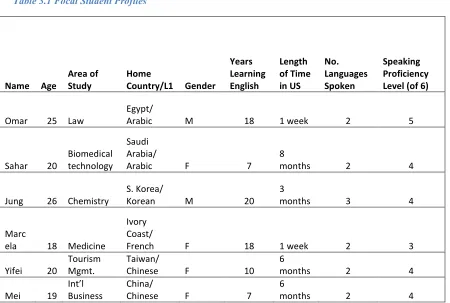
Table 3.1 Focal Student Profiles ... 45
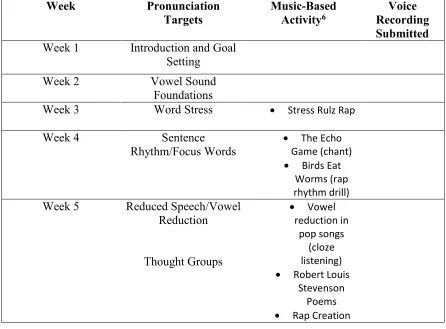
Table 3.2 Summary of Weekly Pronunciation Targets and Activities ... 46
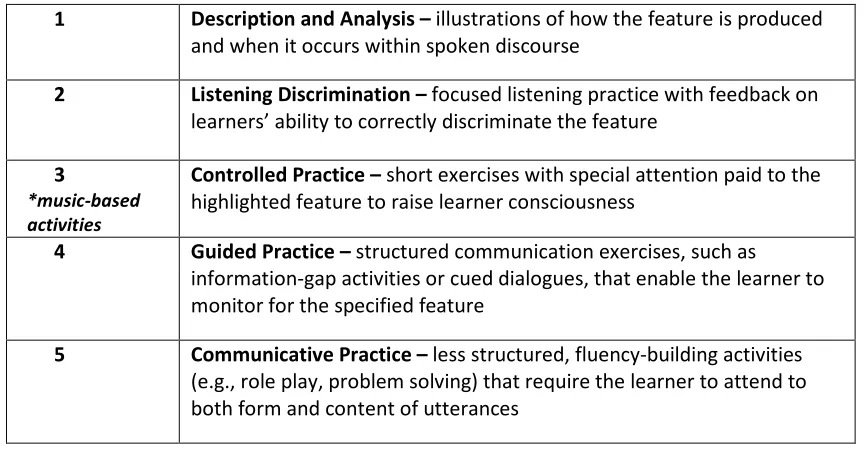
Table 3.3 A Communicative Framework for Pronunciation Teaching... 48
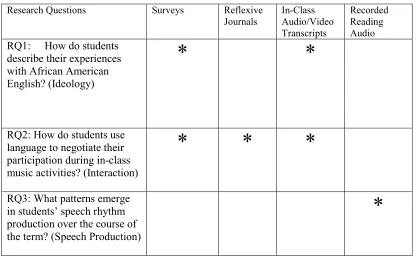
Table 3.4 Summary of Research Questions and Instruments ... 54
Table 4.1 Descriptions of Words and Phrases Students Associated with African American English ... 61
Table 5.1 Learners’ Judgments about Usefulness of Music for Improving Pronunciation ... 80
Table 5.2 Students’ Comments about Stress Rulz Rap Activity ... 82
Table 6.1 Mean group scores (with standard deviation) for all three correlates ... 113
Table 6.2 Student L1 Timing Classes ... 116
xi
LIST OF FIGURES
Figure 2.1 A Visual Representation of the Theoretical Framework ... 9
Figure 2.2 Comparison of Prominence Alternation in Stress and Syllable-Timed Languages ... 14
Figure 2.3 The Prosody Pyramid (Gilbert, 2008) ... 17
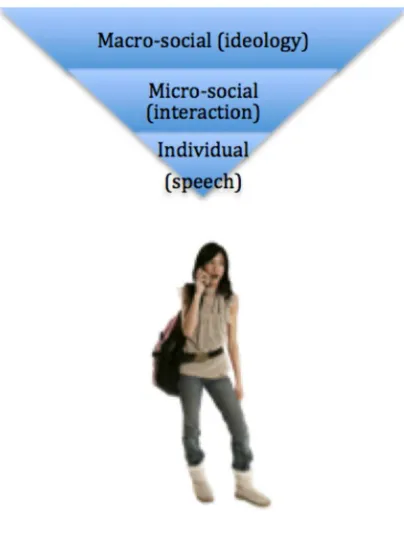
Figure 2.4 Three Subsystems of Language Development: An Ecological View ... 39
Figure 5.2 Front of the Room Students Noticing Each Other’s Performances ... 92
Figure 6.1 Timing Class nPVI Scoring Continuum ... 112
Figure 6.2 Group Averages over Time on Three Rhythm Correlates... 114
Figure 6.3 nPVI-Duration Scores Grouped by L1 Timing Class... 117
Figure 6.4 nPVI-F0 Grouped by L1 Accent Class ... 119
Figure 6.5 Parallel Plot of Change in Students’ nPVI Scores for All Three Rhythm Correlates from Time 1 to Time 3 ... 123
Figure 6.6 Intraindividual Variation for Mei on Three Rhythm Correlates ... 127
Figure 6.7 Intraindividual Variation for Omar on Three Rhythm Correlates ... 128
Figure 6.8 Intraindividual Variation for Yifei on Three Rhythm Correlates ... 129
Figure 6.9 Intraindividual Variation for Sahar on Three Rhythm Correlates ... 130
Figure 6.10 Intraindividual Variation for Marcela on Three Rhythm Correlates ... 131
Figure 6.11 Intraindividual Variation for Jung on Three Rhythm Correlates ... 132
Figure 6.12 Change in Duration Compared with Intensity for Six Students ... 133
Figure 6.13 Change in Duration Compared with f0 for Six Students ... 133
Figure 6.14 Change in Intensity Compared with f0 for Six Students ... 134
1
CHAPTER 1
INTRODUCTION
“Listening for rhythm signals attending to the flow of interactions. There is rhythm in poetry, rhythm in speech, and rhythm in a classroom.”
-Katherine Schultz, 2003, p. 43
Overview and Framing the Problem
There is a place in our songs, in our speech and even in our silence where rhythm lives.
Each world language is distinct in what linguists refer to as its speech rhythm. In the case of language, rhythm is comprised of alternations between prominent (stressed) and
non-prominent (unstressed) syllables. English speakers manipulate three major speech
features - pitch, duration and intensity (volume) – to produce the prominence contrasts
that result in the rhythm a listener perceives. White and Mattys (2007) found there to be
a direct influence of speech rhythm patterns from the first language to the second
language. When applied to English, these patterns can result in particular pronunciation
challenges for learners, such as robotic cadence, misconstrual of their social intent, or
even intelligibility issues (Anderson-Hsieh et al., 1992). When we consider that all
around the world, rhythm is universally experienced through music, and, as Gilbert
(2008) suggests, English communication is organized into “musical signals,” the starting
point of this dissertation is a seemingly simple question: could the use of music in a
2
A Poetic and Musical Approach to the Problem
In this dissertation, I begin by proposing a music-based approach to helping
students develop their L2 English speech rhythm. There are several reasons for this.
Speech rhythm is a unique suprasegmental language feature in that it carries its own
embedded connections to music. For example, Patel and Daniele (2003) compared the
rhythmic patterns of spoken English and French with the rhythm found in the music of
these two languages; they found that the musical differences in rhythm between English
and French trended in the same direction as the linguistic rhythmic differences (i.e., more
stressed and syllable timed, respectively). In a sense, then, rhythm can be thought of as
the common ground between music and language. As English language learners build
fluency, the language-music connection seems to be a natural and engaging next step
toward aligning their fluency with the techniques (linking, vowel reduction, etc.) used to
produce English rhythm. Gilbert (1994) recognized this by suggesting an emphasis on
the musical (and suprasegmental) aspects of pronunciation over segmentals as a means to
move beyond the more decontextualized methods that have been used traditionally.
The embrace and prioritization of suprasegmental pronunciation instruction is hardly
new news (Munro & Derwing, 1995). Perhaps one of the more noteworthy byproducts
of the move away from singular dedication to small structural units has been the push to
recognize the need for more context in pronunciation teaching (Gilbert, 2008). In this
dissertation, I would like to expand that line of reasoning even further. If we are really
looking to attend to context, what types of (research) questions about music-based pronunciation pedagogy really help us understand the complexity of second language
3
Attending to the Context of Learning Beyond Binaries
My contemplation over the issue of exactly what to investigate about music-based
pedagogy has been rewarded by face-to-face interaction with other scholars and
educators. When attending a conference or similar space of intellectual exchange, I had
grown accustomed to being approached with a familiar question – “Oh, what is your
dissertation about?” As a dutiful doctoral candidate, I prided myself on reducing my
answer to this question down to a solid 3-second elevator speech – “I’m researching a
music-based approach to teaching pronunciation to English language learners.”
Interestingly, after sharing this, I was typically asked to advise on tricks, tips and “best
practices” for using music in the classroom. As much as I appreciated my immediate
expert status upgrade, I began to question the assumption underlying some of the
responses. They seemed to imply a one-size-fits-all view of music in the classroom.
Eventually, another question emerged for me: Could it be that the learners and the
environment determine what is actually “best?” As far as my dissertation was concerned,
this was the path of no return.
My focus shifted beyond just seeking to make a binary determination about
whether the music-based intervention works. Using mixed methods, I have found it worthwhile, instead, to research the intervention by adopting “a (complex) systems
perspective” (Larsen-Freeman, 2015) on second language development. In particular, I
view music-based pedagogy through the lens of three major complex subsystems of
second language development (Larsen-Freeman, 2011): speech rhythm production
(recorded student samples), ideological (reflections on societal varieties of language) and
4
investigate more than just knowledge and skills. I can also examinemy positionality as a
Black teacher-researcher (among the very few in TESOL – Nero, 2006), and how this
factors into what my learners bring to the social fabric of my music-based pronunciation
classroom. These contextual nuances complicate traditional, one-dimensional (often
solely cognitive) views of what it means to learn a second language. Additionally, from a
teaching perspective, my dissertation complicates the notion that best practices – i.e.,
specifiable procedures and predictable outcomes (Edge and Richards, 1998) - exist for
5
CHAPTER 2
THEORETICAL FRAMEWORK AND LITERATURE
REVIEW
Complexity Theory: A (Meta) Theoretical Framework for Second Language
Development
As Ravitch and Riggan (2011) argue, the task of a theoretical framework is not
only to piece together a relevant range of theories, but also to unpack and consider the
underlying assumptions theories hold with regard to which tools and ideas are of value in
answering the research question(s). The power of a reflexive theoretical framework is
twofold: it enables us to re-consider existing relationships among concepts in the
literature and it inspires us to uncover new ways of relating relevant aspects of our
inquiry.
Over the past few decades, scholarship on second language development has
yielded an increasingly multifaceted view of language learning processes. Much of the
advancement is due to a willingness of scholars to engage the field in ongoing
self-criticality about its tacit assumptions on second language learning. Recent work has
addressed the need to move traditional theoretical and methodological stances in a more
expansive direction. Firth and Wagner (1997), for instance, leveled a pivotal critique at
the field for its tendency to account too narrowly for language as an individual cognitive
6
contextual and interactional dimensions of language use” (p. 285). Apart from
reductionist theoretical orientations, there are also some methodological assumptions that
may also overlook the contextual richness of language in use by individuals. Data in
second language studies are often collected before and after an intervention, which
suggests that these points hold the most meaningful revelation about what has been
learned. In some cases, these data are entirely quantitative and typically aggregated,
obscuring the individual variability within the group. Above all, the few existing studies
on L2 speech rhythm development - and L2 pronunciation more broadly (see Derwing &
Munro, 2005) - lack a classroom context to authentically reflect the contingencies of
learning in such a domain.
Raising these conceptual issues about second language research traditions is not
meant to imply that there exists a perfectly comprehensive theory of language
development. It does, however, expose the need to consider how our teaching and
research agendas are guided by specific belief systems about language, or theories of
language. With the term “theory of language,” I am taking a cue from scholars such as
Gee (2012) and van Lier (2004), who argue that our theories of language are typically
tacit and underexamined in our actual practice as scholars or educators. With an attempt
to bring as much conscious attention as possible to my own theory of language, I am
approaching this work with the belief that that learners draw from multiple subsystems of
language to find and create meaning throughout their unique developmental trajectories.
Therefore, second language development must be studied in a way that accounts for a
much fuller context of language learning. Below I present Complexity Theory (CT) as a
7
Complexity Theory is a theory that originates from the natural sciences. Put
simply, CT aims to explain the interaction of elements in a complex system. In many
ways, CT reveals order from seemingly random, chaotic and dispersed elements of an
expansive system. From a natural sciences perspective, CT has been used to interpret the
growth or behavior of organisms in relation to other elements of the environment (e.g.,
other organisms, climate, etc.). Commitment to interaction and interconnectedness is a
feature of CT, which has greatly facilitated its adoption into second language research.
Diane Larsen-Freeman has been one of the major champions of CT in terms of applying
its principles to the area of second language learning. Her work (1997; 2006; 2011; 2015
and many more) posits that the ways that language is conceived, taught, learned and used
can each be thought of as individual systems. The ecological orientation of CT offers a
means of working beyond traditionally reductionist theories of second language
development. Rather than dividing cognitive and social concerns, CT supplies a way to
harmonize them, as they are both relevant to the true operation of the complex system of
second language development. Larsen-Freeman explains: “complexity [is] a
metaphorical lens through which diverse perspectives [on language development] can be
accommodated, indeed integrated” (2000, p. 173). She further highlights the
distinguishing features of a complex system as:
• emergent – giving rise to spontaneous occurrences
• dynamic – always changing
• open – boundless
• adaptive – responsive to change in the environment
8
• nonlinear – yielding effects not proportionate to a cause
(Larsen-Freeman, 2015)
Thus, if second language development is taken to be an entire complex system,
the contribution of CT lies in how it accounts for the ways in which multiple subsystems
of language development interact – that is, not simply at a pre and post-intervention time
point, but across an extended series of points in time and in relation to cognitive and
social influences. In 2006, Larsen-Freeman applied the tenets of CT through a
mixed-methods empirical study on the emergence of complexity in the writing of five adult
Chinese learners of English. In the quantitative analysis she found that the aggregated
averages of the whole class, when plotted over time, differed significantly from the
micro-level trajectories of individual learners. In other words, although learners had been
exposed to the same second language instruction over a 10-month period, they exhibited
drastically divergent patterns of development in the areas of complexity, fluency and
accuracy. The qualitative analysis revealed that over time certain learners showed
increased ability in morphosyntax, the expression of agency (through narration) and in
establishing intersubjectivity with the audience.
Empirical work employing CT so far highlights the value of attending to the
contextual nuances that guide individuals along their respective paths of development. Given the central role of context in the title of this dissertation (and in CT– see
Larsen-Freeman, 2015), it is worth taking time here to clearly establish what I mean by context.
Drawing from van Lier (2004), I see context not just as extraneous detail about the
9
classroom (if this is, in fact, where learning is taking place), it is important to understand
context as existing not only externally, but also within and through the environment. As
interaction proceeds (or not) through language and other communicative means in the
environment, so too is the context being constructed moment by moment. Schultz (2003)
alludes to the socially constructed nature of context through her reference to the “rhythm
in a classroom” (p. 43) – a thematically suitable parallel to the musical aims of this
study. To be clear, the context of learning exists both within and outside of the
classroom; likewise, it exists inside and outside of one’s brain. Motivated by these
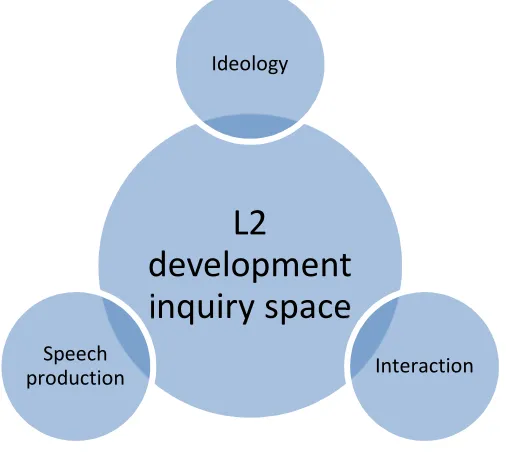
considerations, I have devised a theoretical framework intended to engage analytically
with the implementation of music-based pedagogy through the lens of three complex
subsystems of language development: speech production, ideology and interaction.
Figure 2.1 A Visual Representation of the Theoretical Framework
L2
development
inquiry space
Ideology
Interaction Speech
10
Figure 2.1 shows that each of the three focal subsystems of language development
works independently at its level of scale, yet interconnectedly with the larger system of second language development. By way of the constant dynamic change inherent to the subsystems, one would expect spontaneously emergent activity to stem from any or all subsystems in a way that may trigger (co)adaptation from another subsystem,
demonstrating the openness of all subsystems in the space. The progression of outcomes that result from this activity could move in systematic, yet unexpected directions as a
result of the nonlinear nature of change in the larger complex system of L2 development. Taken together, these core principles depict the anticipated work of CT in this study.
Another way to understand the theoretical framework is in how it serves to
illustrate the efficacy of CT as a metatheory. A metatheory is a broad conceptual
container within which each subsystem’s theoretical principles operate. Overton (2007)
elaborates: “Theories and methods refer directly to the empirical world, while
metatheories refer to the theories and methods themselves” (p. 154).
Literature Review
Speech Production
The music-based pedagogical approach of this study was designed largely to be
responsive to and compatible with phonological properties of English speech rhythm.
Therefore, I begin with theoretical coverage and a review of scholarship in this area.
Theoretical Foundations Of Speech Rhythm
Loritz (1999) describes rhythm as the “central organizing mechanism of
language” (p. 142). At the lowest level of English rhythm is one of its smaller,
11
louder, longer and higher in pitch than unstressed syllables. Accordingly, these three
features translate to three common (stress) correlates used to measure speech rhythm
acoustically – intensity, duration, and fundamental frequency (pitch or f0). While
phoneticians claim that there are as many as six levels of word stress, only three levels
are typically presented to students in a pronunciation course – stressed, unstressed and
reduced (Celce-Murcia et al., 2010).
Although our ears are perceptually attuned to cross-linguistic rhythmic
differences, the matter of developing a taxonomy to account for these differences has
generated decades worth of debate. This debate essentially boils down to a divide
between advocates and opponents of the rhythm class hypothesis. According to the rhythm class hypothesis, there are three rhythm classes, or discrete categories for
grouping the world’s languages based on rhythm: syllable-timed, stress-timed and mora-timed. The first two classes were coined by Pike in 1945; the mora (proposed by Bloch, 1942; Han, 1962; Ladefoged,1975) only applies to Japanese and will not be discussed
further in this study. The term syllable-timed implies that the start of each syllable is
equidistant in time from the start of the next syllable; stress-timed means that the start of
each stressed syllable is equidistant in time from the start of the next stressed syllable. This distinction has long been accepted as a way to explain the perceptual differences in
linguistic cadence such as the “machine gun rhythm” (Lloyd, 1940, p. 25) of French or
Spanish (typically classified as syllable-timed) and the “Morse code rhythm” of English
or Dutch (typically classified as stress-timed). As Abercrombie (1967) asserted, these
categories rely on the principle of isochrony, or the idea that either syllables or interstress
12
principle that has been used in pronunciation teaching is the “cats chase mice” rhythm
drill below (Celce-Murcia et al., 2010, p. 320):
the CATS CHASE MICE
the CATS have CHASED MICE
the CATS will CHASE the MICE
the CATS have been CHASing the MICE
the CATS could have been CHASing the MICE
In this drill, the three levels of sentence-level stress are represented typographically as
follows: lowercase = unstressed, capitalized = normal stress, capitalized and boldfaced =
strong stress (focus word). Each line contains a different number of total syllables, but
the time it takes to say each line is the same. Native speakers of English would use
vowel reduction on the function words in between the stressed syllables to keep the
rhythm “flowing” on time. What’s more, the stressed syllables fall at the same point in
time for each utterance, implying equal interstress intervals. This is the basis of
isochrony theory and consequently, for the classification of English as stress-timed. Although “syllable-timed” and “stress-timed” have remained generally accepted
as apt descriptors of speech rhythm over the years (Mehler, Dupoux, Nazzi &
Dehaene-Lambertz, 1996), later studies began to challenge isochrony as the basis of speech
rhythm. Bolinger (1965) showed that the duration of interstress intervals is not constant,
but is influenced by the specific types of syllables. Compared to languages such as
13
containing consonant clusters, diphthongs or tense vowels in coda position (Setter, 2006).
These phonotactic differences can pose a challenge for speakers/learners who are not
accustomed to producing the amount of contrast required to distinguish the “heavy”
syllables from the “light” ones in English. In Dauer’s (1983) seminal study she points
out that syllable structure, vowel reduction and word stress (rather than interstress timing)
bring a language relatively closer to being categorized as stress or syllable timed. This reasoning has been supported by a recent mass of studies (Grabe & Low, 2002; Ramus,
2002; Torgersen, 2012), which favor the idea of a rhythmic continuum over discrete
rhythm classes.
The Measurement Of Speech Rhythm
The theoretical developments which began to challenge isochrony and the rhythm
class hypothesis generated a renewed interest in the study of speech rhythm. Particularly
over the last decade, this interest has resulted in a number of proposed metrics for
quantifying speech rhythm. Typically, these metrics of rhythm are based on
measurements taken from the acoustic speech signal. The Normalized Pairwise Variability Index (nPVI) (Grabe & Low, 2002) – is one such metric that has been particularly successful in its adoption.
The nPVI is the result of continual refinements to earlier calculations, which also
looked at durations at the lowest level of the prosodic hierarchy - the phonetic level. In
order to show prominence in certain syllables over others in a language, there must be
some marker that will distinguish more prominent units from the less prominent. As the
14
difference between adjacent vowel durations. In the visual representation of the vocalic
nPVI in Figure 2.2 below (taken from Nolan & Asu, 2009) the greater slope of the solid
slanted line illustrates how, in the case of stress-timed languages, prominence differences
are greater than in syllable-timed languages (dotted line):
Figure 2.2 Comparison of Prominence Alternation in Stress and Syllable-Timed Languages
This principle applies directly to the nPVI, as a higher nPVI indicates a greater
contrast in vowel durations, suggesting a more stressed-timed rhythm. As a linguistic
example, consider the following sentence, in which the bolded syllables are stressed. A
speaker who applies a stress-timed rhythm to the utterance would differentiate the
stressed syllables (and consequently the vowels in these syllables) by making them
longer, louder and/or higher in pitch than the unstressed and reduced syllables:
15
A lower nPVI value, on the other hand, indicates that the vowel durations across the
utterance are not much different in length from each other, which is a feature common to
the rhythm of syllable-timed languages. A syllable-timed rendition of the same English
utterance might convey much less contrast, giving a similar emphasis to all syllables.
Consider the following, for instance:
____ ___ _______ __ ___ _________ ______ Excuseme. Whereis thegrocerystore?
Regular alternation between stressed and unstressed syllables and their vowels
thus provides the contrastive basis of the nPVI calculation. An important critique of
studies using nPVI, however, is that they tend to focus exclusively on duration (Nolan &
Asu, 2009; Cummings, 2011) when rhythm has been known to manifest
multidimensionally through three correlates: duration, intensity and pitch. In some
respects, a focus on duration seems well supported by studies that have shown it to be the
most salient correlate of the three (Adams & Munro, 1978; Beckman & Edwards, 1994).
On the other hand, research on L2 rhythm has brought forth considerable evidence
regarding L1 influence on the salience of particular correlates in speech rhythm
production. Lee and Cho (2011) found that for Japanese L1 speakers, intensity was the
most salient marker of English L2 speech rhythm. It is unclear why this is the case, given
that intensity is not generally regarded as key in the Japanese prosodic system. For
speakers with Mandarin (a tone language) as an L1, numerous studies have found
fundamental frequency (pitch) to be more salient than the other two correlates in English
L2 speech rhythm production (Zhang, Nissen, & Francis, 2008; Barto-Sisamout, 2011;
16
As a result of cross-linguistic influence considerations in L2 speech rhythm
production, there is a clear disadvantage to focusing solely on duration. Only in the past
couple of years has speech rhythm scholarship begun actively applying techniques that
seek to address the limitations of a one-dimensional approach to measuring rhythm.
Fuchs (2014) conducted a perceptual experiment where he found that a 60 Hz increase in
f0 contributed to a perceived increase in duration of 4%. Using these results, he modified
the nPVI to include a factor to account for the f0 influence. When comparing his
modified nPVI to the traditional version on British and Indian English data, the modified
nPVI correlated more closely with reported perceptions than did the traditional nPVI. He
(2012) draws on L2 data to make another contribution toward modifying the nPVI to be
multidimensional. Instead of using duration, he calculated an nPVI.db (for intensity).
Applying this metric, he was able to quantitatively differentiate the L2 English of
Mandarin speakers from that of native English speakers. Based on the results of a few
existing studies, a multidimensional approach to the nPVI appears promising, but is in
need of further investigation.
Issues In The Teaching Of Speech Rhythm
Theoretical linguistics has enriched pronunciation pedagogy with a wealth of
information. Studies about rhythmic differences among languages enable instructors to
make more informed choices about the potential needs of students. In their
groundbreaking study, Anderson-Hsieh et al. (1992) confirmed the role of speech rhythm
as an intelligibility factor in L2 speech. This work is complemented empirically by
numerous studies such as Grabe and Low’s (2002) acoustic confirmation of the strong
17
learners with Spanish as an L1 would make good candidates for rhythmic instruction in
English, a language with strong stress-timed properties. Identifying the rhythmic
classification of learners’ L1 may be the simpler part of the equation, however. As more
details emerge about the mechanics of speech rhythm production, the options for setting
instructional priorities and sequences becomes another issue to contend with.
With so many levels of the prosodic hierarchy available, there is little agreement
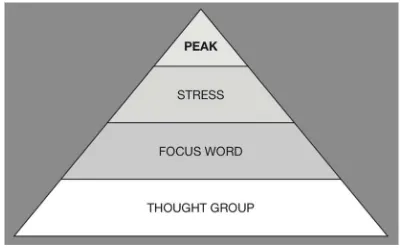
in the literature over where to begin teaching speech rhythm. Gilbert (2008) proposes an
incremental approach through which learners move progressively through the prosodic
hierarchy, which she represents figuratively as the “prosody pyramid” (Figure 2.3).
Instruction begins from the top of the pyramid, with the stressed vowel (or syllable peak),
and moves downward toward accentual phrases (commonly referred to as “thought
groups” in pronunciation teaching). Celce-Murcia et al. (2010) agree that mastery of
smaller stress units such as words is necessary before tackling larger units. Chela-Flores
(2001), on the other hand, argues for just the opposite. She contends that learners benefit
more from a bottom-up approach where they start with larger “fully fledged meaningful
utterances” (p. 88). Her claim is that this ordering is more effective at facilitating skill
transfer across the levels of the hierarchy (than vice versa).
18
Since rhythm is a matter of systematically altering prominence, an additional
point of contention in speech rhythm pedagogy is whether to begin by showing students
how to produce strong stress units or weak ones. In her textbook, Targeting
Pronunciation, Sue Miller (2007) urges instructors to teach sentence level stress by beginning with the focus word, the most strongly stressed word in an accentual phrase.
Her reasoning is that the focus word naturally attracts the most attention and will
therefore be the easiest unit for students to orient to both perceptually and in their speech
production. Liang (2003) sees the issue differently, however. Based on her work as an
EFL instructor in China, she has noticed that Chinese students tend to overuse strong
forms. In the sentence “John thinks that man is evil,” for example, the pronoun that, depending on whether it is pronounced with a full stressed vowel or a weak, reduced
vowel, completely alters the meaning of the sentence. As a result, Liang recommends
using weak forms as a starting point for orienting learners to the important ways in which
vowel reduction impacts the rhythm of spoken English.
Lacking a clear consensus on how to teach speech rhythm poses a challenge to
ESL/EFL instructors, who commonly already lack confidence and training in
pronunciation teaching (Faez and Valeo, 2012). Despite these challenges, the efforts of
second language scholars and educators who have sought to exploit the shared rhythmic
connections between natural spoken language and music/poetry may offer a valuable
perspective to the challenge of teaching speech rhythm.
Music, Poetry And Rap Based Approaches To Second Language Instruction
Perceptually, it is very obvious to the human ear that music and natural speech are
19
in music. Music also exhibits more periodicity, whereby the structured temporal
organization of a musical composition is provided in the form of a time or meter
signature1. While isochrony and its claims to a similar regularity of timing in natural
speech have failed under empirical scrutiny (see discussion above), the connections
between language and music can be found along other dimensions.
At perhaps the most basic starting point, both music and language are universal to
all human cultures. Duration, intensity (volume), pitch and tone are acoustic elements
used in the production of both speech and music. Coupled with the instincts of innovative
educators, the speech-music connection has opened up numerous possibilities in language
education over the years.
A number of studies in ESL/EFL have attested to the benefits of using music in
the classroom. Regardless of where we are from, our innate affinity for music makes it
an accessible and inviting way to introduce learners to difficult or otherwise intimidating
concepts. In a Colombian primary school EFL class, Pérez Niño (2010) observes how
teachers use music as thematic containers within which new vocabulary is introduced.
Oftentimes, a chorus or other part of a song is repeated in such a way that reinforces
language and aids in memorization (Mora, 2000). Pérez Niño also notes how teachers
offered listening to music in class as a muse or impetus for stimulating speaking among
students. In an extensive teacher research dissertation, Terrell (2012) exploits the
1 The time signature (also known as meter) is a notational convention used in Western musical notation to specify how many beats are in each bar and which note value constitutes one beat. From a pedagogical perspective, the beats in a line often have a one-to-one correspondence with each stressed syllable. A musical approach helps students identify how and where to direct their loudest, longest and highest pitched changes in syllable production. It also helps them to practice hearing a difference as stressed and
20
acoustic cues that are shared between language and music to teach pragmatic aspects of
pronunciation to English language learners (ELLs). These shared cues include: a high
speech rate and intensity for anger; low voice intensity and rising pitch contour for fear;
and slow speech rate and falling pitch contour for sadness. These are emotional features
than can be found in music of any genre, making a large pool of resources for teaching to
draw from.
On a spectrum, with music being located on one extreme and natural speech on
the other, poetry seems to fall somewhere in the middle. Similar to natural speech, there
is typically no instrumental composition accompanying poetic verse. And even if there
is, the poetic meter or rhythmic organization is not so tightly bound to that of the music
(as it is in rap, which will be discussed shortly). On the other hand, poetic meter lends a
musical quality to poetry through structure and tendency for pattern repetition. As
Frances Mayes (1987) notes, “Recurrence of a sound is itself music. Like the chorus in a
song, a refrain or rhyming pattern, once set up, rewards our anticipation.” Therefore, in
this study, the term “music-based” will include poetry as well. Consider an example
using a common meter in English poetry, iambic pentameter:
x / × / × / × / × / So long as men can breathe, or eyes can see,
× / × / × / × / × / So long lives this, and this gives life to thee.
Each unstressed (x), stressed (/) pair forms the basic unit, or foot, of the meter. In this
21
times for each line - hence pentameter. This type of repetitious “play with sound texture” (Disney, 2012, p. 6) can be exploited to make the patterning of stressed and unstressed
syllables more apparent to learners. Hadaway, Vardell and Young (2001) advocate
strongly for the use of poetry in the ESL classroom, identifying it as an “ideal entry point
to language learning” (p. 799). Below is a list provided by Hadaway et al. (2001) that I
have slightly adapted, which explains ways that poetry contributes to oral language
development:
1. The reading and re-reading of poetry through choral and read-aloud
activities promotes fluency
2. The brevity and short lines appear less intimidating to language learners
than academic prose and other genres
3. Repetition of words and rhythmic patterns aids deciphering of meaning
and builds familiarity and habit with target forms
4. The accent on focus words is sometimes exaggerated or repeated in ways
that draw attention to meaning
5. Provides succinct or humorous character sketches that can be used to
spark discussion
While poetry has enjoyed a certain amount of coverage in second language
research and textbooks, it has a not-too-distant relative that could potentially provide
some of the same benefits to learning as poetry. The relative I am speaking of is also
22
documented the centrality of rhythm to rap in its context as a Black cultural formation.
In herseminal book, Black Noise, Tricia Rose (1994) describes rap as “a Black cultural expression that prioritizes Black voices from the margins of urban America . . . a form of
rhymed storytelling accompanied by highly rhythmic, electronically based music” (p. 2).
Likewise, Tilford Brooks (1984) highlights that “one of the most characteristic qualities
of Black music in the New World is its rhythm” (p. 11). Yasin (1997) documents the
historical shifts in the relationship between talk and the beat in African American music
across centuries. He notes that prior to rap, talk typically foregrounded music in African
American traditions. Rap changed this paradigm by requiring a careful coordination of
syllables, words, dialectal features of African American English (AAE ) and the beat.
Recently, Black linguistic styling and affect have spread globally, expanding
hip-hop’s sphere of influence far beyond its previous confinement to the United States. Over
the past decade, in particular, English globalization has become energized by the
linguistic practices of the imagined community commonly referred to as the Global Hip
Hop Nation (GHHN) (Alim, Ibrahim & Pennycook, 2009). Naturally, elements of Black
linguistic styling and affect persist through these processes. GHHN membership spans
China (Barrett, 2012a), Tanzania (Higgins, 2009) and Brazil (Roth-Gordon, 2009), all of
which have engaged with hip-hop in ways that both reflect and create novel, complex
sociolinguistic changes. The lyrical innovation of youth through the vehicle of hip-hop
music serves as this study’s main inspiration for bringing the artform into the ESL
classroom. Furthermore, due to its underexplored status in the literature on
suprasegmental pronunciation, rap, in a sense, is the flagship element of this study’s
23
Perhaps one of the most compelling works exploring the linkages between poetry
and rap is Adam Bradley’s Book of Rhymes (2009). Ironically though, as Bradley points out, much of rap’s popularity rests on the fact that the populace tends not to regard it as
poetry! But at closer glance, one realizes that rap is nothing less than urban poetry
anchored in kindred relationship with the beat. An easy demonstration of this would be
to recall the poetic meter from the example above (so long as men can breathe . . .). Just
as a pentameter line is marked by five feet (or daDUMs in the iambic case), the “meter”
of rap is marked in beats rather than feet. To be precise, there are typically four quarter
note beats per rap line (also known as 4/4 time). Bradley illustrates with a simple
transcription of rapper Melle Mel’s classic verse on Grandmaster Flash’s “The Message:”
one TWO three FOUR
STANDing on the front STOOP, HANGing out the WINDOW,
WATCHing all the CARS go by, ROARing as the BREEZES BLOW
The elegant simplicity of this verse works well for suprasegmental pronunciation
teaching as it offers a clear and clean break of the verse into thought groups and focus
words. Thought groups – or accentual phrases - are a unit of speech commonly covered
in suprasegmental pronunciation pedagogy (Miller, 2007). They are small, logical ways
that we (often unconsciously) group our words in order to facilitate listener processing.
In English, thought groups consist of one strongly stressed (focus) word and are
connected to the next thought group with lengthening of the focus word and a brief pause.
24
practice thought grouping in the latter. Returning to the rap example above, the thought
grouping would be represented like this (focus word underlined and slash indicating a
pause): standing on the front stoop/ hanging out the window.
Looking to rap for insight on the teaching of speech rhythm is a logical move.
After all, rhythm is the heartbeat of rap. Unlike traditional literary poetry, the pacing and
timing of rap are contractually entangled in the dual rhythmic relationship (Bradley, 2009) between vocals and the beat. The beat works as a guidepost for the vocals, forcing
regular breaks in cadence and constant re-adjustment of syllables into the allotted
timeslot. This relationship translates into an interesting learning opportunity for English
language learners. For an unfamiliar learner, the task of reciting rap lyrics over a beat
can make it difficult to fluently utter a sentence that might otherwise cause less difficulty
for him/her. In my experience designing and facilitating ESL/EFL rap/poetry workshops,
the beat of rap serves as a signal of urgency, prompting the learner to consider what is
hindering his/her fluency. Oftentimes, the issue is anomalous production of English
speech rhythm (i.e., inability to connect smoothly across word boundaries, difficulty
creating contrast between content and structure words, etc.). Indeed, the unforgiving
nature of the beat has prompted many of my students into a practice trance, retracing the
steps of their stressed and unstressed syllables, connected speech and even segmental
issues. When applied in this way, rap has the ability to aid in the development of ESL
students’ self-monitoring and metalinguistic competence. Both of these skills are
essential for sustained progress after students have left the classroom (Miller, 2007).
Beyond its distinctive sonic character, rap has historically been a bold and
25
know for sure is that the music has a commanding presence. If explored from the
perspective of its roots in Black, urban spaces and its subsequent global proliferation, the
boldness of rap has not only been befitting, it has been necessary for elevating voices out
of the margins of society. One feature that gives rap its attitude is the artist’s tendency to
overemphasize accented syllables. The advantage that this characteristic sound holds for
pronunciation instruction is that it draws explicit attention to the way that alternating
prominences work in English speech.
At present, small traces of rap and chanting activities have appeared in
pronunciation teaching materials. Other than Fischler’s (2009) investigation of the
effectiveness of her rap-based word stress textbook, Stress Rulz (2006), however, I found no empirical work that studies the use of rap-based materials in the pronunciation
curriculum. Stress Rulz is a collection of raps, each focusing on a particular rule
regarding the use of word stress in English. The raps are reminiscent of the earlier Jazz Chants (Graham, 1978), which rely on choral repetition of rhythmic verse. Hadaway et al. (2001) blend poetry and music into “singing poems” for English language learners to
form a more melodic variety of poetry. In the 1996 edition of their Teaching
Pronunciation book, Celce-Murcia et al. included a brief suggestion of rap lyric creation for the teaching of speech rhythm. They advised that the lyrics should be recorded in a
language lab due to students’ possible hesitation to be embarrassed about sharing.
Interestingly, the rap creation suggestion was removed entirely from the second edition of
the text (Celce-Murcia et al., 2010).
This section has covered theoretical background on the phonological properties of
26
issue of teaching the mechanics of speech rhythm to L2 learners. However, the
mechanics of speech production only constitute one subsystem in the ecology of the
larger complex system of second language development (as reflected in the theoretical
framework presented earlier in Figure 2.1). Another important - and less emphasized -
consideration that enters the equation of introducing a learning intervention is the issue of
how ideologies about language factor into second language learning.
Ideology
Theories Of Language In Pronunciation Teaching And Learning
As ESL students become exposed to new forms of talk (including pronunciation),
the possibilities for including these into their own communicative repertoires (Rymes,
2010) expand. New repertoire elements are not adopted indiscriminately, however. As
Lippi-Green (1997) contends, they are filtered through an ideological system, which is
ultimately constructed through discourse (i.e., talk about language and groups of
language users). Gee (2012) refers to these constructions – whether tacit or overt – as
theories of language:
[A theory of language is] a set of generalizations about . . . language and language acquisition in terms of which descriptions . . . can be couched and explanations can be offered . Theories ground beliefs and claims to know things [about language] (p. 13)
A range of theories of language circulate regularly in the second language
classroom. According to van Lier (2004), a normative, prescriptive theory of language is
concerned with the absolute correctness to language based on form. This is a view
undoubtedly familiar to students and teachers of pronunciation. On the surface, this view
27
“true” form of correctness. It turns out, however, that a prescriptive theory of language is
not non-ideological at all; it simply obscures and standardizes its ideologies. These
ideologies are grounded in norms that privilege and reproduce the language use of
particular sectors of society.
Ironically, despite the fact that non-native speakers make up the majority of the
world’s English speakers (Jenkins, 1998), prescriptive theories of language often fail to
honor these speakers’ accents. According to Rymes (2009) this reality has direct
implications in the classroom: past, present and future all converge as individuals bring
outside social contexts (e.g., religious, racial and other affiliations) with them. Parrino
(1998) observes this phenomenon at work in her own adult ESL class. In her chapter on
“The Politics of Pronunciation,” she notes several cases in which students state their
pronunciation goals, not in terms of self-generated desires, but rather in terms of criticism
they received from others about their accent. This intersubjective process of ideology
formation operates internally on learners’ own speech as well as upon external varieties
of language encountered in the social milieu.
African American English
Students devise theories of language about their own speech and also about the
varieties of language they encounter daily. Of the many varieties of English in the United
States, ESL students’ theories of language about AAE are central to this study for a
couple of reasons. First, the music-based pedagogy of this dissertation relies heavily on
rap, an artform historically derived from and associated with African American speech
(Bradley, 2009; Richardson, 2006; Smitherman, 2006). This connection is meaningful in
28
study. Secondly, although there are large numbers of ESL students attending educational
institutions in America’s urban centers - which have been known for historical reasons to
have significantly large African American populations (Wilkerson, 2010) – little research
has documented ESL students’ discursive experiences with African Americans. Third, as
a Black teacher-researcher (among the very few in TESOL – Nero, 2006), I anticipate
that students’ reading of my race will play a part in their ideological responses (both tacit
and overt).
Geneva Smitherman (2006) describes AAE as “a style of speaking English words
with Black flava – with Africanized semantic, grammatical, pronunciation and rhetorical
patterns” (p. 3). A strong ideological ambivalence toward Black English has existed for
centuries, on the part of both Whites and Blacks. Smitherman playfully proclaims that
America has found itself in a state of loving and hating on Black language all at the same
time. Pejorative theories that have framed AAE as “baby talk” (Harrison, 1884) and
“intellectually lazy, indolent” (Bennett, 1909) have been documented existed historically
as systemic mechanisms for reinforcing White supremacy. However, not all disparaging
theories about AAE exist in some distant past, nor are they always articulated by Whites.
Legendary Black comedian Bill Cosby, in his scathing class-laden critiques of
(low-income) Blacks, regularly dismissed AAE as not being English at all. At the NAACP
award ceremony held in commemoration of the 50th anniversary of the Brown vs. Board
of Education decision, he states:
29
speak English except these knuckleheads. You can't land a plane with “why you ain't...” You can't be a doctor with that kind of crap coming out of your mouth. There is no Bible that has that kind of language. Where did these people get the idea that they're moving ahead on this?
(Schochet, 2013)
The historically commonplace disdain for AAE led to an important ideological
shift that began around the early 1970s. Spears (1998) documents overt campaigns
fueled by the influence of the Black Panther Party and the broader Black Power
Movement to do the exact opposite of what Cosby condemns – using AAE publicly and
proudly. Spears refers to this as “uncensored mode;” it reflects deliberate sociocultural
efforts to reverse White supremacy as it is enacted through tacit and overt theories of
language. Likewise, the work of Walt Wolfram (1969) and William Labov (1970) lent
academic credibility to this movement, as they helped to promote the legitimacy of AAE
as a linguistic system by documenting its rule-governed nature. Their efforts served as a
catalyst for a rich tradition of linguistic scholarship that affirms the value of AAE through
coverage of its structural, social and cultural depth – see Baugh, 2003; Rickford &
Rickford, 1976; Smitherman, 1977; Alim, 2006 and others.
To date, the historically ambivalent ideologies circulating about AAE typically
have been researched from the perspective of informants who are American-born or have
had longstanding ties with African Americans (Rickford, Sweetland & Rickford, 2004).
Notwithstanding their noticeable absence from this body of literature, ESL students have
in fact demonstrated an awareness of the distinction between AAE and other English
30
Eisenstein and Verdi (1985) looked at learner attitudes in an adult ESL class in
New York. Their study utilized a verbal guise approach, common to studies on language
attitudes. The approach examined L2 English students’ social judgments (about items
such as job status, friendliness, etc.) after they had heard speech samples of AAE, the
racially unmarked (i.e., White) New Yorkese and Standard English varieties. Similarly,
Al Kahtany (1995) used verbal guise methodology and found that Saudi students
studying at a U.S. university – whom he describes as arriving to the U.S. with a “dialectal
tabula rasa” (p. 165) - view AAE less favorably than Standard American English. He also found that students’ length of time in the U.S. correlated negatively with their
perception about the linguistic quality/value of AAE. Likewise, there was also a
correlation between students’ rating of the AAE speaker’s education level and the
appropriateness of AAE as a medium of instruction. From a more contemporary
standpoint, Haeusler (2010) employed perceptual dialectology techniques in which 102
community college ESL students in California were asked to draw boundaries around
areas on a map that mark dialect differences. The students were also asked to listen to
speech samples - one of which was an AAE sample – and classify them accordingly.
Overall, AAE was one of the two varieties most accurately identified (19.6% of
instances), while students experienced much less success identifying regional varieties
such as Californian, Bostonian and Southern Englishes. Haeusler partially attributes the
strong AAE recognition to the dissemination taking place through the activities of the
Global Hip Hop Nation (Alim, 2009).
Additional studies, while not focusing directly on AAE, point out that proficiency
31
dialects of English. Drawing from the Middle Eastern EFL context, Buckingham (2014)
attests that teachers’ own accents factor into students’ instructional preferences. Little is
known, however, about how students perceive the use of materials grounded in African
American language and culture, or how they perceive instructors who are Black speakers
of AAE. Furthermore, the verbal guise technique is limited in how it can account for the
context in which language is actually used for authentic interaction.
Hip-Hop Pedagogies: Language, Ideology And Music Intertwined
When discussed with respect to subsystems of speech production (as was covered in
previous sections), the phonological connection between language and music is central. However, when it comes to ideological subsystems of language development, there is another dimension to music-based pedagogy in which hip-hop has played a central role.
Hip-hop pedagogies have developed over recent years as a counternarrative to the
symbolic and ideological violence present in institutional practices (including/especially
educational ones) that privilege standardized English and marginalize, ignore or
subordinate Blackness and related forms of variety in linguistic expression. Flores and
Rosa (2015) remind us of the need to critically inspect these raciolinguistic ideologies and the work that they do to enforce uneven norms of appropriateness. With an eye
toward this crisis in the education of Black and Brown youth, Kirkland (2008) proposes
the incorporation of popular and student-generated hip-hop texts as a means of advancing
New English Education.
In recent years, a number of scholar-educators have responded to the call to merge a
critical view of hip-hop, literacy and education. For instance, Marc Lamont Hill (2009)