Inducing omnipotence or powerlessness in learners with
developmental and attention difficulties through
structuring technologies
H. V. Andersen
1,* and E. K. Sorensen
21Dept. of Learning and Philosophy, Aalborg University, Denmark 2Dept. of Learning and Philosophy, Aalborg University, Denmark
Abstract
Schoolwork of learners with developmental and attention difficulties is often characterised by low productivity, many errors due to carelessness or inattention and poor organizing ability. Focus learners have difficulties performing at the same level as their peers. This paper addresses these challenges and investigates the potential of technologies for creating and facilitating learning environments, where learners with developmental and attention difficulties are well-supported with respect to overviewing, structuring and planning tasks, evaluating and adjusting participation and management of time. Would it be possible to take advantage of the affordances of Persuasive Technologies and how could Persuasive Technology Tools in the hand of teachers and learners assist, motivate and enable the presence, participation and achievements of learners with developmental and attention difficulties at school? Using this lens, the authors examine, to what extent technology may assist teachers to create more ideal learning environments by reducing the threat for these learners and enable them to participate in learning. Virtual Learning Environments (VLEs), digital templates, timers and calendars are identified as specific valuable tools for enhancing the learners’ ability to become ready to learn, join and maintain within the learning processes. Likewise, visualisations in the classroom, notifications, video instructions, assessment and evaluation tools to seems to help the learner to navigate, remember, become aware and understand their own role in the classroom. This paper suggest technologies for structuring and overviewing as basic assistive tools for equalizing the learning possibilities for learners with developmental and attention difficulties in an inclusive school setting.
Keywords: Inclusion, Learning, Digital Technologies, Attention Deficits, Structuring, Overviewing, VLE, School, Education, Special Educational Needs, Assistive Technologies, Timers, Calendars, Visualisation, Templates.
Received on 25 October 2016, accepted on 06 May 2017, published on 03 July 2017
Copyright © 2017 Andersen, H. V & Sorensen, E. K., licensed to EAI. This is an open access article distributed under the terms of the Creative Commons Attribution licence (http://creativecommons.org/licenses/by/3.0/), which permits unlimited use, distribution and reproduction in any medium so long as the original work is properly cited.
doi: 10.4108/eai.3-10-2017.153158
1. Introduction
Since the ratification of the Salamanca Statement and Framework for Action on Special Needs Education in 1994 [1] the general societal demand to mainstream schools and teachers to be able to include children with special educational needs has been reinforced. It seems to be a
*Corresponding author. Email: [email protected]
challenge for schools, SEN learners and teachers [2], where school leaders and teachers specifically point out the lack of tools and competences for inclusion of children with extensive developmental and attention deficit disorders [3, 4, 5] and call for support and further professional development.
Individuals with Attention and Developmental Difficulties (focus learners) as e.g. Attention Deficit
Hyperactivity Disorder (ADHD) are challenged in life and learning, because of the core symptoms of their diagnosis The attention deficit reveals through poor memory, attention and persistence, while hyperactivity or impulsivity manifest itself in restlessness, behaviour problems, emotional vulnerability or social problems [6].
The schoolwork of learners with ADHD is often characterised by low productivity, many errors due to carelessness or inattention and poor organizing ability [7]. The focus learners have difficulties performing at the same level as their peers [8, 9]. Due to lacking memory and attention, it appears difficult for them independently to command and cope with what to do, how to do, when to do, where to do, with whom to do, for how long to do etc. They attain lower scores and poorer grades and are at a high risk for dropping out of school [10], the reason why teachers and researchers worldwide are searching for new methods to facilitate inclusion in the sense of increasing presence, participation and achievements [11] for this particular group of learners.
Furthermore, the perspective of ADHD in adulthood shows continuing challenges for focus learners in relation to structuring and planning tasks, evaluating and adjusting their own behaviour, reactions, intuition and management of time etc. This affects them socially and in family, educational or working life [6]. It should be an overall concern for professionals to provide this group of learners with assistive tools and supportive structures, to bring them overview and help them remain on track [12] in changing this unfavourable future perspective. Research shows a wide potential “when students with ADHD are taught planning skills and strategies, and provided proper support and guidance, they can use a plan effectively and use strategies. This, in turn, can improve their academic performance” [13].
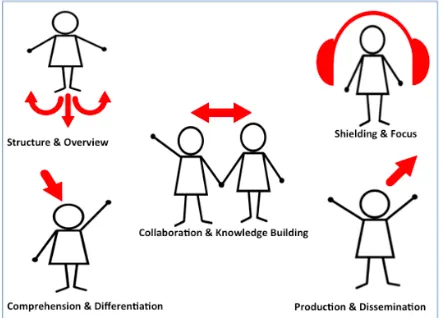
Earlier research has indicated [14], how learners with developmental and attention deficits might be able to participate more equally in the classroom activities – and thereby be less excluded – when teachers are aware of the potential of ICT based interventions for structuring, shielding, differentiating, producing, dialoguing and collaborating as illustrated in figure 1.
Figure 1. Five-type-model of including, ICT based interventions
The five-type-model of including ICT-based interventions gives birth to a potential for using technologies for:
(i) Structuring & Overviewing – Technologies could be used for structuring the programme for the day, the content of the lessons or the task solving processes. But it may as well contribute to overviewing the hole curriculum and content in a subject and the students’ academic products [15, 12].
(ii) Shielding & Focussing – Technologies could be used for shielding from disturbing impressions (like e.g. sounds, light, visions, movements etc.) and ease focusing and maintaining concentration [16].
(iii) Differentiating & Comprehending – Technologies could be used to present the academic content in different ways and with different modalities and thereby enable students to choose the modality which bring them the best comprehension of a topic [17]. (iv) Producing & Disseminating – Technologies could
be used to give students more opportunities and different modalities for communication, which might enable them easier to reify their academic knowledge to other people [18].
(v) Dialoguing & Collaborating – Technology could be used as a medium for students’ academic dialogues and collaboration processes, which might enable them easier to engage in construction of knowledge that seem true and meaningful to them [19].
Building on this five-type-model of including, ICT based interventions [14], this paper addresses the challenges of creating and facilitating a learning environment, in which focus learners are supported in relation to overviewing, structuring and planning tasks, evaluating and adjusting participation and management of time and, finally, examining the digital potential for these processes. Section 2 of the paper outlines the theoretical perspective on which the research is resting. Section 3 gives an account of the research design behind the study, while section 4 forms the forum for the actual analysis and insight into data. A more thorough discussion of the findings occurs in section 5 and, finally, section 6 makes an attempt to assess the degree to which it is possible to make conclusions on the basis of these findings.
2. Theoretical perspective
things. Powerlessness causes learners to search for protection and confirmation.
If the stages are experienced positively, the learner will develop a robust/solid self, which make him/her able to assess opportunities in the world. If necessary frustration turns into invincible frustrations, narcissistic infringement occurs [20], which makes the self-developmental processes impossible. Invincible frustration leaves the self in a depressive emptiness and feeling of being abandoned – or chooses other environments for reflection – as e.g. gangs, religious sects, etc. [20].
Learning can be seen to happen in the ideal tension field between reflection and idealization [20]. To change the learning and life perspective for focus learners it will be necessary that they meet a reflecting and understanding environment at school, where the level of frustration is adjusted to the learners’ zone of approximate development [21] – and the learner experience more omnipotent and less powerless.
This resonance in the reflecting and understanding environment is only a necessary base; it is not on its own enough to increase self-development and learning [20]. The constructive frustration brings something new to light, while missing or destructive confrontation decreases or hinders the learner’s development. The ideal learning environment is one, in which the teacher has reduced the threat against the learner to a minimum and facilitated different views on the case [22].
Resonance and acknowledgement emerge with different depth and power; to be realised is not the same as to be acknowledged [23]. To realise the difficulties and needs by children with e.g. ADHD leads not necessary to acknowledgement of their rights to participate on other premises. It is crucial for learners with developmental and attention difficulties, that the school acknowledge their individual characteristics as precious and unique individuals and – in respect for their specific qualifications and functionality - is provided the necessary support to be able to participate and contribute in the shared knowledge building in the learning community in the classroom.
Technology is widely recognised as valuable tools for people with special educational needs [24, 25]
.
Technology, however, may be used in many perspectives and with different functional roles. From a Persuasive Technology point of view [26], technology may function as a tool to increase capability, a medium to provide experience or a social actor to create relationships [26 p. 25]. Assistive Technologies (AT) may be used to train or rehearse something, or assist or enable learning [27]. When using Assistive Technologies, the idea is not to fix or cure the disability [14], but to enhance quality of life, accentuate strength and enable expression of abilities [28].For focus learners challenged when structuring and planning tasks, and when evaluating and adjusting own behaviour or reactions, intuition and management of time - it could be fruitful to utilise the persuasive potential in Technology as a Tool for “change attitudes or behaviours or both by making desired outcomes easier to achieve” [26]. But is it possible to bring the seven types of
Persuasive Technology Tools [26]: reduction, tunnelling, tailoring, suggesting, self-monitoring, surveillance and conditioning into play in a real world school practice? And how might Persuasive Technology Tools in the hand of teachers and learners assist, motivate and enable the presence, participation and achievements of focus learners at school? Using this lens, the authors examine, to what extent technology may assist teachers to create more ideal learning environments by reducing the threat for focus learners and enable them to participate in learning. In which ways may technology increase resonance and constructive confrontation, facilitate necessary frustration and optimise learning? How may technology help enhancing the learners’ feeling of omnipotence, reduce powerlessness and minimize invincible frustration?
3. Research design
This piece of research is one of the outcomes from a wider iterative and explorative qualitative research design, ididakt, carried out 2013-2016 by the authors of this paper [29, 30]. Ididakt is a case study framed by Educational Design Research (EDR) [31] and Action Research (AR) [32, 33] and data is collected in a real school context. EDR is a “genre of research, in which the iterative development of solutions to practical and complex educational problems also provides the context for empirical investigations, which yields theoretical understanding that can inform the work of others” [31 p.7].
The authors/researchers were included as professional dialog partners and facilitators in the transformations processes at 11 schools, where 46 teachers have been inspired to experiment with and examine the impacts of using ICT facilitated interventions in their teaching practises in 26 classes. More than 500 learners aged 6 to 16 years are included in the project – among them 56 learners with extensive developmental or attention deficit disorders (focus learners). “It is crucial for our data collection, that the unfolding research process goes hand in hand with the involved teachers’ work and interventions into the field of study, so the process becomes a learning endeavour in terms of learning how to work with SEN learners and integrating ICT in the classroom” [14]. The empirical data set consists of teachers’ statements at seminars, in interviews or at a research blog, from surveys, interviews with school leaders or students and from classroom observations. All in all, a rich data set, which were analysed in a hermeneutical, phenomenological perspective.
4. Analysis and findings
Table 1. Type of individual or shared technology
Type Grade Number
of classes Per cent of classes Laptops 1:1
Chromebooks 1:1 Mix of laptops, workstations and iPads 1:1 or 1:2 iPads 1:1
Additional booking of iPads
6, 7, 8, 10 4 4 1, 2 4, 7 9 1 4 3 7 35 % 4 % 15 % 12 % 27 %
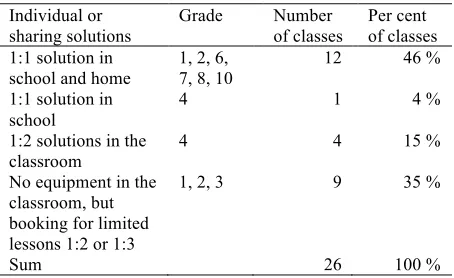
In a total of 26 classes have only 12 classes 1:1 equipment (one piece of hardware pr. student) in both school and at home, while 1 class have 1:1 in school but do not bring it home. 4 classes have access to 1:2 equipment (one piece of hardware pr. two students) in the classroom, while 9 classes only have opportunity for occasional booking of 1:2 or 1:3 equipment for limited lessons, as shown in table 2.
Table 2. Access to technology
Individual or sharing solutions
Grade Number of classes
Per cent of classes 1:1 solution in
school and home
1, 2, 6, 7, 8, 10
12 46 %
1:1 solution in school
1:2 solutions in the classroom
No equipment in the classroom, but booking for limited lessons 1:2 or 1:3 Sum
4
4
1, 2, 3
1 4 9 26 4 % 15 % 35 % 100 %
Some of the schools without equipment in the classroom provide during the project focus learners ‘a digital schoolbag’ in form of individual tablets or laptops, and at the end of the project 44 out of 56 focus learners (79 %) at grade 2-10 have their own laptop or iPad, while 12 out of 56 focus learners (21%) at grade 1-4 still do not have.
Among the 11 schools in the project different ICT based interventions have been implemented and evaluated in order to help the focus learners structuring and overviewing their school day and the task solving. From these various interventions the authors have identified Virtual Learning Environments (VLEs), Timers, Calendars, Visualisations and Templates as the most valuable tools for structuring and overviewing the school day and supporting and planning their task solving. The categories of interventions and technologies appear in table 3.
Table 3. Used technologies
Type Used
technology Number of schools Per cent of classes VLE VLE VLE VLE Timer Calendar Visualisation Templated SkoleIntra GAfE Office365 Meebook Time-timer MobilizeMe IWB, Posters Powerpoint 9 7 1 1 5 2 8 10 82 % 64 % 9 % 9 % 45 % 18 % 73 % 91 %
4.1. Virtual Learning Environments (VLEs)
The schools have used four different types of VLEs: SkoleIntra, Meebook, Google Apps for Education (GAfE) and Office 365. In the VLEs teachers compile and structure all materials for a subject, a course or a task in an online resource, which always appear accessible for the students. The VLE serves as a shared curriculum or portfolio reflecting what is processed and learned, and it contains information, instructions, guidance, links, assignments, calendar, checkboxes, shared files and folders etc. Learners and teachers communicate in multiple modes with each other, and it is easy for teachers to differentiate content, explanations and tasks: “We have created websites for the classes at Google Classroom for Danish Language, Math and German Language. It provides us a place for sharing links to tasks or sites at the Internet, where the students can search for information. We use Google Classroom for:
• Distribution of assignments • Space for feedback
• Communication with students • Sharing folders
• Submission oft assignments
• Distribution of small Flipped Learning videos • Sharing files
Everything is gathered in one place and it is very easy to use. All students are familiar with GAfE” (Teacher, 6th grade, school H).
The use of VLEs seems to foster a visible and shared frame for the academic work, which reduces complexity for the learners in offering suggestions for what to do, and help them keep on track: “It works well for all students. L. (Focus learner, girl in 6th grade) benefits from reading the writings of her peers. It helps her getting started and gives her ideas for her writing” (Teacher, school B).
(Google Slides) for the task solving processes” (Teacher, 1st Grade, School H).
The VLE is very helpful for learners with lacking memory and attention, as it helps them to cope more independently with what to do, how to do, when to do, where to do, with whom to do something, for how long to do something. “It has a good effect on S. and R. (focus learners 6th grade), because it gives them an overview and
they have all their materials at hand every day at the computer (Teacher, School B). This teacher uses Google Website for Danish Language: “Everything is here. A structure for the academicwork with a novel: Different tasks for the introduction, before-reading, while-reading and after-reading. All tasks are gathered, many different kinds of multimodalities, texts, instructions, models for analysis etc. are provided. The learners can compare this novel with earlier readings and return to older assignments” (ibid.) for inspiration and memory support.
In one younger class, the teacher says that the VLE is more useful for peers than for the focus learners, but that it nonetheless was an important tool for inclusion, while it reduced his tasks in the classroom and allowed him to spend more time together with the focus learners (School I). Teachers describe how the VLE - specifically amongst the oldest group of focus learners - scaffolds the learning process and helps them participate and contribute more autonomously in the classroom: “N. (focus learner with NLD, 10th grade) were not able to structure a larger task why we provided him a scaffold in OneNote (Application in Office365): All students have access to the same Notebook in OneNote. The learners can see the documents while the teachers can edit them. The Notebook contains a tab called ESO (the name of a yearly mandatory assignment in Danish school system), which we can reuse every year. The tab contains seven pages:
• What must the task encompass? • Table for checkmarks
• A week plan
• Template for the statement of intent • Template for the report
• Inspiration to the content
• A flyer about rules at the ESO-assignment
This scaffold was a huge help for N. when it comes to structuring and overviewing the task, and he made a very good assignment within the scheduled time frame. He had never before tried or been able to do so. At the same time, he had a really good week in school” (Teacher School K). The VLEs Skole-Intra and Meebook are resources developed for education. They are quite easy to use and offer the teachers a fixed structure. The VLEs GAfE and Office365 are generic tools, where the teachers must create a useful structure by themselves. It requires time, pedagogical visions and technological skills, but offers then a flexible and dynamic user interface, which easier can be adjusted different needs. The value of VLEs seems
dependent on the teachers’ knowledge and competences for using the resource [29].
The VLEs seem to be valuable tools for classroom management. It is evident that a deliberated, structured use of VLEs enhances the learners’ feeling of omnipotence. It might, though, be caused by the fact that the use of VLEs also makes teachers’ preparation and teaching more visible and structured. In contrast, if the VLEs not are well-structured and considered for the needs of focus learners, it would – similarly to a real world setting - still be difficult for them to navigate and overview what to do: “It is important, that all teachers uses the same structure. It must be designed well from the beginning and should be as simple as possible. Two new students in the class find it very difficult overviewing the system, we have fostered during two school years (at Google Apps for Education) (Teacher, 6th Grade, School B).
4.2. Timers
Five schools have used Time-timers in the classroom for structuring time, when focus learners participate in classroom activities and task solving. A Time-timer is a visual watch, which in a simple, graphical way reflect the remaining time. The Time-timer has proved a very strong tool for enhancing the focus learners’ attention and
persistence: “We are using Time-timers to visualise the
remaining time for each activity… We have experienced, that the Time-timers causes that many children quieten down when this intervention structures their task solving processes. We use it in the most of the lessons, where we
prevent disturbing questions (about the time left) and
achieve better concentration among many learners –
included some of the focus learners” (Teacher, 2nd grade,
School J).
The ability for self-monitoring time seems to be essential
for most focus learners. The teachers notice more omnipotence and less stress and invincible frustration, when focus learners are able to measure the time left on a
given task: “The two persistent children (focus learners)
worked autonomously in almost four hours, only because of the time managed and adjusted agenda. It was wonderful to se them work without constantly needing to be next to them – while at the same time they felt, that they had performed and contributed well. They went home happy,
for sure, from school that day” (Teacher, school D). Some
of the schools have instead examined the use of online timers. They observed, how animated watches as e.g. bombs who blast, when time is up, are too disturbing for the focus learners’ attention to tasks.
4.3. Calendars
which they are able to collaborate, communicate and create a detailed day plan with text, pictograms and pictures. The focus learner has access to the calendar at his iPad or mobile, wherefrom he can follow the plan and with checkmarks illustrate, what is already done. These applications provide all types of persuasive technology
tools (reduction, tunnelling, tailoring, suggestion,
self-monitoring, surveillance and conditioning), and are used
and recommended in many Special Educational Needs Schools. The focus learners seem pleased with the
applications: “I use Planet every day… I have an alarm for
getting up. I use a program for the day, so I can see, what I need to do. Find cloth, take my medicine, prepare my lunch, brush my teeth, be ready for and go to school… If I didn’t get notifications I wouldn’t do my homework…”
(Focus learner, girl in 8th grade). Nevertheless, it seems to
be difficult to implement such specific assistive tools in a
mainstream educational setting. “We do not use
MobilizeMe, because the daily investment of time will not
measure up to the possible outcome.” (Teacher, School C).
It might be easier to provide such solutions to the focus learners, if the calendar tool was a part of the general VLE for all learners in the classes.
4.4. Visualisations
As a supplement to digital structuring tools most schools have used various visualisations in the classroom to help the focus learners remember what was said and how to do. It might be day plan documents, posters with written expectations to learners’ attitude and behaviour in the classroom, visible learning goals, collaboration groups or just notes at the board. We have observed, that quite often focus learners seek information in these visualisations and use them to navigate in a school day. Even though learners have access to the same information online, it seems important to remember, that they might still need this “off-line” messages in the classroom.
4.5. Templates
Digital templates for structuring tasks have appeared as very valuable tools in the project [18]. At ten schools, the teachers observed that templates enhanced focus learners’ capability for task solving and production. “I have done experiences with writing templates, when my class was writing book reviews. I saw B. (focus learner, boy in 4th grade) autonomously make his assignment and within the deadline. I saw he worked systematically by means of the template. It is the very first time ever I have witnessed him carry out a task in the school by himself.” (Teacher, school F). The templates can support learners with poor organisational ability to perform at the same level as their peers.
4.6. Other interventions
Teachers in the project have made a variety of other interventions adjusted to the specific needs of their focus learners. From those, we found the following fruitful to mention:
1. Cancel morning hymn for focus learners and use this time to give him/her individual instructions about the day plan. The teachers observed a much more participating, calm and contributing learner for the rest of the day.
2. Adjust the homework to the focus learners’ capability. Teachers described less stress and invincible frustration.
3. Use of alarm and notifications at the iPad. Teachers observed that the focus learners remember their homework and arrive at school on time.
4. Use of video instructions. The teachers observed that the focus learners watch the video as many times as necessary to understand what to do
5. Use of assessment and evaluation tools. The teachers described enhanced awareness and understanding in focus learners about their own role in learning processes.
5. Discussion
We have noticed, that there is little access to technology in the classroom of the younger learners. When technology not is a daily working tool, it spoils the teachers’ possibilities for taking advantage of the potential in structuring and planning technologies. Likewise, it seems unfruitful for the implementationprocesses, when the focus learners do not have permission to use their technological tool both in school and at home.
It is evident that use of digital structuring tools has a positive impact when it comes to the focus learners’ participation and contribution in the learning processes. We have seen, how technologies have supported the focus learners memory, attention and persistence at level which enable them to be more productive in classroom activities. However, the technologies are not able to foster such changes on their own. As such we do not understand the technologies as persuasive themselves. They must be utilized in the hand of an intentional teacher, who uses his/her pedagogical imagination [34] to adjust the technologies and the structures according to the special needs of the focus learners. Then technologies can be used
as tools to increase capability, as mediums to provide
experiences, and as social actors to foster the building of
relationships. This intentionally use of technology with a persuasive purpose is what we could define as a Persuasive Pedagogical setting.
types, we would argue that structuring and shielding tools are assistive technologies, which compensate for the focus learners’ difficulties and enable them to become ready for
– and join - the learning process, while the differentiating,
producing and dialoguing tools are utilities directed
towards the learning process.
6. Conclusion
This paper has examined and discussed the extent to which technology may assist teachers in creating a more ideal learning environment for learners with attention and developmental difficulties. It seems evident, that digital tools, which provide possibilities for reduction, tunnelling, tailoring, suggestion, self-monitoring, surveillance and
conditioning, are, in fact, able to assist, motivate and enable focus learners’ presence, participation and achievements at school. Our research contains many statements from both focus learners and teachers where they describe how the use of technology in the classroom have induced omnipotence in the sense that the focus learners are able to work on their own and succeed in their task solving processes in the classroom.
We have identified well-structured Virtual Learning Environments (VLEs), digital templates, timers and calendars as specific valuable tools for enhancing the focus learners’ ability to become ready to learn, join and remain within the learning processes. We have further realised that visualisations in the classroom, notifications, video instructions, assessment and evaluation tools help focus learners to navigate, remember, become aware and understand their own role in the classroom.
Using these structuring technologies in a reflecting and understanding environment in the school, it seems possible to reduce invincible frustration and increase resonance and constructive confrontation in the zone for proximate development, in which the focus learners experience more omnipotence than powerlessness. Finally, we consider technologies for structuring and overviewing as basic assistive tool for equalizing the learning possibilities of the focus learners in an inclusive school setting.
Acknowledgements
We would like to express our gratitude towards the teachers at the eleven participating schools in ididakt for sharing this learning endeavour with us and provide us with new insight in this complex field of research. We also thank our research assistant, Rune Hagel Skaarup Jensen, whose never failing support and cooperation have been very helpful during condensation and analysis of data.
References
[1] UNESCO. (1994). The Salamanca Statement and Framework for Action on Special Needs Education.
Retrieved from
http://www.unesco.org/education/pdf/SALAMA_E.PDF
[2] Ministeriet for Børn og Undervisning. (2012). Udmøntning af pulje til It-baserede læringsformer/pædagogik og redskaber rettet mod fagligt svage elever og elever med særlige behov. Retrieved from 121128 Udmoentning af satspulje til IT bilag REV.ashx.pdf
[3] Ministeriet for Børn og Undervisning. (2012). Udmøntning af pulje til It-baserede læringsformer/pædagogik og redskaber rettet mod fagligt svage elever og elever med særlige behov. Retrieved from 121128 Udmoentning af satspulje til IT bilag REV.ashx.pdf
[4] Danmarks Evalueringsinstitut. (2011). Indsatser for inklusion i folkeskolen. Kbh.: Danmarks Evalueringsinstitut. [5] Dyssegaard, C. B., Søgaard Larsen, M., & Dansk Clearinghouse for Uddannelsesforskning. (2013). Viden om inklusion. Dansk Clearinghouse for Uddannelsesforskning. [6] Almer, G. M., & Sneum, M. M. (2009). ADHD - Fra
barndom til voksenalder (1. udgave, 2. oplag). København: Frydenlund.
[7] Steiner, N. J., Sheldrick, R. C., Frenette, E. C., Rene, K. M., & Perrin, E. C. (2014). Classroom Behavior of Participants with ADHD Compared with Peers: Influence of Teaching Format and Grade Level. Journal of Applied School Psychology, 30(3), 209–222. http://doi.org/10.1080/15377903.2014.896297
[8] Barkley, R. A. (1998). Attention deficit hyperactivity disorder: A handbook for diagnosis and treatment (2nd ed.). New York: Guilford.
[9] DuPaul, G. J., & Stoner, G. (2003). ADHD in the schools: assessment and intervention strategies (2nd ed). New York: Guilford Press.
[10] DuPaul, G. J., Weyandt, L. L., & Janusis, G. M. (2011). ADHD in the Classroom: Effective Intervention Strategies. Theory Into Practice, 50(1), 35–42. http://doi.org/10.1080/00405841.2011.534935
[11] Booth, T., & Ainscow, M. (2002). Index for inclusion -developing learning and participation in schools. Centre for Studies on Inclusive Education (CSIE). Retrieved from http://www.eenet.org.uk/resources/docs/Index%20English. pdf
[12] Sorensen, E. K., & Andersen, H. V. (2016a). Amplifying the proces of inclusion through a genuine marriage between pedagogy and technology. Presented at the European Distance and E-Learning Network (EDEN) 2016 Annual Conference, Budapest 15-17 June 2016.
[13] Johnson, J., & Reid, R. (2011). Overcoming Executive Function Deficits With Students With ADHD. Theory into Practice, 50(1), 61–67.
[14] Andersen, H. V., & Sorensen, E. K. (2015). Technology as a Vehicle for Inclusion of Learners with Attention Deificits in Mainstream Schools. In Proceedings of the European Distance and E-Learning Network 2015 Annual Conference Barcelona, 9-12 June, 2015 (pp. 720–730). Barcelona:
EDEN. Retrieved from
file:///Users/voldborg/Downloads/BRPA_Voldborg-Andersen_Korsgaard_Sorensen.pdf
[15] Andersen, H. V., & Sorensen, E. K. (2016c). Powerlessness or Omnipotence – the Impact of Structuring Technologies in Learning Processes for Children with Attention and Developmental Deficits. Presented at the 1st EAI International Conference on Design, Learning & Innovation, Esbjerg.
[17] Andersen, H. V., & Sorensen, E. K. (2016a). Differentiated Technology-based Interventions for Enhancing Understanding, Flow and Self-efficacy by Learners with Developmental and Attention Deficits. Presented at the 9th EDEN Research Workshop - EDENRW9, 4-6 October 2016, Oldenburg.
[18] Sorensen, E. K., & Andersen, H. V. (2016c). Using Digital Technologies for Inclusion through Strengthen Participation and Contribution for Learners with Developmental and Attention Deficits. Presented at the 9th EDEN Research Workshop - EDENRW9, 4-6 October 2016, Oldenburg. [19] Sorensen, E. K., & Andersen, H. V. (2016b). Learning
Together Apart – the Impact on Participation when Using Dialogic Educational Technologies for Kids with Attention and Developmental Deficits. Presented at the 1st EAI International Conference on Design, Learning & Innovation, Esbjerg.
[20] Kohut, H. (1990). Selvets psykologi. [Kbh.]: Hans Reitzel. [21] Vygotsky, L. S. (1978). Mind in society: The development
of higher psychological processes. Cambridge: Harvard University Press.
[22] Rogers, C. R., & Freiberg, H. J. (1994). Freedom to learn (3rd ed). New York : Toronto : New York: Merrill ; Maxwell Macmillan Canada ; Maxwell Macmillan International. [23] Honneth, A. (2014). Kampf um Anerkennung: zur
moralischen Grammatik sozialer Konflikte ; mit einem neuen Nachwort (8. Aufl). Frankfurt am Main: Suhrkamp. [24] Waller, T., & Watkins, A. (2013). Information and
Communication Technology for Inclusion. Research Literature Review. Brussels: European Agency for Development in Special Needs Education. Retrieved from https://www.european-agency.org/sites/default/files/ict4i- research-literature-review_ICT4I-Research-Literature-Review.pdf
[25] McKnight, L., & Davies, C. (2012). Current Perspectives on Assistive Learning technologies. University of Oxford: The Kellogg College Center for Research into Assistive Learning Technologies. Retrieved from
http://www.kellogg.ox.ac.uk/wp- content/uploads/2015/03/Current-Perspectives-on-Assistive-Learning-Technologies.pdf
[26] Fogg, B. J. (2003). Persuasive technology: using computers to change what we think and do. Amsterdam ; Boston: Morgan Kaufmann Publishers.
[27] Abbott, C. (2007). Defining assistive technologies - a discussion. Journal of Assistive Technologies, 1(1), 6–9. http://doi.org/10.1108/17549450200700002
[28] Raskind, M. H. (1994). Assistive technology for adults with learning disabilities: a rationale for use. In Learning disabilities in adulthood: persisting problems and evolving issues (pp. 152–162). Stoneham, MA: Andover Medical. [29] Andersen, H. V., & Sorensen, E. K. (2016b). Empowering
Teachers and their Practices of Inclusion through Digital Dialogic Negotiation of Meaning in Learning Communities of Practice. Presented at the The EdMedia World Conference on Educational Media and Technology, 27th to 30th June 2016, Vancouver, British Columbia, Canada.
[30] Sorensen, E. K., Andersen, H. V., & Grum, H. (2013). Intercultural Dialogic eLearning: A Tool for Fostering Shared Understanding and Sustainable Competence Development in Practices of Inclusion. In Proceedings of World Conference on Educational Multimedia, Hypermedia and Telecommunications 2013 (pp. 389–397). Victoria, Vancouver Island: AACE.
[31] McKenney, S. E., & Reeves, T. C. (2012). Conducting educational design research. New York: Routledge. [32] Duus, G., Husted, M., Kildedal, K., & Laursen, E. (2012).
Aktionsforskning: en grundbog. (D. Tofteng, Ed.). Frederiksberg: Samfundslitteratur.
[33] Jungk, R., & Müllert, N. R. (1989). Håndbog i fremtidsværksteder. Kbh.: Politisk revy.