J
SSE
Journal of
Social Science
Education
What’s Wrong With Secondary School Economics and How Teachers Can Make it Right - Methodological Critique and Pedagogical Possibilities
Jacek Wiktor Brant
About the Use of the Word “Market” in the Teaching of Economics: The Lexicon at Work at the High School and at the University Hervé Blanchard, Yves-Patrick Coléno
Why We Need to Question the Democratic Engagement of Adolescents in Europe
Isolde de Groot, Wiel Veugelers
Iranian EFL Teachers’ Voices on the Pedagogy of Word and World Parvin Safari, Nasser Rashidi
What’s Wrong With (Secondary School) Economics and How Teachers Can Make it Right
Martin Tolich, Bonnie Scarth, Kerry Shephard
Economics from a Different Point of View - Good Practice in Teacher Training: How to Handle, Use and Judge External Standardized Tests in Schools
Julia Prieß-Buchheit
20th AEEE Conference and 1st ENSECASS Symposium, Aix-Marseille University, 27-29 August 2014: Summary and Perspectives 20ème Conférence de l’AEEE et 1er Colloque ENSECOSS, Université d’Aix-Marseille, 27-29 août 2014: Eléments de bilan et
perspectives
Alain Legardez, Hans-Jürgen Schloesser
Volume 14, Number 4, Winter 2015 ISSN 1618–5293
Masthead
Editors:
Reinhold Hedtke, Bielefeld University, Faculty of Sociology Ian Davies, Department of Educational Studies, University of York
Andreas Fischer, Leuphana University Lüneburg, Faculty of Economics and Social Sciences Tilman Grammes, University of Hamburg, Faculty of Educational Science
Isabel Menezes, University of Porto, Faculty of Psychology and Educational Sciences Birgit Weber, University of Cologne, Faculty of Human Sciences
Editors of this Issue:
Birgit Weber, University of Cologne, Faculty of Human Sciences
Editorial Assistant: Simon Niklas Hellmich
Editorial Office:
Journal of Social Science Education Bielefeld University
Faculty of Sociology Postbox 100 131 33501 Bielefeld Germany
E-Mail: [email protected]
http://jsse.ub.uni-bielefeld.de/index.php/jsse/index
Editorial Board:
Prof. Mehmet Acikalin, PhD, Instanbul, Turkey; Prof. Dr. Helena C. Araújo, Porto, Portugal; Prof. Dr. François Audigier, Genève, Switzerland; Prof. Dr. Gert Biesta, Luxembourg; Prof. Dr. Cesar Birzea, Bucharest, Romania; Prof. Dr. Olga Bombardelli, Trento, Italy; Prof. Pepka Boyadjieva, Sofia, Bulgaria; Dr. Jennifer Bruen, Dublin, Ireland; Ass. Prof. Dr. Kenan Çayir, Istanbul, Turkey; Prof. Peter Davies, PhD, Stoke-on-Trent, UK; Prof. Dr. Georgi Dimitrov, Sofia, Bulgaria; Ass. Prof. Niklas Eklund, PhD, Umeå, Sweden; Prof. Dr. Peter Filzmaier, Krems, Austria; Prof. Dr. Karl Peter Fritzsche, Magdeburg, Germany; Prof. Dr. Ipek Gurkaynak, Ankara, Turkey; Prof. Dr. Ireneusz Pawel Karolewski, Wroclaw, Poland; Prof. Takahiro Kondo, PhD, Tokyo, Japan; Prof. Dr. Gitsa Kontogiannopoulou-Polydorides, Athens, Greece; Dr. Janez Krek, Ljubljana, Slovenia; Prof. Dr. Klaus-Peter Kruber, Kiel, Germany; Ass. Prof., PhD, Anna Larsson, Umeå, Sweden; Prof. Dr. Bruno Losito, Rome, Italy; Ass. Prof. Despina Makridou-Bousiou, Thessaloniki, Greece; Dr. Tristan McCowan, London, UK; Prof. Erich Mistrik, PhD, Bratislava, Slovakia; Prof. Dr. Concepción Naval, Pamplona, Spain; Prof. Dr. Dr. h.c. Fritz Oser, Fribourg, Switzerland; Prof. Dr. Vedrana Spajic-Vrkas, Zagreb, Croatia; Prof. Dr. Anu Toots, Tallinn, Estonia; Prof., PhD, Ilo Trajkovski Skopje, Rep. Macedonia; Prof. Dr. Nicole Tutiaux-Guillon, Villeneuve d’Ascq Cedex, France; Dr. Ruud Veldhuis, Amsterdam, the Netherlands; Prof. Arja Virta, Turku, Finland; Ass. Prof. Dr. Irena Zaleskiené, Vilnius, Lithuania
The Journal of Social Science Education is published quarterly by sowi-online e.V., a non-profit organisation and registered society at the Bielefeld Court of Record (Registergericht), Germany. Members of the JSSE team are the editors, the editorial assistant, the technical staff, and the editorial board.
Journal of Social Science Education
Volume 14, Number 4, Winter 2015 ISSN 1618–5293
Contents
Editorial
Multiperspectivity, Values and Criticism in Economic and Civic Education 2-6 Birgit Weber
Featured Topic
What’s Wrong With Secondary School Economics and How Teachers Can Make it Right (Methodological Critique and Pedagogical Possibilities)
7-16
Jacek Wiktor Brant
About the Use of the Word “Market” in the Teaching of Economics: The Lexicon at Work at the High School and at the University
17-26
Hervé Blanchard, Yves-Patrick Coléno
Why We Need to Question the Democratic Engagement of Adolescents in Europe 27-38 Isolde de Groot, Wiel Veugelers
Iranian EFL Teachers’ Voices on the Pedagogy of Word and World 39-52
Parvin Safari, Nasser Rashidi Article
What’s Wrong With (Secondary School) Economics and How Teachers Can Make it Right
53-63
Martin Tolich, Bonnie Scarth, Kerry Shephard Project
Economics from a Different Point of View − Good Practice in Teacher Training: How to Handle, Use and Judge External Standardized Tests in Schools
64-69
Julia Prieß-Buchheit Congress
Report
20th AEEE Conference and 1st ENSECASS Symposium, Aix-Marseille University, 27-29 August 2014: Summary and Perspectives
20ème Conférence de l’AEEE et 1er Colloque ENSECOSS, Université d’Aix-Marseille, 27-29 août 2014 : Eléments de bilan et perspectives
70-72
Alain Legardez, Hans-Jürgen Schloesser
Civics and citizenship education in the Nordic Conference on Subject Didactics NoFa-5, May 26 – 28, 2015, Helsinki, Finland
73-74
Jan Löfström Review
Review of the Book: McCloskey, Stephen. 2014 (ed.). Development Education in Policy and Practice. Hampshire: Palgrave MacMillan
75-76
Jennifer Bruen
Volume 14, Number 4, Winter 2015 DOI 10.2390/jsse-v14-i4-1510
2
Dr. Birgit Weber is Professor for social science with a
focus on economic education at University of Cologne and editor of the JSSE. Her research interests are social science education with a special focus on economic education, curriculum
development and research of economic and social science education.
Universität zu Köln, Humanwissenschaftliche Fakultät, Gronewaldstraße 2, 50931 Köln
Email: [email protected]
Birgit Weber
Editorial: Multiperspectivity, Values and Criticism in Economic and Civic Education
Keywords
Crises, economic education, civic education, multipers-pectivity, values, criticism
1 Introduction: Facing multiple and multipolar crises Until last year the European Union was overshadowed by severe economic crises including various ordeals by the referendum on the United Kingdom's membership and the Grexit option and the troubled debates in national parliaments about help for the most affected countries. In issue 2013-2 about Crisis and Economic Education in Europe we still characterized that with multiple crises.
Even if these crises would not have been really mastered, additional crises appear. Wars developed at the edge of the EU and raised the question of support or intervention. At the risk of life nearly a million persons flee 2015 from Zones of war, crises and poverty to the affluent societies in the EU, that seem to be safe, with the exception of raising terrorist attacks. While European countries differ between welcoming culture and separation, anxiety about social decline creates the rise of xenophobic groups. Even if those groups use democratic forms, threats to democracy are developed. However, the freedom to migrate is also used by others, who do not flee out of fear for their lives, but want to secure their own capital in safe havens before nationa-lization.
As long as capital finds the means to migrate to avoid taxes, only economic growth seems to be the panacea against national and global poverty. But as the rates of growth are narrowing in OECD countries, the high rates of emerging markets reached their peak recently. With the evidence, that social inequality rises with economic growth, because capital income grows stronger, the French economist Thomas Piketty also warns about dangers for democracy and economy, as inherited assets concentration causes power imbalances and the lack of host-economic growth affects the economic base. Mean-while, the world is trying to compensate for the lack of growth and global inequality through free trade. In Bali 2013, a new free trade agreement was agreed, that should allow better access to the markets of the indus-trialized and emerging countries, pledging financial and development aid and agreeing on eliminating agricultural subsidies.
Even if the poor countries as well as the countries with emerging markets are not really content, the strong economic areas continue forcing free trade by bilateral negotiations. NGOs demonstrate their concern, that the fight against protectionism could undermine future democratic self-determination of nations by independent arbitration courts and regulatory councils that create extended space for lobbyism. At the end of 2015, the countries of the world committed to climate protection in Paris in order to keep global warming "far below" two degrees. This historic agreement was possible because national targets have not been set, voluntarily climate targets were allowed, while the agreement should be realized within five years and the balance of greenhouse gases by mid-century.
2 Interdependence of crises versus narrowing perspectives
These global entanglements of social, economic, political and environmental challenges as well as regional, national and global crises can be mastered by confrontation and decoupling, or by cooperation. Facing such crises shows, how strong economic, political and social developments on the one side, regional, national and global developments on the other side are intertwined. Economic and civic education should enable students for a better understanding of the world in its social, politic and economic dimensions and prepare them to take part in creating a world they want to live in. It has also to deal with such intertwinements that ask for different perspectives, dealing with values and critique.
Journal of Social Science Education
Volume 14, Number 4, Winter 2015 ISSN 1618–5293
3
Looking at the discussion in Europe and its individualcountries, we see that the discussion about narrowing perspectives in subjects is not just a German pheno-menon. European debates on economic education - such as the Joint declararation of AEEE 2015 -, as well as the contributions from Jacek Brant (UK) and Hervé Blanchard/Yves Coleno (France) show the demand for different perspectives, inclusion of values and a critical focus of real world phenomena.
3 Limiting interpretation and explanation to a mainstream perspective
Also on the sovereignty of interpretation and explanation of social, economic and social phenomena, exist different views, as clearly presented this year by a conflict over a teaching material called "Economy and Society", which was edited by Bettina Zurstrassen, university of Bielefeld, and published by the German Federal Agency for Political Education. Employers' organizations had lobbied, with the support of the Ministry of the interior, that this publication should not be distributed. The employers association found themselves denounced in one of twelve articles which was about lobbying. Uninten-tionally, they delivered with their attempt, simultane-ously an authentic lesson for lobbying. The publication did not strive to conduct a comprehensive economic education basic set, but offered socio-economic issues by way of example, in a critical, pluralistic way that does not use only economics, but also the approaches of other social sciences to analyze economic reality. In addition to the claim of other social sciences to deal with economic phenomena and contribute additional perspectives, the question arises, about how far critical perspectives are sacrificed on the altar of functionalism even in democratic systems, if the approaches are problem-oriented and controversial. (see Case Study: Controversy versus Unilateralism or Lobbying against Interdis-ciplinary)
4 Pluralism, values and criticisms in science
Long time calls for pluralistic economic perspectives for the analysis of real-world phenomena seem to be unique to heterodox and pluralist economists, who have doubts about the liberalization of markets as a last resort panacea. Nowadays even liberal economists emphasize more strongly the social relevance of liberal values. As the former chairwoman of the Hayek Society, Karen Horn confirmed strongly to liberal values in order to defend liberal position against right-wing-movements. She stressed the fundamental humanitarianism of liberalism, which derives from the fundamental value of liberty also values of openness, pluralism, tolerance and respect for those who think differently. As a result of an escalating dispute about liberalism vis-a-vis national funda-mentalism and conservatism, liberal economists, politi-cians and managers left the society in solidarity with Horn, while actually opposing the narrowing of the debate culture, and the lack of attention on uncon-ventional positions in a scientific association. With this step the liberals have taken a position against
sim-plification, intolerance, dogmatism and they want to distinguish themselves against inhuman positions (see Case Study: Liberalist against Liberalist or Liberal Humanism against Right-wing-Inhumanism).
5 Contributions of this issue
Originally the issue was planned as "Teaching Economics in a Europe in Crisis". With the multipolarity of crises associated with confrontation and segregation, as well as cooperation and compromise with regard to common values entangled between regional, national and global issues we decided to expand the focus. On first sight this issue is gathering quite heterogeneous contributions. An in-depth examination presents a lot of similarities, which can be characterized by the fact that a special importance is attached to multiple perspectives, to the consideration of values and to the role of a critical approach. In many conceptions of civic and economic education those principles have become self-evident, but their actual implementation seems to be anything else than self-evident.
Jacek Brant, Senior Lecturer in Business and Economics Education at the Institute of Education at the University College London calls for a new conception of Economics Education in order to understand the world’s historical and political relations involving criticism as well as the moral and social dimensions. The scientific claim of neo-classism with its over-reliance on mathematical methods, especially leads to a neglect of important issues such as those of an inclusive capitalism. Referring to the philosopher Roy Bhaskar, Jacek Brant suggests a trans-cendental realism with access to the world by way of structures and mechanisms, and a critical realism per-ceiving human beings not only as passive sensors, but also by their different approaches. Thus, he recommends the DREIC model of Bhaskar to economic education: First a description is needed, then the ‘retroduction’ of hypotheses, wherein the unrealistic has to be eliminated, the realistic has to be identified and at least the model has to be corrected. Even if the economic contribution to the understanding of the economic and social environ-ment has to be appreciated, an inquiring, critical and reflected approach to studying economic behaviour from multiple perspectives and a consideration of alternative approaches is necessary. Brant shows, that a new curriculum in the United Kingdom allows teachers and students to reflect about business and economy, and assess their impacts on social systems using an experience-based approach, considering values, interests and purpose of economic activity equally. Economic Models should not be taught as if they were real, instead concepts should be distilled by experience. Explanation opportunities should be checked as well as social or political embedment.
Volume 14, Number 4, Winter 2015 ISSN 1618–5293
4
concept of market. This favouring leads to thedominance of microeconomic models, which seems to be the main approach, even the notion of market did not appear in need of explanation. Looking to academic economic encyclopedias they present the normative neoclassical market as modelled for efficiency and optimization, whereas the values have been abolished. While the market is not doubted as a means of social regulation, the value of freedom presides over equality. They criticize the attempts of educational policy, to address the lack of economic culture by glorifying the virtues of the market. The authors show the lexicon of capitalism as a combination of market and capital: Markets are an indisputable reality, welfare is justified by human capital, Money is not even mentioned, and the concept of man is not clarified, whereas work as a decisive word disappears and a labour market is nothing more than another market. Blanchard and Coleno criticize the depletion of economics and demand in accordance with their English colleague, that the subject of economic education has to look for goals and be associated with values as well.
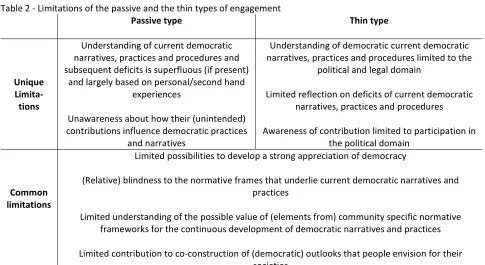
As the prior contributions analyse and conceptualize problems in economic education in different countries, Isolde de Groot and Wiel Veugelers relate to democratic deficits and gaps in democratic commitment. While social scientists explain those problems with a depo-larization of the political debate, a lack of appreciation of opposing positions, and the decline in the importance of civil institutions promoted by the dramatization of the media, the educationalist complain, that democracy is presented as a neutral political system, whereas the attention for values decreases with the decline of religious education, and a technical rationality over-whelms the confrontation of power and social justice. Their own democratic model is composed upon a democratic theory viewing a political system under construction, whose deficits are never completely overcome, but recognized, reduced and refined. From 27 narratives of 16-20-year-old Students, de Groot and Veugelers developed a typology, in which they charac-terize ‘passive, thin and thick’ democratic commitment types. They are distinguished according to their perception and appreciation of democracy and diversity, and in their sense of effectiveness of citizenship and responsibility. According to this, it is difficult to the passive and thin type to develop an appreciation for democracy, if they just perceive the system as a legal one. Instead they should get chances to develop deliberative and critical participation skills and investigate their ideals. With this innovation of the typology regarded by the more complex conception of imagination and the consideration of democracy as ethos, the authors want to formulate facets, how a strong commitment to democracy could be cultivated. Looking at this we can conclude that acceptance is based on understanding as well as on critiques.
Parvin Safari and Nasser Rashadi show in their contribution that the promotion of critical thinking is not limited to social science education. In their case,
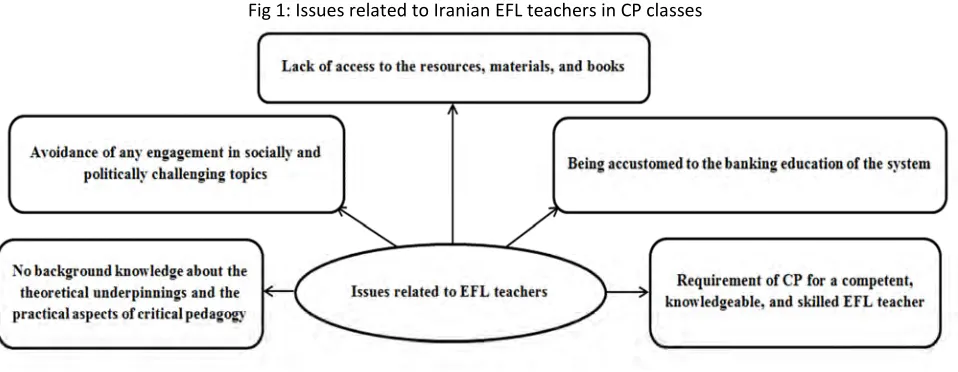
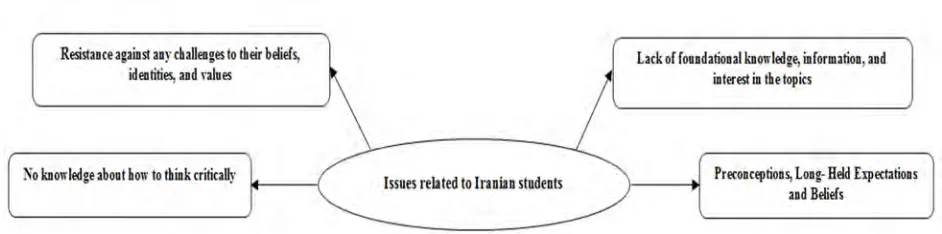
language teaching can include critical pedagogy as well, that should enable students to critical thinking about oppressive power relations, inequality and lack of freedom. Referring to Paolo Freire they contrasted his critique on the banking model of education with his central concepts of critical Pedagogy (practice of dialogue, critical consciousness). In focus interviews with language teachers in private institutions in Iran the authors try to identify obstacles, frustrations and problems, which resist an integration of critical pedagogy. According to their findings the teachers complain about the many lacking issues (background knowledge, competence, appropriate resources), but they also find an avoidance of controversial issues that could conflict with traditions, ethnic cultures and religion and the habituation of the banking model. The teachers also anticipate a reserved image of their students because of their lack of knowledge about critical thinking and democratic freedoms, a familiarity with the banking model, and also a resistance to the changes in attitudes, values and identity. They conclude that an education that will empower marginalized students and minorities against oppression and subordination, must overcome the bank model by broader forms of civic education, but it also cannot disregard sociocultural and socio-political conditions.
From the viewpoint of Sociology and Education Science, Martin Tolich, Bonny Scarth and Kerry Shephard evaluate how sociology students in research internships train their identity as qualitative researchers. These internships are placed in local community projects according to specific clients. Studying the role of fear, support, feedback, teamwork, use of research methods, and project benefits, the authors observe a significant development of self-confidence by experiential learning in real situations, whilst the students have to deal with the challenges of limited research planning in a non-linear world. The development of students has been interpreted by way of different educational theories, model of experiential learning, high-impact learning, the self-efficacy approach, social constructionism, commu-nities in practice, affective learning model. Remarkable is the demand for a public sociology that uses qualitative research to improve communities and the quality of life – and allows at the same time, the creation of research competence and promotes employability.
Julia Prieß-Buchheit presents a project in teacher training at the University of Kiel, where student learn to analyze standardized tests, regarding their function and consequences as instruments of New Public Mana-gement. They also study the underlying values in order to develop their own point of view. In a final examination carried out as a simulation beyond colleagues, students discuss the test application. Prieß-Buchheit also points out, that the lack of sociological and political knowledge especially complicates the understanding of inter-disciplinary relationships.
Journal of Social Science Education
Volume 14, Number 4, Winter 2015 ISSN 1618–5293
5
discourse about the problems of real life world, inscience as well as in school. All of the contributions in this issue, regardless of whether they come from France, United Kingdom, Netherlands, Iran or the New Zealand claim the role of multiple perspectives, the debate about values, the relevance of criticism in regard to the phenomena and challenges of the real social, economic and political world.
Finally the two congress reports of the Association of Economics Education 2014 in Aix en Provence, France,
and the Nordic Conference of civics and citizenship education 2015 in Helsinki, Finland, represent a vivid impression in the multi-perspective, interdisciplinary and critical debates in the Social Science Education fields. At least Jennifer Bruen discuss the manual of Stephen McCloskey on Development Education in Policy and Practice. We appreciate also those formats, which inform the international audience about interesting debates and publications in the field of social science education.
Case study I: Controversy versus Unilateralism or Lobbying against Interdisciplinary
The case is about the recent teaching material “Ökonomie und Gesellschaft” [Economy and Society], edited by Bettina Zurstrassen, professor at Bielefeld university and distributed by the Bundeszentrale für politische Bildung (BPB) (Federal Agency for Political Education, in Bonn). The 12 lesson units were written by academics from economic and civic education. The units are about such different topics as lobbying, financial crises, social balance in an economic order, development and continuance of markets, money in modern societies, responsible action in consumer societies, sustainable economies with or without economic growth, labor-relations, subject and society, discrimination in the workplace, the EU und the world economy (1). Peter Clever, vice president of the German employer organization (BDA), worries especially about an article about lobbying that does not deliver arguments about the engagement of enterprises for vocational education of the youth. As a very few additional sentences in two other units did not meet his pleasure, he asked the agency and the ministry above to stop the distribution of the publication (2).
Comparing the criticized quotations with the publication the editor Bettina Zurstrassen found fundamental reductions and content isolations in the criticized citations (3).
According to the freedom of information act, the government has to provide clarity about the whole process (4). Mass media criticized the lobbying (5/6), and scientific organizations of civic education (GPJE, DVPB) as well as the Association of Sociology (DGS) were outraged against this act against freedom of science and the option to offer students more than just standard economic views. The scientific association of economists (Verein für Sozialpolitik) did not really take attention, but their officer for young academics Rüdiger Bachmann wondered that there were not only economists among the authors (10). Pressured, Peter Clever does not take the chance to glorify his name, but needs to confirm his critique against unilateralism (11). The public may use the chance to form their own impressions about Unilateralism, controversy, interdisplinary and lobbying.
The controversial book and the attempt to stop his distribution
1. Zurstrassen, Bettina (ed.) 2015: Ökonomie und Gesellschaft [Economy and Society], Bonn https://www.bpb.de/shop/lernen/themen-und-materialien/200345/oekonomie-und-gesellschaft 2. Letter of Peter Clever (BDA) addressed to agency and ministry
http://www.arbeitgeber.de/www/arbeitgeber.nsf/res/Brief-PC.pdf/$file/Brief-PC.pdf 3. Zurstrassen, Bettina 2015: Comparison of the BDA citation with the original publication
http://www.iboeb.org/aktuelles/detail/iboeb/bundesinnenminister_verbietet_oekonomie_und_gesellschaft.html 4. The blog for freedom of information portal: Ask the state: Sales Ban on BPB Publication.
http://blog.fragdenstaat.de/2015/bpb-bda-okonomie-publikation/
Critique against Lobbying by massmedia and against freedom of Science by Social Science organisations 5. Oppel, Max: Wie Lobbyisten ein Schulbuch stoppten [As Lobbyists stopped a textbook]
http://www.deutschlandradiokultur.de/arbeitgeberverband-gegen-bundeszentrale-wie-lobbyisten-ein.2156.de.html?dram:article_id=335876
6. Scheloske, Marc: Auf Zuruf eines Interessenverbands. [On acclamation of an interest group] In Spektrum 29.10.2015
http://www.deutschlandradiokultur.de/arbeitgeberverband-gegen-bundeszentrale-wie-lobbyisten-ein.2156.de.html?dram:article_id=335876
7. Gesellschaft für Politikdidaktik und politische Jugend- und Erwachsenenbildung (GPJE) [Society for Civic Education Didactics and Civic Youth and Adult Education] http://www.gpje.de/Stellungnahme_BMI-BDA_2015.pdf
8. Deutsche Vereinigung für politische Bildung (DVPB) [German Association of political education]
http://dvpb.de/wir-ueber-uns/positionen/stellungnahme-der-dvpb-zur-unabhaengigkeit-der-bundeszentrale-fuer-politische-bildung/
9. Deutsche Gesellschaft für Soziologie (DGS) [German Association of Sociology]
http://www.soziologie.de/de/nc/aktuell/meldungen-archiv/aktuelles-singleview/archive/2015/10/23/article/vorlaeufiges- vertriebsverbot-der-sammelpublikation-oekonomie-und-gesellschaft-bundeszentrale-fuer-politische-bildung-durch-das-bundesministerium-des-innern.html
Criticism of Criticism
10. Rüdiger Bachmann, Verein für Socialpolitik, (officer for young academics at the Economic Association] https://www.socialpolitik.de/De/die-bundeszentrale-f%C3%BCr-politische-bildung-bpb-antwortet 11. Final Statement of the employer associations vice president Peter Clever
Volume 14, Number 4, Winter 2015 ISSN 1618–5293
6
Case Study II: Liberalist against Liberalist or Liberal Humanism against Right-wing-InhumanismIn an article the former chairwoman of the Hayek Society, Karen Horn, discuss the foundation of liberalism and warns against reactionary infiltration. She criticizes xenophobic attempts as well as the glorification of discrimination and the call for authority in the name of liberalism. Instead of those occupations of the liberalism through to the right wing, she confirms the beginning of liberal thinking from the individual and not from a collective with never ending truths. From this appreciation of the individual results the respect for the individual themselves and for his appreciated forms of living and his personality. From this deeper moral of liberalism are the values of openness, pluralism and respect for those who think differently derived, and from this point of view she argues strongly against any kind of discrimination against different sexual orientation, against feminism, atheism, pluralism and other cultures, and gives according to the fundamental principles of humanism within liberalism, a passionate plea to openness, pluralism and tolerance (1, as well in 2).
As a result of an escalating dispute about the values of liberalism against national fundamentalism and conservatism (3;4,5) a lot of liberal economists, politicians and managers left the society in solidarity with her former chairwoman Horn, and the attacks against her (6). Those Liberals actually oppose against the narrowing of the debate culture and the lack of attention to unconventional positions in a scientific association. With this step the liberals took a position against simplification, intolerance, dogmatism and wish to distinguish themselves against inhuman positions.
.
1. Horn, Karen (2015): Die rechte Flanke der Liberalen [The right wing of the liberals], In: Frankfurter Allgemeine Sonntagszeitung 17. Mai 2015
https://www.dropbox.com/s/sgbtg854wx9w8br/Liberalreaktion%C3%A4r-1.docx?dl=0 2. Horn, Karen (2015: Auf dem rechten Auge blind [Being blind to the right]?
Schweizer Monat Ausgabe 2018 / Juli 2015
http://www.schweizermonat.ch/artikel/auf-dem-rechten-auge-blind
3. Göbel, Heike (2015): Streitbare Geister der Freiheit [Disputatious Spirit auf Freedom]. In: Frankfurter Allgemeine Zeitung, 26.06.2015
http://www.faz.net/aktuell/wirtschaft/wirtschaftspolitik/hayek-gesellschaft-streitbare-geister-der-freiheit-13668202.html 4. Neuerer, Dietmar (2015): [Hateful subjects and fatal conspiracy]. In Handelsblatt 15.7.2015
http://www.handelsblatt.com/politik/deutschland/liberale-hayek-gesellschaft-hassenswerte-subjekte-und-fatale-verschwoerung/12060936.html
5. Blum, Eggert (2015): [Conflict in the Hayek-Society: Liberals contra Rightwing-Conservatists]
http://www.swr.de/swr2/programm/sendungen/journal/eggert-blum-ueber-den-streit-in-der-friedrich-a-liberale-gegen-rechtskonservative
Journal of Social Science Education
Volume 14, Number 4, Winter 2015 DOI 10.2390/jsse-v14-i4-1391
7 Dr Jacek Brant (EdD, MA, PGCE, BA) is Subject Leader
for the Economics PGCE at the Institute of Education, London. He is Senior Lecturer in Education with a background of teaching in the economics & business education field since 1986, with previous experience in manufacturing industry. Institute of Education, University of London, 20 Bedford Way, London, WC1H 0AL, United Kingdom
Email: [email protected]
Jacek Wiktor Brant
What’s Wrong With Secondary School Economics and How Teachers Can Make it Right -
Methodological Critique and Pedagogical Possibilities
iIn the wake of current world financial crisis serious efforts are being made to rethink the dominant economic assumptions. There is a growing movement in universities to make economics more relevant and to embrace an understanding of diverse models. Additionally, philosophical schools such as critical realism have provided new tools for thinking about economics. However, not much attention has been paid to relate these developments to school economics and this paper aims to respond to this need. It is about economics as a discipline, school economics and issues pertaining to the teaching and learning of school economics. Mainstream economists focus predominately on static neo-classical models that are poor predictors of the future and do not even adequately explain current states of affairs. I argue that conceptualised differently, economics can be seen as a social science, concerned with understanding the often conflicting values, interests, and capacities of large numbers of individuals operating within the constraints of limited resources. In line with this orientation, I recommend that economics teachers start engaging in exploring the purpose of economics and adopt an interactive pedagogy that seeks to explain the world in which we live.
Im Zuge der jüngsten weltweiten Finanzkrise wurden ernsthafte Bemühungen unternommen, die Annahmen der herrschenden Ökonomik neu zu überdenken. In den Universitäten gibt es eine wachsende Bewegung, die die Bedeutung der Wirtschaftswissenschaft stärken will, auch durch ein Verständnis unterschiedlicher Modelle. Zusätzlich bieten philosophischen Denkrichtungen wie der Kritische Realismus neue Werkzeuge über Ökonomik nachzudenken. Die schulische Wirtschaftslehre hat dieser Entwicklung noch wenig Aufmerksamkeit gewidmet, wozu dieser Artikel beitragen möchte. Er behandelt Ökonomik als Wissenschaft, als Schulfach und als Gegenstand des Lehrens und Lernens im Unterricht. Mainstream Ökonomen konzentrieren sich vorrangig auf statische neoklassische Modelle, die die Zukunft nur schwach vorhersagen können und noch nicht einmal angemessen die derzeitige Situation erklären können. Der Verfasser begründet, dass die Wirtschaftswissenschaft als eine Sozialwissenschaft verstanden werden kann, die sich auch gegensätzliche Grundwerte, Interessen und Kapazitäten einer Vielzahl von Individuen widmet, die mit der Begrenzung beschränkter Ressourcen umgehen müssen. Im Einklang mit dieser Orientierung wird empfohlen, dass Wirtschaftslehrkräfte mit der Erkundung des Zwecks der Wirtschaft im Rahmen einer interaktiven Pädagogik starten sollten und danach zu trachten, die Welt, in der wir leben, zu erklären.
Suite à la crise financière mondiale, des efforts sérieux ont été entrepris pour repenser les hypothèses économiques dominantes. Il y a un mouvement croissant au sein des universités pour rendre la discipline économique plus pertinente et apte à rendre compte des modèles variés existants. De plus, les écoles philosophiques, comme par exemple le réalisme critique, ont offert des nouveaux outils pour penser l’économie. Cependant, peu de ces développements se sont préoccupés de relier leurs avancées à l’enseignement de l’économie dans les écoles, un besoin auquel ce papier propose de répondre. Ce papier traite de l’économie comme discipline, de l’économie à l’école et des questions qu’elle pose en termes d’enseignement et d’apprentissage. Les économistes des courants principaux s’intéressent de manière prédominante aux modèles néoclassiques qui s’avèrent très limités en termes de prédictions du futur ou même d’explications du présent. J’argumente dans ce papier pour une conceptualisation différente de l’économie en tant que sciences sociales qui s’attacherait à la compréhension des valeurs, intérêts et capacités (souvent en conflits) d’un grand nombre d’individus opérant sous la contrainte de ressources limitées. Conformément à cette orientation, je recommande les enseignants de l’économie commencent à s’engager à explorer le but de l’économie et adoptent une pédagogie interactive qui s’attache à expliquer le monde dans lequel nous vivons.
Keywords:
economics, methodology, pedagogy, curriculum, critical realism, financial crisis, moral philosophy
1 Introduction
Volume 14, Number 4, Winter 2015 ISSN 1618–5293
8
preparation and a dearth of exciting economics texts forthe Secondary school student. This decline was not just an English phenomenon but was observed globally, with fewer students taking up the subject worldwide (Abelson, 1996; Pisanie, 1997; Hahn & Jang, 2010; Round & Shanahan, 2010; Watts & Walstad, 2010 and Yamaoka et al, 2010). This apparently universal decline in the study of economics suggests a common explanation and a number of hypotheses have been proposed to explain it. One is that the subject is inherently difficult and overly conceptual and that this has led to a substitution effect towards related subjects such as business studies (Hurd et al, 1998). Another is that “this is a reflection of dissa-tisfaction with the subject, brought about by the feeling that economics is largely irrelevant to the values and development of the young people at whom it is aimed” (Lines, 2000 page 249).
The global financial crisis of 2008 and subsequent crisis of the Euro-zone have contributed to a resurgence of economics as a discipline and many writers have written about the opportunity this presents for the teaching of economics at Secondary school level; for example Mittelstädt et al (2013, p. 11) describe this as an “ideal teaching moment” and Lofstrom & van den Berg (2013, p53) a “golden opportunity”. In England, 27,576 students sat the A-level examination in June 2015 (compared to 17,762 eleven years before) and 46,245 sat the advanced subsidiary (AS) level compared to 21,076 in 2004 (www.jcq.org.uk). It is evident that the number of pupils studying economics is approaching its peak of twenty years ago and the high numbers taking the AS exami-nation suggest that A-level entries still have potential for further growth. It is not good enough, however, to rely on financial crises to achieve good student numbers; the fundamental reasons for the subject’s decline in the 1990s and 2000s should be addressed and the mistakes of the past should not be repeated. This paper attempts to make a contribution to this end.
2 Economics and economics teaching at school
The belief of many economists (and economics teachers) that the discipline is a value-free ‘positive’ subject leads to an acceptance of the status quo and a type of hegemony exists in which theories are accepted as facts and often taught that way. From my professional experience I have observed that both teachers and students fail to challenge this orthodoxy and as a consequence, students’ learning is often passive with a tendency for teachers to be overly didactic. On the other hand, by challenging out-dated theory and critiquing unrealistic economic models, teachers can create dynamic learning environments where students’ under-standing of the economy can be developed. Far from jeopardising performance in traditional examinations such as the English Advanced-level General Certificate of Education (GCE), such deeper understanding is likely to have positive benefits on examination grades.
There is a further problem with school economics: there is evidence that studying the subject may make students more selfish – an outcome which goes against
the grain of the values of liberal western education. Research by Marwell & Ames (1981) of American graduates supports this hypothesis but their study findings are complex. They noted that comparing non-economics graduates with non-economics graduates was difficult: “more than one-third of the economists either refused to answer the question regarding what is fair, or gave very complex, uncodable responses. It seems that the meaning of ‘fairness’ in this context was somewhat alien for this group” (p. 309). Wang et al’s (2011) research of Australian graduates found that studying economics leads to more self-interested and potentially greedy action (compared to students in an education class). As explained in Brant and Panjwani (2015), there appear to be a number of mechanisms working together. First, the neo-classical assumption of self-interest maximisation appears to be pervasive and seen to be ‘na-tural’ with other human motivations being over-looked. Secondly, game theory adopts a clinical analytical approach to interpersonal behaviour with an implication that intelligent people will analyse their behaviours rationally and only focus on their own outcomes. Thirdly, the relationship between economics education and the belief that others also pursue self-interest creates a false consensus. If studying economics at school makes young people more selfish and greedy then perhaps economics should not be on the school curriculum? Yet I assert that economics should be taught in schools, but not nece-ssarily as it presently is. The changes in examination specifications in England (teaching from 2015) give teachers scope to approach the subject in a more critical and relevant way.
As evidenced by the global financial crisis of 2008 which manifested itself and developed in various ways (e.g. the ‘Sovereign debt crisis’, ‘bank crisis’ and ‘Euro crisis’), all is not well with economics as a discipline. As commented in the English Guardian newspaper, econo-mists are struggling to explain contradictory economic signals in what is an artificially low interest rate environ-ment:
The message from the Bank of England was clear. As clear as mud, that is. The economy is a mystery to the best brains of Threadneedle Street, scratching their heads at figures showing unemployment and earnings growth are both heading south at a rapid pace. This really shouldn't be happening as far as the Bank is concerned, which is why its quarterly inflation report was riddled with uncertainty. The Bank's monetary policy committee is at odds about how much spare capacity remains after the Great Recession. Policy-makers are unsure what is happening to the housing market. Some of them think wage growth is about to pick up; some of them don't.
http://www.theguardian.com/business/economics- blog/2014/aug/13/pay-puzzle-bank-of-england-inflation-report-mark-carney Accessed 14/8/14
Journal of Social Science Education
Volume 14, Number 4, Winter 2015 ISSN 1618–5293
9
subject as providing an explanatory function to help usunderstand the world in which we live (and perhaps to suggest ways of improving it). A second argument is one of content: economics should be conceptualised as a social science which must be contextualised historically and politically. The third argument is one of pedagogy: by exploring reality first and then using economic theory as an explanatory tool, lessons will prove more interesting and more relevant to students with the result that more of them may wish to study economics and continue that study beyond school leaving age.
3 What’s wrong with economics?
There is a long history of economic thought that is differ-rent in nature to contemporary orthodox economics. As early as the thirteenth century, Thomas Aquinas (1274) wrote about just price in relations to financial transact-tions, the Catholic Church taking a view that consumers should be protected against unscrupulous traders. Similar ideas were prevalent throughout Europe in the middle ages and economics was de facto a branch of moral philosophy. As Thompson (1991) discusses, eighteenth century Britain saw the moral economy of the poor and modern popular discourse include the widely accepted concept of a “fair price” (p. 336). For Adam Smith too, economics was a branch of moral philosophy (Smith, 1759). Smith saw capitalism as an ethical project (Brant and Panjwani, 2015) whose success required political commitment to justice and freedom, not merely an understanding of economic logistics. He stressed the necessity of motives other than the pursuit of one’s own gain and he cared particularly that the poor benefited from the prosperity created by markets (ibid). I note how neo-classical economists extol The Wealth of Nations (Smith, 1776), reducing Smith to “a one-idea man propa-gating only the excellence and self-sufficiency of the market” (Sen, p. 52) while ignoring his earlier written A Theory of Moral Sentiments (Smith, 1759). In Smith, and in history of economic thought generally, we see that a vision of what a human being is and what are his or her purposes is central to economic thought. He and many others did not see economics as an end in itself, but a means to achieve other purposes of life arrived through philosophical, religious or ethical reflections.
Yet despite these roots in moral philosophy, economics took a mathematical turn in the twentieth century and one can see the reliance on mathematical modelling as evidence of mainstream economists aspiring to the cer-tainties of the sciences. The methodology of mathe-matics allows economists to make testable propositions and then to make generalizable claims and the adoption of such methodological approaches gives economics apparent scientific respectability. In this paper, I critique this approach and present alternative conceptualisa-tions which I argue are more fit-for-purpose. Robbins (1935) defined economics as a science that stu-dies human behaviour as a relationship between ends and scarce means which have alternative uses. This definition, or variations of it, has become a standard star-ting point for learning economics at school throughout
the world (Brant, 2011). Furthermore, most standard economics text books distinguish positive from nor-mative economics, the latter observed to be dealing with values and value judgments whereas the former is extolled for being value free and scientific. So both in the definition of the subject and its methodology, there is a claim of science and scientific method.
I now explore the methodology of neoclassical econo-mics further. Friedman (1953) asserts that econoecono-mics is a pure and objective science and that it is in principle independent of any particular ethical position or nor-mative judgements. He states that the task of economics “is to provide a system of generalizations that can be used to make correct predictions about the conse-quences of any change in circumstance. Its performance is to be judged by the precision, scope, and conformity with the experience of the predictions it yields. In short, economics is, or can be, an objective science, in precisely the same sense as any of the physical sciences” (p. 4). Friedman asserts that the only important criterion for judging a theory is if it works and that “realism of the assumptions is not important” (p. 16). Friedman offers the example of a minimum wage as a case in point, stating that arguing for such a minimum wage is a value call (i.e. to protect employees who do not have strong wage-bargaining possibilities to ensure a minimum socially acceptable wage). Friedman then states that a minimum wage would increase unemployment and claims this to be an objective statement. Now this is an assertion that I challenge for the objectivity of this statement rests on accepting a neo-classical model of the economy as fact and I do not – it is a theory based on closed model underpinned by unrealistic assumptions. In contrast, a Keynesian analysis may conclude that under certain conditions, a minimum wage may stimulate aggregate demand which may actually lower unem-ployment (this analysis is based on a different model underpinned by different assumptions). My point is not to arbitrate between Keynes and Friedman but to challenge Friedman’s epistemological claim of object-tivity.
Volume 14, Number 4, Winter 2015 ISSN 1618–5293
10
social and natural sciences. Whereas natural scientistscan isolate variables, economists must rely on uncon-trolled experiences and here the problem lies with the number of variables in consideration. Furthermore, in social sciences the deterministic relationships assumed in the natural sciences are not possible because of human free will. So the objects of social science are not just much more complicated than those of natural science but also qualitatively different. For social sciences such as economics, this makes objectivity almost impossible in practice.
And what is the problem of maintaining a neo-classical position for economics? A number of heterodox econo-mists have offered arguments against the orthodoxy of neo-classical economics. Donaldson (1984) argues that the discipline is becoming irrelevant and furthermore that economists are not good at dealing with real problems. Houseman & McPherson (1996) suggest that economics should subscribe to a descriptive metho-dology, McCloskey (1983) argues that economics is a historical rather than predictive science while Thomas (1992) criticises the abstract nature, complexity of modeling, lack of application and the positivist metho-dology of economics. Lawson (1997) also suggests that contemporary academic economics is not in a healthy state and he doubts the capacity of many of its strands to explain real world events or to facilitate policy evaluation. He further states that contemporary econo-mics is marked by a neglect of ontology and an uncritical application of formulistic methods and systems to conditions for which they are obviously unsuited. Aldred (2009) states that economics is not what it appears to be and is an odd kind of science, if a science at all and that many of those who call themselves economists peddle a narrow or simplistic view of economics to serve vested interests and political ends.
It is not often that a book on the ‘dismal science’ becomes a ‘bestseller’, but that has been the case with Piketty’s Capital in the Twenty-first Century. Piketty (2014) explains that an over-reliance on simple mathe-matic models and unrepresentative agents in economics has led to a neglect of important issues such as the distribution of wealth. While Piketty does not challenge the orthodoxy of economics in terms of methodology, his understanding and analysis of data present a direct challenge to the neo-liberal economic consensus. Piketty studied data of twenty countries, examining historic trends of wealth and income. He observes that there is nothing natural in the distribution of wealth and income and he notes the inherent weakness of orthodox economics because of its refusal to see the world in its social and political context. Piketty notes that in an economy where the rate of return on capital outstrips the rate of growth, inherited wealth will always grow faster than earned wealth and that eventually wealth will concentrate to levels that are incompatible with democracy, in other words, capitalism creates levels of inequity that are politically unsustainable. Piketty sees the 2008 world financial meltdown as no accident, simply the system working normally. He notes that if growth is
high and returns on capital can be suppressed, there can be a more equal capitalism and he states that the redis-tribution of wealth (as well as income) may be necessary for capitalism to survive. There are of course different forms of capitalism, American capitalism being very different say from a Scandinavian version. It is beyond the scope of this paper to speculate on the demise of capitalism per se, but I note comments from Mark Carney, Governor of the Bank of England and Christine Lagarde, Managing Director, International Monetary Fund at a recent conference on inclusive capitalismiii. Carney warns that there is a growing sense that the basic social contract at the heart of capitalism is breaking down amid rising inequality and states that capitalism is at risk of destroying itself unless bankers realise they had an obligation to create a fairer society. He explains that market radicalism and light-touch regulation have ero-ded fair capitalism, while scandals such as the rigging of Libor markets have undermined trust in the financial system (Carney, 2014). He states that "All ideologies are prone to extremes. Capitalism loses its sense of mode-ration when the belief in the power of the market enters the realm of faith. In the decades prior to the crisis such radicalism came to dominate economic ideas and became a pattern of social behaviour." (p. 3). Lagarde (2014) informs us that the world's richest 85 people control the same wealth as the poorest half of the global population of 3.5 billion people and worries that rising inequality may be a barrier to growth which could under-mine democracy and human rights. She states that if we want capitalism to do its job – enabling as many people as possible to participate and benefit from the economy – then it needs to be more inclusive and that means addressing extreme income disparity. Legarde’s and Carney’s thoughts are in harmony with Adam Smith’s sentiments that “no society can surely be flourishing and happy, of which the far greater part of the members are poor and miserable” (1776, p. 230) and the need for economics to have a moral and social dimension.
Of course neo-classical economics is not the only economics taught in schools in England. Keynesian ideas are engaged with during the study of the macro economy and there is now a requirement by some of the awarding bodies to cover the ideas of Adam Smith, Friedrich Hayek and Karl Marx. Nevertheless, the specifications are still dominated by neo-classical thinking with an implicit assumption that economics is a positive science. In the next section I offer a methodological critique of neo-classical economics from a critical realist perspective and I go on to argue that critical realism as a philosophy offers a better ontological, epistemological and metho-dological underpinning than does positivism.
4 Critical realism as a conceptual framework for economics
Journal of Social Science Education
Volume 14, Number 4, Winter 2015 ISSN 1618–5293
11
science; its underpinning argument is that the world isreal, but not necessarily directly accessible and therefore needs to be understood through the structures and mechanisms at play (Bhaskar, 1978). Critical naturalism is a theory of social science and for Bhaskar (1979), its key question is to what extent society can be studied in the same way as nature. The naturalistic tradition, based on the Humean notion of law, is based on a belief that there is an essential unity of method between natural and social sciences. In contrast, hermeneutics offers a radical distinction in method between the natural and social sciences. Bhaskar’s argument is that the error that unites these opposing traditions is the acceptance of an essen-tially positivist account of natural science; he argues for a qualified anti-positivistic naturalism (ibid).
Positivism arose out of the Enlightenment where science was seen to have the answers to the problems of the universe and it was believed that truth could be discovered through observation and experimentation (Scott and Usher, 1996). Bhaskar (2011) notes that Humean theory, which forms the lynchpin of the posi-tivist system, presupposes an ontology of closed systems and atomistic events and it presumes a conception of people as passive sensors of given facts. In contrast, critical realism offers an understanding of the world that is real but which may be differently experienced and interpreted by different observers.
For positivists such as Milton Friedman and Mark Blaug, the world is objective in the sense that it is independent of its knowers and thus by using scientific method it is possible to discover universal laws. Positivists believe that it is possible to have intersubjective validation where different observers exposed to the same data come to the same conclusions. This may be possible in a science such as physics, but it is not possible for social sciences as they operate in open systems with many variables that are subject to change (Bhaskar, 2008). There are alternative methodologies to positivism which are of particular value to economics. Critical realism accepts the hermeneutical starting point; a need for empathy and an understanding of social life and people’s subjectivity. But critical realists argue that there is more to the social world, for there are material realities to contend with too.
Bhaskar (1979) suggests that (just as in the natural sciences) a retroductive approach can be followed by seeking plausible mechanisms that would account for the phenomenon in question. These mechanisms can then be used to explain the concrete phenomena observed. So for a critical realist, to explain economic phenomena it is necessary to determine a hypothesis of mechanism. I now apply critical realism to a specific example in economics. Working backwards, people experience phe-nolmena we call ‘prices’ and these ‘prices’ are generated by processes that we do not directly experience but which we can model or imagine through our reasoning. We may, for example, refer to these processes as ‘supply’ or ‘demand’ but we do not directly experience a ‘demand curve’, a ‘supply curve’ or indeed an ‘equili-brium’. The actual reality that gives rise to these
processes lies a step further removed from our experience, essentially unreachable, but that does not mean that we are not influenced by its nature (Davies and Brant, 2006). To illustrate this, I now borrow an example from physics: magnetic forces may not be seen or experienced directly, but can be evidenced by moving a magnet under a piece of paper sprinkled with iron filings (ibid). For the social sciences, Bhaskar (1979) advocates following a ‘DREIC’ model of enquiry. When trying to understand a phenomenon the first step is Description (as in hermeneutics) followed by Retro-duction, the process of generating explanatory hypo-theses. The next stage is to Eliminate unlikely hypotheses and by doing so Identify the ones that seem to best explain the phenomenon. The final process is an iterative one where Corrections are made and the phenomenon is examined again to see if the explanatory mechanism has been identified. The critical realist DREIC approach applied to economics offers the subject a powerful expla-natory function in contrast to the dubious claims of accurate predictions. My argument is that economics should be seen as an explanatory social science that attempts to address highly complex financial and social issues that face the world in which we live.
5 Economics and changes to the school economics curriculum
Orthodox economics, in its current manifestation, is individualistic and lacks a social context; the neo-classical ‘rational economic man’ is purported to behave selfishly and in pursuit of self-interest. Indeed, Adam Smith famously wrote in favour of the pursuit of selfish beha-viour: “it is not from the benevolence of the butcher, the brewer or the baker, that we expect our dinner, but from their regard to their own interest” (Smith, 1994 [1776] p15). Wang et al (2011) explain that the language of economics makes it especially difficult to differentiate between self-interest and greed. Neo-classical economics see people as ‘rational self-maximisers’ with an assumption of self-interest embodied in the desire to ‘maximise gains’. The notion of ‘rational economic man’ implies pursuit of unlimited and un-relented consump-tion. While individual greed benefits one person at the expense of others; systemic greed can damage an entire system and there are many examples we could draw upon to illustrate thisiv. iiiUniversity economics as taught around the world reflects this orthodoxy and school economics offers a simplified version of university econo-mics (Brant, 2011).
Volume 14, Number 4, Winter 2015 ISSN 1618–5293
12
missed opportunity to address the issues raised in thispaper. Nevertheless, there are changes and I see a significant improvement on current requirements. For the sake of brevity, I will not compare and contrast exis-ting and new specifications, rather I will signal significant changes.
The DfE aims and objectives are as follows:
1. develop an interest in and enthusiasm for the study of the subject
2. appreciate the contribution of economics to the understanding of the wider economic and social environment
3. develop an understanding of a range of con-cepts and an ability to use these concon-cepts in a variety of different contexts
4. use an enquiring, critical and thoughtful appro-ach to the study of economics and an ability to think as an economist
5. understand that economic behaviour can be stu-died from a range of perspectives
6. develop analytical and quantitative skills, toge-ther with qualities and attitudes which will equip them for the challenges, opportunities and responsibilities of adult and working life
Source: https://www.gov.uk/government/uploads /system/uploads/attachment_data/file/302106/A_leve l_economics_subject_content.pdf Accessed 09/07/14
These specifications require economics to be relevant and analytical. The significant addition from the earlier specifications is in point 5 “understand that economic behaviour can be studied from a range of perspectives”. While the syllabus is still broadly neo-classical in its approach, there is clear scope for engaging with alter-native conceptualisations and with critiquing established models. The DfE document continues with a requirement of the Knowledge, understanding and skills that specifications in economics must:
1. provide a coherent combination of micro-econo-mic and macro-economicro-econo-mic content, drawing on local, national and global contexts
2. foster the appreciation of economic concepts and theories in a range of contexts and develop a criti-cal consideration of their value and limitations in explaining real-world phenomena
(Ibid)
Both these requirements are highly significant, there is now a requirement to contextualise economics in the real world in local, national and international contexts and furthermore for students to understand the limi-tations of neo-classical models and concepts. The DfE document further states that specifications must require students to:
1. develop an understanding of economic concepts and theories through a critical consideration of current
economic issues, problems and institutions that affect everyday life
2. develop analytical and quantitative skills in selecting, interpreting and using appropriate data from a range of sources, including those indicated in the Annex 3. explain, analyse and evaluate the strengths and weaknesses of the market economy and the role of government within it
4. develop a critical approach to economic models of enquiry, recognising the limitations of economic models
(Ibid)
While retaining a neo-classical underpinning, the new specifications now allow teachers to ‘test’ models and to ground economics in the real world rather than in abstracted a priori models. In terms of specified content, the normal orthodox economics content is present such as the margin, opportunity cost, wage determination, inflation and the circular flow of income, but there is an added requirement of criticality. So for example in the study of supply and demand, students are required to “be aware of the assumptions of the model of supply and demand; explain the way it works using a range of techniques; and use the model to describe, predict and analyse economic behaviour” (ibid). Teachers are now required to teach economic models (more) critically and they have the scope to explore alternative conceptuali-sations. For the sake of clarity and illustration, I now offer an example of how teachers may approach the teaching of ‘price’ (see box 1).
The English education system is characterised by a regulatory body, the Office of Qualifications and Exa-minations Regulation (OfQual), setting broad require-ments and competing awarding bodies offering detailed specifications and sample assessment questions; individual schools then decide which awarding bodies to choose for each subject and teachers follow that specification. I have studied the proposals from the largest three awarding bodies (Edexcelv, ivOCRvi and AQAvii). Their stated aims and objectives reflect the DfE/OfQual requirements stated above and consequently I will not repeat them here. Drawing from the Edexcel draft specification, I note a number of interesting inclusions:
Economics as a social science: a) Thinking like an economist: the process of developing models in economics, including the need to make assumptions b) The use of the ceteris paribus assumption in building models c) The inability in economics to make scientific experiments
Positive and normative economic statements: a) Distinction between positive and normative economic statements b) The role of value judgements in influencing economic decision making and policy
Journal of Social Science Education
Volume 14, Number 4, Winter 2015 ISSN 1618–5293
13
advantages and disadvantages of a free marketeconomy and a command economy c) The role of the state in a mixed economy
Rational decision making: a) The underlying assumptions of rational economic decision making: b) consumers aim to maximise utility c) firms aim to maximise profits
Source; Pearson Edexcel Level 3 Advanced GCE in Economics A (9EC0) Specification, First certification 2017
The Edexcel specification will allow teachers to teach economics in a more critical and more balanced way.
Nevertheless the sample examination questions (Pearson Edexcel, 2014b) are still traditional with a strong neo-classical underpinning. So while teachers will still have to cover a neo-classical syllabus, at least they can do so honestly and critically. A strength of the new specifications and sample examinations questions is that they appear to reclaim reality from abstract models with questions in all three awarding bodies contextualised with relevant examples (AQA 2014a, 2014b, Pearson Edexcel, 2014a, 2014b, OCR, 2014a, 2014b). Teaching for these courses started in September 2015 with first examination of the AS level in June 2016 and the full A-level in June 2017.
Box 1: teaching about price
In ‘traditional’ secondary school economics lessons, teaching is often theory-led. As described earlier in this paper, theories are often accepted as facts and taught that way and learning is often passive due to a (false) acceptance that knowledge is a static collection of facts to impart on learners. Typically, teachers will explain theory, present a diagrammatical conceptualisation on the whiteboard and students will copy (or be given as handout). Examples from the real world often follow, ‘validating’ or exemplifying the theory. So in the teaching of ‘price’, students may learn about ‘supply’ and about ‘demand’ and a graphical representation may look something as follows:
The diagram implies an equilibrium price of €1.25 with 35 units being bought and sold. Teachers rarely label in more detail (than my construction above) and it is often left for the student to assume additional information. Are we to assume 35 bottles are exchanged? How large are the bottles? Perhaps they are half-litre ones? How often does this exchange happen? Perhaps it is daily? Where does the exchange take place? Perhaps it takes place in a convenience store? Such a graph implies a degree of certainty and it would not be unreasonable for a learner to assume that a supply curve ‘exists’ and that likewise a demand curve is ‘real’. It would also be fair to assume that the learner may consider €1.25 as the ‘correct’ price for a (half-litre) bottle of water, especially after a teacher asserting that the price IS €1.25. I suggest that such a teaching approach is deficient in that it presents certainty where certainty does not exist and that it is likely to lead to misunderstandings and misconceptions in the learners that may be hard to correct.
I advocate what I call a ‘back-to-front’ approach (in contrast to usual economics teaching methodology). Students could be given a scenario where a half-litre bottle of branded water has a price of €1 in a supermarket, €1.25 in a convenience store, €2 in a restaurant and €5 in an exclusive club. Students, working in groups (of say 4), could then discuss explanations for the price differences. Working in groups allows students to articulate their reasoning aloud and it allows the teacher to address misconceptions in a sensitive way. A formal whole-class plenary session may consolidate learning and explore the various mechanisms at work that influence price, price differentials of the same product and possible forces at work that may influence a changes in prices. A supply and demand diagram may follow for the model is a powerful and useful one (and one that must be taught for it is a specified requirement), but it will be predicated on reality and taught as an explanatory device rather than a real entity.
6 An opportunity for teachers to reflect on their teaching of economics
The new economics curriculum in England is an opportunity for teachers to reflect on the way students learn economics and the way economics might be tau-ght. It is my recommendation that students are taught to

![Figure 1: Number of articles reporting on PISA in selected quality newspapers [Anzahl der Artikel zu PISA in ausgewählten Qualitätszeitungen] (Knodel et al](https://thumb-us.123doks.com/thumbv2/123dok_us/8420215.1693882/67.595.54.542.473.782/articles-reporting-selected-newspapers-anzahl-artikel-ausgewahlten-qualitatszeitungen.webp)