SHORT COMMUNICATION
MORPHO-PHYSIOLOGICAL CHARACTERIZATION OF SOME WHEAT GENOTYPES
UNDER RAINFED CONDITION
PRAKASH KALITA*, RANJAN KALITA AND RANJAN DAS
Department of Crop Physiology, Assam Agricultural University, Jorhat-785 013, Assam, India Received on 30 March, 2009, Revised on 29 Dec., 2009
A study was conducted to characterize the morpho–physiological traits of seven genotypes of wheat, viz. Sonalika, HDR-77, PBW-343, PBW-154, Raj-3077, C-306 and K-8027 under rain fed condition . Sonalika, HDR-77and C-306 are recommended for Assam. Genotypes were found to show significant variation for all the studied traits. Highest leaf area per plant was recorded in PBW-154 followed by Sonalika, whereas, highest specific weight of flag leaf (SLW) was observed in C-306 followed by PBW-343 , HDR-77 and Sonalika. Genotype K-8027 registered the highest values of relative leaf water content (RLWC). Highest in-vivo nitrate reductase activity in the leaves was observed in C-306 followed by Sonalika and HDR-77. At maximum tillering stage, highest total leaf chlorophyll content was found in PBW-343, but at ear emergence, C-306 contained highest amount of total leaf chlorophyll. Genotype C-306 was found to accumulate highest total plant biomass and grain biomass followed by PBW-343, however, in terms of harvest index (HI) C-306 was superior followed by Raj-3077 and HDR-77. The study showed that cv. PBW-343 is a promising genotype from physiological and yield point of view next to C-306 for the rainfed condition of Assam.
Key words: Dry matter, leaf area, nitrate reductase activity, RLWC, SLW, yield
throughout the life cycle or at least during critical growth stages of wheat plant is essential for higher biological yield. Therefore, in view of the lack of irrigation facility better-adapted genotypes having improved water use efficiency hold the key for success of this crop in Assam. Therefore, a study was undertaken with seven genotypes of wheat, viz. Sonalika, HDR-77, PBW-343, PBW-154, Raj-3077, C-306 and K-8027 to evaluate them for various morpho-physiological characters, biological yield, partitioning efficiency and grain yield under rain fed condition.
The crop was raised in the research farm of Assam Agricultural university, Jorhat. The surface soil of the experimental plot was sandy loam in texture with a pH In Assam, wheat is presently being grown in an area
of 0.1million hectares and it is rain fed (Saikia et al. 2006). Wheat is gradually gaining popularity in Assam since 1972 , especially in view of the failure of winter rice (Sali) owing to flood as well as irregular monsoon rains. The productivity of wheat in Assam is only 1219 kg per hectare (Anonymous 2004) compared to the national average of 2900 kg/ha, which mainly appears to be related to lack of irrigation facility and also non availability of well adapted genotypes for rain fed condition of this region. Wheat crop in Assam invariably suffers from moisture stress during various stages of crop growth even during the years of normal monsoon as the crop can utilize only the residual moisture left behind by the previous crop. Adequacy in moisture in root zone
of 5.16. Weekly average rainfall received during the crop season was 211.5 mm. During the period between first week of December and third week of January there was no rainfall which corresponded with the tillering and jointing stage of the crop, however the rain fall again resumed from mid of January and it continued till the harvest. Crop was raised in a randomized block design with four replications and recommended package of practices were followed. Average Soil moisture content was between 12- 13% from sowing to ear emergence there after it was around 14-18%. Leaf area was measured with leaf area meter (LI-COR model 3000). Relative leaf water content (RLWC) was determined following the method of Weatherly and Barrs (1962).Chlorophyll content was estimated following the method of Hiscox and Israelstam (1979). For assay of in-vivo nitrate reductase activity in leaf the method of Hageman and Hucklesby (1971) was followed as modified by Nair and Abrol (1973). Five plants from each plot were used for taking observations at each sampling date.
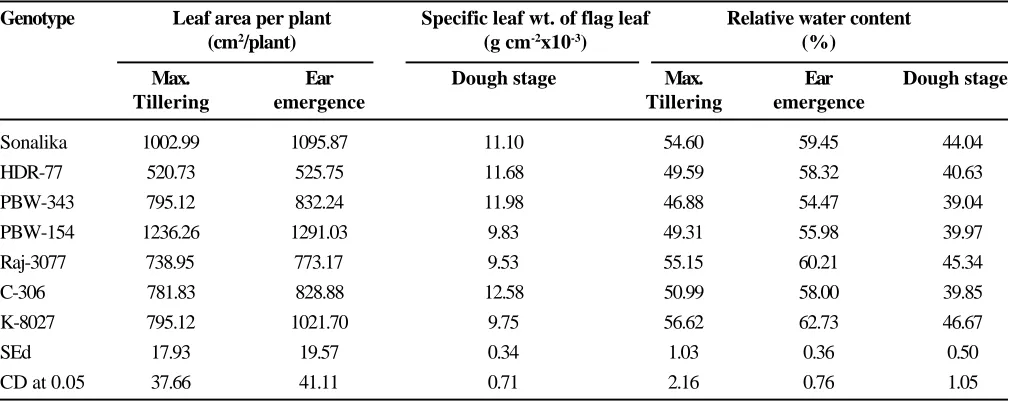
Genotypes showed significant variation in terms of total leaf area per plant (Table 1). At maximum tillering PBW-154 recorded the highest value followed by Sonalika .At ear emergence stage also similar trend was observed, with PBW-154 showing the highest value. A significant variation in terms of leaf area per plant among wheat genotypes was also reported by Reddy et al.
(1995). PBW-154 was followed by Sonalika , PBW-343, and K-8027 at both the stages of observation whereas HDR-77 recorded the lowest leaf area per plant . Aggarwal and Sinha (1987) opined that higher grain yield in a drought environment was related to higher leaf area index during the pre-anthesis stage. In the present study though LAI was not determined but the higher leaf area in PBW-154 was not associated with higher biological and grain yield and PBW-154 was next only to C-306 and PBW-343. It might indicate that some factors other than leaf area are important in determining biological and grain yield in wheat .
Specific leaf weight of flag leaf showed significant genotypic variation. Genotype C-306 recorded the highest value of SLW followed by PBW-343 and HDR-77. Values of all these three genotypes were statistically at par. Specific leaf weight defined as the lamina dry weight per unit area , has been reported to have a strong positive association with lamina photosynthesis ( Bhatia et al. 1993). Higher specific weight of flag leaf may be a major contributing factor for storage and subsequent retranslocation of photosynthates to the developing grains. Guru et al. (1999) working with wheat genotypes suggested that SLW of flag leaf lamina at fully expanded stage can be used as a reliable criterion for photosynthetic rates. In the present study Genotype C-306 recorded the highest value followed by PBW-343, HDR-77 and Sonalika whereas PBW-154 was the
Table 1. Leaf area, specific leaf weight and relative water content in leaves in wheat genotypes.
Genotype Leaf area per plant Specific leaf wt. of flag leaf Relative water content
(cm2/plant) (g cm-2x10⁻³) (%)
Max. Ear Dough stage Max. Ear Dough stage
Tillering emergence Tillering emergence
Sonalika 1002.99 1095.87 11.10 54.60 59.45 44.04 HDR-77 520.73 525.75 11.68 49.59 58.32 40.63 PBW-343 795.12 832.24 11.98 46.88 54.47 39.04 PBW-154 1236.26 1291.03 9.83 49.31 55.98 39.97 Raj-3077 738.95 773.17 9.53 55.15 60.21 45.34 C-306 781.83 828.88 12.58 50.99 58.00 39.85 K-8027 795.12 1021.70 9.75 56.62 62.73 46.67
SEd 17.93 19.57 0.34 1.03 0.36 0.50
lowest. C-306 and PBW-343 were the highest biomass accumulators. Correlation studies revealed positive association between SLW of flag leaf and biological yield (r=0.59)
Significant variation in relative leaf water content (RLWC) among genotypes was observed at different stages (Table 1). Higher values were observed at ear emergence stage compared to maximum tillering and dough stage. Genotype K-8027 recorded the highest value of RLWC at all the stages. Raj-3077 and Sonalika also had shown higher values of RLWC. Genotype PBW-343 all along showed lowest values of RLWC. It may be mentioned that K-8027 possessed higher root dry weight and higher root to shoot dry weight ratio just next to C-306 (Prakash Kalita et al., unpublished ). Genotypes C-306 and PBW-343 though possessed better root system they could not maintain higher RLWC which may indicate the involvement of stomatal mechanisms. However, in C-306 and PBW-343 the RLWC values never fell below 39%. Chandrasekhar et al. (2008) reported lower reduction in RLWC in tetraploid compared with hexaploid genotypes of wheat under conditions of water stress. They opined that water stress tolerance is the result of the cumulative action of various physiological processes and all the parameters may not be positively associated with the drought tolerance of a particular tolerant type.
Genotypes also differed significantly in terms of in-vivo leaf nitrate reductase activity at all the stages of observation (Fig.1). Genotype C -306 recorded the highest values in all the stages, i.e. at maximum tillering , ear emergence and dough stages. Raj-3077 showed the lowest NR activity at all the stages of observation .All genotypes showed higher values of NR activity at maximum tillering compared to other two stages. Goodman et al. (1974) observed close relationship between nitrate reductase activity and dry matter accumulation. Chandrasekhar et al. (2008) reported lower per cent reduction in nitrate reductase activity and chlorophyll content in tolerant variety C-306. Genotype Sonalika, HDR-77 and PBW-343 closely followed C-306 in terms of in-vivo leaf nitrate reductase activity in all the stages. A close relationship between nitrate reductase activity and dry matter accumulation was reported by Goodman et.al. (1974).
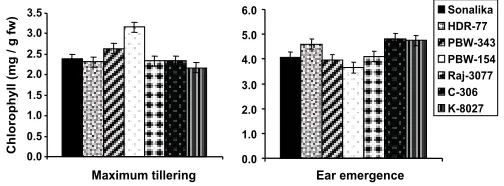
Significant variation in total chlorophyll content in the leaves of wheat genotypes was observed (Fig. 2). At maximum tillering stage PBW-154 registered the highest total chlorophyll content in leaf. At ear emergence stage genotype C-306 recorded the highest value. In the present study highest biomass and grain yield was recorded in C -306. This variety also had highest chlorophyll content at ear emergence stage. Ashraf et al. (1995) however, have reported that in wheat chlorophyll content can not be correlated with higher grain yield.
Fig. 1. Nitrate reductase activity in the leaves of different wheat genotypes
0.0 0.5 1.0 1.5 2.0 2.5 3.0 3.5
Maximum tillering
Chlorophyll
(m
g/gf
w
)
0.0 1.0 2.0 3.0 4.0 5.0 6.0
Ear emergence
Sonalika HDR-77 PBW-343 PBW-154 Raj-3077 C-306 K-8027
Fig. 2. Chlorophyll content in the leaves of different wheat genotypes
Genotype C-306 recorded the highest grain yield per plant at harvest followed by PBW-343 whereas Raj-3077 showed the lowest value (Fig. 3). Significant genotypic variations were observed in terms of harvest index (Fig. 3). C-306 showed the highest value followed by Raj-3077 and HDR-77. Genotype PBW-154 registered the lowest value, which was at par with K-8027. Qingwu et al. (2006) observed that water stress during grain filling induced remobilization of pre-anthesis carbon reserves to grain and it significantly contributed to increased grain yield and harvest index in wheat. Genotypes PBW-343 and C-306 accumulated higher plant dry matter in culm at ear emergence, which might have been retranslocated to grains and there by contributed towards greater harvest index values. On the other hand Sonalika and HDR-77 accumulated least dry matter in plant.
Table 2. Biomass accumulation in different wheat genotypes (g/ plant).
Genotype Ear Emergence Dough Stage
Sonalika 6.11 11.34
HDR-77 4.92 11.74
PBW-343 8.02 15.73 PBW-154 6.47 14.62 Raj-3077 6.64 13.38
C-306 9.00 17.87
K-8027 6.73 13.87
SEd 0.22 0.56
CDat 0.05 0.40 0.90
0 2 4 6 8 10 12
Grain yield
20 22 24 26 28 30 32
Harvest index
Sonalika HDR-77 PBW-343 PBW-154 Raj-3077 C-306 K-8027
Harvest
Index
(%
)
Grai
n
yiel
d
(g
plan
t-1
)
Fig. 3. Grain yield (g/plant) and harvest index (%) of different wheat genotypes
In the present study the genotype C-306 showed the highest biological and grain yield at harvest followed by PBW-343. Genotype C-306 recorded highest specific weight of flag leaf and leaf nitrate reductase activity. Genotype PBW-343 also recorded higher specific leaf weight next to C-306. In case of C-306 higher biomass at all the stages appeared to be the major contributing factor for higher grain yield and harvest index.. This genotype and PBW-343 possessed better root characters during ear emergence stage which corresponded to the period of soil moisture shortage. Possession of higher leaf area did not appear to contribute much towards higher biological and grain yield in wheat under rain fed condition because the genotype PBW-154 though showed higher leaf area its biological and grain yield were lower compared to other varieties , viz. C-306 and PBW-343. It appears that higher root biomass and total plant biomass throughout the crop duration and higher specific leaf weight of flag leaf during grain growth period can be better selection criteria for superior wheat genotypes under rain fed condition of Assam.
REFERENCES
Aggarwal, P.K. and Sinha ,S.K.(1984). Differences in water relations and physiological characteristics in leaves of wheat associated with leaf position on the plant. Plant
Physiol. 74: 1041-1045.
Anonymous (2004). Agricultural Guide Book, Argil. Information Press, Department of Agriculture ,Assam, India.
Ashraf, M.Y., Khan, A.H. and Naqvi, S.S.M. (1995). Relationship of chlorophyll content and leaf area with grain yield in wheat genotypes. Indian J. Plant Physiol. 28: 162-163.
Bhatia, V.S., Tiwari, S.P. and Joshi, O.P. (1996). Interrelationship of lamina photosynthesis, specific lamina weight and lamina anatomical characters in soybean. Indian J. Plant Physiol. 1: 6-9.
Chandrasekhar, V., Sairam, R.K., and Srivastava, G.C. (2008). Physiological and biochemical responses of hexaploid and tetraploid wheat to drought stress. J. Agron. Crop
Goodman, P.J., Fothergill, M. and Haugues, D.M. (1974). Variation in nitrate reductase and nitrite reductase in some grasses and cereals. Ann. Bot. 38: 31-37.
Guru, S.K., Jain, V., Pal, M. and Abrol, Y.P. (1999). Relationship between specific leaf weight and photosynthetic rate in two wheat genotypes. Indian J. Plant Physiol. 4: 117-120.
Hageman, R.H. and Hucklesby, D.P. (1971). Nitrate reductase. In: A. San Pietro (ed.), Methods in Enzymology, 22, pp. 497-503. Academic Press, New York.
Hiscox, J.D. and Israelstam, G.F. (1979). A method for the extraction of chlorophyll from leaf tissue without maceration. Can. J. Bot. 57: 1332-1334.
Murty, K.S., Dey, S.K., Swain, P. and Baig, M.J. (1993). Physiological traits of selected maintainers in hybrid rice breeding. IRRI Notes 18: 12-13.
Nair, T.V.R. and Abrol, Y.P. (1973). Nitrate reductase activity in developing wheat ears. Experientia 29: 1480-1481.
Qingwu, X., Zixi, Z., Musick, J.T., Stewart, B.A. and Dusek, D.A. (2006). Physiological mechanisms contributing to the increased water use efficiency in winter wheat under deficit irrigation. J. Plant Physiol. 163: 154-164.
Reddy, Y.A.N., Prasad, T.G. and Udaykumar, M. (1995). Relationship between lamina area index ,specific leaf weight and assimilation rate in rice genotypes. Madras
Agril. J. 82: 616-617.
Saikia, T.P., Barman, B. and Ortiz Ferrara, G. (2006). Participatory evaluation by farmers of on-farm seed priming in wheat in Assam, India . In: N.C. Turner , T.
Acuna and R.C. Johnson (eds.), Proc. 13th Agronomy
Conference. Perth, Western Australia.