Study Of Fuzzy-Ahp Model To Search The
Criterion In The Evaluation Of The Best
Technical Institutions: A Case Study
Debmallya Chatterjee1*, Dr.Bani Mukherjee2
1
Senior Lecturer, Department of Business Administration, Management Institute of Durgapur, Durgapur-713212, India. *Email: [email protected]
2
Associate Professor, Department of Applied Mathematics, ISM Dhanbad, Dhanbad, Jharkhand, India. ABSTRACT
Technical education contributes a major share to the overall education system and plays a vital role in the social and economic development of the nation. A technical Institution was under government undertaken or funded by government agencies before nineties but since nineties onwards, there was a metamorphic turn around the field of education. Thousands of private institution emerged with a business orientation leading to the degradation of quality education. The stakeholders are in a state of utter confusion in the selection of a technical institution for their growth and prosperity. In this paper by fuzzy analytical hierarchy process (fuzzy-AHP) a model is developed to search the criteria’s for the evaluation of best technical institutions, which can tolerate vagueness and uncertainty of human judgment. At the end, a case study is presented to make this model more understandable.
Key words: AHP, Fuzzy-AHP, Triangular fuzzy numbers, Technical education 1. INTRODUCTION
1.1 Background of the study
Technical education in India contributes a major share to the overall education system and plays a vital role in the social and economic development of our nation. In India, technical education is imparted at various levels such as: craftsmanship, diploma, degree, post-graduate and research in specialized fields, catering to various aspects of technological development and economic progress [22]. Since 1991 there is a metamorphic turn around in the field of Technical Education in India. Three new things had emerged; Privatization, Tailor made courses and introduction of Information Technology in the education system. Thousands of Private self financing Technical Institutions have emerged with a business orientation. Few are truly worthy and offering quality education in India but many of them are compromising with the quality. The stakeholders are in a state of utter confusion in choosing a quality Institution for their career development and prosperity. Hundreds of agencies are publishing materials containing contradictory judgments about the Institutions and thus confusing the stakeholders at the highest level. This paper presents a Fuzzy-AHP model to evaluate technical institutions. In this model Triangular Fuzzy numbers are utilized along with Analytical Hierarchy Process for better result.
1.2 Objective of the Study
The primary objective of the present study is to identify the performance measurement indicators for evaluating the best Technical Institutions in India and secondly to develop an appropriate Fuzzy-AHP model for evaluating the Technical Institutions.
1.3 Introduction to Analytic Hierarchy Process
wise comparisons, which result in the determination of factor weights. Finally the alternative with the highest total weighted score is selected as the best alternative [13].
1.4 Fuzzy set and Triangular Fuzzy Number
To deal with vagueness of human thought, Zadeh first introduced the fuzzy set theory, which was oriented to the rationality of uncertainty. A major contribution of fuzzy set theory is its capability of representing vague data. A fuzzy set is a class of objects with a membership function ranging between zero and one. It was specifically designed to mathematically represent uncertainty and vagueness. Fuzzy set theory implements groupings of data with boundaries that are not sharply defined (i.e. fuzzy). Any methodology or theory implementing “crisp” definitions such as classical set theory, arithmetic, and programming, may be “fuzzified” by generalizing the concept of a crisp set to a fuzzy set with blurred boundaries. The benefit of extending crisp theory and analysis methods to fuzzy techniques is the strength in solving real-world problems, which inevitably entail some degree of imprecision in the variables and parameters measured and processed for the application [3]. A triangular fuzzy number (TFN) is the special class of fuzzy number whose membership is defined by three real numbers, expressed as (l, m, u). The triangular membership function is represented as follows [18]. Figure 1.1 displays the structure of a Triangular Fuzzy Number (TFN).
. . . .
,
, . . . .
.
. . . ( 1 )
0 ,
A
x l
l x m
m l
u x
m x u
u m
o t h e r w i s e
Fig 1.1 Triangular Fuzzy Number
The operational laws between two triangular fuzzy numbers M1 and M2 are as follows
1 2 1 2 1 2 1 2
1 2 1 2 1 2 1 2
( , , ) . . . ( 2 )
( , , ) . . . ( 3 )
M M l l m m u u
M M l l m m u u
1.5 Fuzzy- Analytical Hierarchy Process Method (Fuzzy-AHP)
The conventional AHP method is incapable of handling the uncertainty and vagueness involved in the mapping of one's preference to an exact number or ratio. The major difficulty with classical AHP is its inability in mapping human judgments. In recent years it has been observed that due to confusion in decision makers mind probable deviations should be integrated to the decision making process [1]. In Fuzzy-AHP, pair wise comparisons are done using fuzzy linguistic preference scale ranging from 0 to 10. For simplicity, the reciprocal fuzzy numbers are replaced by individual TFN’s in the pair wise comparison matrix [12].
l
m
u
1.6 Organisation of the Study
In order to develop a Fuzzy-AHP decision making model for the evaluation of private technical institutions, the piece of work is organized as follows. In the next section review of existing work is done. Then the methodology is introduced along with the stages of development of the model. After that an empirical study is conducted along wÅŸh its findings. Finally the paper ends with the conclusion.
1.7 . REVIEW OF EXISTING WORK
Among the different methodologies used, it has been observed that Fuzzy-AHP method was used extensively in decision making. The method was used to select the best bridge construction method among the alternatives avoiding the inconsistency there in [12]. In the literature, fuzzy-AHP has been widely used in solving many complicated decision making problems. Fuzzy-AHP and its extensions were developed in selecting the key capabilities in technology management [20]. The fuzzy AHP approach was used in the evaluation of computer integrated manufacturing alternatives. The same approach was used in the selection of the best location for a facility and in the evaluation of catering firms in Turkey [9]. Fuzzy Integrated Analytic Hierarchy Process Approach is used for Selecting Strategic Big-sized R&D Programs in the Sector of Energy Technology Development [17]. It is further used it in Multi-criteria Supplier Evaluation and vendor selection [3, 8]. Many researchers who have studied Fuzzy AHP provided evidences that it shows more efficiency in handling human judgments than the Classical AHP method [5, 6, 7, 10].
2. METHODOLOGY
2.1 Development of Fuzzy-AHP model in multicriteria decision making
2.1.1 Conceptual Hierarchy of Fuzzy –AHP model
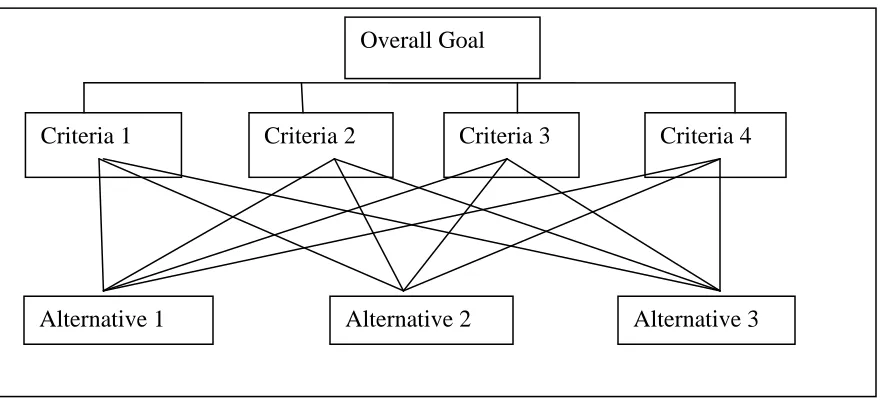
Analytical Hierarchy Process starts by laying out the overall hierarchy of the decision making problem. The hierarchy is structured from the top (the overall goal of the problem) through the intermediate levels (criteria and sub-criteria on which subsequent levels depend) to the bottom level (the list of alternatives). Each criterion in the lower level of hierarchy is compared with respect to the criteria in the upper level of hierarchy. The criteria in the same level are compared using pair wise comparison. Fig 2.1 describes the hierarchy of a decision making problem.
Fig 2.1
Hierarchy of the Decision making problem
2.1.2 Fuzzy pair wise comparison method
Once the hierarchy is established, the pair wise comparison evaluation takes place. All the criteria on the same level of the hierarchy are compared to each of the criterion of the preceding (upper) level. A pair wise comparison is
Overall Goal
Criteria 1
Criteria 2
Criteria 3
Criteria 4
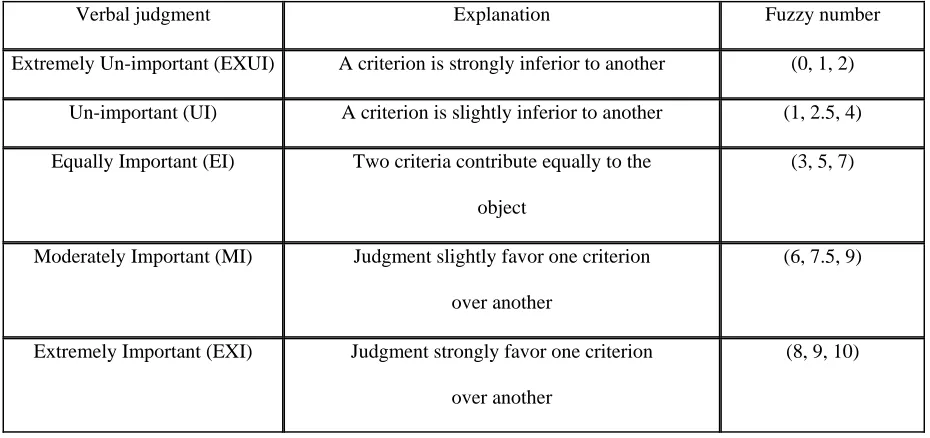
performed by using Fuzzy linguistic terms in the scale of 0 – 10 described by the Triangular Fuzzy Numbers in the Table 2.1.
Table 2.1
Fuzzy Importance scale with TFN
Verbal judgment Explanation Fuzzy number
Extremely Un-important (EXUI) A criterion is strongly inferior to another (0, 1, 2) Un-important (UI) A criterion is slightly inferior to another (1, 2.5, 4) Equally Important (EI) Two criteria contribute equally to the
object
(3, 5, 7)
Moderately Important (MI) Judgment slightly favor one criterion over another
(6, 7.5, 9)
Extremely Important (EXI) Judgment strongly favor one criterion over another
(8, 9, 10)
To reflect pessimistic, most likely and optimistic decision making environment, triangular fuzzy numbers with minimum value, most plausible value & maximum value are considered.
Here the fuzzy comparison matrix is defined as
Where is the relative importance of each criteria in Pair wise comparison and are the minimum value, most plausible value & maximum value of the triangular fuzzy number.
To simplify the calculation of element weight the fuzzy pair wise comparison matrix is broken into crisp matrices formed by taking the minimum values, most plausible values & maximum values from the triangular fuzzy numbers. 2.1.3 Generation of Criteria and Sub-Criteria weight
The Normalization of the Geometric Mean (NGM) method (Buckley et al, 1985) is applied to compute weights from the fuzzy pair wise comparison matrices which is given by
1 i n i i i
a
a
, where1/ 1 n n i ij j
a
a
1 2 1
2 1 2
3 1 3 2 3
1
1
....
1
....
...( 4 )
1 ...
..
..
1
n n n n n
a
a
a
a
A
a
a
a
a
( L , M , U ) ai j a i j a i j a i j
,
,
,
L M U
i j i j i j
In the above equations,
a
i is geometric mean of criterion i.a
i j is the comparison value of criterion i to criterion j.
i is the ith criterion's weight, where
i
0
and1 1 n i i
.For group evaluation, it is required to aggregate evaluator’s opinions into one. Considering the evaluation given by expert
E
i
(
a
L( )i,
a
M( )i,
a
U( )i)
the aggregate of all experts’ judgments can be calculated using average means( ) ( ) ( )
1 1 1
1
1
1
,
,
. . . ( 5 )
n n n
i i i
L M U
i i i
A
a
a
a
n
n
n
The final weight vector is generated by defuzzyfying the average [11]
( ) ( ) ( )
1 1 1
( )
1
1
1
2
. . . ( 6 )
4
n n n
i i i
L M U
i i i
i
a
a
a
n
n
n
w
The weight of ith sub criteria under kth main criteria is obtained
by( w k s k i ) . . . ( 7 )
where
w
k is the kth main criteria weight ands
ki is the weight of ith sub criteria with respect to kth main criteria. 2.1.4 Calculation of overall score for alternativesOnce the weight of criteria, sub criteria are evaluated and are multiplied using equation (3) to obtain global weight of sub criteria, it is required to calculate the overall score of alternatives for their evaluation.
The overall score of mth alternative is obtained by
1
. . . ( 8 )
Nm l m l
l
A
s
a
where
s
l is the weight of lth sub criteria anda
m l is the weight ofm
t h alternative with respect to lth sub criteria.2.2 Identification of Criteria and Sub Criteria for evaluating alternatives
One of the important steps of the proposed model is to determine all the important criteria and their relationship with the decision variables. This step is crucial because the selected criteria and sub criteria can influence the final choice. Here in this project the criteria and sub-criteria are selected based on the format mentioned by National Board of accreditation & through expert’s opinion. The alternatives taken are the private self financing technical institutions of Durgapur, West Bengal, India. The criteria and sub-criteria selected are described in Table 2.2
Criteria Sub Criteria
Campus Infrastructure Hostel, Transport/ canteen/ Internet, Power backup, Security
Faculty Teacher/ Student ratio, Qualification/ Experience of
Faculty, Faculty retention
Student Admission, Academic Result, Placement
Academic Ambience Classroom, Laboratory, Library
Teaching Learning Process Syllabus coverage, Tutorial/ remedial class, Use of Advance Teaching Aid
2.3 Construction of the detailed hierarchy of the problem
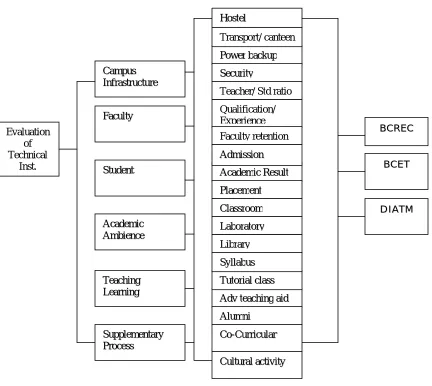
The hierarchy is constructed taking all the criteria, sub-criteria and alternatives specific to the research problem. The hierarchy is structured from the top (performance evaluation of technical institutions) through the intermediate levels (main and sub-criteria on which subsequent levels depend) to the bottom level (the list of technical institutions).Figure 2.2 describes the hierarchy in detail.
Figure 2.2
Detailed hierarchy of the problem
3. RESULTS AND DISCUSSIONS
The detail of the steps of Fuzzy-AHP model described in section 2.1.2 to 2.1.4 are explained elaborately using the data collected from experts and the engineering students of Durgapur.
3.1 Illustration of the Fuzzy-AHP model
Once the hierarchy was established and a series of questions were asked to direct pair wise comparisons, each expert performed a pair wise comparison. Hence the main criteria weights from the first e éert’s judgment can be expressed in Table 3.1.
Evaluation of Technical
Inst.
F
Faaccuullttyy C
Caammppuuss
I
Innffrraassttrruuccttuurree
S
Sttuuddeenntt
A
Accaaddeemmiicc A
Ammbbiieennccee
P
Poowweerrbbaacckkuupp S
Seeccuurriittyy H
Hoosstteell
Transport/ canteen
Qualification/ Experience Faculty retention
A
AccaaddeemmiiccRReessuulltt
P
Pllaacceemmeenntt
L
Liibbrraarryy
A
Addvvtteeaacchhiinnggaaiidd
D DIIAATTMM B BCCRREECC
B BCCEETT
T
Teeaacchhiinngg
L
Leeaarrnniinngg
L
Laabboorraattoorryy
S
Suupppplleemmeennttaarryy
P
Prroocceessss
Teacher/ Std ratio
C
Cllaassssrroooomm A
Addmmiissssiioonn
A
Alluummnnii
C
Coo--CCuurrrriiccuullaarr
C
Cuullttuurraallaaccttiivviittyy T
Tuuttoorriiaallccllaassss S
Table 3.1
First Expert’s judgment
Fuzzy weight of Main Criteria
( l m u )
Campus Infrastructure 0.4473 0.2470 0.2291
Faculty 0.5527 0.2808 0.2474
Student 0.0000 0.1777 0.1795
Academic Ambience 0.0000 0.1058 0.1220
Teaching Learning Process 0.0000 0.1132 0.1270 Supplementary Process 0.0000 0.0756 0.0950
Repeating the same procedure for all experts’ judgments following equation (5) in section 2.1.3 the global weights of the main criteria was obtained in Table 3.2
Table 3.2
Global weight of main criteria
Name of the Main Criteria Global weight of main criteria
( l m u )
Campus Infrastructure 0.3620 0.2433 0.2261
Faculty 0.3379 0.2075 0.1935
Student 0.0831 0.1766 0.1800
Academic Ambience 0.1098 0.1565 0.1609
Teaching Learning Process 0.0381 0.1064 0.1191
Supplementary Process 0.0692 0.1096 0.1203
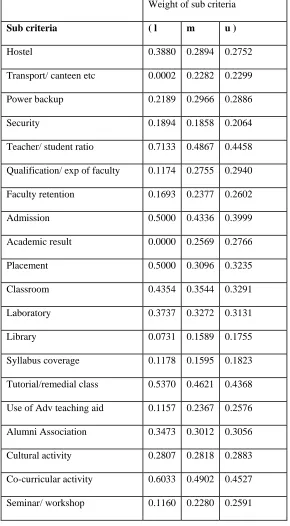
Table 3.3
Sub criteria weights
Weight of sub criteria
Sub criteria ( l m u )
Hostel 0.3880 0.2894 0.2752
Transport/ canteen etc 0.0002 0.2282 0.2299 Power backup 0.2189 0.2966 0.2886
Security 0.1894 0.1858 0.2064
Teacher/ student ratio 0.7133 0.4867 0.4458 Qualification/ exp of faculty 0.1174 0.2755 0.2940 Faculty retention 0.1693 0.2377 0.2602
Admission 0.5000 0.4336 0.3999
Academic result 0.0000 0.2569 0.2766
Placement 0.5000 0.3096 0.3235
Classroom 0.4354 0.3544 0.3291
Laboratory 0.3737 0.3272 0.3131
Library 0.0731 0.1589 0.1755
Syllabus coverage 0.1178 0.1595 0.1823 Tutorial/remedial class 0.5370 0.4621 0.4368 Use of Adv teaching aid 0.1157 0.2367 0.2576 Alumni Association 0.3473 0.3012 0.3056 Cultural activity 0.2807 0.2818 0.2883 Co-curricular activity 0.6033 0.4902 0.4527 Seminar/ workshop 0.1160 0.2280 0.2591
Table 3.4
Global weight of sub-criteria
Global weight of sub criteria
( l m u )
Hostel 0.1405 0.0704 0.0622
Transport/ canteen etc 0.0002 0.0555 0.0520
Power backup 0.0792 0.0722 0.0653
Security 0.0686 0.0452 0.0467
Teacher/ student ratio 0.2410 0.1010 0.0863
Qualification/ exp of faculty 0.0397 0.0572 0.0569
Faculty retention 0.0572 0.0493 0.0504
Admission 0.0415 0.0766 0.0720
Academic result 0.0000 0.0454 0.0498
Placement 0.0415 0.0547 0.0582
Classroom 0.0478 0.0555 0.0530
Laboratory 0.0410 0.0512 0.0504
Library 0.0080 0.0249 0.0282
Syllabus coverage 0.0129 0.0250 0.0293
Tutorial/remedial class 0.0204 0.0492 0.0520
Use of Adv teaching aid 0.0044 0.0252 0.0307
Alumni Association 0.0132 0.0320 0.0364
Cultural activity 0.0194 0.0309 0.0347
Co-curricular activity 0.0417 0.0537 0.0545
Seminar/ workshop 0.0080 0.0250 0.0312
Table 3.5
Weights of alternatives
Weights of the Alternatives
BCREC DIATM BCET
( l m u ) ( l m u ) ( l m u )
Hostel 0.362 0.354 0.349 0.199 0.246 0.266 0.439 0.400 0.385
Transport/ canteen etc 0.271 0.297 0.306 0.490 0.427 0.401 0.239 0.276 0.293
Power backup 0.403 0.380 0.370 0.242 0.272 0.288 0.356 0.347 0.342
Security 0.713 0.474 0.444 0.117 0.246 0.264 0.169 0.281 0.293
Teacher/ student ratio 0.355 0.340 0.343 0.529 0.441 0.412 0.117 0.219 0.245
Qualification/ exp of faculty 0.339 0.340 0.343 0.331 0.330 0.329 0.331 0.330 0.329
Faculty retention 0.426 0.356 0.356 0.574 0.430 0.400 0.000 0.214 0.244
Admission 0.580 0.387 0.365 0.210 0.306 0.317 0.210 0.306 0.317
Academic result 0. 713 0.496 0.447 0.000 0.215 0.246 0.210 0.289 0.307
Placement 0.415 0.386 0.371 0.386 0.367 0.359 0.198 0.248 0.270
Classroom 0.625 0.477 0.434 0.117 0.243 0.267 0.259 0.280 0.299
Laboratory 0.655 0.439 0.405 0.123 0.250 0.275 0.223 0.311 0.320
Library 0.423 0.391 0.376 0.198 0.243 0.263 0.379 0.366 0.361
Syllabus coverage 0.309 0.289 0.278 0.280 0.274 0.269 0.256 0.259 0.258
Tutorial/remedial class 0.556 0.453 0.422 0.155 0.244 0.262 0.289 0.304 0.316
Use of Adv teaching aid 0. 790 0.474 0.432 0.117 0.246 0.270 0.169 0.281 0.299
Alumni Association 0.534 0.452 0.416 0.233 0.274 0.292 0.233 0.274 0.292
Cultural activity 0.167 0.289 0.303 0.667 0.479 0.440 0.167 0.232 0.258
Co-curricular activity 0.333 0.333 0.333 0.333 0.333 0.333 0.333 0.333 0.333
Seminar/ workshop 0.380 0.361 0.353 0.284 0.302 0.309 0.336 0.337 0.338
Table 3.6
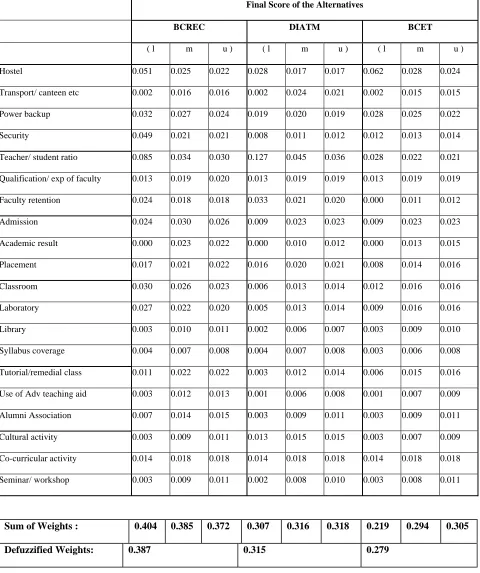
Global weights of alternatives
Final Score of the Alternatives
BCREC DIATM BCET
( l m u ) ( l m u ) ( l m u )
Hostel 0.051 0.025 0.022 0.028 0.017 0.017 0.062 0.028 0.024
Transport/ canteen etc 0.002 0.016 0.016 0.002 0.024 0.021 0.002 0.015 0.015
Power backup 0.032 0.027 0.024 0.019 0.020 0.019 0.028 0.025 0.022
Security 0.049 0.021 0.021 0.008 0.011 0.012 0.012 0.013 0.014
Teacher/ student ratio 0.085 0.034 0.030 0.127 0.045 0.036 0.028 0.022 0.021
Qualification/ exp of faculty 0.013 0.019 0.020 0.013 0.019 0.019 0.013 0.019 0.019
Faculty retention 0.024 0.018 0.018 0.033 0.021 0.020 0.000 0.011 0.012
Admission 0.024 0.030 0.026 0.009 0.023 0.023 0.009 0.023 0.023
Academic result 0.000 0.023 0.022 0.000 0.010 0.012 0.000 0.013 0.015
Placement 0.017 0.021 0.022 0.016 0.020 0.021 0.008 0.014 0.016
Classroom 0.030 0.026 0.023 0.006 0.013 0.014 0.012 0.016 0.016
Laboratory 0.027 0.022 0.020 0.005 0.013 0.014 0.009 0.016 0.016
Library 0.003 0.010 0.011 0.002 0.006 0.007 0.003 0.009 0.010
Syllabus coverage 0.004 0.007 0.008 0.004 0.007 0.008 0.003 0.006 0.008
Tutorial/remedial class 0.011 0.022 0.022 0.003 0.012 0.014 0.006 0.015 0.016
Use of Adv teaching aid 0.003 0.012 0.013 0.001 0.006 0.008 0.001 0.007 0.009
Alumni Association 0.007 0.014 0.015 0.003 0.009 0.011 0.003 0.009 0.011
Cultural activity 0.003 0.009 0.011 0.013 0.015 0.015 0.003 0.007 0.009
Co-curricular activity 0.014 0.018 0.018 0.014 0.018 0.018 0.014 0.018 0.018
Seminar/ workshop 0.003 0.009 0.011 0.002 0.008 0.010 0.003 0.008 0.011
Sum of Weights : 0.404 0.385 0.372 0.307 0.316 0.318 0.219 0.294 0.305
3.2 Findings and discussions
From the main and sub-criteria weights in the tables is can be inferred that there exists variation between the priorities of the main and sub criteria mentioned in the model. It is further observed that the priority of the main criteria “Campus Infrastructure” is highest followed by “Faculty”. In case of sub criteria the priority is highest for ”Hostel” under “Campus Infrastructure” , “Teacher student ratio” among “Faculty”, “Admission” and “placement” among “Student”, “Classroom” among “Academic ambience” and “Co-curricular activity” among “Supplementary process”. When it comes to the alternative technical institutions it is found that the Hostel of BCET, Teacher student ratio, Placement of BCREC and Cultural activity of DIATM are the best. Finally from the defuzzified final score of the alternative technical institutions it has been observed that the overall score ofDr. B. C. Roy engineering college is the highest followed by Durgapur Institute of Advanced Technology and Management and Bengal college of engineering and Technology.
4. CONCLUSIONS
Since nineties there is a sea change in the field of Technical Education in India. Lots of Private self financing Technical Institutions have emerged with a business orientation offering readymade courses. Few of them are truly worthy and offering quality education in India but many of them are managing with the quality. The stakeholders are in a state of utter confusion in choosing a quality Institution for their career development and prosperity. Agencies are giving contradictory judgments about the Institutions and thus confusing the stakeholders at the highest level. Previously no attempt was made to generate a model which would help the stakeholders in decision making. This paper presents a Fuzzy-AHP model to overcome stakeholders problem in evaluating Technical Institutions. In this model Triangular Fuzzy numbers are utilized in collecting human judgments through linguistic variables. Further Analytical Hierarchy Process was used in generating criteria weights and sub criteria weights for the evaluation of alternatives. Although for simplicity less number of alternatives are taken but this model can be used in evaluating a number of alternatives. Further this study is not limited to the evaluation of Technical Institutions; rather it can be used in multi-criteria decision making in any field of study.
REFERENCES
[1] Askin, Ozdagoglu, Guzin, Ozdagoglu, comparison of AHP and Fuzzy AHP for the multicriteria decision making processes with linguistic evaluations, Ýstanbul Ticaret Üniversitesi Fen Bilimleri Dergisi, 6, 65-85, 2007
[2] Boender, C. G. E., De Graan, J. G., and Lootsma, F. A., Multicriteria Decision Analysis with Fuzzy Pairwise Comparisons, Fuzzy Sets and Systems, 29,133-143, 1989
[3] Bohui Pang, Multi-criteria Supplier Evaluation Using Fuzzy AHP, Proceedings of the IEEE International Conference on Mechatronics and Automation,August 5 - 8, 2007, Harbin, China
[4] Bojadziev, G., Bojadziev, M., Fuzzy sets, fuzzy logic, applications, World Scientific, 2000
[5] Buckley, J. J., Ranking Alternatives Using Fuzzy Members, Fuzzy Sets and Systems, 15, 21-31, 1985. [6] Buckley, J. J., Fuzzy Hierarchical Analysis, Fuzzy Sets and Systems, 17, 233-247, 1985.
[7] Chang, D. Y., Applications of The Extent Analysis Method on Fuzzy-AHP, European Journal of Operational Research, 95, 649-655, 1996.
[8] Hua Bai, A Fuzzy AHP based evaluation method for vendor selection, Proceedings of IEEE ICMIT ,2008.
[9] Kahraman, C., Cebeci, U., and Da, R., Multi-Criterion Comparison of Catering Service Companies Using Fuzzy AHP: The Case of Turkey, International Journal of Production Economics, 87, 171-184, 2004.
[10] Lootsma, F., Fuzzy Logic for Planning and Decision-Making, Kluwer, Dordrecht, 1997.
[11] Mehdi, Farzad, The fuzzy evaluation of E-Commerce customer satisfaction-, world appl sc journal 4(2), 164-168, 2008.
[12] Pan, N.F, Fuzzy AHP approach for selecting the suitable bridge construction method”, Automata in construction, 17, 958-965, 2008. [13] Saaty, T. L., The Analytical Hierarchy Process, Mc Graw Hill, New York, 1980.
[14] Saaty, T. L., Fundamentals of Decision Making and Priority Theory with The Analytical Hierarchy Process, RWS Publications, Pittsburgh, 1994.
[15] Saaty, T. L., Decision Making with Dependence and Feedback: Analytic Network Process, RWS Publications, Pittsburgh, 2001.
[16] Shouming Chen, A Research of Fuzzy AHP Approach in Evaluating Distance Education System Alternatives, IEEE First International Workshop on Education Technology and Computer Science, 2009
[17] S. K. Lee, G. Mogi, M. Koike, K.S. Hui, J.W. Kim, Fuzzy Integrated Analytic Hierarchy Process Approach for Selecting Strategic Big-sized R&D Programs in the Sector of Energy Technology Development, FUZZ-IEEE 2009, Korea, August 20-24, 2009. [18] Tae-heon Moon, Woo-bae Lee, Construction Of Supporting System For Decision Making Process Of Zoning Designation and Change
That has Fuzziness, The 6th International Conference Computers in Urban Planning and Urban Managemen, 1999
[19] Tien-Chin wang, Yueh-Hsiang Chen, Applying fuzzy linguistic preference relations to the improvement of consistency of fuzzy AHP, Information Science178 , 3755-3765, 2008
[20] Yasemin Claire Erensal, Determining key capabilities in technology management using fuzzy analytic hierarchy process- A case study of Turkey, Information Sciences, 176, 2755–2770, 2006
[21] Zadeh, L.A, Fuzzy sets, Information and control, 8, 338-353, 1965