Grid-Connected PV plants using Fuzzy Logic
Controller for mitigation of Fault Current
under Grid Faults
T.S.Immanullah1, P.Kiran Kumar 2P.G. Student, Dept of EEE, Kuppam Engineering College, Kuppam , A.P, India 1 Assistant Professor, Dept of EEE, Kuppam Engineering College, Kuppam , A.P, India2
ABSTRACT: In this paper, Grid connected distributed generation sources interfaced with Fuzzy Logic Control (FLC) based voltage source inverters (VSIs) are discussed under grid fault conditions (like voltage sag ,swells).The DG can be disconnected from the grid under: 1) excessive dc-link voltage; 2) excessive ac currents; and 3) loss of grid-voltage synchronization. In this project, the proposed FLC control of single and two stage grid connected VSIs in photovoltaic (PV) power plants is developed to address the issue of inverter disconnecting under various grid faults. Proposed FLC based inverter control incorporates reactive power support in the case of voltage sags based on the grid codes (GCs) requirements to ride through the faults and support the grid voltages and this leads to reduction in fault current.
A case study of a 1-MW system simulated in MATLAB/ Simulink software is used to illustrate the proposed FLC control. Problems that may occur during grid faults along with associated remedies are discussed. The results presented illustrate the capability of the system to ride through different types of grid faults.
.
KEYWORDS: DC–DC converter, fault-ride-through, photovoltaic (PV) systems, Fuzzy Logic Controller (FLC) power system faults, reactive power support.
I.INTRODUCTION
FAULT STUDIES are imperative in extensive scale grid connected renewable energy systems and have been reported in the specialized writing. In any case, the majority of these thinks about concentrated on grid connected wind power plants. On account of grid connected photovoltaic (PV) power plants (GCPPPs), Specifically, a three-phase current-source inverter (CSI) setup was explored under different shortcoming conditions, in which the output currents stay constrained under a wide range of flaws because of the usage of a present source model for the inverter. In any case, this configuration leads to may prompt instability under dynamic conditions. Three-phase voltage source inverters (VSIs) are utilized as a grid-connected power transformation systems. Because of the expanding number of these systems, the control of the VSIs is required to work and backing the grid in light of the grid codes (GCs) during voltage disturbances and unbalanced conditions.
Considering FRT procedures for grid-connected VSIs, a few researches have been done on wind turbine applications furthermore on VSI-based high-voltage direct current (HVDC) systems. Some of these studies depend on passive control, e.g., crowbar and chopper resistors though others depend on active control plans. Although both classes can give FRT ability, the detached strategies have the disadvantages of requiring extra parts and scattering huge force during the voltage list forms. In the use of GCPPPs with the setups of single-stage change (single-stage transformation implies direct association of the PV source to the dc side of the VSI), some examination were done assessing the FRT issues of both air conditioning and dc sides of the inverter under lopsided voltage conditions. In any case, in the application of a two-phase transformation (which means a dc–dc change or pre regulator unit exists between the PV source and VSI), no paper so far has proposed a far reaching system to secure the inverter during voltage sags while giving reactive power backing to the lattice. All the plans and changes for the inverter in both the single-and two-phase transformations need to suit different sorts of flaws and address FRT ability taking into account the GCs. PV inverter detachment under grid issues happens because of essentially three components: 1) excessive dc-link voltage; 2) excessive ac currents; and 3) loss of grid voltage synchronization.
The control system presented for a single-stage transformation is utilized, despite the fact that the voltage sag location and reactive power control is adjusted in view of person estimations of the grid voltages. The primary target of this paper is to present new control methodologies for the two stage change in GCPPPs that permit the inverter to remain associated with the grid under different sorts of flaws while infusing reactive power to meet the required GCs.
II. GRID CODES
As the German GCs are the most comprehensive codes for the different power levels of PV installations and coordination advancements, this paper takes after these codes as a basis for the exchanges. During voltage sags, the GCPPP should support the grid voltage by injecting reactive current. The amount of reactive current is determined based on the droop control defined as follows:
(1)
Where droop is a steady value, deL is the measure of voltage drop, and In is the rated current of the PV inverter in dq
organizes, i.e., I1n = √ 3In, where In is the appraised rms line current of the inverter. The measure of voltage drop deL is
acquired based on the most reduced rms estimation of the line-to-line voltages of the three phases at the terminal of the GCPPP, i.e., eL min appeared in Fig. 1.The rms voltage is acquired utilizing the following expression:
(2)
Where eL is the instantaneous line-to-line voltage, TW is the window width for the rms value estimation, and T is
the grid voltage period, which is equivalent to 20 ms for a grid frequency of 50 Hz. The subsequent control graph for the reactive current generation is depicted in Fig. 1.
'
n L
qref
droop
de
I
i
2 % 10 anddroop E de for n L 2 ,1 2 T
III. CASE STUDY FOR A SINGLE AND TWO -STAGE CONVERSION
Fig. 1. Droop control diagram for the reactive current reference provision.
A. Grid Voltage Synchronization
In grid-connected inverters, one important issue is the voltage phase angle detection. This is normally performed by phase locked- loop (PLL) system in view of a synchronous reference outline PLL (SRF-PLL), known as ordinary PLL. The traditional PLL arrangement does not perform well under unbalanced voltage sags and thus may prompt the inverter being separated from the grid. A few strategies were proposed to extricate the voltage phases precisely under lopsided voltage conditions. The strategy in light of moving normal channels (MAFs) presented is connected, which was additionally utilized as a part of appearing exceptionally attractive execution. In this strategy, the positive sequence of the voltage is extricated from the grid by method for a perfect low-pass channel. At that point, the angle of the positive grouping is recognized.
B. Excessive AC Current
Commercial grid-connected inverters have a maximum ac current quality indicated. In the event that any of the streams surpass such esteem, the inverter is disconnected from the grid. Under grid voltage sag, the d-segment of the current (in the SRF) increments in light of the fact that the controller needs to keep up the dynamic power infused into the grid and grid voltages are briefly diminished. Notwithstanding the expansion of the d current segment, the inverter needs to infuse reactive current during the shortcoming to meet the FRT requirements. The measure of reactive current is according by load control given in (1). Since the d and q current segments expand, this may lead the over-current protection to separate the inverter from the grid.
C. Excessive DC-Link Voltage
If the active current reference is restricted, i.e., idref < i1dref , the produced power from the PVs is more than the infused
power into the electrical grid. As an outcome, some energy is at first accumulated into the dc-link capacitor, expanding the dc bus voltage as appeared in Fig. 5(c). In a solitary stage GCPPP, as the dc-link voltage increases, the working point on the I−V curve of PV array moves toward the open-circuit voltage point (Voc), which drives the PV current to diminish, as
appeared in Fig. 6. The power generated by the PV panels is reduced because the operating point is taken away from the maximum power point (MPP) and in this manner; less active current is injected into the ac side. This happens until the GCPPP achieves a new steady state where the dc-link voltage quits expanding. In this manner, single-stage GCPPPs are self-protected since the produced power is decreased when the dc-link voltage increases under ac shortcomings. It should to be said that the inverter needs to withstand the most pessimistic scenario of the dc-link voltage,
Which is produced when the voltage gave by the PV modules achieves the open-circuit value (Voc) under the maximum
solar radiation expected on the generation site. Henceforth, the number of PV modules connected in series (ns) must be
restricted in the outline of the GCPPPs so that the dc-link voltage is never higher than the maximum acceptable estimation of the inverter (Vdc-max).
This concept in the case of a single-stage GCPPP. An issue that may show up in view of the deviation of the MPP during the voltage list is that, after the flaw being cleared, the dc-join voltage and ac currents may take a long time to come to the pre fault values, as appeared in Fig. 5(b) furthermore, (c). The reason is that the error in the dc-link voltage produces accumulation of control activity to the essential part of the proportional-integral (PI) controller. This control activity is constrained by the present limiter and in this way it has no impact on the lattice streams. Be that as it may, when the voltage list closes, the exorbitant control activity gathered in the necessary part of the controller must be remunerated by an input mistake the other way. As an outcome, the dc-link voltage is lessened beneath the reference value. For this situation, a critical diminishing of the dc-link voltage may lead inverter losing control and be disconnected. To conquer this issue, an anti-wind-up system is connected to stop the PI controller accumulating excessive control action when it exceeds a specified value. The schematic of the anti-wind-up method Is appeared in Fig.4. which V*dc and Vdc are the reference also,
real dc-link voltages, individually.
The enhanced results while applying the counter twist up system are portrayed in Fig. 8. For this situation, once the grid fault is cleared, the dc link voltage recovers to the pre fault value with no perceptible overcompensation.
Low-voltage ride through (LVRT)
In electric power system, low-voltage ride through (LVRT), or flaw ride through (FRT), at times under-voltage ride through (UVRT), is the capacity of electric generators to stay associated in brief times of lower electric system voltage. It is required at circulation level (wind parks, PV systems, conveyed cogeneration, and so forth.) to keep away from that a short out on HV or EHV level will prompt a far reaching loss of era. Comparable necessities for basic loads, for example, PC systems and modern procedures are frequently taken care of using a uninterruptible power supply (UPS) or capacitor bank to supply make-up power during these occasions.
Numerous generator plans use electric current coursing through windings to create the attractive field on which the engine or generator works. This is rather than outlines those utilization changeless magnets to produce this field. Such devices may have a base working voltage, beneath which the device does not work effectively, or does as such at extraordinarily lessened proficiency. Some will remove themselves of the circuit when these conditions apply. This impact is more extreme in doubly-bolstered instigation generators (DFIG), which have two sequences of controlled attractive windings, than in squirrel-confine prompting generators which have one and only. Synchronous generators may slip and get to be shaky, if the voltage of the stator twisting goes down beneath a specific edge.
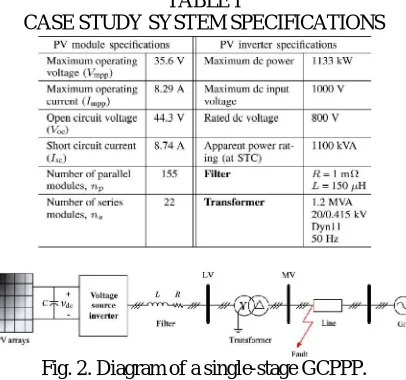
TABLE I
CASE STUDY SYSTEM SPECIFICATIONS
Fig. 2. Diagram of a single-stage GCPPP.
illustrated according to the GCs. A two-stage GCPPP includes a dc–dc converter between the PV arrays and the inverter. In high-power GCPPPs, more than one dc–dc converter can be included, one per each PV array. Despite having several dc–dc converters, these systems will be referred anyway as two-stage GCPPPs. In two-stage GCPPPs, the MPP tracking (MPPT) is performed by the dc–dc converter and the dc-link voltage is regulated by the inverter.
During voltage sag, if no action is taken in the control of the dc–dc converter, the power from the PV modules is not reduced and therefore, the dc-link voltage keeps rising and may exceed the maximum limit. Hence, the system is not self-protected during grid fault conditions. A specific control action has to be taken to reduce the power generated by the PV modules and provide the two-stage GCPPP with FRT capability.
A simple method to provide dc-link overvoltage protection consists on shutting down the dc–dc converter when the dc voltage rises above a certain limit. The dc–dc converter can be reactivated when the dc-link voltage is below a certain value using a hysteresis controller. In the solutions proposed in this paper, the dc-link voltage is controlled during the voltage sag process and there is no significant increase in the dc-link voltage during this transient.
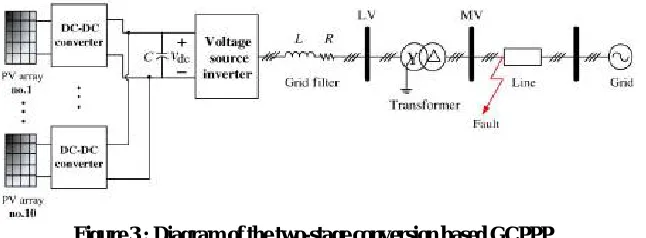
The diagram of the case study for a two-stage GCPPP is shown in Fig.3. It consists of a 1-MVA inverter and 10 parallel 100-kW dc–dc boost converters. Details of the individual dc–dc converter as well as the PV array characteristics connected to each dc–dc converter.
Figure 3 : Diagram of the two-stage conversion based GCPPP
In two-stage GCPPPs, the PV voltage (vpv) is controlled by the duty cycle (d) of the dc–dc converter. The reference for the PV voltage is given by the MPPT.
A feed-forward strategy is applied to improve the dynamics of the dc-link voltage. The strategy is based on the assumption that the PV generated power is equal to the injected power into the grid, i.e.,
4
Where ipv and vpv are the PV current and voltage, respectively, and edand eqare the d and q grid voltage components extracted by the PLL. Since the PLL forces the eqcomponent to be zero, the estimated d current component is obtained as
5
In two-stage GCPPPs, three different ways to limit thedc-link voltage under fault conditions are proposed: 1) short circuitingthe PV array by turning ON the switch of the dc–dc converter throughout the voltage sag duration; 2) leaving the PV array open by turning OFF the switch of the dc–dc converter; and 3) changing the control of the dc–dc converter to inject less power from the PV arrays when compared with the prefault operating conditions.
pv pv d d q q
i u
e i
e i
pv pv d est
d
i v
i
e
Fig. 4. FLC controller with an anti-wind-up technique.
Fuzzy logic is a form of many-valued logic in which the truth values of variables may be any real number between 0 and 1. By contrast, in Boolean logic, the truth values of variables may only be 0 or 1. Fuzzy logic has been extended to handle the concept of partial truth, where the truth value may range between completely true and completely false. Furthermore, when linguistic variables are used, these degrees may be managed by specific functions.
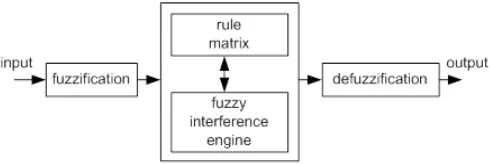
Usually fuzzy logic control system is created from four major elements presented on Figure fuzzification interface, fuzzy inference engine, fuzzy rule matrix and defuzzification interface. Each part along with basic fuzzy logic operations will be described in more detail below.
Fig 5.Fuzzy Interface system structure
The fuzzy logic analysis and control methods shown in Figure 1 can be described as:
1. Receiving one or large number of measurements or other assessment of conditions existing in some system that will be analyzed or controlled.
2. Processing all received inputs according to human based, fuzzy ”if-then” rules, which can be expressed in simple language words, and combined with traditional non-fuzzy processing.
3. Averaging and weighting the results from all the individual rules into one
single output decision or signal which decides what to do or tells a controlled system what to do. The result output signal is a precise defuzzified value. First of all, the different level of output (high speed, low speed etc.) of the platform is defined
similarly, the different angles between the platform and the pendulum and...
the angular velocities of specific angles are also defined
Fig 6:Fuzzy inputs and Output
V. SIMULATION RESULTS
(a)
(b)
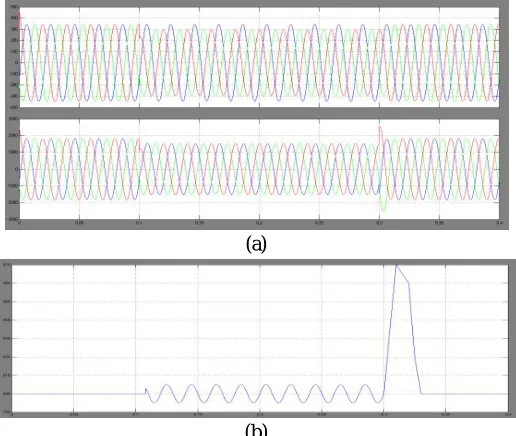
Fig. 7. (a) Grid voltages and grid currents at the LV side (b) Dc link Voltage fewer than 60% SLG voltage sag produced at MV side of the transformer.
(a)
Fig. 8. Adding the current limiter to the VSI control: (a) grid voltages, grid currents; and (b) dc-link voltage under an SLG-voltage sag at MV side of the transformer.
It should be mentioned that when operating with high solar radiation and/or small voltage sags. The output currents would contain some high-frequency harmonics.
(a)
(b)
Fig. 9. Application of an anti-wind-up technique to the PI controller: (a) grid voltages and grid currents; and (b) dc-link voltage under 60% SLG voltage sag at MV side of the transformer.
(b)
Fig. 10. Short-circuiting the PV panels: (a) grid voltages & grid currents; and (b) dc-link voltage when applying a 60% SLG voltage sag at MV side of the transformer.
(a)
(b)
Fig. 11. Turning the dc–dc converter switch ON: (a) grid voltages & grid currents; and (b) dc-link voltage when applying a 60% SLG voltage sag at the MV side.
The diode was continuously ON and no current from the PV was provided to the dc-link. The main difference with the previous case is the transition process, as depicted in Fig. 6.
(b)
Fig. 12. Control of the dc–dc converter to produce less power under voltage sag: (a) grid voltages, grid currents, actual duty cycle, input voltage of the dc–dc converter, estimated duty cycle; and (b) dc-link voltage.
The parameters of this controller (PI- 1) can be decreased during the voltage sag in order to improve the performance of the proposed method.
Fig. 13. Control of the dc–dc converter with existing PI produce less power under voltage sag: grid voltages, related grid currents, related dc-link voltage
Above figures show that, the comparison of the line current fewer than 60% SLG grid fault using PI and Fuzzy Logic Controllers. The fault current of the proposed Fuzzy control can be limited much more than existing PI controller of the grid connected PV Inverter.
VI. CONCLUSION
In this paper Performance requirements of GCPPPs interfaced with Fuzzy Logic Control (FLC) based voltage source inverters (VSIs) under fault conditions for single and two stage grid connected inverters have been addressed in this paper. Some modifications have been proposed for Conventional controllers to make the GCPPP ride through compatible to any type of faults according to the GCs. These modifications include applying current limiters and controlling the dc-link voltage by Fuzzy Logic Control (FLC) methods. It is concluded that for the single-stage configuration, the dc-link voltage is naturally limited and therefore, the GCPPP is self-protected, whereas in the two-stage configuration it is not. Three methods have been proposed for the two-stage configuration to make the GCPPP able to withstand any type of faults according to the GCs without being disconnected. The first two methods are based on not generating any power from the PV arrays during the voltage sags, whereas the third method changes the power point of the PV arrays to inject less power into the grid compared with the prefault condition. The validity of all the proposed methods to ride-through voltage sags has been demonstrated by multiple case studies performed by MATLAB simulations.
REFERENCES
[1] L. Trilla et al., “Modeling and validation of DFIG 3-MW wind turbine using field test data of balanced and unbalanced voltage sags,” IEEE Trans. Sustain. Energy, vol. 2, no. 4, pp. 509–519, Oct. 2011.
[2] M. Popat, B. Wu, and N. Zargari, “Fault ride-through capability of cascaded current-source converter-based offshore wind farm,” IEEE Trans. Sustain. Energy, vol. 4, no. 2, pp. 314–323, Apr. 2013.
[3] A. Marinopoulos et al., “Grid integration aspects of large solar PV installations: LVRT capability and reactive power/voltage support requirements,” in Proc. IEEE Trondheim PowerTech, pp. 1–8, Jun.2011.
[4] G. Islam, A. Al-Durra, S. M. Muyeen, and J. Tamura, “Low voltage ride through capability enhancement of grid connected large scale photovoltaic system,” in Proc. 37th Annu. Conf. IEEE Ind. Electron. Soc. (IECON), pp. 884–889,Nov. 2011.
[5] P. Dash and M. Kazerani, “Dynamic modeling and performance analysis of a grid-connected current-source inverter-based photovoltaic system,” IEEE Trans. Sustain. Energy, vol. 2, no. 4, pp. 443–450, Oct. 2011.
[6] Mitra Mirhosseini, Student Member, IEEE, Josep pou, Senior Member, IEEE, and Vassilios G.Agelidis, Senior Member, IEEE “Single-and Two-Stage Inverter-Based Grid-Connected Photovoltaic Power Plants With Ride- Throgh Capability Under Grid Faults,”IEEE Trans.Sustain.Energy, Vol. 6, no.3, pp. 1150-1159, July.2015.
[7] G. Azevedo, P. Rodriguez, M. Cavalcanti, G. Vazquez, and F. Neves, “New control strategy to allow the photovoltaic systems operation under grid faults,” in Proc. BrazilianPower Electron. Conf. (COBEP), pp. 196-201, Sep. 2009.
BIOGRAPHY
T.S.Immanullah was born in AP, Currently He is studying her Post graduate degree in Kuppam Engineering College affiliated to Jawaharlal Nehru Technological University Anantapur in Electrical and Electronics Engineering with specialization in Power Electronics& Electric Drives. His areas of interest include Control Systems and Drives, FACTS, Renewable Energy Resources and Power Quality.
P.Kiran Kumar is currently working as an Assistant Professor in EEE department, Kuppam Engineering College, Kuppam. He has