c e-ISSN: 2348-6848, p- ISSN: 2348-795X Volume 2, Issue 11, November 2015
International Journal of Research (IJR)
Available at http://internationaljournalofresearch.orgEnergy efficient approach in MANETs Using CACO
Mohita trehan & Parminder Singh
Associate Professor
ECE., Rayat institute of engineering & technology, Rail majra
Abstract —
Although establishing correct and efficient routes is an important design issue in mobile ad hoc networks (MANETs), a more challenging goal is to provide energy efficient routes because mobile nodes’ operation time is the most critical limiting factor. A recent trend in ad hoc network routing is the reactive on-demand philosophy where routes are established only when required. Most of the protocols in this category, however, use single route and do not utilize multiple alternate paths. This paper proposes an analytical analysis of energy parameters, their usage and their evaluation in ad hoc networks. The scheme is incorporated with the AODV protocol and the performance has been studied through simulation. The main purpose of this paper is to facilitate the research efforts in combining the performance of ACO with Cuckoo search algorithm to offer a more energy efficient routing mechanism.
Keywords— MANETs; AODV; Energy; Cukoo;ACO
I. INTRODUCTION
As the importance of computers increases, it also sets new demands for connectivity. Number of Solutions using Wired has been around for a long but there is increasing demand on working wireless solutions. Wireless communication between mobile users is growing more popular than ever before. This growth is due to the technological advancements in the field of computers and communicating devices. Technology has enabled computers and communicating devices (like laptops, wireless modems, tablets etc) to be equipped with radio interfaces to communicate. Wireless networking enhances the utility of carrying a computing device. It provides the mobile user with versatile and flexible communication and continuous access of networked services.
A mobile ad hoc network (Manet) is a group of mobile &wireless nodes which cooperatively form a network
independent of any fixed infrastructure or centralized administration. In a particular, a Manet has no base stations, a node directly communicate with nodes within wireless range. Mobile Ad Hoc Networks (MANETs) represents the decentralized paradigms where clients themselves sustain the network in the absence of a central infrastructure. Nodes in Manet network are basically battery operated and thus have access to a limited amount of energy. Each device in a MANET is free to move independently in any direction, and therefore change their links to alternate devices. The primary challenge in building a MANET is equipping each device to continuously maintain the information required to properly route traffic. This type of networks may operate by them or may be connected to the larger Internet.
Features of MANET
Rapidly deployable, self configuring.
No need for existing infrastructure.
Wireless links.
Nodes are mobile the topology can change dynamically.
Nodes must be able to cope with the traffic since communicating nodes might be out of range.
II. ROUTING PROTOCOLS IN MANETS
2.1 Reactive Protocols
Reactive protocols seek to set up routes on-demand. In this, if a node wants to initiate communication with a node to which it has no route then this routing protocol will try to establish such a route.
Pros and cons:
Does not use bandwidth except when needed (when finding a route)
Network overheads in the flooding process
when querying for routes
c e-ISSN: 2348-6848, p- ISSN: 2348-795X Volume 2, Issue 11, November 2015
International Journal of Research (IJR)
Available at http://internationaljournalofresearch.orgExamples:
Admission Control enabled On demand Routing (ACOR)
Ad hoc On-demand Distance Vector. Dynamic Source Routing (RFC 4728)
Dynamic Manet On-demand Routing (RFC 4728)
Power-Aware DSR-based
2.2 Proactive Protocols
A proactive protocol approach to MANET routing seeks to maintain a constantly updated topology. Whole of the network should be known to all nodes. It results in a constant overhead of routing traffic, but not any initial delay in communication.
Pros and cons:
Constantly overheads are created by control traffic
Routes are always available
Examples:
B.A.T.M.A.N. – Better approach to mobile adhoc networking.
Babel, a loop-avoidance distance-vector routing protocol RFC 6126.
2.3 Hybrid Protocols
Hybrid protocols are the protocols which combine the proactive and reactive approaches. The routing is initially established with some proactively prospected routes and then serves the demand from additionally activated nodes through reactive flooding. The choice of method requires predetermination for typical cases.
Examples:
ZRP (Zone Routing Protocol) ZRP uses IARP as pro-active and IERP as reactive component.
2.4 Ad-hoc On-demand Distance Vector (AODV)
The well known protocol which uses distance vector algorithm is Ad-hoc On-demand Distance Vector designed for MANET which is an updated version of DSDV protocol.
Routing Mechanism in AODV
AODV uses DSDV mechanism for routing and consists of few key contents in the routing algorithm these are listed below,
Sequence Number
Route Request
Route Reply
Route Error
Local Repair
Advantages of AODV
AODV avoids the ``counting to infinity'' problem from the classical distance vector algorithm by using sequence numbers for every route.
The AODV protocol is only used when two endpoints do not have a valid active route to each other. Nodes keep a “precursor list” that contains the IP address for each of its neighbors that are likely to use it for a next hop in their routing table. Route table information must be kept for all routes even short lived routes.
The routing table fields used by AODV are:
Destination IP Address
Destination SequenceNumber
Valid Destination Sequence number flag
Other state and routing flags
Network Interface
Hop Count
Next Hop
List of Precursors
Lifetime
III. ENERGY EFFICIENT ROUTING OPTIMIZATION USING CACO
AODV is a manet routing reactive protocol. Routes are determined and maintained for nodes that need to send data to a specific destination. Route requests (rreqs) and route replies (rreps) are two aodv defined message types. During route discovery, rreqs are flooded through networks to locate a route to destination. Each node maintains route table entries with destination ip address, next hop id, hop count, destination sequence number and life in aodv. This information is kept for temporary routes, like those created to track the reverse paths towards nodes originating rreqs.
A. Ant colony optimization(aco)
c e-ISSN: 2348-6848, p- ISSN: 2348-795X Volume 2, Issue 11, November 2015
International Journal of Research (IJR)
Available at http://internationaljournalofresearch.orgP a g e | 317
routing algorithms were proposed to tackle manet routing. Aco technique for manet routing uses stigmergy to determine best possible routes from source node to destination node. To find route,artificial ants are positioned at each node which marks their trails with pheromone when they move within a network. Pheromone concentration levels on trails depend on path quality.
The ACO heuristic is as follows:
SET PARAMETERS,INITIALIZE PHEROMONE TRAILS
WHILE TERMINATION CONDITION NOT MET DO
CONSTRUCT ANTSOLUTIONS
APPLY LOCALSEARCH
UPDATE PHEROMONES
END WHILE
B. Cuckoo Search
Cuckoo Search (CS) algorithm is modeled based on the lifestyle and aggressive reproduction strategy the cuckoo species of birds. These birds lay eggs in nests of other bird species. The birds has the abilities like choosing recent spawned nests, and removing existing eggs to increase the hatching expectation of their eggs. But, some host birds combat this parasitic cuckoo's behavior by throwing out discovered alien eggs/building new nests in new locations. Pseudo code of Cuckoo Search (CS) algorithm explained as follows:
Begin
Objective function F(x),x=(x1,x2...xd)
Generate initial population of n host nests Xi(i=1,2,3,...n)
While (t<MaxGeneration)
Get a cuckoo randomly by Levy flights Evaluate its quality /fitness Fi
Choose a nest j among n randomly If (Fi>Fj) replace j by the new solution;
End
A fraction (pa) of worse nests are abandoned and new ones are built;
Keep the best solutions
Rank the solution tofind the current best end while
Post process results and visualization end
3.1 Basic Design of Proposed Work:
3.2 Proposed Algorithm:
Input: No of nodes, route information Output: Energy efficient routes Start
{
Initialize ‘n’ no of nodes and parameters Initialize array heuristic and pheromone motion While (stopping criteria)
{
Build solution Apply local search Pheromone update }
End while
View best solution(k)
Generate initial population of k host nest, While(+<Max generations)
{
Get a cuckoo randomly (i) Evaluate quality fitness Fi
Chose a nest among ‘k’ randomly (j) If (Fi>Fj)
Replace j by new solution; End if
Keep the best solution;
Rank the solution and find the current best; Pass the current best solution to next generation }
c e-ISSN: 2348-6848, p- ISSN: 2348-795X Volume 2, Issue 11, November 2015
International Journal of Research (IJR)
Available at http://internationaljournalofresearch.orgIV.IMPLEMENTATION
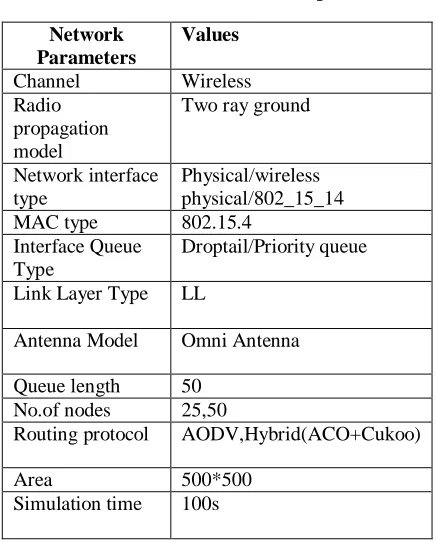
To implement this proposed solution we used Network Simulator 2. We test this proposed algorithm to different network scenario but here only discussed the scenario of 50 nodes with 500x500 areas. Manet scenario is generated by using NS-2 with this defined configuration using AODV protocol and comparison of AODV with CACO based routing is analyzed by using different network parameters. The network setup is defined below in table 1.
Table 1: Simulation Setup Network
Parameters
Values
Channel Wireless
Radio propagation model
Two ray ground
Network interface type
Physical/wireless physical/802_15_14 MAC type 802.15.4
Interface Queue Type
Droptail/Priority queue
Link Layer Type LL
Antenna Model Omni Antenna
Queue length 50 No.of nodes 25,50
Routing protocol AODV,Hybrid(ACO+Cukoo)
Area 500*500
Simulation time 100s
Implementation in ns-2
NS-2 is used to simulate the real moving behaviours of the nodes in a mobile ad hoc network. The evaluation will be conducted with some specific number of nodes that will be randomly scattered in a specific region with specific number of connections. Figure 4.1 shows the MANET Environment generated by using NS-2.
Route request
Figure 4.1 This shows how routes are requested in ns-2 Route discovery
Figure 4.2 This shows how routes are discovered in ns-2 Packet transmission
Figure 4.3 shows how packet can move or how data can be move from one node to another node by using NS-2.
5. Results & Discussion
c e-ISSN: 2348-6848, p- ISSN: 2348-795X Volume 2, Issue 11, November 2015
International Journal of Research (IJR)
Available at http://internationaljournalofresearch.orga) Throughput b) Energy efficiency c) End to End Delay
Packet Sent: It is the number of packets sent by the application layer of source nodes.
Packet received: It is the number of packets received by the application layer of destination nodes.
Routing Overhead:The total number of routing control packets generated by all nodes to the total data packets during the simulation time.
Network Load: It is the total traffic received by the network layer from the higher MAC that is accepted and queued for transmission. It is measured as bits per second.
Packet delivery Ratio (PDR): It is the ratio of all the received data packets at the destination to the number of data packets sent by all the sources. It is calculated by dividing the number of packet received by destination through the no. of packet originated from the source. PDR = (Pr / Ps) * 100
Where, Pr is total packet received and Ps is total packet
sent.
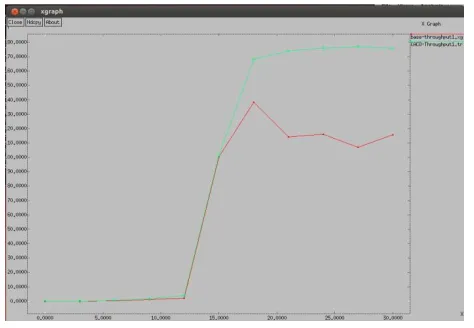
Throughput: It is the average at which data packet is delivered successfully from one node to another over a communication network. It is usually measured in bits per second.
Throughput = (no of delivered packets * packet size) / total duration of simulation
Figure 5.1:Throughput is more in Improved CACO
Figure 5.2:Energy efficiency is more in Improved CACO End to End Delay: This includes all possible delays caused by buffering during route discovery, latency, and retransmission by intermediate nodes, processing delay and propagation delay. It is calculated as
D = (Tr - Ts)
Tr is receive time and Ts is sent time of the packet.
Figure 5.3: Delay is less in Improved CACO
V. CONCLUSION
c e-ISSN: 2348-6848, p- ISSN: 2348-795X Volume 2, Issue 11, November 2015
International Journal of Research (IJR)
Available at http://internationaljournalofresearch.orgwithin a MANET, an efficient routing protocol is required to discover routes between mobile nodes. Energy efficiency is one of the main problems in a MANET, especially in designing a routing protocol. In this paper, we used two optimizing algorithms and classified a number of energy aware routing schemes. In many cases, it is difficult to compare them directly since each method has a different goal with different assumptions and employs different means to achieve the goal. In this paper, CACO algorithm is used to achieve better results in the network of nodes. This is achieved by using the nodes first, which have less residual energies left. As you can see in the graphs our approach has given better results in terms of Delay, Throughput and energy efficiency.
REFERENCES
[1]Baolin Sun, Chao Gui, PengyuanLiu”Energy Entropy Multipath Routing Optimization Algorithm In MANET based on GA” 978-1-4244-6439-5/10/$26.00, IEEE 2010
[2] B.Nancharaiah and B.ChandraMohan”Hybrid Optimization Using Ant Colony ptimization and Cuckoo Search in Manet Routing”978-1-4799-3358-7/14/$31.00,IEEE 2014
[3] Bhavna Sharma, ShailaChugh and Vismay Jain”Energy Efficient Load Balancing Approach to Improve AOMDV Routing in MANET” 978-1-4799-3070-8/14 $31.00 © 2014
[4] Dr. Annapurna P Patil, VarshaChandan B, Aparna S, Greeshma R, Akshatha H P” An Improved Energy Efficient AODV Routing Protocol for MANETs” 978-1-4799-3156-9/14/$31.00 ©2014 IEEE
[5] Tran The Son, Hoa Le Minh, Graham Sexton, NaumanAslam, and Rayana Boubezari” A New Mobility, Energy and Congestion Aware Routing Scheme for MANETs” 978-1-4799-2581-0/14/$31.00 ©2014 IEE
[6] Hrishabha Raj Jain,and Sanjay Kumar Sharma” Improved Energy Efficient Secure Multipath AODV Routing Protocol for MANET” 978-1-4799-6393-5/14/$31.00 ©2014 IEEE
[7] Kumar, M., & Mishra, R. (2012). An Overview of MANET: History, Challenges and Applications. indian Journal of Computer Science and Engineering (JJCSE), 3(1).
[8] Abolhasan, M., Wysocki, T., & Dutkiewicz, E. (2004). A review of routing protocols for mobile adhoc networks. Adhoc networks, 2(1), 1-
22.
[9] Ducatelle, F., Di Caro, G., & Gambardella, L. M. (2005). Using ant agents to combine reactive and proactive strategies for routing in mobile ad-hoc networks.lnternational Journal of Computational intelligence and Applications, 5(02), pp.169-184.
[10]Kalaavathi, B., & Duraiswamy, K. (2008). Ant colony based node disjoint hybrid multi-path routing for mobile adhoc network. Journal of Computer Science,4(2), 80.
[11] Gill, A., & Diwaker, C. (2012). Comparative Analysis of Routing in MANET.lnternational Journal of Advanced Research in Computer Science and Software Engineering, 2(7).
[12]Tamilarasi, M., Palanivelu, T. G., Rajan, B., & Das, S. K. (2005). Node Optimization in MANETs for Maximum Throughput UsingOn-Demand Routing Protocols. In Proceedings of the Eleventh National Coriference on Communications: NCC-2005, 28-30JanualY, 2005 (p. 66). Allied Publishers.
[13] Sharma, M., & Singh, G. (2012). Evaluation of Proactive, Reactive and Hybrid Adhoc Routing Protocol for various Battery models in VANET using Qualnet.arXiv preprint arXiv: 1205.2678.
[14] Dorigo, M., Stutzle, T., & Birattari, M. (2006). Ant colony optimization Artificial Ants as a Computational Intelligence Technique.
[15]Kaveh, A., & Bakhshpoori, T. (2012). Optimum design of space trusses using Cuckoo Search algorithm with Levy flights. Iranian J Sci Technol.
[16]Mou, Zonghua; Meng, Xiaojing. (2011). A modified AODV routing protocol based on route stability in MANET.
[17]Akhter, A., & Sanguankotchakorn, T. (2010, May). Modified AODV for
c e-ISSN: 2348-6848, p- ISSN: 2348-795X Volume 2, Issue 11, November 2015
International Journal of Research (IJR)
Available at http://internationaljournalofresearch.org[18]Sujatha, K. S., Dharmar, V., & Bhuvaneswaran, R. S. (2012, April). Design of genetic algorithm based IDS for MANET. In Recent Trends Informatiion technology international (ICRTIT),2012 conference on (pp.28-33) IEEE.
[19]D.G. Reina, S.L. ToralMarin, N. Bessis, F. Barrero, E. Asimakopoulou(2013),An evolutionary computation approach for optimizing connectivity in disaster response scenarios, Applied Soft Computing, VoU3, Issue 2, February 2013, Pages 833-845,
[20]Hui Cheng, Shengxiang Yang, Jiannong Cao(2013), Dynamic
problem in mobile adhoc networks, Expert Systems with Applications, Volume 40, Issue 4, March 2013, Pages 1381-1392.
[21]SalimBitam, AbdelhamidMellouk, SheraliZeadally(2013), HyBR: A Hybrid Bio-inspired Bee swarm Routing protocol for safety applications Vehicular Adhoc NETworks(VANETs), Journal of Systems Architecture, Available online 24 April 2013.
[22]Shangchao Pi, Baolin Sun, Fuzzy Controllers Based MUltipath Routing Algorithm in MANET, Physics Procedia, Volume 24, Part B, 2012, Pages1178-1185.
[23]Yun-Sheng Yen, Han-Chieh Chao,
Ruay-Shiung Chang, AthanasiosVasilakos(2011) ), Flooding-limited and multi-constrainedQoS multicast routing based on the genetic algorithm for MANETs, Mathematical and Computer Modelling, Volume 53, Issues 11-12,June 2011, Pages 2238-2250.
[24]Wahabou Abdou, Adrien Henriet, Christelle Bloch, Dominique Dhoutaut, Damien Charlet, Fran90is Spies(2011), Using an evolutionary algorithm to optimize the broadcasting methods in mobile adhoc networks, Journal of Network and Computer Applications, Vol. 34, Issue 6, November 2011, Pages 1794-1804.
[25]Deepalakshmi, P.; Radhakrishnan, S., (2011) "A receiver initiated mesh based multicasting for MANETs using ACO," Recent Advances in Intelligent Computational Systems (RAlCS).
[26]Chowdhury, N. M., Baker, S. M., & Choudhury, E. H. (2008, December). A new adaptive routing approach
based on Ant Colony Optimization (ACO) for Adhoc Wireless Networks. In Computer and Information Technology, 2008. ICCIT 2008. 11th International Conference on (pp. 51-56). IEEE.
[26]Barani, F., & Abadi, M. (2011, November). An ABC-AIS Hybrid Approach to Dynamic Anomaly Detection in AODV-Based MANETs. [n Trust, Security and Privacy in Computing and Communications (TrustCom), 2011 IEEE 10th international Conference on (pp.714-720). [EEE.
[27] Nancharaiah, 8., & Mohan, B. C. (2013, April). MANET link performance using Ant Colony Optimization and Particle Swarm Optimization algorithms. InCommunications and Signal Processing (ICCSP), 2013 International Conference on (pp. 767-770). IEEE.
[28]Kumar, M. S., & Asokan, R. (2010). Impact of Node Density and Pause Time on the Performance of Adhoc Routing Protocols. Computer, (4).
[29].Nancharaiah and 8.Chandra Mohan(2013), Routing in Mobile Adhoc Networks(MANETS) using Fuzzy Aided Ant Colony Optimization(ACO)Technique, Journal of Theoretical and Applied Information Technology, Vol. 53 No.2, pp. 227-235, June 2013.
[30]Layeb, A. (20I I). A novel quantum inspired cuckoo search for knapsack problems. International Journal of Bio-InspiredComputation, 3(5), 297- 305.