Comparative Analysis of Discrete Wavelet Transform and
Complex Wavelet Transform For Image Retrieval
Shweta VhanmaneP
1
P
and Sunil SangveP
2
P
1
P
Department of Electronics and Telecommunication
P
2
P
Department of computer Engineering Dyanganga College of Engineering and Research
Pune-411041, India.
Abstract
This paper presents comparative analysis of image retrieval systems based on discrete wavelet transform and complex wavelet transform. Standard discrete wavelet transform (DWT) is non-redundant. So it is very powerful tool for many non-stationary signal processing applications. First we have decomposed DWT up to two levels. To overcome the disadvantages of Dual-Tree Discrete Wavelet Transform such as shift invariance, poor directional selectivity and loss of phase we implemented Dual-Tree Complex Wavelet Transform. Texture feature is extracted by applying Grey Level Co-occurrence matrix (GLCM) in each sub-bands of DT-DWT and DT-CWT. Euclidian and Canberra distances are used for similarity measures. Then image retrieval efficiency of DT-DWT and DT-CWT is compared for performance measurement.
Keywords: Content Based Image Retrieval (CBIR), Euclidian distance, grey level co-occurrence matrix (GLCM), feature extraction, Canberra distance.
1.
Introduction
Retrieval of required query similar images from large amount of data of digital images is a challenging need of today. Image retrieval finds its application in different domains such as multimedia, satellite image databases, medical imaging etc. Image retrieval techniques can be broadly classified as: i) Text based, ii) Content based. Earlier image retrieval techniques were based on text based approach. This type of
search requires associating meaningful image descriptive text labels as metadata with all images of the database. Manual image labeling also known as manual image annotation and it is practically difficult for exponentially increasing image database. This makes the manual approach inadequate for the
increasing database.
To overcome the limitations of text based approach, content based image retrieval (CBIR) approach has emerged as a promising alternative. CBIR is very active research topic in recent years. In CBIR system images are indexed by its own visual contents, such as color, texture and shape. The main advantage of CBIR is its ability to support visual queries. The challenge in CBIR is to develop the methods that will increase retrieval accuracy and reduce the retrieval time. Comprehensive and extensive literature survey on CBIR is presented in [1] [2].
CBIR aims at automatic extraction of features based on the mathematical characteristics and contents of the image. CBIR technique uses low level features to represent the images relevant to the query image from the database. The Fig.1 represents block diagram of typical CBIR system.
the database is to be considered as match to the query image. The search is usually based on the similarity rather than exact match and retrieval results are then ranked accordingly to a similar index.
Fig.1 Block Diagram of Typical CBIR system.
The main contribution and novelty of this paper are summarized as follows:
1) Design of 2D dual-tree discrete wavelet transform and 2D dual-tree complex wavelet transform.
2) The texture feature extraction using GLCM.
3) Comparison of DT-DWT and DT-CWT on
the basis of image retrieval efficiency.
2. Related Work
Several authors have proposed texture feature extraction on the basis of different algorithm. Minh N. Do, Martin Vetterli [3] presented a statistical view of the texture retrieval problem by combining the two related tasks, namely feature extraction and similarity measurement. For similarity measurement Kullback-Leibler distance (KLD) was used. The statistical scheme leads to a new wavelet-based texture retrieval method that is based on the accurate modelling of the
marginal distribution of the wavelet coefficients using Generalized Gaussian Density (GGD) and on the existence. GGD was used to model coefficients from the wavelet transform and wavelet frames. They applied three levels of wavelet decomposition which generated nine wavelet sub-bands. Only gray-scale levels of images (computed from the luminance component) were used in experiment.
Grigorescu, Perkov and Kruizing represented comparison of texture feature based on Gabor filters [4]. They compare a number of texture operators that comprise Gabor filtering stage followed by different types of non-linear “post-Gabor” processing. They did not include textures at different scales and orientations because the operators compared here are not scaling and rotation invariant.
Manjunath and Ma [5] have used features derived from the Gabor wavelet coefficients for indexing photographic and satellite images .They compared texture retrieval performance of Gabor wavelet, pyramid structured wavelet transform (PWT), tree structured wavelet transform (TWT), and multi resolution simultaneous autoregressive model (MRSAR) methods. Their experiments based on a large set of textured images show that retrieval performance is better using Gabor filters than using conventional orthogonal wavelet based features. Though Gabor wavelet based features give better retrieval performance, Gabor wavelet suffer from following two main drawbacks:
1) Redundancy and memory requirement is large as Gabor basis functions is not orthogonal.
2) Feature extraction time required is quite high, which limits the retrieval speed.
There are lots of recent developments for texture feature extraction using wavelet based approach. These are using Discrete Wavelet Transform (DWT) and Complex Wavelet Transform (CWT) [6] [7].
3. Our Approach
DatabaseImage
Query Image
Feature Extraction
Feature Extraction
Similarity measures (color, texture and shape)
In this paper we have decomposed discrete wavelet transform up to second level. Also we decomposed complex wavelet transform up to second level. After second level decomposition i.e. Dual-Tree Discrete Wavelet Transform (DT-DWT), we got six sub bands. Then we decomposed complex wavelet transform up to second level. After second level decomposition i.e. Dual-Tree Complex Wavelet Transform (DT-CWT), we got total sixteen sub bands. We have applied Gray Level Co-occurrence Matrix (GLCM) in each sub bands of DT-DWT and DT-CWT, which improves retrieval performance. Also computational complexity is less. The results are checked for WANG database of 1000 images of 10 different classes.
4. DT-DWT Implementation
DWT and Filter Bank
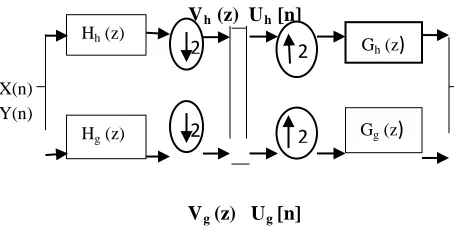
In the applications of multi rate filter banks, a bank of analysis filters is applied to a discrete input signal and then down sampled at fixed rate to produce a set of sub-band signals. If a dual bank of synthesis filters exists, by means of which the original input signal can be recovered by first up sampling each of the above sub-band signals and then applying it to a synthesis filter, then the two filter banks are said to be a perfect reconstruction (PR) pair of filter banks. The term uniform filter bank (UFB) is used to emphasize that all the sub-band signals are down sampled at the same rate. PR pair of wavelet analysis and synthesis filter banks is dual. The discrete wavelet transform (DWT), and multi resolution analysis, can be viewed as the application of a non-uniform filter bank, defined by a UFB. In terms of wavelet theory, a low-pass filter corresponds to scaling function and the subsequent high-pass or band-pass filter corresponds to wavelet function. The DWT computation involves repetitive application of UFB on the low-pass channel.
In filter bank applications, a discrete-time signal x[n] is split into sub-band signals by means of an analysis filter bank. The sub-band signals are then processed and finally combined by a synthesis filter bank resulting in an output signal y[n]. If the sub-band signals are band limited to frequency ranges much smaller than that of the original input signal, they
could be down sampled before processing. Due to lower sampling rate, the processing of the down sampled signals can be carried out more efficiently. After processing, these signals are up sampled before being combined by the synthesis filter bank into a higher-rate signal.
VRhR (z) URhR [n]
X(n) Y(n)
VRg R(z) URg R[n]
Fig.2 Two channel Filter Bank for Implementing DWT
HRhR (z) and HRgR (z) form an analysis filter bank, GRhR (z)
and GRgR (z) form a synthesis filter bank.
The input signal is filtered in parallel by a low-pass filter and a high-pass filter to give approximation (coarser) and details of the input signal as shown in Fig. 2. The approximation part can be further decomposed up to level j.
In real DWT we get the edge information in the horizontal, vertical and diagonal direction. However, for texture feature extraction, directional selectivity with real DWT is poor (only three directions information). Also, since small shifts in the input signal can result in large differences of DWT coefficients at different scales, same two patterns with small spatial shifts will produce widely different feature vectors. Above problems of real DWT can be overcome by DT-CWT. DT-CWT gives texture information strongly oriented in six different directions.
5. DT-CWT Implementation
The limitations of real DWT can be overcome by complex wavelet transform. This complex wavelet transform also called as Complex DWT. Features of Complex DWT or Complex Wavelet Transform are as follows:
Hh (z)
Hg (z)
2
2
2
2
Gh (z)
• Approximate Shift invariance
• Good directional selectivity
• Perfect reconstruction with Linear phase filters
• Limited redundancy
• Can be implemented existing DWT platform.
Complex Wavelets Transforms (CWT) use complex-valued filtering (analytic filter) that decomposes the real/complex signals into real and imaginary parts in transform domain. The real and imaginary coefficients are used to compute amplitude and phase information, just the type of information needed to accurately describe the energy localization of oscillating functions (wavelet basis).
Edges and other singularities in signal processing applications manifest themselves as oscillating coefficients in the wavelet domain. The amplitude of these coefficients describes the strength of the singularity while the phase indicates the location of singularity. In order to determine the correct value of localized envelope and phase of an oscillating function, ‘analytic’ or ‘quadrature’ representation of the signal is used. The 1-D DT-CWT is implemented using two filter banks in parallel operating on the same data as illustrated in Fig.3. A complex-valued wavelet ψ (t) can be obtained from the Hilbert transform of the given signal as
ψRcR (t) = ψRrR (t) + jψRiR (t)
(1)
Where ψRrR(t) is real and even and jψRiR(t) is imaginary
and odd. ψRrR(t) and ψRiR (t) are 90˚ out of phase with
each other. Tree 1: Real part
Tree 2: Imaginary part
Fig.3 1-D Dual Tree Complex Wavelet Transform
Now we have to implement 2-D CWT. If ψRiR(t) is the
approximate Hilbert transform of ψRrR (t), then to
implement an oriented non separable 2-D wavelet transform by combining the sub- bands of two separable 2-D DWTs. The scaling and directional wavelet are obtained by defining a 2-D separable wavelet basis via
𝜑R1R (x, y) = φRhR(x) φRhR(y) φR2R (x, y) = φ RgR(x) φRgR(y)
(2)
ψR1,1R (x, y) = φRhR(x) ψRhR(y) ψR2,1R (x, y) = φRgR(x) ψRgR(y)
(3)
ψR1,2R (x, y) = ψRhR(x) φRhR(y) ψR2,2R (x, y) = ψRgR(x) φRgR(y)
(4)
ψR1,3R (x, y) = ψRhR(x) ψRhR(y) ψR2,3R (x, y) = ψRgR(x) ψRgR(y)
(5)
Then the six wavelets defined by
ψR iR (x, y) = ψRh,iR (x, y) + ψRg,iR (x, y)
(6)
ψ Ri+3R (x, y) = ψRh,iR (x, y) – ψRg,iR (x, y)
(7)
For 1 ≤ i ≤ 3 are directional .A wavelet transform based on these six wavelets can be implemented by taking sum and difference of two separable 2-D DWTs. The resulting directional wavelet transform is two-times redundant. The inverse requires taking sum and difference, dividing by 2, and the separable inverse DWTs. The six sub bands of the 2D DTCWT gives information strongly oriented at {± 15˚, ± 45˚, ± 75˚}.
6. Texture Feature Extraction
Texture is an important feature of an image. To describe the texture of the region three approaches are used in image processing these are statistical, structural and spectral. Statistical approaches specify the characterization of the textures by smooth, coarse, grainy, and silky and so on. The common second order statistic is gray level co- occurrence matrix.
h0(n)
h1(n)
h0(n)
h1(n)
2
2
h0(n)
h1(n)
2
2
2
2
h0(n)
h1(n)
2
6.1 Grey Level Co-occurrence Matrix
GLCM is performed on Haar Wavelet because in Haar wavelet transform the resulting wavelet bands are strongly correlated with the orientation elements in the GLCM computation. The second reason is because the total pixel entries for Haar wavelet transform is always minimum. Thus, the GLCM computation burden can be reduced.In order to use information contained in the GLCM, Haralick [8] defined some statistical measures to extract textual characteristics. Some of these features are entropy, contrast, homogeneity, correlation etc. Contrast measures the local variation in the gray level of GLCM. Correlation measures the joint probability of occurrence of pixel pairs of GLCM. Energy gives the sum of squared pixel values of GLCM. Homogeneity refers to the closeness of distribution of elements to the GLCM diagonal. Homogeneous textures contain ideal repetitive structures. Weak homogeneity refers to variation in texture elements in their spatial arrangements.
The GLCM element P (i, j, d, Ө) represent probability of the pair of pixels, which are located with an inter sample distance d and a direction Ө, have a gray level i and a gray level j. If the inter-pixel distance is set to 1 or 2 GLCM measure the local high frequency information [9].
Energy E= ∑ ∑ 𝑝𝑥 𝑦 (𝑥,𝑦)P 2
P
(8)
Contrast I= ∑ ∑ (x-y)P
2
P p(x, y)
(9)
Entropy S= - ∑ ∑ p(x, y) log p(x, y) (10)
Inverse Difference H = R ∑ ∑
1
1+(𝑥−𝑦)²𝑝(𝑥,𝑦)
𝑦
𝑥
(11)
7. Distance Measures
Similarity measures also named as distance metric plays important role in content based image retrieval. Content based image retrieval calculates visual
similarities between a query image and database images. Hence, the retrieval result is not a single image but a number of images ranked by their similarities with the image. The query image will be more similar to the database images if the distance is smaller. Here, we have used Euclidian distance and Canberra distance for similarity measures.
Euclidian Distance dP
2
PRE R(x, y) = ∑ (𝑥 − 𝑦)²
𝑑
𝑘=1
(12)
Canberra Distance dP
2
PRc R(x, y) = ∑
|𝑋ᵢ−𝑌ᵢ | |𝑋ᵢ|+|𝑌ᵢ|
𝑑
𝑘=1 (13)
8. Results and Discussion
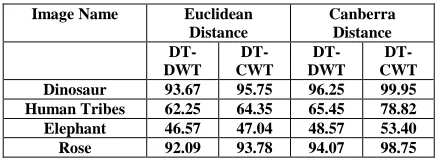
Simulation results are performed with MATLAB. This database consists of 1000 images 10 different classes. Each classes have 100 images, for the experimental purpose we took four images from each class. We have applied GLCM at DWT and DT-CWT.
Table 1: Comparison of Percentage Average Retrieval Accuracy
Image Name Euclidean
Distance
Canberra Distance
DT-DWT DT-CWT
DT-DWT
DT-CWT
Dinosaur 93.67 95.75 96.25 99.95
Human Tribes 62.25 64.35 65.45 78.82
Elephant 46.57 47.04 48.57 53.40
Rose 92.09 93.78 94.07 98.75
9. Conclusion
This paper outlines a scheme for image texture recognition based on a two level decomposition of DT-DWT and DT-CWT using Haar Wavelets. It demonstrates an improvement in recognition accuracy over another popular scheme using Grey Level Co-occurrence Matrix (GLCM). Further, it has been shown that the recognition accuracy can be further improved by combining GLCMs with Wavelet Decomposition Matrices.
References
Theory and Applications”, RITA, Volume XIII, Numero 2, 2006.
[2] Sajilal D.,“Content Based Image Retrieval”, CSI Communications, April 2012.
[3] Minh N. Do, Martin Vetterli, “Wavelet-Based Texture Retrieval Using Generalized Gaussian Density and Kullback–Leibler Distance”,IEEE Transaction on Image Processing, Vol.11, No. 2, pp.146-158, February 2002.
[4] Simona E. Grigorescu, Nicolai Petkov, and Peter Kruizinga, “Comparison of Texture Features Based on Gabor Filters”, IEEE transaction on Image Processing”, vol.11, No.10, pp.1160-1167, October.2002.
[5] B.S. Manjunathi and W.Y. Ma, “Texture Features for Browsing and Retrieval of Image Data”, IEEE Transaction on Pattern Analysis and Machine Intelligence, vol.18, No.8, pp.837-842, August 1996.
[6] N S T Sai, R C Patil, “Image Retrieval Using 2D Dual-Tree Discrete Wavelet Transform”, International Journal of Computer Applications (0975 – 8887),vo.14, No.6, February 2011.
[7] Ivan W. Selesnick, Richard G. Baraniuk, and Nick G. Kingsbury, “The Dual-Tree Complex Wavelet Transform”, IEEE Signal Processing Magazine, pp.123-151, November 2005.
[8] Robert M. Harlic, K.Shanmugam ans Hack
Distein,“Texture Feature For Image
Classification”, IEEE Transaction on Systems, Man and Cybernetics, vol.SMC-3, No.6, pp.610-612, Novmber 1975.
[9] Ranjan Parekh, “ Improving Texture Recognition Using Combined Features of GLCM and Wavelet Features”, International Journal of Computer Applications (0975 – 8887),vol. 29, No.10, pp.41-46, September 2011.
Shweta Vhanmane is student of Masters in Electronic and Telecommunication (VLSI and Embedded Systems) in Dnyanganga College of Engineering and Research under University of Pune. She completed Degree of B.E. in Electronics and Telecommunication in 2005. She has published 1 paper in reputed International Conference.