An Observer-Based Optimal Voltage Control Scheme for
Three-Phase Three Level UPS Systems
Mr.Satish Bandaru1(Assistant Professors& HOD, Dept Of EEE, MITS, Kodad, Telangana, India.) Mr.Vankudothhathiram2(Assistant Professors, Dept Of EEE, MITS, Kodad, Telangana, India.)
Mr.Srikanth Borra3(PG Scholor, Dept Of EEE , MITS, Kodad, Telangana, India.)
Abstract:
Uninterrupted Power Supply (UPS) system supplies required power in case of utility power failures. UPS system has got significant importance in the field of industrial electronics due to increase in technology of power electronic devices.This paper proposes a Neutral Point Clamped (NPC) inverter with simple Sinusoidal Pulse Width Modulation Technique (SPWM), which is well suitable for inverter control. The proposed system would be subjected to fast transient response, small steady state error and low harmonic distortion test under different load conditions. Finally, the comparative results for the proposed scheme and the observer based voltage control scheme are presented to show that the proposed scheme achieves better performance. The results are tested and verified through MATLAB/Simulink. The proposed methodology reduces the total cost, complexity and THD.
Keywords: Inverter, Uninterrupted Power Supply (UPS), Neutral Point Clamped (NPC) Inverter, Three-Phase Inverter, Total Harmonic Distortion (THD), SinusoidalPulse Width Modulation(SPWM).
I.
INTRODUCTION
Uninterrupted power supply (UPS) systems play a vital role in case of utility power failures. It supplies emergency power when power failure occurs. Recently the significance of the UPS system has been increased more and more due to increase of critical and sensitive applications like telecommunication systems, medical equipment, manufacturing of semiconductor devices and data processing systems. Such applications need high reliability and clean power irrespective of the electric power failures and distorted supply voltages. UPS system performance is generally evaluated in terms of steady state /transient response and total harmonic distortion of the output voltage irrespective of load conditions like linear load, nonlinear load and sudden load step change. To enhance the above mentioned performance parameters, several control strategies have been evolved such as adaptive control method, proportional-integral (PI) control method, sliding mode control scheme, model predictive control method, feedback linearization control, deadbeat control method and observer based voltage controlmethod.
The conventional PI control method [2] and [3] is simple for implementation but, the THD of the output voltage is not reduced under nonlinear-load condition. A model predictive control method is suggested in [4]. A load current observer is used in place of current sensors, which resulted in the
reduction of overall system cost. However, thesimulation and experimental results do not show better performance in terms of steady-state error and THD. In [5], the deadbeat control method uses the state feedback information to compensate for the voltage drop across the inductor, but this method is sensitive as parameter mismatches. FLC is presented in [6]. This control strategy is proposed to achieve low THD under nonlinear load. However, it is complex due to computations. In [1], the observer based voltage control method is proposed. This method achieved better performance, but involves complex design.
Therefore, this paper proposes Neutral Point Clamped (NPC) inverter with space vector modulation technique, which is well suitable for inverter control. The proposed system would be subjected to fast transient response, small steady state error and low harmonic distortion test under different load conditions. Finally, the comparative results for the proposed schemend the observer based voltage control scheme are presented to show that the proposed scheme achieves better performance. The results would be tested and verified through Matlab/Simulink. The proposed methodology reduces the total cost, complexity and THD.
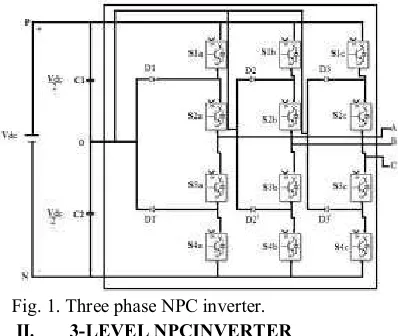
Fig. 1. Three phase NPC inverter.
II. 3-LEVEL NPCINVERTER
Neutral Point Clamped (NPC) or Diode-Clamped inverter is a well-known topology which is widely used in industrial applications [7]. Fig .1 shows the structure of a 3-level three- phase NPC. It needs one DC source as input as shown inFig .1. Clamping diodes of this topology results in an additional zero voltage at the output. There are 4 switches in each leg of a 3-level NPC so, a total number of 24 =16 switching
states may be possible. By ignoring invalid switching states (the ones leading to a open-circuit or short-circuit in the output) and considering the fact that in phase R (R=a,b or c) the lower switches ( 3 , 4 )are always in an
contradictorystatewithrespecttotheupperswitches( 1,
2 )therewillbeonly3effectiveswitchingstates.Each one of
thesethree
voltages in the output are given in Table I.
TABLE I
SWITCHING STATES OF NPC INVERTER State―1‖givesazerovoltagebyusingclampingdiodesto connect
the neutral point (O) to the output. In the similar
Switching states S1a
S2a S3a
S4a Inverter Terminal mannerstate―2‖(―0‖)gives+ (- 2 2 ) by applying voltage Voltage of capacitor C1 (reverse voltage of C2) to the output. As an
illustration,Fig.2Showshowswitchingstate―2‖generates apositive(+ )voltageatthephaseoutput( ).As
2
stated earlier, the only change between 3- level NPC and the conventional 2- level full-bridge inverter is clamping diodes. For each leg of an n- level NPC, there would be ( − 1)( − 2) clamping diodes and there would be ( − 1)DC- link capacitors. Since these capacitors didvide the input voltage ( ) among themselves, nominal voltage rating of each of them them would be Vdc/ (n-1) as well as that of each switches. But in case of an n-level ( > 3) NPC inverter, clamping diodes will have different voltage ratings because different reverse voltages might be given to them [8]. 3-level output waveform of this inverter gives high quality output but switching technique is another factor that has to be taken in toaccount.
(a)
(b)
Fig.2. Operating principle of three level NPC. (a) Conducting path. (b). Corresponding outputvoltage.
(Va) 2 On On Off OffVdc/2 1 Off On On Off 0 0 Off Off On On-Vdc/2
There are three main switching techniques:
1- Carrier-based methods, 2- Selective Harmonic Modulation (SHE) and 3- Space-Vector Modulation (SVM). In general, SVM method is superior and advanced when compared to the other methods. In the following section a generalized SVM technique has beenproposed.
III. SYSTEMCONFIGURATION
The proposed three level inverter with load consists of voltage source inverter. The inverter model connected to the load as shown in Fig 3. This is controlled to produce the sinusoidal output. Three level SVPWM which is based on orientation of reference point in terms of hexagon line is proposed to lower the harmonic contents in the output voltage.
Fig.3. Block diagram of the proposed NPC model.
Each leg of 3-level inverter have switching states of 0,1 or 2. So, 27 switching states can be generated by this inverter. Each one of these switching states can be denoted by a number where ∈ {0,1,2} which is well explained in [14]. Combination of some switches leads to identical vectors known as redundant switching states. All 27 switching states results in producing only 19 different voltage vectors due to redundant switching states. All the 19 voltage vectors and their respective switching states of a 3- level NPC are represented in tableII.
−
TABLE II
THD(%) COMPARISON OF PROPOSED MODEL AND EXISTING MODEL
Model Step change in load
Unbalanced load
Nonlinear load Observer
based voltage control model
2.74 4.69 35.28
Proposed model
1.57 1.59 8.25
IV. CONTROL DESIGN OF THREE LEVEL
INVERTER
For industrial converters applications the sinusoidal PWM technique is the most popular. In the general principle of SPWM, a carrier wave of frequency fc is compared with the fundamental frequency f sinusoidal modulating waveand the points of intersection indicates the switching points of power devices[9]. There are 8 switching states in the traditional three phase two level inverter and there are 27 switches states in three level inverter. Three level pulse width modulated waveforms can be produced by sine carrier PWM. Sine carrier PWM is generated by comparing the three reference control signals with two triangular carrier waves [10] [11]. The block diagram of the proposed controller is shown inFig:4.
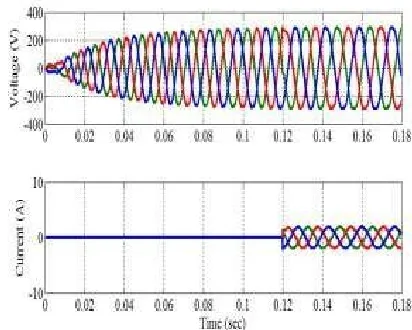
Fig.5. Simulation results of the proposed NPC model under load step change —First: Load output voltages ( ), Second: Loadoutputcurrents( ).
Fig:4.Blockdiagramofthecontroller
Fig.6. Simulation results of the observer based voltage control model under load step change —First: Load output voltages (), Second: Load output currents ( ).
= ,,i> ,1
=0, ,1> , i> , 2, where i = a, b or c = , ,2> ,i
2
The three reference control signals are in a phase shift of 1200 each other with same amplitude. Two carrier waves are in phase each other with dc offset voltage.
V. SIMULATION RESULTS AND DISCUSSION Simulationwascarriedoutwiththehelpof―MATLAB‖. The proposed technique is carried out under different conditions (i.e., load step change, unbalanced load, and nonlinear load) to clearly represent its merits. The resistive load is subjected to both the load step change condition and the unbalanced load condition (i.e., phase B opened) to check the capability of the proposed scheme when the load is suddenly disconnected. To further test the robustness of the proposed technique all load conditions such as load step change, unbalanced load, and nonlinear load areconsidered.
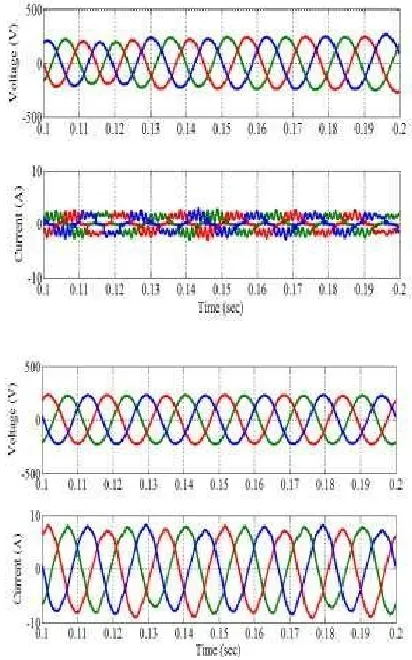
Fig.7. Simulation results of the proposed NPC model under unbalanced load (i.e., open phase) —First: Load output voltages (), Second: Load output currents ( ).
Fig.8. Simulation results of the observer based voltage control model under unbalanced load (i.e., open phase) — First: Load output voltages (), Second: Load output currents ( ).
Fig. 5.Shows the simulation results of the proposed control technique during the load step change andFig. 6. Presents the comparative results obtained by employing the optimal voltage control technique under the same condition. Precisely, the figures display the load voltages (First waveform:), load currents (Second waveform: ). It can be seen in
Fig. 5 that when there is a sudden change in load, the output voltage has little distortion. However, it returnsto a steady-state condition in 2.0 ms.On the other hand, as shown in the simulation results in Fig. 6, current distortion is longer as compared with that in Fig. 5. Also, the THD values of the load output current at variousoperating conditions are presented in Table II. These values are found as 2.74% for observer based model and 1.57% usingthe proposed scheme. Therefore, it is clearly stated that the proposed technique attains lower THD.
.
Fig.10. Simulation results of the observer based voltage control model under nonlinear load — First: Load output voltages (), Second: Load output currents ( ).
The characteristic performances of the transient and steady state under unbalanced load are tested through Figs. 7 and 8. This case is implemented under a situation of full-load condition by suddenly opening phase B. It is shown that the output voltages are well controlled, although there is a rapid change in the load current of phase B is observed as phase B is opened. As shown in Fig. 7 and 8, the corresponding THD values of the output currents are 4.69% for the observer based model and 1.59% using the proposedmethod.
To estimate the steady-state performance in case of nonlinear load, a three-phase diode rectifier is used. The simulation results of both control methods under this condition are shown in Figs. 9and 10. The THD values of the load output current waveforms obtained with the
proposed scheme are 8.25% for proposed model and 35.28% for observer based model, respectively. Finally, all THD values under the three load conditions described earlier are summarized in TableII.
VI. CONCLUSION
This paper has proposed an NPC inverter with simple SPWM for three-phase UPS system. The simulation of the inverter was carried out using sinusoidal pulse width modulation (SPWM). The performance of the proposed control system was demonstrated through simulation under various load conditions (load step change, unbalanced load and nonlinear load). The proposed control scheme achieved a better performance such as lower THD, small steady state error and faster transientresponse.
REFERENCES
1. Eun-Kyung Kim, Francis Mwasilu, Han Ho Choi, andJin-WooJung―Anobserverbasedoptimal voltage control scheme for three phase UPS system,‖ IEEE TRANSACTIONS ON INDUSTRIAL ELECTRONICS, VOL. 62, NO. 4, APRIL2015.
2. U.Borup,P.N.Enjeti,andF.Blaabjerg,―Anew space-vector-based control method for UPS systems powering nonlinear and unbalanced loads,‖ IEEE Trans. Ind. Appl., vol. 37, no. 6, pp. 1864– 1870, Nov./Dec.2001.
3. H.Karimi,A.Yazdani,andR.Iravani,―Robust control of an autonomous four-wire electronically- coupled distributed generation unit,‖ IEEE Trans.Power Del., vol. 26, no. 1, pp. 455–466, Jan. 2011. 4. P.Cortésetal.,―Modelpredictivecontrolofan inverter
with output LC filter forUPS applications,‖ IEEE Trans. Ind. Electron., vol. 56, no. 6,pp. 1875–1883, Jun.2009.
5. T. Kawabata, T. Miyashita, and Y. Yamamoto, ―DeadbeatcontrolofthreephasePWMinverter,‖IEEE Trans. Power Electron., vol. 5, no. 1, pp. 21– 28, Jan. 1990.
6. D.E.KimandD.C.Lee,―Feedbacklinearization control of three-phase,‖ IEEE Trans. Ind. Electron., vol. 57, no. 3, pp. 963–968, Mar.2010.
7. R. H. Baker, "Switching circuit," ed: Google Patents, 1980.
8. J. Rodriguez, J.-S. Lai, and F. Z. Peng, "Multilevel inverters: a survey of topologies, controls, and applications," Industrial Electronics, IEEETransactions on, vol. 49, pp. 724-738, 2002. 9. KapilJain,PradyumnChaturvedi―Matlab-based
Simulation & Analysis of Three - level SPWM Inverter‖ International Journal of Soft Computing and Engineering (IJSCE)ISSN: 2231-2307, Volume-2, Issue-1, March2012.
10. H. Vahedi and K. Al-Haddad, "Real-Time Implementation of a Packed U-Cell Seven-Level Inverter with Low Switching Frequency VoltageRegulator," Power Electronics, IEEE Transactions on, vol. PP, pp. 1-1,2015.
11. P. Qashqai, A. Sheikholeslami, H. Vahedi, and K. Al-Haddad, "A Review on Multilevel Converter Topologies for Electric Transportation Applications," in Vehicle Power and PropulsionConference(VPPC), 2015 IEEE, 2015, pp.1-6.
12. Hamid R. Teymour, Kashem M. Muttaqi, “Solar PV and Battery Storage Integration using a New Configuration of a Three-Level NPC Inverter With Advanced Control
Strategy,‖IEEETRANSACTIONS ON ENERGY CONVERSION, VOL. 29, NO. 2, JUNE 2014.
13. XinboRuan, Bin Li, Qianhong Chen, Siew-Chong Tan,”Fundamental Considerations of Three-Level DC DC Converters: Topologies, Analyses, and Control‖, IEEE TRANSACTIONS ON CIRCUITS AND SYSTEMS—I: REGULAR PAPERS, VOL. 55, NO. 11, DECEMBER2008.
14. PouriaQashqai, Hani Vahedi,“A general space vector nodulation technique for multilevel NPC inverter‖ IEEE TRANSACTIONS ON CIRCUITS AND SYSTEMS—I: REGULAR PAPERS, DECEMBER2016.
15. H.Tao,J.L.Duarte,andM.A.M.Hendrix,―Line- interactive UPS using afuel cell as the primary source‖ IEEE TRANSACTIONS ON CIRCUITS AND SYSTEMS—I: REGULAR PAPERS, VOL. 55, NO. 8, Aug 2008.
AUTHORS:
Available online:
http://edupediapublications.org/journals/index.php/IJR/
P a g e | 1960University, Hyderabad, India. He completed his Master of Technology in Power Electronics from JNT University, Hyderabad, Telangana, India. His area of interest includes Multi Level Inverters, Power Quality, Renewable Energy Sources, FACTS Devices and Electrical Machines. He is currently working as an HOD in Electrical and Electronics Engineering Department in Madhira Institute of Technology and Sciences, Kodad, Telangana, India.
2.Mr.VankudothHathiram obtained his Bachelor of Technology in Electrical and Electronics Engineering from JNT University, Hyderabad, India. He completed his Master of Technology in Power Electronics from JNT University, Hyderabad, Telangana, India. His area of interest includes Multi Level Inverters, Power Quality, Renewable Energy Sources, FACTS Devices and Electrical Machines. He is currently working as Asst.prof in Electrical and Electronics Engineering Department in Madhira Institute of Technology and Sciences, Kodad, Telangana, India
3..srikanth Borra.He completed his professional career of education in B.Tech(EEE) at Madhira Institute of Technology and Sciences in the year of 2012 and pursuing M.Tech fromMadhira Institute of Technology and Sciences. He is