LIN, YILIANG. Shape-Transformable Gallium-based Liquid Metal Particles for Soft Electronics. (Under the direction of Dr. Michael D. Dickey and Dr. Jan Genzer).
by Yiliang Lin
A dissertation submitted to the Graduate Faculty of North Carolina State University
in partial fulfillment of the requirements for the degree of
Doctor of Philosophy
Chemical Engineering
Raleigh, North Carolina 2018
APPROVED BY:
_______________________________ _______________________________ Dr. Michael Dickey Dr. Jan Genzer
Committee Co-Chair Committee Co-Chair
ii DEDICATION
iii BIOGRAPHY
iv ACKNOWLEDGMENTS
I can’t not be luckier to work with Dr. Michael D. Dickey and Dr. Jan Genzer through my Ph.D. You are great mentors, teaching me how to do research from scratch. I would like to specifically thank you for always being patient to my “quick questions”. I really enjoyed those moments when we discussed about new crazy ideas, they are so inspiring and always make my days. You are so supportive through my whole Ph.D., never hesitating to encourage me to try out new research ideas and help whatever you can to pave my way for further research career. None of those achievements during my Ph.D. would be possible without you.
I am also grateful to my committee members. Dr. Christopher Gorman, for allowing me to work extensively in his laboratory space and give me many ideas regarding the chemistry part of my project. Dr. Glenn M. Walker for the guidance and the insightful comments through my time at NC State.
I would like to thank all the past and present members of the Dickey Group and Genzer Group for the help and support. Of special mention: Dr. Rashed M. Khan, Dr. Mohammed Mohammed and Dr. Ying Liu for the mentoring and support when I initially joined the group. Ishan D. Joshipura, Dishit Parekh, Dr. Yuanchao Li, Dr. Timothy Shay, Dr. Pandiyarajan Chinnayan Kannan, Yeongun Ko, Steven Zboray Amber Hubbard and Jason Miles for the help, support and helpful discussion in the past few years.
I really appreciate the research collaboration with Dr. Shiyang Tang, Dr. Yang Liu, Dr. Yue Lu, Dr. Yuanchao Li, Dr. Junjie Zhao, Dr. Kenneth P Mineart, Dr. Meng Wang, Dr. Saad Khan, Dr. Jacob J. Adam, Dr. Gregory N. Parsons,Dr. Richard J Spontak and Dr. Zhen Gu.
v different time zones. Binwu Zhao, Yining Tian, Junjie Zhao, Xing Wang, Sicong Peng, Yunhu Peng for the great time at NC State with great foods.
vi TABLE OF CONTENTS
LIST OF FIGURES ... viii
CHAPTER 1 ... 1
1.1 Introductions ... 3
1.2 Liquid Metals ... 4
1.3 Attributes of Liquid Metal Particles ... 7
1.4 Fabrication of Liquid Metal Particles ... 9
1.5 Applications of Liquid Metal Particles ... 16
1.6 References ... 35
CHAPTER 2 ... 48
2.1 Introduction ... 51
2.2 Results and Discussion ... 53
2.3 Conclusion ... 65
2.4 References ... 67
CHAPTER 3 ... 73
3.1 Introduction ... 75
3.2 Materials and Methods ... 78
3.3 Results and Discussion ... 78
3.4 Conclusion ... 88
3.5 References ... 90
CHAPTER 4 ... 95
vii
4.2 Results and Discussion ... 100
4.3 Conclusion ... 110
4.4 Experimental Section ... 111
4.5 References ... 114
4.6 Supporting Information ... 117
CHAPTER 5 ... 119
5.1 Introduction ... 121
5.2 Results and Discussion ... 122
5.3 Conclusions ... 132
5.4 Methods ... 132
5.5 References ... 134
5.6 Supporting Information ... 139
CHAPTER 6 ... 148
6.1 Outlook... 148
6.2 Long-term, Stable Nanoparticles in Aqueous Solution ... 150
6.3 Liquid Metal Dielectric Elastomer for Actuation ... 151
6.4 Core-Shell Liquid Metal Microparticle with Flow Focusing ... 152
viii LIST OF FIGURES
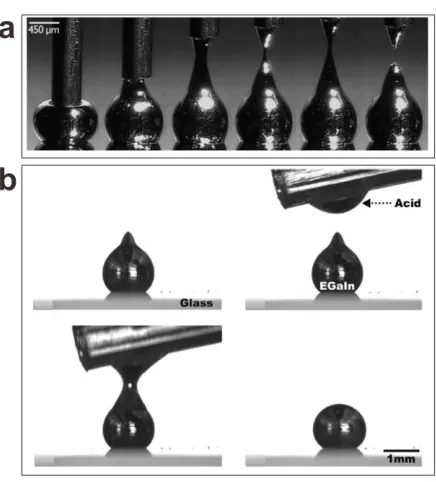
Figure 1.1 Oxide skin on liquid metal particle. a) The oxide skin helps maintain liquid metals as non-spherical structures. Adapted with permission.47 b) The oxide skin can be
removed by acid to change the particle shape from non-spherical to spherical. Adapted with permission.8 ... 5
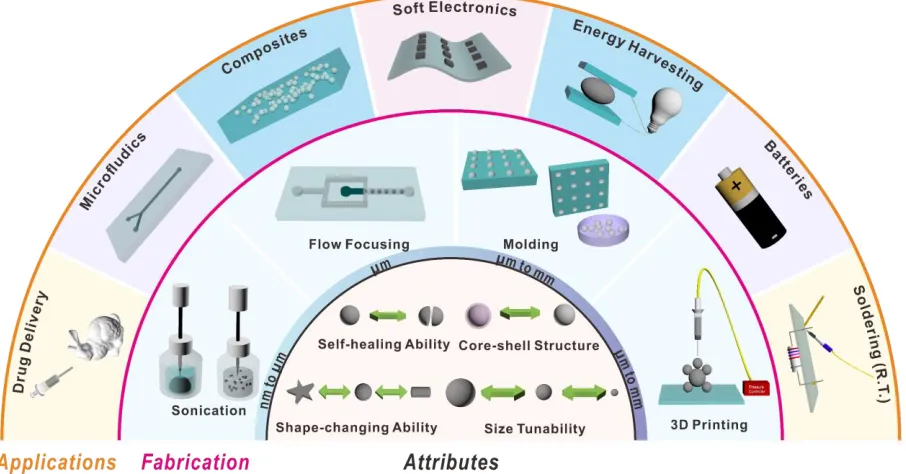
Figure 1.2 Attributes, fabrication and applications of liquid metal particles. 1) The inner semi-circle describes the attributes of liquid metal particles, including, self-healing ability, core-shell structure, shape-changing ability, and size tunability; 2) the middle annulus describes the methods of fabrication of liquid metal particles with different sizes using sonication, flow focusing, molding or 3D printing; 3) the outer annulus describes the application of liquid metal particles, including, drug delivery, microfluidics, composites, soft electronics, energy harvesting, batteries and soldering at room-temperature (R.T.) . ... 6 Figure 1.3 Attributes of liquid metal particles. a) Core-shell structure of liquid metal particles
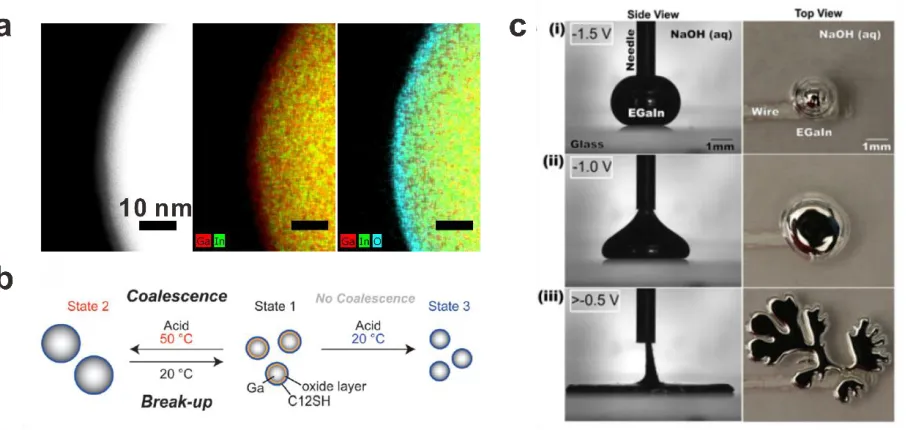
with a liquid core and oxide shell. Liquid metal nanoparticles images under transmission electron microscope (TEM) with element mapping and the thickness of the oxide layer (cyan) is ~3 nm. Adapted with permission.44 b) Size-tunable
liquid metal particles. The size of liquid metal nanoparticles can be tuned reversibly through modulating the balance between the oxide layer and the stabilization effort of surfactants. Adapted with permission58. c) Shape-changing
ability. Without the presence of oxide, the surface tension of liquid metal particles can be tuned by applying low voltages to expand liquid metal into confined structures. Without confinement, the particles grow into a “finger” shape. Adapted with permission.40... 9
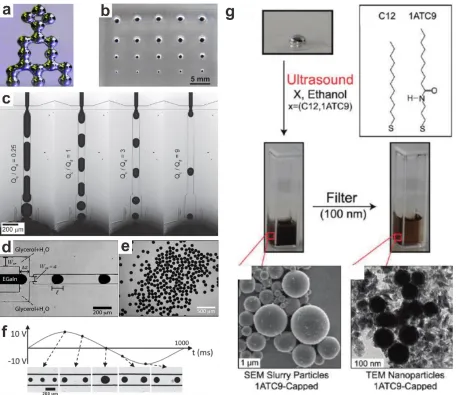
Figure 1.4 Liquid metal particles produced with a variety of fabrication methods. a) A 3D “tower” stacked with liquid metal particles produced by 3D printing. Adapted with permission.90 b) Molding to produce liquid metal particles with various sizes.
Adapted with permission.66 c) Microfluidic production to produce different
micron liquid metal particles by changing the flow rate ratios. Adapted with permission.81 d-e). A flow-focusing device to produce homogenous liquid metal
microparticles. Adapted with permission.71 f.) The size of liquid metal
microparticles could be tune with modest voltage (-10 V to 10V) in flow-focusing. Adapted from permission80. g) Fabrication of liquid metal micro/nanoparticles via
ultrasound, followed by filtering to remove larger particles. Adapted with permission.83 ... 15
Figure 1.5 Liquid metal nanoparticles for drug delivery. a) Nanomedicine based on liquid metal nanoparticles can be injected into tumor cells and fused under low pH to fasten the releasing of drugs on the surface. Adapted with permission.40 b) Coated
with graphene quantum dots, liquid metal nanomedicine can transform from a spherical shape to a solid rod shape in tumor cells under IR treatment due to the oxidation of the metal. Adapted with permission.93 c). Schematic illustration of
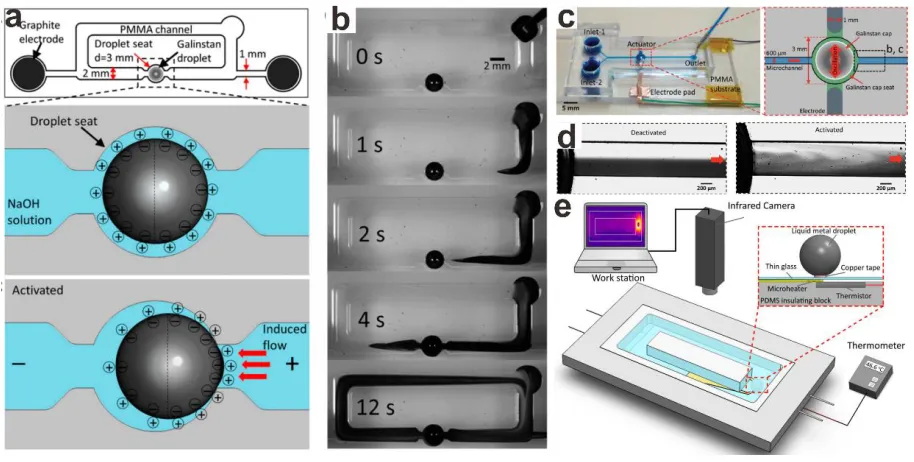
ix Figure 1.6 Microfluidics based on liquid metal particles. a) Schematic of the liquid metal
enabled pump and its pumping mechanism. b) Screenshots of the pumping process. Adapted with permission.98 c) Schematic of the liquid metal-enable
mixer and the experimental setup. d) Screenshot of the two immiscible liquid phases when the mixer is deactivated/activated. Adapted with permission.99 e)
Schematic of the liquid metal particles enabled cooling system. Adapted with permission.100
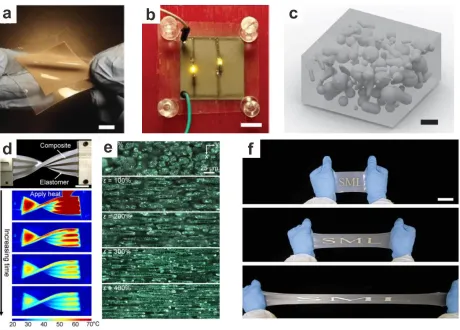
... 20 Figure 1.7 Composite of liquid metal particles and elastomer. a) Image of soft, flexible and
stretchable liquid metal elastomer composite. b) The composites become conductive under localized mechanical force and electrically connect the circuits to light up LEDs. c) Schematic morphology of the liquid metal elastomer composite. Liquid metal particles are caged in elastomer mattress. Adapted with permission.101d) Flexible liquid metal elastomer composite can dissipate heat
quickly, demonstrating a relatively high thermal conductivity. e) Morphology of liquid metal elastomer under 0, 100, 200, 300 and 400% strain. The images are taken under optical microscope. Adapted with permission.102 f) Highly stretchable
liquid metal elastomer composite with excellent dielectric properties. Adapted with permission.104 ... 22
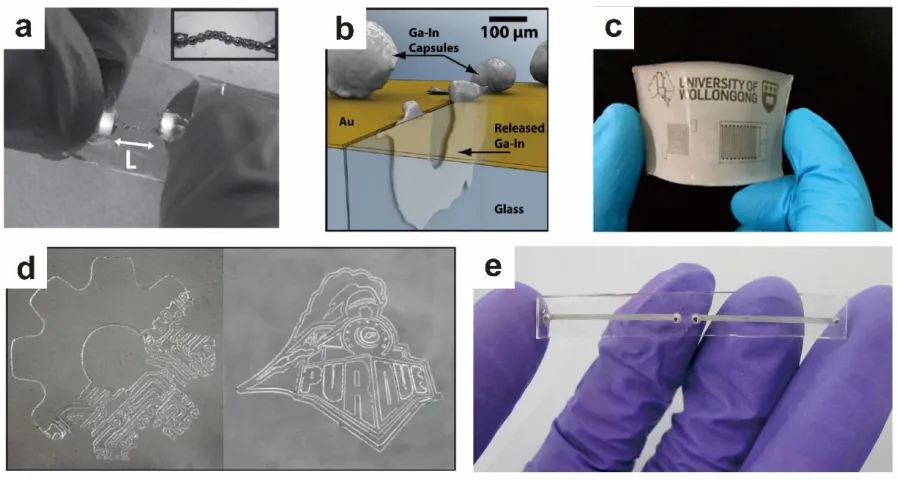
Figure 1.8. Soft electronics based on liquid metal particles. a) Stretchable interconnects using 3D printing liquid metal droplets. Adapted with permission.90 b) Self-healing
circuits with liquid metal particle capsules. Upon mechanical damage, the capsules will break to release the inner liquid metal to restore conductivity. Adapted with permission.106c) A soft circuit based on liquid metal nanoparticles.
Adapted with permission.44 d) Spray printing of liquid metal particles, followed
by mechanical sintering into conducive patterns. Adapted with permission.113 e)
A soft antenna device based on microfluidics and liquid metal nanoparticles. The conductive length of the antennas can be tuned via mechanical sintering to alter the resonant frequency. Adapted with permission.44 ... 25
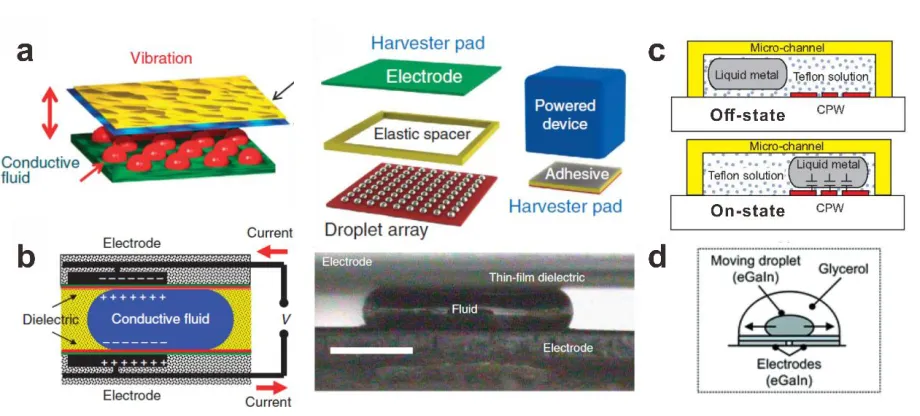
Figure 1.9 Liquid metal particle-based energy harvesting devices or microswitches. a) Schematic mechanism and application of liquid metal reversible-electrowetting to convert vibration into electrical energy. b), Schematic mechanism and experimental design of liquid metal reversible-electrowetting microfluidic device. Adapted with permission.115 c) A microswitch based on liquid metal particle,
Teflon solution is utilized to prevent the adhesion of liquid metal. Adapted with permission.118d) An inertial sensor based on liquid metal particle, glycerol
solution is applied to prevent the liquid metal adhesion. Adapted with permission.119
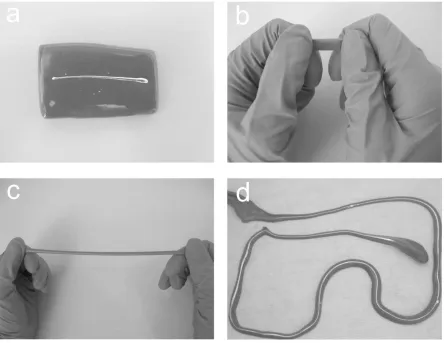
... 28 Figure 2.1 Drawing of EGaIn wires by hand at room temperature. (a) EGaIn lines dispensed
on a putty (viscoelastic polymer) substrate. (b) Putty before stretching by hand. (c) Stretched putty with elongated liquid metal lines. (d) A curvy EGaIn wire supported by putty after stretching. ... 54 Figure 2.2 Characterization of the EGaIn wires on putty. (a) Plot for the diameters of EGaIn
wires as a function of the strain applied to the putty. (b) Linear plot of diameter as a function of the inverse square root of the stretch ratio. The fit quality is R2=0.98. (c) Optical microscopic images of a small EGaIn wire. The scale bar is
x Figure 2.3 Fabrication of wires consisting of a metal core and insulating shell of three
disparate materials (scale bar 10 mm). (a) Fabrication of core-shell metal wires using putty. (b) Fabrication of core-shell metal wires using SE 1700 pre-polymer gel. (c) Fabrication of core-shell metal wires using PVA (with water and borax). (d) Plot of the tensile stress as a function of tensile strain for cured PVA and SE 1700 samples. (e) Plot of the storage modulus and loss modulus as a function of frequency for putty, PVA, SE 1700 samples before curing (G’ closed symbols, G’’ open symbols). (f) Plot of complex viscosity as a function of frequency for putty, PVA, SE 1700 before curing... 60 Figure 2.4 Patterning of wires for “wires on demand”. (a) After draping an EGaIn wire in
putty across a circuit, the EGaIn sinks through the putty to complete the electrical circuit. (b) Dissolving away an encapsulating polymer (PVA) produces free-standing liquid metal wires. The scale bar is 2 mm. ... 62 Figure 2.5. Metal wires with various geometries formed at room temperature. (a) Parallel
networks of metal lines. (b) Branched wires on a PVA substrate. (c) Branched wires obtained by first contacting a wire loop with additional PVA and then stretching. (d) Helical wires. (e) Stretchable and twistable wires. (f) Helices of liquid metal wires can light up an LED inserted into the putty... 64 Figure 3.1 a) Schematic process of vacuum filling liquid metal into a T-shaped microfluidic
channel with only one inlet and no outlets. A drop of metal covers the inlet. The whole substrate is placed in a vacuum chamber, which removes the air from both the chamber and the elastomer. Releasing the vacuum returns the ambient to atmospheric pressure, which pushes the metal into the channels. Excess metal can be removed as a final step (optional). b) Snapshots of vacuum filling a maze of microchannels at different time frames. The scale bar is 3 mm. ... 77 Figure 3.2 Direct comparison of vacuum filling and injection using a T-shape microchannel.
The scale bars are 5 mm (left column) and 200 μm (right column). ... 79 Figure 3.3. Comparison of vacuum filling and injection (into microchannels with an outlet)
samples taken with a camera (left, scale bar 3 mm) and optical microscope (right, scale bar 200 μm). ... 80 Figure 3.4 Complex microfluidic designs completed with vacuum filling. a) A road map,
scale bar 5 mm; b) coil antenna, scale bar 1 mm; c) branched tree design, scale bar 5 mm; d,e,f) branched structure, scale bar 1 mm, g) soft circuit board, scale bar 1 mm; h) wheel design with four adjacent terminals and its inset under optical microscope, scale bar 1 mm (main image) and 100 μm (zoomed in image); i) a linear microfluidic channel with narrowing end and its inset taken by top-down optical microscopy (so the metal appears shiny), scale bar 1 mm (main image) and 10 μm (zoomed in image) ... 82 Figure 3.5. a) Comparison between experimental data and simulation data (assuming no gas
xi starting point is defined as when the liquid metal begins to fill into the microchannel. ... 86 Figure 4.1 Characterization of EGaIn nanoparticles. (a) EGaIn in ethanol solvent before
probe sonication. (b) EGaIn suspension after probe sonication. (c) Size distribution of EGaIn particles. Mean diameter is ~105 nm and is fit by a Gaussian distribution. Thumbnail is a typical TEM image of EGaIn NPs under JEOL 2010F. The scale bar is 50 nm. (d) A TEM image for EGaIn coating. The black core is the liquid metal and the lighter part is the coating. Two layers of coating could be observed; the inner coating (gallium oxide) is ~3nm thick. The scale bar is 5 nm. (e) A typical STEM image of EGaIn NPs. The scale bar is 50 nm. (f) Element mapping of the EGaIn coating. From left to right, the picture shows EGaIn NPs; In (green); Ga (red) and In (green); Ga (red), In (green), O (cyan); Ga (red), In (green), O (blue), C (cyan). The scale bar is 10 nm. ... 99 Figure 4.2. Fabrication and characterization of a soft circuit board. (a) Schematic design of
the soft circuit board. (b) A rectangle circuit board inserted with two copper wires. The path between the copper wires is initially non-conductive. After applying external pressure using a marker, the path becomes conductive with a resistance of 4.5 Ω. (c) Linear plot for the resistivity data of the soft circuit board. The slope (resistivity) is 0.00104 Ω ∙ cm; the fit quality is R2=0.96. (d) A “NC” soft circuit
board with LEDs. (e) A laser sintered sample with a conductive “Liquid” pattern. The scale bar is 3 mm. ... 102 Figure 4.3 Fabrication and characterization of microfluidic devices that can be sintered
mechanically. (a) Schematic design of the microfluidic devices. (b) A microfluidic device with “NCSU” logo. (c-d) SEM images of liquid metal particles in the channel before sintering. The scale bars are 25 and 10 μm, respectively. (e-f) SEM images of the particles after sintering. The scale bars are 25 and 10 μm, respectively. (g) Experimental design of sintering pressure measurement. (h) Plot of the sintering pressure versus thickness of the PDMS overlayer. ... 106 Figure 4.4 Fabrication and characterization of a tunable dipole antenna formed on-demand
by mechanical sintering. (a-b) Flexible antenna injected with a suspension of EGaIn particles. (c) Schematic design of the antenna with different conductive lengths tuned by mechanical pressure. (d) Measured reflection coefficient of an antenna with different conductive lengths. With the increased conductive lengths from 15 to 25 mm, the resonant frequency shifts from 3 to 1.8 GHz. ... 109 Figure S4.1 Photographs of vials containing EGaIn particles in (from left to right) benzene,
water, dodecane and ethanol imaged 4 hours after identical sonication conditions. ... 117 Figure S4.2. I-V curve of the EGaIn NPs film before and after sintering respectively. ... 118 Figure 5.1 TEM images of liquid metal nanoparticles. (a) Rods obtained from sonicating
gallium (left column) and EGaIn (right column) in aqueous solution with the presence of Lys protein. (b) Nanospheres synthesized by repeating (a) while using an ice bath. (c) Rods obtained from post heating the spheres from (b). The scale bars are 100 nm. ... 124 Figure 5.2.Characterization of liquid metal (EGaIn) nanomaterials along with proposed
xii particles taken after sonication and the spectra for standard GaOOH (PDF 04-010-9861) and indium (PDF 01-080-5356). (b) 1) TEM image of GaOOH rods; 2) Selected-area electron diffraction (SAED) pattern from the red region in image 1), which can be indexed to Orthorhombic GaOOH phase; 3) and 4) High-resolution TEM (HRTEM) image and its Fast Fourier transform (FFT), showing the defective lattice structure. The scale bars are 100 and 3 nm. (c) Synthesis of GaOOH from direct sonication and corresponding STEM image and EDS mapping. The scale bar is 100 nm. (d) Mechanism for the shape transformation and corresponding STEM image and EDS mapping. The scale bars are 30, 100, and 300 nm for Stage 1, Stage 2, and Stage 2, respectively... 128 Figure 5.3.TEM micrographs depicting liquid metal nanomaterials stabilized with different
positively-charged surfactants, including small molecule cetrimonium bromide (CTAB) (CTAB), synthetic polymer poly(4-vinyl-1-methyl-pyridinium bromide) (P4VMPB), and protein lysozyme (Lys). The particle morphology was the same for all three positively-charged surfactants. The scale bars are 100 nm. ... 130 Figure 5.4 Characterization of liquid metal (GaInSn) materials using STEM-EDS. EDS
mapping of the rods and nanosphere obtained from sonication. The scale bars are (from top to bottom) 100, 20, and 100 nm. ... 131 Figure S5.1 Liquid metal sonication in an aqueous solution. (a) Liquid metal in an aqueous
solution with/without Lysozyme (Lys) before sonication. (b) Liquid metal in an aqueous solution with/without Lys immediately after sonication. (c) Liquid metal in an aqueous solution with/without Lys after sonication and settling for one hour. The volume of the vial is 20 mL... 139 Figure S5.2 Morphology transition as a function of sonication time explored by scanning
electron microscopy. (a) Liquid metal particles obtained after 1 min sonication with Lys. (b) Liquid metal particles obtained after 3 min sonication with Lys. (c) A transition from sphere to rod, obtained after 5 min sonication with Lys. (d) Rods obtained after 10 min sonication with Lys. The scale bars are 500 nm... 140 Figure S5.3 SEM micrographs of the rods in the foam that forms above the liquid during
sonication. The scale bar is 200 nm. ... 141 Figure S5.4.TEM micrographs of the nanoparticles obtain from sonicating liquid metal in ice
bath. The size distribution plot is calculated from more than 100 particles with Gauss fit. The scale bar is 100 nm. ... 142 Figure S5.5.Characterization of GaOOH rods before and after beam damage. Scale bars are
100 nm. ... 143 Figure S5.6 Morphology of liquid metal particles in the presence of different
positively-charged surfactants including Cytochrome C (from equine heart) and polyethyleneimine. The scale bars are 500 nm. ... 144 Figure S5.7. Morphology of liquid metal particles in the absence of surfactants or the
presence of different negatively-charged surfactants, including: albumin, polystyrene sulfonic acid, sodium dodecyl sulfate (SDS). The scale bars are 500 nm. ... 145 Figure S5.8. XPS spectrum of 1) EGaIn thin film on silicon wafer, 2) lysozyme on silicon
xiii Figure S5.9. Characterization of liquid metal particles with the presence of Lys and
1 CHAPTER 1
Introduction - Attributes, Fabrication and Applications of Gallium-based Liquid Metal Particles
2
Attributes, Fabrication and Applications of Gallium-based
Liquid Metal Particles
Yiliang Lin, Jan Genzer, Michael D. Dickey,
Department of Chemical & Biomolecular Engineering, North Carolina State University, Raleigh, NC 27695-7905, USA
Abstract
3
1.1
Introductions
Metals that are liquid at room temperature are attractive due to their unique combination of fluidic and metallic properties. As a fluid, liquid metal is the softest among all the conductive materials1. It can be stretched while maintaining metallic conductivity. The ability to remain highly conductive, yet soft and stretchable, endows liquid metals with unique properties that can be employed in numerous applications, especially, in soft and stretchable electronics2.
Mercury is a commonly-known liquid metal; yet, its toxicity limits application3,4. In contrast, gallium and its alloys serve as promising liquid metals due to their low toxicity and negligible vapor pressure5. The native oxide that formed on these metals can not only lower the interfacial tension of liquid metal, but can also add a thin, mechanical “skin” to the surface, which allows the liquid metal to sustain non-spherical structures. The presence of oxide skin helps liquid metals to adhere to various substrates and can thus be utilized for patterning. Recent reviews6,7 have introduced methods to pattern liquid metals; the presence of oxide skin enables liquid metal to be employed in a variety of applications8, including, stretchable wires9,10, soft conductors11–14, sensors15–19, antennas20–28, electrodes29–32 and circuit components33,34.
4
1.2 Liquid Metals
The unique combination of fluidic and metallic properties of gallium and gallium-based liquid-metal alloys makes them promising candidates for soft electronics2,8, soft composites35,
microfluidics36, chemistry37 and many other applications. While the melting point of gallium is
~30°C, alloying with other metals, e.g., indium and tin, can lower the melting point below room temperature. The two most popular examples are eutectic gallium-indium (EGaIn, 75 wt% gallium and 25 wt% indium) with a melting point of 15.7°C and Galinstan (typically composed of 68 wt% of gallium, 22 wt% of indium and 10 wt% of tin) with a melting point ~−19°C. Gallium-based liquid metals have similar physical and chemical properties.
These metals have several intriguing and beneficial properties: 1) The melting point of gallium and its alloys are near or below room temperature. In some applications, it may be appealing for particles to undergo phase change (to absorb heat or dramastically change mechanical properties). Notably, the metal can stay as a liquid well below the melting point due to the supercooling effect of gallium.38 2) Gallium has negligible vapor pressure39 and low toxicity,
which makes it compatible with biological applications40. 3) These metals have water-like
viscosity (the viscosity of EGaIn is 1.99 × 10⁻³𝑃𝑎 ∙ 𝑠, ~2 times that of water41). 4) Compared to
other liquids, the electrical conductivity of gallium and its alloys are relatively high (i.e., the conductivity of EGaIn is 3.4 × 10⁶𝑆 𝑚⁄ )42. 5) Gallium and its alloys have very high surface
tension (> 500 mN 𝑚⁄ )43. It spontaneously forms a thin oxide skin when exposed to oxygen, thus
significantly lowering the interfacial tension of the liquid, yet adding a mechanical “skin” to the
5 when the external pressure overcomes the yield stress of the oxide skin42. The reformed oxide skin
stabilizes the structures when the applied stress (e.g., pressure or shear) is below the surface yield stress. 7) The oxide skin can be removed by acid or base (Figure 1b) or via electrochemical reduction; the surface tension of EGaIn can be manipulated with less than 1 V by depositing or removing the oxide via electrochemical reactions. 45. 8) Many metals can dissolve into gallium, it
is therefore possible to change the properties of the metal, including the nature of the surface species.46
Figure 1.1 Oxide skin on liquid metal particle. a) The oxide skin helps maintain liquid metals as non-spherical structures. Adapted with permission.47 b) The oxide skin can be removed by acid to
change the particle shape from non-spherical to spherical. Adapted with permission.8
What is a Particle?
6 length ( λ𝑐 = √
𝛾
𝜌𝑔, where 𝑔 is the gravitational acceleration and ρ is the density of the fluid, and 𝛾
is the surface tension of the fluid-fluid interface), beyond which the gravity becomes important. For gallium-based liquid metal, the capillary length is 2.9 mm. Therefore, the liquid metal particles discussed within this review are no larger than a few mm.
Organization of the Chapter
The chapter is divided into three sections, as shown in Figure 2: 1) the attributes of liquid metal particles; 2) the fabrication of the liquid metal particles; and 3) the applications of liquid metal particles.
7
1.3 Attributes of Liquid Metal Particles
Liquid metal particles not only possess high electrical and thermal conductivity, low melting point and natural oxide skin, but also have several other unique features. Some attributes of the liquid metal particles are summarized below.
Core-shell Structure
Liquid metal particles adopt a core-shell structure due to the oxide skin forming on the surface, similar to a water balloon. The oxide skin is ~3 nm thick and comprises primarily gallium oxide, despite the fact that the gallium-based liquid metals might contain indium or tin44,48, as
demonstrated in Figure 3a. While the most stable gallium oxide structure is 𝛽 − Ga2O3, the oxide automatically forming on the liquid metal surface is reported to be amorphous or poorly crystallized.44,48,49 Interestingly, when gallium alloys with other metals, whose oxides have a lower
Gibbs free energy of formation compared to gallium oxides, i.e., aluminum, hafnium and gadolinium, the oxides forming on the alloys will change from gallium oxide to the others, i.e., aluminum oxide, hafnium oxide or gadolinium oxide.
During formation of the particles, surface modification strategies can either anchor a molecular modifier on the bare metal (before oxidation occurs or in the absence of oxidation) or to the gallium oxide itself. A variety of chemical modification strategies can be applied, e.g., thiols
50 for binding to metals or silanes 51 or a phosphates52 for oxides. The capability to engineer the
8
Self-healing Ability
Gallium-based liquid metal can spontaneously form an oxide skin on the surface when exposed to air; the oxide skin behaves as a mechanical “membrane” for stabilization. The oxide skin on the liquid metal particles endow them with healing properties. For instance, when a liquid metal particle is broken, the newly forming oxide skins stabilizes the resulting particles. Bringing the resulting particles together with sufficient stress or removal of oxide skin, reunites the smaller particles into one larger particle. This unique property can endow devices with self-healing properties, especially for conductive electronics.44,48,53–55
Size Tunability
While it is generally possible to synthesize/fabricate metallic particles of various sizes, it is difficult to change their sizes afterward. However, liquid metal particles can be physically broken into smaller ones (e.g. by sonication). Likewise, particles can merge together by bringing the particles in contact with sufficient pressure. The balance between the break-up and coalescence of liquid metal nanoparticles can be adjusted by changing the temperature or adding acid to modulate the balance between the oxide layer and the stabilization effort of surfactants56(Figure 3b).
Shape-changing Ability
9 Figure 1.3 Attributes of liquid metal particles. a) Core-shell structure of liquid metal particles with a liquid core and oxide shell. Liquid metal nanoparticles images under transmission electron microscope (TEM) with element mapping and the thickness of the oxide layer (cyan) is ~3 nm. Adapted with permission.44 b) Size-tunable liquid metal particles. The size of liquid metal
nanoparticles can be tuned reversibly through modulating the balance between the oxide layer and the stabilization effort of surfactants. Adapted with permission58. c) Shape-changing ability.
Without the presence of oxide, the surface tension of liquid metal particles can be tuned by applying low voltages to expand liquid metal into confined structures. Without confinement, the particles grow into a “finger” shape. Adapted with permission.40
1.4 Fabrication of Liquid Metal Particles
Generally, metallic particles could be produced through bottom-up approach or top-down approaches and there exists many ways to produce metallic particles, i.e., chemical reduction of metallic salts, microemulsions, chemical vapor deposition, microwave irradiation and so on. For gallium, gallium micro/nanoparticles can be deposited on substrates via thermal deposition or by molecular-beam epitaxy59–61. It is difficult, yet possible, to synthesize colloidal gallium particles
using conventional solution-phase chemistries due to the large oxidation potential of gallium62.
top-10 down approaches.
3D Printing and Dispersing (10s of μm to a few mm)
The fluidic nature of liquid metals makes them compatible with numerous patterning techniques. Perhaps the easiest approach to produce liquid metal particles is through manual syringe/pipet extrusion. Based on this simple phenomenon, arbitrary 3D conductive structures could be produced through stacking the liquid metal particles or chaining them together.63–65 Loaded in a
fluid dispenser, liquid metal particles/lines ranging from tens of microns to a few mm can be fabricated with accurate pressure control and arbitrary 3D conductive microstructures can be directly written with a 3D moving stage (Figure 4a). During the printing process, the applied pressure overcomes the yield stress of the oxide skin to shape the liquid metal into different structures, i.e., particles or wires, and the newly formed oxide skin helps to stabilize the structures afterwards. The smallest reported liquid metal particles are limited to tens of microns, and in principle, smaller liquid metal particles can be produced with smaller-diameter nozzles. However, with smaller-diameter nozzles, the pressure required to disperse the liquid metal particles (to overcome the surface yield stress of the oxide) will also increase, which in turn makes it harder to control the particle size.
Molding (10s of um to a few mm)
Molding generally refers to the fabrication process that involves shaping liquid or pliable raw materials using a mold. It is possible to mold liquid metal to produce particles66. In this molding
11 of the reservoir. (Figure 4b) In this specific case, elastomer reservoirs are prepared through molding on patterned acrylic substrates via laser writing, which limits the size of the particles. In principle, it should be possible to create structures as small as 1 μm through the use of molds with smaller features67 or selective wetting68. As the mold dimensions get smaller, the pressure required
to push metal into the mold increases. Thus, the smallest particles created by molding are limited by the ability to fill the mold with metal. In principle, if the metal wets the mold (e.g. by using a metal coating on the mold), the necessary pressure should decrease. Molding has appeal of being simple, while providing control over the size (and size distribution) of the particles. In addition, the particles can be arranged spatially within a mold, which may be useful for certain applications. Although in principle molding can scale to be high throughput technique, in a laboratory environment it produces fewer particles in a given amount of time relative to other methods.
Microfluidic Production (50-200 μm)
Microfluidics provides a way for fabricating droplets in a controlled and reproducible manner, and it is capable to produce a narrow-distribution of particles diameters with ~1-3% polydispersity (defined as the standard deviation of the size distribution divided by the mean droplet size)69. In
microfluidic production, one phase “A” is driven into a microchannel, in which, it encounters the immiscible carrier fluidic (continuous phase B). The interface deforms due to the local flow field and can cause the phase “A” to deform into droplets. Multiple studies70–76 have demonstrated the
12 shear the metal into particles as they pass through the orifice. The addition of surfactants, i.e., sodium dodecyl sulfate or polyvinyl alcohol, help stabilize the microparticles and prevent the coalescence after production. The oxide that forms on the particles also helps stabilize the particles, but the addition of surfactants helps to prevent them from coalescing. For liquid metal, the interfacial tension could be further tuned with electrical field to change the size of the microparticles, as shown in Figure 4f. Interestingly, after the formation of the liquid metal microparticles in the microchannels, it is also possible to hydrodynamically transfer the particles across a fluid-fluid interface into other fluidics within a monolithic chip. 77
Typically, the produced microdroplets size are tens to hundreds of microns in diameter and can be tuned by adjusting the flow rates, microfluidic channel geometry, viscosity of the continuous phase and the interfacial tension between the two phases, similar to other fluidic systems78. One of the exciting aspects of using liquid metals is that the surface tension of liquid
metal can be tuned in real time with electrical potential. The electrical double layer that forms at the interface lowers the tension, as described by Lippmann’s equation. In addition, electrochemical oxidation of the surface can further lower the tension43,79. Therefore, using a modest voltage range
(< 20 V), the diameter of the liquid metal microparticles can be tailored in real time, resulting in microspheres, some of which have diameters even 25% smaller than the width of the orifice(which is unusual in flow focusing)80. Interestingly, microfluidic production can also produce oval
particles81 or even liquid metal fibers80
Ultrasonication (10s of nm to a few μm)
13 high temperature (~5000°C) and very high pressure (~500 atmospheres), making it a powerful method to produce nanoparticles82. Ultrasonication can produce liquid metal micro/nanoparticles.
In a typical experiment, liquid metal is added into a vial filled with solvent (typically ethanol) and placed in an ultrasonic bath a few hours, followed by filtering or centrifugation to remove larger particles. The addition of molecules such as 1-dodecanthiol/3-mercapto-N-nonylpropionamide form self-assembled monolayers on the surface of the particles to help stabilize them from coalescence83 (Figure 3g). One systematic study84 investigated the stabilization effect of thiols
with different alkyl chains and revealed that 1-octadecanethiol is the most efficient thiol tested to bind to the metal for stabilization and de-oxygenating the solution will result in unstable suspension due to the lack of the oxide skin. Interestingly, in ethanol solvent, the produced nanoparticles are stable without precipitation for a few weeks without the presence of self-assembled layers attached to the particle surface. This is most likely due to the presence of carbon layer on the nanoparticles44,48. Generally, liquid metal nanoparticles in aqueous solution are not
stable since gallium tend to react with water and oxygen and the suspension will precipitate within one hour. Yet, it is possible to stabilize the colloidal liquid metal nanoparticles in aqueous solution with the presence of surfactants85 or hydrophilic polymer86 to a few days. Also, it is possible to
reversibly manipulate the size of the nanoparticles during sonication to some extent. Under ultrasonication, the balance between the break-up and coalescence of the gallium nanoparticles can be adjust by the changing the temperature or adding acid through modulating the natural surface oxide layer (which can be removed with acid) and stabilizing effects of the thiols56. While
an ultrasonic bath is easily accessible in most laboratories and provides sufficient energy to break the liquid metal into particles, follow-up studies44,48,55,58,87 have introduced probe sonication to
14 can induce the acoustic wave to break liquid metal into micro- to nanoparticles using acoustic waves. It has the advantage to further control the size of the particles through tuning the interfacial tension via electrochemistry or electrocapillarity in the acoustic field86,88. Finally, under large shear
15 Figure 1.4 Liquid metal particles produced with a variety of fabrication methods. a) A 3D “tower” stacked with liquid metal particles produced by 3D printing. Adapted with permission.90 b)
Molding to produce liquid metal particles with various sizes. Adapted with permission.66 c)
Microfluidic production to produce different micron liquid metal particles by changing the flow rate ratios. Adapted with permission.81 d-e). A flow-focusing device to produce homogenous liquid
metal microparticles. Adapted with permission.71 f.) The size of liquid metal microparticles could
be tune with modest voltage (-10 V to 10V) in flow-focusing. Adapted from permission80. g)
16
1.5 Applications of Liquid Metal Particles
Drug Delivery
Transporting a pharmaceutical compound into the body to safely achieve its desired therapeutic effect is important for biomedical application. Generally, the direct delivery of drugs or biomolecules is not efficient as it suffers from numerous problems, including, for instance, enzymatic degradation of DNA. Therefore, it is desired to explore safe and efficient carriers for drug delivery, among which inorganic nanoparticles are one promising candidate due to their versatile properties91. Given that mercury (another liquid metal) is toxic, liquid metals are
generally associated with the notion that they are all toxic. Yet, gallium-based liquid metals possess very low toxicity and are suitable candidates as carriers for drug delivery40,92,93. A recent review
highlight some biomedical applications of liquid metal94 and here we will only discuss liquid metal
17 Moreover, gallium-based nanomedicines become near-infrared (IR) light responsive upon surface modification. Liquid metal nanosphere can transform into gallium oxide hydroxide nanorods in the presence of water due to the oxidization of gallium95. Coated with graphene
quantum dots, the spherical liquid metal nanoparticles absorb the IR light, which drives the shape changing process. Within tumor cells, the shape transformation from nanosphere to nanorod can not only fasten drug release but also breaks the endosomal membrane to achieve better cancer treatment.92,93 (Figure 5 b-c) In addition to photothermal effect and the control release of
anticancer drugs, reactive oxygen species generated in the IR light/laser radiation also effectively eliminate cancer cells. 92,93 When combined with biomedical hydrogels, liquid metals can be
utilized as drug delivery vehicles responding to magnetic and electrical field.96 While the
18 Figure 1.5 Liquid metal nanoparticles for drug delivery. a) Nanomedicine based on liquid metal nanoparticles can be injected into tumor cells and fused under low pH to fasten the releasing of drugs on the surface. Adapted with permission.40 b) Coated with graphene quantum dots, liquid
metal nanomedicine can transform from a spherical shape to a solid rod shape in tumor cells under IR treatment due to the oxidation of the metal. Adapted with permission.93 c). Schematic
illustration of the experimental system and design drawing of the microdevice based on a straight microchannel. Red arrows show the direction of liquid metal nanocapsule movement. Adapted with permission.92
Microfluidics
A recent review highlighted the advantage and applications of liquid metals for microfluidics36.
19 such as coalescence, mixing and sorting in combination with fast analysis tools97. The metallic and
soft nature of the liquid metals particles make them unique in droplet-based microfluidics and several applications are discussed. 1) Pump: In microfluidics, pumps are essential to drive liquid flow in the channels and liquid metal particles can be employed as pumping elements. As shown in Figure 6a 98, when voltage is applied across the electrolytes, the charges at the interface will
repel each other, resulting in decreasing the interfacial tension (Lippmann’s equation). As the potential drops across the liquid metal particles, there is an interfacial tension gradient on the particles, which leads to Marangoni flow at the interface. Therefore, the electrolyte moves across the surface of the metal particle, resulting in pumping (cf. Figure 6b). 2) Mixer: Similar to the pumping mechanism, while under a sinusoidal signal, liquid metal particles in solution induce harmonic Marangoni flow, thus generating vortices the solution. Such phenomenon can be integrated in a microchannel system to induce chaotic advection, where high efficiency of mixing is achieved for the two fluidic phases99 (cf. Figure 6c-d). 3) Cooler: Pumping can be further
20 Figure 1.6 Microfluidics based on liquid metal particles. a) Schematic of the liquid metal enabled pump and its pumping mechanism. b) Screenshots of the pumping process. Adapted with permission.98 c) Schematic of the liquid metal-enable mixer and the experimental setup. d)
Screenshot of the two immiscible liquid phases when the mixer is deactivated/activated. Adapted with permission.99 e) Schematic of the liquid metal particles enabled cooling system. Adapted with
permission.100
Composites
Polymer-metal composites are important due to their ability to engineer the electrical, thermal, and mechanical properties. The unique combination of liquid metal and elastomer can create soft composites. A recent review35 highlights the advantages and the recent progress of liquid metal
and polymer composites and describes recent progress in the area of composites featuring liquid metal droplets and elastomers. Thus, we only briefly discuss them here.
21 polydimethylsiloxane (PDMS) via pestle to make liquid metal and elastomer composites101
(Figure 7a-b). Under shear, the liquid metal broke into smaller particles within PDMS and the following curing step “caged” the particles within the PDMS network. The composite was non-conductive (cf. Figure 7c). However, it turned into a conductive system when localized compression force was applied due to the tearing or rupture of the foam cell walls around the liquid metal particles and the formation of continuous network of liquid metal. Such a composite can then be used as a soft and writable circuit to connect circuit elements. The composite can be stretched to more than 100% strain repeatedly with relatively high conductivity (1.05 × 10⁴𝑆 𝑚⁄ ).
In addition to the electrical properties, the liquid metal particles within elastomer composites can exhibit excellent thermal properties. Combined with liquid metal particles, the elastomer composite increases the thermal conductivity ~25 times relative to the base elastomer under no stress. Under stress, the soft liquid metal droplets in the elastomer network are deformed and the morphology of the composite changes to create thermally conductive pathways. Therefore, the thermal conductivity further increases102 (Figure 7d-e). The unique combination of high
thermal conductivity and elasticity is promising for creating soft devices with rapid heat dissipation.
The liquid metal elastomer composites also exhibit excellent dielectric properties. Dielectric elastomer is a suitable category for Maxwell stress-induced actuation due to its relatively low Young’s modulus. Such systems are promising for generating soft sensors or soft robotic systems103. However, most dielectric elastomers possess low dielectric properties, which require
22 composite can increase the dielectric performance without noticeably increasing the composite modulus. The integration of liquid metal microparticles inside silicone elastomer can increase the dielectric constant to over 400% with a low dielectric dissipation factor, while allowing the composite to be stretched multiple times of its original length104 (Figure 7f). Such composite
materials would be ideal for soft sensors and soft robot applications.
Figure 1.7 Composite of liquid metal particles and elastomer. a) Image of soft, flexible and stretchable liquid metal elastomer composite. b) The composites become conductive under localized mechanical force and electrically connect the circuits to light up LEDs. c) Schematic morphology of the liquid metal elastomer composite. Liquid metal particles are caged in elastomer mattress. Adapted with permission.101d) Flexible liquid metal elastomer composite can dissipate
heat quickly, demonstrating a relatively high thermal conductivity. e) Morphology of liquid metal elastomer under 0, 100, 200, 300 and 400% strain. The images are taken under optical microscope. Adapted with permission.102 f) Highly stretchable liquid metal elastomer composite with excellent
23
Soft Electronics
While flexible or stretchable electronics can be produced based on materials and mechanical design strategies1,105,106, soft electronics requires the integration of intrinsically soft materials. The
fluidic and metallic nature of liquid metal makes it a great candidate for soft electronics. A recent review107 highlights the progress in liquid metal-based stretchable electronics; here soft electronics
based applications involving liquid metal particles will be discussed within several categories.
1) Soft Conductors
Liquid metals are intrinsically suitable to produce soft conductors due to their metallic and soft nature. Liquid metal particles produced by 3D printing108 or inkjet printting109 can be used for
stretchable interconnects to electrically connect circuit elements together.(Figure 8a) Also, it is possible to draw conductive liquid metal wires (as small as a few microns) at room temperature via stretching a polymer substrate with a liquid metal particles on it110.
2) Soft Circuits
Beyond soft conductors, liquid metal particles can be integrated on circuits and endow them not only with softness and stretchability, but with self-healing and responsive properties. 1) Self-healing. Liquid metal particles can be encapsulated with polymer shells to integrate on a gold substrate within a circuit. When the circuit is cut or broken and the gold substrate loses electrical continuity, the liquid metal will reconnect the path thus restoring the functionality of the circuit.
53,111 (Figure 8b) In principle, the mechanical properties of the polymer shell can be engineered to
24 be used as a soft circuit board with different circuit components. Initially, the circuit is not conductive due to the non-conductive oxide skin on the liquid metal nanoparticles. Yet, under located mechanical stress, the oxide skin will rupture and the liquid metal will merge to form a conductive path, akin to rupturing small water balloons.(Figure 8c)44,48 The merging of particles
is referred to as “mechanical sintering”, whereas conventional sintering of solid articles requires high temperatures to merge particles together, the “mechanical sintering” approach can be done at room temperature112. Liquid metal elastomer composites can achieve similar results but with lower
electrical conductivity than abovementioned “sandwich” structure101. It is possible to use
non-contact method, i.e., laser sintering, to connect the liquid metal particles, thus achieving the transition from non-conductive to conductive pathway with relatively high-resolution patterns44.
Alternatively, liquid metal particle inks can be prepared and spray-printed to fabricate different devices, followed by mechanical sintering into conductive patterns.113 (Figure 8d)
3) Soft Antennas
Liquid metal is a suitable candidate for soft antennas due to excellent electrical properties, which are necessary to radiate efficiently. A variety of soft antennas have been designed and fabricated using liquid metal, and the antennas can tune their spectral properties accordingly by changing the shape of the liquid metal20–26,28,114. In addition, the ability to mechanically sinter liquid metal
25 Figure 1.8. Soft electronics based on liquid metal particles. a) Stretchable interconnects using 3D printing liquid metal droplets. Adapted with permission.90 b) Self-healing circuits with liquid metal
particle capsules. Upon mechanical damage, the capsules will break to release the inner liquid metal to restore conductivity. Adapted with permission.106c) A soft circuit based on liquid metal
nanoparticles. Adapted with permission.44 d) Spray printing of liquid metal particles, followed by
mechanical sintering into conducive patterns. Adapted with permission.113 e) A soft antenna device
based on microfluidics and liquid metal nanoparticles. The conductive length of the antennas can be tuned via mechanical sintering to alter the resonant frequency. Adapted with permission.44
Energy Harvesting
26 (provided by applying a potential between the droplets and the dielectric-coated electrode). Electrowetting effectively converts electrical energy to mechanical energy (particle movement). In reverse electrowetting, the liquid particles are manipulated to vary the geometry of a capacitor and thereby move charge through a circuit. Liquid metals are an ideal conductive fluid for reversible electrowetting due to their high electrical conductivity, high surface tension and low vapor pressure compared to other conductive fluidics. Mercury is a suitable candidate especially considering that it tends not to wet on substrates; but its toxicity limits applications. Meanwhile, gallium-based liquid metals are safe to work with, but they require extra work to prevent adhesion to surfaces due to the native oxide. Figure 9a demonstrates a schematic of a droplet actuation mechanism based on vibration. A conductive fluidic array is patterned on an electrode substrate, covered by another dielectric-coated electrode. Vibration is applied to change the gap between the fluid and the dielectric-coated electrode to generate current.115 Alternatively, flowing a conductive
fluidic particle within a microchannel device can vary geometry of a capacitor as it flows past an electrode, as shown in Figure 9b.115
Switches
Liquid metal electrowetting can be applied for droplet-based microswitches. Droplet-based microswitches116,117 using mercury have been used widely over the past few decades. Yet, the
27 to avoid the alloying of gallium, and more importantly to prevent oxide adhesion in applications. Placing gallium-based liquid metal particles in a Teflon solution helps to eliminate adhesion, and a wide-band MEMS capacitive switch is developed, as shown in Figure 9c.118 In addition to Teflon,
other systems, i.e., glycerol solution119, can also prevent the adhesion of liquid metal particles. A
liquid metal particle is placed between two electrodes separated by a dielectric layer, which acts as a capacitor. Depending on the location of the liquid metal particle, the contact area of the capacitor changes and therefore the output capacitance alters accordingly (Figure 9d). Interesting, under modest voltages of ~1-10 V in basic aqueous electrolytic solution, two liquid metal particles could separate or coalesce, and a field-control electrical switch has been demonstrated for potential application as memory storage or logic and shape-programmable circuitry120. Another simple
approach to prevent wetting of liquid metal is to pre-wet the substrate with water, which behaves as a slip layer.121 While those abovementioned methods are based primarily on wet methods to
prevent liquid metal from adhesion, surface modification utilizing surface chemistry or geometry effects (dry methods), i.e., lotus leaf effect122, might be applicable to prevent the wetting of liquid
28 Figure 1.9 Liquid metal particle-based energy harvesting devices or microswitches. a) Schematic mechanism and application of liquid metal reversible-electrowetting to convert vibration into electrical energy. b), Schematic mechanism and experimental design of liquid metal reversible-electrowetting microfluidic device. Adapted with permission.115 c) A microswitch based on liquid
metal particle, Teflon solution is utilized to prevent the adhesion of liquid metal. Adapted with permission.118d) An inertial sensor based on liquid metal particle, glycerol solution is applied to
prevent the liquid metal adhesion. Adapted with permission.119
Batteries
29
Room-temperature Soldering
Soldering typically refers to a process when two or more items are joined together by melting and putting a solder into the joint; it typically requires high temperature for melting the solder. Gallium-based liquid metals possess melting points near or below the room temperature, and more importantly, they tend to alloy with other metals readily. Therefore, liquid metal particles are utilized for room-temperature soldering without heating to heal the damage surfaces.124
Liquid Metal Marbles
The naturally grown oxide on liquid metals tends to adhere to most substrates. Although it causes a variety of issues in many applications, it also provides a facile way to coat/modify the liquid metal particles with a variety of materials to engineer the surface properties for a variety of applications. The concept of liquid metal marbles is evident when the liquid metal particles are coated with insulator particles (including Teflon and silica), semiconductor particles, i.e., WO3, TiO2 , MoO3 , In2O3 , or carbon nanotube, by rolling the liquid metal particles over powders or
submerging them into a colloidal suspension.125 The marble coating can endow liquid metal
particles with mechanical stability and new functionality. For instance, liquid metal marbles could be utilized as active electronic junctions or heavy metal ion sensors. Specifically, liquid metals combined with WO3 coatings have the ability to induce bipolar electrochemically-induced actuation, due to the migrate of WO3 NPs along the surface of the marble upon the applications of an electrical field, thus changing the capacitive behavior and surface tension126. The WO
3 coating
can behave as photocatalysts that trigger a photochemical reaction in H2O2 solution, generating
oxygen bubbles to propel the marble127. Moreover, with Teflon coating128, liquid metal marbles
30 coating129, the resulted marbles can be conductive and behave as a droplet-based, floating
electrodes. The ability to engineer the surface properties of liquid metal marbles offers new opportunities for the application of liquid metal particles in different scenes.
Self-propelled particles
Liquid metal particles could also be used as motors130. When an aluminum flake is attached to a
liquid metal particle, in electrolyte (such as sodium hydroxide), hydrogen gas generated by the aluminum enables movement of the particle; the direction and speed of such a self-powered liquid metal motor can be controlled through electrical voltage.131 Interestingly, replacing aluminum with
nickel induces dramatic hydrogen generation, leading to the intermittent jumping of liquid metal particles instead of swimming. In addition to liquid metal motors, coated with rigid shells, liquid metal particles could behave as vehicles for cargo delivery132.
While the liquid metal microfluidic pump/mixer/cooler90,91,92 are based on the
Marangoni flow induced through electrical voltage and abovementioned liquid metal motors convent chemical energy to mechanical activity, there are also other strategies to induce the movement of liquid metal particles. 1) In aqueous solution, liquid metal particles could run along metallic traces, such as gold or silver, due to the tendency to alloy with these metals. The running speeds of such particles are ~200 max body length per second; while the running speed of crangon shrimp, the fastest known aqueous creatures, is ~ 75 max body length per second.133 2) The ionic
imbalance on liquid metal particles induces autonomous motion through the modification of the surrounding liquid electrolyte. Such an autonomous motion could be utilized for pumping or switching. 134
31 liquid metal particles can be jetted on a substrate and then topped with a parylene/Teflon coated indium tin oxide glass slide as an area-tunable micromirror.135 Based on electrowetting actuation,
the radius of the micromirror and the normalized area can be tuned accordingly to change the relative reflected energy from 0 to 100% within 1 ms. Liquid metal particles can also be immobilized onto electrodes under electrode field to form 3D microstructures136. The 3D
electrodes can be fabricated with different aspect ratios and sizes and they exhibit superior trapping efficiency of metal oxide nanoparticles compared to planar microelectrodes. Moreover, they can enhance the convective heat transfer within a microfluidic channel.
Challenges and Opportunities
There are a number of remaining of challenges and opportunities for liquid metal particles.
How to improve the conductivity of liquid metal particle systems?
Gallium has a very high electrical conductivity (3.4 × 10⁶𝑆 𝑚⁄ ) compared to other room temperature liquid conductors. Yet it is still one magnitude lower than copper. The composite of liquid metal particles with elastomer can switch from non-conductive to conductive under external pressure, but the conductivity (9.6 × 10⁴𝑆 𝑚⁄ )44 is lower than that of bulk liquid metal. The reason
for the relative low conductivity in the composite may be attributed to defects in the conductive path or excessive amount of the oxide skin (due to the large surface areas of liquid metal droplets compared to bulk materials). It remains a challenge to further improve the conductivity of liquid metal particles-based composite/devices.
How two liquid metal particles merge?
32 that remains is how exactly this merging process happen? More specifically, what happens to the oxide skin that was previously present at the contact between the two particles? Does the oxide migrate to the surface of the new particle? Does it get “annihilated”/dissolved in the liquid metal? Fundamentally understanding the merging process might help to design liquid metal devices with better electrical performance. It might be possible to either label the oxide with dyes and study the merging process under high-speed camera or use isotope labelling to understand this phenomenon.
How to better store liquid metal particles?
Multiple fabrication methods were mentioned earlier that lead to production of liquid metal particles. Other methods may emerge after some challenges have been resolved. For instance, 3D printing can generate liquid metal droplets on demand. But it is difficult to further transfer the particles on other substrates, plus such printed particles tend to merge with each other when contacted. It is possible to store the colloidal liquid metal particles in solution after appropriately modifying their surfaces or when using surfactants. Yet, particle surface modification or the presence of surfactants might hinder the conductivity of the particles and therefore, additional post-processing to remove the surfactants/surface modification may be required. Gallium-based liquid metal nanoparticles in aqueous solution tend to oxidize over time, forming gallium oxide hydroxide nanorods. And the oxidation process is even faster in biological buffers. It is critical to find a way to store liquid metal particles especially in biological buffers for biomedical applications.
How to resolve liquid metal particles wettability issue?
33 particles in solution are effective methods to avoid this problem it is limited only to some applications. Engineering the wettability of liquid metal particles with appropriate surface treatment, i.e., using liquid metal marbles, offers a simple strategy to potentially overcome this issue. However, such produced liquid metal marbles reported thus far are too large to be applied in microelectromechanical systems. It is thus desired to create other ways to produce liquid metal microparticles with various surface properties. Generating core-shell microparticles with flow-focusing microfluidic devices might help to solve the problem.
How to produce nanoparticles with narrow distribution and high concentration?
Sonication offers a simple method to produce liquid metal nanoparticles but with relatively large size distribution. In specific applications, i.e., drug delivery, additional post-processing, including centrifuging or filtering, needs to be conducted to narrow the size distribution. As a result, the concentration of the nanoparticles of an appropriate size may be relatively low. The highest concentration of liquid metal particles after 72 h is reported to be only ~ 0.2 mM/mL.84
Conclusions
35
1.6 References
1. Wagner, S. & Bauer, S. Materials for stretchable electronics. MRS Bull. 37, 207–213 (2012). 2. Dickey, M. D. Stretchable and Soft Electronics using Liquid Metals. Adv. Mater. 29, 1606425
(2017).
3. Clarkson, T. W. The Toxicology of Mercury. Crit. Rev. Clin. Lab. Sci. 34, 369–403 (1997). 4. Clarkson, T. W. & Magos, L. The Toxicology of Mercury and Its Chemical Compounds. Crit.
Rev. Toxicol. 36, 609–662 (2006).
5. Haynes, W. M. CRC Handbook of Chemistry and Physics, 95th Edition. (CRC Press, 2014). 6. Joshipura, I. D., Ayers, H. R., Majidi, C. & Dickey, M. D. Methods to pattern liquid metals. J
Mater Chem C 3, 3834–3841 (2015).
7. Khondoker, M. A. H. & Sameoto, D. Fabrication methods and applications of microstructured gallium based liquid metal alloys. Smart Mater. Struct. 25, 093001 (2016).
8. Dickey, M. D. Emerging Applications of Liquid Metals Featuring Surface Oxides. ACS Appl. Mater. Interfaces 6, 18369–18379 (2014).
9. Mineart, K. P. et al. Ultrastretchable, cyclable and recyclable 1- and 2-dimensional conductors based on physically cross-linked thermoplastic elastomer gels. Soft Matter 9, 7695 (2013). 10. Zhu, S. et al. Ultrastretchable Fibers with Metallic Conductivity Using a Liquid Metal Alloy
Core. Adv. Funct. Mater. 23, 2308–2314 (2013).
11. Kramer, R. K., Majidi, C. & Wood, R. J. Masked Deposition of Gallium-Indium Alloys for Liquid-Embedded Elastomer Conductors. Adv. Funct. Mater. 23, 5292–5296 (2013).
12. Liang, S. et al. Liquid metal sponges for mechanically durable, all-soft, electrical conductors. J. Mater. Chem. C 5, 1586–1590 (2017).
36 Ga-Based Liquid Metal Circuits. ACS Appl. Mater. Interfaces 7, 26923–26929 (2015).
14. Park, J. et al. Three-dimensional nanonetworks for giant stretchability in dielectrics and conductors. Nat. Commun. 3, 916 (2012).
15. Lipomi, D. J. et al. Skin-like pressure and strain sensors based on transparent elastic films of carbon nanotubes. Nat. Nanotechnol. 6, 788–792 (2011).
16. Majidi, C., Kramer, R. & Wood, R. J. A non-differential elastomer curvature sensor for softer-than-skin electronics. Smart Mater. Struct. 20, 105017 (2011).
17. Mengüç, Y. et al. Wearable soft sensing suit for human gait measurement. Int. J. Robot. Res. 33, 1748–1764 (2014).
18. Park, Y.-L., Majidi, C., Kramer, R., Bérard, P. & Wood, R. J. Hyperelastic pressure sensing with a liquid-embedded elastomer. J. Micromechanics Microengineering 20, 125029 (2010). 19. Ponce Wong, R. D., Posner, J. D. & Santos, V. J. Flexible microfluidic normal force sensor
skin for tactile feedback. Sens. Actuators Phys. 179, 62–69 (2012).
20. Cheng, S., Rydberg, A., Hjort, K. & Wu, Z. Liquid metal stretchable unbalanced loop antenna. Appl. Phys. Lett. 94, 144103 (2009).
21. Hayes, G. J., So, J. H., Qusba, A., Dickey, M. D. & Lazzi, G. Flexible Liquid Metal Alloy (EGaIn) Microstrip Patch Antenna. IEEE Trans. Antennas Propag. 60, 2151–2156 (2012). 22. Huang, Y. et al. Microfluidic serpentine antennas with designed mechanical tunability. Lab
Chip 14, 4205–4212 (2014).
23. Jeong, S. H. et al. Liquid alloy printing of microfluidic stretchable electronics. Lab. Chip 12, 4657–4664 (2012).
37 25. Khan, M. R., Hayes, G. J., So, J.-H., Lazzi, G. & Dickey, M. D. A frequency shifting liquid
metal antenna with pressure responsiveness. Appl. Phys. Lett. 99, 013501 (2011).
26. Kubo, M. et al. Stretchable Microfluidic Radiofrequency Antennas. Adv. Mater. 22, 2749– 2752 (2010).
27. Morishita, A. M., Kitamura, C. K. Y., Ohta, A. T. & Shiroma, W. A. A Liquid-Metal Monopole Array With Tunable Frequency, Gain, and Beam Steering. IEEE Antennas Wirel. Propag. Lett. 12, 1388–1391 (2013).
28. So, J.-H. et al. Reversibly Deformable and Mechanically Tunable Fluidic Antennas. Adv. Funct. Mater. 19, 3632–3637 (2009).
29. Hallfors, N., Khan, A., Dickey, M. D. & Taylor, A. M. Integration of pre-aligned liquid metal electrodes for neural stimulation within a user-friendly microfluidic platform. Lab. Chip 13, 522–526 (2013).
30. Pekas, N., Zhang, Q. & Juncker, D. Electrostatic actuator with liquid metal–elastomer compliant electrodes used for on-chip microvalving. J. Micromechanics Microengineering 22, 097001 (2012).
31. Richards, A. L., Dickey, M. D., Kennedy, A. S. & Buckner, G. D. Design and demonstration of a novel micro-Coulter counter utilizing liquid metal electrodes. J. Micromechanics Microengineering 22, 115012 (2012).
32. So, J.-H. & Dickey, M. D. Inherently aligned microfluidic electrodes composed of liquid metal. Lab. Chip 11, 905 (2011).