1220
Survey On Designing Adaptive Interactive Agent
Shubham R. Jadhav
1, Sandeep A. Thorat
2K.E.S. Rajarambapu Institute of Technology College1,2, Computer Science Department, Maharashtra, India Email: [email protected], [email protected]
Abstract-This paper consists a survey on the different techniques of communicational agent to give the universal access for Human and Computer Interaction. This interaction used for various purposes in different manner. There are enormous Natural language processing techniques which has covered the interaction between humans and computer. All chatbot systems performs as a virtual assistant as well as it can have its own virtualization. The chatbot systems interaction skills and other human like behavior is simulated through artificial intelligence(AI).
Keywords-Chatbot, RNN (Recurrent Neural Networks), NLP (Natural Language Processing), LSTM (Long
Short-term Memory), HRED (hierarchical recursive decoder-encoder)
1. INTRODUCTION
If a chatbot system answers a question logically correct or solves a given task then it should be considered as a clever and intelligent. A lot of virtual assistants like Apple Siri part of Apple.Inc’s IOS, Amazon Alexa developed by Amazon, and Google Home can be regarded as smart agents.
Nowadays, Chatbots is a trending system which with it in hand may assist human in doing many tasks [1]. It offers many advantages of using Chatbots, for instance, Chatbots are able to assist human inquiry and giving feedback 24 hours per day as well as it also can improve efficiency by taking over tasks for which lots of humans are essential. One of the biggest advantages of Chatbot system is that it is able to reach a huge amount of audience on a messenger system and the ability to automate personalized messages[1]. Recent chatbots have been used in various industries for conveying the information or performing tasks, such as estimating the weather information, making the flight, answer the educationally based queries or purchasing products. Chatbot systems have been widely used in the various field. Due to its flexibility, Chatbot systems are used for education, healthcare and in business industries, particularly for marketing purpose.
2. COMPUTERTOHUMAN
COMMUNICATIONTECHNIQUES
It is no novelty that the idea or thought of various chatbot systems that can get adapted in accordance with the new requirements or criteria. Numerous cases are contained by new relevant records. These records show that the performance of present systems can be improved by the adaptation of these techniques. These techniques can also be used in order to enable new dimensions in computing technology such as; in application domains, such as information retrieval and classification, networks and decision support.
2.1. Chatterbot
Chatterbots simulates conversations typed with users. Chatterbots are computer programs with complexity in their conclusion that is variable. But in general, chatterbots are used to respond to user input with digitized instruction statements. However This shows that, without having the ability to understand the response of human users, chatterbots can have a logical conversation between the human and the machine.
2.1.1. Matching patterns as well as templates
The pattern matching technique is to find one or more patterns. These several patterns used to match the sentences given by the user. Matching the pattern is defined as analysis of keywords in NLP. In NLP certain words have been replaced which is done by wild cards. And this content that is replaced is matched with any group of words present in a sentence that matches. Wild cards are used to identify the original sentences.Personal information is given as input to these wild cards; for instance, it includes the words such as “Mine, My, I,”. These words become “you, your and yours”.
2.1.2. Information retrieval and chatterbots
In the classical information retrieval approach, some modules give a query which are expressed by a human and a collection of documents in natural language. There are various task for the given type of system such as finding the documents in the collection. Finding in such way that, the collection should be a closest match for the query given by user.
2.2. Natural Language Interfaces
1221 the appropriate context as well as answer to the
particular question of user. Without tracking the current human to computer dialogue, machine can not be able to move forward. Hence, machine requires structured interaction and some knowledge to implicit the expected information by user. If the amount of implicit information can be very large, so that, it will get critical to give the output by using natural language dialogues.
3. NEURALNETWORKFORNATURAL
LANGUAGEPROCESSING
3.1. RNN encoder–decoder
In the applications like object detection and speech recognition, deep neural networks got the great success. Moreover, lots of recent work showed that numbers of task in NLP can be done by using neural networks. The empirical evaluation on the task containing translation of English language to French is already designed by RNN Encoder-decoder.
3.1.1. Preliminary: recurrent neural networks
Neural network consist of different types in which RNN is one of them. RNN takes a input as a variable length sequence l(i) = (l1, l2 so on up to l(n)) and produces a sequence of hidden states h(i) =(h1, h2 so on up to h(n)), by using recurrence. This is also called as an unrolling or unfolding of the network, visualized in Figure 2.2.1 At each step the network takes input as l(i) and h(i−1) and generates a h(i) . At each step (i), the h(i) is updated by,
h(i) = f (W[h( i−1)] + U[l(i)] ) (1)
where W and U are matrices containing the weights (parameters) of the network. The function f is known as function used to non-linear activation. It is complex like a LSTM and it may be a sigmoid function having element wise logistic. RNN ENcoder-Decoder trained model can be used in two ways. Usage of the model in order to generate a target sequence that can be given as an input sequence, is a first way and according to second way a pair of input and output sequences can be scored where the score id a simply probability. The probability will be p θ ( y | l ). In Fig.1. l and o are input sequence and output sequence respectively. The sequence of hidden states is defined as s. U ,W and V are the weights [parameters] of the network.
Fig. 1. Unfolding an RNN.
3.1.2. Hierarchical recurrent encoder-decoder
If we compare with RNN Encoder-Decoder and hierarchical recurrent encoder-decoder above the work increases the Sordoni et al. (2015a) proposed HRED architecture for suggestion of consultation on the web. HRED predicts the output web query, given the queries are already submitted by the user. The past submitted queries are considered as a sequence at two levels, first one is for each web-query there is sequence of words and another one is a sequence of queries HRED models, this hierarchy of sequences with two RNNs first one at the word level and another one at query level.
3.2. Long short term memory
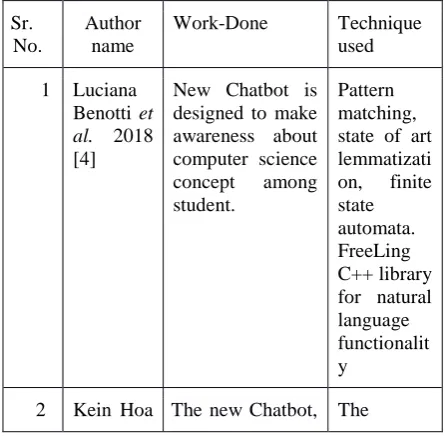
A typical RNN has a short-term memory. LSTM is a special type of RNN that provides long-term memory. It consists of special oblivion gates in addition to the exit and entrance gates of the simple RNN. LSTM are designed to recall the input state for longer than a single RNN, thus allowing long sequences to be processed accurately. Wang et al. They presented an LSTM-based model with 97% accuracy was presented by them which was used for POS tagging. The key part of Natural Language Processing architecture are the LSTM’s. The following table summarize the articles used for study to analyze contribution to the chatbot design and techniques used.
Table 1. A Summary of Contribution for designing Chatbot
Sr. No.
Author name
Work-Done Technique used
1 Luciana Benotti et al. 2018 [4]
New Chatbot is designed to make awareness about computer science concept among student.
Pattern matching, state of art lemmatizati on, finite state automata. FreeLing C++ library for natural language functionalit y
1222 the domain expert.
1223
4. DATASET
There are multiple conversational agents available. Some of them are conversational based or some are purely question answer system or some are combination of both. The conversational agent mainly exists in two main form. One is traditional goal-oriented dialog system which has limited conversational capabilities. These are built to accomplish specific task like modelling financial market. These systems often don’t have the ability to response for random irrelevant sentence because they are limited to specific domain.
The dialogue or open domain conversational agent try to capture human dialogue in all possible ways. It means they are hard to distinguish from real human. But current models are still far away from such domain. To develop more intelligent conversational agent requires a large amount of data to train model. Usually deep learning methods required large amount of data for building a conversational system.
There are multiple ways for collecting a data for training a conversational agent. One way is to use large corpus or dataset available in website. There are many open domain corpus like Cornell movie dialog corpus used in. It has around 25000 conversations from movie script. Open domain question answering system provides the exact answer to the question in natural language. For such system there are some datasets such as Web-Question dataset is a popular dataset for benchmarking of question answer engine. It provides questions paired with answers on number of different articles.Training the conversational model by using the large dataset or corpus is not the only approach. Many researchers have proposed training conversational system online through the live interaction with human and offline using user simulator model and reinforcement learning model. As well as the work in developed a conversational model called as SOCIO which build a domain model based on the interaction of software developer with the social network. It means information required to train the model is based on the online social network. Sometimes for collecting a data a Wizard-of-oz method is used [5]. To develop a dialog system an appropriate collection of training data is essential part, especially for the task-oriented dialog system. In such case Wizard-of-oz paradigm is useful for collecting domain specific data.
The glass-box evaluation and black-box evaluation mechanism are used to evaluate conversational agent. The glass-box evaluation evaluates individual component and black box evaluates whole system. The Loebner Prize Competition is standard way to evaluate the performance of conversational agent. At the end the best evaluation of conversational agent is much more depends upon applications, services or task.
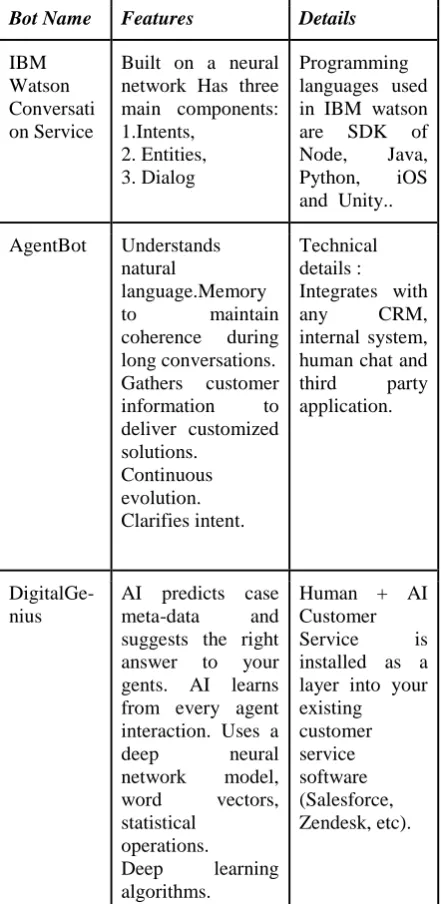
5. COMPARISON
Table 2. Popular chatbot with their features and details
1224
REFERENCES
[1] Haller, E., Rebedea, T. (2013): Designing a Chat-bot that Simulates an Historical Figure. 19th International Conference on Control Systems and Computer Science, Bucharest, pp. 582-589.
[2] Pawar, S., Rane, O., Wankhade, O., Mehta, P., (April 2018): A Web Based College Enquiry Chatbot with Results. International Journal of Innovative Research in Science, Engineering and Technology, 7(4).
[3] Bin, Y., Cunlin, P., Dan, L. (2013): Chinese text feature extraction method based on bigram. International Conference on Communications, Circuits and Systems (ICCCAS), Chengdu, pp. 342-346
[4] Pilato, C., Augello. A., Gaglio. S. (2011): A Modular Architecture for Adaptive ChatBots. IEEE Fifth International Conference on Semantic Computing, Palo Alto, CA,, pp. 177-180.
[5] Setiaji, B., Wahyu, F., Wibowo, (2016) : Chatbot Using a Knowledge in Database. 7th International Conference on Intelligent Systems, Modelling and Simulation.
[6] Augello, A., Pilato, G., Machi, A., Gaglio S. (2012) : An Approach to Enhance Chatbot Semantic Power and Maintainability: Experiences within the FRASI Project. IEEE Sixth International Conference on Semantic Computing, Palermo, 2012, pp. 186-193.
[7] Zhou Yu, Ziyu Xu, Alan W Black, Alexander I. Rudnicky, (2016) : Chatbot Evaluation and Database Expansion via Crowdsourcing. 7th International Conference on Intelligent Systems,
Modelling and Simulation.
[8] Roos, S. (2018) : CHATBOTS IN EDUCATION. Chapter 3, 4. Department of Informatics and Media, Uppsala University.
[9] Krisztián Csáky. R. (2017) : Deep Learning Based Chatbot Models. SCIENTIFIC STUDENTS’ ASSOCIATIONS REPORT, Supervised by Recski, G.Chapter 4, 5.
[10]Nahdatul Akma Ahmad, Mohamad Hafiz Che Hamid, Azaliza Zainal, Muhammad Fairuz Abd Rauf, Zuraidy Adnan, (August 2018) : Review of
Chatbots Design Techniques. International Journal of Computer Applications, 181(8).
[11]Shaikh, A., Phalke, G.,Patil, P., Bhosale, S., Raghatwan, J. (2016) : A Survey On Chatbot Conversational Systems. IJESC 6(11).
[12]Vrajitoru, D., Ratkiewicz, J. : Evolutionary Sentence Combination for Chatterbots.
[13]Antonella De Angeli, Graham I. Johnson, Lynne Coventry (2001): The unfriendly user: exploring social reactions to chatterbots. Helander, Khalid and Tham (Editors) Proceedings of The International Conference on Affective Human Factors Design Asean Academic Press, London.
[14]Dutta, D. : Developing an Intelligent Chat-bot Tool to assist high school students for learning general knowledge subjects.