Mixture-Model Adaptation for SMT
George Foster and Roland Kuhn National Research Council Canada
Abstract
We describe a mixture-model approach to adapting a Statistical Machine Translation System for new domains, using weights that depend on text distances to mixture compo-nents. We investigate a number of variants on this approach, including cross-domain versus dynamic adaptation; linear versus loglinear mixtures; language and transla-tion model adaptatransla-tion; different methods of assigning weights; and granularity of the source unit being adapted to. The best methods achieve gains of approximately one BLEU percentage point over a state-of-the art non-adapted baseline system.
1 Introduction
Language varies significantly across different gen-res, topics, styles, etc. This affects empirical mod-els: a model trained on a corpus of car-repair manu-als, for instance, will not be well suited to an appli-cation in the field of tourism. Ideally, models should be trained on text that is representative of the area in which they will be used, but such text is not al-ways available. This is especially the case for bilin-gual applications, because parallel training corpora are relatively rare and tend to be drawn from spe-cific domains such as parliamentary proceedings.
In this paper we address the problem of adapting a statistical machine translation system by adjust-ing its parameters based on some information about a test domain. We assume two basic settings. In
cross-domain adaptation, a small sample of parallel
in-domain text is available, and it is used to optimize for translating future texts drawn from the same do-main. In dynamic adaptation, no domain informa-tion is available ahead of time, and adaptainforma-tion is based on the current source text under translation. Approaches developed for the two settings can be complementary: an in-domain development corpus can be used to make broad adjustments, which can then be fine tuned for individual source texts.
Our method is based on the classical technique of mixture modeling (Hastie et al., 2001). This involves dividing the training corpus into different components, training a model on each part, then weighting each model appropriately for the current context. Mixture modeling is a simple framework that encompasses many different variants, as de-scribed below. It is naturally fairly low dimensional, because as the number of sub-models increases, the amount of text available to train each, and therefore its reliability, decreases. This makes it suitable for discriminative SMT training, which is still a chal-lenge for large parameter sets (Tillmann and Zhang, 2006; Liang et al., 2006).
Techniques for assigning mixture weights depend on the setting. In cross-domain adaptation, knowl-edge of both source and target texts in the in-domain sample can be used to optimize weights directly. In dynamic adaptation, training poses a problem be-cause no reference text is available. Our solution is to construct a multi-domain development sample for learning parameter settings that are intended to generalize to new domains (ones not represented in the sample). We do not learn mixture weights di-rectly with this method, because there is little hope
that these would be well suited to new domains. In-stead we attempt to learn how weights should be set as a function of distance. To our knowledge, this ap-proach to dynamic adaptation for SMT is novel, and it is one of the main contributions of the paper.
A second contribution is a fairly broad investiga-tion of the large space of alternatives defined by the mixture-modeling framework, using a simple genre-based corpus decomposition. We experimented with the following choices: cross-domain versus dynamic adaptation; linear versus loglinear mixtures; lan-guage and translation model adaptation; various text distance metrics; different ways of converting dis-tance metrics into weights; and granularity of the source unit being adapted to.
The remainder of the paper is structured follows: section 2 briefly describes our phrase-based SMT system; section 3 describes mixture-model adapta-tion; section 4 gives experimental results; section 5 summarizes previous work; and section 6 concludes.
2 Phrase-based Statistical MT
Our baseline is a standard phrase-based SMT sys-tem (Koehn et al., 2003). Given a source sentences, this tries to find the target sentenceˆtthat is the most likely translation ofs, using the Viterbi approxima-tion:
ˆ
t= argmax
t
p(t|s)≈argmax
t,a
p(t,a|s),
where alignment a = (˜s1,t˜1, j1), ...,(˜sK,˜tK, jK);
˜
tkare target phrases such thatt = ˜t1. . .˜tK;s˜kare source phrases such thats = ˜sj1. . .s˜jK; and ˜sk is the translation of thekth target phrase˜tk.
To model p(t,a|s), we use a standard loglinear approach:
p(t,a|s)∝exp "
X
i
αifi(s,t,a)
#
(1)
where each fi(s,t,a) is a feature function, and weights αi are set using Och’s algorithm (Och, 2003) to maximize the system’s BLEU score (Pa-pineni et al., 2001) on a development corpus. The features used in this study are: the length of
t; a single-parameter distortion penalty on phrase reordering in a, as described in (Koehn et al., 2003); phrase translation model probabilities; and
4-gram language model probabilities logp(t), us-ing Kneser-Ney smoothus-ing as implemented in the SRILM toolkit.
Phrase translation model probabilities are features of the form: logp(s|t,a) ≈ Pk=1K logp(˜sk|˜tk). We use two different estimates for the conditional probabilitiesp(˜t|s˜)andp(˜s|˜t): relative frequencies and “lexical” probabilities as described in (Zens and Ney, 2004). In both cases, the “forward” phrase probabilitiesp(˜t|s˜)are not used as features, but only as a filter on the set of possible translations: for each source phrases˜that matches some ngram ins, only the 30 top-ranked translations˜taccording top(˜t|s˜)
are retained.
To derive the joint counts c(˜s,t˜) from which p(˜s|˜t)andp(˜t|s˜)are estimated, we use the phrase in-duction algorithm described in (Koehn et al., 2003), with symmetrized word alignments generated using IBM model 2 (Brown et al., 1993).
3 Mixture-Model Adaptation
Our approach to mixture-model adaptation can be summarized by the following general algorithm:
1. Split the corpus into different components, ac-cording to some criterion.
2. Train a model on each corpus component.
3. Weight each model according to its fit with the test domain:
• For cross-domain adaptation, set param-eters using a development corpus drawn from the test domain, and use for all fu-ture documents.
• For dynamic adaptation, set global param-eters using a development corpus drawn from several different domains. Set mix-ture weights as a function of the distances from corpus components to the current source text.
4. Combine weighted component models into a single global model, and use it to translate as described in the previous section.
3.1 Corpus Decomposition
We partition the corpus into different genres, defined as being roughly identical to corpus source. This is the simplest way to exploit heterogeneous training material for adaptation. An alternative, which we have not explored, would be to cluster the corpus automatically according to topic.
3.2 Component Models
We adapt both language and translation model fea-tures within the overall loglinear combination (1).
To train translation models on each corpus com-ponent, we used a global IBM2 model for word alignment (in order to avoid degradation in align-ment quality due to smaller training corpora), then extracted component-specific relative frequencies for phrase pairs. Lexical probabilities were also de-rived from the global IBM2 model, and were not adapted.
The procedure for training component-specific language models on the target halves of each cor-pus component is identical to the procedure for the global model described in section 2. In addition to the component models, we also used a large static global model.
3.3 Combining Framework
The most commonly-used framework for mixture models is a linear one:
p(x|h) =X
c
λcpc(x|h) (2)
where p(x|h) is either a language or translation model; pc(x|h)is a model trained on componentc, andλcis the corresponding weight. An alternative, suggested by the form of the global model, is a log-linear combination:
p(x|h) =Y
c
pc(x|h)αc
where we write αc to emphasize that in this case the mixing parameters are global weights, like the weights on the other features within the loglinear model. This is in contrast to linear mixing, where the combined modelp(x|h)receives a loglinear weight, but the weights on the components do not partici-pate in the global loglinear combination. One conse-quence is that it is more difficult to set linear weights
using standard minimum-error training techniques, which assume only a “flat” loglinear model.
3.4 Distance Metrics
We used four standard distance metrics to cap-ture the relation between the current source or tar-get text q and each corpus component.1 All are monolingual—they are applied only to source text or only to target text.
The tf/idf metric commonly used in information retrieval is defined as cos(vc,vq), where vc and
vqare vectors derived from component cand doc-ument q, each consisting of elements of the form:
−p˜(w) log ˜pdoc(w), where p˜(w) is the relative fre-quency of word w within the component or docu-ment, andpdoc(w)is the proportion of components it appears in.
Latent Semantic Analysis (LSA) (Deerwester et
al., 1990) is a technique for implicitly capturing the semantic properties of texts, based on the use of Singular Value Decomposition to produce a rank-reduced approximation of an original matrix of word and document frequencies. We applied this tech-nique to all documents in the training corpus (as op-posed to components), reduced the rank to 100, then calculated the projections of the component and doc-ument vectors described in the previous paragraph into the reduced space.
Perplexity (Jelinek, 1997) is a standard way of
evaluating the quality of a language model on a test text. We define a perplexity-based distance metric pc(q)1/|q|, wherepc(q)is the probability assigned to q by an ngram language model trained on compo-nentc.
The final distance metric, which we call EM, is based on expressing the probability ofqas a word-level mixture model:p(q) =Q|i=1q| Pcdcpc(wi|hi), where q = w1. . . w|q|, and pc(w|h) is the ngram probability ofwfollowing word sequencehin com-ponentc. It is straighforward to use the EM algo-rithm to find the set of weights dˆc,∀c that maxi-mizes the likelihood ofq. The weightdˆcis defined as the distance to componentc. For all experiments described below, we used a probability difference threshold of 0.001 as the EM convergence criterion.
1
3.5 Learning Adaptive Parameters
Our focus in this paper is on adaptation via mixture weights. However, we note that the usual loglinear parameter tuning described in section 2 can also be considered adaptation in the cross-domain setting, because learned preferences for word penalty, rel-ative LM/TM weighting, etc, will reflect the target domain. This is not the case for dynamic adapta-tion, where, in the absence of an in-domain devel-opment corpus, the only information we can hope to glean are the weights on adapted models compared to other features of the system.
The method used for adapting mixture weights depends on both the combining framework (loglin-ear versus lin(loglin-ear), and the adaptive setting (cross-domain versus dynamic), as described below.
3.5.1 Setting Loglinear Mixture Weights
When using a loglinear combining framework as described in section 3.3, mixture weights are set in the same way as the other loglinear parameters when performing cross-domain adaptation. Loglin-ear mixture models were not used for dynamic adap-tation.
3.5.2 Setting Linear Mixture Weights
For both adaptive settings, linear mixture weights were set as a function of the distance metrics de-scribed in section 3.4. Given a set of metrics
{D1, . . . , Dm}, letdi,cbe the distance from the cur-rent text to componentcaccording to metricDi. A simple approach to weighting is to choose a single metricDi, and set the weights in (2) to be propor-tional to the corresponding distances:
λc=di,c/
X
c0
di,c0. (3)
Because different distance metrics may capture complementary information, and because optimal weights might be a non-linear function of distance, we also experimented with a linear combination of metrics transformed using a sigmoid function:
λc= m
X
i=1
βi
1 +exp(ai(bi−di,c)) (4)
whereβireflects the relative predictive power ofDi, and the sigmoid parametes ai andbi can be set to
selectively suppress contributions from components that are far away. Here we assume thatβi absorbs a normalization constant, so that theλc’s sum to 1. In this approach, there are three parameters per dis-tance metric to learn:βi,ai, andbi. In general, these parameters are also specific to the particular model being adapted, ie the LM or the TM.
To optimize these parameters, we fixed global loglinear weights at values obtained with Och’s al-gorithm using representative adapted models based on a single distance metric in (3), then used the Downhill Simplex algorithm (Press et al., 2002) to maximize BLEU score on the development corpus. For tractability, we followed standard practice with this technique and considered only monotonic align-ments when decoding (Zens and Ney, 2004).
The two approaches just described avoid condi-tioning λc explicitly on c. This is necessary for dynamic adaptation, since any genre preferences learned from the development corpus cannot be ex-pected to generalize. However, it is not necessary for cross-domain adaptation, where the genre of the development corpus is assumed to represent the test domain. Therefore, we also experimented with us-ing Downhill Simplex optimization to directly learn the set of linear weights λc that yield maximum BLEU score on the development corpus.
A final variant on setting linear mixture weights is a hybrid between cross-domain and dynamic adap-tation. In this approach, both the global loglinear weights and, if they are being used, the mixture pa-rametersβi, ai, biare set to characterize the test do-main as in cross-dodo-main adaptation. When trans-lating, however, distances to the current source text are used in (3) or (4) instead of distances to the in-domain development corpus. This obviously limits the metrics used to ones that depend only on source text.
4 Experiments
genre for cross-domain adaptation was newswire, for which high-quality training material is avail-able. The cross-domain development set
NIST04-nw is the newswire subset of the NIST 2004
evalu-ation set, and the dynamic adaptevalu-ation development set NIST04-mix is a balanced mixed-genre subset of NIST 2004. The NIST 2005 evaluation set was used for testing cross-domain adaptation, and the NIST 2006 evaluation set (both the “GALE” and “NIST” parts) was used to test dynamic adaptation.
Because different development corpora are used for cross-domain and dynamic adaptation, we trained one static baseline model for each of these adaptation settings, on the corresponding develop-ment set.
All results given in this section are BLEU scores.
role corpus genres sent
train FBIS04 nw 182k
HK Hans proceedings 1,375k
HK Laws legal 475k
HK News press release 740k
Newswire nw 26k
Sinorama news mag 366k
UN proceedings 4,979k
dev NIST04-nw nw 901
NIST04-mix nw, sp, ed 889
test NIST05 nw 1,082
[image:5.612.316.539.193.263.2]NIST06-GALE nw, ng, bn, bc 2,276 NIST06-NIST nw, ng, bn 1,664
Table 1: Corpora. In the genres column: nw = newswire, sp = speeches, ed = editorial, ng = news-group, bn = broadcast news, and bc = broadcast con-versation.
4.1 Linear versus Loglinear Combination
Table 2 shows a comparison between linear and loglinear mixing frameworks, with uniform weights used in the linear mixture. Both types of mixture model are better than the baseline, but the linear mixture is slightly better than the loglinear mix-ture. This is quite surprising, because these results are on the development set: the loglinear model tunes its component weights on this set, whereas the linear model only adjusts global LM and TM weights. We speculated that this may have been due to non-smooth component models, and tried various
smoothing schemes, including Kneser-Ney phrase table smoothing similar to that described in (Foster et al., 2006), and binary features to indicate phrase-pair presence within different components. None helped, however, and we conclude that the problem is most likely that Och’s algorithm is unable to find a good maximimum in this setting. Due to this re-sult, all experiments we describe below involve lin-ear mixtures only.
combination adapted model
LM TM LM+TM
baseline 30.2 30.2 30.2
loglinear mixture 30.9 31.2 31.4 uniform linear mixture 31.2 31.1 31.8
Table 2: Linear versus loglinear combinations on NIST04-nw.
[image:5.612.72.299.285.468.2]4.2 Distance Metrics for Weighting
Table 3 compares the performance of all distance metrics described in section 3.4 when used on their own as defined in (3). The difference between them is fairly small, but appears to be consistent across LM and TM adaptation and (for the LM metrics) across source and target side matching. In general, LM metrics seem to have a slight advantage over the vector space metrics, with EM being the best overall. We focus on this metric for most of the experiments that follow.
metric source text target text
LM TM LM TM
tf/idf 31.3 31.3 31.1 31.1
LSA 31.5 31.6
perplexity 31.6 31.3 31.7 31.5
EM 31.7 31.6 32.1 31.3
Table 3: Distance metrics for linear combination on the NIST04-nw development set. (Entries in the top right corner are missing due to lack of time.)
[image:5.612.336.517.482.566.2]the performance of the normalized source-side EM metric on its own (reproduced on the first line from table 3). In additional tests we verified that this also holds for the test corpus. We speculate that this dis-appointing result is due to compromises made in or-der to run Downhill Simplex efficiently, including holding global weights fixed, using only a single starting point, and running with monotone decoding.
weighting LM TM
EM-src, direct 31.7 31.6
[image:6.612.315.536.131.243.2]EM-src + LSA-src, parameterized 31.0 30.0 direct optimization 31.7 30.2
Table 4: Weighting techniques for linear combina-tion on the NIST04-nw development set.
[image:6.612.77.296.180.236.2]4.3 Cross-Domain versus Dynamic Adaptation
Table 5 shows results for cross-domain adaptation, using the source-side EM metric for linear weight-ing. Both LM and TM adaptation are effective, with test-set improvements of approximately 1 BLEU point over the baseline for LM adaptation and some-what less for TM adaptation. Performance also im-proves on the NIST06 out-of-domain test set (al-though this set includes a newswire portion as well). However, combined LM and TM adaptation is not better than LM adaptation on its own, indicating that the individual adapted models may be capturing the same information.
model dev test
nist04- nist05
nist06-nw nist
baseline 30.2 30.3 26.5
EM-src LM 31.7 31.2 27.8
EM-src TM 31.6 30.9 27.3
EM-src LM+TM 32.5 31.2 27.7
Table 5: Cross-Domain adaptation results.
Table 6 contains results for dynamic adaptation, using the source-side EM metric for linear weight-ing. In this setting, TM adaptation is much less effective, not significantly better than the baseline; performance of combined LM and TM adaptation is also lower. However, LM adaptation improves over the baseline by up to a BLEU point. The
per-formance of cross domain adaptation (reproduced from table 5 on the second line) is slightly better for the in-domain test set (NIST05), but worse than dy-namic adaptation on the two mixed-domain sets.
model dev test
nist04- nist05 nist06-
nist06-mix nist gale
baseline 31.9 30.4 27.6 12.9
cross LM n/a 31.2 27.8 12.5
LM 32.8 30.8 28.6 13.4
TM 32.4 30.7 27.6 12.8
LM+TM 33.4 30.8 28.5 13.0
Table 6: Dynamic adaptation results, using src-side EM distances.
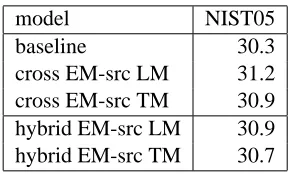
model NIST05
baseline 30.3
[image:6.612.354.499.306.393.2]cross EM-src LM 31.2 cross EM-src TM 30.9 hybrid EM-src LM 30.9 hybrid EM-src TM 30.7
Table 7: Hybrid adaptation results.
Table 7 shows results for the hybrid approach de-scribed at the end of section 3.5.2: global weights are learned on NIST04-nw, but linear weights are derived dynamically from the current test file. Per-formance drops slightly compared to pure cross-domain adaptation, indicating that it may be impor-tant to have a good fit between global and mixture weights.
4.4 Source Granularity
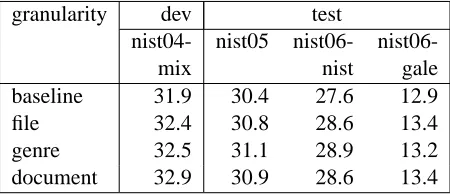
[image:6.612.79.293.481.580.2]granularity dev test
nist04- nist05 nist06-
nist06-mix nist gale
baseline 31.9 30.4 27.6 12.9
file 32.4 30.8 28.6 13.4
genre 32.5 31.1 28.9 13.2
document 32.9 30.9 28.6 13.4
Table 8: The effects of source granularity on dy-namic adaptation.
5 Related Work
Mixture modeling is a standard technique in ma-chine learning (Hastie et al., 2001). It has been widely used to adapt language models for speech recognition and other applications, for instance us-ing cross-domain topic mixtures, (Iyer and Osten-dorf, 1999), dynamic topic mixtures (Kneser and Steinbiss, 1993), hierachical mixtures (Florian and Yarowsky, 1999), and cache mixtures (Kuhn and De Mori, 1990).
Most previous work on adaptive SMT focuses on the use of IR techniques to identify a relevant sub-set of the training corpus from which an adapted model can be learned. Byrne et al (2003) use co-sine distance from the current source document to find relevant parallel texts for training an adapted translation model, with background information for smoothing alignments. Hildebrand et al (1995) de-scribe a similar approach, but apply it at the sentence level, and use it for language model as well as trans-lation model adaptation. They rely on a perplexity heuristic to determine an optimal size for the rele-vant subset. Zhao et al (2004) apply a slightly differ-ent sdiffer-entence-level strategy to language model adap-tation, first generating an nbest list with a baseline system, then finding similar sentences in a monolin-gual target-language corpus. This approach has the advantage of not limiting LM adaptation to a parallel corpus, but the disadvantage of requiring two trans-lation passes (one to generate the nbest lists, and an-other to translate with the adapted model).
Ueffing (2006) describes a self-training approach that also uses a two-pass algorithm. A baseline sys-tem generates translations that, after confidence fil-tering, are used to construct a parallel corpus based on the test set. Standard phrase-extraction
[image:7.612.73.298.58.155.2]tech-niques are then applied to extract an adapted phrase table from the system’s own output.
Finally, Zhang et al (2006) cluster the parallel training corpus using an algorithm that heuristically minimizes the average entropy of source-side and target-side language models over a fixed number of clusters. Each source sentence is then decoded us-ing the language model trained on the cluster that assigns highest likelihood to that sentence.
The work we present here is complementary to both the IR approaches and Ueffing’s method because it provides a way of exploiting a pre-established corpus division. This has the potential to allow sentences having little surface similarity to the current source text to contribute statistics that may be relevant to its translation, for instance by raising the probability of rare but pertinent words. Our work can also be seen as extending all previous approaches in that it assigns weights to components depending on their degree of relevance, rather than assuming a binary distinction between relevant and non-relevant components.
6 Conclusion and Future Work
We have investigated a number of approaches to mixture-based adaptation using genres for Chi-nese to English translation. The most successful is to weight component models in proportion to maximum-likelihood (EM) weights for the current text given an ngram language model mixture trained on corpus components. This resulted in gains of around one BLEU point. A more sophisticated ap-proach that attempts to transform and combine mul-tiple distance metrics did not yield positive results, probably due to an unsucessful optmization proce-dure.
Other conclusions are: linear mixtures are more tractable than loglinear ones; LM-based metrics are better than VS-based ones; LM adaptation works well, and adding an adapted TM yields no improve-ment; cross-domain adaptation is optimal, but dy-namic adaptation is a good fallback strategy; and source granularity at the genre level is better than the document or test-set level.
cross-domain adaptation, and investigate better combina-tions of cross-domain and dynamic adaptation.
References
Peter F. Brown, Stephen A. Della Pietra, Vincent Della J. Pietra, and Robert L. Mercer. 1993. The mathematics of Machine Translation: Parameter estimation.
Com-putational Linguistics, 19(2):263–312, June.
W. Byrne, S. Khudanpur, W. Kim, S. Kumar, P. Pecina, P. Virga, P. Xu, and D. Yarowsky. 2003. The JHU 2003 Chinese-English Machine Translation System. In MT Summit IX, New Orleans, September.
S. Deerwester, S. T. Dumais, G. W. Furnas, T. K. Lan-dauer, and R. Harshman. 1990. Indexing by latent semantic analysis. JASIS, 41(6):391–407.
Radu Florian and David Yarowsky. 1999. Dynamic non-local language modeling via hierarchical topic-based
adaptation. In ACL 1999, pages 167–174, College
Park, Maryland, June.
George Foster, Roland Kuhn, and Howard Johnson. 2006. Phrasetable smoothing for statistical machine translation. In EMNLP 2006, Sydney, Australia.
Trevor Hastie, Robert Tibshirani, and Jerome Friedman. 2001. The Elements of Statistical Learning. Springer.
Almut Silja Hildebrand, Matthias Eck, Stephan Vogel, and Alex Waibel. 1995. Adaptation of the transla-tion model for statistical machine translatransla-tion based on information retrieval. In EAMT 1995, Budapest, May.
R. Iyer and M. Ostendorf. 1999. Modeling long dis-tance dependence in language: Topic mixtures vs. dy-namic cache models. In IEEE Trans on Speech and
Language Processing, 1999.
Frederick Jelinek. 1997. Statistical Methods for Speech
Recognition. MIT Press.
Reinhard Kneser and Volker Steinbiss. 1993. On the dynamic adaptation of stochastic language models. In ICASSP 1993, pages 586–589, Minneapolis, Min-nesota. IEEE.
Philipp Koehn, Franz Josef Och, and Daniel Marcu. 2003. Statistical phrase-based translation. In NAACL
2003, pages 127–133.
Roland Kuhn and Renato De Mori. 1990. A cache-based natural language model for speech recognition. IEEE
Trans on PAMI, 12(6):570–583, June.
Percy Liang, Alexandre Bouchard-Cˆot´e, Dan Klein, and Ben Taskar. 2006. An end-to-end discriminative ap-proach to machine translation. In ACL 2006
Franz Josef Och. 2003. Minimum error rate training for statistical machine translation. In ACL 2003, Sapporo, July.
Kishore Papineni, Salim Roukos, Todd Ward, and
Wei-Jing Zhu. 2001. BLEU: A method for automatic
evaluation of Machine Translation. Technical Report RC22176, IBM, September.
William H. Press, Saul A. Teukolsky, William T. Vetter-ling, and Brian P. Flannery. 2002. Numerical Recipes
in C++. Cambridge University Press, Cambridge, UK.
Christoph Tillmann and Tong Zhang. 2006. A discrimi-native global training algorithm for statistical MT. In
ACL 2006.
Nicola Ueffing. 2006. Self-training for machine trans-lation. In NIPS 2006 Workshop on MLIA, Whistler, B.C., December.
Richard Zens and Hermann Ney. 2004. Improvements
in phrase-based statistical machine translation. In
HLT/NAACL 2004, Boston, May.
R. Zhang, H. Yamamoto, M. Paul, H. Okuma, K. Yasuda, Y. Lepage, E. Denoual, D. Mochihashi, A. Finch, and E. Sumita. 2006. The NiCT-ATR statistical machine translation system for the IWSLT 2006 evaluation. In
IWSLT 2006.
Bing Zhao, Matthias Eck, and Stephan Vogel. 2004.
Language model adaptation for statistical machine translation with structured query models. In COLING