Hanne Moa
Department of Language and Communication Studies
Norwegian University of Science and Technology
7491 Trondheim, Norway
[email protected]
Abstract
ReCompounder is a working proto-type for automatic translation of com-pounds by using the web as language model and a comprehensive bilingual dictionary as translation model. Evalu-ation shows this strategy is viable also with current search engine technolo-gies.
In addition to a detailed overview of the system, there is a discus-sion of the current capabilities of the search engines used (Google and Ya-hoo! Search) and some tendencies rel-evant to lexicography. As the system currently translates from Norwegian to English, a brief introduction to com-pounding in Norwegian is included.
1
Introduction
A major problem in machine translation is what to do with words that are not found in the machine-readable lexicon.
A possible solution is to somehow connect a regular bilingual dictionary to the system, all the time keeping in mind that definitions are made in the lexicographical tradition and not finely tuned to the particular framework and methods used in the MT-system in question.
ReCompounder extends on the connected-dictionary idea. It is a proof-of-concept proto-type which tries to translate previously unseen compounds. It is part of the LOGON machine translation project (Lønning et al., 2004) which aims to translate tourism1-relevant texts from
1More specifically hiking trip information
Norwegian to English, using an approach based on semantic transfer.
The underlying idea is similar to what is done in Rackow et al.(1992) and Tanaka and Bald-win (2003), but using the world wide web as corpus. Grefenstette (1999) used a similar technique for example-based machine transla-tion with the then popular search-engines.
Using a web search engine directly greatly limits what sort of translation is possible, but since the web and the indexes of the search en-gines continuously grow by the addition of new and newly written pages, the data onecan ana-lyze more closely resembles language as it used just now.
As for the rest of this paper, section 2 gives a brief overview of compounds in Norwegian and what they might translate to in English, sec-tion 3 presents ReCompounder in some detail, section 4 summarizes the first round of evalua-tion of the system, secevalua-tion 5 gives an overview of the results so far, and thereafter follows the conclusion.
2
The problem
Compounding as a word-formation process is very productive in Norwegian (Johannesen and Hauglin, 1996). Thus any MT-system translat-ing to or from Norwegian needs a way to handle newly minted compounds that was not found in the system’s lexicon.
The Engelsk Stor Ordbok is a paper
dictio-nary containing over 42000 Norwegian nouns
translated to English. Bokmålsordboka is a dic-tionary of Norwegian while the NorKompLeks-lists are NorKompLeks-lists of Norwegian words in both in-flected and uninin-flected forms and with pronun-ciations. The NorKompLeks lists were designed from the beginning to be machine-readable while the two others originally only existed on paper.
2.1 Compounding in Norwegian
The list of examples marked 1a) to e) below starts with a compound that were not found in any of the available dictionaries and wordlists, both text-versions and machine-readable, and derives other compounds from it:
(1) a. gårdshus
gård+hus farmhouse
b. gårdshustak gård+hus+tak farmhouse roof
c. gårdshustakstein gård+hus+tak+stein farmhouse roof tile
d. gårdshustaksteinsproblem gård+hus+tak+stein+problem problem with the roof tiles of farm-houses
e. storgårdshus stor+gård+hus house of a large farm
This paper will not debate the definition of compounds, especially when or if a word form ceases to be a compound and instead turns into a proper lexical item. Instead a very pragmatic stance is taken: when it isuseful to treat some-thing as if it was a compound, it is treated as if itis a compound.
Most Norwegian compounds consists of
noun-stems, as in example 1a) to d) above.
Some nouns have compound-only suppletive stems, as in example 5 below.
The stems are in general not to be written
with spaces, but occasionally they are
sepa-rated by an epenthetic s or e. Compounds
containing abbreviations are written with a hy-phen, and newer compounds often are as well. See Johannesen and Hauglin (1996) for details.
(2) Direct juxtaposition realfag
real+fag
natural science + mathematics
(3) Epenthesis
a. gårdshund gård+hund farm dog
b. sauebonde sau+bonde sheep farmer
(4) Hyphen ABC-våpen ABC+våpen ABC weapon
(5) Suppletive stem klesklype klær+klype clothes pin
(6) Spelling changes busstasjon buss+stasjon bus station
When three or more identical letters are ad-jacent, only two are written, as shown in ex-ample 6 above. Furthermore, many Norwegian words can be spelled in more than one way,
for instance the compound andregradsligning
(second-degree equation) can also be spelled andregradslikning, annengradsligning and an-nengradslikning.
Finally, when more than two stems are in-volved, the compound can technically be split more than one way. Example 1e),storgårdshus, can be split as
(7) a. (stor+gård)+hus
house of a large farm
b. * stor+(gård+hus)
large farmhouse
The split in example 7b)is not reasonable be-cause the epenthetic s tends to force a split when ambiguity arises.
An example like 1d) splits to
((gård+hus)+(tak+stein))+problem since
2.2 Compounding in English
Compounding in English is not so clear cut. It is more fruitful to look at what Norwegian com-pounds translate to in English2:
(8) noun + noun
a. gårdshus - farmhouse b. bygård - apartment building
(9) adjective + noun
a. statsvitenskap - political science b. forretningsstrøk - commercial area
(10) noun +of -phrase
a. produksjonsmidler - means of pro-duction
b. streikevarsel - notice of a/the strike c. allemannsrett - public right of
ac-cess
(11) single words
a. arbeidsgiver - employer b. hovedstad - capitol (12) other
a. arbeidsro - opportunity to work undisturbed
b. skoleplikt - compulsory school atten-dance
c. skolevei - way to and from school d. streikerett - right to strike e. kjøpelyst - desire to buy
Of the examples 8 to 12, only example 8a)
wasn’t found in any dictionary, while the exam-ples 10c), 12a)and 12e)were found in the bilin-gual dictionary but not in Bokmålsordboka.
3
The prototype
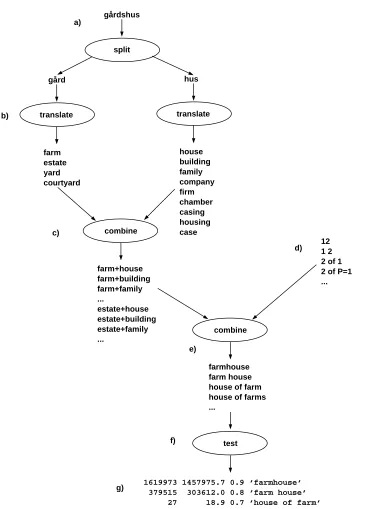
The entire recompounding process is shown in figure 1.
At point a), after having been handed an
already lemmatized word, ReCompounder first
tries to look up the word in its bilingual dictio-nary. If the word is not found it tries to treat the source-language term as a compound by at-tempting to split the potential compound into stems. If this is possible, each stem is trans-lated into the target language at point b). The translated stems are then recombined first with each other in point c), then with the templates
2Most of the examples were found in Hasselgård
et. al. (1998).
of point d)into possible compounds of the tar-get language at point e). Finally,ReCompounder checks whether these potential compounds are in use on the web at point f), and from the re-sult of that test, in point g), the most frequent candidate is chosen as the best translation.
The assumptions are as follows:
• The stems in a compound each carry their most frequent meanings
• The translations/meanings in the bilingual dictionary are sorted by frequency, most frequent first
• It is sufficient to split a compound only once, into just two stems, because if a com-pound stem is used in a larger comcom-pound, it carries only its most frequent meaning
• If a compound exists in Norwegian there is a construction in English with approxi-mately the same meaning that already ex-ists on the indexed part of the web
3.1 Use of the dictionaries
The prototype searches through a digitized ver-sion of the Engelsk Stor Ordbok, treating it as a treebank. Furthermore, the number of known Norwegian stems have been increased by the stems in the NorKompLeks-lists, and checked against Bokmålsordboka.
3.2 The compound splitter/recognizer
The compound splitter3 at point a), figure 1 works by attempting to split the word in two. Each piece, hereafter called theoriginal stems, is then looked up in a list of known stems, so as to filter out misspelled stems.
3.3 The stem-translator
After having been split, each each original stem is looked up in the bilingual dictionary at point b). The translations of each are then stored in a single ordered, duplicate-free list per original stem, as in example 13.
(13) gård:{f arm, estate, . . .}
hus:{house, building, . . .}
These lists of stem candidates are then
stored in the order they were made into another ordered list, thereby maintaining the order of the original stems, as in example 14.
3The compound splitter can also be used as a
farm estate yard courtyard translate
gård
house building family company firm chamber casing housing case translate
hus split
gårdshus
combine
farm+house farm+building farm+family ...
estate+house estate+building estate+family ...
combine
farmhouse farm house house of farm house of farms ...
test
1 2
2 of P=1 ... 2 of 1 12
1 1.0 1.0 ’house of farms’ 27 18.9 0.7 ’house of farm’ 379515 303612.0 0.8 ’farm house’ 1619973 1457975.7 0.9 ’farmhouse’
c)
e)
f) a)
d)
[image:4.595.74.443.132.641.2]g) b)
(14) {{f arm, estate, . . .},{house, building, . . .}}
3.4 Potential translation candidates
Thetranslation candidates are the strings to be tested with an Internet search engine. They are derived by first combining each stem can-didate for each position in the original com-pound while maintaining the order of the orig-inal stems, as shown in point c) of figure 1,
then combining these with thetemplates from
point d), resulting in the translation candidates at point e).
In table 1, the examples 8 to 10 have been used to show how the templates bridge the translation between the Norwegian and English words.
Norwegian Template English gård1+hus2 12 farm1house2
by1+gård2 1 2 apartment1building2
forretning1+strøk2 A=1 2 commercial1area2
produksjon1+middel2 P=2 of 1 means2of production1
streik1+rett2 2 to 1 right2to strike1
Table 1: Each digit in the template is replaced by the correspondingly indexed stem candi-date. A= means the following stem is an adjec-tive derived from the indexed noun, P= means the following noun-stem must be in the plural.
3.5 Testing the candidates
Each translation candidate is then tested by doing a web search on Google or Yahoo!, at point f), yielding a list like the one at point g). The first column is the raw frequency as ex-tracted from the search, the second is the fre-quency adjusted for quality, the third is the quality and the fourth is the translation candi-date.
Adjusting for quality is needed due to the lim-its mentioned in section 3.7. The first ten re-sults of each run are checked to see if they ac-tually contain the search terms in the required order and without intruding punctuation. The
number of results that do contain the search
terms in the returned context is then divided by ten, yielding the quality of the search, a num-ber between 0.0 and 1.0, inclusive. Assuming that following pages of results have the same ratio of good hits to bad4. The total frequency is
4The number of bad hits generally increases, but
does so depending both on filtering done by the par-ticular search engine as well as the number of hits.
then multiplied with the quality, yielding the ad-justed frequency. To date, this has not changed the order of the two highest scoring candidates.
3.6 Other oddities
The prototype has been used to experiment
with snowclones (Pullum, 2004), a variety of
cliched fixed expressions where one or more specific words can be replaced by words that look almost the same written, sound almost the same spoken, or belong to the same part of speech. One example is “All your base are be-long to us.”, a catchphrase that still has over
500000 hits on Google. Variations include “All your base are belong to U.S”, “All your bias are belong to us” and “All your office are belong to me”.
If the target language has a construction with similar meaning and same number and types of replaceable parts, these can be translated in the same vein asReCompoundertranslates com-pounds. However, since there are few if any snowclones in the texts in the domain of the LOGON project, further experiments have been put on hold.
3.7 Search engine capabilities
Due to consolidation and mergers in the search engine industry, as of today the two leading search engines, both in terms of users and
index-size, are Google at http://www.google.
com/ and Yahoo!’s search engine at http://
search.yahoo.com/. Alta Vista, which was previously used for a similar purpose (Grefen-stette, 1999), is now a front-end to Yahoo!, as isAlltheweb (personal communication with Ya-hoo!). Not only are the indexes much larger5, but the query syntax and ranking algorithms are also different from 1999. In addition, in-stead of parsing a web page of results the search engines can now be accessed and used through stable APIs (Application Program In-terface).
3.7.1 Number of queries
When this paper was written, the Google-API had a limit of 1000 queries per developer
id per undefined day. The limits for Yahoo!
were5000queries per application id per ip ad-dress per24hour period. An exhaustive search for a translation ofgårdshus costs200queries,
5As of September 27, 2005, index-size is no longer
meaning there’s a very limited amount of ex-haustive searches possible per “day”. Using a page scraper6 would get around the limits but the search engine providers provided the APIs so that various web-robots do not count as peo-ple for statistical purposes.
3.7.2 Possible queries
Currently, it is not possible to use web search to discover whether an English compound is written with or without a hyphen due to how “hyphen” is interpreted by the search-engines. When this paper was written, a search for "stem1-stem2" now yields approximately the same result as a search for "stem1 stem2" stem1stem2(Liberman, 2005) if using Google.
3.7.3 Possible results
Punctuation is completely ignored, so a search for rare phrases like "repair truck" might return only results containing the two
words separated by punctuation. The hits
might not even contain the exact search terms at all, so it is always necessary to check if the returned pages actually contains the query, es-pecially if the number of returned pages is in the low hundreds.
3.7.4 Precision and recall
Web search excels at recall. If there is a docu-ment in the index that contains one of the words of the search query, or a link to a document that is not indexed but was found to contain one of the words of the search query, or it fulfills other criteria only known to the designers of the search engine in question, a link to the doc-ument will be returned. As can be seen from the previous paragraph, these criteria doesn’t necessarily lead to the same results as what a language researcher would call a relevant hit.
Furthermore, the algorithms for how the hits are ranked are not known and are subject to change, as does the actual number of total documents indexed, the number of documents containing information relevant to the query, how the query is interpreted, how the rele-vancy is computed, how the frequency given is estimated from the actual frequency and how the data is presented to the consumer. Ergo, the traditional formulas for precision and recall cannot be used.
6Page scraping: parsing a page directly,
syn-onyms: web scraping, site scraping, screen scraping
The web search presents you to a snapshot of the document index and query syntax and rank-ing algorithm at the moment of search. A later search might not return the same results, the same ranking or the same frequency, but the relative frequency of the query as compared to another query changes only when the index is updated, thus slowly. This means that the dif-ferences between the frequencies of the results of many searches done in a short and limited period of time will be approximately the same, and that is the measure used here.
3.7.5 Linguistic limits
There is no guarantee that the most frequent candidate translation is the best translation. The system as it stands does no domain check-ing what so ever, uscheck-ing the entire index for its searches. The readers and writers of doc-uments on the web are the subset of people that can afford to and have the time to access it, there is thus a systematic bias. A document might have been written by someone with only a basic grasp of the language.
4
Evaluation
Count %of nouns Nouns, total 228 100.0%
Known 151 66.2%
Unknown, not recompoundable 20 8.8%
[image:6.595.311.539.430.485.2]Unknown, recompoundable 57 25.0%
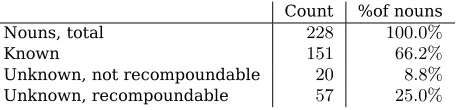
Table 2: Overview of the nouns in the corpus.
The prototype was tested on a small corpus built by Ola Huseth in January 2004. It is a collection of tourist information built from web pages that had both a Norwegian and an En-glish version. Stylistically they resemble ad-vertisements, having a high frequency of adjec-tives per sentence.
The evaluation corpus consisted of 112 sen-tences including fragments. A locally made pos-tagger was used to extract the common nouns, finding 263 potential, inflected, nouns. While the tagger is capable of returning uninflected forms of known words, compounds are gener-ally unknown, so a basic lemmatizer based on the same principle as the compound splitter was made to derive the base forms of the nouns.
The lemmatizer rejected 21 of the tagged
in-flected noun or noun stem7, another 14 words mistagged as nouns was found by manual
in-spection. Of the remaining, 151 already had
translations in the dictionary and was dis-carded. At this point, duplicates were removed, leaving77potential compounds to be translated by ReCompounder.
ReCompounder had translation suggestions for 57 of the remaining words.
While most of the failures was due to mis-spellings and mistaggings that had not been caught earlier or the original stems not be-ing in the bilbe-ingual dictionary, there were two very interesting instances of a related,
non-software problem. The word bautastein could
not be translated because the original stem bauta translates to "menhir", a menhir is a standing stone, and there were no instances of menhir stone or with other synonyms for stone on the web. This is a good indication that
the word bautastein itself needs to be added
to the bilingual dictionary. A similar case was fiskevær, meaning "fishing village". One of the meanings of the stem vær is also "fishing vil-lage", ergo one wound up with a reduplicated stem in the candidate.
Random Ranked Highest ranked is good 7.0% 36.9%
At least one good 21.1% 31.6%
At least one possible 33.3% 17.5%
No good candidates 38.6% 14.0%
Table 3: Evaluation-results: random sample of size 5 from all possible combinations and five best existing collocations sorted by score
Evaluation was done by having a human bilin-gual in Norwegian and English rate the sugges-tions. For each list of translation candidates, the evaluator was presented with a context for the original compound and with up to five of the best candidates8, as seen in figure 2. The evaluator was then asked to quickly mark each candidate as to whether it was an acceptable translation, completely unacceptable or poten-tially acceptable. This is summarized in the
col-umnRanked in table 3.
In addition to the sets of ranked candidates the evaluator was also given sets of candidates that were random samples of all generated,
7and thus not translatable in the current system 8Sorted by score, but the evaluator was not made
aware of this.
unchecked candidates, to serve as a basis for
comparison. This is the columnRandom in
ta-ble 3.
The most desirable outcome is that the can-didate of the highest frequency is suitable as a translation, as shown in the second row of ta-ble 3. More interestingly, there was at least one good translation out of five about two thirds of the time, as shown by the second and third rows.
5
Results so far
Already while testing the system during the de-velopment stage, certain tendencies emerged. All the compounds so far tested can be catego-rized as follows:
Good to excellent translations
(15) gårdshus→gård + hus
=⇒farm house→farmhouse
The top five of the complete results for farm-house are in table 4.
1427890 1285101.0 0.9 farmhouse
332322 265857.6 0.8 farm house
72417 50691.9 0.7 farm family
35695 24986.5 0.7 estate family
[image:7.595.77.270.415.472.2]34652 31186.8 0.9 farm building
Table 4: Top five results for “farmhouse”. No-tice how “farm building” beats “estate family” when ranking by adjusted frequency.
Unsplittable compound No stems to search, no result. Often this is due to a compound-only suppletive stem missing from the dictio-nary or wordlists, as discussed in section 2.1, example 5.
Bilingual dictionary lacks usable English stem Sometimes, this is due to the stem
miss-ing from the dictionary, but there are also cases where there are no single word translations of the stem.
(16) seterbu→seter + bu
=⇒no useful translations + ...
46. 604 meter over Lysefjorden henger denne markante fjellformasjonen.
fjellformasjon
[ ] mountain formation [ ] formation of mountains [ ] formation of mountain [ ] formation of mount [ ] mount formation
Figure 2: Evaluation
One of the stems of the compound means the same as the compound This was the case withbautastein and fiskevær as discussed in section 4.
The meaning of the Norwegian compound stem systematically differs from stand-alone stem
(17) ulvestamme→ulv + stamme
=⇒wolf + no useful translations
This is so far the most interesting result, show-ing that the meanshow-ing of the stem when part of a compound is missing from the dictionary.
<mammal> + stamme means approximately
"total population of <mammal> in a certain area" and is this synonymous with bestand. A similar problem is bil, when in a compound it generally translates to “truck”, not “car”. While ReCompounder can be used some of the way to discover such holes in the dictionary, making the definition of the missing stem or meaning still takes a lexicographer.
6
Conclusion
Using current web search engines instead of traditional static corpora is a workable strategy for automatic translation of compounds.
Compared to a baseline where all combina-tions are equally likely, the results are pretty good. As a bonus, the system as-is detects er-rors and gaps in the bilingual dictionary and is therefore useful as a tool for lexicography.
The strategy itself will be used in the machine-translation project LOGON to improve coverage there.
References
Øystein Eek et al., editors. 2001. Engelsk
stor ordbok: engelsk-norsk/norsk-engelsk.
Kunnskapsforlaget, Norway.
Gregory Grefenstette. 1999. The WWW as a resource for example-based machine transla-tion tasks. InProceedings of the ASLIB Con-ference on Translating and the Computer, London, October.
Hilde Hasselgård, Stig Johansson, and Per
Lysvåg. 1998. English Grammar: Theory and
Use. Universitetsforlaget, Oslo, Norway.
Janne Bondi Johannesen and Helge Hauglin. 1996. An Automatic analysis of compounds.
In T. Haukioja, editor, Papers from the
16th Scandinavian Conference of Linguistics, pages 209–220, Turku/Åbo, Finland.
Mark Liberman. 2005. Google usage.
Lan-guage Log, http://itre.cis.upenn.edu/
~myl/languagelog/archives/001956.html, 6 March.
Jan Tore Lønning, Stephan Oepen, Dorothee Beermann, Lars Hellan, John Carroll, Helge Dyvik, Dan Flickinger, Janne Bondi Jo-hannsen, Paul Meurer, Torbjørn Nordgård, Victoria Rosén, and Erik Velldal. 2004.
LO-GON. A Norwegian MT effort. InProceedings
of the Workshop in Recent Advances in Scan-dinavian Machine Translation, Uppsala, Swe-den.
Torbjørn Nordgård. 1996. NorKompLeks:
Some Linguistic Specifications and Applica-tions. In Lindebjerg, Ore, and Reigem, edi-tors,ALLC-ACH ’96. Abstracts, Bergen. Uni-versitetet i Bergen, Humanistisk Datasenter.
Geoffrey K. Pullum. 2004. Snowclones: lexi-cographical dating to the second. Language Log, http://itre.cis.upenn.edu/~myl/ languagelog/archives/000350.html, 6 January.
Ulrike Rackow, Ido Dagan, and Ulrike Schwall. 1992. Automatic translation of noun
com-pounds. InProceedings of COLING 92, pages
1249–1253, Nantes, France, August.
Danny Sullivan. 2005. End Of Size Wars?
Drops Home Page Count. Search
En-gine Watch, http://searchenginewatch.
com/searchday/article.php/3551586, 27 September.
Takaaki Tanaka and Timothy Baldwin. 2003. Translation selection for Japanese-English
Noun-Noun Compounds. InProc. of Machine
Translation Summit IX, pages 378–385, New Orleans, USA.
Boye Wangensteen, editor. 2005.