Volume 9, No. 2, March-April 2018
International Journal of Advanced Research in Computer Science
RESEARCH PAPER
Available Online at www.ijarcs.info
ISSN No. 0976-5697
IMPROVED 4-LEVEL DISCRETE WAVELET TRANSFORM USING DIGITAL
WATERMARKING
Mili Singh
Computer Science.St. Paul Institute of Professional Studies, Indore, India.
Abstract—Watermarking is a branch of data hiding which is utilized to shroud restrictive data in digital media like images, digital, or video. The simplicity with which computerized substance can be traded over the web has made copyright infringement issues. In this paper we examine about the watermarking of a fingerprinting to keep the fraud clients away and furthermore talk about the idea of a watermarking. What’s more, to ascertain the outcome investigation of a DWT based for an installing and separating process. The experimental outcomes to demonstrate that the proposed method effectively survives picture handling operations, 4-level DWT. We extract the authentic embedded watermark (EW) picture from all bands and compare them on the basis of their mean square error (MSE) and Peak Signal Noise Ratio (PSNR) parameters. Then calculate the MSE of embedded image and PSNR and calculates the BER of embedded image. In this approach, we try to recover original WI from attacked WI
Keywords—digital watermarking; fingerprinting watermarking; 4-DWT; BER ; Noise attacks.
I. INTRODUCTION
The progression of the Internet has brought about numerous new open doors for the creation and conveyance of substance in digital frame. Applications incorporate electronic publicizing, real time video and audio conveyance, advanced stores and libraries, and Web publishing. In any case, the digital inquiry that emerges in these applications is the information security. It has been watched that present copyright laws are not adequate for managing advanced information. Henceforth the insurance and requirement of licensed innovation rights for advanced media has turned into a vital issue. This has prompted an enthusiasm towards growing new duplicate prevention and insurance components. One such exertion that has been drawing in expanding interest depends on digital watermarking (DW) strategies. As steganography give careful consideration towards the level of intangibility, watermarking pay the greater part of its ascribes to the heartiness of the message and its capacity to withstand assaults of expulsion, for example, picture operations (revolution, trimming, separating) and so on in the event of pictures being watermarked. Advanced watermarking is the way toward inserting data into computerized interactive media substance to such an extent that the data (which we call the watermark) can later be separated or distinguished for an assortment of purposes including duplicate avoidance and control. DW has turned into a dynamic and imperative zone of research, and advancement and commercialization of watermarking strategies is being considered basic to help address a portion of the difficulties looked by the fast expansion of computerized content.[1]
Fingerprinting is biometric terms depend on a guarantee system benefit of a personal identification techniques. It provides the security of an unauthorized users. This does not allow an individual, other than the owner, to manipulate, duplicate, or access media information without owner’s permission. “Digital watermarking” is a procedure to ensure the copyright information, for example, report i.e. sound, video, picture et cetera of a fraud person. Fingerprints are an unique biometric data mainly used for personal identification
and authentication purpose. But while transmitting over network to serve the request of intelligence agencies in order to use them for identification purposes they may be susceptible to accidental or purpose attacks. It is important to preserve devotion and furthermore the forbid modifications[2].
Unique finger impression acknowledgment has quickly turned into the generally utilized innovation in biometrics and legal application. In a wrongdoing scene, fingerprints assume a critical part regarding recognizable proof of culprits. Dormant prints are vital in legal as they are proof of connection between an individual and the surface containing the unique mark impression. In particular, change from customary unique mark preparing may debase the confirmation and even discount assist assessment from other point of view. The fingerprints acquired in wrongdoing scenes are known as dormant fingerprints. Inert fingerprints are either obvious or not unmistakable to human stripped eye. Legal specialists utilize different procedures to make undetectable prints obvious. In any case, these systems depend on glues and chemicals to identify, envision and protect dormant fingerprints on the surfaces. A few authoritative, lawful, and news associations rely upon the advanced pictures to take real judgments or utilized as a photographable verification for a specific occasion.
II.APPLICATION FINGERPRINTING WATERMARKING
There are different watermarking applications for pictures, as recorded underneath [3]
1)Fingerprints:
The fingerprint impression inserts data about the lawful collector in the picture. This includes inserting an alternate watermark into each circulated picture and enables the proprietor to find and monitor pirated pictures that are unlawfully acquired. Partner interesting data about each circulated duplicate of advanced substance is called fingerprinting, and watermarking is a fitting answer for that application since it is undetectable and indistinguishable from the substance. Counteractive action of unapproved duplicating is expert by implanting data about how frequently a picture can be legitimately replicated.
2) Tamper Detection:
Fragile watermarks are utilized for tamper detection. On the off chance that the watermark is annihilated or corrupted, it shows nearness of altering and consequently advanced substance can't be trusted.
3) Image and content authentication:
In a picture confirmation application the goal is to distinguish adjustments to the information. The attributes of the picture, for example, its edges, are inserted and contrasted and the present pictures for contrasts. An answer for this issue could be obtained from cryptography, where digital signature has been considered as a message confirmation technique. Advanced mark basically speaks to some sort of outline of the substance. On the off chance that any piece of the substance is adjusted, its synopsis, the mark, will change making it conceivable to identify that some sort of altering has occurred. One case of digital signature innovation being utilized for picture verification is the dependable digital camera.
4)Medical applications:
Names of the patients can be imprinted on the X-ray reports and MRI checks utilizing strategies of obvious watermarking. The restorative reports assume an essential part in the treatment offered to the patient. If there is a mix up in the reports of two patients this could lead to a disaster [14].
5)Broadcasting Monitoring:
This type of monitoring is used to confirm the content that is supposed to be transmitted and. For instance, business promotions could be observed through their watermarks to affirm timing and check.
6) Owner Identification:
The customary type of scholarly proprietorship check is a visual marks. But, nowadays, this is easily overcome by the use of software that modifies images. A case is pictures with a copyright enrollment image © which have this stamp expelled by particular programming. For this situation undetectable watermarks are utilized as a part of request to beat the issue.
7) Signatures:
The substance proprietor is perceived by the watermark. It is possible that this might be exploited by a potential user to get hold of legal rights to copy or publish the content from the contact owner.
8)Publication Monitoring and Copy Control:
The watermark contains proprietor information and indicates the comparing measure of duplicates permitted. This surmises equipment and programming ready to refresh the watermark at each utilization. It also allows copy tracking of
unauthorized distribution since owner data is recorded in the watermark..
III.LITERATURE SURVEY
Mohammad Rasool Mirzaei, et.al (2017) [4] Digital imagewatermarking (DIW) has been risen as a fundamental technique for copyright protection and realness of the proprietor. This paper proposes a novel and versatile visually impaired watermarking strategy utilizing nearby investigation of angles in a picture piece. The technique segments the picture into non-covering pieces. The inserting is performed in the exchange space of each picture square. Two change coefficients are altered utilizing a variable quality factor. The estimation of quality factor relies upon the neighborhood multifaceted nature of the picture. This esteem is adaptively acquired from the mean angle of each piece and the DC component of the DCT coefficients of the square.
V Muni SekharI,et.al (2017) [5] In this procedure validation of advanced items are basic. To give verification numerous watermarking plans are proposed. Among edge based watermarking plans uncommon classification in view of low twisting while at the same time watermarking. Notwithstanding, display edge based watermarking plan are experiencing smoothing impact and furthermore reversibility is a questionable parameter. In this paper we are proposing a Reference Image and Edge (RIE) based watermarking plan to overcome smoothing impact issue in existing edge based watermarking plans. RIE watermarking plan likewise consider cover content data while inserting watermark design. Compared to existing edge based data hiding schemes proposed RIE watermark scheme improves visual perception with more or less same embedding capacity.
Andjela Draganić, et.al. (2017) [6] This paper proposes a system for the recognizing confirmation of the photo source and substance by using the Public Key Cryptography Signature (PKCS). The strategy depends on the PKCS watermarking of the pictures caught with various programmed watching cameras in the Trap View cloud framework. Watermark is made in light of 32-bit PKCS serial number and inserted into the caught picture. Watermark identification on the recipient side concentrates the serial number and demonstrates the camera which caught the picture by contrasting the first and the removed serial numbers. The watermarking methodology is intended to give power to picture enhancement in light of the Compressive Sensing approach. Likewise, the strategy is tried under different assaults and shows fruitful recognizable proof of proprietorship.
Sanjay Kumar, et.al. (2016) [8] DW empowers us to ensure proprietorship rights on advanced media, for example, sound, picture and video information. Advanced watermark is computerized flag conveying data of the maker or wholesaler of the media. DW is embedded into advanced media such that it is subtle to the human eye; however it is obvious to a PC. A watermarking assault is any handling that may disable watermark identification. There are diverse sorts of assaults which can influence the watermarked picture which incorporate editing, commotion (salt and pepper, Gaussian), revolution and so on.
Abhishek Basu et.al. (2016) [9] Digital domain is the present most favored region for information preparing and transmission. If there should be an occurrence of information increase or approved replication, CP has turned into a critical test. DW is a conventional procedure to serve this purpose. Here a SD picture watermarking plan is created through a pixel based saliency outline the deficient idea of human visual framework is used. The experimental results and a brief assessment with some existing frameworks confirm that this proposed scheme not only makes the information transparent into the cover question yet additionally gives prevalent heartiness and concealing limit.
N. SenthilKumaran, et.al.(2016) [10] In this paper proposed to favorable circumstances and that working functionalities. This calculation is confirmed on various WIs. What's more, it's giving vigorous and secure outcomes. To measure the effectiveness of this algorithm is provide embedding and extracting images. PSNR and MSE also calculated the EW pictures. In this DWT watermarking embedding result images provide the good, secure and robust. In this paper proposed to how to process LSB technique.
Asna Furqan, et.al.(2015) [11] This paper presents a sturdy and blind DIW technique to obtain copyright protection. In order to guard copyright material from unlawful duplication, diverse technologies were evolved, like key-based cryptographic approach, DW and so on. In DW, a mark or copyright message is covertly installed in the picture by utilizing a calculation. In our paper, we actualize that calculation of DW by consolidating both discrete wavelet transform (DWT) and SVD procedures.
IV.PROPOSE WORK
In this paper, a picture confirmation system by inserting digital "watermarks" into pictures is proposed. Watermarking is a procedure for naming DI by concealing mystery data into the pictures. Digital watermark installing is a potential strategy to dishearten unapproved duplicating or bear witness to the root of the pictures. In our approach, we insert the watermarks with outwardly conspicuous examples into the pictures by specifically adjusting the center recurrence parts of the picture. A few varieties of the proposed technique are tended to. The exploratory outcomes demonstrate that the proposed procedure effectively survives picture preparing operations, 4-level DWT.
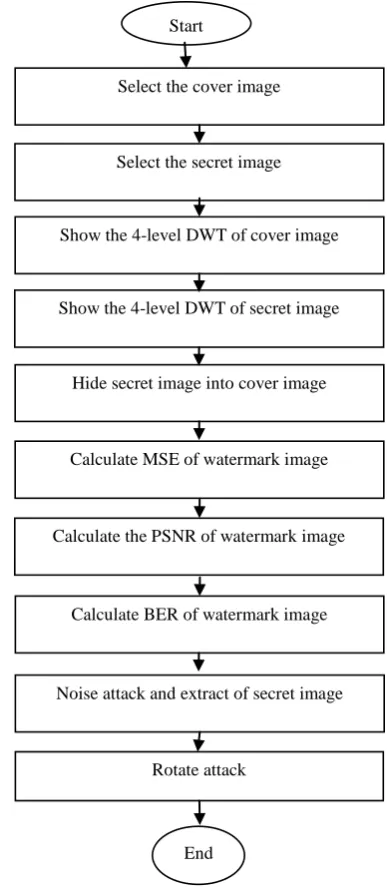
Propose Algorithm-
Step-1 First selects the cover image
Step-2 convert the cover image into gray level and apply
4-level DWT .then split into LL3, LH3, HL3, HH3 Step-3 Now selects the secret image.
Step-4 Then split into L_L3,L_H3,H_L3,H_H3.
Step -4 convert secret images into gray level and apply 4-level DWT.
Step-5 Embed LL band of secret image into LL band of cover image.
Step -6 now calculate the MSE of embedded image.
Step-7 now calculates the PSNR of embedded image.
Step-8 calculates the BER of embedded image.
Step-9 Apply noisy attack of embedded image and extract the secret image.
[image:3.595.333.527.290.734.2]Step-10 Apply rotate attack of embedded image.
Fig. 1 Flow chart of Propose work
Select the cover image
Select the secret image
Noise attack and extract of secret image Calculate BER of watermark image Calculate the PSNR of watermark image
Show the 4-level DWT of cover image
Show the 4-level DWT of secret image
Hide secret image into cover image
Calculate MSE of watermark image Start
Rotate attack
V.RESULT ANALYSIS
[image:4.595.61.285.56.432.2].
[image:4.595.360.525.59.169.2]Fig. 2. Image watermarking proposed menu
Fig. 3. First select the cover image for hiding secret image.
Fig. 4 Now select the secret image to hiding into cover image.
[image:4.595.355.527.206.323.2]Fig. 5. Apply 4-level DWT of cover image to decompose image into four frequency band.
[image:4.595.357.524.359.455.2]Fig. 6Apply 4-level DWT of secret image to decompose image into four frequency band
[image:4.595.333.548.482.602.2]Fig. 7 finally we obtain watermark image.
Fig. 8. Recovered image after noise attack.
[image:4.595.340.543.630.734.2]Table 1. Comparison on BASE PSNR and PROPOSE PSNR
Original Image Watermark Image
Proposed( PSNR)
Base(P SNR)
BER
58.3486 43.09 -5.0906
[image:5.595.46.350.69.688.2]e-05
[image:5.595.39.319.73.359.2]Fig. 10 Graph 1. Comparison on BASE PSNR and PROPOSE PSNR
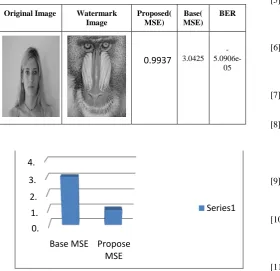
Table 2. Comparison on BASE MSE and PROPOSE MSE
Original Image Watermark Image
Proposed( MSE)
Base( MSE)
BER
0.9937 3.0425
-
5.0906e-05
Fig. 11 Graph 2. Comparison on BASE PSNR and PROPOSE PSNR
CONCLUSION
Digital watermarking provides security to the digital content. Today digital watermarking focus various issues with respect to and its strength against various attacks on the digital images. This paper shows the literature survey of various
Digital watermarking techniques under time and transform domain. This paper thoroughly covers and talks about different DIW procedures both in the spatial and transform domain. In this paper, different watermarking techniques were studied and basic watermarking technique known as 4-DWT is proposed. The executed calculation chips away at gray pictures. Proposed method has been tested under different attacks and noise the performance was observed under those attacks and noise. This novel method gives successful results comparing to methods using different cover images. Results demonstrate that the new technique is exceptionally powerful against various assaults and noise.
REFERENCES
[1] Aaqib Rashid, “Digital Watermarking Applications and Techniques: A Brief Review”. International Journal of Computer Applications Technology and Research Volume 5–Issue 3, 147-150, 2016, ISSN:2319–8656
[2] Mili Singh, Dr. Jitendra Sheetlani, “Performance Analysis on Fingerprint Watermarking with its Transform Techniques”. IOSR Journal of Computer Engineering (IOSR-JCE) e-ISSN: 2278-0661,p-ISSN: 2278-8727, Volume 18, Issue 6, Ver. VI (Nov.-Dec. 2016), PP 34-41 [3] Kirti1 , Vikram Nandal, “A Review on Digital
Watermarking and Its Techniques” , International Journal of Computer Science and Mobile Computing, Vol.3 Issue.6, June- 2014, pg. 686-690
[4] Mohammad Rasool Mirzaei, Maryam Karimi, Nader
Karimi, Shadrokh Samavi, “Blind Image Watermarking Based on Local Analysis of Gradients”. 2017 25th Iranian Conference on Electrical Engineering (ICEE) IEEE 20 17© $3l.00/978-1-5090-5963-8/17
[5] V Muni SekharI, Ch Sravan Kumar, K V G RaoI, N Sambasiva RaoII, M Gopichand, “A Reversible RIE based Watermarking Scheme”. 2017 IEEE 7th International Advance Computing Conference, 978-1-5090-1560-3/17 $31.00 © 2017 IEEE DOI 10.1109/IACC.2017.179 [6] Andjela Draganić*, Milan Marić**, Irena Orović* and
Srdjan Stanković, “Identification of image source using serialnumber-based watermarking under CompressiveSensing conditions”. MIPRO 2017, May 22- 26, 2017, Opatija, Croatia.
[7] Ismat Ara Tanima, Jia Uddin, “An Adaptive Digital Image Watermarking Scheme with PSO, DWT and XFCM”.978-1-5090-6004-7/17/$31.00 2017 IEEE
[8] Sanjay Kumar, Ambar Dutta, “A Study on Robustness of Block Entropy Based Digital Image Watermarking Techniques with respect to Various Attacks”. IEEE International Conference On Recent Trends In Electronics Information Communication Technology, May 20-21, 2016, India. 978-1-5090-0774-5/16/$31.00 © 2016 IEEE [9] Abhishek Basu , Subhrajit Sinha Roy , Avik Chattopadhyay
, “Implementation of a Spatial Domain Salient Region Based Digital Image Watermarking Scheme”. 978-1-5090-1047-9/16/$31.00 ©2016 IEEE
[10] N. SenthilKumaran, and S. Abinaya, “Comparison Analysis of Digital Image Watermarking using DWT and LSB Technique”. International Conference on Communication and Signal Processing, April 6-8, 2016, India, 978-1-5090-0396-9/16/$31.00 ©2016 IEEE
[11] Asna Furqan, Munish Kumar, “Study and Analysis of Robust DWT-SVD Domain Based Digital Image Watermarking Technique Using MATLAB”. 2015 IEEE International Conference on Computational Intelligence & Communication Technology, 978-1-4799-6023-1/15 $31.00 © 2015 IEEE DOI 10.1109/CICT.2015.74
0. 15. 30. 45. 60.
Base
PSNR Propose PSNR
Series1
0. 1. 2. 3. 4.
Base MSE Propose MSE
[image:5.595.40.321.385.656.2]