ISSN(Online): 2320-9801
ISSN (Print): 2320-9798
International Journal of Innovative Research in Computer
and Communication Engineering
(An ISO 3297: 2007 Certified Organization) Website: www.ijircce.com
Vol. 5, Issue 5, May 2017
Design an Architecture for Object’s Feature
Extraction and Retrieval of a Gray Scale
Image
Pooja Garg
Student, Department of Computer Science, Panchkula Engineering College, Mouli (Barwala), Haryana, India
ABSTRACT:Content-based image retrieval, a technique which uses visual contents to search images from large scale
image databases since 1990s. CBIR involves the subsequent four parts in system realization, data collection, build up feature database, search in the database, arrange the order and deal with the results of the retrieval. Image retrieval is the way of retrieval an image on the basis of local and global features derived from color, texture, and simple shape information. Content-based retrieval from an annotated image databases is a wide and versatile field of research interests. We know that image retrieval is not an easy task, because the images are in digital form and with various object (river/sunset/buildings) and it is not easy to search the image on the basis of other image. Even human can do this task vary easily we can see and sense what we have seen so we can manage it, but what will do if we have a huge amount of images in a database. It may be very exhaustive process. So we need an algorithm which can help us to do this task for the human being and the answer is image retrieval on the basis of its internal objects features.
KEYWORDS: Content Based Image Retrieval, Peak signal to noise ratio, Root mean Square error, Image retrieval,
Corner Detector, Corner Matrix.
I. INTRODUCTION
Image retrieval is the way of retrieval an image on the basis of local and global features derived from color, texture, and simple shape information. Content-based retrieval from an annotated image databases is a wide and versatile field of research interests. A simple CBIR problem occurs when the database in question consists of images of a strongly restricted domain. One widely-studied application of this complexity is retrieval of trademark images, mainly based on different shape features as the lack of background enables automatic segmentation of such images. In the other extreme lies the problem of retrieving relevant images from large and dynamic collections of miscellaneous images. The basic problem in CBIR is the gap between the high level semantic concepts used by humans to understand image content and the low-level visual features extracted from images and used by a computer to index the images in a database. Two most important research topics in CBIR are thus (1) the selection of the used features and the measure of similarity between them, and (2) the techniques for indexing the images, i.e., how to collect images and extract the features from the selected images, the system will display to the user next. In this paper, we will concentrate on the latter issue. The basic idea is to have a query image or an input image and then the important features from the input images are detected and extracted after this, the image having similar image is retrieved from the database. The object of the image may be the good candidate for retrieval an image and it includes the categories of the object classes (city/human/animal/sunset).
II. RELATED WORK
ISSN(Online): 2320-9801
ISSN (Print): 2320-9798
International Journal of Innovative Research in Computer
and Communication Engineering
(An ISO 3297: 2007 Certified Organization) Website: www.ijircce.com
Vol. 5, Issue 5, May 2017
image segmentation, image decomposition and similarity matching techniques. In [17] Ritika Hirwane et al. defines content-based image retrieval (CBIR), a technique for retrieving images on the basis of automatically-derived features like color, texture and shape. There is need to find a desired image from a collection is shared by many professional groups, including journalists, design engineers and art historians. During the requirements of image users can vary considerably, it can be useful to illustrate image queries into three levels of abstraction first is primitive features such as color or shape, second is logical features such as the identity of objects shown and last is abstract attributes such as the significance of the scenes depicted. While CBIR systems currently operate well only at the lowest of these levels, most users demand higher levels of retrieval. In [16] Reshma Chaudhari1 et al. definesContent-Based Image Retrieval (CBIR) uses the visual contents of an image such as color, shape, texture, and spatial layout to represent and index the image. Active research in CBIR is geared towards the development of methodologies for analyzing, interpreting cataloging and indexing image databases. In this research, Reshma Chaudharil et al. proposed an algorithm which incorporates the advantages of various other algorithms to improve the accuracy and performance of retrieval. The accuracy of color histogram based matching can be increased by using Color Coherence Vector (CCV) for successive refinement. The speed of shape based retrieval can be enhanced by considering approximate shape rather than the exact shape. In [14]A.Kannan et al. used an image mining system is the Content-Based Image Retrieval (CBIR) which performs retrieval based on the similarity defined in terms of extracted features with more objectiveness. The drawback in CBIR is the features of the query image alone are considered. Hence, a new technique called Image retrieval based on optimum clusters is proposed for improving user interaction with image retrieval systems by fully exploiting the similarity information.
III.PROPOSED ALGORITHM
A. Design Considerations:
Design architecture for object’s feature extraction and retrieval of a gray scale image.
Implementation using Matlab (image processing tool box).
Graphically presentation and comparison of the extracted and matched features of an images.
Calculate and analyze the results MSE and PSNR value.
B. Description of the Proposed Algorithm:
Aim of the proposed algorithm is image retrieval on the basis of its internal objects features. The proposed algorithm is consists of three main steps.
Step 1: Finds corners in a grayscale image using Corner Matrix and Corner Detector
The Corner Detector object of vision package finds corners in a grayscale image. It returns corner locations as a matrix of [x y] coordinates. The object finds corners in an image using the Harris corner detection minimum Eigen value or local intensity comparison method.
Step 2: Match Features
ISSN(Online): 2320-9801
ISSN (Print): 2320-9798
International Journal of Innovative Research in Computer
and Communication Engineering
(An ISO 3297: 2007 Certified Organization) Website: www.ijircce.com
Vol. 5, Issue 5, May 2017
Step 3: Parameters:
a) PSNR: It is the ratio between the maximum possible power of a signal and the power of corrupting noise that affects the fidelity of its representation. The PSNR of the fusion result is defined as follows:
PSNR= 10Xlog ( ) … (4)
Where fmax is the maximum gray scale value of the pixels in the fused image. Higher the value of the PSNR, better the performance of the fusion algorithm.
b) RMSE: A commonly used reference based assessment metric is the Root Mean Square Error (RMSE). The MSE between a reference image, R, and a fused image, F, is given by the
Following equation:
RMSE =
∑
∑
( , )
−
( , )
… (5)Where R (m, n) and F (m, n) are the reference (CT or MR) and fused images, respectively, and M and N are image dimensions. Smaller the value of the RMSE, better the performance of the fusion algorithm.
Step 4: Image Processing Toolbox:
Image Processing Toolbox [32] is a collection of functions that extend the capability of the MATLAB numeric computing environment. The toolbox supports a wide range of image processing operations. In this work, to design and implement the image enhancement of natural and un-natural dark images using improved genetic algorithm code we have used image processing toolbox of MATLAB version 7.14.0.739 (R2012a).
IV.PSEUDO CODE Step 1: Load Query Image.
Step 2: Detection of Edge of objects in Input Query Image. Step 3: Detection of object feature of input image (11) Step 4: Image from Database Detection Feature (12) Step 5: Feature Extraction of both images (11, 12) Step 6: Compare & Match the Extracted Feature Step 7: If features are matched
Then
Go to Image Database Else
Go to Image from Database Detection Feature (12) Step 8: Display the Results & Plot Graphs
Results Images
Plot Extracted Features (11, 12) Plot Matched Features (11, 12) Plot Comparative Features Step 9: End
V. SIMULATION RESULTS
ISSN(Online): 2320-9801
ISSN (Print): 2320-9798
International Journal of Innovative Research in Computer
and Communication Engineering
(An ISO 3297: 2007 Certified Organization) Website: www.ijircce.com
Vol. 5, Issue 5, May 2017
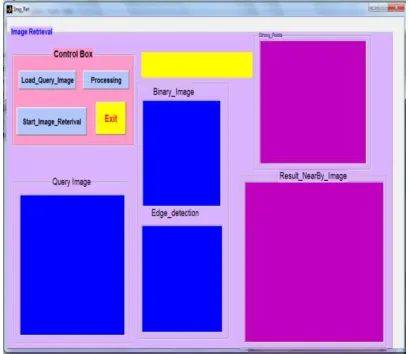
loaded then processed and then the retrieval will be started. Next figure is showing the main layout of the proposed work.
Figure 5.1: The main layout of the proposed work
1. Load query image
To load the query image a user has to click on load_Query_Image button from the control box as shown in next figure. As the user will click on this button than an open file box will be appeared on the screen now the user has to open query image folder and then he has to select query image. The selected image will called input image and will be displayed in the given place.
ISSN(Online): 2320-9801
ISSN (Print): 2320-9798
International Journal of Innovative Research in Computer
and Communication Engineering
(An ISO 3297: 2007 Certified Organization) Website: www.ijircce.com
Vol. 5, Issue 5, May 2017
Figure 5.3: Open file box for selecting Query Image.
Figure 5.4: Loaded query image.
1. Processing
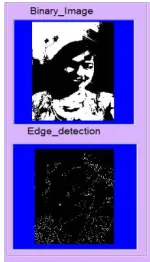
If user has loaded the input query image for retrieval, the next step is to start the processing. Here the input query image will be converted in black and white (binary) image, because binary image can be easily understand by computer as shown in next figure
ISSN(Online): 2320-9801
ISSN (Print): 2320-9798
International Journal of Innovative Research in Computer
and Communication Engineering
(An ISO 3297: 2007 Certified Organization) Website: www.ijircce.com
Vol. 5, Issue 5, May 2017
2. Start_Image_Retrieval
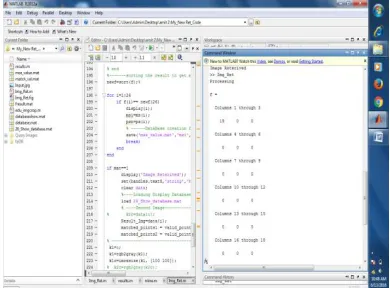
After loaded the query image next work is to compare the input image with the database images. First of all the points from the input image and the first image from the database are detected for matching purpose. After detecting the matching point’s features are extracted and matched with the next image. The same process is repeated with all the images stored in the database. To store the matched features for all the comparison pairs a variable is taken “F”. Next figure is showing the corresponding selecting points. On the basis of matched features, an image will be selected and displayed as most nearby image.
Figure 5.6: Running of Code in Code Editor Window right side
Figure 5.7: Selected points from images
Figure 5.8: Retrieved image
ISSN(Online): 2320-9801
ISSN (Print): 2320-9798
International Journal of Innovative Research in Computer
and Communication Engineering
(An ISO 3297: 2007 Certified Organization) Website: www.ijircce.com
Vol. 5, Issue 5, May 2017
Figure 5.9: Complete layout design of the result.
3. Graphical Representation
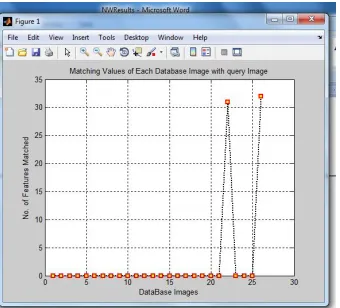
Next figure is showing the graphically results of all the matched features of all the database images. The image which
has the higher number of matched pixel will be selected and displayed.
Figure 5.10: Graphical representation of matched features.
4. Performance Evaluation
When the result image is retrieved by the user than the next work is to analyses the performance on the basis of MSE
and PSNR values. The results are calculated and displayed in the next table.
ISSN(Online): 2320-9801
ISSN (Print): 2320-9798
International Journal of Innovative Research in Computer
and Communication Engineering
(An ISO 3297: 2007 Certified Organization) Website: www.ijircce.com
Vol. 5, Issue 5, May 2017
VI.CONCLUSION AND FUTURE WORK
When designing this kind of image retrieving system. I have used here, detect surf feature method and corner detector object to extract and matched the features of input and the database image. On the basic of those extracted features an image is retrieved from the database and displayed in the given place. Later these results are graphically analyse and displayed, after this the performance is evaluated on the basis of MSE and PSNR values between the retrieved and input images.
In future there is good scope of this image retrieval method, there may be more methods and more features which can be used to retrieve an image from the large database. Using new features the results may be improved.
REFERENCES
1. Stricker M A,Orengo M, Similarity of color images , Proc of SPIE, Storage and Retrieval for Image and Video Database, San Jose, CA:s.n, 1995:381-392.
2. Yi Li and Linda, G. Shapiro, “Object Recognition for Content-Base Image Retrieval” University of Washington seattle, WA 98195-2350. 3. Image Retrieval: Current Techniques, Promising Directions, and Open Issues Yong Rui, Thomas Huang and Shih-Fu Chang.
4. [Content-Based Image Retrieval (CBIR) By: Victor Makarenkov]
5. A. Del Bimbo, P.Pala, S.Santini: Visual image retrieval by elastic deformation of object sketches, IEEE Symposium on Visual Languages, pp. 216-223, 1994.
6. M. Adoram and M. S. Lew, “IRUS: Image Retrieval Using Shape,” Proceedings of IEEE International Conference on Multimedia Computing and System, Vol. 2, pp. 597–602, 1999.
7. Yong Rui and Thomas S. Huang, “Image Retrieval: Current Techniques, 1Promising Directions, and Open Issues”, JVCIR 10, Pg. 39-62, 1999. 8. Arnold W.M. Smeulders, “Content-Based Image Retrieval at the End of the Early Years”, IEEE Transactions o patterns analysis and machine
intelligence, Vol 22, No 12, December 2000.
9. Markus Koskela, Jorma Laaksonen, and Erkki Oja, Comparison Of Techniques For Content-Based Image Retrieval” 12th Scandinavian Conference on image Analysis (SCIA) , Pg. 579-586, 2001.
10. Yi Li and Linda G. Shapiro, “Object recognition for Content-Based Image Retrieval”, 2003.
11. Ritendra Datta Jia Li James Z. Wang, “Content-Based Image Retrieval - Approaches and Trends of the New Age”, 2005.
12. Amit Jain, Ramanathan Muthuganapathy and Karthik Ramani, “Content-Based Image Retrieval Using Shape and Depth from an Engineering Database”, 2007.
13. Ritendra Datta, Dhiraj Joshi, Jia Li, and James z. Wang, “Image Retrieval: Ideas, Influences, and Trends of the New Age”, ACM Computing Surveys, Vol. 40, No. 2, Article 5, Publication date: April 2008.
14. A.Kannan, Dr. V. Mohan and Dr. N. Anbazhagan, “An Effective Method of Image Retrieval using Image Mining Techniques, ,IJMA, Vol.2, No.4, November 2010.
15. Gulfishan Firdose Ahmed, Raju Barskar , “A Study on Different Image Retrieval Techniques in Image Processing”, IJSCE, ISSN: 2231-2307, Volume-1, Issue-4, September 2011.
16. Reshma Chaudhari1, A. M. Patil, “Content Based Image Retrieval Using Color and Shape Features”, IJAREEIE, Vol. 1, Issue 5, ISSN: 2278 – 8875, November 2012.
17. Ritika Hirwane , “Fundamental of Content Based Image Retrieval”, (IJCSIT) International Journal of Computer Science and Information Technologies, Vol. 3 (1) , Pg. 3260 – 3263, 2012.
18. Suman Lata, Parul Preet Singh, “A Review on Content Based Image Retrieval System”, International Journal of Advanced Research in Computer Science and Software Engineering Volume 4, Issue 5, ISSN: 2277 128X, May 2014.