141 | P a g e
INVESTIGATING THE PERFORMANCE OF OPTIMIZATION
TECHNIQUES WITH SVM FOR MEDICAL IMAGE
CLASSIFICATION
Dr. N.T. Renukadevi
1, Ms. S.Nandhinidevi
21, 2
Assistant Professors, Department of CT-UG, Kongu Engineering College, Perundurai (India)
ABSTRACT
Computerized tomography uses X-rays, and a computer to create detailed body image. CT scan images are called
tomograms having more detail than standard X-rays. Content-based image retrieval (CBIR) of medical images,
according to its domain specific image features, is a valuable tool for physicians. A method for automatic
classification of computed tomography (CT) images of different types is presented in this paper. The proposed
method has three major steps: 1. Feature are extracted from the CT images using Coif let wavelets; 2. The features
extracted are classified using Support Vector Machine; 3. The parameters of the SVM are optimized using Particle
Swarm Optimization (PSO), and modified PSO with a genetic algorithm
Keywords- Content-Based Image Retrieval, Computed Tomography, Coif Let Wavelets, Particle Swarm
Optimization, Genetic Algorithm, Support Vector Machine
I INTRODUCTION
Computerized tomography uses X-rays, and a computer to create detailed body image. CT scan images are called
tomograms having more detail than standard X-rays. A CT scan produces images of structures within the body like
internal organs, blood vessels, bones and tumours [1]. The various types of CT scans that help investigate particular
body areas include: Head scans, which can check for suspected brain tumours and arterial bleeding/swelling; head
scans also investigate the brain after a stroke (when blood supply to a part of the brain is cut). Abdominal scans can
detect tumours and diagnose conditions causing internal organs like liver, kidneys, pancreas, intestines or lungs, to
become enlarged or inflamed. Vascular scans assess conditions affecting blood flow to various parts of the body.
Bone scans assess bone injuries and disease, specially the spine.
Support Vector Machines (SVMs) achieve good empirical on different learning problems when compared to the
other machine learning methods [2]. Though, the accomplishments of SVMs are governed by the adequate choice of
142 | P a g e
problem wherein a search technique is used to the optimal parameters to maximize the SVM performance [3][4][5].
Even though search techniques represent a systematic approach for parameter selection in SVM, it can also be
expensive if the number of parameters to be evaluated during the search process is large [6].
Classification includes a broad range of decision-theoretic approaches that is used for identification of images.
All classification algorithms are mainly based on the assumption that the image in question portrays one or
more features and each of these features belongs to one of several distinct and exclusive classes. The class specifies
a prior by an automatically clustered into sets of prototype classes, where the analyst merely specifies the number of
desired categories.
Image classification analyzes the numerical properties of various image features and organizes the data into
categories. Classification algorithms mainly employs into two phases of processing such as training and testing. In
initial training phase, the characteristic properties of typical image features are isolated based on the training
class, is created. In the subsequent testing phase, these feature-space partitions are used for classification of image
features. The description of training classes is an extremely important component of the classification
process.
Supervised classification: here the statistical processes or distribution-free processes can be used for
extraction of class descriptors.
Unsupervised classification: it relies on clustering algorithms for automatically segment the training
data into prototype classes.
A support vector machine classification can be constructed as a hyper plane or set of hyper planes in a high
or infinite-dimensional space, which are used for classification. A separation is achieved by the hyper plane that
consists of the largest distance to the nearest training data points of any class so-called as functional margin, since in
general the larger the margin the lower the generalization error of the classifier. SVM is a binary classifier and it is
immune to noise.
A different method to SVM parameter selection is based on Meta-Learning wherein the SVM parameter selection is
treated as supervised learning tasks [7]. In this, the characteristics of the training examples and the performance
achieved for a set of parameters for the problem are stored. Meta-learners on the basis of the set of training examples
received as input, predicts the best values for the parameters for a new problem. The Meta-Learning is also used as it
is less expensive when compared to the search approach.
The SVM parameters are often selected by calculating different combinations of parameters and utilizing the
combination which achieves the best performance for the particular dataset. To automatize the search process,
various search and optimization techniques are used [8][9]. The search space is made up of a set of possible
combination of parameters and a fitness function corresponding to performance measure achieved by the SVM is
considered. Different search techniques available in the literature are based on Evolutionary Algorithms [10],
143 | P a g e
II OVERVIEW OF GA
Population Initialization
The parameters in problem space are not calculated directly, but instead the feasibility solutions of the problem to be
solved that are expressed as Chromosomes or individuals in genetic space by encoding. The population of kernel
function parameter can be initialized.
Fitness Function
Fitness functions are used to distinguish the quality of individuals in population and it is the only guide for natural
selection, which is usually derived from objective function. If the fitness function value is larger then there will be
better in quality of individual [14][15]
Selection
By selection relay, tremendous individuals is found from old population, and new population can be build for
reproduction of the next generation individual. If the fitness function value of individual is larger than the
probability of being selected is higher. For instance, an selection method to fitness Proportion, is performed and the
probability of being selected to the individual i is
(1)
In above formula, Fi is the fitness function values of the individual i, n is population size.
There are different types of selection process of which Roulette wheel selection is considered.
Roulette–Wheel selection : In this, the strings with higher fitness values has higher probability of being selected
in the new mating pool. Fig shows that, the top surface area of Roulette wheel is divided as N parts according to
their fitness values where higher fitness value string consumes larger area. Each part of the wheel represents a
string like f1, f2, f3,....fn. A fixed pointer is used here for identifying the selected string or winner of the rotation
and the wheel is rotated either in clockwise or anti-clockwise. After N rotation, N number of string can be selected
to form a new population of size N. The probability of a string to be selected after a rotation is proportional
to its area or its fitness value.
Crossover
It is used to find two individuals randomly from the present population, whose chromosome information‟s are
exchanged and combined for each other to pass outstanding characteristics of father string down to son string, in
order to reproduce the new admirable individuals. The original crossing method is adopted here because all
144 | P a g e
(2)
In above formula, d is a random number on interval (0, 1) [18].
Different types of crossovers are
Single-point crossover: Here crossover operation is done at a single point i.e. a single point which is
selected between 1 and (L-1) at random where L is the length of the string.
Two-point crossover: The only difference is that, it has two crossover sites rather than one as in single point
cross over.
Multi point crossover: In multiple crossover points are selected along the string length randomly with
no duplicates and are sorted into ascending order. The bits between successive crossover points are
exchanged alternatively between two parents in order to produce new offspring.
Uniform crossover: It is more general version of multi point crossover. At each bit position there will be a
tossing of coin which decides whether crossover will occur at that bit position or not. The mask
consists of same length as the chromosome structure is created at random and the parity of the bits in
the mask indicates which parent will supply the offspring with which bits. The “1” in the random
mask means bits swapping and the “0” means bit replacing
Mutation
It helps to reproduce a better individual, which are randomly found from the present population and mutated
slightly. Mutation aims at maintaining the diversity of population. The operation of mutation to the jth gene of the
ith individual as follows
(3)
In above formula, max a and min a are upper and lower bounds of gene aij. r is a random number on interval (0 ,
1), g is the present number of iterations, maxG is the maximum evolutionary generation
In the current work, PSO is implemented for parameter selection of the RBF kernel of SVM. “Swarm intelligence”
is usually used for optimization, to maximize or minimize the cost function by searching for a set of variable is
termed optimization. Swarm optimizations are based on the collective behavior of the bees or ants, or social
behavior of bird flocking and fish schooling. The Particle Swarm Optimization algorithm is a population-based
145 | P a g e
as it is easily implemented, computationally inexpensive. To prevent premature convergence in PSO, the PSO is
modified using genetic algorithm (GA).
III RELATED WORKS
Kharrat et al (2011) proposed a new approach for automatic classification of Magnetic Resonance (MR) human
brain images as normal and abnormal. Wavelets Transform (WT) is used as input module to Genetic Algorithm
(GA) for feature selection and Support Vector Machine (SVM) for classifying the MR images. The GA requires
very less computation when compared with Sequential Floating Backward Selection (SFBS) and Sequential Floating
Forward Selection (SFFS) methods. A reduction rate of 88.63% is realized and classification rate of 100% was
obtained using the support vector machine.
Zhang et al (2010) presented adaptive chaotic particle swarm optimization (ACPSO) for optimizing parameters. The
methodology is used to classify MR brain image as normal or abnormal. Wavelet transforms are used to extract
features and principle component analysis (PCA) is applied to reduce the dimensions of features. Feed forward
neural network is used to classify the features. To enhance the generalization, K-fold stratified cross validation was
applied. The proposed method was evaluated using 160 images (20 normal, 140 abnormal), and classification
accuracy of 98.75% was achieved.
Gal et al (2012) presented a multi-disciplinary approach to address the classification problem. The proposed
methodology combined image features, meta-data, textual and referential information for classification of medical
images. Image CLEF 2011 medical modality classification data set was used to evaluate the system‟s accuracy.
Multiple kernels were used for classification; significantly better classification accuracy was achieved as the kernels
were selected for different features. Best classification accuracy of 88.47% obtained and outperforms the other
methods available in the literature.
Uma maheswari et al (2012) proposed PSO SVM for classification of DICOM images. The proposed method was
used to recognise and classify brain images as normal and abnormal. Optimal recognition and detection of disease in
DICOM images is crucial for the diagnosis process. The proposed method focused on recognition and classification
based on combined approach of digital image processing incorporating PSO, GA and SVM. The combined approach
by using PSO-SVM achieves high approximation capability and faster convergence.
IV MATERIALS AND METHODS
Feature extraction using Coif let wavelet
Coif lets are discrete wavelets designed to have scaling functions with vanishing moments [23]. The wavelet is near
symmetric with N/3 vanishing moments and N/3-1 scaling functions. The function Ψ has 2N moments equal to 0
and the function φ has 2N-1 moments equal to 0. The support length of the two functions is 6N-1. The coifN Ψ and
φ are considerably more symmetric than the dbNs. The coifN are compared to db3N or sym3N when considering the
146 | P a g e
If s is a sufficiently regular continuous time signal, for large j the coefficient [23]
s
,
j k, is approximated by
/ 2
2j s 2jk
.
If s is a polynomial of degree d, d ≤ N - 1, then the approximation becomes equality.
Support Vector Machine (SVM)
Given a set of features that can be represented in space, SVM maps features non-linearly into n dimensional feature
space when provided with features set that can be represented in space. When a kernel is introduced with high
computation the algorithm uses inputs as scalar products with classification being solved by translating the issue into
a convex quadratic optimization problem with a clear solution being obtained by convexity [7]
In SVM, an attribute is a predictor variable and a feature a transformed attribute. A set of features describing an
example is a vector. Features define the hyperplane. SVM aims to locate an optimal hyper plane separating vector
clusters with a class of attributes on one side of the plane with the on the other side. The margin is the distance
between hyper plane and support vectors. SVM analysis orients the margin that space between it and support vectors
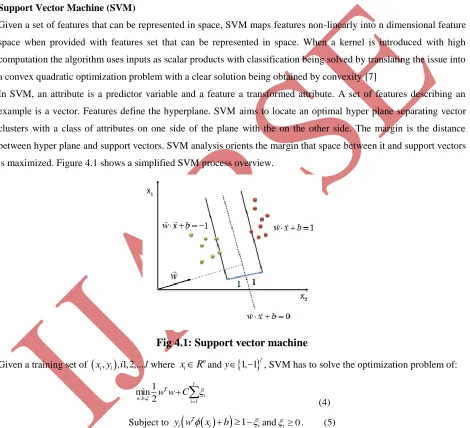
is maximized. Figure 4.1 shows a simplified SVM process overview.
Fig 4.1: Support vector machine
Given a training set of
x yi, i
, 1,2,....i lwherex
i
R
nandy
1, 1l, SVM has to solve the optimization problem of:, ,
1
1 min
2
l T
i w b
i
w w C
(4)
Subject to
T
1i i i
y w x b andi0. (5)
The function maps the vectors xiin higher dimensional space. C>0 is penalty parameter of the error term.
This optimization model is solved through the use of the Lagrangian method, equal to the method for solving
147 | P a g e
1 , 1
1
.
2
m m
D i i j i j i j i i j
Max L y y x x
(6)
Subject to:
0
iC i
1,..,
m
and1
0
m i i iy
To find the optimal hyper plane, a dual LagrangianLD(α) should be maximized as regards non-negative αi under the
constrains
1 0
m i i i
y
and0
iC
. The penalty parameter C, now the upper bound on αi, is user determined.A kernel function is defined as K x x
i, j
xi T
xj . The Radial Basis function is given as follows:
2
, exp , 0
i j i j
K x x xx
(7)
A proper parameter setting improves SVM classification accuracy. There are two parameters to be determined in the SVM model with the RBF kernel: C and gamma (γ). The value of C and γ influence the learning performance of the SVM. Intuitively the γ parameter defines the distance a single training example can reach, with low values meaning „far‟ and high values meaning „close‟. The C parameter trades off training examples misclassification against
decision surface simplicity. A low C ensures a smooth decision surface while a high C attempts to classify training
examples correctly. Experiments are undertaken to evaluate SVM performance through variations of the γ and C
parameters [20][21].
4.1.GA-SVM Algorithms
There are two methods used to combine Genetic algorithm and SVM are as follows:
Dealing with dataset: The initial training dataset are optimized by including the important samples in order
to find a sample subset that preserves or improves the discrimination ability of SVM. Training on the
subset is equal to the initial sample sets and the training time is greatly reduced. Main idea is to find out the
important examples that affect the classification results significantly. If the feature vectors are removed,
then the separating boundary can be changed.
Defining parameters: The value of parameters is important in case of Support Vector Machines for better
performance of algorithm. A methodology is presented to train SVM where the regularization parameter
(C) was determined automatically by the use of an efficient Genetic Algorithm in order to solve multiple
category classification problems [13].
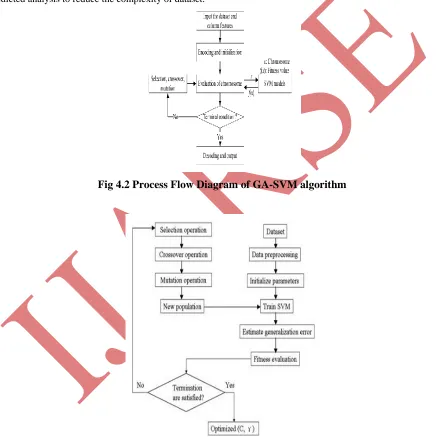
GA-SVM algorithm is proposed using the character of GA in which searching the optimal combination is made to
combine SVM classification algorithm to which it gets the tool of optimal columns combination. Fig. shows the
process details of the GA-SVM algorithm. After users input for the dataset and column features, GA-SVM
algorithm first acquire the feature of column dataset in which values are initialized with chromosome, and encodes
148 | P a g e
evaluated to create fitness value of each chromosome based on condition of good or bad. Before the condition of
satisfaction closed down, it continually passed through the evolution procedure such as selection, crossover and
mutation in order to find the highest categories of predicted accuracy of the combination columns for the selecting
key combination columns. The optimal combination searching of GA-SVM algorithm effectively reduces the dataset
columns. The following figure 4.2 shows the process of GA-SVM algorithm. Also it is used to find the important
columns that affects classification predicted accuracy and survive as the main column of dataset in classification
predicted analysis to reduce the complexity of dataset.
Fig 4.2 Process Flow Diagram of GA-SVM algorithm
149 | P a g e
Steps for New Generation Formation: A new generation can be formed by (a) selection of some individuals
from current population based on their fitness values, (b) by exchanging part of the genes for the
chromosomes in current generation with a certain probability using a crossover operator, (c) by modifying
one or more genes in some chromosomes with a certain probability using a mutation operator, (d) selection
of new off springs to substitute old individuals according to their fitness values and (e) rejecting others to
keep the population size constant. The flow chart of the GA-based parameter optimization algorithm of the
SVM is given away in following figure 4.3.
4.2 PSO-SVM Algorithms
To optimize the parameters C and γ, PSO is adapted to execute the search for optimal combination (C, γ). The
objective function for evaluating the quality of combination of parameters is based on Root Mean Squared Error
(RMSE) achieved by the SVM in a 10-fold cross validation experiment. Thus, the PSO finds the combination of
parameters with the lowest RMSE[16].
Each particle i represents a combination of parameters which also indicates the position of the particle in the search
space. The velocity of the particle is indicative of the direction of the search of the particle. The PSO algorithm
keeps updating the position and velocity of the particle in each iteration which leads to best regions in the search
space. The velocity and the position of the particle are updated as follows:
1 1 2 2
d d d d d d
i i i i g i
d d d i i i
v wv c r p x c r p x x x v
(8)
where w is the Inertia weight; d represents the number of dimensions; i is the size of the population; the two "best"
values - pbest and gbest - of a particle where „pbest‟
di
p is the best solution achieved by the particle till then and
„gbest‟
dg
p is the best value obtained till then by any particle in the population; c1, c2 are positive constants; r1 and
r2 are random values with value between (0, 1).
The parameters w, c1, c2, r1, r2 in the PSO affect the performance of the algorithm significantly. The inertia weight
controls the exploration and exploitation; generally 0 < w < 1 for the particles to converge. Higher value of w (near
1) favours global search and lower values less than 0.5 favours local search. The random numbers r1 and r2 are with
value between (0, 1). The coefficients c1 and c2 are usually equal (i.e., c1=c2) and has a value in the range of (0, 4).
The value of c1 and c2 are significant as convergence is dependent on these values.
Convergence is feasible when
1
1
1 2
1
2
w
where
1
c r
1 1,
2
c r
2 2 Also for stochastic
1and
2,convergences results when
1 2 crit ratio c c
is close to 1 and
1 2
sup 0.5 1 , 0,
crit w c c
150 | P a g e
To avoid premature convergence and to combine the coordinates to achieve high convergence speed, the classical
PSO is modified using GA. The GA incorporated, coordinates the relationship of the PSO parameters to maximize
the performance. The GA generates a population by encoding the PSO parameters. The fitness value is calculated
based on
ratiowith the objective to maximize it. Genetic operators, selection, crossover and mutation, are applied togenerate the next generation. On termination of the GA algorithm, the PSO parameters obtained are updated into
PSO algorithm.
V RESULTS AND DISCUSSION
Experiments were conducted using 150 CT scans images of brain, chest and colon. Features were extracted using
Coif let wavelet. Experiments were conducted to evaluate the classification accuracy for SVM-RBF, with PSO and
with modified PSO. All the experiments were conducted for 10-fold cross validation. The classification accuracy
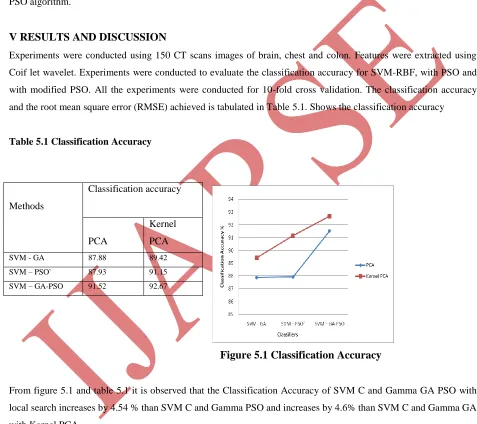
and the root mean square error (RMSE) achieved is tabulated in Table 5.1. Shows the classification accuracy
Table 5.1 Classification Accuracy
Figure 5.1 Classification Accuracy
From figure 5.1 and table 5.1 it is observed that the Classification Accuracy of SVM C and Gamma GA PSO with
local search increases by 4.54 % than SVM C and Gamma PSO and increases by 4.6% than SVM C and Gamma GA
with Kernel PCA.
VI CONCLUSIONS
In this paper, to improve the performance of the SVM-RBF for classifying the CT images, the SVM parameters C
and Gamma (γ) are optimized. Particle Swarm Optimization (PSO) is implemented to select the values of two SVM Methods
Classification accuracy
PCA
Kernel
PCA
SVM - GA 87.88 89.42
SVM – PSO` 87.93 91.15
151 | P a g e
parameters for classification problems. To avoid premature convergence and to combine the coordinates to achieve
high convergence speed, the classical PSO is modified using GA. The experiments were conducted for 10-fold cross
validation. The classification accuracy and the root mean square error (RMSE) achieved for the proposed modified
PSO is significantly better.
REFERENCES
1. Kalender, W. A. Computed tomography. (Wiley-VCH 2011).
2. C. Soares, P. Brazdil, and P. Kuba, “A meta-learning approach to select the kernel width in support vector
regression,” Machine Learning, vol. 54, no. 3, pp. 195–209, 2004.
3. Lorena and A. de Carvalho, “Evolutionary tuning of SVM parameter values in multiclass problems,” Neuro
computing, vol. 71, pp. 16–18, 2008.
4 S. Lessmann, R. Stahlbock, and S. Crone, “Genetic algorithms for support vector machine model selection,”
International Joint Conference on Neural Networks, pp. 3063–3069, 2006.
5 X. Guo, J. Yang, C. Wu, C. Wang, and Y. Liang, “A novel LS-SVMS hyper-parameter selection based on
particle swarm optimization,” Neurocomputing, vol. 71, pp. 3211–3215, 2008.
6 S. Ali and K. A. Smith-Miles, “A meta-learning approach to automatic kernel selection for support vector
machines,” Neuro computing, vol. 70, no. 1-3, pp. 173–186, 2006.
7 F. Friedrichs and C. Igel, “Evolutionary tuning of multiple svm parameters,” Neurocomputing, vol. 64, pp. 107–
117,2005.
8 B. de Souza, A. de Carvalho, and R. Ishii, “Multiclass SVM model selection using particle swarm
optimization,” in Sixth International Conference on Hybrid Intelligent Systems, pp. 441–446, 2006.
9 S. Lessmann, R. Stahlbock, and S. Crone, “Genetic algorithms for support vector machine model selection,” in
International Joint Conference on Neural Networks, pp. 3063–3069, 2006.
10 O. Chapelle, V. Vapnik, O. Bousquet, and S. Mukherjee , “Choosing multiple parameters for support vector
machines,” Machine Learning, vol. 46, no. 1, pp. 131–159, 2002.
11 Xiaoyong LIU “A Hybrid Algorithm for Text Classification Problem”, PRZEGL ĄD
ELEKTROTECHNICZNY (Electrical Review), ISSN 0033-2097, 2012.
12 Fengchun Tian “Classification of Electronic Nose Data on Wound Infection Detection Using Support Vector
Machine Combined GA”, Journal of Computational Information Systems 8: 8, 2012.
13. Fengmei Gao, “Application of SVM Optimization Based on GA in Electronic Sphygmomanometer Data
Fusion”, IJCSI International Journal of Computer Science Issues, Vol. 10(1) ,2013.
14. D.E. Goldberg, K. Deb, “ A comparison of selection schemes used in genetic algorithms,” In G.
Rawlins, (Ed.), Proceedings of Foundation of Genetic Algorithms-, San Mateo: Morgan
152 | P a g e
15. D.K. Pratihar, “Soft Computing ”, IIT Kharagpur, department of Mechanical Engg, ISBN
978-81-7319-866-3
16. Satyobroto Talukder, “Mathematical Modelling and Applications of Particle Swarm Optimization, Master‟s
Thesis submitted to the School of Engineering at Blekinge Institute of Technology, 2011.
17. Kharrat, A., Gasmi, K., Ben Messaoud, M., Benamrane, N., & Abid, M. “Medical Image Classification Using
an Optimal Feature Extraction Algorithm and a Supervised Classifier Technique”. International Journal of
Software Science and Computational Intelligence (IJSSCI), 3(2), 19-33, 2011.
18. Zhang, Y., Wang, S., & Wu, L. “A novel method for magnetic resonance brain image classification based on
adaptive chaotic PSO”. Progress in Electromagnetics Research, 109, 325-343, 2010.
19. G. Beylkin, R. Coifman, and V. Rokhlin ,Fast wavelet transforms and numerical algorithms, Comm. Pure Appl.
Math., 44, pp. 141-183, 1991.
20. B. E. Boser, I. Guyon, and V. Vapnik, “A training algorithm for optimal margin classifiers”. In Proceedings of
the Fifth Annual Workshop on Computational Learning Theory, pages 144-152. ACM Press, 1992.
21. P.Brazdil C.Soares and A. Woznica , “Exploiting sampling and meta-learning for parameter setting support
vector machines”. Proceedings of the IBERAMIA, pages 217–225, 2001.
22. Umamaheswari, J., & Radhamani, G., “An Amalgam Approach for DICOM Image Classification and
Recognition. World Academy of Science, Engineering and Technology”, pg. 62, 2012.