Pairing Cryptography Meets Isogeny:
A New Framework of Isogenous Pairing Groups
Takeshi Koshiba and Katsuyuki Takashima December 8, 2016
Saitama Univ. and Mitsubishi Electric
Abstract. We put forth a new mathematical framework called Isoge-nous Pairing Groups (IPG) and new intractable assumptions in the framework, theIsogenous DBDH (Isog-DBDH) assumptionand its vari-ants. Three operations, i.e., exponentiation, pairing and isogeny on el-liptic curves are treated under a unified notion of trapdoor homomor-phisms, and combinations of the operations have potential new crypto-graphic applications, in which the compatibility of pairing and isogeny is a main ingredient in IPG. As an example, we present constructions of (small and large universe) key-policy attribute-based encryption (KP-ABE) schemessecure against pre-challenge quantum adversaries in the quantum random oracle model (QROM). Note that our small universe KP-ABE hasasymptotically the same efficiencyas Goyal et al.’s small universe KP-ABE, which has only classical security. As a by-product, we also proposepractical(hierarchical) identity-based encryption ((H)IBE) schemessecure against pre-challenge quantum adversariesin the QROM from isogenies, which are based on the Boneh-Franklin IBE and the Gentry-Silverberg HIBE, respectively.
Keywords: Attribute-Based Encryption, Post-Quantum Crypto., Isogeny
1
Introduction
1.1 Backgrounds
Since the seminal work of Boneh-Franklin, pairings on elliptic curves have many applications, i.e., identity-based encryption, short (group) signatures, attribute-based encryption, efficient anonymous credential systems, etc. Elliptic curves have another interesting operation called isogeny, which has been used for quantum-resistant cryptosystems [22, 33, 19]. This paper establishes a unified framework for these operations, namely, a notion of isogenous pairing groups (IPG). Using this framework, we can raise pairing cryptosystems to quantum resistant ones in a weak sense. As an example, we construct secure (H)IBE and ABE in a weak form of post-quantum security model.
to decrypt a ciphertext if and only if the secret key formula is satisfied by the ci-phertext attributes. Hence, there exists a hierarchical structure in keys, namely, master secret keys and user-level keys, where the master secret key can generate a user key for any formula. Therefore, leakage of the master secret key is more serious than the leakage of each user key.
All pairing-based ABE proposals (e.g., [29, 35]) would be totally broken by the emergence of quantum computers [38], in particular, the master secret key would be revealed. In the post-quantum era, it is important to confirm whether classical cryptographic techniques are still secure against quantum adversary. Recently, strong security notions and constructions against quantum computers have been intensively studied [9, 49, 48, 13, 14, 21, 20, 4]. All existing quantum-resistant IBE and ABE schemes have been constructed only from lattices [26, 2, 28, 11]. However, it is important to propose IBE/ABE schemes with quantum resistance from another mathematical foundation since, for example, a very re-cent NIST report [16, Sec. 2] (draft) mentions that “.., it has proven difficult to give precise estimates of the security of lattice schemes against even known cryptanalysis techniques.”
Here, we demonstrate a power of isogenies on elliptic curves for the issue and open a new research avenue (or let pairing-based IBE/ABE (partially) survive in the quantum world). In [15], Charles et al. constructed a hash function based on the intractability of computing a (large degree) isogeny between two supersin-gular elliptic curves given only the two curves. Hence, the isogeny one-way func-tion is another quantum-resistant mathematical tool, and several post-quantum cryptosystems have been proposed by using isogenies [22, 33, 19, 25]. But, these proposals achieve just limited functionalities and security from several reasons. First, the previous isogeny cryptosystems use only isogenies. Here, we also em-ploy pairing operations since supersingular curves are suitable for deem-ploying pair-ing crypto as well. Second, there exist only limited foundational isogeny-related computational assumptions for security, i.e., isogeny computation hardness [15, 22] and supersingular isogeny DH (SIDH) hardness assumptions [22, 19]. Both assumptions are basic, but have limited applications. For enjoying various advan-tages of pairing assumptions in isogeny crypto, we establish a new mathematical framework, i.e., isogenous pairing groups (IPG).
secret, then it can attack any challenge ciphertext just by executing classical
decryption algorithm by using the master secret.
1.2 Our Results
We put forth a new mathematical framework called Isogenous Pairing Groups (IPG)and new intractable assumptions in the framework, theIsogenous DBDH (Isog-DBDH) assumptionand its variants. As an application of IPG, we propose an ABE scheme secure against pre-challenge quantum adversaries, whose secu-rity is reduced from a newly established intractability assumption, i.e., a variant of Isog-DBDH assumption. We achieve the result step-by-step as described be-low. (For mathematical backgrounds on IPG, refer to Section A.)
– We establish a mathematical framework for enjoying both merits of pairings and isogenies, called Isogenous Pairing Groups (IPG). Moreover, we define new assumptions in the framework for proving the above security for our IBE and ABE schemes: the Isog-DBDH assumption and its variants. The assumptions seem to have more applications in future, and it is of indepen-dent interest. For the details, see Section 2.
– We formulate a new security definition against pre-challenge quantum ad-versaries (Section 3), which is based on the framework given in [49]. In the security game, an adversary consists of two parts, quantum and classical ma-chines, i.e.,A:= (A1,A2). The task of the first quantum machineA1 is to
analyze the public key and pre-challenge information, and his/her result is passed to the second classical machineA2, whose task is the same as usual,
i.e., to distinguish the challenge bit with asking auxiliary key queries.
– We present an anonymous IBE construction secure against pre-challenge quantum adversaries in the quantum random oracle model (QROM) in Sec-tion 4. Our IBE scheme is based on the Boneh-Franklin IBE (BF-IBE), and has an efficiency (practicality) comparable to the BF-IBE. One of the main differences is that a public master key has two elliptic curve parameters for using isogeny in the cryptographic construction. Since BF-IBE was adopted as an international standard [32], our IBE is quite practical with respect to the data sizes, encryption and decryption times. We can also extend our construction to HIBE based on the Gentry-Silverberg HIBE [27] (Appendix C).
1.3 Key Techniques
New Mathematical Framework of Isogenous Pairing Groups (IPG) We first observe a similarity of scalar multiplications and isogenies on elliptic curves. We unify the two homomorphic operations as a notion of Trapdoor Homomor-phism (TH), which is defined in Section 2.1. Informally, a randomly chosen TH cannot be computed efficiently (without a trapdoor), but, once having a trap-door, the homomorphic computation turns out to be easy.
For most pairing cryptosystems, the bilinear propertye(g0,ˆgα0) =e(g0,ˆg0)α
is a key point, which is considered as a compatibility condition on pairing with (public key) ˆgα
0 and scalar multiplication with (secret key)α. Based on the above
similarity, for our IBE and ABE, a compatibility of pairing and isogeny, e.g.,
e0(g0,gˆ0) = e1(φ(g0),ˆg1), is required. Note that since we use multiple elliptic
curves, pairingse0 ande1 are defined on differentE0 andE1 :=φ(E0),
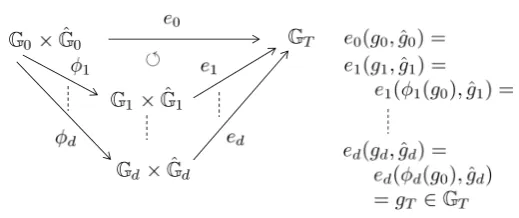
respec-tively. Based on the compatibility, we formulate a notion of Isogenous Pairing Groups, an extension of that of pairing groups. In the system, multiple pairing groups of the same prime order are employed, where efficient homomorphisms between them are hidden from adversaries. It is schematically presented in Fig. 1 in Section 2.2.
(H)IBE and ABE on IPG By using the above similarity, we replace a part of master key pair of BF-IBE, (pk:= (ˆg0,ˆgα0), sk:=α) for a group element ˆg0∈G0ˆ
and a random scalarα, by (pk:= (ˆg0, φ(ˆg0)), sk:=φ)) for a randomly chosen
isogeny φ. The important difference of scalar multiplications and isogenies is that the former security is assured only against classical adversaries but the latter security is assured even against quantum adversaries (at the present knowledge). The difference leads to security against pre-challenge quantum adversaries.
Moreover, for achieving the security, we should not include two (or more) dif-ferent elements in one same group in the public key. Otherwise, the quantum ad-versary reveals the secret exponent (discrete log) relating the two elements. The public key condition restricts our ciphertext construction. For example, our small universe KP-ABE has a simple ciphertext ascttag, Γ := ({ˆgtζ}t∈Γ, e0(H(tag),ˆg0)ζ)
with a uniformly random ζ ←U Fq (and hash H) for tag tag and attributes Γ. With this strong restriction, we obtain provably secure small and large universe KP-ABE schemes against pre-challenge quantum adversaries.
New Assumptions on IPG: Isog-DBDH and Variants We formulate new assumptions for our proposals, namely, Isog-DBDH assumption and its exten-sion,d-qIsog-DBDH. The usual DBDH instance consists of (g, gα, gβ, gγ, h
T) for distinguishing whetherhT is gαβγT or random wheregT :=e(g, g). An instance for the Isog-DBDH problem consists of (g, gα, φ(g), φ(g)β, h
T) for distinguishing whether hT isgTαβ or random, whereg∈E0and φ(g)∈E1 are encoded on
dif-ferent (isogenous) elliptic curvesE0 andE1, respectively. Therefore, informally,
an adversary without knowing φcannot obtain a meaningful pairing valuegαβT
1.4 Related Works
Previous IBEs have been constructed by three types of mathematical problems: pairing, factoring, and lattice (See Table 1). While lattice-based IBE is con-sidered to be quantum-secure, factoring-based IBEs are never converted to be quantum-secure. Our proposal is placed in the middle of the two situations. By using isogenies, we can achieve security against pre-challenge quantum adver-saries. For the comparison, see Table 1.
Most of lattice-based IBE and ABE schemes are believed to be quantum se-cure, but recently, Biasse and Song [7] demonstrated an effective quantum attack for some ideal based cryptosystems. While Ducas et al. [24] improved a lattice-based IBE for practical use, lattice-lattice-based ABE schemes [28, 11] are inefficient far from practical use. Some efficient pairing-based ABEs are implemented in the publicly available software, e.g., Charm [3], and our isogeny-based technique can
Table 1.Comparison with existing IBE schemes, where LWE stands for Learning With Errors and the right most column represents the type of the adversaryA:= (A1,A2) in the security definition as is given in Def. 10, in which c(resp.,q) means “classical ppt (resp., quantum polynomial-time) machine”.
Math. Primitive Assumption Sec. Model Type of (A1,A2)
BF01 [10] pairing DBDH ROM (c,c)
Wat09 [45] DLIN adaptive (c,c)
Coc01 [18] factoring Quad. Residuosity ROM (c,c)
BGH07 [12] ROM (c,c)
GPV08 [26] lattice LWE ROM (q,q)
ABB10 [2] selective (q,q)
Proposed pairing & isogeny 1-qIsog-DBDH QROM (q,c) Table 2. Comparison with existing large universe KP-ABE schemes, whered, n are size parameters of the large universe for our KP-ABE in Section 5.3 and the type of (A1,A2) column represents the same as in Table 1.
Math. Primitive Assumption Sec. Model Type of (A1,A2)
GPSW06 [29] pairing DBDH selective (c,c)
OT10 [35] DLIN adaptive (c,c)
GVW13 [28] lattice LWE selective (q,q)
BGG+14 [11] selective (q,q)
Proposed pairing & isogeny 2dn-qIsog-DBDH selective
be applied to the legacy IBE/ABE cryptosystems with comparable efficiency. For the comparison of our ABE and previous ones, see Table 2.
For the security proofs based on the simulation, the rewinding techniques have been commonly used. In the quantum setting, the naive usage of the rewind-ing techniques does not work for the proofs. Watrous [46] devised a technique to affirmatively resolve the rewinding problem. His technique has contributed to provide security proof of classical cryptographic protocols against quantum adversaries [4, 42, 30, 43]. Showing security proofs against quantum adversaries that can invoke oraclesis another important issue. Since quantum adversaries can make quantum-superposition queries to the oracle, simulators (for security proofs) have to respond with the corresponding quantum-superposition answers. For this problem, Damg˚ard et al. [21] gave a positive solution in the case of secret sharing. Especially, the quantum superposition attacks in the ROM is problem-atic. Boneh et al. [9] first considered a ROM security definition against quantum computers. Based on the definition, Zhandry proposed a construction of secure identity-based encryption in the quantum random oracle model (QROM) [49], then quantum random functions in the model [48]. Moreover, the authors pro-posed quantum-safe MAC, signatures and CCA-secure encryption constructions [13, 14]. For other cryptographic techniques, the security against quantum ad-versaries has been discussed [20, 41].
1.5 Notations
WhenAis a random variable or distribution,y←RAdenotes thaty is randomly selected fromA according to its distribution. WhenA is a set,y ←U A denotes that yis uniformly selected from A. We denote the finite field of orderqbyFq. Let [n] :={1, .., n} and [0, n] :={0} ∪[n] :={0, .., n}for any n∈Z>0. For two
vectorsy= (yi)i∈[r] andv= (vi)i∈[r],y·vdenotes the inner-product
r
i=1yivi.
2
Isogenous Pairing Groups
For mathematical backgrounds on IPG, refer to Section A.
2.1 Trapdoor Homomorphisms
Definition 1 (Trapdoor Homomorphism (TH)).A (randomly chosen) func-tion φ:=φξ : G0 →G1 with two (randomly chosen) cyclic groups G0, G1 of a prime order q is called a trapdoor homomorphism if the following conditions hold.
– (Homomorphism) φ is a non-trivial (e.g., non-zero for an additive group) homomorphism.
– (TH-DH (TH-Diffie-Hellman) intractability assumption) Any probabilistic polynomial-time (ppt) machineBcomputesφ(g)only with a negligible prob-ability when given(g0, φ(g0), g)for randomly chosenφandg0, g
U
←G0. – (Polynomial-size trapdoor) There exists a ppt machine B which computes
Examples.By using elliptic curves, we have three examples of THs.
1. (Exponentiation)G0:=G1:=Gis an elliptic curve cyclic group andφ:=φξ is an exponentiation on G (i.e., scalar multiplication on the curve), i.e.,
φξ : g → gξ, where ξ is a scalar. TH-DH input and output are given as (g0, φ(g0), g) = (g0, gξ0, g) and φ(g) = gξ, respectively, and then TH-DH
intractability is the same as the usual computational DH assumption. 2. (Pairing) G0 := G, G1 := GT is a pairing group and φ := φξ is a pairing
operation on G, i.e., φξ : g → e(g, ξ), where ξ is an element in G in the symmetric pairing case (or ˆGin the asymmetric pairing case). TH-DH input and output are given as (g0, φ(g0), g) = (g0, e(g0, ξ), g) andφ(g) = e(g, ξ),
respectively, and then TH-DH intractability is reduced to the computational BDH (CBDH) assumption (Lemma 1).
3. (Isogeny) G0 :=G0, G1 :=G1 are two different elliptic curve cyclic groups
obtained from two curvesE, E, respectively, andφ:=φξ is an isogeny from
G0 to G1, i.e., φξ :E → E := E/C, where ξ := C is a (cyclic) subgroup in E. For the details, see Section A.3, in particular, Algorithms 1 and 2. The TH-DH intractability is another kind of natural extensions of the DH assumption obtained by using isogenies other than that given in [22].
Remark 1 (Trapdoor Extraction Intractability).Trapdoor Extraction Intractabil-ity assumption is formulated as follows: Any ppt machineBcomputes a trapdoor
ξonly with a negligible probability given a (g0, φ(g0)) forg0
U
←G0. As is easily
seen, the trapdoor extraction is intractable if the TH-DH is intractable. For the exponentiation case, it is the Discrete Logarithm Problem (DLP) assumption, and for the pairing case, it is the Pairing Inversion (PI) assumption. For the isogeny case, it is called the Isogeny assumption. (Refer to Def. 5.)
Lemma 1. The TH-DH assumption for pairing is reduced to the CBDH as-sumption. That is, for any adversary B for TH-DH, there exists a probabilistic machineC, whose running time is essentially the same as that ofB, such that for any security parameter λ, AdvTHB -DH(λ) = AdvCBDHC (λ), where AdvTHB -DH (resp.,
AdvCBDHC ) is an advantage ofBfor the TH-DH (resp.,Cfor the CBDH) problem.
Proof. A ppt machineCis given a CBDH instance (g, gα, gβ, gγ) whereα, β, γ←U
Fq.Csends (g, e(gα, gβ) =e(g, gαβ), gγ) to a TH-DH adversaryB, where implic-itly settingξ:=gαβ. IfBoutputse(gγ, gαβ) =e(g, g)αβγ, thenC outputs it. By combining the TH-DH intractability assumptions for isogeny and pairing, we have the following definition.
Definition 2 (Isog-CBDH). The Isog-CBDH assumption is as follows: For two (randomly chosen) cyclic symmetric pairing groupsG0,G1 (in two different elliptic curves) and a (randomly chosen) isogeny φ : G0 → G1, any ppt
ma-chine B computes hT := e1(φ(g), φ(h)) only with a negligible probability given
(g0, φ(g0), g, φ(h))for uniformly generatedg0, g, h
U
Lemma 2. The TH-DH assumption for isogeny is reduced to the Isog-CBDH as-sumption. That is, for any adversaryBfor TH-DH, there exists a ppt machineC, whose running time is essentially the same as that ofB, such that for any security param.λ, AdvTHB -DH(λ) = AdvIsogC -CBDH(λ), whereAdvTHB -DH (resp.,AdvIsogC -CBDH) is an advantage ofB for the TH-DH (resp.,C for the Isog-CBDH) problem.
Proof. A ppt machineCis given an Isog-BDH instance (g0, φ(g0), g, φ(h)) where
g0, g, h←U G0. C sends (g0, φ(g0), g) to TH-DH adversary B. IfB outputs φ(g),
thenC outputse1(φ(g), φ(h)).
The decisional version of the Isog-CBDH assumption is given below.
Definition 3 (Isog-DBDH). The Isog-DBDH assumption is as follows: For two (randomly chosen) cyclic symmetric pairing groupsG0,G1 (in two different elliptic curves) and a (randomly chosen) isogenyφ:G0→G1, any ppt machine B guesses whether hT =e1(φ(g), φ(h))or random in GT only with a negligible
probability given(g0, φ(g0), g, φ(h), hT)forg0, g, h←UG0 andhT ∈GT.
2.2 Isogenous Pairing Groups (IPG)
Combining the three trapdoor homomorphic structures, we propose a useful cryptographic framework called “Isogenous Pairing Groups (IPG)”. After estab-lishing the framework, we define a natural and useful computational assumption on IPG called “Isog-DBDH”, which is a generalization of that in Def. 3. When applying IPG framework and Isog-DBDH to crypto constructions, “compatibil-ity” of pairings on different groups (or elliptic curves) and isogenies is a main ingredient. For the symmetric pairing groupsG0,G1 in Def. 3, it is described as
e0(g, h) =e1(φ(g), φ(h)), (1)
where e0 (resp.,e1) is an efficiently computable pairing on G0 (resp.,G1), i.e.,
on the curveE0 (resp.,E1). For the correctness, see Prop. 2 in Section A.4. The
above property (1) is extended to among multiple curves{Et}t∈[0,d] or multiple
asymmetric pairing groups (Gt,Gˆt)t∈[0,d] as is given in Eq. (2) below.
Definition 4 (Isogenous Pairing Groups (IPG)).Isogenous Pairing Groups (IPG) generator generates a random instance as follows:
GenIPG(1λ, d)−→R (pkIPG:= ((Gt,Gˆt, gt,gˆt, et)t∈[0,d],GT), skIPG:= (φt)t∈[d]), where (Gt,Gˆt, et,GT) are asymmetric pairing groups of a prime order q with pairings et: Gt×Gˆt →GT, gˆt ∈Gˆt, trapdoor homomorphisms φt : G0 →Gt
(given by isogenies between different elliptic curves), and gt=φt(g0)∈Gt. The
isogenous pairing groups satisfy
Fig. 1.Compatibility of IPG
We denote the common non-trivial pairing value bygT, i.e.,gT =e0(g0,gˆ0)= 1. See Fig. 1. Moreover, we require that Gt = ˆGt. (Namely, points in Gt and Gˆt
generate the group of q-torsion points on the t-th elliptic curve.)
For simulation in security proof, the simulation algorithmSimGenIPG(G0,G0ˆ , g0,ˆg0, e0)outputs a newly isogenous group(G,Gˆ, g,g, e, φˆ )such thatφ:G0→G is an efficiently computable group isomorphism,g=φ(g0), and the compatibility holds, i.e., e0(g0,gˆ0) =e(φ(g0),ˆg) =e(g,gˆ).
Remark 2. A concrete instantiation of IPG by supersingular elliptic curves is given in Appendix B.1. The above compatibility is also assured by Prop. 2 in Sec. A.4.
1. An isogenyφtabove is calculated by using Algorithm 1 or 2 in Section A.3. A trapdoorξfor Algorithm 1 (resp., 2) is given by a torsion pointRon the elliptic curve (resp., a walk dataω∈ {0,1}κ). An isogenyφ
tin a secret key skIPG is given by the above trapdoorξt depending on Algorithm 1 or 2 for efficient computing ofφt.
2. We note that each isogeny φt is defined from the elliptic curve E0 to Et, hence,φt is defined from the rank two torsion group G0⊕G0ˆ to Gt⊕Gˆt such thatGt=φt(G0) and ˆGt=φt( ˆG0). However, sinceφt is enough to be defined only onG0 for our schemes in Sections 4 and 5,φt is defined only onG0 in the present definition, Def. 4 for IPG.
Assumptions The most basic security requirement is given by the intractability of the simple isogeny computation problem: calculate (trapdoors of) any non-zero (φt)t∈[d] s.t.φt : G0 → Gt when given (Gt)t∈[0,d]. The most basic case is
given whend= 1: calculateφ1when givenG0andG1. Based on the fundamental
Definition 5 (Isogeny Problem on IPG (for d= 1)). Let (pkIPG:= ((Gt,Gˆt, gt,gˆt, et)t=0,1,GT), skIPG:=φ1)
R
←GenIPG(1λ,1).
If a ppt adversaryB outputs φ1 when givenpkIPG,B wins.
While the problem instance has auxiliary inputs, points on groups, that is, (gt∈Gt,gˆt∈Gˆt)t=0,1, it is believed to haveno efficient quantum adversary at
present. We use the intractability for thepre-challenge quantum security. In Def. 15 in Section A.3, De Feo et al.’s assumption, Computational Super-singular Isogeny (CSSI) assumption (for smooth order pairing groups) by using a primepwithp+ 1 =κA
A κBB·f and isogeny generation Isog
djp
,κ(Algorithm 1) with:=A, κ:=κA, is given as a special instantiation of the isogeny assump-tion given in Def. 5. The CSSI problem is believed to havenoefficient quantum attack, which gives a reasonable justification for our isogeny assumption on IPG. For provable security of our schemes, we define new problems, Isog-DBDH problem on IPG. The adversary against the Isog-DBDH problem has two parts, the first is quantum and the second is classical. We first formulate a classical adversary form of our Isog-DBDH, for simplicity (ford= 1).
Definition 6 (Isog-DBDH Assumption (on IPG)).LetBbe a classical ppt machine adversary. For (pkIPG := ((Gt,Gˆt, gt,ˆgt, et)t=0,1,GT), skIPG :=φ1)
R
← GenIPG(1λ,1)andα, β, δ←UF
q,Breceives Xb forb
U
← {0,1}, that is defined by
X0:= (pkIPG, gα0, ˆgβ1, gαβT ) and X1:= (pkIPG, gα0, gˆβ1, gδT ), (3)
where gT := e0(g0,ˆg0). B outputs a guess bit b. If b= b, B wins. The Isog-DBDH assumption is: For any ppt adversary B, the advantage of B for the Isog-DBDH problem is negligible inλ.
In other words,X0andX1contain four group elements (g0, gˆ1, g0α, ˆgβ1) and
the problem asks whether the target GT element isgαβT or random. Here, we note that two elements inG0 and ˆG1 cannot be paired, in particular, Bcannot obtain the pairing valuegαβT fromgα
0 and ˆg1β=φ1(ˆg0)β(by Item 2 of Remark 2).
Compared with the usual DBDH instance, one scalar multiplication is replaced by another trapdoor homomorphismφ1in the Isog-DBDH instance.
Security of our schemes is based on the next assumptions, qIsog-DBDH andd -qIsog-DBDH, where an adversaryBis given by two machines (B1,B2), whereB1
is modeled as a polynomial-time quantum adversary,B2a classical ppt machine. Definition 7 (qIsog-DBDH Assumption (on IPG)). Let B:= (B1,B2)be an adversary, where B1 is modeled as a polynomial-time quantum adversary,
B2 a classical ppt machine. For (pkIPG := ((Gt,Gˆt, gt,gˆt, et)t=0,1,GT),skIPG :=
φ1)←R GenIPG(1λ,1), B1 outputs state ← BR 1(pkIPG). Then, for α, β, δ←UFq,B2 receivesXbforb← {0U ,1}, that is defined by Eq. (3).B2outputs a guess bitb. If
For a general positive integerd >0,d-qIsog-DBDH problem is given as follows:
Definition 8 (d-qIsog-DBDH Assumption (on IPG)). Let B := (B1,B2) be an adversary, where B1 is modeled as a polynomial-time quantum adversary,
B2 a classical ppt machine. For (pkIPG:= ((Gt,Gˆt, gt,gˆt, et)t∈[0,d],GT), skIPG:= (φt)t∈[d])
R
←GenIPG(1λ, d),B
1outputsstate
R
← B1(pkIPG). Then, forα, β, δ
U
←Fq, B2 receives Xb forb
U
← {0,1}, that is defined by
X0:= (state, g0α, (ˆgtβ)t∈[d], gαβT ) and X1:= ( state, g0α, (ˆgβt)t∈[d], gδT ),
where gT :=e0(g0,gˆ0).B2 outputs a guess bit b. Ifb=b,B:= (B1,B2)wins. The advantage of adversaryBin the experiment is defined asAdvdB-qIsog-DBDH(λ) := Pr[B wins]−1/2 for any security parameterλ. The d-qIsog-DBDH assumption is: For any ppt B, the advantage ofB,AdvBd-qIsog-DBDH(λ), is negligible in λ.
A concrete instantiation of thed-qIsog-DBDH assumption by supersingular elliptic curves is given in Appendix B.2.
3
Definitions of IBE and ABE Secure Against
Pre-challenge Quantum Adversaries
3.1 Intuition
As is described in Section 1.4, there already exist several security models against quantum adversary. For achieving efficient (or practical) quantum-secure IBE and ABE, we define a new, intermediate notion between classical and (full-)quantum security ones, i.e., security against pre-challenge quantum adversary. In the definitions (of IBE and ABE), an adversaryA consists of two machines (A1,A2), the first A1 is modeled by a quantum machine for the pre-challenge
phase and the secondA2a classical machine for the post-challenge phase. (That
is, A1 is stronger than A2, which is analogous to the concept of non-adaptive
chosen ciphertext attack (CCA1) security [6] in literatures.) In the IBE security game, A1is given a target master public key pk, makes random oracle and key
generation queries (with some restrictions) and outputs some state information denoted bystate. After obtainingstate,A2makes a challenge encryption query,
obtains a challenge ciphertext and then makes ID-secret key queries (with other restrictions than the pre-challenge phase) andA2’s task is guessing the random
bitb(encoded on the ciphertext) as usual. As is easily seen, if both (A1,A2) are
classical (resp. quantum), the notion is classical (resp. quantum). Therefore, our security notion is an intermediate one of the two notions.
(resp. policy) secret key by using a real key generation algorithm, which is a clas-sical ppt algorithm. Therefore, the adversary first targets the master secret key for an effective attack. On the other hand, if the master secret key is protected, the attacker should break each ciphertext one-by-one. A quantum adversary can attack each ciphertext, but, if he/she can attack the master secret key at the first stage of the attack, the strategy is considered to be effective. From this point, the defense of the master key from a quantum adversary is important and our security notion called PH-PQ (Payload-Hiding against Pre-challenge Quantum adversaries) in Definitions 10 and 14 is motivated by this observation.
3.2 Quantum Computation
A quantum algorithm is an algorithm executed on a quantum computer that produces a classical output. Quantum algorithms can keep and operate quantum states in the registers, where the quantum states can be represented as a linear combination of distinct states. A classical output that a quantum algorithm produces is one of the distinct states that represent the final quantum state. Refer the reader to [34] for a more thorough discussion.
Here we remind a few basic facts about quantum computation necessary for understanding our results in a manner similar to [49].
Fact 1 Any classical computation can be implemented on a quantum computer.
Fact 2 Any function that has an efficient classical algorithm computing it can be implemented efficiently as a quantum-accessible oracle.
Fact 3 Given a quantum algorithm Awith oracle access to an oracle O, each oracleOdefines a probability distribution of the outputs ofA. Hence, any prob-ability amplitude D of oracles leads to a probability distribution of outputs of A, and if two probability amplitudes D1 and D2 are identical, the probability
distributions of the outputs ofAunder these amplitudes are also identical.
3.3 Identity-Based Encryption (IBE)
Definition 9 (Identity-Based Encryption: IBE).An identity-based encryp-tion scheme consists of probabilistic polynomial-time algorithms Setup,KeyGen,
Enc andDec. They are given as follows:
Setuptakes as input a security parameter 1λ. It outputs public parameters pk
and master secret keysk.
KeyGen takes as input public parameters pk, a master secret key sk, and an identityID. It outputs a corresponding secret keyskID.
Enctakes as input public parameterspk, a messagemin some associated mes-sage spacemsg, and an identityID. It outputs a ciphertextctID.
Dec takes as input public parameters pk, a secret key skID for an identity ID,
and a ciphertext ctID that was encrypted under an identity ID. It outputs
An IBE scheme should have the following correctness property: for all (pk,sk)←R Setup(1λ), all identitiesID, all secret keyssk
ID←R KeyGen(pk,sk,ID), all messages
m, all identities ID, all ciphertextsctID R
← Enc(pk, m,ID), it holds that m = Dec(pk,skID,ctID) ifID=ID. Otherwise, it holds with negligible probability.
We define the security notion of Payload-Hiding against Pre-challenge Quan-tum adversary (PH-PQ) for IBE.
Definition 10 (PH-PQ for IBE). Let (Setup,KeyGen,Enc,Dec) be an IBE scheme and let A = (A1,A2) be a stateful adversary, where A1 is modeled as a polynomial-time quantum adversary. Consider the experiment ExpibeA,ph-pq[λ]
below:
ExpibeA,ph-pq[λ] : (sk,pk)←RSetup(1λ), state← AR 1RO(·),KeyGen(sk,·)(pk), /∗ID∗ is not queried toROin the pre-challenge phase by A1,
and not queried to KeyGenin any phase ∗/
(ID∗, m0, m1)
R
← ARO(·),KeyGen(sk,·)
2 (state), b
U
← {0,1}, ct∗←R Enc(pk, mb,ID∗), b← AR 2RO(·),KeyGen(sk,·)(ct∗), outputb.
Here, ROis quantum-accessible (i.e., with quantum superposed inputs and out-puts) and KeyGen is classical-accessible. If b = b, A := (A1,A2) wins. The advantage of adversary A in the experiment is defined as AdvibeA,ph-pq(λ) := Pr[A wins]−1/2 for any security parameter λ. An IBE scheme is payload-hiding against pre-challenge quantum adversary (PH-PQ)if all adversariesA= (A1,A2), where A1 be a polynomial-time quantum machine and A2 a classical ppt machine, achieve at most a negligible advantage in the above security game (or experiment).
The security notion of anonymous-ID secure against pre-challenge quantum adversary for IBE in Definition 17 in Appendix D.
3.4 Key-Policy Attribute-Based Encryption (KP-ABE)
For a polynomiald=d(λ), a sub-universeUt(⊂ {0,1}∗) is assigned for t∈[d]. Each attribute is expressed by a pair of sub-universe id and value of attribute, i.e., (t, v), where t ∈[d] and v ∈ Ut. Let Ut :={1} for the small universe case andUt:={0,1}n for the large universe case with a polynomialn:=n(λ). Thus, the small universe [d]× {1}is identified with [d] and the large universe is given by [d]× {0,1}n.
Span Programs and (Monotone) Access Structures
Definition 11 (Span Programs [5]). A span program over Fq is a labeled matrixS:= (M, ρ)where M is an (l×r) matrix overFq andρ is a labeling of
Γ := {(tj, xj)}1≤j≤d (xj ∈ Utj). The span program S accepts Γ, denoted by
R(S, Γ) = 1, if and only if1 ∈span(Mi)ρ(i)∈Γ, i.e., some linear combination
of the rows(Mi)ρ(i)∈Γ gives the all one vector1. No rowMi(fori∈[l]) of the matrix M is zero.
Definition 12. A secret-sharing scheme for span programS:= (M, ρ)is: 1. LetM be anl×rmatrix and a column vectorf:= (f1, . . . , fr)
U
←Fr q. Then,
s0 :=1·f =
r
k=1fk is the secret to be shared, and s := (s1, . . . , sl)T :=
M·fT is thel shares of the secret s
0 and the sharesi belongs toρ(i).
2. If span program S := (M, ρ) accepts Γ, i.e., 1 ∈ span(Mi)ρ(i)∈Γ, there
exist constants {σi ∈ Fq | i ∈ I} such that I ⊆ {i ∈ [l] | ρ(i) ∈ Γ} and
i∈Iσisi=s0. Furthermore, these constants {σi}can be computed in time
polynomial in the size of the matrixM.
KP-ABE In KP-ABE, encryption (resp. a secret key) is associated with at-tributesΓ (resp. access structureS). In fact, our KP-ABEs are tagged schemes, and the relationR+for the tagged KP-ABE is defined asR+((tag,S),(tag, Γ)) :=
Eq(tag,tag) ∧ R(S, Γ) for a key parameter (tag,S) and ciphertext parameter (tag, Γ), where R(S, Γ) = 1 iffSaccepts Γ andEq(tag,tag) = 1 ifftag=tag.
Definition 13 (Key-Policy Attribute-Based Encryption: KP-ABE). A key-policy attribute-based encryption scheme consists of probabilistic polynomial-time algorithmsSetup,KeyGen,EncandDec. They are given as follows:
Setuptakes as input a security parameter 1λ. It outputs public parameters pk
and master secret keysk.
KeyGentakes as input a public parameterspk, a master secret keysk, a tagtag, and an access structure S := (M, ρ). It outputs a corresponding secret key
sktag,S.
Enc takes as input a public parameters pk, a message m in some associated message spacemsg, a tagtag, and a set of attributes,Γ :={(tj, xj)}1≤j≤d.
It outputs a ciphertextcttag,Γ.
Dectakes as input a public parameters pk, a secret keysktag,Sfor access
struc-ture S and tagtag, and a ciphertext cttag,Γ that was encrypted under a set
of attributesΓ and tag tag. It outputs eitherm ∈msgor the symbol ⊥.
A KP-ABE scheme should have the following correctness property: for all (pk,sk)←R Setup(1λ), all tagstag, all access structuresS, all secret keyssk
tag,S
R
← KeyGen(pk,sk,tag,S), all messagesm, all tagstag, all attribute setsΓ, all cipher-texts cttag,Γ
R
←Enc(pk, m,tag, Γ), it holds thatm =Dec(pk,sktag,S,cttag,Γ) if tag=tag andSaccepts Γ. Otherwise, it holds with negligible probability.
stateful adversary, whereA1is modeled as a polynomial-time quantum adversary. Consider the experiment ExpabeA ,ph-pq[λ]below:
ExpabeA ,ph-pq[λ] : Γ∗← AR 1(1λ), (sk,pk)←RSetup(1λ),
(state,tag∗)← AR 1RO(·),KeyGen(sk,·)(pk),
/∗ tag∗ is not queried toROnorKeyGen in the pre-challenge phase byA1∗/
(m0, m1)← AR 2RO(·),KeyGen(sk,·)(state), b
U
← {0,1}, ct∗←REnc(pk, mb,tag∗, Γ∗),
b← AR 2RO(·),KeyGen(sk,·)(ct∗), outputb.
/∗if (tag∗,S) is queried to KeyGenin the post-challenge phase by A2, S does not acceptΓ∗∗/
Here, ROis quantum-accessible (i.e., with quantum superposed inputs and out-puts) and KeyGen is classical-accessible. If b = b, A := (A1,A2) wins. The advantage of adversary A in the experiment is defined as AdvabeA ,ph-pq(λ) := Pr[A wins]−1/2 for any security parameter λ. A tagged KP-ABE scheme is (selective-attribute) payload-hiding against pre-challenge quantum adversaries (PH-PQ)if all adversariesA= (A1,A2), whereA1 be a polynomial-time quan-tum machine and A2 a classical ppt machine, achieve at most a negligible ad-vantage in the above security game (or experiment).
4
Proposed Anonymous IBE against Pre-challenge
Quantum Adversaries
4.1 Construction
The proposed IBE scheme is a Boneh-Franklin type IBE. A master secret key skis given by an isogeny fromG0toG1. A hash functionH :Fq→G0maps an arbitraryID∈Fq to a point ofG0. Note that the size ofFq is exponential inλ.
Setup(1λ) : (pkIPG:= ((Gt,Gˆt, gt,ˆgt, et)t=0,1,GT), skIPG:=φ1 )
R
←GenIPG(1λ,1),
generate a random hashH:Fq →G0 with the identity spaceFq, return pk:= ((Gt,Gˆt,gˆt, et)t=0,1,GT, H), sk:=φ1.
KeyGen(pk,sk,ID) : h0:=H(ID)∈G0, h1:=φ1(h0), returnskID:=h1.
Enc(pk, m,ID) : h0:=H(ID), ζ
U
←F×
q , c:= ˆgζ1, z:=e0(h0,gˆ0)ζ, cT :=z·m, return ctID:= (c, cT).
Dec(pk, skID=h1, ctID = (c, cT)) : ifID=ID, z:=e1(h1, c),
m:=cT ·(z)−1, returnm, otherwise, return⊥.
Dec correctly decrypts sincez =e1(h1, c) =e1(φ1(h0),ˆg1ζ) =e1(φ1(h0),gˆ1)ζ =
e0(h0,ˆg0)ζ = z if ID = ID. Here, we use the compatibility e1(φ1(h0),gˆ1) =
Note that a secret key skID (resp., ciphertext ctID) consists of one element
of G0 (resp., one ˆG1 element and one GT element), which are almost the same as those in the original BF-IBE. However, size of public parameters is double of that in BF-IBE, i.e., two elliptic curve parameters. This shows that our IBE is quite practical. A concrete instantiation of our IBE by supersingular elliptic curves is given in Appendix B.3.
4.2 Security
The following proposition assures the correctness of a simulation strategy of the random oracleH by using a random degree 2ν1 polynomial for a quantum
adversary which makes quantum random oracle queries at mostν1times. Cf. Fact
3 in Section 3.2.
Proposition 1. [49] Let H be an oracle drawn from a 2ν1-wise independent distribution. Then, the behavior of any quantum algorithm making at most ν1 quantum queries to H is identical to the behavior of the quantum algorithm making at mostν1 quantum queries to a truly random function.
Remark 3 (Lemma 6.4 in [13]). Furthermore, we can show that for an oracle
H drawn from a (2ν1+ν2)-wise independent distribution, the behavior of any
quantum algorithm making at mostν1 quantum andν2classical queries toH is
identical to the behavior of the quantum algorithm making at mostν1quantum
andν2classical queries to a truly random function.
Theorem 1. The proposed IBE scheme is PH-PQ secure under the 1-qIsog-DBDH assumption in the quantum random oracle model.
For any adversary A := (A1,A2), there exists an adversary B := (B1,B2) for the 1-qIsog-DBDH problem, whereB1 is a polynomial-time quantum machine andB2 is a classical ppt machine, such that for any security parameter λ,
AdvibeA,ph-pq(λ)≤ν2·Adv1-BqIsog-DBDH(λ),whereν2 is the maximum number of the random oracle queries of A2.
Our IBE can be shown to be anonymous ID secure against pre-challenge quantum adversaries. (The security notion is defined in Appendix D.)
Theorem 2. The proposed IBE scheme is anonymous ID secure against pre-challenge quantum adversaries under the 1-qIsog-DBDH assumption in the quan-tum random oracle model.
Theorem 2 is proven in a manner similar to Lemma 4.3 in [1] (given in Ap-pendix D). Anonymous IBE has an application to searchable encryption as is well known. In the application, if the master secret key is revealed by a quantum attacker, all the trapdoor keys for encrypted search can be generated by a clas-sical attacker. Our pre-challenge quantum security prevents such a devastating attack scenario (see Section 3.1).
for the classicalA2. Note that the targetID∗is never queried to the random
ora-cle nor key generation queries in the pre-challenge phase. Hence, the simulation in the phase is simpler than that given in [49]. Let ν1 (resp.,ν2) the maximum
number of random oracle queries in the pre-challenge phase (resp., in the post-challenge phase), and ν := 2ν1+ν2. We can simulate the random oracle (and
then key generation) by using a random degree ν polynomial F(X) since a ν -wise independent function is enough for oracle simulation forA1andA2, which
is obtained from Remark 3.
We will simulate the environment of the second part of the adversary,A2,
in a similar manner to the indistinguishability proof of the Boneh-Franklin IBE [10].
In order to prove Theorem 1, we construct a probabilistic machine B := (B1,B2) against the 1-qIsog-DBDH Problem using an adversaryA:= (A1,A2)
in a security game as a black box as follows:
1. Pre-challenge phase simulation for the quantum machine A1:
B1 is given a public parameter for the 1-qIsog-DBDH problem, pkIPG :=
((Gt,Gˆt, gt,gˆt, et)t=0,1,GT), then, B1 provides the quantum adversary A1
the public keypk:= ((Gt,Gˆt,gˆt, et)t=0,1,GT) and answers to quantum ran-dom oracle access for H and classical key queries. Let F(X) be a random degreeν polynomial, i.e.,F(X)← ⊕U ν
i=0FqXiwithν:= 2ν1+ν2. A quantum
superposition random oracle queryRO(forH) is answered by the superpo-sition of gτID
0 using g0 in pkIPG and τID := F(ID). A classical (not
super-posed) key generation query forIDis answered bygτID
1 usingg1 inpkIPGand
τID:=F(ID).
2. WhenA1 outputsstate
R
← A1(pk) and sends state to A2, B1 obtains state
and outputsstate:= (state, F(X)) (and then givesstate toB2).
3. Post-challenge phase simulation for the classical ppt machineA2:
B2 is given Xb := (state, g0α, gˆ1β, gTθ ), where θ=αβ ifb= 0 andθ
U
←Fq ifb= 1 andstate := (state, F(X)).B2 plays a role of the challenger in the
security game against adversaryA2, andB2 sends state to A2. B2 chooses
a randomν0 (1≤ν0≤ν2) for embedding the problem instance to classical
random oracle answers, whereν2 is the maximum number of random oracle
queries of classicalA2.
4. When theι-th random oracle query is issued for an identityID,
(a) if ι = ν0, B2 generates τID := F(ID) and calculates hID := gτ0ID, then
returns the valuehIDto A2.
(b) ifι=ν0, B2 obtains the hash valuehIDν0 :=h0:=g
α
0 from Xb, i.e., set
τIDν0 :=αimplicitly, then returns the valuehIDν0 toA2.
5. When a key query is issued for identityID, B2 generatesτID :=F(ID) and
calculatesskID:=gτ1ID, then returns the value skIDto A2.
6. WhenB2receives an encryption query with challenge identityID∗and
plain-texts (m(0), m(1)) from A
2, if the current number ν∗ of the RO queries in
the the post-challenge phase is greater than or equal toν0, first B2 checks
RO. If it does not hold, B2 aborts the game. If ν∗ < ν0 or (ν∗ ≥ ν0 and
ID∗=IDν0),B2selects (challenge) bitb
U
← {0,1}.B2generates the challenge
ciphertextctID∗ := (c, cT) such that c := ˆgβ1 is obtained from the inputXb
(which implicitly setsζ :=β) and cT :=gθ
T ·mb where gTθ is also obtained from the inputXb. B2 returnsctID∗ toA2.
7. When the ι-th random oracle query for identity ID is issued by A2 after
the encryption query,B2 executes the same procedure as that of step 4a if
ι =ν0. Whenι=ν0, ifID=ID∗,B2 executes the same procedure as that of
step 4b, otherwise,B2aborts the game.
When a key query is issued for identityID,B2generates and returnsskID to
A2as in the same way as in step 5.
8. A2finally outputs bitb. Ifb=b,B2outputsb := 0. Otherwise,B2outputs
b := 1.
Whenb= 0 (resp.b= 1), the view ofA:= (A1,A2) is equivalent to that in the
real game (resp., the random ciphertext game). Moreover, the advantage ofAin the latter is equal to zero since the value ofbis independent from the adversary’s view in the game. We obtain the inequality in Theorem 1, and this completes
the proof of Theorem 1.
5
Proposed PH-PQ Secure KP-ABE
5.1 Small Universe Construction
The proposed KP-ABE scheme is based on the GPSW06 KP-ABE [29]. By identifying (t,1) ∈ [d]× {1} = [d]× U with t ∈ [d], an attribute is considered as an element of the polynomial-size universe [d], i.e., attribute setΓ ⊂[d]. The IPG with (d+ 1) pairing groups is used.
Key Idea in Constructing the Proposed KP-ABE In GPSW06 KP-ABE, the public parameters (resp., master secret key) are given as pk := (( ˆG,ˆgt := ˆ
gαt)
t∈[d],GT, gyT) (resp.,sk:= ((αt)t∈[d], y)), where ˆgt:= ˆgαt are group elements in thesamegroup ˆGandαt, y←UFq. The exponentiation-basedpkis vulnerable to quantum attack. Instead, we encode these group elements ondifferentgroups (i.e., different elliptic curves) such as (ˆgt∈ Gˆt)t∈[d], where ˆgt∈Gˆt are defined as ˆgt = φt(ˆg0) ∈ Gˆt = φt( ˆG0) using master secret isogenies φt. Informally, the public parameters are invulnerable to quantum attack from the quantum hardness of the isogeny problem (Def. 5). (The security of the proposed scheme is formally proved under the d-qIsog-DBDH assumption in Theorem 3.) From the compatibility of IPG (Eq. (2)), we decrypt ciphertexts correctly.
KP-ABE has a simple ciphertext ascttag, Γ := ({ˆgtζ}t∈Γ, e0(H(tag),gˆ0)ζ) with a
uniformly randomζ←UFq (and hashH).
Note thatpkincludesd+1 pairing groups (Gt,Gˆt)t∈[0,d]as well asdelements
(ˆgt)t∈[d] and components of secret keysktag,Sand ciphertextcttag, Γ have similar structures as the original GPSW06 KP-ABE. Therefore, all sizes of public pa-rameters, secret keys and ciphertxts of our KP-ABE areasymptotically the same
as GPSW06 KP-ABE. A concrete instantiation of our KP-ABE by supersingular elliptic curves is given in Appendix B.4.
Construction
Setup(1λ) :
(pkIPG:= ((Gt,Gˆt, gt,ˆgt, et)t∈[0,d],GT), skIPG:= (φt)t∈[d])
R
←GenIPG(1λ, d),
generate a random hashH:Fq →G0 with the tag spaceFq,
return pk:= ((Gt,Gˆt,gˆt, et)t∈[0,d],GT, H), sk:= (φt)t∈[d].
KeyGen(pk, sk, tag, S:= (M, ρ)) : h0:=H(tag)∈G0,
choose randomusuch that1·u= 1,
fori∈[l], si:=Mi·u, t:=ρ(i), ki :=φt(h0)si,
returnsktag,S:={ki}i∈[l].
Enc(pk, m, tag, Γ) : h0:=H(tag)∈G0, ζ
U
←Fq, fort∈Γ, ct:= ˆgζt,
z:=e0(h0,ˆg0)ζ, cT :=z·m, return cttag, Γ := ({ct}t∈Γ, cT). Dec(pk, sktag,S:={ki}i∈[l], cttag, Γ := ({ct}t∈Γ, cT)) :
iftag=tag andS:= (M, ρ) acceptsΓ :={t}, then compute{σi}ρ(i)∈Γ such that 1 =
ρ(i)∈Γ
σiMi, whereMi is thei-th row ofM,
z := t:=ρ(i)∈Γ
et(ki, ct)σi, return m:=c/z, otherwise, return⊥.
[Correctness]: Iftag=tag andS acceptsΓ,
z =t:=ρ(i)∈Γet(ki, ct)σi =
t:=ρ(i)∈Γet
φt(h0)si,gˆζt
σi
=t:=ρ(i)∈Γ et(φt(h0),ˆgt)ζσisi =
ρ(i)∈Γe0(h0,gˆ0)ζσisi =e(h0,gˆ0)ζ =z.
5.2 Security of Our Small Universe KP-ABE
Theorem 3. The proposed KP-ABE scheme is (selective-attribute) PH-PQ se-cure under thed-qIsog-DBDH assumption in the quantum random oracle model. For any adversary A := (A1,A2), there exists an adversary B := (B1,B2) for the d-qIsog-DBDH problem, where B1 is a polynomial-time quantum ma-chine andB2 is a classical ppt machine, such that for any security parameterλ,
Remark 4. We will employ two different simulation strategies for two phases, the pre-challenge phase for the quantumA1and the post-challenge phase for the
classicalA2, in a similar manner to the case of the proposed IBE. In particular,
we note that we can simulate the random oracle (and then key generation) by using a random degreeν polynomialF(X) since aν-wise independent function is enough for oracle simulation forA1, which is obtained from Remark 3, where
ν1 (resp., ν2) is the maximum number of random oracle queries in the
pre-challenge phase (resp., in the post-pre-challenge phase) andν:= 2ν1+ν2. We make
two remarks on why challengeΓ∗ andtag∗should be declared beforehand.
– Our simulated public parameters given in Eq. (4) below have two parts de-pending on whethert∈Γ∗or not. Therefore, challenge attributesΓ∗should be declared at the beginning of the game.
– Our access relation is given by the conjunctive combination of span program andtagmatching, i.e.,R+((tag,S),(tag∗, Γ)) :=Eq(tag,tag∗)∧R(S, Γ). We
cannot determine which part of the condition does not hold for a key query with a parameter (tag,S) before knowing the challenge tagtag∗. Therefore, challenge tagtag∗ should be declared before the post-challenge phase simu-lation byB2.
Proof. In order to prove Theorem 3, we construct a probabilistic machine B:= (B1,B2) against thed-qIsog-DBDH Problem using an adversaryAin a security
game as a black box as follows:
1. Pre-challenge phase simulation for the quantum machine A1:
B1 is given a public parameter for the d-qIsog-DBDH problem, pkIPG :=
((Gt,Gˆt, gt,gˆt, et)t∈[0,d],GT), and B1 plays a role of the challenger in the
security game against adversaryA1.
2. A1declares the challenge attributesΓ∗, then,B1 provides the quantum
ad-versaryA1the public keypkwhich are generated as: Generate (Gt,Gˆt, gt,gˆt,
et, φt)←SimGenIPG(G0,G0ˆ , g0,gˆ0, e0) fort ∈Γ∗(andt∈[d]). Then,B1
pro-vides the adversaryA1
pk:= ((Gt,Gˆt,ˆgt, et)t∈{0}∪Γ∗, (Gt,Gˆt,gˆt, et)t∈Γ∗, GT), (4) where (Gt,Gˆt,ˆgt, et)t∈{0}∪Γ∗ are obtained frompkIPGof thed-qIsog-DBDH instance, and sends it toA1.
3. B1simulates quantum random oracle access forHin the pre-challenge phase.
LetF(X) be a random degree ν polynomial, i.e.,F(X)← ⊕U ν
i=0FqXi with
ν:= 2ν1+ν2. A quantum superposition random oracle queryRO(forH) is
answered by the superposition ofgτtag
0 usingg0 in pkIPG and τtag :=F(tag).
A classical (not superposed) key generation query is answered as follows: B1 chooses random u∈ Frq such that 1·u= 1, and for i ∈ [l], sets si :=
Mi·u, then returns (ki := gρτ(tagi)·si)i∈[l] to A1. Here, l (resp.,r) is the row
(resp., column) number of the access structure matrixM. 4. WhenA1 outputs (state,tag∗)
R
← A1(pk) and sends stateto A2,B1 obtains
5. Post-challenge phase simulation for the classical ppt machineA2:
B2 is givenXb := (state, g0α, (ˆgβt)t∈[d], gTθ ), where θ =αβ if b= 0 and
θ ←U Fq if b = 1 and state := (state,tag∗, F(X)). B2 plays a role of the
challenger in the security game against adversaryA2, andB2 sendsstate to
A2.
6. When a random oracle query is issued for a tagtag,
(a) if tag=tag∗, B2 generatesτtag :=F(tag) and calculateshtag :=h0 :=
gτtag
0 , then returns the value htag toA2.
(b) iftag=tag∗, B2 obtains the hash value htag∗ :=h0:=g0αfrom Xb, set
τtag∗ :=αimplicitly, then returns the valuehtag∗ toA2.
7. When a key query is issued for a tagtag and access structure S:= (M, ρ), firstB2 checks whether tag = tag∗ or not, where tag∗ is the challenge tag
declared byA1.
(a) If it does not hold,B2executes the same procedure ofKeyGenas that of
step 3.
(b) If it holds,B2 generates a vectorv
U
←Fr
q. Pickw
U
← {w ∈Fr
q|w·Mi= 0 if ρ(i) ∈ Γ∗, μ := w ·1 = 0}. Finally, define the vector u := v+
χ w, where χ := α−v·1
μ , and α is defined in the instance Xb, then
u·1 = α. Thus, let u := u/α and si := Mi·u, then u·1 = 1 and
Mi·u=αsi. Fori∈[l],B2 calculates
ki:=
gηt1,i if ρ(i)∈Γ∗, φt (gα
0)η2,i·g
η3,i
0
if ρ(i) ∈Γ∗.
whereη1,i:=Mi·v, η 2,i:=Mμi·w, η3,i:=Mi·v−(Mi·w)·(v· 1)
μ . The{ki} is a legitimate key since
ifρ(i)∈Γ∗, Mi·u =Mi·(v+χ w) =Mi·v=η1,i,then ki =gηt1,i =
gtMi·u =gαsi
t =φt(htag∗)si, and
if ρ(i) ∈ Γ∗, Mi ·u = Mi ·(v+χ w) = Mi ·v+ α−v·1
μ (Mi ·w) =
αMμi·w+Mi·v−(Mi·wμ)·(v·1)=αη2,i+η3,i,thenki =φt (gα0)η2,i·g
η3,i
0
=
φt
gαη0 2,i+η3,i
= (gt)αη2,i+η3,i = (g t)Mi·u
= (gt)αsi=φ
t(htag∗)si. ThenB2 returns the valuesktag∗,S:={ki}i∈[l] to A2.
8. When B2 receives an encryption query with plaintexts (m(0), m(1)) (and
challenge the tagtag∗, attributesΓ∗) fromA2, firstB2selects (challenge) bit
b← {U 0,1}.B2 generates the challenge ciphertext cttag∗,Γ∗ := ((ct)t∈Γ∗, cT) such that (ct:= ˆgtβ)t∈Γ∗ are obtained from the input Xb andcT :=gTθ·mb wheregθ
T is also obtained from the input Xb.B2 returnscttag∗,Γ∗ toA2.
9. When a random oracle (resp. key) query is issued byA2after the encryption
query,B2 executes the same procedure as that of step 6 (resp. step 7).
10. A2finally outputs bitb. Ifb=b,B2outputsb := 0. Otherwise,B2outputs
b := 1.
When b = 0 (resp.b = 1), the view ofA := (A1,A2) is equivalent to that in