Phasing: Private Set Intersection using Permutation-based Hashing
(Full Version)
∗Benny Pinkas
Bar-Ilan University, Israel
[email protected]
Thomas Schneider
TU Darmstadt, Germany
[email protected]
Gil Segev
Hebrew University, Israel
[email protected]
Michael Zohner
TU Darmstadt, Germany
[email protected]
Abstract
Private Set Intersection (PSI) allows two parties to com-pute the intersection of private sets while revealing noth-ing more than the intersection itself. PSI needs to be ap-plied to large data sets in scenarios such as measurement of ad conversion rates, data sharing, or contact discovery. Existing PSI protocols do not scale up well, and therefore some applications use insecure solutions instead.
We describe a new approach for designing PSI proto-cols based on permutation-based hashing, which enables to reduce the length of items mapped to bins while en-suring that no collisions occur. We denote this approach as Phasing, for Permutation-based Hashing Set Intersec-tion. Phasing can dramatically improve the performance of PSI protocols whose overhead depends on the length of the representations of input items.
We apply Phasing to design a new approach for circuit-based PSI protocols. The resulting protocol is up to 5 times faster than the previously best Sort-Compare-Shuffle circuit of Huang et al. (NDSS 2012). We also apply Phasing to the OT-based PSI protocol of Pinkas et al. (USENIX Security 2014), which is the fastest PSI protocol to date. Together with additional improvements that reduce the computation complexity by a logarithmic factor, the resulting protocol improves run-time by a fac-tor of up to 20 and can also have similar communication overhead as the previously best PSI protocol in that re-spect. The new protocol is only moderately less efficient than aninsecure PSI protocol that is currently used by real-world applications, and is therefore the first secure PSI protocol that is scalable to the demands and the con-straints of current real-world settings.
∗Please cite the conference version of this paper published at
USENIX Security’15 [PSSZ15].
1
Introduction
Private set intersection (PSI) allows two partiesP1andP2 with respective input setsX andY to compute the inter-section X∩Y of their sets without revealing any infor-mation but the intersection itself. Although PSI has been widely studied in the literature, many real-world applica-tions today use an insecure hash-based protocol instead of a secure PSI protocol, mainly because of the insuffi-cient efficiency of current PSI protocols.
In this work we presentPhasing, Permutation-based Hashing Set Intersection, which is a new approach for constructing PSI protocols based on a hashing technique that ensures that hashed elements can be represented by short strings without any collisions. The overhead of re-cent PSI protocols depends on the length of these rep-resentations, and this new structure of construction, to-gether with other improvements, results in very efficient performance that is only moderately larger than that of theinsecureprotocol that is in current real-world usage.
1.1
Motivating Scenarios
The motivation for this work comes from scenarios where PSI must be applied quite frequently to large sets of data, and therefore performance becomes critical. Moreover, the communication overhead might be even more important than the computation overhead, since in large data centers it is often easier to add computing power than to improve the outgoing communication in-frastructure. We describe here three scenarios which re-quire large-scale PSI implementations.
Measuring ad conversion rates Online advertising,
site or perform a transaction there. For banner ads or ser-vices like Google Adwords it is easy to approximate this value by measuring ad click-throughs. However, mea-suring click-throughs is insufficient in other online ad-vertising settings. One such setting is mobile advertis-ing, which is becoming a dominating part of online ad-vertising. Even though mobile ads have a great effect, click-throughs are an insufficient measure of their utility, since it is unlikely, due to small displays and the casual nature of mobile browsing, that a user will click on an ad and, say, purchase a car using his mobile device. An-other setting where click rate measurement is unsatisfac-tory is advertising of offline goods, like groceries, where the purchase itself is done offline.1
An alternative method of measuring ad performance is to compare the list of people who have seen an ad with those who have completed a transaction. These lists are held by the advertiser (say, Google or Facebook), and by merchants, respectively. It is often possible to identify users on both ends, using identifiers such as credit card numbers, email addresses, etc. A simple solution, which ignores privacy, is for one side to disclose its list of cus-tomers to the other side, which then computes the nec-essary statistics. Another option is to run a PSI protocol between the two parties. (The protocol should probably be a variant of PSI, e.g. compute total revenues from customers who have seen an ad. Such protocols can be derived from basic PSI protocols.) In fact, Facebook is running a service of this type with Datalogix, Epsilon and Acxiom, companies which have transaction records for a large part of loyalty card holders in the US. Accord-ing to reports2, the computation is done using a variant of theinsecurenaive hashing PSI protocol that we describe in§3.1. Our results show that it can be computed using secure protocols even for large data sets.
Security incident information sharing Security
inci-dent handlers can benefit from information sharing since it provides them with a global view during incidents. However, incident data is often sensitive and potentially embarrassing. The shared information might reveal in-formation about the business of the company that pro-vided it, or of its customers. Therefore, information is typically shared rather sparsely and protected using legal agreements. Automated large scale sharing will improve security, and there is in fact work to that end, such as the IETF Managed Incident Lightweight Exchange (MILE) effort. Many computations that are applied to the shared data compute the intersection and its variants. Applying
1See, e.g.,http://www.reuters.com/article/2012/10/01/
us-facebook-ads-idUSBRE8900I120121001.
2See, e.g., https://www.eff.org/deeplinks/2012/09/deep
-dive-facebook-and-datalogix-whats-actually-getting -shared-and-how-you-can-opt.
PSI to perform these computations can simplify the le-gal issues of information sharing. Efficient PSI protocols will enable it to be run often and in large scale.
Private contact discovery When a new user registers
to a service it is often essential to identify current regis-tered users who are also contacts of the new user. This operation can be done by simply revealing the user’s con-tact list to the service, but can also be done in a pri-vacy preserving manner by running a PSI protocol be-tween the user’s contact list and the registered users of the service. This latter approach is used by the TextSe-cure and Secret applications, but for performance rea-sons they use the insecure naive hashing PSI protocol described in§3.1.3
In these cases each user has a small number of recordsn2, e.g.,n2=256, whereas the service has mil-lions of registered users (in our experiments we use
n1 =224). It therefore holds that n2 n1. In our best PSI protocol, the client needs only O(n2logn1) memory,O(n2)symmetric cryptographic operations and
O(n1)cheap hash table lookups, and the communication isO(n1logn1).(The communication overhead is indeed high as it depends onn1, but this seems inevitable if brute force searches are to be prevented.)
1.2
Our Contributions
Our goal in this work is to enable PSI computations for large scale sets that were previously beyond the capabil-ities of state-of-the-art protocols. The constructions that we design in this work improve performance by more than an order of magnitude. We obtain these improve-ments by generalizing the hashing approach of [PSZ14] and applying it to generic secure computation-based PSI protocols. We replace the hash function in [PSZ14] by a permutation which enables us to reduce the bit-length of internal representations. Moreover, we suggest several improvements to the OT-based PSI protocol of [PSZ14]. We explain our contributions in more detail next:
Phasing: Using permutation-based hashing to reduce
the bit-length of representations. The overhead of the
best current PSI protocol [PSZ14] is linear in the length of the representations of items in the sets (i.e., the ids of items in the sets). The protocol maps items into bins, and since each bin has very few items in it, it is tempt-ing to hash the ids to shorter values and trust the birthday paradox to ensure that no two items in the same bin are
3See https://whispersystems.org/blog/contact-disco
hashed to the same representation. However, a closer ex-amination shows that to ensure that the collision proba-bility is smaller than 2−λ, the length of the representation must be at leastλ bits, which is too long.
In this work we utilize the permutation-based hash-ing techniques of [ANS10] to reduce the bit-length of the ids of items that are mapped to bins. These ideas were suggested in an algorithmic setting to reduce mem-ory usage, and as far as we know this is the first time that they are used in a cryptographic or security setting to im-prove performance. Essentially, when usingβ bins the first logβ bits in an item’s hashed representation define the bin to which the item is mapped, and the other bits are used in a way which provably prevents collisions. This approach reduces the bit-length of the values used in the PSI protocol by logβ bits, and this yields reduced over-head by up to 60%-75% for the settings we examined.
Circuit-Phasing: Improved circuit-based PSI. As
we discuss in §3.4 there is a great advantage in using generic secure computation for computing PSI, since this enables to easily compute variants of the basic PSI func-tionality. Generic secure computation protocols evalu-ate Boolean circuits computing the desired functionality. The best known circuit for computing PSI was based on the Sort-Compare-Shuffle circuit of [HEK12]. We de-scribe Circuit-Phasing, a new generic protocol that uses hashing (specifically, Cuckoo hashing and simple hash-ing) and secure circuit evaluation. In comparison with the previous approach, our circuits have a smaller num-ber of AND gates, a lower depth of the circuit (which af-fects the number of communication rounds in some pro-tocols), and a much smaller memory footprint. These factors lead to a significantly better performance.
OT-Phasing: Improved OT-based PSI. We introduce
the OT-Phasing protocol which improves the OT-based PSI protocol of [PSZ14] as follows:
• Improved computation and memory. We reduce
the length of the strings that are processed in the OT fromO(log2n)toO(logn), which results in a reduction of computation and memory complexity for the client fromO(nlog2n)toO(nlogn).
• 3-way Cuckoo hashing. We use 3 instead of 2
hash functions to generate a more densely populated Cuckoo table and thus decrease the overall number of bins and hence OTs.
OT-Phasing improves over state-of-the-art PSI both in terms of run-time and communication. Compared to the previously fastest PSI protocol of [PSZ14], our protocol improves run-time by up to factor 10 in the WAN setting and by up to factor 20 in the LAN setting. Furthermore, our OT-Phasing protocol in some cases achieves similar
communication as [Mea86], which was shown to achieve the lowest communication of all PSI protocols [PSZ14].
1.3
Outline
We give preliminary information in§2 and summarize related work in§3. In§4 we describe Phasing, our op-timization for permutation-based hashing that reduces the bit-length of elements in PSI. Afterwards, we ap-ply Phasing to generic secure computation protocols, and present Circuit-Phasing, our new approach for circuit-based PSI§5. Thereafter, we apply Phasing to the pre-viously fastest OT-based PSI protocol of [PSZ14] and present several optimizations in§6. In§7 we analyze the hashing failure probability of Circuit- and OT-Phasing. Finally, we provide an evaluation of our PSI protocols in§8.
2
Preliminaries
2.1
Notation
We denote the parties asP1andP2. For all protocols we assume thatP2obtains the output. The respective input sets are denoted asXandY, with sizesn1=|X|andn2= |Y|. Oftenn1=n2and we use the notationn=n1=n2. We assume that elements are of bit-lengthσ.
We call the symmetric security parameterκ, the bit-length of the elliptic curvesϕ, and the statistical security parameterλ. Throughout the paper we assume 128-bit security, i.e.,κ =128,ϕ=283 (using Koblitz-curves), andλ=40. For symmetric encryption we use AES-128. We refer to the concatenation of bit-strings by ||, to the exclusive-OR (XOR) operation by⊕, and to thei-th element in a sequenceSbyS[i]. In many protocols, we shorten the size of hash values that are sent to`=λ+
log2(n1) +log2(n2)instead of 2κ. This yields collision probability 2−λ, which is suited for most applications.
2.2
Security
Ideal PSI functionality:An execution of PSI that is ideal in terms of security, can be run in the presence of a trusted third party. In that case, the two parties can sim-ply send their inputs to the trusted party, which then com-putes the intersection and sends it toP2. It is obvious that if the trusted third party is indeed honest then the correct function is computed and nothing is leaked. The chal-lenge is to obtain the same level of security in a setting that involves no trusted third party.
messages it receives. This adversary model is appropri-ate for scenarios where execution of the correct software is enforced by software attestation or where an attacker might obtain the transcript of the protocolafter its ex-ecution, either by stealing it or by legally enforcing its disclosure. In contrast, amaliciousadversary can behave arbitrarily. Most work on PSI was in the semi-honest setting. Protocols that are secure against malicious ad-versaries, e.g., [FNP04,JL09,DSMRY09,HN10,CKT10, FHNP14, Haz15], are considerably less efficient. We fo-cus on optimal performance and therefore design proto-cols secure against semi-honest adversaries only. Fur-thermore, the security of the protocols is proven in the random oracle model, as is justified in next.
The random oracle model: As in most previous works on efficient PSI, we use the random oracle model to achieve more efficient implementations [BR93]. The only PSI protocol described in the recent survey in [PSZ14] that is not based on the random oracle model is the protocol of [FNP04] which uses oblivious polyno-mial evaluation based on El-Gamal encryption, but that protocol is considerably less efficient than other state-of-the-art PSI protocols.
2.3
Hashing to Bins
Our protocols hash the input items to bins and then op-erate on each bin separately. In general, our hashing schemes use a tableT consisting ofβ bins. An elemente
is mapped to the table by computing an addressa=H(e)
using a hash function H that is modeled as a random function. A value related toe(oreitself) is then stored in binT[a]. An elemente0can be looked up by checking the content of binT[H(e0)].
There is a rich literature on hashing schemes, which differ in the methods for coping with collisions, the com-plexity for insertion/deletion/look-up, and the utilization of storage space. In [FNP04, FHNP14, PSZ14, Haz15], hashing to bins was used to improve the number of com-parisons that are performed in PSI protocols. In the following, we detail the two most promising hashing schemes for use in PSI, according to [PSZ14]: simple hashingandCuckoo hashing. For the OT-based PSI pro-tocol of [PSZ14] it was shown that a combination of sim-ple hashing (forP1) and Cuckoo hashing (forP2) results in the best performance.
2.3.1 Simple Hashing
Simple hashing builds the tableT by mapping each ele-menteto binT[H(e)]and appendingeto the bin. Each bin must, of course, be able to store more than one ele-ment. The size of the most populated bin was analyzed in [RS98], and depends on the relation between the
num-ber of bins and the total numnum-ber of elements. Most im-portantly for our application, when hashingn elements intoβ =nbins, it was shown that the maximum number of elements in a bin is ln lnlnnn(1+o(1)). In§7.1 we give a theoretical and an empirical analysis of the maximum number of elements in a bin.
2.3.2 Cuckoo Hashing
Cuckoo hashing [PR01] useshhash functionsH1, ...,Hh to map an elementeto a bin using either one of the h
hash functions. (Typically,his set to beh=2; we also useh=3.) In contrast to simple hashing, it allows at most one element to be stored in a bin. If a collision occurs, Cuckoo hashing evicts the element in the bin and performs the insertion again for the evicted element. This process is repeated until an empty bin is found for the evicted element. If the resulting sequence of inser-tion attempts fails a certain number of times, the current evicted element is placed in a special bin called stash. In [KMW09] it was shown that forh=2 hash functions, β=2(1+ε)nbins, and a stash of sizes≤lnn, the inser-tion of elements fails with small probability ofO(n−s), which is smaller thann−(s−1)for sufficiently large values ofn(cf.§7.2).
2.4
Oblivious Transfer
1-ouf-of-2 oblivious transfer (OT) [EGL85] is a proto-col where the receiver with choice bitc, chooses one of two strings(x0,x1)held by the sender. The receiver re-ceivesxcbut gains no information aboutx1−c, while the sender gains no information aboutc.
OT extension protocols [KK13, ALSZ13] precompute a small number (say,κ=128) of “real” public-key-based OTs, and then compute any polynomial number of OTs using symmetric-key cryptography alone. The most ef-ficient OT variant that we use computesrandom OT. In that protocol the sender has no input but obtains random
(x0,x1)as output, while the receiver with inputcobtains
xc[ALSZ13]. The advantage of this protocol is that the sender does not need to send messages based on its in-puts, as it does not have any inin-puts, and instead com-putes them on-the-fly during the OT extension protocol. As a result, the communication overhead of the protocol is greatly reduced.
two PRG andNCRF evaluations for the sender. In addi-tion, if the sender only requiresi≤Noutputs of the OT, it only needs to performiCRF evaluations.
We use 1-out-of-NOT since we have to perform OTs for every bit of an element. By using 1-out-of-NOT for
N=2µ, we processµbits in parallel with communica-tion equal to that of processing two bits. We denotem
1-out-of-NOTs on`-bit strings by N1-OTm`.
2.5
Generic Secure Computation
Generic secure two-party computation protocols allow two parties to securely evaluate any function that can be expressed as a Boolean circuit. The communication overhead and the number of cryptographic operations that are computed are linear in the number of non-linear (AND) gates in the circuit, since linear (XOR) gates can be evaluated “for free” in current protocols. Fur-thermore, some protocols require a number of interac-tion rounds that are linear in the AND depth of the cir-cuit. The two main approaches for generic secure two-party computation on Boolean circuits areYao’s garbled circuits [Yao86] and the protocol by Goldreich-Micali-Wigderson[GMW87] summarized next
2.6
Yao’s Garbled Circuits
Yao’s garbled circuits protocol [Yao86] is run between a server and a receiver. The server garbles the Boolean circuit by assigning a symmetric key to each input wire and encrypting the output wires of a gate using the keys on the input wires. The server then sends the garbled cir-cuit together with the keys of its own input wires to the receiver. The receiver uses oblivious transfers to obliv-iously obtain the input keys corresponding to its input wires to the garbled circuit and then iteratively decrypts the garbled circuit. The output can be decrypted by hav-ing the server provide a mapphav-ing from keys to their plain values for all output wires.
Numerous optimizations to Yao’s basic garbled circuit protocol have been proposed, including the following techniques: point-and-permute [BMR90], free-XOR [KS08], pipelining [HEKM11], fixed-key AES garbling [BHKR13], and the recent half-gates method [ZRE15]. Using all these optimizations, in the construction stage the server has to evaluate AES four times for each AND gate, and send twoκ-bit ciphertexts to the receiver. In the evaluation stage the receiver has to evaluate AES twice per AND gate.
2.7
Goldreich-Micali-Wigderson (GMW)
In the Goldreich-Micali-Widgerson protocol for secure computation [GMW87], the two parties secret-share
their inputs using an XOR secret-sharing scheme. They evaluate each XOR gate locally and perform an interac-tive random 21-OT21 to evaluate each AND gate. The output can be obtained by having either party send its shares of the output wires to the other party.
Using OT extension, for each AND gate each party has to perform three PRG evaluations and three CRF evalu-ations and send (κ+2)-bits. The number of commu-nication rounds of the protocol is linear in the depth of the circuit when counting only AND gates. To decrease the number of communication rounds, several depth-efficient circuit constructions for standard functionalities were summarized in [SZ13].
An efficient implementation of the GMW protocol for secure multi-party computation was given in [CHK+12].
3
Related Work
We reflect on existing PSI protocols by following the classification of PSI protocols in [PSZ14]: the
naive hashing protocol (§3.1), server-aided PSI proto-cols (§3.2), public-key cryptography-based PSI proto-cols (§3.3), generic secure computation-basedPSI pro-tocols (§3.4), and OT-based PSI protocols (§3.5). For each category, we review existing work and outline the best performing protocol, according to [PSZ14].
3.1
(Insecure) Naive Hashing
The naive hashing protocol is the most commonly used, but it is an insecure solution for PSI, except for rare cases. In the protocol,P2samples a random 2κ-bit saltk and sends it toP1. Both parties then use a cryptographic hash functionH :{0,1}∗7→ {0,1}` to hash their ele-ments salted withk. Namely,P1computeshi=H(xi⊕k) for each of its inputs, andP2similarly computesh0jvalues from its own inputs.P1then randomly permutes the hash valueshi and sends them toP2, which computes the in-tersection as the elements for which there exists ajsuch thathi=h0j.
Security:The naive hashing protocol is very efficient:
P1andP2each evaluaten1(resp. n2) hash functions and
P1 sends n1 hash values of length `=λ+log2(n1) + log2(n2)bit. Note, however, that the naive hashing pro-tocol has a major security flaw if the elements are taken from a domainDwhich does not have very large entropy. In this case,P2can recover all elements in the set ofP1 by running a brute force attack computing the hash of all
possible elementsx∈Dand checking ifH(x⊕k)=? hi for any 1≤i≤n1. This attack is relevant for many set-tings, say, where the inputs are ip addresses, credit card numbers, names, social security numbers, etc.
with high entropy, forward-secrecy is not guaranteed, since an attacker can compute whether a specific element was part of the other party’s set if the attacker learns the element after the protocol execution.
3.2
Server-Aided PSI
To increase the efficiency of PSI, protocols that use a semi-trusted third party were proposed [KMRS14]. These protocols are secure as long as the third party does not collude with any of the participants. We mention this set of protocols here for completeness, as they re-quire different trust assumptions as protocols involving no third party.
The protocol of [KMRS14] has only a slightly higher overhead than the naive hashing PSI solution described in§3.1. In that protocol,P1samples a randomκ-bit keyk and sends it toP2. Both parties computehi=Fk(xi)(resp.
h0j=Fk(yj)), whereFkis a pseudo-random permutation that is parametrized by k. Both parties then send the hashes to the third party (in randomly permuted order) who then computesI=hi∩h0j, for all 1≤i≤n1 and 1≤j≤n2and sendsItoP2. P2obtains the intersection by computingFk−1(e)for eache∈I.
3.3
Public-Key Cryptography based PSI
The first protocols for PSI were outlined in [Mea86, HFH99]4and were based on the Diffie-Hellmann (DH) key exchange. The overhead of these protocols is
O(n) exponentiations. In [FNP04, FHNP14], a PSI protocol based on El-Gamal encryption was introduced that uses oblivious polynomial evaluation and requires
O(nlog log(n))public-key encryptions (the advantage of that protocol was that its security was not based on the random oracle model). Protocols for different set oper-ations, such as set-intersection and set-union, on multi-sets were presented in [KS05]. A PSI protocol that uses blind-RSA was introduced in [CT10] and implemented efficiently in [CT12].
We implement the DH-based protocol of [Sha80, Mea86, HFH99] based on elliptic-curve-cryptography, which was shown to achieve lowest communication in [PSZ14]. We describe the protocol in more detail next.
DH-based PSI: The DH-based PSI protocol is se-cure based on the Decisional Diffie-Hellmann (DDH) as-sumption (cf. security proof in [AES03]) and works as follows:
• Both parties agree on a cyclic group of prime order
q and on a hash function H that is modeled as a random oracle.
4The technique that is used for PSI in [Mea86, HFH99] was de-scribed in [Sha80] where it was used to construct a message-dependent signature scheme.
• P1chooses a secretα∈RZqandP2chooses a secret
β ∈RZq.
• P1 computes (H(x1))α, ...,(H(xn1))
α, permutes the order of the results and sends them to P2. In parallel to that operation, P2 computes
(H(y1))β, ...,(H(yn2))
β, permutes the order of the results and sends them toP1.
• P1then raises each of the values that it received to the power ofα and sends the results toP2, whileP2 raises each of the values that it received to the power ofβ.
• P2 compares the values that it computed to those received from P1. The associativity of the expo-nentiation operation guarantees that if x=ythen
((H(x)α)β= ((H(y)β)αand this enablesP
2to iden-tify the intersection.
To further decrease communication, P1 can hash the group elementse= ((H(y)β)α)to shorter`-bits that are sent toP2. This step requires an additional hash operation per item.
Overall,P1andP2have to sendn1+n2andn2group elements (resp. hash values), and computen1+n2 expo-nentiations andn1+n2(resp. 2(n1+n2)) hash functions each.
A major advantage of this protocol is that the two parties execute similar computations and can therefore work in parallel and in full utilization of their com-puting power. In addition, the exponentiation can be implemented using elliptic-curve cryptography, improv-ing computation and, even more notably, communication overhead.
Another advantage, of no lesser importance, is that this protocol is very simple to implement, compared to all other protocols that we discuss here.
3.4
PSI based on Generic Protocols
Generic secure computation can be used to perform PSI by encoding the intersection functionality as a Boolean circuit. The most straightforward method for this encod-ing is to perform a pairwise-comparison which compares each element of one party to all elements of the other party. However, this circuit usesO(n2)comparisons and hence scales very poorly for larger set sizes [HEK12]. The Sort-Compare-Shuffle (SCS)circuit of [HEK12] is much more efficient. As indicated by its name, the cir-cuit firstsortsthe union of the elements of both parties, thencomparesadjacent elements for equality, and finally
shufflesthe result to avoid information leakage. The sort and shuffle operations are implemented using a sorting network of only O(nlogn) comparisons, and the com-parison step requires onlyO(n)comparisons.
[PSZ14] describes a depth-optimized version for use in the GMW protocol. The size-optimized SCS circuit has σ(3nlog2n+4n) AND gates5 and AND depth (σ+ 2)log2(2n)+log2(σ)+1 while the depth-optimized SCS circuit has about the same number of gates and AND depth of(log2(σ) +4)log2(2n), forn= (n1+n2)/2.
PSI protocols based on generic secure computation have higher run-time and communication complexity than most special-purpose PSI protocols [CT12, PSZ14]. Yet, these protocols are of great importance since they enable to easily compute any functionality that is based on basic PSI. Consider, for example, an application that needs to find if the size of the intersection is greater than some threshold, or compute the sum of revenues from items in the intersection. Computing these functionali-ties using specialized PSI protocols requires to change the protocols, whereas a PSI protocol based on generic computation can be adapted to compute these functional-ities by using a slightly modified circuit. In other words, changing specialized protocols to have a new functional-ity requires to employ a cryptographer to design a new protocol variant, whereas changing the functionality of a generic protocol only requires to design a new circuit computing the new functionality. The latter task is of course much simpler. An approximate PSI protocol that uses generic secure computation protocols in combina-tion with Bloom filters was given in [WLN+15].
3.5
OT-based PSI
OT-based PSI protocols are the most recent category of PSI protocols. Their research has been motivated by re-cent efficiency improvements in OT extension. The gar-bled Bloom filter protocol of [DCW13] was the first OT-based PSI protocol and was improved in [PSZ14]. A novel OT-based PSI protocol, which we denoteOT-PSI
protocol, was introduced in [PSZ14], combining OT and hashing to achieve the best run-time among all analyzed PSI protocols. We next summarize the OT-PSI protocol of [PSZ14] and give a detailed description without the stash in Fig. 1.
The abstract idea of the OT-PSI protocol is to have both parties hash their elements into bins using the same hash function (Step 1, cf. §3.5.1) and compare the ele-ments mapped to the same bin. The comparison is done using OTs that generate random masks from the elements (Step 2, cf.§3.5.2), such that the intersection of the ran-dom masks corresponds to the intersection of the original inputs (Step 3, cf.§3.5.3). Finally, the intersection of the elements in the stash is computed (§3.5.4). We give the overhead of the protocol in§3.5.5.
5The original description of the SCS circuit in [HEK12] embedded input keys into AND gates in the sort circuit to reduce communication. We did not use this optimization in our implementation.
3.5.1 PSI via Hashing to Bins
In the first step of the protocol, the parties map their el-ements into their respective hash tablesT1andT2, con-sisting ofβ =h(1+ε)n2bins (cf.§7). P2uses Cuckoo hashing withhhash functions (withh=2), and obtains a one-dimensional hash tableT2. P1hashes each itemh times (once for each hash function) usingsimple hash-ingand obtains a two-dimensional hash tableT1(where the first dimension addresses the bin and the second di-mension the elements in the bin). Each party then pads all bins in its table to the maximum size using respective dummy elements: P1 pads each bin to maxβ elements using a dummy elementd1(wheremaxβis computed us-ingβ andn1 as detailed in§7 to set the probability of mapping more items to a bin to be negligible), whileP2 fills each empty bin with dummy element d2 (different thand1). The padding is performed to hide the number of elements that were mapped to a specific bin, which would leak information about the input.
3.5.2 Masking via OT
After the hashing, the parties use OT to generate an`-bit random mask for each element in their hash table.
Naively, for each bin, and for each item thatP2mapped to the bin, the parties run a 1-out-of-2 OT for each bit of this item. P2 is the receiver and its input to the OT is the value of the corresponding bit in the single item that it mapped to the bin. P1’s input is two random`-bit strings. After running these OTs for allσbits of the item,
P1sends toP2the XOR of the strings corresponding to the bits of P1’s item. Note that ifP1’s item is equal to that ofP2then the sent value is equal to the XOR of the output strings thatP2received in the OTs. Otherwise the values are different with high probability, which depends on the length`of the output strings.
This basic protocol was improved upon in [PSZ14] in several ways:
• Recall that OT extension is more efficient when ap-plied to 1-out-of-NOT [KK13]. Therefore, the pro-tocol usesµ-bit characters instead of a binary repre-sentation. It splits the elements intotµ-bit charac-ters, and usestinvocations of 1-out-of-NOT where
N=2µ, instead oftµinvocations of 1-out-of-2 OT. • In each bin the parties run OTs for allmaxβ items that P1 mapped to the bin, and to all characters in these items. P2’s inputs are the same for allmaxβ OTs corresponding to the same character. Thus, the parties could replace them with a single OT, where the output string of the OT hasmaxβ longer size. • Recall that random OT, where the protocol
P1 Input:X={x1, ...,xn1} P2 Input:Y={y1, ...,yn2}
Output:⊥ Output:X∩Y
Common Inputs
Bit-length of elementsσ; random hash functions{H1, ...,Hh}; number of binsβ=2(1+ε)n2; max. number of elements
in P1’s bins maxβ=F(n1,β); mask-length`=λ+log2(n1) +log2(n2);µfor which2µ=N and N
1
-OT1
max
β`;
number of characters t=dσ/µe; dummy elements d16=d2.
1) Hashing
a)T1[ ][ ]= SimpleHashing(X,{H1, ...,Hh},β) a)T2[ ]= CuckooHashing(X,{H1, ...,Hh},β)
b) fori=1 toβ: b) fori=1 toβ:
PadT1[i]tomaxβelements usingd1 IfT2[i]empty, putd2inT2[i] Randomly permute elements inT1[i]
2) Masking via OT
for each bini:
a) Letvj=T1[i][j] a) Letw=T2[i]
b) Dividevj=vj[1]||...||vj[t]intµ-bit characters b) Dividew=w[1]||...||w[t]intµ-bit characters c) fork=1 tot:
w[k]
mw[k][k]
-(m1[k], ...,mN[k])
Rand-N1
-OT1max
β`
d) forj=1 tomaxβ: d) forj=1 tomaxβ:
M1[i][j] =Lk=t 1mv j[k][k][j] M2[i][j] =Lk=t 1mw[k][k][j]
3) Intersection
a) LetV={M1[i][j]| ∀i,j:T1[i][j]6=d1} b) Randomly permute the elements ofV
V
-Output:⊥ Output:{T2[i]| ∃js.t.M2[i][j]∈V}
Figure 1: OT-based PSI protocol of [PSZ14] without the stash.
OT. It is also important to note that ifP1 mapped
m<maxβ elements to a bin, it only needs to eval-uate inputs formrandom OTs in this bin and not for allmaxβrandom OTs that are taking place. This improves the overhead of the protocol.
3.5.3 Intersection
The parties compute the intersection of their elements us-ing the random masks (XOR values) generated durus-ing Step 2: P1generates a setV as the masks for all of its non-dummy elements. P1 then randomly permutes the setV to hide information about the number of elements in each bin, and sendsV toP2. P2 computes the
inter-sectionX∩Y by computing the plaintext intersection be-tweenV and the set of XOR values that it computed.
3.5.4 Including a Stash
The OT-based PSI protocol of [PSZ14] uses Cuckoo hashing with a stash of sizes, which we omitted in our description of the protocol in Fig. 1. The intersection of
P2’s elements withP1’s elements is done by running the masking procedure of Step 2 for allsitems in the stash, comparing them with alln1items inP1’s input. Finally,
3.5.5 Overhead
The overhead of this protocol is linear in the bit-length of the input elements. Therefore, any reduction in the bit-length of the inputs directly results in a similar im-provement in the overhead.
For readers interested in the exact overhead of the pro-tocol, we describe here the details of the overhead. In total, the parties have to evaluate random N1-OTβtmax
β`
+ N1-OTstn1` and send (h+s)n1 masks of `-bit length, where β =h(n2+ε), N =2µ, t =dσ/µe, `=λ+ log2(n1) +log2(n2), andsis the size of the stash. To be exact, the server has to perform 2t(β+s) pseudo-random generator evaluations during OT extension,(h+ s)n1t correlation-robust function evaluations to gener-ate the random masks, and send (2+s)n1` bits. The client has to perform 4t(β+s)pseudo-random generator evaluations during OT extension,n2tmaxβ`/o+sn1t`/o correlation-robust function evaluations to generate the random masks, and send 2(β+s)tκ bits during OT ex-tension, whereois the output length of the correlation-robust function. Note especially that the client has to evaluate the correlation-robust functionO(nlog2n)times to generate the random bits which represent the masks of the server’s elements. This cost can become prohibitive for larger sets, as we will show in our evaluation in§8.
4
Permutation-based Hashing
The overhead of the OT-based PSI protocol of [PSZ14] and of the circuit-based PSI protocols we describe in§5 depends on the bit-lengths of the items that the parties map to bins. The bit-length of the stored items can be re-duced based on a permutation-based hashing technique that was suggested in [ANS10] for reducing the memory usage of Cuckoo hashing. That construction was pre-sented in an algorithmic setting to improve memory us-age. As far as we know this is the first time that it is used in secure computation or in a cryptographic context.
The construction uses a Feistel-like structure. Let
x=xL|xR be the bit representation of an input item, where|xL|=logβ, i.e. is equal to the bit-length of an index of an entry in the hash table. (We assume here that the number of binsβ in the hash table is a power of 2. It was shown in [ANS10] how to handle the general case.) Let f()be a random function whose range is[0,β−1]. Then itemxis mapped to binxL⊕f(xR). The value that is stored in the bin isxR, which has a length that is shorter by logβbits than the length of the original item. This is a great improvement, since the length of the stored data is significantly reduced, especially if|x|is not much greater than logβ. As for the security, it can be shown based on the results in [ANS10] that if the functionf isk-wise in-dependent, wherek=polylogn, then the maximum load
of a bin is lognwith high probability.
The structure of the mapping function ensures that if two itemsx,x0store the same value in the same bin then it must hold thatx=x0: if the two items are mapped to the same bin, thenxL⊕f(xR) =x0L⊕f(x0R). Since the stored values satisfyxR=x0Rit must also hold thatxL=x0L, and thereforex=x0.
As a concrete example, assume that|x|=32 and that the table hasβ=220bins. Then the values that are stored in each bin are only 12 bits long, instead of 32 bits in the original scheme. Note also that the computation of the bin location requires a single instantiation of f, which can be implemented with a medium-size lookup table.
Note that, in case the elements are mapped to a ta-ble using multiple mapping functions (as is the case for Cuckoo hashing), uniqueness of the representations stored in the bin is not guaranteed and collisions can occur. To restore uniqueness, the id of the mapping function can be appended to the representation stored in the bin, which slightly increases the overhead. This problem was independently discovered and pointed out in [Lam16].
A comment about an alternative approach An
al-ternative, and more straightforward approach for reduc-ing the bit-length could mapxusing a random permuta-tion p()to a random|x|-bit string p(x). The first logβ bits of p(x) are used to define the bin to which x is mapped, and the value stored in that bin holds the re-maining|x| −logβ bits ofp(x). This construction, too, has a shorter length for the values that are stored in the bins, but it suffers from two drawbacks: From a perfor-mance perspective, this construction requires the usage of a random permutationon|x|bits, which is harder to compute than a randomfunction. From a theoretical per-spective, it is impossible to have efficient constructions of k-wise independent permutations, and therefore we only know how to prove the lognmaximum load of the bins under the stronger assumption that the permutation is random.
5
Circuit-Phasing
The new protocol, which we denote as Circuit-Phasing, is based on the two parties mapping their in-puts to hash tables before applying the circuit. The idea is similar to the OT-based PSI protocol of [PSZ14] de-scribed in §3.5, but instead of using OTs for the com-parisons, the protocol evaluates a pairwise-comparison circuit between each bin ofP1andP2in parallel:
• Both parties use a table of sizeβ =O(n)to store their elements. Our analysis (§7) shows that setting β=2.4nreduces the error probability to be negligi-ble for reasonanegligi-ble input sizes (28≤n≤224) when setting the stash size according to Tab. 4.
• P2maps its input elements toβ bins using Cuckoo hashing with two hash functions and a stash; empty bins are padded with a dummy elementd2.
• P1 maps its input elements intoβ bins using sim-ple hashing. The size of the bins is set to bemaxβ, a parameter that is set to ensure that no bin over-flows (see§7.1). The remaining slots in each bin are padded with a dummy elementd16=d2. The analy-sis described in§7.1 shows howmaxβ is computed and is set to a value smaller than log2n.
• The parties securely evaluate a circuit that compares the element that was mapped to a bin byP2to each of themaxβ elements mapped to it byP1.
• Finally, each element in P2’s stash is checked for equality with alln1input elements ofP1by securely evaluating a circuit computing this functionality. • To reduce the bit-length of the elements in the
bins, and respectively the circuit size, the protocol uses permutation-based hashing as described in§4. (Note that using this technique is impossible with SCS circuits of [HEK12].)
A detailed analysis of the circuit size and depth
Letmbe the size ofP1’s input to the circuit withm= βmaxβ+sn1, i.e., for each of theβ bins,P1inputsmaxβ items as well asn1items for each of the spositions in the stash. The circuit computes a total ofmcomparisons between the elements of the two parties. Each element is of lengthσ0 bits, which is the reduced length of the elements after being mapped to bins using permutation-based hashing, i.e.σ0=σ−log2β.
A comparison of twoσ0-bit elements is done by com-puting the bitwise XOR of the elements and then a tree ofσ0−1 OR gates, with depthdlog2σ0e. The topmost gate of this tree is a NOR gate. Afterwards, the circuit computes the XOR of the results of all comparisons in-volving each item ofP2. (Note that at most one of the comparisons results in a match, therefore the circuit can compute the XOR, rather than the OR, of the results of the comparisons.) Overall, the circuit consists of about
m·(σ0−1)≈n1·(maxβ+s)·(σ
0−1)non-linear gates
and has an AND depth ofdlog2σe.
Advantages Circuit-Phasing has several advantages
over the SCS circuit:
• Compared to the number of AND gates in the SCS circuit, which is 3nσlogn, and recalling thatσ0< σ, and that maxβ was shown in our experiments to be no greater than logn, the number of non-linear gates in Circuit-Phasing is smaller by a factor greater than 3 compared to the number of non-linear gates in the SCS circuit (even though both circuits have the same big “O” asymptotic sizes).
• The main advantage of Circuit-Phasing is the low AND depth of log2(σ), which is also independent of the number of elementsn. This affects the over-head of the GMW protocol that requires a round of interaction for every level in the circuit.
• Another advantage of Circuit-Phasing is its simple structure: the same small comparison circuit is eval-uated for each bin. This property allows for a SIMD (Single Instruction Multiple Data) evaluation with a very low memory footprint and easy parallelization.
Hashing failures: The correct performance of the
pro-tocol depends on the successful completion of the hash-ing operations: The Cuckoo hashhash-ing must succeed, and the simple hashing must not place more thanmaxβ ele-ments in each bin. Tables of size 2(1+ε)nandmaxβ=
O(logn)guarantee these properties with high probabil-ity. We analyze the exactly required table sizes in§7 and set them to be negligible in the statistical security param-eterλ.
6
OT-Phasing
We improve the OT-PSI protocol of [PSZ14] by applying the following changes to the protocol:
• Reducing the bit-length of the items using the permutation-based hashing technique described in§4. This improvement reduces the length of the items from|x|bits to|x| −β bits, whereβis the size of the tables, and consequently reduces the number of OTs by a factor ofβ/|x|.
• Using OTs on a single mask instead of onO(logn)
masks before. This improvement is detailed in§6.1. • Improving the utilization of bins by using 3-way
Cuckoo hashing (§6.2).
6.1
A Single Mask per Bin
In order to hide information about the number of items that were mapped to a bin, the original OT-PSI protocol of [PSZ14] (cf.§3.5) padded all bins to a maximum size ofmaxβ=O(logn). The protocol then ran OTs onmaxβ masks of`-bit length where the parties had to generate and process all of the maxβ masks. We describe here a new construction that enables the parties to compute only a constant number of masks per element, regardless of the number of elements that were mapped to the bin by P1. While this change seems only small, it greatly increases the performance and scalability of the protocol (cf.§A). In particular, this change results in two improve-ments to the protocol:
• The number of symmetric cryptographic operations to generate the masks is reduced fromO(log2n)to
O(logn). Furthermore, note thatP2had to compute the plaintext intersection between hisn2maxβ gen-erated masks and the 2n1 masks sent byP1. This also greatly improves the memory footprint and plaintext intersection.
• In the previous OT-based protocol, a larger value of the parametermaxβ reduced the failure probability of the simple hashing procedure used byP1, but in-creased the string size in the OTs. In the new proto-col the value ofmaxβ does not affect the overhead. ThereforeP1can use arbitrarily large bins and en-sure that the mapping that it performs never fails.
Recall that in the OT-based PSI protocol of [PSZ14] (cf. §3.5) the parties had inputs oft characters, where each character was µ bits long, and we used the no-tation N=2µ. The parties performed OTs on strings of maxβ masks per bin. Each mask had length `= λ+log2(n1) +log2(n2)bits, corresponded to an element that P1 mapped to the bin, and included a 1-out-of-N random-OT for each of thet characters of this element.
P1was the sender, received all theNsender input-strings of each OT, and chose from them the one correspond-ing to the value of the character in its own element. P2 was the receiver and received the string corresponding to the value of the character in its own element. ThenP1 computed the XOR of thet strings corresponding to the
tcharacters of its element and sent this XOR value toP2, which compared it to the XOR of itstoutputs from OT.
The protocol can be improved by running thet 1-out-of-N OTs on a single mask per bin. Denote by u the actual number of items mapped by P1 to a bin. The value ofuis not revealed toP2in the new protocol and therefore there is no need to pad the bin with dummy items. Denote the single item thatP2mapped to the bin asy=y1, . . . ,yt, and theuitems thatP1mapped to the bin asx1, . . . ,xu, where eachxiis defined asxi=xi1, . . . ,xit.
Define the input strings to the j-th OT as{sj,`}`=1...N. The protocol that is executed is a random OT and there-fore these strings are chosen by the protocol and not by P1. The parties run a single set of t OTs and P2 learns thetstringss1,y1, . . . ,st,yt. It computes their XOR
SP2 =s1,y1⊕ · · · ⊕st,yt, and the valueH(SP2), whereH() is a hash function modeled as a random oracle.
P1learns all theNt strings generated in the random-OT protocols. For each input elementxithatP1mapped to the bin, it computes the XOR of the strings corre-sponding to the characters of the input, namely SPi
1 =
s1,xi
1⊕ · · · ⊕st,xti, and then computes the value H(S
i P1). Note that over all bins,P1needs to perform this compu-tation onlyO(n1)times and computeO(n1)hash values.
P1then sends all these values toP2in randomly permuted order. P2computes the intersection between these values and theH(SP2)values that it computed in the protocol.
Efficiency: P2computes only a single set oftOTs per bin on one mask, compared tot OTs onmaxβ masks in the OT-based protocol of [PSZ14]. As for P1’s work, it computes a single set of OTs per bin, and in addi-tion computes a XOR of strings and a hash for each of its O(n1) input elements. This is a factor of maxβ =
O(logn1)less work as before. Communication is only
O(nσ)strings, as before.
Security: Assuming that the OT protocols are secure and that the parties are semi-honest, the only informa-tion that is received by any party in the protocol is the
H(Si
P1)values that are sent fromP1toP2. For all val-ues in the intersection of the input sets of the two parties,
P1sends toP2the same hash values as those computed byP2. Consider the set of input elements ¯X that are part ofP1’s input and are not inP2’s input, and the set of XOR values corresponding to ¯X. There might be linear depen-dencies between the XOR values of ¯X, but it holds with overwhelming probability that all these values are differ-ent, and they are also all different from the XOR values computed byP2. Therefore, the result of applying a ran-dom hash functionH()to these values is a set of random elements in the range of the hash function. This prop-erty enables to easily provide a simulation based proof of security for the protocol.
6.2
3-Way Cuckoo Hashing
func-tions in our protocol requiresP1to map each elementh times into its bins using simple hashing and requiresP1 to sendhn1masks in the intersection step of the proto-col (cf. Fig. 1).
We detail in Tab. 1 the utilization and total communi-cation of our PSI protocol forn1=n2=220 andn2= 28n
1=220, forσ =32-bit elements with different numbers of hash functions. We observe that there is a tradeoff between the communication for the OTs and the communication for the masks that are sent byP1. Our goal is to minimize the total communication, and this is achieved forh=3 hash functions in the setting ofn1=n2 and forh=2 in the setting ofn2n1. Forn1=n2 us-ing h=3 instead of h=2, as in the original protocol of [PSZ14], reduces the overall communication by 33%.
h Util. [%] #OTs #Masks Comm. [MB]
n1=n2 n2n1 2 50.0 2.00n2t 2n1` 148.0 17.0 3 91.8 1.09n2t 3n1` 99.8 25.5 4 97.7 1.02n2t 4n1` 105.3 34.0 5 99.2 1.01n2t 5n1` 114.6 42.5 Table 1: Overall communication for a larger number of hash functionsh. Communication is given for a)n1=
n2=220and b)n2=28n1=220elements ofσ= 32-bit length. Utilization according to [DGM+10].
Hashing failures: We observe that with OT-Phasing,
there is essentially no bound on the number of items that the server can map to each specific bin, since the client does not observe this value in any way (the message that the client receives only depends on the total number of items that the server has). However, the parameters used in the protocol do need to ensure that the Cuckoo hashing procedure does not fail. The analysis appears in§7.
7
Hashing Failures
The PSI schemes we presented use simple hashing (by
P1), and Cuckoo hashing (by P2). In both hashing schemes, the usage of bins (or a stash) of constant size, might result in hashing failures if the number of items mapped to a bin (or the stash) exceeds its capacity.
When hashing fails, the party which performed the hashing has two options: (1) Ignore the item that can-not be mapped by the hashing scheme. This essentially means that this item is removed from the party’s input to the PSI protocol. Consequently, the output of the compu-tation might not be correct (although, if this type of event happens rarely, the effect on correctness is likely to be marginal). (2) Attempt to use a different set of hash func-tions, and recompute the hash of all items. In this case the other party must be informed that new hash functions are used. This is essentially a privacy leak: for example,
the other party can check if the input setS of the first party might be equal to a setS0(if a hashing failure does not occur forS0 then clearlyS06=S). The effect of this leak is likely to be weak, too, but it is hard to quantify.
The effect of hashing failures is likely to be marginal, and might be acceptable in many usage settings (for ex-ample, when measuring ad conversion rates it typically does not matter if the revenue from a single ad view is ignored). However, it is preferable to set the probability of hashing failures to be negligibly small.
In OT-Phasing,P2does not learn the number of items thatP1maps to each bin, and thereforeP1can set the size of the bins to be arbitrarily large. However, in that PSI protocolP1 knows the size of the stash that is used in the Cuckoo hashing done byP2. In Circuit-Phasing, each party knows the size of the bins (or stash) that is used by the other party. We are therefore interested in learning the failures probabilities of the following schemes, and bound them to be negligible, i.e., at most 2−40:
• §7.1: Simple hashing in the Circuit-Phasing scheme, where n items are mapped using two in-dependent functions to 2.4nbins. This is equivalent to mapping 2nitems to 2.4nbins.
• §7.2: Cuckoo hashing, using 2.4nbins and either 2-way hashing (for Circuit-Phasing), or 3-2-way hash-ing (for OT-Phashash-ing). The failure probability for 3-way hashing is smaller than for 2-way hashing (since there is an additional bin to which each item can be mapped), and therefore we will only examine the failure probability of 2-way Cuckoo hashing.
7.1
Simple Hashing
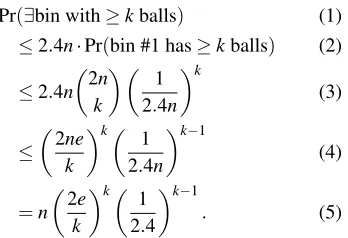
It was shown in [RS98] that whennballs are mapped at random tonbins then the maximum number of elements in a bin is with high probability ln lnlnnn(1+o(1)). Let us examine in more detail the probability of the following event, “2nballs are mapped at random to 2.4nbins, and the most occupied bin has at leastkballs”:
Pr(∃bin with≥kballs) (1)
≤2.4n·Pr(bin #1 has≥kballs) (2) ≤2.4n
2n
k
1 2.4n
k
(3)
≤
2ne k
k
1 2.4n
k−1
(4)
=n
2e
k
k 1 2.4
k−1
. (5)
It is straightforward to see that this probability can be bounded to be at most 2−40by setting
We calculated for some values ofnthe desired bin sizes based on the upper bound of Eq. (6) and the tighter cal-culation of Eq. (5), and chose the minimal value ofkthat reduces the failure probability to below 2−40. The results are in Table 2. It is clear that Eq. (5) results in smaller bins for sufficiently largen, and therefore the maximal bin size should be set according to Eq. (5).
n 212 216 220 224
Eq. (5) 18 19 20 21
Eq. (6) 19 22 26 29
Table 2: The bin sizesmaxβ that are required to ensure that no overflow occurs when mapping 2nitems to 2.4n
bins, according to Eq. (5) and Eq. (6).
7.2
Cuckoo Hashing
It was shown in [KMW09] that Cuckoo hashing with a stash of sizesfails with probability O(n−s). The con-stants in the big “O” notation are unclear, but it is ob-vious thatO(n−s)≤n−(s−1)for sufficiently large values ofn.
We would like to find the exact size of the stash that ensures that the failure probability is smaller than 2−40. We ran 230 repetitions of Cuckoo hashing, mappingn
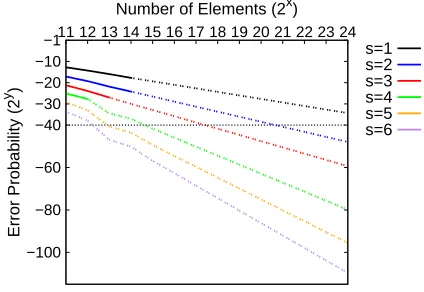
items to 2.4n bins, for n ∈ {211,212,213,214}, and recorded the stash size s that was needed for Cuckoo hashing to be successful. Tab. 3 depicts the number of repetitions where we required a stash of sizes. From the results we can observe that, to achieve 2−30failure prob-ability of Cuckoo hashing, we would require a stash of sizes=6 forn=211,s=5 forn=212, ands=4 for bothn=213andn=214elements.
However, in our experiments we need the stash sizes for larger values ofn≥214to achieve a Cuckoo hashing failure probability of 2−40. To obtain the failure proba-bilities for larger values ofn, we extrapolate the results from Tab. 3 using linear regression and illustrate the re-sults in Fig. 2. We observe that the stash size for achiev-ing a failure probability of 2−40is drastically reduced for higher values ofn: forn=216 we need a stash of size
s=4, forn=220 we need s=3, and forn=224 we needs=2. This observation is in line with the asymp-totic failure probability ofO(n−s).
Finally, we extrapolate the required stash sizes s to achieve a failure probability of 2−40for smaller values of
n∈ {28,212}and give the results together with the stash sizes forn∈ {216,220,224}in Tab. 4.
8
Evaluation
We report on our empirical performance evaluation of Circuit-Phasing (§5) and OT-Phasing (§6) next. We
eval-s 211 212 213 214
0 1,068,592,289 1,070,826,935 1,072,132,187 1,072,845,430 1 4,994,200 2,861,137 1,592,951 891,497
2 147,893 52,038 16,404 4,840
3 7,005 1,647 274 56
4 407 62 8 1
5 28 5 0 0
6 2 0 0 0
Table 3: Required stash sizes s accumulated
over 230 Cuckoo hashing repetitions mapping
n∈ {211,212,213,214}elements to 2.4nbins.
−100 −80 −60 −40 −30 −20 −10
−111 12 13 14 15 16 17 18 19 20 21 22 23 24
Error Probability (2
y )
Number of Elements (2x)
s=1 s=2 s=3 s=4 s=5 s=6
Figure 2: Error probability when mappingnelements to 2.4n bins using 2-way Cuckoo hashing for stash sizes 1≤s≤6. The solid lines correspond to actual measure-ments, the dashed lines were extrapolated using linear regression. Both axes are in logarithmic scale.
uate their performance separately (§8.1 and§8.2), since special purpose protocols for set intersection were shown to greatly outperform circuit-based solutions in [PSZ14]. (The latter are nevertheless of independent interest be-cause their functionality can be easily modified.)
Benchmarking Environment We consider two
benchmark settings: aLAN setting and a WANsetting. The LAN setting consists of two desktop PCs (Intel Haswell i7-4770K with 3.5 GHz and 16GB RAM) connected by Gigabit LAN. The WAN setting consists of two Amazon EC2 m3.medium instances (Intel Xeon E5-2670 CPU with 2.6 GHz and 3.75 GB RAM) located in the US east coast (North Virginia) and Europe (Frankfurt) with an average bandwidth of 50 MB/s and average latency (round-trip time) of 96 ms.
number of elementsn 28 212 216 220 224
stash sizes 12 6 4 3 2
Table 4: Required stash sizes s to achieve 2−40 error probability when mappingnelements into 2.4nbins.
average the results over 10 executions. In our experi-ments, we frequently encountered outliers in the WAN setting with more than twice of the average run-time, for which we repeated the execution. The resulting variance decreased with increasing input set size; it was between 0.5%−8.0% in the LAN setting and between 4%−16% in the WAN setting. Note that all machines that we per-form our experiments on are equipped with the AES-NI extensions which allows for very fast AES evaluation.
Implementation Details We instantiate the random
or-acle, the function for hashing into smaller domains, and the correlation-robust function in OT extension with SHA256. We instantiate the pseudo-random generator using AES-CTR and the pseudo-random permutation in the server-aided protocol of [KMRS14] using AES. To compute the 21µ-OTt`functionality, we use the random 1-out-of-N OT extension of [KK13] and setµ=8, i.e., useN=256, since this was shown to result in minimal overhead in [PSZ14]. We measure the times for the func-tion evaluafunc-tion including the cost for precomputing the OT extension protocol and build on the OT extension implementation of [ALSZ13]. Our OT-Phasing imple-mentation is available online athttps://github.com /encryptogroup/PSI and our Circuit-Phasing imple-mentation is available as part of the ABY framework
of [DSZ15] athttps://github.com/encryptogroup
/ABY.
For simple hashing we use the maximum bin sizes that were computed using Equation 5 in§7.1 (cf. Tab. 2). For Cuckoo hashing, we setε=0.2 and mapnelements to 2(1+ε)nbins for 2-way Cuckoo hashing and to(1+ε)n bins for 3-way Cuckoo hashing with a stash size accord-ing to Tab. 4. The only exception for the stash size are the experiments with different set sizes in§8.2.2, where we use no stash for our OT-Phasing protocol.
For OT-based PSI [PSZ14] and OT-Phasing, where the performance depends on the bit-length of elements, we hash theσ-bit input elements into a`=λ+log2(n1) + log2(n2)-bit representation using SHA256 ifσ> `. This decrease the performance impact of the bit-length.
We use a Yao’s garbled circuits implementation with most recent optimizations, including the recent half-gate optimization of [ZRE15] (cf.§2.6 for details).
We emphasize that all implementations are done in the same programming language (C++), use the same underlying libraries for evaluating cryptographic opera-tions (OpenSSL for symmetric cryptography and Miracl
for elliptic curve cryptography), perform the plaintext-intersection of elements using a standard hash map, are all executed using a single thread (except for the GMW implementation which uses two threads), and run in the same benchmarking environment.
8.1
Generic
Secure
Computation-based
PSI Protocols
For the generic secure computation-based PSI protocols, we perform the evaluation on a number of elements vary-ing from 28to 220 and a fixed bit-length ofσ=32-bit. Forn=220all implementations, except Circuit-Phasing with GMW, exceeded the available memory, which is due to the large number of AND gates in the SCS cir-cuit (estimated 2 billion AND gates) and the requirement to represent bits as keys for Circuit-Phasing with Yao, where storing only the input wire labels to the circuit re-quires 1 GB. A more careful implementation, however, could allow the evaluation of these circuits. We com-pare the sort-comcom-pare-shuffle (SCS) circuit of [HEK12] and its depth-optimized version of [PSZ14], with Circuit-Phasing (§5), by evaluating both constructions using Yao’s garbled circuits protocol [Yao86] and the GMW protocol [GMW87] in the LAN and WAN setting. We use the size-optimized version of the SCS circuit in Yao’s garbled circuit and the depth-optimized version of the circuit in the GMW protocol (cf. §3.4). For the evalu-ation in Circuit-Phasing, we set the maximum bin size in simple hashing according to Equation 5 (cf. Tab. 2, set ε=0.2, set the stash size according to Tab. 4, and assume
n=n1=n2. The run-time of Circuit-Phasing would in-crease linear in the bin sizemaxβ, while the stash sizes
would have a smaller impact on the total run-time as the concrete factors are smaller.
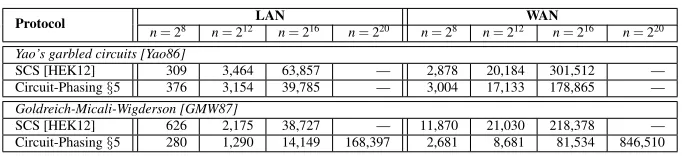
Run-Time (Tab. 5) Our main observation is that
Circuit-Phasing outperforms the SCS circuit of [HEK12] for all parameters except Yao’s garbled circuits with small set sizesn=28. In this case, the high stash size of
Protocol LAN WAN
n=28 n=212 n=216 n=220 n=28 n=212 n=216 n=220
Yao’s garbled circuits [Yao86]
SCS [HEK12] 309 3,464 63,857 — 2,878 20,184 301,512 — Circuit-Phasing§5 376 3,154 39,785 — 3,004 17,133 178,865 —
Goldreich-Micali-Wigderson [GMW87]
SCS [HEK12] 626 2,175 38,727 — 11,870 21,030 218,378 — Circuit-Phasing§5 280 1,290 14,149 168,397 2,681 8,681 81,534 846,510
Table 5: Run-time in ms for generic secure PSI protocols in the LAN and WAN setting onσ=32-bit elements.
Protocol n=28 n=212 n=216 n=220 Asymptotic
Number of AND gates
SCS [HEK12] 229,120 5,238,784 107,479,009 ∗2,000,000,000
σ(3nlog2(n) +4n)
Circuit-Phasing§5 297,852 3,946,776 49,964,540 600,833,968 (σ−log2(n)−2)(6(1+ε)n lnn
ln lnn+sn)
Communication in MB for Yao’s garbled circuits [Yao86] and GMW [GMW87]
SCS [HEK12] 7 169 3,485 ∗64,850 2κ σ(3nlog2(n) +4n) Circuit-Phasing§5 9 122 1,550 18,736 2κ(σ−log2(n)−2)(6(1+ε)n lnn
ln lnn+sn)
Number of communication rounds for GMW [GMW87]
SCS [HEK12] 85 121 157 193 (log2(σ) +4)log2(2n) +4
Circuit-Phasing§5 5 5 5 5 log2(σ)
Table 6: Number of AND gates, concrete communication in MB, round complexity, and failure probability for generic secure PSI protocols onσ=32-bit elements. Numbers with∗are estimated.
circuit, and the use of permutation-based hashing, which reduces the bit-length of the inputs to the circuit. Note that our Yao’s garbled circuits implementation suffers from similar performance drawbacks in the WAN setting as our GMW implementation, although being a constant round protocol. This can be explained by the pipelining optimization we implement, where the parties pipeline the garbled circuits generation and evaluation. The per-formance drawback could be reduced by using an im-plementation that uses independent threads for sending / receiving.
Communication (Tab. 6) Analogously to the run-time
results, Circuit-Phasing improves the communication of the SCS circuit by factor of 1-4 and grows slower with increasing values of n. The improvement of the round complexity, which is mostly important for GMW, is even more drastic. Here, Circuit-Phasing outperforms the SCS circuit by a factor of 16-38. Note that the round complex-ity of Circuit-Phasing only depends on the bit-length of items and is independent of the number of elements.
8.2
Special Purpose PSI Protocols
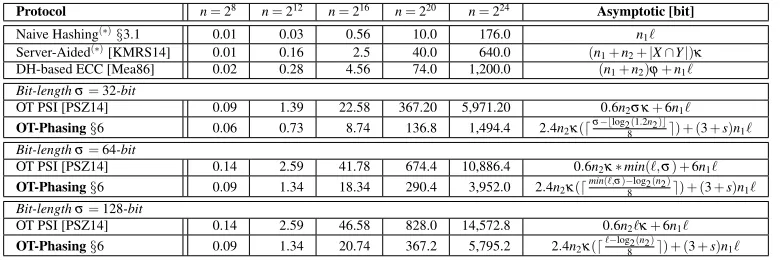
For the special purpose PSI protocols we perform the experimental evaluation for equally sized sets n1 =
n2 (§8.2.1) and differently sized sets n2n1 (§8.2.2), for set sizes ranging from 28to 224 in the LAN setting and from 28to 220in the WAN setting.
We compare OT-Phasing (§6) to the original OT-based PSI protocol of [PSZ14], the naive hashing solution (§3.1), the semi-honest server-aided protocol of [KMRS14] (§3.2), and the Diffie-Hellmann
(DH)-based protocol of [Mea86] (§3.3) using elliptic curves. Note that the naive hashing protocol and the server-aided protocol of [KMRS14] have different security assump-tions and cannot directly be compared to the remaining protocols. We nevertheless included them in our com-parison to serve as a base-line on the efficiency of PSI. For the protocol of [KMRS14], we run the server rou-tine that computes the intersection between the sets on the machine located at the US east coast (North Virginia) and the server and client routine on the machine in Eu-rope (Frankfurt). For the original based PSI and OT-Phasing, we give the run-time and communication for three bit-lengths:shortσ=32 (e.g., for IPv4 addresses),
mediumσ=64 (e.g., for credit card numbers), andlong σ=128 (for set intersection between arbitrary inputs).
Note that the OT-based PSI protocol of [PSZ14] and our OT-Phasing protocol both evaluate public-key cryp-tography during the base-OTs, which dominates the run-time for small sets. However, these base-OTs only need to be computed once and can be re-used over multiple sessions. In the LAN setting, the average run-time for computing the 256 base-OTs was 125 ms while in the WAN setting the run-time was 245 ms. Nevertheless, our results all contain the time for the base-OTs to provide an estimation of the total run-time.
8.2.1 Experiments with Equal Input Sizes
In the experiments for input sets of equal sizen=n1=n2 we setn∈ {28,212,216,220,224}in the LAN setting and
![Figure 1: OT-based PSI protocol of [PSZ14] without the stash.](https://thumb-us.123doks.com/thumbv2/123dok_us/7930969.1316899/8.612.87.512.94.483/figure-ot-based-psi-protocol-psz-stash.webp)