Adaptively Secure Garbled Circuits
from One-Way Functions
∗
Brett Hemenway
†Zahra Jafargholi
‡Rafail Ostrovsky
§Alessandra Scafuro
¶Daniel Wichs
kAbstract
A garbling scheme is used to garble a circuit C and an input xin a way that reveals the output C(x) but hides everything else. In many settings, the circuit can be garbled off-line without strict efficiency constraints, but the input must be garbled very efficientlyon-line, with much lower complexity than evaluating the circuit. Yao’s scheme has essentially optimal on-line complexity, but only achieves
selective security, where the adversary must choose the inputxprior to seeing the garbled circuit. It has remained an open problem to achieveadaptive security, where the adversary can choosexafter seeing the garbled circuit, while preserving on-line efficiency.
In this work, we modify Yao’s scheme in a way that allows us to prove adaptive security under one-way functions. As our main instantiation, we get a scheme where the on-line complexity is only proportional to the width w of the circuit, which corresponds to the space complexity of the computation, but is independent of the circuit’s depth d. Alternately, we can also get an instantiation where the on-line complexity is only proportional to the input/output size and the depthdof the circuit but independent of its widthw, albeit in this case we incur a 2O(d)security loss in our reduction. More broadly, we relate the on-line complexity of adaptively secure garbling schemes in our framework to a certain type ofpebble
complexity of the circuit.
As our main tool, of independent interest, we develop a new notion ofsomewhere equivocalencryption, which allows us to efficiently equivocate on a small subset of the message bits.
∗This work was done in part while some of the authors were visiting the Simons Institute for the Theory of Computing,
supported by the Simons Foundation and by the DIMACS/Simons Collaboration in Cryptography through NSF grant CNS-1523467.
†University of Pennsylvania. Department of Computer Science.
[email protected] ‡Northeastern University. Department of Computer Science.
§University of California, Los Angeles. Department of Computer Science and Mathematics. [email protected]Research
supported in part by NSF grants 09165174, 1065276, 1118126 and 1136174, US-Israel BSF grant 2008411, OKAWA Foundation Research Award, IBM Faculty Research Award, Xerox Faculty Research Award, B. John Garrick Foundation Award, Teradata Research Award, and Lockheed-Martin Corporation Research Award. This material is based upon work supported in part by DARPA Safeware program. The views expressed are those of the author and do not reflect the official policy or position of the Department of Defense or the U.S. Government.
¶Boston University and Northeastern University. Department of Computer Science.
[email protected] supported by NSF grants 1012798.
kNortheastern University. Department of Computer Science. [email protected]. Research supported by NSF grants
1
Introduction
Garbled Circuits. Agarbling scheme (also referred to as a randomized encoding) can be used to garble a circuitCand an inputxto derive a garbled circuitCeand a garbled inputxe. It’s possible to evaluateCeon
e
xand get the correct outputC(x). However, the garbled valuesC,e xeshould not reveal anything else beyond
this. In particular, there is a simulator that can simulateC,e xegiven onlyC(x).
The notion of garbled circuits was introduced by Yao in (oral presentations of) [Yao82,Yao86], and can be instantiated based on one-way functions. Garbled circuits have since found countless applications in diverse areas of cryptography, most notably to secure function evaluation (SFE) starting with Yao’s work, but also in parallel cryptography [AIK04,AIK05], verifiable computation [GGP10,AIK10], software protection [GKR08,
GIS+10], functional encryption [SS10,GVW12,GKP+13], key-dependent message security [BHHI10,App11], obfuscation [App14] and many others. These applications rely on various efficiency/functionality properties of garbled circuits and a comprehensive study of this primitive is explored in the work of Bellare, Hoang and Rogaway [BHR12b].
On-line Complexity. In many applications, the garbled circuit Ce can be computed in an off-line
pre-processing phase before the input is known, and therefore the efficiency of this procedure may not be of paramount importance. On the other hand, once the input x becomes available in the on-line phase, creating the garbled input exshould be extremely efficient. Therefore, the main efficiency measure that we consider here is theon-line complexity, which is the time it takes to garble an inputx, and hence also a bound on the size of ex. Ideally, the on-line complexity should only be linear in the input size|x|and independent of the potentially much larger circuit size|C|.1
Yao’s Scheme. Yao’s garbling scheme already achieves essentially optimal on-line complexity, where the time to garble an inputxand the size ofxeare only linear in the input size|x|, independent of the circuit size.2
However, it only realizes a weak notion of security calledselective security, which corresponds to a setting where adversary must choose the inputxbefore seeing the garbled circuit Ce. In particular, the adversary
first chooses bothC andxand then gets the garbled valuesC,e exwhich are either correctly computed using
the “real” garbling scheme or “simulated” using onlyC(x). The adversary should not be able to distinguish between the real world and the simulated world.
Selective vs. Adaptive Security. Selective security is often unsatisfactory in precisely the scenarios envisioned in the off-line/on-line setting, where the garbled circuitCe is given out first and the garbled input
e
xis only given out later. In such settings, the adversary may be able to (partially) influence the choice of the inputxafter seeing the garbled circuitCe. Therefore, we need a stronger notion calledadaptive security,
defined via the following two stage game:
1. The adversary chooses a circuitC and gets the garbled circuitCe.
2. After seeing Ce the adversary adaptively chooses an inputxand gets the garbled inputxe.
In the real worldC,e xeare computed correctly using the garbling scheme, while in the simulated world they
are created by a simulator who only gets the outputC(x) in step (2) of the game but does not get the input
x. The adversary should not be able to distinguish these two worlds.
The work of Bellare, Hoang and Rogaway [BHR12a] gave the first thorough treatment of adaptively secure garbling schemes and showed that this notion is crucial in many applications. They point out that it remains unknown whether Yao’s garbling scheme or any of its many variants can satisfy adaptive security, and the proof techniques that work in the selective security setting do not extend to the adaptive setting.
1Note that, without any other restrictions on the structure of the garbling scheme, there is a trivial scheme where e
Cis empty andex=C(x), whose on-line complexity is proportional to|C|.
2More precisely, in Yao’s garbled circuits, the garbled input is of size|x| ·poly(λ) whereλis the security parameter. The
They left it as the main open problem to construct adaptively secure garbling schemes where the on-line complexity is smaller than the circuit size.3,4
1.1
Prior Approaches to Adaptive Security
Lower Bound and Yao’s scheme. The work of Applebaum et al. [AIKW13] (see also [HW15]) gives a lower bound on the on-line complexity of circuit garbling in the adaptive setting, showing that the size of the garbled inputxemust exceed the output size of the circuit. This is in contrast to the selective security setting, where Yao’s garbling scheme achieves on-line complexity that depends only on the input size and not the output size. In particular, this shows that Yao’s garbling scheme cannot directly be adaptively secure.
Complexity Leveraging. It turns out that there is a simple and natural modification of Yao’s garbling scheme (i.e., by withholding the mapping of output-wire keys to output bits until the on-line phase) that would match the above lower bound and could plausibly be conjectured to provide adaptive security. In fact, one can prove that the above variant of Yao’s scheme is secure in the adaptive setting usingcomplexity leveraging, but only at a 2nsecurity loss in the reduction, wherenis the input size. There is no known proof
of security that avoids this loss.5
One-Time Pad and Random-Oracles. An alternate approach, suggested by [BHR12a], is to use one-time pad encryption to encrypt a Yao garbled circuit in the off-line phase and then provide the decryption key with the garbled input in the on-line phase. Intuitively, since a one-time pad encryption is “non-committing” and the ciphertext can beequivocatedto any possible message by providing a corresponding key, the adversary does not gain any advantage in seeing such a ciphertext in the off-line phase. Unfortunately, this solution blows up the on-line complexity to be at least as large as the circuit size.
The work of [BHR12a] also noted that one can replace the one-time pad encryption in the above solution with a random-oracle based encryption scheme, which can be equivocated by programming random oracle outputs. This gives an adaptively secure garbled circuit construction with optimal parameters in the random oracle model. In fact, this approach can even be used to prove security in parameter regimes that beat the lower bound of [AIKW13], and therefore we should be suspicious about it’s implications in the standard model, when the random oracle is replaced by a hash function. In particular, the construction is using the random oracle for equivocation in ways that we know to be uninstantiable in the standard model [Nie02].
Heavy Hammers. Lastly, we mention two approaches that get adaptively secure garbled circuits with good on-line complexity under significantly stronger assumptions than one-way functions. The work of Boneh et al. [BGG+14] implicitly provides such schemes where the on-line complexity is proportional to
the input/output size and the depth d of the circuit, under the learning with errors assumption with a modulus-to-noise ratio of 2poly(d). This translates to assuming the hardness of lattice problems with 2poly(d) approximation factors. The work of Ananth and Sahai [AS15] shows how to get an essentially optimal schemes, where the on-line complexity is only proportional to the input/output size of the circuit, assuming
indistinguishability obfuscation. In terms of both assumptions and practical efficiency, these schemes are a far cry from Yao’s original scheme.
1.2
Our results
In this work, we construct the first adaptively secure garbling scheme whose on-line complexity is smaller than the circuit size and which only relies on the existence of one-way functions. Our construction is an adaptation of Yao’ scheme that maintains essentially all of its desirable properties, such as having highly
3The adaptive security notion we described, is denotedprv1by [BHR12a]. They also consider a stronger variant calledprv2,
where the adversary adaptively chooses bits of the inputxone at a time and gets the corresponding bits of the garbled inputxe.
They show that there is an efficiency preserving transformation fromprv1toprv2following the ideas from [GKR08]. Therefore, in this work we can focus solely on achievingprv1.
4The problem of achieving adaptively secure garbled circuits is different from the problem of achieving adaptively secure
two-party computation (with constant rounds) using an approach based on garbled circuits. We do not address the latter.
5Even if we’re willing to assume exponentially secure primitives, the use of complexity leveraging blows up parameter sizes
parallelizable circuit garbling and projective/decomposable input garbling.6 In particular, our construction simply encrypts a Yao garbled circuit with asomewhere equivocal symmetric-key encryption scheme, which is a new primitive that we define and construct from one-way functions. The encrypted Yao garbled circuit is sent in the off-line phase, and the Yao garbled input along with the decryption key is sent in the on-line phase. We get various provably secure instantiations of the above approach depending on how we set the parameters of the encryption scheme.
As our main instantiation, we get a garbling scheme whose on-line complexity is w·poly(λ) where w
is the width of the circuit andλ is the security parameter, but is otherwise independent of the depth dof the circuit.7 Note that, if we think of the circuit as representing a Turing Machine or RAM computation,
then the widthwof the circuit corresponds to the maximum of the input size n, output sizem, and space complexitysof the computation, meaning that our on-line complexity is (n+m+s)·poly(λ), but otherwise independent of the run-time of the computation.
Alternately, we also get a different instantiation where the on-line complexity is only (n+m+d)·poly(λ), wherenis the input size,mis the output size, anddis the depth of the circuit, but is otherwise independent of the circuit’s widthw. In this case, we also incur a 2O(d) security loss in our reduction, but this can be a significant improvement over the naive complexity-leveraging approach which incurs a 2n security loss, wherenis the input size. In particular, in the case ofNC1 circuits whered=O(logn), we get a polynomial reduction and achieve optimal on-line complexity of (n+m)·poly(λ).
More broadly, we develop a connection between constructing adaptively secure schemes in our framework and a certain type ofpebble complexityof the given circuit. The size of the garbled input is proportional to the maximal number of pebbles and the number of hybrids in our reduction is proportional to the number of moves needed to pebble the circuit.
1.3
Applications of Our Results
We briefly mention how our results can be used to get concrete improvements in several applications of garbled circuits in prior works.
On-line/Off-line Two-Party Computation. One of the main uses of garbled circuits is in two-party secure computation protocols. In this setting, Alice holds an input xA, Bob holds an input xB and they
wish to computef(xA, xB). To do so, Alice creates a garbled circuitCef for the functionf and sends Cef
along with her portion of the garbled inputxeAto Bob. Bob runs an oblivious transfer (OT) protocol to get
the garbled version of his inputexB without revealingxB to Alice. This can be done if the garbling scheme is projective/decomposable (see footnote 6) so that each bit of the garbled input only depends on one bit of the original input. Security against fully malicious parties can be obtained via zero-knowledge proofs or cut-and-choose techniques. It is possible to instantiate the above construction with selectively secure garbled circuits, by having Bob commit toxB before he gets the garbled circuitCfe . This ensures that the choice of
the input cannot depend on the garbled circuit.
However, in many cases, creating the garbled circuitCfe for the functionf is expensive and we would like
to do this off-line before the inputsxA, xB are known to Alice and Bob. Once the inputs become known, the on-line phase should be extremely efficient, and ideally much smaller than the size of the circuit computing
f. This setting was recently explored in the work of Lindell and Ben Riva [LR14] who showed how to solve this problem very efficiently using cut-and-choose techniques, given an adaptively secure garbling scheme with low on-line complexity. To instantiate the latter primitive, they relied on the random oracle model. Using our construction of adaptively secure garbled circuit, we can instantiate the scheme of [LR14] in the standard model, where the on-line complexity of the two-party computation protocol would match that of our garbling schemes.
One-Time Programs and Verifiable Computation. As noted by [BHR12a], two prior works from the literature on one-time programs [GKR08] and verifiable computation [GGP10] implicitly require adaptively
6Each bit of the garbled input only depends on one bit of the original input.
7We consider circuits made up of fan-in 2 gates with arbitrary fan-out. The circuit is composed of levels and wires can only
secure garbling.8 In both cases, we can plug in our construction of adaptively secure garbling to these constructions.
In the case of one-time programs, the on-line complexity of the garbling scheme translates to the number of hardware tokens needed to create the one-time program. In the case of verifiable computation, the on-line complexity of the garbling scheme translates to the complexity of the verification protocol – it is essential that this is smaller than the circuit size to make the verification protocol non-trivial.
Compact Functional Encryption. The recent work of [ABSV15] shows how to convert any selectively secure functional encryption (FE) scheme into an adaptively secure FE. However, their transformation is not compact and the ciphertext size is as large as the maximum circuit size of the allowed functions. This is true even if the selectively secure FE that they start with is compact. Implicitly, the main bottleneck in the transformation is having adaptively secure garbled circuits with low on-line complexity. The work of [AS15] gives an alternate and modular transformation from a selectively secure compact FE to an adaptively secure one using adaptively secure garbled circuits (actually, their main construction is for Turing Machines and relies on garbling TMs which require heavier machinery – however, it can be scaled down to work for circuits to get the above result). This transformation applies to both bounded-collusion schemes and unbounded-collusion schemes. By plugging in our construction of adaptively secure garbled circuits into the above result we get a transformation from compact selectively secure FE to adaptive FE where the ciphertext size is only proportional to the on-line complexity of our garbling scheme.
1.4
Our Techniques
In order to explain our techniques, we must first explain the difficulties in proving the adaptive security of Yao’s garbling schemes. Since these difficulties are subtle, we begin with a description of the scheme and the proof of selective security, following Lindell and Pinkas [LP09]. This allows us to fix a precise notation and terminology which will be needed to also explain our new construction and proof. We expect that the reader is already familiar with the basics of Yao circuits and refer to [LP09] for further details.
1.4.1 Yao’s Scheme and The Challenge of Adaptive Security
Yao’s Scheme. For each wire win the circuit, we pick two keys k0
w, kw1 for a symmetric-key encryption
scheme. For each gate in the circuit computing a functiong :{0,1}2→ {0,1} and having input wires a, b
and output wirec we create agarbled gate consisting of 4 randomly ordered ciphertexts created as:
c0,0=Enck0
a(Enck0b(k
g(0,0)
c )) c1,0=Enck1
a(Enckb0(k
g(1,0)
c )),
c0,1=Enck0
a(Enck1b(k
g(0,1)
c )) c1,1=Enck1
a(Enckb1(k
g(1,1)
c ))
(1)
where (Enc,Dec) is a CPA-secure encryption scheme. The garbled circuit Ce consists of all of the gabled
gates, along with an output mapping {kw0 → 0, kw1 → 1} which gives the correspondence between the keys
and the bits they represent for each output wirew . To garble ann-bit valuex=x1x2· · ·xn, the garbled
inputexconsists of the keyskxi
wi for theninput wires wi.
To evaluate the garbled circuit on the garbled input, it’s possible to decrypt (exactly) one ciphertext in each garbled gate and get the keykvw(w) corresponding to the bit v(w) going over the wirew during the
computation C(x). Once the keys for the output wires are computed, it’s possible to recover the actual output bits by looking them up in the output mapping.
Selective Security Simulator. To prove the selective security of Yao’s scheme, we need to define a simulator that gets the outputy=y1y2· · ·ym=C(x) and must produceCe,xe. The simulator picks random
keysk0
1, kw1 for each wirewjust like the real scheme, but it creates the garbled gates as follows: c0,0=Enck0
a(Enckb0(k 0
c)) c1,0=Enck1
a(Enckb0(k 0
c)), c0,1=Enck0
a(Enckb1(k 0
c)) c1,1=Enck1
a(Enckb1(k 0
c))
(2)
8The work of [GKR08] requires an even stronger notion of adaptivity calledprv2but this can be generically achieved given
where all four ciphertext encrypt the same keyk0c. It creates the output mapping{kw0 →yw, k1w→1−yw}
by “programming it” so that the key k0w corresponds to the correct output bityw for each output wire w.
This defines the simulated garbled circuitCe. To create the simulated garbled inputxethe simulator simply
gives out the keys k0
w for each input wire w. Note that, when evaluating the simulated garbled circuit on
the simulated garbled input, the adversary only sees the keysk0
w for every wirew.
Selective Security Hybrids. To prove indistinguishability between the real world and the simulation, there is a series of carefully defined hybrid games that switch the distribution of one garbled gate at a time, starting with the input level and proceeding up the circuit level by level. In each step we switch the distribution of the ciphertexts in the targeted gate to:
c0,0=Enck0
a(Enck0b(k
v(c)
c )) c1,0=Enck1
a(Enckb0(k
v(c)
c )), c0,1=Enck0
a(Enck1b(k
v(c)
c )) c1,1=Enck1
a(Enckb1(k
v(c)
c ))
(3)
wherev(c) is the correct value of the bit going over the wirec during the computation ofC(x).
Let us give names to the three modes for creating garbled gates that we defined above: (1) is called
RealGate mode, (2) is calledSimGatemode, and (3) is calledInputDepSimGate mode, since the way that it is defined depends adaptively on the choice of the inputx.
We can switch a gate from RealGate to InputDepSimGate mode if the gates in the previous level are in
InputDepSimGatemode (or we are in the input level) by CPA security of ecryption. In particular, we arenot
changing the value contained in ciphertextcv(a),v(b)encrypted under the keysk
v(a)
a , kvb(b)that the adversary
obtains during evaluation, but wecan change the values contained in all of the other ciphertexts since the keysk1−v(a), k1−v(b)do not appear anywhere inside the garbled gates in the previous level.
At the end of the above sequence of hybrid games, all gates are switched fromRealGatetoInputDepSimGate
mode and the output mapping is computed as in the real world. The resulting distribution is statistically identicalto the simulation where all the gates are inSimGatemode and the output mapping is programmed. This is because, at any level that’s not the output, the keysk0
c, kc1are used completely identically in the
sub-sequent level so there is no difference between always encryptingkcv(c)(InputDepSimGate) andk0c (SimGate).
At the output level there is no difference between encryptingkvc(c)and giving the real mapping kvc(c)→yc
or encryptingk0
c and giving the programmed mappingkc0→yc whereyc is the output bit on wirec.
Challenges in Achieving adaptive security. There are two issues in using the above strategy in the adaptive setting: an immediate but easy to fix problem and a more subtle but difficult to overcome problem. The first immediate issue is that the selective simulator needs to know the outputy=C(x) to create the garbled circuitCe and in particular to program the output mapping{k0w→yw, kw1 →1−yw}for the output
wiresw. However, the adaptive simulator does not get the outputyuntilafter it creates the garbled circuit
e
C. Therefore, we cannot (even syntactically) use the selective security simulator in the adaptive setting. This issue turns out to be easy to fix by modifying the construction to send the output-mapping as part of the garbled inputxein the on-line phase, rather than as part of the garbled circuitCe in the off-line phase.
This modification raises on-line complexity to also being linear in the output size of the circuit, which we know to be necessary by the lower bound of [AIKW13]. With this modification, the adaptive simulator can program the output mapping after it learns the output y=C(x) in the on-line phase and therefore we get a syntactically meaningful simulation strategy in the adaptive setting.
The second problem is where the true difficulty lies. Although we have a syntactically meaningful simulation strategy, the previous proof of indistinguishability of the real world and the simulation completely breaks down in the adaptive setting. Recall that the proof consisted of a sequence of hybrids where we changed one garbled gate at a time (starting from the input level) fromRealGatemode to theInputDepSimGate
(One could hope to bypassInputDepSimGatemode altogether and define the hybrids by changing a gate directly fromRealGate mode toSimGatemode. Unfortunately, this change is easily distinguishable already for the very first gate we would hope to change at the input level – the output value on the gate would no longer be v(w) but 0 which may result in an overall incorrect output since we have not programmed the output map yet. On the other hand, we cannot immediately jump to a hybrid where we program the output map since all of the keys and their semantics are contained under encryption in prior levels of the circuit and we haven’t argued about the security of the ciphertexts in these levels yet.)
1.4.2 Our Solution
Outer Encryption Layer. Our construction starts with the approach of [BHR12a] which is to encrypt the entire garbled circuit with an additional outer encryption layer in the off-line phase (this is unrelated to the encryption used to construct the garbled gates). Then, in the on-line phase, we give out the secret key for this outer encryption scheme. The approach of [BHR12a] required a symmetric-key, one-time encryption scheme which isequivocal, meaning that the ciphertext doesn’t determine the message and it is possible to come up with a secret key that can open the ciphertext to any possible message. Unfortunately, any fully equivocal encryption scheme where a ciphertext can be opened to any message (e.g., the one-time pad) must necessarily have a secret key size which is as large as the message size. In our case, this is the entire garbled circuit and therefore this ruins the on-line efficiency of the scheme. Our main idea is to use a new type of
partially equivocal encryption scheme, which we callsomewhere equivocal.
Somewhere Equivocal Encryption. Intuitively, a somewhere equivocal encryption scheme allows us to create a simulated ciphertext which contains “holes” in some small subset of the message bit positions
I chosen by the simulator, but all other message bits are fixed. The simulator can later equivocate this ciphertext and “plug the holes” with any bits it wants by deriving a corresponding secret key. An adversary cannot distinguish between seeing a real encryption of some messagem=m1m2· · ·mn and the real secret
key, from seeing a simulated encryption created using only (mi)i6∈I with “holes” in positions I and an
equivocated secret key that later plugs the holes to the correct bits (mi)i∈I. We show how to construct
somewhere equivocal encryption using one-way functions. The size of the secret key is only proportional to the maximum number of holes t=|I| that we allow, which we call the “equivocation parameter”, but can be much smaller than the message size.9
Our proof of security departs significantly from that of [BHR12a]. In particular, our simulator doesnot
take advantage of the equivocation property of the encryption scheme at all, and in fact, our simulation strategy is identical to the adaptive simulator we outlined above for the variant of Yao’s garbling where the output map is sent in the on-line phase. However, we crucially rely on the equivocation property to carefully define a meaningful sequence of hybrids that allows us to prove the indistinguishability of the real and simulated worlds.
Hybrids for adaptive security. We define hybrid distributions where various garbled gates will be created in one of three modes discussed above: RealGate,SimGateandInputDepSimGate. However, to make the last option meaningful (even syntactically) in the adaptive setting, we rely on the somewhere equivocal encryption scheme. For these hybrids, when we create the encrypted garbled circuit in the off-line phase, we will simulate the outer encryption layer with a ciphertext that contains “holes” in place of all gates that are inInputDepSimGatemode. Only when we open the outer encryption in the on-line phase after the input
xis chosen, we will “plug the holes” by sampling these gates correctly in InputDepSimGatemode in a way that depends on the inputx. Our equivocation parametertfor the somewhere equivocal encryption scheme therefore needs to be large enough to support the maximum number of gates inInputDepSimGatemode that we will have in any hybrid.
Sequence of hybrids. For our main result, we use the following sequence of hybrids to prove indisit-nguishability of real and simulated worlds. We start by switching the first two levels of gates (starting with
9A different notion of partially equivocal encryption, called somewhat non-committing encryption, was introduced in
the input level) to InputDepSimGate mode. We then switch the first level of gates to SimGate mode and switch the third level InputDepSimGatemode. We continue this process, where in each stepi we maintain leveli inInputDepSimGatemode but switch the previous level i−1 fromInputDepSimGateto SimGateand then switch the next leveli+ 1 fromRealGate toInputDepSimGate. Eventually all gates will be inSimGate
mode as we wanted. We can switch a leveli−1 from InputDepSimGateto SimGatemode when the subse-quent leveli is inInputDepSimGatemode since the keysk0
c, k1c for wiresc crossing from leveli−1 to iare
used identically in leveli and therefore there is statistically no difference between encrypting the keykvc(c)
(InputDepSimGate) andk0
c (SimGate). We can also switch a level i+ 1 from RealGate to InputDepSimGate
when the previous leveliisInputDepSimGate(ori+ 1 is the input level) by CPA security following the same argument as in the selective setting. With this strategy, at any point in time we have at most two levels in InputDepSimGate mode and therefore our equivocation parameter only needs to be proportional to the circuit widthw.
Connection to pebbling. We can generalize the above idea and get other meaningful sequences of hybrids with different parameters and implications. We can think of the process of switching between RealGate,
SimGateandInputDepSimGatemodes as a new kind ofgraph pebbling game, where pebbles can be placed on the graph representing the circuit according to certain rules. Initially, all gates are inRealGatemode, which we associate withnot having any pebble on them. We associateInputDepSimGatemode with having ablack pebble andSimGatemode with having agray pebble. The rules of the game go as follows:
• We can place or remove a black pebble on a gate as long as both predecessors of that gate have black pebbles on them (or the gate is an input gate).
• We can replace a black pebble with a gray pebble on a gate as long as all successors of that gate have black or gray pebbles on them (or the gate is an output gate).
The goal of the game is to end up with a gray pebble on every gate. Any such pebbling strategy leads to a sequence of hybrids that shows the indistinguishability between the real world and the simulation. The number of moves needed to complete the pebbling corresponds to the number of hybrids in our proof, and therefore the security loss of our reduction. The maximum number of black pebbles that are in play at any given time corresponds to the equivocation parameter needed for our somewhere equivocal encryption scheme.
For example, the sequence of hybrids discussed above corresponds to a pebbling strategy where the number of black pebbles used is linear in the circuit widthw(but independent of the depth) and the number of moves is linear in the circuit size. We give an alternate recursive pebbling strategy where the number of black pebbles used is linear in the circuit depthd(but independent of the width) and the number of moves is 2O(d)times the circuit size.
Constructing somewhere equivocal encryption. Lastly, we briefly discuss our construction of some-where equivocal encryption from one-way functions, which may be of independent interest. Recall that a somewhere equivocal encryption provides a method for equivocating some small number (t out ofn) of bits of the message.
Our construction is based on the techniques developed in recent constructions ofdistributed point func-tions [GI14,BGI15]. These techniques give us a way to construct a pseudorandom function (PRF) family
fk with the following equivocation property: for any inputx, we can create two PRF keysk0, k1 that each
individually look uniformly random but such thatfk0(x
0) =f
k1(x
0) for allx06=xand f
k0(x)6=fk1(x). The
construction is based on a clever adaptation of the Goldreich-Goldwasser-Micali (GGM) PRF [GGM84]. Using distributed point functions, we can immediately create a somewhere equivocal encryption with equivocation parameter t = 1. We rely on a PRF family fk with the above equivocation property and
with one-bit output. To encrypt a messagem=m1m2· · ·mn∈ {0,1}n we create a ciphertext c=fk(1)⊕ m1||fk(2)⊕m2|| · · · ||fk(n)⊕mnusing the PRF outputs as a one-time pad. To create a simulated encryption
with a hole in position i, the simulator samples two PRF keysk0, k1 that only differ on input x=i. The
simulator encrypts then-bit message by setting the unknown value in positionitomi:= 0 and usingk0. If
We can extend the above approach to an arbitrarily large equivocation parameter t, by using the XOR oftindependently chosen PRFs with the above equivocation property. The key size will bet·poly(λ).
2
Preliminaries
General Notation. For a positive integern, we define the set [n] :={1, . . . , n}. We use the notationx←
X for the process of sampling a valuexaccording to the distributionX. For a vectorm= (m1, m2,· · ·, mn),
and a subset P ⊂[n], we use (mi)i∈P to denote a vector containing only the values mi in positionsi∈P
and⊥symbols in all other positions. We use (mi)i /∈P as shorthand for (mi)i∈[n]\P.
Circuit Notation. A boolean circuitCconsists of gatesgate1, . . . ,gateq and wiresw1, w2, . . . , wp. A gate
is defined by the tuple gatei = (g, wa, wb, wc) whereg : {0,1}2 → {0,1} is the function computed by the
gate,wa, wbare the incoming wires, andwcis the outgoing wire. Although each gate has a unique outgoing wire wc, this wire can be used as an incoming wire to several different gates and therefore this models a circuit with fan-in 2 and unbounded fan-out. We letq denote the number of gates in the circuit,ndenotes the number of input wires andmdenote the number of output wires. The total number of wires isp=n+q
(since each wire can either be input wire or an outgoing wire of some gate). For convenience, we denote the
n input wires by in1, . . . ,inn and them output wires by out1, . . . ,outm. Forx∈ {0,1}n we write C(x) to
denote the output of evaluating the circuitC on inputx.
We sayC is leveled, if each gate has an associated level and any gate at levell has incoming wires only from gates at levell−1 and outgoing wires only to gates at levell+ 1. We let thedepthddenote the number of levels and thewidth wdenote the maximum number of gates in any level.
A circuitCis fully specified by a list of gate tuplesgatei= (g, wa, wb, wc). We use Φtopo(C) to refer to the
topology of a circuit– which indicates how gates are connected, without specifying the function implement by each gate. In other words, Φtopo(C) is the list of sanitized gate tuples gatedi = (⊥, wa, wb, wc) where the
functiongthat the gate implements is removed from the tuple.
3
Garbling Scheme
We now give a formal definition of a garbling scheme. There are many variants of such definitions in the literature, and we refer the reader to [BHR12b] for a comprehensive treatment.
Definition 1. A Garbling Scheme is a tuple of PPT algorithms GC= (GCircuit,GInput,Eval)such that:
• (C, ke ) $
←GCircuit(1λ, C): takes as input a security parameter λ, a circuitC :{0,1}n → {0,1}m, and outputs the garbled circuitCe, and key k.
• x˜←GInput(k, x): takes as input, a stringx∈ {0,1}n, and keyk and outputsx˜.
• y=Eval(C,e x˜): given a garbled circuit Ce and a garbled input x˜ outputy∈ {0,1}m.
Correctness There is a negligible function ν such that for any λ∈ N, any circuit C and input x it holds that Pr[C(x) =Eval(C,e x˜)] = 1−ν(λ), where(C, ke )←GCircuit(1λ, C),x˜←GInput(k, x).
Adaptive Security. There exists a PPT simulatorSim= (SimC,SimIn)such that, for any PPT adversary
A, there exists a negligible functionν such that:
Pr[ExpadaptiveA,GC,Sim(1λ,0) = 1]−Pr[ExpadaptiveA,GC,Sim(1λ,1) = 1]≤ν(λ)
where the experimentExpadaptiveA,GC,Sim(1λ, b)is defined as follows:
1. The adversaryAspecifiesC and getsCe whereCe is created as follows:
• if b= 1: (C,e state)←SimC(1λ,Φtopo(C)), whereΦtopo(C)reveals the topology ofC.
2. The adversaryAspecifiesxand gets ˜xcreated as follows:
• if b= 0,x˜←GInput(k, x),
• if b= 1,x˜←SimIn(C(x),state).
3. Finally, the adversary outputs a bitb0, which is the output of the experiment.
On-line Complexity. The time it takes to garble an inputx, (i.e., time complexity ofGInput(·,·)) is the
on-line complexity of the scheme. Clearly the on-line complexity of the scheme gives a bound on the size of the garbled inputex. Ideally, the on-line complexity should be much smaller than the circuit size|C|.
Projective Scheme. We say a garbling scheme isprojectiveif each bit of the garbled inputxeonly depends on one bit of the actual input x. In other words, each bit of the input, is garbled independently of other bits of the input. Projective schemes are essential for two-party computation where the garbled input is transmitted using an oblivious transfer (OT) protocol. Our constructions will be projective.
Hiding Topology. A garbling scheme that satisfies the above security definition may reveal the topology of the circuit C. However, there is a way to transform any such garbling scheme into one that hides everything, including the topology of the circuit, without a significant asymptotic efficiency loss. More precisely, we rely on the fact that there is a functionHideTopo(·)that takes a circuitC as input and outputs a functionally equivalent circuitC0, such that for any two circuitsC1, C2of equal size, ifC10 =HideTopo(C1)
andC20 =HideTopo(C2), then Φtopo(C10) = Φtopo(C20). An easy way to construct such functionHideTopois by
settingC0 to be a universal circuit, with a hard-coded description of the actual circuitC. Therefore, to get a topology-hiding garbling scheme, we can simply use a topology-revealing scheme but instead of garbling the circuitC directly, we garble the circuitHideTopo(C).
4
Somewhere Equivocal Symmetric-Key Encryption
We introduce a new cryptographic primitive called somewhereequivocal encryption scheme. Intuitively, a somewhere equivocal encryption scheme allows one to create a simulated ciphertext which contain “holes” in some small subset of the messages in positions I chosen by the simulator, but all other messages are fixed. The simulator can later equivocate this ciphertext and “plug the holes” with any message it wants by deriving a corresponding secret key.
In more detail, encryptions can be computed in two modes: real mode and simulated mode. In the real mode, a key key ←KeyGen(1λ) is generated using the honest key generation procedure and a vector of n
messagesm=m1, . . . , mn is encrypted using the honest encryption procedurec←Enc(key, m).
In the simulated mode, there is an encryption procedure SimEncthat gets in input a setI (set of holes) and only a subset of messages (mi)i /∈I and outputs simulated ciphertextc that is equivocal in positions I.
In a later stage, upon learning the remaining messages (mi)i∈I, there exists a procedureSimKeythat plugs
the holes by generating a keykey0 that will decryptc correctly according tom.
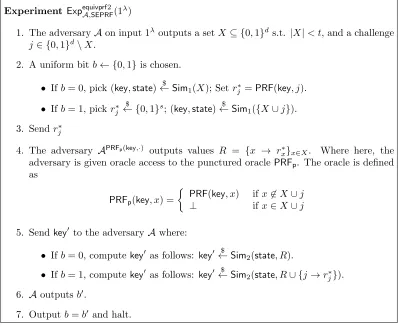
The security property that we require is that the distributions of {c,key} generated in the two modes are indistinguishable. To capture this property, one could envision a non-adaptive security game where and adversary Afirst selects the full vector m and the set I, then it receives the tuple (c,key) and needs to distinguish which distribution it belongs to. However, such security definition is not sufficient for our indistinguishability proof where instead we need an adversary to decide on the missing messagesafter she receives the ciphertex c. Therefore, we consider an adaptive security definition where the security game is defined in two stages: in the first stage, the adversary choosesI, anincompletevector of messages (mi)i /∈I,
and a challenge index j /∈ I and receives the ciphertex c. In the second stage, the adversary sends the remaining messages (mi)i∈I and gets key. The adversary knows that all positions in I are equivocal and
are plugged to the values (mi)i∈I chosen in the second stage. The challenge is to distinguish whether the
the non-adaptive security definition sketched above. For completeness, we give the simpler non-adaptive definition and prove the above implication in AppendixC.
Definition 2. A somewhere equivocal encryption scheme with block-lengths,message-length n(in blocks), andequivocation-parametert(all polynomials in the security parameter) is a tuple of probabilistic polynomial algorithmsΠ = (KeyGen,Enc,Dec,SimEnc,SimKey)such that:
• The key generation algorithm KeyGen takes as input the security parameter 1λ and outputs a key:
key←KeyGen(1λ).
• The encryption algorithmEnctakes as input a vector ofnmessagesm=m1, . . . , mn, withmi∈ {0,1}s, and a key key, and outputs ciphertext c←Enc(key, m).
• The decryption algorithmDectakes as input ciphertextcand a keykeyand outputs a vector of messages m=m1, . . . , mn. Namely,m←Dec(key, c).
• The simulated encryption algorithm SimEnc takes as input a set of indexes I ⊂[n], such that |I| ≤
t, and a vector of n− |I| messages (mi)i /∈I and outputs ciphertext c, and a state state. Namely,
(state, c)←SimEnc((mi)i /∈I, I).
• The simulated key algorithmSimKey, takes as input the variablestateand messages(mi)i∈I and outputs a key key0. Namely,key0 ←SimKey(state,(mi)i∈I).
and satisfies the following properties:
Correctness. For everykey←KeyGen(1λ), for everym∈ {0,1}s×n it holds that:
Dec(key,(Enc(key, m)) =m
Simulation with No Holes. We require that the distribution of(c,key)computed via(c,state)←SimEnc(m,∅)
andkey←SimKey(state,∅)to be identical to key←KeyGen(1λ)andc←Enc(key, m). In other words, simulation when there are no holes (i.e., I=∅) is identical to honest key generation and encryption.
Security. For any PPT adversaryA, there exists a negligible functionν =ν(λ) such that:
Pr[ExpsimencA,Π (1λ,0) = 1]−Pr[Exp
simenc
A,Π (1λ,1) = 1]≤ν(λ)
where the experiment ExpsimencA,Π is defined as follows:
Experiment ExpsimencA,Π (1λ, b)
1. The adversary A on input 1λ outputs a setI ⊆[n] s.t. |I|< t, vector (m
i)i /∈I, and a challenge index j∈[n]\I. Let I0 =I∪j.
2. – If b= 0, computec as follows: (state, c)←SimEnc((mi)i /∈I, I). – If b= 1, computec as follows: (state, c)←SimEnc((mi)i /∈I0, I0).
3. Sendc to the adversaryA.
4. The adversaryAoutputs the set of remaining messages(mi)i∈I. – If b= 0, computekey as follows: key←SimKey(state,(mi)i∈I). – If b= 1, computekey as follows: key←SimKey(state,(mi)i∈I0).
5. Sendkey to the adversary A.
6. A outputsb0 which is the output of the experiment.
In Appendix B, we construct somewhere equivocal encryption from one-way functions, proving the fol-lowing theorem.
5
Adaptively Secure Garbling Scheme and Simulator
In this section we describe our garbling scheme and the simulation strategy.
5.1
Construction
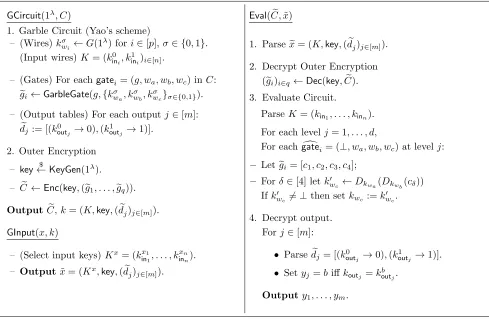
Our adaptively-secure garbling scheme consists in two simple steps: (1) garble the circuit using Yao’s gar-bling scheme; (2) hide the garbled circuit (without the output tables) under an outerlayer of encryption instantiated with asomewhere-equivocalencryption scheme. In the on-line phase, the garbled input consists of Yao’s garbled input plus the output tables. Next we provide the formal description of our scheme that contains the details of Yao’s garbling scheme.
LetC be a leveled boolean circuit with fan-in 2 and unbounded fan-out, with inputs size n, output size
m, depthdand widthw. Let q denote the number of gates inC. Recall that wires are uniquely identified with labels w1, w2, . . . , wp, and a circuit C is specified by a list of gate tuples gate= (g, wa, wb, wc). The
topology of the circuit Φtopo(C) consists of the sanitized gate tuplesgatedi = (⊥, wa, wb, wc). For simplicity,
we implicitly assume that Φtopo(C) is public and known to the circuit evaluator without explicitly including
it as part of the garbled circuit Ce. To simplify the description of our construction, we first describe the
procedure for garbling a single gate, that we denote byGarbleGate.
Let Γ = (G, E, D) be a CPA-secure symmetric-key encryption scheme satisfying the special correctness property defined in Appendix A.GarbleGateis defined as follows.
– eg ←GarbleGate(g,{kσ a, kσb, k
σ
c}σ∈{0,1}): This function computes 4 ciphertextscσ0,σ1 : σ0, σ1 ∈ {0,1}
as defined below and outputs them in a random order as eg= [c1, c2, c3, c4].
c0,0←Ek0
a(Ek0b(k
g(0,0)
c )) c0,1←Ek0
a(Ek1b(k
g(0,1)
c ))
c1,0←Ek1
a(Ek0b(k
g(1,0)
c )) c1,1←Ek1
a(Ek0b(k
g(1,1)
c ))
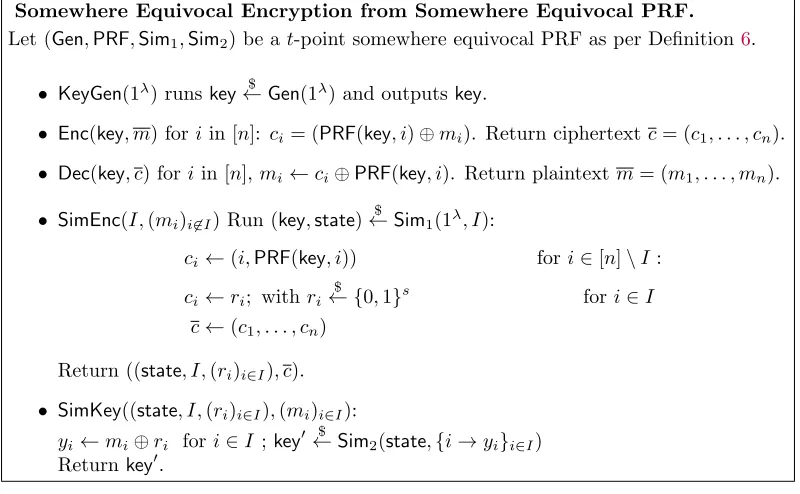
Let Π = (KeyGen,Enc,Dec,SimEnc,SimKey) be a somewhere-equivocal symmetric-encryption scheme as defined in Sec.4. Recall that in this primitive the plaintext is a vector ofnblocks, each of which hassbits. In our construction we use the following parameters: the vector size n=q is the number of gates and the block sizes=|eg|is the size of a single garbled gate. The equivocation parametertis defined by the strategy used in the security proof and will be specified later. The garbling scheme is formally described in Fig.1.
5.2
Adaptive Simulator
The adaptive security simulator for our garbling scheme is essentially the same as the static security simulator for Yao’s scheme (as in [LP09]), with the only difference that the output table is sent in the on-line phase, and is computed adaptively to map to the correct output. Note that the garbled circuit simulator does not rely on the simulation properties of the somewhere equivocal encryption scheme - these are only used in the proof of indistinguishability.
More specifically, the adaptive simulator (SimC,SimIn) works as follows. In the off-line phase, SimC
computes the garbled gates using procedure GarbleSimGate, that generates 4 ciphertexts that encrypt the same output key. More precisely,
– GarbleSimGate({kσ wa, k
σ
wb}σ∈{0,1}, k 0
wc) takes both keys for input wires wa, wb and a single key for the
output wire wc, that we denote by k0wc. It then output egc = [c1, c2, c3, c4] where the ciphertexts,
arranged in random order, are computed as follows.
c0,0←Ek0
a(Ek0b(k 0
c)) c1,0←Ek1
a(Ek0b(k 0
c)) c0,1←Ek0
a(Ek1b(k 0
c)) c1,1←Ek1
a(Ek0b(k 0
c))
The simulator invokes GarbleSimGateon input kc0 =k0
c. It then encrypts the garbled gates so obtained by
using the honest procedure for the somewhere equivocal encryption.
GCircuit(1λ, C)
1. Garble Circuit (Yao’s scheme) – (Wires)kσ
wi ←G(1
λ) fori∈[p],σ∈ {0,1}.
(Input wires)K= (k0
ini, k 1
ini)i∈[n].
– (Gates) For eachgatei= (g, wa, wb, wc) in C:
e
gi←GarbleGate(g,{kwσa, k
σ wb, k
σ
wc}σ∈{0,1}).
– (Output tables) For each outputj∈[m]:
e
dj := [(kout0 j →0),(k 1
outj →1)].
2. Outer Encryption
– key←$ KeyGen(1λ).
– Ce ←Enc(key,(ge1, . . . ,egq)).
OutputCe,k= (K,key,(dej)j∈[m]).
GInput(x, k)
– (Select input keys)Kx= (kx1
in1, . . . , k xn
inn).
– Outputx˜= (Kx,key,(
e
dj)j∈[m]).
Eval(C,e x˜)
1. Parseex= (K,key,(dej)j∈[m]).
2. Decrypt Outer Encryption (egi)i∈q ←Dec(key,Ce).
3. Evaluate Circuit.
ParseK= (kin1, . . . , kinn).
For each levelj= 1, . . . , d,
For eachgatedi= (⊥, wa, wb, wc) at levelj:
– Letegi = [c1, c2, c3, c4];
– Forδ∈[4] letk0wc←Dkwa(Dkwb(cδ)) Ifkw0c6=⊥then setkwc:=k
0
wc.
4. Decrypt output. Forj∈[m]:
• Parsedje = [(kout0 j →0),(k1outj →1)].
• Setyj=b iffkoutj =k
b
outj.
Outputy1, . . . , ym.
Figure 1: Adaptively-secure Garbling Scheme.
only key encrypted in the output gategoutj, which isk 0
outj. For the input keys, SimInjust sends keysk 0
ini for
eachi∈[n]. The detailed definition of (SimC,SimIn) is provided in Fig.2.
5
Hybrid Games
We now need to prove the indistinguishability of our garbling scheme and the simulation. We devise a modular approach for proving indistinguishability using different strategies that result in different parameters. We first provide a template for defining hybrid games, where each such hybrid game is parametrized by acircuit configuration, that is, a vector indicating the way the gates are garbled and encrypted. Then we define the rules that allow us to indistinguishably move from one configuration to another. With this framework in place, an indistinguishability proof consists of a strategy to move from the gate configuration of the real game to the gate configuration of the simulated game, using the allowed rules.
5.1
Template for Defining Hybrid Games
Gate/Circuit Configuration. We start by defining agate configuration. A gate configuration is a pair (outer mode, garbling mode) indicating the way a gate is computed. The outer encryption mode can be
{EquivEnc,BindEnc} depending on whether the outer encryption contains a “hole” in place of that gate or whether it is binding on that gate. The garbling mode can be{RealGate,SimGate,InputDepSimGate}which corresponds to the distributions outlined in Figure 3. We stress that, if the garbling mode of a gate is
InputDepSimGatethen we require that the outer encryption mode isEquivEnc. This means that there are 5 valid gate configurations for each gate.
Simulator
SimC(1λ,Φtopo(C))
• (Wires)kσ
wi←G(1
λ) fori∈[p],σ∈ {0,1}.
• (Garbled gates) For each gategategi= (⊥, wa, wb, wc) in Φtopo(C):
e
gi←GarbleSimGate({kσwa, kwσb}σ∈{0,1}, k0wc).
• (Outer Encryption): key←$ KeyGen(1λ),
e
C←Enc(key,eg1, . . . ,egq).
• OutputCe, state= ({kσwi},key).
SimIn(y,state)
• Generate output table: sdje ←[(k
yj
outj →0),(k 1−yj
outj →1)]j∈[m]. // ensuresk 0
outj →yj
• Outputex= ((k0
ini)i∈[n],key,(sdej)j∈[m]).
Figure 2: Simulator for Adaptive Security.
RealGate
c0,0←Ek0
a(Ek0b(k
g(0,0)
c ))
c0,1←Ek0
a(Ek1b(k
g(0,1)
c ))
c1,0←Ek1
a(Ek0b(k
g(1,0)
c ))
c1,1←Ek1
a(Ek1b(k
g(1,1)
c ))
SimGate
c0,0←Ek0
a(Ek0b(k 0
c)) c0,1←Ek0
a(Ek1b(k 0
c)) c1,0←Ek1
a(Ek0b(k 0
c)) c1,1←Ek1
a(Ek1b(k 0
c))
InputDepSimGate
c0,0←Ek0
a(Ek0b(k
v(c)
c ))
c0,1←Ek0
a(Ek1b(k
v(c)
c ))
c1,0←Ek1
a(Ek0b(k
v(c)
c ))
c1,1←Ek1
a(Ek1b(k
v(c)
c ))
Figure 3: Garbling Gate modes: RealGate (left),SimGate(center), InputDepSimGate(right). The valuev(c) depends on the inputxand corresponds to the bit going over the wirecin the computation C(x).
• The setI⊆[q] contains the indexes of the gates iwhose outer mode isEquivEnc.
• The value modei∈ {RealGate,SimGate,InputDepSimGate}describes the garbling mode of gatei.
Avalid circuit configuration is one where all indexesi such thatmodei=InputDepSimGatesatisfyi∈I.
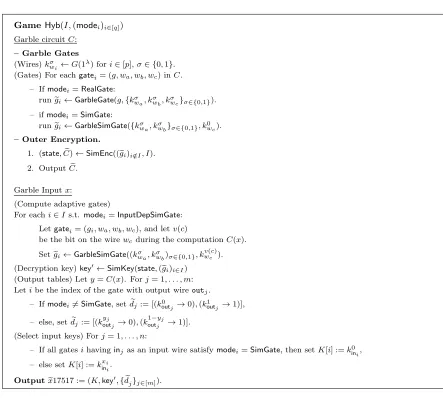
The Hybrid GameHyb(I,(modei)i∈[q]). Every valid circuit configurationI,(modei)i∈[q] defines a hybrid
gameHyb(I,(modei)i∈[q]) as specified formally Figure 4 and described informally below. The hybrid game
consists of two procedures: GCircuit0 for creating the garbled circuitCe andGInput0 for creating the garbled
inputxerespectively. The garbled circuit it created by picking random keyskσ
wj for each wire wj. For each
gatei, such thatmodei∈ {RealGate,SimGate}it creates a garbled gateegiusing the corresponding distribution
as described in Figure 3. The garbled circuit Ce is then created by simulating the outer encryption using
the valuesegi in locationsi6∈Iand “holes” in the locationsI. The garbled input is created by first sampling the garbled gatesegi for eachisuch that modei =InputDepSimGateusing the corresponding distribution in
Figure 3 and using knowledge of the inputx. Then the decryption keykeyis simulated by plugging in the holes in locationsIwith the correctly sampled garbled gatesegi. There is some subtlety about how the input
labelsK[i] and the output label mapsdej are created when computingxe:
• If all of the gates havinginias an input wire are inSimGatemode, then K[i] :=k0ini elseK[i] :=k
xi
ini.
• If the unique gate havingoutj as an output wire is inSimGatemode, then we give the simulated output
map dje := [(k
yj
outj →0),(k 1−yj
outj →1)] else the real onedje := [(k 0
outj →0),(k 1
GameHyb(I,(modei)i∈[q]) Garble circuitC:
– Garble Gates
(Wires)kσ wi←G(1
λ) fori∈[p],σ∈ {0,1}.
(Gates) For eachgatei= (g, wa, wb, wc) inC.
– Ifmodei=RealGate: runegi←GarbleGate(g,{k
σ wa, k
σ wb, k
σ
wc}σ∈{0,1}). – ifmodei=SimGate:
runegi←GarbleSimGate({k
σ wa, k
σ
wb}σ∈{0,1}, k0wc).
– Outer Encryption.
1. (state,Ce)←SimEnc((egi)i /∈I, I).
2. OutputCe.
Garble Inputx:
(Compute adaptive gates)
For eachi∈Is.t.modei=InputDepSimGate:
Letgatei= (gi, wa, wb, wc), and letv(c)
be the bit on the wirewcduring the computationC(x).
Setegi←GarbleSimGate((k
σ wa, k
σ
wb)σ∈{0,1}, k v(c)
wc ).
(Decryption key)key0←SimKey(state,(egi)i∈I)
(Output tables) Lety=C(x). Forj= 1, . . . , m: Letibe the index of the gate with output wireoutj.
– Ifmodei6=SimGate, setdej:= [(k0out
j →0),(k
1
outj →1)],
– else, setdej:= [(k yj
outj →0),(k
1−yj outj →1)]. (Select input keys) Forj= 1, . . . , n:
– If all gatesihavinginjas an input wire satisfymodei=SimGate, then setK[i] :=k0in i, – else setK[i] :=kxi
ini.
Outputex17517 := (K,key
0,{
e
dj}j∈[m]).
Real game and Simulated Game. If we look at the definition of adaptively secure garbled circuits (Definition1) then:
• The real gameExpadaptiveA,GC,Sim(1λ,0) is equivalent toHyb(I=∅,(modei=RealGate)i∈[q]).
• The simulated gameExpadaptiveA,GC,Sim(1λ,1) is equivalent toHyb(I=∅,(modei=SimGate)i∈[q]).
Therefore, the main aim is to show that these hybrids are indistinguishable.10
5.2
Rules for Indistinguishable Hybrids
Next, we provide rules that allow us to move from one configuration to another and prove that the corre-sponding hybrid games are indistinguishable. We define three rules that allow us to do this. For convenience, let us definemodedef= (modei)i∈[q].
5.2.1 Indistinguishability Rule 1: Changing the Outer Encryption ModeBindEnc↔EquivEnc.
This rule allows to change the outer encryption of a single gate. It says that one can move from a valid circuit configuration (I,mode) to a circuit configuration (I0,mode) whereI0 =I∪j. Thus one more gate is now computed equivocally (and vice versa).
Lemma 1. Let (I,mode) be any valid circuit configuration, let j ∈ [q]\I and let I0 = I∪j. Then
Hyb(I,mode)comp≈ Hyb(I0,mode) are computationally indistinguishable as long as Π = (KeyGen, Enc,Dec,
SimEnc,SimKey)is a somewhere equivocal encryption scheme with equivocation parametertsuch that|I0| ≤t.
Proof. Towards a contradiction, assume there exists a PPT distinguisherAthat distinguishes the distribu-tionsH0=Hyb(I,mode) andH1=Hyb(I0,mode) as defined in the Lemma.
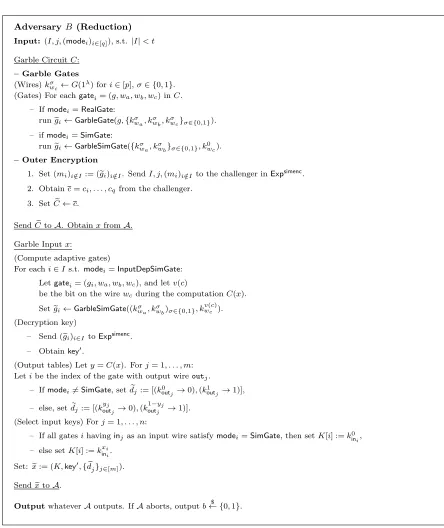
We construct a distinguisher B for the security of somewhere equivocal encryption scheme as follows. AdversaryBis formally described in Fig.5. Informally, adversaryBis playing in experimentExpsimencB,Π (1λ, b)
and uses her oracle access to SimEnc to reproduce the distribution of Hb. B, on input I, j and mode =
mode1, . . . ,modeq computes each garbled gate egi on its own exactly as inH0/ H1 accordingly tomodei. B
computes the outer encryptions of the gates by sending the gates, along with setsI, jtoExpsimenc.
In the on-line phase, after obtainingxfromA, B computes the values for the missing gates (egi)i∈I and
send them toExpsimenc, and obtain a keykey0. B uses such key to compute the garbled inputsex.
Now, if B is playing the game ExpsimencB,Π (1λ, b) with a bit b, then the view generated byB is distributed identically toHb. Thus,B distinguishes whether it is playing the game withb= 0 or b= 1 with the same probability thatAdistinguishesH0 fromH1.
5.2.2 Indistinguishability Rule 2. Changing the Garbling ModeRealGate↔InputDepSimGate
This rules allows us to change the mode of a gatej fromRealGatetoInputDepSimGateunder the conditions that j∈Iand thatgatej = (g, wa, wb, wc) has incoming wireswa, wb that are either input wires or are the outgoing wires of some predecessor gates both of which are inInputDepSimGatemode.
Definition 3 (Predecessor/Successor/Sibling Gates). Given a circuit C and a gate j ∈ [q] of the form
gatej= (g, wa, wb, wc)with incoming wireswa, wb and outgoing wirewc:
• We define the predecessors of j, denoted by Pred(j), to be the set of gates whose outgoing wires are either wa or wb. Ifwa, wb are input wires thenPred(j) =∅, else|Pred(j)|= 2.
• We define the successorsofj, denoted bySucc(j)to be the set of gates that containwc as an incoming wire. Ifwc is an output wires thenSucc(j) =∅.
10Note that, the gamesHyb(· · ·) use the simulated encryption and key generation procedures of the somewhere equivocal
AdversaryB (Reduction) Input:(I, j,(modei)i∈[q]), s.t.|I|< t
Garble CircuitC:
– Garble Gates
(Wires)kσ wi←G(1
λ) fori∈[p],σ∈ {0,1}.
(Gates) For eachgatei= (g, wa, wb, wc) inC.
– Ifmodei=RealGate: runegi←GarbleGate(g,{k
σ wa, k
σ wb, k
σ
wc}σ∈{0,1}). – ifmodei=SimGate:
runegi←GarbleSimGate({k
σ wa, k
σ
wb}σ∈{0,1}, k
0
wc).
– Outer Encryption
1. Set (mi)i /∈I:= (egi)i /∈I. SendI, j,(mi)i /∈I to the challenger inExp simenc.
2. Obtainc=ci, . . . , cqfrom the challenger.
3. SetCe←c.
SendCetoA. ObtainxfromA.
Garble Inputx:
(Compute adaptive gates)
For eachi∈Is.t.modei=InputDepSimGate:
Letgatei= (gi, wa, wb, wc), and letv(c)
be the bit on the wirewcduring the computationC(x).
Setegi←GarbleSimGate((k
σ wa, k
σ
wb)σ∈{0,1}, kvw(cc)). (Decryption key)
– Send (egi)i∈I toExp simenc.
– Obtainkey0.
(Output tables) Lety=C(x). Forj= 1, . . . , m: Letibe the index of the gate with output wireoutj.
– Ifmodei6=SimGate, setdej:= [(k0outj →0),(k
1
outj →1)],
– else, setdej:= [(k yj
outj →0),(k
1−yj outj →1)]. (Select input keys) Forj= 1, . . . , n:
– If all gatesihavinginjas an input wire satisfymodei=SimGate, then setK[i] :=k0ini,
– else setK[i] :=kxi ini.
Set: ex:= (K,key
0,{
e
dj}j∈[m]).
SendextoA.
OutputwhateverAoutputs. IfAaborts, outputb← {$ 0,1}.
• We define the siblings of j, denoted by Siblings(j) to be the set of gates that contain either wa orwb as an incoming wire.
Lemma 2. Let (I,mode = (modei)i∈[q]) be a valid circuit configuration and let j ∈ I be an index such
that modej = RealGate and for all i ∈ Pred(j): modei = InputDepSimGate. Let mode0 = (mode0i)i∈[q] be
defined by mode0i=modei for alli6=j and mode0j =InputDepSimGate. Then the gamesHyb(I,mode)
comp ≈
Hyb(I,mode0)are computationally indistinguishable as long asΓ = (G, E, D)is an encryption scheme secure under chosen double encryptionas per Definition5.
Proof. Let I,mode, j and mode0 be as in the statement of the Lemma. Towards a contradiction, assume that there exists a PPT adversary A distinguishing distributions generated in H0 := Hyb(I,mode) and
H1:=Hyb(I,mode0).
We construct an adversaryBthat breaks the CPA-security of the inner encryption scheme Γ = (G, E, D) which is used to garble gates. More specifically, we show thatB wins the chosen double encryption security game (Def.5) which is implied by CPA security. The formal description of adversaryB is provided in Fig.6. Informally, B, on input mode, I and target gatej aims to use her CPA-oracle access inExpdouble(1λ, b)
to generate a distributionHb. Recall that the only difference between H0 and H1 is in the way that the
garble gate egj is computed. On a high level, the reduction B will compute all garbled gatesegi for i 6=j, according to experimentHyb(I,mode), and will compute the garbled gateegj using the ciphertexts obtained as a challenge in the experimentExpdouble(1λ, b).
In mored detail, let gatej = (g, wa, wb, wc) be the target gate. Recallj∈I and therefore the valuegje is
only needed in the on-line phase. If the values going over the wireswa, wb during the computationC(x) are
α, β respectively, the reductionB will know all wire keysexcept fork1−α wa , k
1−β
wb . To create the garbled gate
e
gj it will create the cihertextcα,β as an encryption ofkwg(cα,β)on its own, but the remaining three cihertexts
cα0,β0 will come from the experimentExpdouble(1λ, b) as either encryptions of different values kg(α 0,β0)
wc (real)
or of the same valuekgw(cα,β).
The one subtlety is that reduction needs to create encryptions under the keysk1−α wa , k
1−β
wb to create garbled
gatesegifor gatesithat are siblings of gatej. It can do that by using the encryption oracles which are given
to it as part of the experimentExpdouble(1λ, b). However, since some of the sibling gatesimight be inRealGate
orSimGatemodes, the reduction needs to create these encryptions already in the offline phase and therefore needs to know the values of α, β in the offline phase before the input x is chosen. To deal with this, we simply have the reduction guess the bits α, β randomly in the offline phase. If in the online phase it finds out that the guess is incorrect it outputs a random bit and aborts, else continues. The formal description of the reductionB is provided in Fig. 6.
LetCorrectbe the event that the reductionB guessesαandβ correctly. Then
|Pr[ExpdoubleB (1λ,0) = 1]−Pr[Exp
double
B (1λ,1) = 1]|
= 1
4|Pr[Exp
double
B (1
λ,0) = 1|Correct]−Pr[Expdouble
B (1
λ,1) = 1|Correct]|
= 1 4|Pr[H
0
A(1λ) = 1]−Pr[HA1(1λ)]|
Meaning that
|Pr[HA0(1λ) = 1]−Pr[HA1(1λ)]| ≤4|Pr[ExpdoubleB (1λ,0) = 1]−Pr[Exp
double
B (1λ,1) = 1]| ≤negl(λ)
which proves the Lemma.
5.2.3 Indistinguishability Rule 3. Changing the Garbling Mode: InputDepSimGate↔SimGate.
AdversaryB (Reduction)
Input(I,mode),j.
Letgatej= (g, wa, wb, wc) the target gate. Guess two bitsα, β← {0,1}uniformly at random.
Garble circuitC:
(Wires) Samplekσ wi←G(1
λ) for alli∈[p],σ∈ {0,1}exceptfor the two keysk1−α wa , k
1−β wb .
Let: x0=kg(α,1
−β)
wc , y0=k g(1−α,β)
wc , z0=k
g(1−α,1−β)
wc andx1=y1=z1=k g(α,β)
wc . Givekwαa, k
β
wband (x0, y0, z0),(x1, y1, z1) to the challenger ofExp
double(1λ, b).
The challenger ofExpdouble(1λ, b) chooses two keys which we implicitly define ask1−α wa , k
1−β wb . It givesBthe ciphertextscx, cy, cz and oracle access toEk1−α
wa (·) andEk1wb−β(·). (Gates) For eachgatei= (g0, w0a, wb0, w
0
c) inCsuch thati6=j: – Ifmodei=RealGate:
runegi←GarbleGate(g
0,{kσ w0
a, k σ w0b, k
σ w0
c}σ∈{0,1}).
a
– ifmodei=SimGate: runegi←GarbleSimGate({k
σ w0
a, k σ
wb0}σ∈{0,1}, k
0
w0 c).
a
(Outer Encryption:) Sample (state,Ce)←SimEnc((egi)i /∈I, I).
SendCetoA. ObtainxfromA.
Garble Inputx:
If the values going over the wireswa, wbduring the computationC(x) are notα, βrespectively, then abort.
(Compute adaptive gates) For eachgatei= (g, w0a, wb0i, w
0
ci) inCs.t. modei=InputDepSimGate:
Letvbe the bit going over wirew0
cduring the computationC(x).
Setegi←GarbleSimGate((k
σ w0
ai, k σ w0
bi
)σ∈{0,1}, kvw0 c).
a,b
For the gatej:
• Computecα,β←Ekα
wa(Ekβwb(k g(α,β)
wc )). Setcα,1−β:=cx, cα,1−β:=cy, c1−α,1−β:=cz.
• Letegjbe a random ordering of [c0,0, c0,1, c1,0, c1,1]
(Decryption key)key0←SimKey(state,(egi)i∈I)
(Output tables) Lety=C(x). Forj= 1, . . . , m: Letibe the index of the gate with output wireoutj.
– Ifmodei6=SimGate, setdej:= [(k0outj →0),(k
1
outj →1)],
– else, setdej:= [(k yj
outj →0),(k
1−yj outj →1)]. (Select input keys) Forj= 1, . . . , n:
– If all gatesihavinginjas an input wire satisfymodei=SimGate, then setK[i] :=k0ini,
– else setK[i] :=kxi ini.
Setex:= (K,key
0,{
e
dj}j∈[m]). SendextoAand output whateverAoutputs.
a To compute
e
gi for gatesi∈ Siblings(j), the reduction Bneeds to create encryptions under unknown keys kw1−aα, k
1−β
wb . It can do so by calling the encryption oraclesEkwa1−α(·) andEk1wb−β(·). bTo compute
e
gifor gatesi∈Pred(j), which are all inInputDepSimGatemode and for whichw0c∈ {wa, wb}, the reductionBdoesnot need to knowk1w−aα, k
1−β
wb since the values going over the wireswa, wbareα, βrespectively.