Narrowing of the Balance Function with Centrality in
Au
Au
Collisions at
p
s
NN130 GeV
J. Adams,3C. Adler,11Z. Ahammed,23C. Allgower,12J. Amonett,14B. D. Anderson,14M. Anderson,5G. S. Averichev,9 J. Balewski,12O. Barannikova,9,23L. S. Barnby,14J. Baudot,13S. Bekele,20V.V. Belaga,9R. Bellwied,31J. Berger,11
H. Bichsel,30A. Billmeier,31L. C. Bland,2C. O. Blyth,3B. E. Bonner,24A. Boucham,26A. Brandin,18A. Bravar,2 R.V. Cadman,1H. Caines,33M. Caldero´nde la Barca Sa´nchez,2A. Cardenas,23J. Carroll,15J. Castillo,15M. Castro,31
D. Cebra,5P. Chaloupka,20S. Chattopadhyay,31Y. Chen,6S. P. Chernenko,9M. Cherney,8A. Chikanian,33B. Choi,28 W. Christie,2J. P. Coffin,13T. M. Cormier,31M. M. Corral,16J. G. Cramer,30H. J. Crawford,4A. A. Derevschikov,22
L. Didenko,2T. Dietel,11J. E. Draper,5V. B. Dunin,9J. C. Dunlop,33V. Eckardt,16L. G. Efimov,9V. Emelianov,18 J. Engelage,4G. Eppley,24B. Erazmus,26P. Fachini,2V. Faine,2J. Faivre,13R. Fatemi,12K. Filimonov,15E. Finch,33
Y. Fisyak,2D. Flierl,11K. J. Foley,2J. Fu,15,32C. A. Gagliardi,27N. Gagunashvili,9J. Gans,33L. Gaudichet,26 M. Germain,13F. Geurts,24V. Ghazikhanian,6O. Grachov,31V. Grigoriev,18M. Guedon,13S. M. Guertin,6E. Gushin,18 T. J. Hallman,2D. Hardtke,15J.W. Harris,33M. Heinz,33T.W. Henry,27S. Heppelmann,21T. Herston,23B. Hippolyte,13
A. Hirsch,23E. Hjort,15G.W. Hoffmann,28M. Horsley,33H. Z. Huang,6T. J. Humanic,20G. Igo,6A. Ishihara,28 Yu. I. Ivanshin,10P. Jacobs,15W.W. Jacobs,12M. Janik,29I. Johnson,15P. G. Jones,3E. G. Judd,4M. Kaneta,15M. Kaplan,7
D. Keane,14J. Kiryluk,6A. Kisiel,29J. Klay,15S. R. Klein,15A. Klyachko,12T. Kollegger,11A. S. Konstantinov,22 M. Kopytine,14L. Kotchenda,18A. D. Kovalenko,9M. Kramer,19P. Kravtsov,18K. Krueger,1C. Kuhn,13A. I. Kulikov,9
G. J. Kunde,33C. L. Kunz,7R. Kh. Kutuev,10A. A. Kuznetsov,9M. A. C. Lamont,3J. M. Landgraf,2S. Lange,11 C. P. Lansdell,28B. Lasiuk,33F. Laue,2J. Lauret,2A. Lebedev,2R. Lednicky´,9V. M. Leontiev,22M. J. LeVine,2Q. Li,31
S. J. Lindenbaum,19M. A. Lisa,20F. Liu,32L. Liu,32Z. Liu,32Q. J. Liu,30T. Ljubicic,2W. J. Llope,24H. Long,6 R. S. Longacre,2M. Lopez-Noriega,20W. A. Love,2T. Ludlam,2D. Lynn,2J. Ma,6D. Magestro,20R. Majka,33 S. Margetis,14C. Markert,33L. Martin,26J. Marx,15H. S. Matis,15Yu. A. Matulenko,22T. S. McShane,8F. Meissner,15
Yu. Melnick,22A. Meschanin,22M. Messer,2M. L. Miller,33Z. Milosevich,7N. G. Minaev,22J. Mitchell,24 C. F. Moore,28V. Morozov,15M. M. de Moura,31M. G. Munhoz,25J. M. Nelson,3P. Nevski,2V. A. Nikitin,10 L.V. Nogach,22B. Norman,14S. B. Nurushev,22G. Odyniec,15A. Ogawa,2V. Okorokov,18M. Oldenburg,16D. Olson,15 G. Paic,20S. U. Pandey,31Y. Panebratsev,9S. Y. Panitkin,2A. I. Pavlinov,31T. Pawlak,29V. Perevoztchikov,2W. Peryt,29 V. A Petrov,10M. Planinic,12J. Pluta,29N. Porile,23J. Porter,2A. M. Poskanzer,15E. Potrebenikova,9D. Prindle,30 C. Pruneau,31J. Putschke,16G. Rai,15G. Rakness,12O. Ravel,26R. L. Ray,28S.V. Razin,9,12D. Reichhold,23J. G. Reid,30
G. Renault,26F. Retiere,15A. Ridiger,18H. G. Ritter,15J. B. Roberts,24O.V. Rogachevski,9J. L. Romero,5A. Rose,31 C. Roy,26V. Rykov,31I. Sakrejda,15S. Salur,33J. Sandweiss,33I. Savin,10J. Schambach,28R. P. Scharenberg,23 N. Schmitz,16 L. S. Schroeder,15A. Schu¨ttauf,16K. Schweda,15J. Seger,8D. Seliverstov,18P. Seyboth,16E. Shahaliev,9 K. E. Shestermanov,22S. S. Shimanskii,9F. Simon,16G. Skoro,9N. Smirnov,33R. Snellings,15P. Sorensen,6J. Sowinski,12
H. M. Spinka,1B. Srivastava,23E. J. Stephenson,12R. Stock,11A. Stolpovsky,31M. Strikhanov,18B. Stringfellow,23 C. Struck,11A. A. P. Suaide,31E. Sugarbaker,20C. Suire,2M. Sˇumbera,20B. Surrow,2T. J. M. Symons,15 A. Szanto de Toledo,25P. Szarwas,29A. Tai,6J. Takahashi,25A. H. Tang,15D. Thein,6J. H. Thomas,15M. Thompson,3 V. Tikhomirov,18M. Tokarev,9M. B. Tonjes,17T. A. Trainor,30S. Trentalange,6R. E. Tribble,27V. Trofimov,18O. Tsai,6 T. Ullrich,2D. G. Underwood,1G. Van Buren,2A. M. Vander Molen,17I. M. Vasilevski,10A. N. Vasiliev,22S. E. Vigdor,12
S. A. Voloshin,31F. Wang,23H. Ward,28J.W. Watson,14R. Wells,20G. D. Westfall,17C. Whitten, Jr.,6H. Wieman,15 R. Willson,20S.W. Wissink,12R. Witt,33J. Wood,6N. Xu,15Z. Xu,2A. E. Yakutin,22E. Yamamoto,15J. Yang,6P. Yepes,24
V. I. Yurevich,9Y.V. Zanevski,9I. Zborovsky´,9H. Zhang,33W. M. Zhang,14R. Zoulkarneev,10and A. N. Zubarev9
(STAR Collaboration)
1Argonne National Laboratory, Argonne, Illinois 60439, USA 2Brookhaven National Laboratory, Upton, New York 11973, USA
3University of Birmingham, Birmingham, United Kingdom 4University of California, Berkeley, California 94720, USA 5University of California, Davis, California 95616, USA 6University of California, Los Angeles, California 90095, USA 7Carnegie Mellon University, Pittsburgh, Pennsylvania 15213, USA
10Particle Physics Laboratory (JINR), Dubna, Russia 11University of Frankfurt, Frankfurt, Germany 12Indiana University, Bloomington, Indiana 47408, USA 13Institut de Recherches Subatomiques, Strasbourg, France
14Kent State University, Kent, Ohio 44242, USA
15Lawrence Berkeley National Laboratory, Berkeley, California 94720, USA 16Max-Planck-Institut fuer Physik, Munich, Germany
17Michigan State University, East Lansing, Michigan 48824, USA 18Moscow Engineering Physics Institute, Moscow Russia 19City College of New York, New York City, New York 10031, USA
20Ohio State University, Columbus, Ohio 43210, USA
21Pennsylvania State University, University Park, Pennsylvania 16802, USA 22Institute of High Energy Physics, Protvino, Russia
23Purdue University, West Lafayette, Indiana 47907, USA 24Rice University, Houston, Texas 77251, USA 25Universidade de Sao Paulo, Sao Paulo, Brazil
26SUBATECH, Nantes, France
27Texas A&M University, College Station, Texas 77843, USA 28University of Texas, Austin, Texas 78712, USA 29Warsaw University of Technology, Warsaw, Poland 30University of Washington, Seattle, Washington 98195, USA
31Wayne State University, Detroit, Michigan 48201, USA 32Institute of Particle Physics, CCNU (HZNU), Wuhan, 430079 China
33Yale University, New Haven, Connecticut 06520, USA (Received 23 January 2003; published 2 May 2003)
The balance function is a new observable based on the principle that charge is locally conserved when particles are pair produced. Balance functions have been measured for charged particle pairs and
identified charged pion pairs inAuAucollisions at sNN
p
130 GeVat the Relativistic Heavy Ion Collider using STAR. Balance functions for peripheral collisions have widths consistent with model predictions based on a superposition of nucleon-nucleon scattering. Widths in central collisions are smaller, consistent with trends predicted by models incorporating late hadronization.
DOI: 10.1103/PhysRevLett.90.172301 PACS numbers: 25.75.Gz
Collisions of Au nuclei at ultrarelativistic energies can produce large energy densities and high temperatures. At these densities and temperatures, the produced matter may be best portrayed by partonic (quark/gluon) degrees of freedom as opposed to those characterizing a hot hadronic phase. This partonic phase would necessarily be followed by a transition to normal hadronic particles, which are ultimately measured [1]. Numerous probes of the high density medium have been proposed [2], including observables related to fluctuations and correla-tions [3–7].
One such observable, the balance function, is sensitive to whether the transition to a hadronic phase was delayed, as expected if the quark-gluon phase were to persist for a substantial time [8]. The authors of Ref. [8] formulate the balance function as follows in this paragraph. As a result of local charge conservation, when particles and their antiparticles are pair produced, they are correlated initially in coordinate space. If hadronization occurs early, the members of a charge/anticharge pair would be expected to separate in rapidity due to expansion and rescattering in the strongly interacting medium. Alternatively, delayed hadronization would lead to a stronger correlation in rapidity between the particles of
charge/anticharge pairs in the final state. Measuring this correlation involves subtracting uncorrelated charge/anti-charge pairs on an event-by-event basis. The remaining charge/anticharge particle pairs are examined to deter-mine the correlation as a function of the relative rapidity,
y, between the members of the pairs. The balance func-tion is expected to be narrower for a scenario with de-layed hadronization, and is therefore sensitive to the conjecture that a quark-gluon plasma may be produced.
The balance function is a new observable for heavy ion collisions. This function is similar in form to what is used in [9] to study the charged balance from bothppand
eecollisions [10].
In this analysis, the balance function is used to exam-ine the pseudorapidity correlation of nonidentified charged particles and the rapidity correlation of identified charged pions. The balance function is calculated as
B1
2
N
N
; (1)
for , , and . In the case of nonidentified
charged particle pairs, pseudorapidity () is used. The terms , , , and are calculated using
pairs from a given event and the resulting distributions are summed over all events. Specifically, the distribution is calculated by taking in turn each positive particle in an event and incrementing a histogram in y ( ) with respect to all the negative particles in that event. The distribution is then summed over all events. A similar procedure is followed for , , and .
N is the number of positive (negative) pions or
non-identified charged particles summed over all events. The balance function is calculated for all charged pion or charged particle pairs for a given centrality bin. The balance function, in addition to being proportional to charge correlations, is also proportional to the average acceptance for each y( ) bin. Because the acceptance falls with increasing y ( ), the measured balance functions presented here are narrower than model calcu-lations assuming no detector acceptance effects.
The data used in this analysis were measured using the Solenoidal Tracker at RHIC (STAR) detector forAuAu
collisions at sNN
p
130 GeV. The main detector used for this analysis was the time projection chamber (TPC) [11] located in a solenoidal magnetic field of 0.25 T [12]. The TPC provided tracking information for charged par-ticles having transverse momentumpt>100 MeV=cand
jj<1:3with complete azimuthal acceptance. Minimum bias triggers were defined by the coincidence of two zero degree calorimeters (ZDCs) [13] located18 mfrom the center of the interaction region. Central collision triggers were defined using both the ZDCs and the central trigger barrel (CTB), an array of scintillator slats surrounding the outside of the TPC. A coincidence in the ZDCs ac-companied by a signal in the CTB above a threshold empirically determined to correspond to approximately the15%most central events was used to define the cen-tral collision trigger. Cencen-trality bins were determined using the charged particle multiplicity distributions. Central collisions correspond to 0%–10%, midcentral
10%–40%, midperipheral 40%–70%, and peripheral
70%–96%of the integrated total. Only events with five or more tracks in the TPC were used in this analysis.
For this analysis 150 777 minimum bias and 111 142 centrally triggered events were used. Only charged par-ticle tracks having more than 15 space points along the trajectory were accepted. In addition, the reconstructed trajectory was required to point within 1 cm of the primary vertex. To suppress double counting due to track splitting, the ratio of reconstructed space points to possible space points along the track was required to be greater than 0.52. Tracks were further required to have a momentum 0:1< p <2 GeV=c. Simulations of TPC performance indicate the tracking efficiency for tracks within this acceptance and momentum range is
85%–90%[14].
Charged pion identification was accomplished by se-lecting particles within 2 standard deviations of the ex-pected dE=dx for a given momentum, which provided pion identification for momenta less than 0:7 GeV=c. Kaon contamination of the pions is negligible at low momentum and is estimated to be 5% at 0:7 GeV=c. Electrons were removed by requiring the measured
dE=dxto be more than 2 standard deviations away from the expected value for an electron of the measured mo-mentum. An estimated1%of the electron contamination remains in the pion sample after these cuts are made. The lowest ( y) bin, which was estimated to contain90%
of the remaining electron contamination, was not used in the calculation of the width of the balance function.
Theoretical simulations of the balance function for
AuAu collisions at psNN 130 GeV were carried out using version 1.36 of HIJING [15] with the default settings for impact parameters ranging from 0 to 15 fm. A realistic distribution was used for event vertices within the interaction region.HIJINGevents were processed using
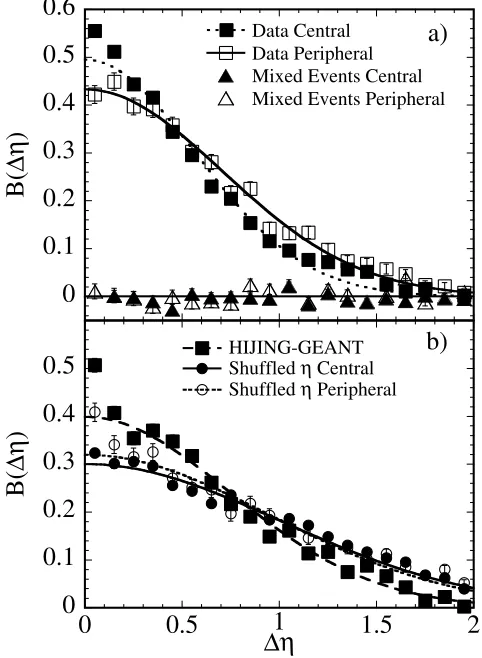
GEANT [16] and the TPC track reconstruction software. The same cuts were applied to theHIJINGevents that were applied to the data. None of the features of the balance functions computed from the filtered simulations show any dependence on centrality [17]. Thus, the STAR results are compared to HIJING integrated over centrality. Figure 1(a) shows the balance function [Eq. (1)] measured for charged particles for the central and peripheralAu
Aucollision samples. The errors shown are statistical. The systematic error in the balance function is estimated to be
5%due to systematic variations in tracking efficiency, the measurement of pseudorapidity, and contamination of electrons. The comparable balance function derived for
HIJING events simulated in the STAR detector using
GEANTis shown in Fig. 1(b).
acceptance in is smooth. For both the mixed events and shuffled pseudorapidity samples, the inclusive mea-sured pseudorapidity distributions are preserved.
Within this area constraint, the variation of the balance function with centrality can be effectively characterized by the single parameter h i, the mean pseudorapidity difference weighted by the balance function (excluding the lowest bin in to reduce the background correlation from electron contamination). We refer toh ibelow as the ‘‘width’’ of the balance function. The measured widths for four centrality classes are shown in Fig. 2 as a function of the impact parameter fraction b=bmax,
which is determined using a simple geometrical picture [19] to relate impact parameter to fractions of the total cross section. In Fig. 2, the width of the balance function measured for central collisions is significantly smaller than that for peripheral collisions. The results for the midperipheral and midcentral centrality classes decrease
smoothly and monotonically from the peripheral colli-sion value. Figure 2 indicates that, while the width ob-served in peripheral collisions is consistent with the
HIJING prediction, the balance function for central colli-sions is significantly narrower, suggesting a variation in the underlying particle production dynamics between these two classes of events. In Fig. 2, the widths from the shuffled pseudorapidity events are also shown. These widths show little centrality dependence and are wider than those of the data orHIJING. The widths from shuffled pseudorapidity events represent the maximum possible width of a balance function measured with the STAR detector consistent with no correlations in momentum.
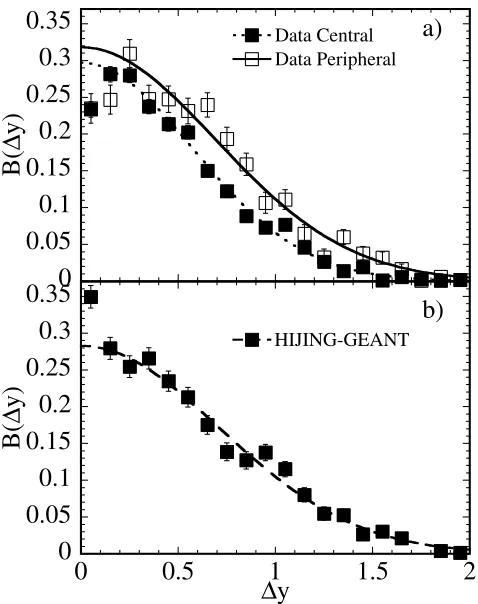
The results for identified charged pion pairs are similar to those for nonidentified charged particles as indicated in Fig. 3. The overall shape of the balance function is similar to that in Fig. 1. However, the data for pions have a dip near y0[Fig. 3(a)]. As shown in Ref. [18], this dip can be understood as the combined effect of Bose-Einstein correlations and Coulomb interactions between charged pions. HIJINGdoes not account for these effects, and the balance function predicted in Fig. 3(b) therefore does not show a dip, although the enhancement of the lowest bin due to electron contamination is still apparent. The width of the balance functions for the four central-ity classes is shown in Fig. 4, where the lowest two bins in
y have been excluded to avoid the effects of Bose-Einstein correlations and Coulomb interactions and en-able a valid comparison withHIJING. The results indicate that the width of the balance function for peripheral events is consistent with that expected fromHIJING, while the width for central events is significantly smaller as was observed with charged particle pairs.
FIG. 2. The width of the balance function for charged
par-ticles, h i, as a function of normalized impact parameter
(b=bmax). Error bars shown are statistical. The width of the
balance function fromHIJINGevents is shown as a band whose
height reflects the statistical uncertainty. Also shown are the widths from the shuffled pseudorapidity events.
0
0.1
0.2
0.3
0.4
0.5
0.6
Data Central Data Peripheral Mixed Events Central Mixed Events Peripheral
B(
∆η
)
a)
0
0.1
0.2
0.3
0.4
0.5
0
0.5
1
1.5
2
HIJING-GEANTShuffled η Central
Shuffled η Peripheral
B(
∆η
)
∆η
b)
FIG. 1. The balance function versus for charged particle
pairs from (a) central and peripheral AuAu collisions at
sNN p
130 GeVand mixed events from central and
periph-eral AuAu collisions, and (b) HIJING events filtered with
GEANT[16] and shuffled pseudorapidity events from measured
central and peripheral AuAu collisions. To guide the eye,
Gaussian fits excluding the lowest bin in are shown. The
error bars shown are statistical. The balance function forHIJING
To gain some insight into the observed widths in cen-tral collisions, we compared with the thermal model (final temperature of 165 MeV) presented in [8] filtered through the acceptance of STAR. We find that the pre-dicted widths are larger than those we observe in central collisions. Thermal model calculations have also been done at low final temperature (105 MeV) and high trans-verse velocity (0:77c), while maintaining the same aver-age transverse momentum. These calculations predict a balance function width consistent with our observations in central collisions. Thus, the observed narrowing of the balance function in central collisions can be parame-trized in a thermal model that incorporates strong trans-verse flow and is constrained to emit the balancing particles close together in space-time [20]. This con-straint could arise from delayed hadronization compared with the characteristic1 fm=chadronization time or from some other phenomena such as anomalously short diffu-sion of particle pairs [20]. Other phenomena besides flow may also affect the width of the balance function as a function of centrality such as resonance decay or the effects of the nuclear medium on jetlike correlations.
In summary, measurement of the balance function for
AuAucollisions atpsNN 130 GeVhas been stimu-lated by the prediction [8] that the width of the balance function should be significantly reduced by late hadroni-zation. We indeed observe a narrowing of the balance function for more central collisions for all charged par-ticle pairs and for charged pion pairs. Only for peripheral collisions is the width consistent with HIJING predic-tions treating the AuAu collision as a superposition of independent nucleon-nucleon scatterings. Inter-pretation of the observed narrowing requires more de-tailed study of its sensitivity to such other effects as flow, resonance production, and diffusion, in addition to late hadronization.
We wish to thank the RHIC Operations Group and the RHIC Computing Facility at Brookhaven National Laboratory, and the National Energy Research Scientific Computing Center at Lawrence Berkeley National Laboratory for their support. This work was supported by the Division of Nuclear Physics and the Division of High Energy Physics of the Office of Science of the U.S. Department of Energy, the U.S. National Science Foundation, the Bundesministerium fuer Bildung und Forschung of Germany, the Institut National de la Physique Nucleaire et de la Physique des Particules of France, the United Kingdom Engineering and Physical Sciences Research Council, Fundacao de Amparo a Pesquisa do Estado de Sao Paulo, Brazil, the Russian Ministry of Science and Technology, the Ministry of Education of China, the National Natural Science Foundation of China, and the Swiss National Science Foundation.
FIG. 4. The width of the balance function for identified
charged pions, h yi, as a function of normalized impact
parameter (b=bmax). Error bars shown are statistical. The width
of the balance function from HIJINGevents is shown as a band
whose height reflects the statistical uncertainty.
0
0.05
0.1
0.15
0.2
0.25
0.3
0.35
Data Central Data Peripheral
B(
∆
y)
a)
0
0.05
0.1
0.15
0.2
0.25
0.3
0.35
0
0.5
1
1.5
2
HIJING-GEANTB(
∆
y)
∆
y
b)
FIG. 3. The balance function versus y for identified pion
pairs from (a) central and peripheral AuAu collisions at
sNN p
130 GeV, and (b) HIJING events simulated inGEANT
[16]. To guide the eye, Gaussian fits excluding the lowest two
bins in yare shown. The error bars shown are statistical. The
[1] J.W. Harris and B. Mu¨ller, Annu. Rev. Nucl. Part. Sci.46, 71 (1996).
[2] S. A. Bass, M. Gyulassy, H. Sto¨cker, and W. Greiner,
J. Phys. G25, R1 (1999).
[3] S. Jeon and V. Koch, Phys. Rev. Lett.85, 2076 (2000).
[4] M. Asakawa, U. Heinz, and B. Mu¨ller, Phys. Rev. Lett.
85, 2072 (2000).
[5] Zi-wei Lin and C. M. Ko, Phys. Rev. C64, 041901 (2001).
[6] H. Heiselberg and A. D. Jackson, Phys. Rev. C63, 064904
(2001).
[7] E.V. Shuryak and M. A. Stephanov, Phys. Rev. C 63,
064903 (2001).
[8] S. A. Bass, P. Danielewicz, and S. Pratt, Phys. Rev. Lett.
85, 2689 (2000).
[9] ACCDHW Collaboration, D. Drijard et al., Nucl. Phys.
B166, 233 (1980).
[10] TPC/Two Gamma Collaboration, H. Aiharaet al., Phys.
Rev. Lett.53, 2199 (1984).
[11] STAR Collaboration, M. E. Beddoet al., LBL PUB-5347
(1992).
[12] W. Bettset al., IEEE Trans. Nucl. Sci.44, 592 (1997);
H. Weiman et al., IEEE Trans. Nucl. Sci. 44, 671
(1997).
[13] C. Adler, A. Denisov, E. Garcia, M. Murray, H. Stro¨bele, and S. White, Nucl. Instrum. Methods Phys. Res., Sect. A
461, 337 (2001).
[14] M. Calderon, Ph.D. dissertation, Yale University, 2001.
[15] X. N. Wang and M. Gyulassy, Phys. Rev. D 44, 3501
(1991).
[16] CERN Program Library, Long Writeups Q123,
Application Software Group, 1993.
[17] M. B. Tonjes, Ph.D. dissertation, Michigan State
University, 2002.
[18] S. Jeon and S. Pratt, Phys. Rev. C65, 044902 (2002).
[19] J. Gossetet al., Phys. Rev. C16, 629 (1977).
[20] S. Pratt and S. Jeon, Proceedings of the 18th Winter
Workshop on Nuclear Dynamics, edited by