Efficient Differential Fault Analysis for AES
Shigeto Gomisawa1, Yang Li1, Junko Takahashi1,2, Toshinori Fukunaga2,
Yu Sasaki2, Kazuo Sakiyama1, Kazuo Ohta1
1 Department of Informatics, The University of Electro-Communications 1-5-1 Chofugaoka, Chofu, Tokyo 182-8585, Japan
2
NTT Information Sharing Platform Laboratories, NTT Corporation 3-9-1 Midori-cho, Musashino-shi, Tokyo 180-8585, Japan
Abstract. This paper proposes improved post analysis methods for Dif-ferential Fault Analysis (DFA) against AES. In detail, we propose three techniques to improve the attack efficiency as 1) combining previous DFA methods, 2) performing a divide-and-conquer attack by consider-ing the AES key-schedule structure, and 3) takconsider-ing the linearity of the MixColumns operation into account. As a result, the expectation of the analysis time in the previous work can be reduced to about one sixteenth. Notice that these improvements are based on the detailed analysis of the previous DFA methods and the calculation time and memory cost in practical implementations. Moreover, the proposed techniques can be widely applied to DFA attacks under different assumptions.
Keywords:Fault Analysis Attack, DFA, AES, Divide-and-Conquer
1
Introduction
Fault Analysis (FA) attacks retrieve secret information by analyzing a faulty ciphertext that is obtained by inducing errors into a cryptographic device while it is working. In 1997, Biham and Shamir applied FA to Data Encryption Standard (DES) [1]. The method is called Differential Fault Analysis (DFA). Since then, several DFA methods for AES have been proposed in [2–8].
Many of previous methods are based on [5] which uses a 1-byte fault at the random fault model, where an attacker does not know the position and value of the fault. The attack procedure of [5] and [7] is summarized in Alg.1.
Algorithm 1.Attack algorithm by [5] and [7] Step 0. Guess the position of the fault injected byte.
Step 1. Reduce the key-candidate space of the last round keyK10 into (28)4= 232 by using a pair of the correct and faulty ciphertexts.
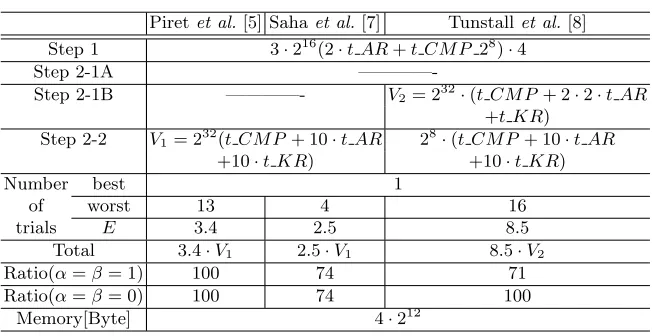
If the correct key is not found, the attack is repeated with changing the guess at Step 0. We see that the number of repetitions of Step 0 in [5] is 13 at the worst case. In 2009, Saha, Mukhopadhyay and RoyChowdhury [7] showed an improvement of [5] so that the number of repetitions could be at most 4 instead of 13. Tunstall and Mukhopadhyay [8] showed another improvement of [5] so that the Step 2 can be divided into 232 times with a 2-round AES decryption
and 28times with a 10-round AES decryption.
In AES, due to the mixture of ShiftRows and MixColumns, the full diffusion reaches after a 2-round operation. Therefore, Step 2 of [5] and [7], which com-putes a 10-round decryption, and Step 2 of [8], which first comcom-putes a 2-round decryption, require the knowledge of all bytes ofK10. This fact reveals that all previous DFA methods need a 232brute force attack which costs the most time. In this research, we propose several improved DFA methods based on [5]. First, we point out that the techniques of [7] and [8] can be combined in order to reduce the analysis time. Second, we present a divide-and-conquer attack at Step 2 with considering the AES key-schedule structure, which significantly reduce the space of the key candidates. Previous methods retrieve the correct key by computing the input difference of the 8th-round MixColumns from a pair of a correct and a faulty ciphertext, which requires the inverse operations of ShiftRows and MixColumns twice for each. In this case, the diffusion reaches the full diffusion.
Meanwhile, we retrieve the correct key by pre-computing the possible output differences (4-byte) of MixColumns in the 8th round and using only 2 bytes of them in Step 2. Hence, Step 2 can compute the inverse of ShiftRows and MixColumns twice and once, respectively, and thus the diffusion does not reach the full diffusion. By taking advantage of this, we could perform Step 2 with the partial knowledge ofK10, and thus a divide-and-conquer attack can be applied
potentially. As a result, the complexity of Step 2 is reduced to 230 1-round decryptions.
Lastly, we further improve this result by considering the linearity of Mix-Columns in the 9th round and apply a divide-and-conquer attack. As a result, the complexity of Step 2 is reduced to 228 1-round decryption, and the number of repetitions at Step 0 is at most 4.
1.1 Notations
The following notations are used in this paper. Notations of the intermediate states of AES are following [9].
2
Previous DFA methods for AES
2.1 Overview
C,C: correct and faulty ciphertexts, respectively Kn :nthround key
i, j: row and column positions of the state
SB,SR,MC:SubBytes,ShiftRows, andMixColumnsfunctions In : input of thenth round
SBOn,MCIn : output ofSBand input ofMCin thenth round
M COn : output ofMCin thenthroundX
Ci,j,Ci,j,Kin,j,Iin,j : (i, j) byte ofC,C,Kn, andIn
tX : computational time for an operationX
into I8. Because an attacker does not know the error byte position, the attack
needs to be repeated for 13 times at the worst case.
Saha, Mukhopadhyay and RoyChowdhury improved this method by utilizing the nature of the AES structure that a 1-byte error injected atI8is diffused to 4
bytes byM Cin the 8thround, and to 16 bytes byM Cin the 9thround. The error path varies by positions where the 1-byte error is injected. Figure 1 describes all of the error paths when a 1-byte error is injected into I8. The numbers “1” to “4” in Fig. 1 represent the propagation paths of the error. As shown in the figure, we see that the number of the paths is only 4. Consequently, Saha et al.’s method indicates that an attacker can recover a secret key by repeating the attack at most 4 times.
1 4 3 2 4 1 2 3 1 2 3 4 2 3 4 1 3 2 1 4 4 1 2 3 3 4 1 2 2 3 4 1
4 3 2 1 2 3 4 1 2 3 4 1 2 3 4 1 1 byte error
injection
1 2 3 4
1 2 3 4 1 2 3 4
Fig. 1.Error propagating paths when 1 byte error is injected atI8
Tunstall and Mukhopadhyay also proposed an efficient DFA method based on the one proposed by Piret and Quisquater. It assumes that an attacker knows in which byte an error is injected atI8. Using the inverse key expansion routine,
Algorithm 2.Improved procedure for Step 2 in [8]
Step 2-1. For 232 candidates ofK10, compute the 2-round decryption forCandC. The correct key has a non-zero difference in the guessed byte position at Step 0 and zero difference for other 3 bytes. This occurs with a probability of 2−24. Hence only 28 candidates remain after this step. Step 2-2. Recover a secret key by the brute force attack for remaining 28candidates,
which are reduced at Step 2-1.
Table 1.Comparison of the analysis time of previous DFA methods
Piretet al.[5] Sahaet al.[7] Tunstallet al.[8] Step 1 3·216(2·t AR+t CM P 28)·4
Step 2-1A
————-Step 2-1B ————- V2= 232·(t CM P+ 2·2·t AR +t KR)
Step 2-2 V1= 232(t CM P + 10·t AR 28·(t CM P+ 10·t AR +10·t KR) +10·t KR)
Number best 1
of worst 13 4 16
trials E 3.4 2.5 8.5
Total 3.4·V1 2.5·V1 8.5·V2
Ratio(α=β= 1) 100 74 71
Ratio(α=β= 0) 100 74 100
Memory[Byte] 4·212
t ARrepresents the processing time of computing one round of AES.t KR
represents the processing time of computing one round of key-schedule.
t KR=β·t AR(0≤β≤1),t CM P represents the processing time of comparing two data.t CM P 2x=x·t CM P,t CM P =α·t AR(0≤α≤1) We measure the
attack efficiency ratio by setting the method by Piret and Quisquater “100”.
Both methods [5, 7] do not have Step 2-1, while the method in [8] does. Because Step 2-1 performs only a 2-round decryption, it is more efficient than the original Step 2 which performs a full-round (10-round) AES decryption. Also since the key space is largely reduced at Step 2-1 before the full-round decryption, the method by Tunstall and Mukhopadhyay can be more efficient. However their attack needs to be repeated 16 times at the worst case.
2.2 The number of trails in previous DFA methods
is 3.4. Note thatpn is the probability that the first success of the attack occurs at thenthtrial.
pn=
{
1
4 (n= 1)
4 16−(n−1)×
∏n−1
k=1(1−pk) (n >1),
(1)
E=
13 ∑
n=1
(n·pn). (2)
For the case of Saha et al.’s method, the number of trials is 1 at the best case, and 4 at the worst case. Consequently, the expectationE is (1+4)2 or 2.5. Finally, we consider the case of Tunstall et al.’s method. The number of trials is 1 at the best case, but 16 at the worst case. Therefore, the expectation is
(1+16)
2 or 8.5. Table 1 compares the computational complexity of previous DFA
methods. The expectation of the number of trials is also compared.
Evaluate the analysis time We evaluate the method by Piret and Quisquater.
Before performing Alg. 1, they pre-compute the difference table ofM CO9. The difference table of M CO9 has 28 entries. Step 1 reduces the space of the key candidates of the last round key K10 per column of the AES state. Instead of
checking 4 bytes in a column at once, we can perform 2-byte checking for 3 times for a efficient computation. The details were explained in [5]. Consequently, the analysis time of Step 1 is considered as 3·216(2·t AR+t CM P 28)·4. Hereafter,
we denote the comparison with a table of 2x entries asCM P 2x.
Step 2 is a step where an attacker performs 232 brute force attack. Hence, the analysis time of Step 2 is V1 = (t CM P + 10·t AR + 10·t KR)·232.
Consequently, the analysis time of Step 1 is negligibly small compared with Step 2. By considering the expectation of the number of trials, the analysis time is 3.4·V1.
Next, we consider the analysis time of the method by Saha, Mukhopadhyay and RoyChowdhury. Their method is almost the same as the method by Piret and Quisquater, while the expectation of the number of trials E is only 2.5. Consequently, the analysis time of their method is derived as 2.5·V1.
We consider the analysis time of the method by Tunstall and Mukhopadhyay. The complexity of Step 1 is calculated based on the attack procedure of [5]. Be-cause Step 1 is not related to our improvement and its computational complexity is small enough, we will omit the detailed explanation. For Step 2-1, an attacker performs a 2-round decryption for 232candidates ofK10. SinceK9needs to be
calculated fromK10in a 2-round decryption, we perform one AES key-schedule operation denoted asKR. Next, we check whether the derived differential values by the 2-round decryption contains only a 1-byte error. We call this operation CM P.
Hence, the analysis time of Step 2-1 isV2= (t CM P+2·2· AR+t KR)·232.
Step 2-2, an attacker performs a 10-round decryption for 28 candidates, and
thus the complexity becomes (t CM P+ 10·t AR+ 10·t KR))·28. Because the
analysis times of Steps 1 and 2-2 are negligibly-small compared with Step 2-1, and as a result, the analysis time of their method is 8.5·V2.
In order to compare the analysis time of previous methods, we measure the ratio by setting that the computational complexity of the method by Piret and Quisquater is 100. We assume that the processing times of CM P andKR are represented witht ARas follow.
1. An attacker sorts 28 difference table while preparing the table and uses a binary search when performingCM P, and hence we can assume thatt CM P 2x=
x·t CM P
2. We assumet CM P =α·t AR, where 0≤α≤1. 3. We assumet KR=β·t AR, where 0≤β≤1.
In a practical implementation of the DFA method, the above assumptions are dependent on computing systems. However, we believe thatARis the most time consuming operation, so we set 0≤α, β≤1.
For the purpose of evaluating the impact of the computational complexity on different platforms (e.g. PC with AES-NI and dedicated hardware implemen-tations)
Whenα=β = 1, we obtainV1= (10 + 10 + 1)·t AR·232= 20·232·t AR
andV2= (1 + 4 + 1)·232= 6·232·t AR. In this condition, the methods of [7] and
[8] achieve 74 and 71, respectively in terms ofRatioin Table 1. On the contrary, for the case ofα=β = 0, we obtainV1= 10·t AR·232= 10·232·t AR and
V2= (0 + 4 + 0)·232= 4·232·t AR. In this condition, the methods of [7] and
[8] achieve 74 and 100, respectively in terms ofRatio.
Note that all of the three methods use at most 4·212-byte memory during
performing the DFA attacks.
3
Our proposed DFA methods
3.1 Combining previous DFA methods
Basic idea for the combined method Sahaet al.reduce the expectation of
the number of trials, while Tunstall et al. reduce the analysis time of Step 2. These two improvements use different properties of the attack, and therefore it is natural to combine them for achieving an efficient DFA.
In the combined method, an attacker guesses the error-propagation path. Therefore, when Step 2-1 is computed, an attacker checks whether the difference of M CI8 contains non-zero in any 1 byte and zeros for other 15 bytes. This
occurs with a probability of 4×2−24 = 2−22, and hence 232×2−22 = 210 key
candidates remain. Finally, we perform a brute force attack with 210candidates
whereV2will be explained in Sect. 3.1.2. The details of the DFA efficiency will be
discussed in the next sub-section. Note that this combining idea is also applicable for the attacks in the following sections.
Computational complexity of the combined method Step 1 of this method
is the same as one in the methods by [7], [8], which cannot be a critical operation since its computational complexity is at most 120·216 or about 223 considering
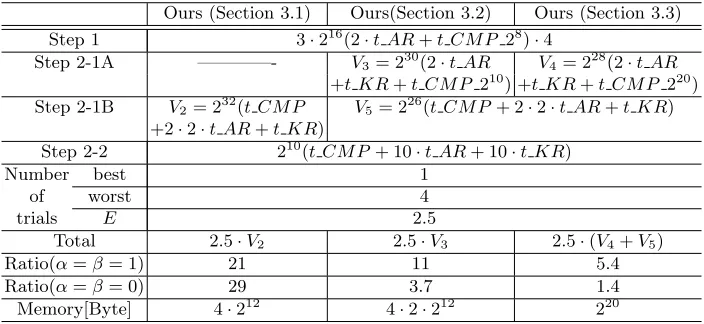
the case ofα= 1. Instead, Step 2-1B is the most time-consuming operation as is the case for the method in [8]. As the number of trials is the same as that of the method in [7], the expectation of the total computational complexity is 2.5·V2
whereV2is the computational complexity in Step 2-1B. As a result, we see that
the reduction of 28..55 or 29% is possible compared to the method in [8] as shown in Tables 1 and 2.
3.2 Divide-and-Conquer by considering the key schedule
In this section, we apply two kinds of DFA improvements. First, we reduce the computation in Step 2-1 of Alg. 1 by introducing a look-up table that keeps the values forI10when performing Step 1. Then, we show a divide-and-conquer
attack by considering the structure of the AES key schedule.
Improving Step 2-1 of Alg. 2 Before introducing how to reduce a half of
the calculation time for the Step 2-1 of Alg. 2, we review some details of Step 1. Note that the position of the fault-injected byte is fixed in Step 1. The attacker first computes the output difference ofSBin the 10th round (∆SBO10) fromC
andC. Then, based on the guesses of the differential value for fault-injected byte
Table 2.Comparison of the analysis time of our improved DFA methods
Ours (Section 3.1) Ours(Section 3.2) Ours (Section 3.3) Step 1 3·216(2·t AR+t CM P 28)·4
Step 2-1A ————- V3 = 230(2·t AR V4= 228(2·t AR +t KR+t CM P 210) +t KR+t CM P 220) Step 2-1B V2 = 232(t CM P V5= 226(t CM P+ 2·2·t AR+t KR)
+2·2·t AR+t KR)
Step 2-2 210(t CM P+ 10·t AR+ 10·t KR)
Number best 1
of worst 4
trials E 2.5
Total 2.5·V2 2.5·V3 2.5·(V4+V5)
Ratio(α=β= 1) 21 11 5.4
Ratio(α=β= 0) 29 3.7 1.4
RotWord
SubWord
Rcon
,
, ,
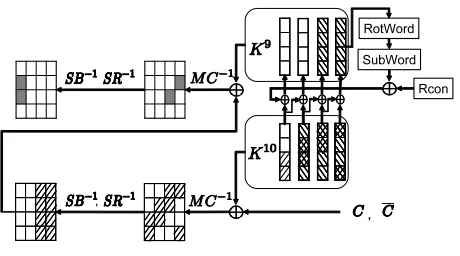
Fig. 2.The last two rounds of the key schedule and the last round of the encryption in AES-128
in M CI9, the corresponding 4-byte difference of I10 can be computed. Based
on the value of ∆SBO10,I10 and the differential table of AES S-box, 28 key
candidates for each column are left after Step 1.
By considering these details, the 2-round decryption in Step 2-1 of Alg. 2 can be reduced to a 1-round decryption. We notice that both the candidates of K10and correspondingI10can be stored in Step 1, while previous methods only
store the candidates of K10. With the stored I10, we do not need to perform
the 10th round decryption again in Step 2-1, so that we can reduce a half of calculation time. However, as a penalty, a double size of memory are required to store the results of Step 1.
Divide-and-Conquer attack for Step 2-1 In this attack, we first pre-compute
all possible differences of I9. Then, Step 2-1 of Alg. 2 can be divided into two phases, 230 1-round decryptions (Step 2-1A) and 2261-round decryptions (Step 2-1B).
In Step 0 of Alg. 1, we guess the error propagation path. In the pre-computation phase, for each byte-position which results in the guessed error propagation path, we consider all 28differences and compute corresponding differences ofI9. Store
the resultant 28·4 or 210 differences in the listGcalled valid list.
In Step 2-1A, we compute a 1-round decryption forI10 and I10 (=SB−1◦
SR−1(K10⊕C)) to obtain the differences of 2 bytes inI9. Without losing the
generality, we discuss the case where guessed error propagation path is “1” in Fig. 1 and thus 210 (∆I9
0,0, ∆I09,1, ∆I09,2, ∆I09,3) are stored in G. Moreover, we
focus on∆I9
0,1and∆I09,2 in Step 2-1A. In general,∆I9 is calculated as
∆I9=SB−1◦SR−1◦M C−1(K9⊕I10)
In order to calculate∆I9
1,0and∆I29,0, we needK29,j,K39,j,I210,j,I310,j,I210,j and I10
3,j forj = 0,1,2,3. From Fig. 2, an attacker can calculate K29,j and K39,j by Eq. (4).
K29,j =K210,j⊕K110.j, K39,j =K310,j⊕K210.j. (4)
Moreover,I10
2,j,I310,j can be calculated by Eq. (5).
I210,j =SB−1◦SR−1(K(310·j+2)mod4,j⊕C(3·j+2)mod4,j), I310,j =SB−1◦SR−1(K310−j,j⊕C3−j,j).
(5)
Similarly, I10
2,j and I310,j can be calculated with C. According to Eqs. (4) and (5), 14 bytes of K10 exceptK010,0 andK010,1 are necessary to calculate ∆I19,0 and∆I29,0at Step 2-1A.
For each valid∆SBO10, two candidates for each byte are considered.
How-ever, in this attack, we do not have to consider K10
0,1 and K010,2 of the key
can-didates. Hence, the number of candidates of 14 bytes of K10 is 230 at Step 1.
Consequently, the analysis time of calculating∆I9
1,0and ∆I29,0 is 230.
We explain the number ofK10candidates after Step 2-1A. When we perform
a 1-round decryption with wrong keys,∆I9
0,1and∆I09,2 can have all 216values.
Hence, the probability that these match one of the 210entries inGis 210·2−16=
2−6. Finally, 230·2−6= 224candidates of 14 bytes ofK10will remain. As a result,
we have 224·22 = 226 candidates of 16-bytes ofK10 after Step 2-1A. Next, we
perform Step 2-1B. In this step, an attacker performs Step 2-1 of Alg. 2 for 226 candidates ofK10 with an improvement shown in Sect. 3.2.
Computational complexity of the method in Sect. 3.2 As can be seen
from Table 2, Steps 1, 2-1B and 2-2B of the method proposed in Sect 3.2 cannot be critical operations since all of them are at least two orders of magnitude less than Step 2-1A in computational complexity. Therefore, we focus on Step 2-1A that consists of the following computations. First, we need to pre-compute the differential values forM CO8, which takes 210·t M Cwheret M Cstands for the operation time of MixColumns. Second, we perform a 1-round decryption with bothCandCall of the 230key candidates and check whether the differential is in the pre-computedM CO8table, which costs (2·t AR+t KR+t CM P 210)·230.
Here, we performKRonce for a 1-round decryption (AR) ofC andC.
From this observation, we find that the pre-computation time can be ignored and V3 in Table 2 decides the total operation time in Step 2-1A. As a result,
the total time necessary for this method is found to be 2.5·V3 and significant
3.3 Further improvement of the method in Sect. 3.2 using the
linearity of M C
This section improves the attack method in Sect. 3.2. We focus on the property thatK10
0,2andK010,3are not related to the last two columns ofK9. Hence, we can
independently simulate the impact of these two bytes and update them to the valid listG. This enables us to divide Step 2-1A into two phases as described in Alg. 3.
Algorithm 3.Our improved procedure for Step 2
Step 2-1Aa. For 22 candidates ofK010,2 andK010,3, update the valid listG. Step 2-1Ab. For 228 candidates of 12-bytes ofK10(K110,j, K
10 2,j, K
10
3,j,forj=0 to 3)
apply the divide-and-conquer attack explained in Sect. 3.2. 226 candidates ofK10 will remain after this step.
Step 2-1B. For 226 candidates, apply the improved procedure of Step 2-1 explained in Sect. 3.2. 210candidates will remain after this step.
Step 2-2. Recover a secret key by the brute force attack for 210candidates.
In Sect. 3.2, we pre-computed G containing 210 entries of (∆I09,1, ∆I09,2). In this attack, we further perform the pre-computation by considering all 216 values of (I09,1, I09,2) for each stored (∆I09,1, ∆I09,2). We then obtain 226 items of
(∆M CI29,2, ∆M CI39,1, M CI29,2, M CI39,1) and store them inG. Notice that for all
216 (∆M CI29,2, ∆M CI39,1), we will obtain 210 items of (M CI29,2, M CI39,1). Also
note that we need a memory with 226 entries in the pre-computation phase.
However, candidates of (∆M CI9
2,2, ∆M CI39,1) are reduced to 28 in Step 1 of
Alg. 1. Hence, in on-line, only 218 entries inGare needed.
In this attack, the validity of the candidates ofK10 is checked by computing
(∆M CI9
2,2, ∆M CI39,1, M CI29,2, M CI39,1) using Eq. (6) for i= 2,3 and matching
them with entries inG.
M C−1(Ki,90⊕Ii,100, Ki,91⊕Ii,101, Ki,92⊕Ii,102, Ki,93⊕Ii,103)T. (6)
By considering the details and linearity ofM C, the match ofM CI9 2,2 using
Eq. (6) can be written as follows (We denote the N-th byte of a columnA by A[N]).
M CI29,2 ?
=M C−1(K29,0, K29,1, K29,2, K29,3)T[2]
BecauseI10
2,2 is not related to the value ofK29,0, K29,1, K29,2, K29,3, we consider the
following form (do the same forM CI9 3,1).
M CI29,2⊕14·I210,2=?M C−1(K29,0, K29,1, K29,2, K29,3)T[2] ⊕13·I210,0⊕9·I210,1⊕11·I210,3, M CI310,1⊕14·I310,3=?M C−1(K39,0, K39,1, K39,2, K39,3)T[3]
⊕11·I310,0⊕13·I310,1⊕9·I310,2.
(7)
With Eq. (7), we can compute the impact ofI10
2,2andI310,3independently of other
12-byte values. The attack procedure is as follows.
For all 28candidates of (∆M CI9
2,2, ∆M CI39,1), do as follows:
- For 2 candidates ofI10
2,2, compute 14·I210,2. Denote these values byu0 and
u1.
- For 2 candidates ofI10
3,3, compute 14·I310,3. Denote these values by v0 and
v1.
- For all 210entries in the listGfor the same (∆M CI9
2,2, ∆M CI39,1), compute
(M CI9
2,2⊕ui, M CI39,1⊕vj) for 0≤i, j≤1. UpdateGwith these 212entries. Finally, we can compute the right side of Eq. (7) with only considering 12 bytes ofK10. The attack complexity is 220 for updatingGand 228 for checking
the match for all 12-byte candidates of K10. Hence, the total complexity is
220+228≈228. After the match, 226key candidates will be left and the remaining
attack procedure is the same as Section 3.2. Note that a memory with 220entries
is used at on-line phase.
Computational complexity of the method in Sect. 3.3 Only the difference
between the methods in Sects. 3.2 and 3.3 is in Step 2-1A. As can be seen from Table 2, the computational complexities of Steps 2-1A and 2-1B in this method are getting close. Therefore, we need to consider both Steps 2-1A and Steps 2-1B. As for Step 2-1A, we pre-compute the listGcontaining 220entries. The
pre-computed table is calculated based on 216 values of (I09,1, I09,2), which results in the computational complexity of much less than the complexity of the main calculation of Step 2-1A. The main calculation performs twoAR and one KR to derive the corresponding value to be checked with ones in list Gfor all 228 candidates. Consequently, the computational step in Step 2-1A becomesV4= (2·
t AR+t KR+t CM P 220)·228. Step 2-1B is the same as the method in Sect. 3.2,
where we perform further reduction of the remaining 226 key candidates by
utilizing the AES key schedule. More precisely, this step computes the differential ofM CI8forCandCand checks whether if the differential has only 1-byte error,
which results in the computational cost of V5 = (t CM P + 2·t AR+t KR)·
226. As a result, the total time of this method is 2.5·(V
4 +V5) and further
4
Conclusion and Future Work
Based on the detailed analyses of the previous DFA methods and the considera-tion of practical implementaconsidera-tions, this paper proposed improved analysis meth-ods for Differential Fault Analysis (DFA) against AES. The expectation of our fastest algorithm only costs about one sixteenth of that of the fastest previous analysis methods. The improvements come from three new techniques as the combination of previous DFA methods, the divide-and-conquer attack by con-sidering the AES key-schedule, and taking the linearity of MixColumns operation into consideration. This paper applied our proposed techniques to the case where 1-byte error is injected at the beginning of 8thround. In the future, we will apply these techniques to the cases where multiple-byte errors are injected into AES.
References
1. E. Biham and A. Shamir, “Differential Fault Analysis of Secret Key Cryptosystems,” inAdvances in Cryptology – CRYPTO ’97, vol. 1294 ofLNCS, pp. 513–525, Springer, 1997.
2. J. Bl¨omer and J.-P. Seifert, “Fault Based Cryptanalysis of the Advanced Encryption Standard (AES),” inFinancial Cryptography FC 2003, vol. 2742 ofLNCS, pp. 162– 181, Springer Berlin, 2003.
3. P. Dusart, G. Letourneux, and O. Vivolo, “Differential Fault Analysis on A.E.S,” in Applied Cryptography and Network Security, First International Conference, ACNS 2003. Kunming, China, October 16-19, 2003, LNCS, pp. 293–306, Springer, 2003. 4. C. Giraud, “DFA on AES,” inAdvanced Encryption Standard - AES, 4th
Interna-tional Conference, AES 2004, Bonn, Germany, May 10-12, 2004, Revised Selected and Invited Papers, vol. 3373 ofLNCS, pp. 27–41, Springer, 2005.
5. G. Piret and J.-J. Quisquater, “A Differential Fault Attack Technique against SPN Structures, with Application to the AES and Khazad,” inCryptographic Hardware and Embedded Systems – CHES 2003, vol. 2779 ofLNCS, pp. 77–88, Springer, 2003. 6. D. Mukhopadhyay, “An Improved Fault Based Attack of the Advanced Encryption Standard,” in AFRICACRYPT 2009, vol. 5580 of LNCS, pp. 421–434, Springer, 2009.
7. D. Saha, D. Mukhopadhyay, and D. RoyChowdhury, “A Diagonal Fault Attack on the Advanced Encryption Standard,” 2009. Cryptology ePrint Archive, Re-port2009/581.
8. M. Tunstall and D. Mukhopadhyay, “Differential Fault Analysis of the Advanced Encryption Standard using a Single Fault,” 2009. Cryptology ePrint Archive, Re-port2009/575.