Generic Side-Channel Distinguishers:
Improvements and Limitations
Nicolas Veyrat-Charvillon?, Fran¸cois-Xavier Standaert?? UCL Crypto Group, Universit´e catholique de Louvain. Place du Levant 3, B-1348, Louvain-la-Neuve, Belgium.
e-mails:{nicolas.veyrat, fstandae}@uclouvain.be
Abstract. The goal of generic side-channel distinguishers is to allow key recoveries against any type of implementation, under minimum assumptions on the under-lying hardware. Such distinguishers are particularly interesting in view of recent technological advances. Indeed, the traditional leakage models used in side-channel attacks, based on the Hamming weight or distance of the data contained in an im-plementation, are progressively invalidated by the increased variability in nanoscale electronic devices. In this paper, we consequently provide two contributions related to the application of side-channel analysis against emerging cryptographic imple-mentations. First, we describe a new statistical test that is aimed to be generic and efficient when exploiting high-dimensional leakages. The proposed distinguisher is fully non-parametric. It formulates the leakage distributions using a copula and discriminates keys based on the detection of an “outlier behavior”. Next, we pro-vide experiments putting forward the limitations of generic side-channel analysis in advanced scenarios, where leaking devices are protected with countermeasures. Our results exhibit that all non-profiled attacks published so far can sometimes give a false sense of security, due to incorrect leakage models. That is, there exists settings in which an implementation is secure against such non-profiled attacks and can be defeated with profiling. This confirms that the evaluations of cryptographic implementations should always consider profiling, as a worst case scenario.
1
Introduction
Since the introduction of differential power analysis by Kocher, Jaffe and Jun in the late 1990s [13], physical attacks have become an important issue for the security of crypto-graphic devices. On the academic side, it gave rise to many exciting developments of new attacks, countermeasures and models for the evaluation (or, recently, proof) of physical security. On the industrial side, security against such attacks is now required to reach high certification levels for cryptographic products. Roughly speaking, side-channel at-tacks are usually classified as profiled or non-profiled [15]. Profiled atat-tacks are typically useful in an evaluation context, where one can exploit devices with known keys in order to build precise leakage models, e.g. templates [5]. They can then be used in order to estimate evaluation metrics such as the mutual information, in order to capture a worst-case scenario [28]. By contrast, non-profiled attacks, on which we will focus in this paper, rather aim to capture the behavior of actual adversaries, who do not have a precise prior
?Postdoctoral researcher supported by the Walloon region SCEPTIC project. ??
characterization of the devices they target. They are usually suboptimal from a data com-plexity point of view, and exploit the “on-the-fly” estimation of the leakage probability distributions (or their moments) in order to recover secret information. In general, the gap between these two scenarios can be large. Hence, profiled and non-profiled attacks are complementary and shed a different light on the security of embedded devices.
In brief, a non-profiled side-channel attack generally works by comparing key-dependent models of the leakage with actual measurements. If the attack is successful, the key can-didate giving rise to the best comparison is the one manipulated by the target device. As a consequence, evaluating the performances of such a distinguisher can typically be done along two axes. On the one hand, attacks are expected to be efficient, meaning that they allow recovering keys with limited data (i.e. measurements), time and memory. On the other hand, attacks should also be generic, i.e. applicable against any type of device and (if possible) unsensitive to unprecise leakage models. A brief look at the state-of-the-art suggests that most previous works can be viewed as exploring the tradeoff between these two (usually contradictory) goals. For example, in the seminal paper of Crypto 1999, the so-called “single-bit DPA” is performed using a simple difference-of-means test. This approach has limited efficiency, because the single-bit model implies a low signal-to-noise ratio, and it cannot take advantage of any knowledge of the target device that may be available to the adversary. As a consequence, many “multiple bit” extensions have been proposed in the literature. Most prominently, the Correlation Power Analysis (CPA) in-troduced in 2004 works very efficiently in contexts where a device leaks according to a well known and linear (e.g. Hamming weight) model [2]. But it is also quite specific, and can end up to be completely ineffective if an unprecise leakage model is used. In order to avoid this model-dependency, a powerful solution is to build stochastic models “on-the-fly”, as suggested by Schindler, Lemke and Paar in 2005 [26]. A possible drawback of stochastic models is their parametric nature. But as discussed in [6], such a linear regression-based approach gives excellent results in the context of first-order side-channel attacks against unprotected devices. Alternatives to stochastic models include the Mu-tual Information Analysis, introduced in 2008 [8], and tests such as the Cram´er-von-Mises one, discussed in [31]. These last two distinguishers are quite generic, and can capture any type of leakage dependency. They are also non-parametric in the case of MIA (which still implies pdf estimation, e.g. with histograms or Kernels, hence requiring to select number of bins or Kernel bandwidth adequately [19]) and completely free of parameters for the Cram´er-von-Mises test (which only requires to build empirical cumulative functions).
the distinguisher. Similarly, extensions of the stochastic model are direct in the profiled context [14], when masks are available during the profiling, but their application in a non-profiled scenario requires either to estimate pdf mixtures in an unsupervised manner (i.e. a problem for which we do not have systematic and efficient solutions), or to take advan-tage of some heuristic assumptions (e.g. using a combination function). In fact, only MIA directly generalizes to multivariate side-channel attacks, without requiring a combination function [1, 7, 19]. Given this attractive feature, it appears natural to investigate how such distinguishers can deal with advanced scenarios, mixing non-linear leakage functions and countermeasures like masking. This paper presents two contributions in this direction.
First, we propose a new test for side-channel analysis, aimed to be generic and ef-ficient when exploiting high-dimensional leakages. For this purpose, we start from the observation that, in order to be generic, MIA selects the key candidate that maximizes the mutual information between an adversary’s key-dependent leakage models and actual measurements. Our new distinguisher uses the alternative criterion to select the key can-didate for which these leakage models deviate the most from a reference (e.g. uniform) distribution. As discussed in Section 3, there exists contexts in which this new criterion allows discriminating the key, whereas the strict application of MIA does not. Next, it has been observed in experiments on MIA that the generalization to multivariate attacks can be less efficient, because of the difficulty of estimating a multivariate pdf “on-the-fly”, without specific assumptions [29]. Also, previously considered estimation methods such as using histograms, Kernels, or splines [30], generally require to tune a parameter, e.g. the number of bins in histograms, that directly impacts the efficiency of the attack. Hence, although MIA aims at genericity more than efficiency, it would be interesting to avoid such parameters, or to make their tuning as easy as possible. Our new distinguisher takes advantage of advanced statistical tools in order to mitigate these issues. For this purpose, we first apply a leakage transformation, exploiting copulas [18]. It projects the samples into a new space where their distribution (among each dimension) is uniform. Thanks to this transform, we base our distinguisher on the generic criterion of selecting the key candidate for which the model maximizes the deviation from uniform. Afterwards, we exploit distance sampling, i.e. we evaluate the distribution of the distance between two samples (conditioned on a leakage model), rather than the distribution of single samples. Distance sampling has interesting features in a multivariate setting, as it allows to avoid dealing with multivariate distributions directly (we rather evaluate the univariate distri-bution of a distance taken over several dimensions). As a result, our test is completely free of parameters and mainly requires to compute empirical cumulative distributions, for each dimension taken independently. Summarizing, it is pointed out in [33] that the efficiency loss of MIA is due to the problem of estimating the leakage distributions. The present paper complements this view and aims at making this estimation step easier.
be strongly affected by inaccurate leakage models, and that the impact of such impre-cisions is amplified with countermeasures such as masking. In other words, even generic tests can be unsuccessful in certain contexts, unless preliminary assumptions (similar to profiling) are available to the adversary. We note finally that this last observation holds for all non-profiled distinguishers published so far. Hence, it raises the question whether non-profiled attacks could be improved to deal with such critical contexts, or alterna-tively, whether these contexts can be formalized and used as a design criteria for new countermeasures. For now on, these results at least confirm the importance of a profiled information theoretic analysis when evaluating leaking cryptographic devices.
2
Side-channel analysis
In a side-channel attack, an adversary tries to recover secret information from a leaking implementation,e.g. an IC computing a cryptographic algorithm. As most cryptanalytic techniques, side-channel attacks are based on a divide-and-conquer strategy. For example, in the context of a block cipher implementation, one typically targets small pieces of the master key - called subkeys in the following - one by one. The core idea is to compare subkey-dependent models of the leakage with actual measurements. That is, for each sub-key candidate, the adversary builds models that hypothetically correspond to the leakage generated by the encryption of different plaintexts. Then, he evaluates which model (i.e. which subkey) gives rise to the best prediction of the physical leakage, measured for the same set of plaintexts. Hence, assuming that the models can be represented by a random variable X, and the leakages can be represented by a random variable Y, side-channel analysis can be seen as the problem of detecting a dependency between these two vari-ables. In the following, we consider thatX is a discrete random variable and that Y is a continuous one, sampled with a sufficient resolution (e.g. using an oscilloscope).
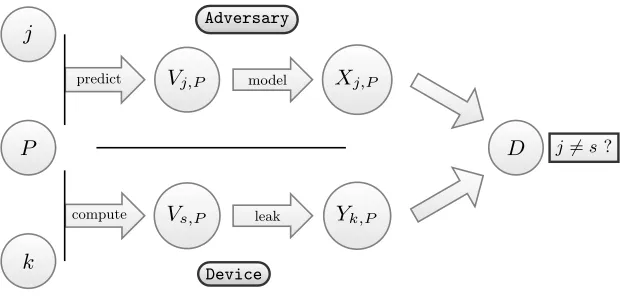
The next sections of the paper analyze the attack depicted in Figure 1, as described in [1]. That is, we consider a device performing several cryptographic computationsEk(p) on different plaintextspdrawn uniformly from the text spaceP, using some fixed key k
drawn uniformly from the key space K. While computing Ek(P) (where P is a random variable over P), the device will handle some intermediate values (defined as sensitive variables in [25]) that depend on the known inputP and the unknown keyk. In practice, the interesting sensitive variables in a DPA attack are the ones that only depend on an enumerable subkey s: we denote them as Vs,P. Anytime such a sensitive intermediate value is computed, the device generates some physical leakage, denoted asYk,P.
P
k
V
s,PY
k,Pj
V
j,PX
j,PD
compute leak
predict model
j6=s?
Device Adversary
Fig. 1.Schematic illustration of a side-channel key recovery attack.
to compare the different models Xj,P with the actual leakages Yk,P. If the attack is successful, the best comparison result (i.e. the highest value of the distinguisher) should be obtained for the correct subkey candidatej=s. This procedure can then be repeated for different subkeys in order to eventually recover the full key.
3
MIA with an identity leakage model
The basic principle of MIA is to use the mutual information between the adversary’s modelsXj,P and the actual leakageYk,P as a distinguisher. That is, to estimate:
ˆI(Xj,P;Yk,P), (1)
and to select the subkeyjthat maximizes this value. Compared to CPA that can only take advantage of linear dependencies betweenXj,P andYk,P, MIA exploits all the information available in a leakage trace, at the cost of a more difficult estimation problem. In other words, it allows successful key recoveries against more devices, but is less efficient than CPA in contexts where the leakage function and adversary’s models are linearly correlated. Following the goal of increasing genericity, the first description of MIA in [8] also came with the proposal of generic leakage models, based on the identity function. That is, one expected advantage of MIA over other non-profiled attacks was that using the target values Vj,P (or some of their bits) directly as leakage model should lead to successful attacks against most devices1. In this section, we consequently motivate the introduction
of a new statistical test and show empirically that maximizing the mutual information betweenXj,P andYk,P may not always be the best solution for this purpose.
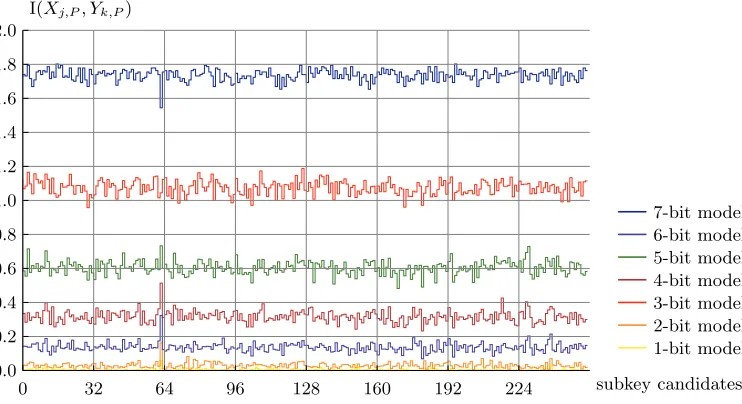
As a simple example, one can mount the following simulated experiment. Take the Hamming weight of the AES S-box as leakage function and launch MIA with an “identity” leakage model, made of 1 to 7 bits of this S-box output. That is, takeYk,p= WH(S(p⊕k))
1
1-bit model 2-bit model 3-bit model 4-bit model 5-bit model 6-bit model 7-bit model
0.0 0.2 0.4 0.6 0.8 1.0 1.2 1.4 1.6 1.8 2.0
0 32 64 96 128 160 192 224 subkey candidates
ˆI(Xj,P, Yk,P)
Fig. 2.Estimated mutual information versus subkey candidate.
and Xj,p = [S(p⊕k)]1:n, with 1 ≤ n ≤ 7. Figure 2 illustrates the mutual information
estimated with histograms, for the different subkey candidates. One can clearly see that the correct subkey candidate (s = 63) maximizes the mutual information when using 1-bit, 2-bit, 3-bit, 4-bit and 5-bit models, but minimizes it for the 7-bit model. We note that this observation is independent of the estimation method and, e.g. is also exhib-ited when using Kernels such as proposed in [19]. This unexpected feature of MIA was observed independently by Whitnall and is given a probabilistic interpretation in [32]. One could naturally try to adapt MIA in order to be successful in this case too. But this experiment suggests that, in order to perform successful key recoveries, adversaries may be more interested in the “outlier” behavior of the correct key model than in its mutual information with the measured leakages. Hence, it gives a motivation for the introduction of an alternative statistical test, as will be detailed in the following section.
4
The new generic test
A central problem in non-profiled side-channel analysis is to properly estimate the leakage distribution “on the fly” during an attack. Previous methods for this purpose typically range in two categories. A first class of distinguishers exploits specific assumptions about the target implementation, resulting in efficient attacks provided that these assumptions are fulfilled. Another class of distinguishers aims to avoid relying on assumptions, at the cost of a (hopefully small) efficiency loss. Quite naturally, the genericity of this second class of distinguishers essentially comes from that they try to completely characterize the leakage distribution (rather than its first- or second-order moments, typically). And its efficiency loss comes from the difficulty of the density estimation problem. For example, tools for estimating pdf usually rely on a good choice of parameters: number of modes in Gaussian mixtures, number of bins in histograms, bandwidth in Kernel estimators, to name a few. Also, these estimators strongly suffer from the curse of dimensionality: a 9-bin univariate histogram will typically require 81 bins in two dimensions. In the remainder of the section, we first describe a distinguisher, illustrated in Figure 3, that aims to limit these drawbacks. Next, we discuss its advantages and limitations in detail.
4.1 Specification
The distinguisher is based on six main steps (one being optional).
Leakage space transform.In order to circumvent the problem of estimating the leakage distribution, our method first transforms the samples by means of copula. A copula simply applies the probability integral transform to every marginal variable, which renders the distribution of samples along each axis uniform. More precisely, forY = (Y1, Y2, . . . , Yd)
a d-dimension random variable, the copula transformation gives a derived variable Z = (Z1, Z2, . . . , Zd) = (F1(Y1), F2(Y2), . . . , Fd(Yd)), where Fi is the cumulative distribution function ofYi, defined by Fi(yi) = Pr[Yi ≤yi]. Interestingly, theZi have a uniform dis-tribution by definition of the probability integral transform, but any dependency among theYi variables implies a corresponding dependency among theZi’s. This is illustrated in Figure 3, where it is clearly seen that the marginal distribution Pr[Z = z] is uni-form after reduction, while the conditional distributions remain easily distinguishable. For illustration, the figure represents the simple case of a single-bit leakage model.
In practice, since the leakage density and its cumulative function are both unknown, we compute an empirical copula, i.e. a copula where the cumulative distributions are approximated by empirical distributions. For an n-sample set y1,· · ·yn drawn from the distribution of a one-dimension random variableY, the empirical cumulative distribution of a valuey is given by ˆF(y) = 1
n P
iI(y ≤yi), where I is the indicator function. That is, it only requires to sort the samples and is equivalent to computing the quantile of y
for that sample set. Thanks to the Glivenko-Cantelli theorem [3, 9], we know that the empirical cumulative distribution function convergesalmost surely towards the common cumulative distribution function, uniformly over ally. That is:
kFˆn−Fk∞≡sup
y∈R
Fˆn(y)−F(y)
a.s.
Marginal distribution
Conditional distributionXj,P = 0 Conditional distributionXj,P = 1
Empirical Cumulant
Copula z= ˆFY(y) y
Pr[Y =y]
y ˆ
FY(y)
0 1z
Pr[Z =z] Leakage transform
correct key Leakage partition wrong key
0 1u
Pr[U =u]
0 1u
Pr[U=u]
Distance sampling
0 1u
Pr[U =u]
Smoothing and evaluation Theoretical distribution
Distance distribution, correct key Distance distribution, wrong key
A significant advantage of the empirical copula is that reduced samples only take quotient values: 0,1n, . . . ,ni, . . .1, built from n real-valued leakages. Hence, from now on, we can deal with probability mass functions instead of densities, which simplifies computations. In the global scope of a side-channel key recovery, this amounts to working on modified valuesZk,P instead of the leakagesYk,P, which have by construction a simple uniform distribution, but still retain the information contained in the original leakages.
Leakage partitioning. This step is common to all side-channel attacks. After trans-formation, the leakage samples are classified, based on predictions Xj,P made up from the plaintexts and key hypotheses. The expectation is that predictions obtained from the correct key candidate will lead to a meaningful leakage partition, i.e. there will be a dependency between the categoriesx and the samples y they contain. By contrast, a wrong key hypothesis should give rise to random predictions, so that the categories only correspond to a random shuffling of leakages from the sample set. Interestingly, thanks to the transformation step, a random sampling should tend towards a uniform distribution, as illustrated in the leakage partition step in Figure 3.
Feature selection and template building.Given the (uniform or not) distributions representing the key candidates, one can select a feature of these distributions, that prop-erly captures possible non-uniformities. In the following, we will consider the distance between couples of samples for this purpose, which corresponds to the notion of spac-ings in statistics [21]. When dealing with multivariate leakages, we define spacspac-ings via theL1 or Manhattan distance (instead of the Euclidean one), which avoids dealing with
irrational values. The Manhattan distance between two samples z and z0 is given by
d1(z, z0) =Pi|zi−z0i|, where the sum is taken over the different dimensions of the sam-ples. Next, since the marginal distribution of the leakages is known to be always uniform, we simply build a template for the distribution of the distance between two uniform samples. This template is precomputed once for all attacks, independently of the target implementation. Its shape is actually a spline, which ensure a degree of smoothness (see appendix A for details). We note that the interest of feature selection is not obvious in the univariate attack context of Figure 3. But it implies a dimensionality reduction that becomes convenient in a multivariate setting, as will be clear later in the section2. Also, it leads to a very efficient solution for the estimation problem, as we now detail.
Estimation.This is the central step of the attack, in which we try to model the distri-butions corresponding to the different key candidates. For this purpose, one limitation of MIA was the need to estimate one conditional distribution per model value, for each key candidate. In other words, each of these distributions has to be estimated from only a part of the available samples3. By contrast, our new test allows to estimate only one
dis-tribution, from all the available samples. This is possible because we know (again thanks to the application of a copula) that the marginal distribution should be uniform for a wrong key candidate. Hence, we can sample the Manhattan distance for all partitions, and combine the results into a single probability mass function, which has to be consistent
2
We also mention that distance sampling is reminiscent of the use of an absolute distance combining function in higher-order side-channel attacks [17]. The prior application of a copula allows us to give it a stronger foundation and to remove its device-dependent flavor.
3 For example, in case of a Hamming weight leakage model, MIA can only exploit one sample
with uniformly drawn samples. Combined with the previous feature selection, it implies that one can estimate the distributions for each key candidate by iterating the next steps:
– Pick a random leakagez from the complete set of samples.
– Pick a different random leakagez0, from the same model category asz.
– Compute their Manhattan distance d1(z, z0).
Finally, we obtain the sampled probability mass function of the distance. This distance can only take n·d distinct values, with n the number of samples available and d the dimensionality of the leakages. This is possible because we use the Manhattan distance (i.e. there are as many possible distances as there are samples). Note that if there arem
leakages corresponding to a model valueX =x, the number of possible couples to sample scales as m2. In our following experiments, it was always possible to test these couples
exhaustively. But in attacks requiring millions of traces, exploiting Monte Carlo sampling would of course be an alternative to reduce the time complexity to more tractable values.
Smoothing. As can be seen from Figure 3, the distance histograms can be used to discriminate the different partitions, but they remain quite noisy. In order to improve the signal-to-noise ratio of the pdf estimations, one straightforward solution is to apply a lowpass filter. Different solutions can be used for this purpose. A very generic one, that we applied in our experiments, is to use Kernel smoothing with an Epanechnikov function [12] (which is both the most efficient Kernel and the least costly to compute). The advantage of Kernel smoothing is to generalize easily to distributions with any number of dimensions. Its drawback is to introduce a parameter (the window size used in the smoothing). However, we note that this parameter is significantly easier to select than, e.g. the number of bins or Kernel bandwidth in the case of MIA, since we know exactly how the distribution of the wrong key candidates should look like. Namely, this distribution should correspond to the previously described uniform distance template. How to select this parameter adequately will be explained in the next subsection.
Evaluation. Finally, we compute the integrated square distance between the sample distributions of all the key candidates and the theoretical distance distribution (i.e. the uniform ditance template construted in step 3 of the attack). The attack is successful if the correct key candidate corresponds to the largest deviation4.
4.2 Pros and cons
Compared to previous distinguishers for side-channel analysis, one first important advan-tage of this new test is that it very nicely extends to multivariate attacks. As illustrated in Figure 4 for a bivariate example (i.e. d = 2) and a Hamming weight leakage model, the leakage transformation is performed independently for each dimension. That is, we just have to compute d univariate empirical cumulative functions (rather than one d -dimensional distribution when applying MIA). The empirical cumulative functions are straightforward to compute and require no parameter at all. By applying the copula, the leakage samples are transformed in such a way that their marginal distribution along each dimension becomes uniform over [0,1]. As a result, we can again discriminate key candi-dates by simply assuming that the leakage model generated with the good key candidate should lead to a partitioning for which the distance to uniform is large.
4 As detailed in [31], different solutions could be considered in this final test. A robust alternative
Leakage transform
ˆ FY1(y)
ˆFY2
(
y
)
Pr[Y =y]
y1
y2
Hamming weight = 1 Hamming weight = 6
correct key Leakage partition wrong key
0 1u
Pr[U=u]
0 1u
Pr[U=u] Distance sampling and smoothing
0 1u
Pr[U =u]
Theoretical distribution Distance distribution, correct key
Distance distribution, wrong key
Next, during the estimation step, the Manhattan distance overddimensions produces an univariate distance distribution, independent of the dimensionality of the attack, hence allowing an easy visualization of the results, which generally helps interpretation. In addition, as the marginal distribution of the wrong key candidates is assumed to be uniform, one can use an ideal template corresponding to the distribution of the distance between uniform samples. This ideal template can be precomputed since it is identical for all attacks of the same dimensionality (i.e. there is one 1D template, one 2D template, one 3D template, . . . to precompute, independent of the implementations).
On the negative side, the estimation of the distance distribution follows a multinomial distribution (a generalization of the binomial distribution to more than two categories), which implies that the sampled distribution tends to be noisy. The smoothing part that aims at reducing this noise requires to set a parameter that can be seen as the counterpart of the number of bins or Kernel bandwidth when directly trying to estimate the leakage pdf in MIA. However, this task is arguably easier in our new distinguisher, since we only need to detect departures from a well-characterized distribution. In practice, a Kernel smoothing with window size equal to 1 allows us to only retain the general features of the distance distribution, which is enough to detect departures from the uniform template. This is only suboptimal when dealing with very low-noise scenarios, where a smaller window size is enough to smooth out the estimated densities.
We finally note that the feature selection step, and the dimensionality reduction that it implies, is optional to a certain extent. That is, one could directly test the deviation from uniformity of the copula-transformed leakages, after the partitioning step. But this would again require the estimation of conditional multivariate distributions, using only a part of the available leakages. As will be illustrated experimentally in the next section, the distance sampling, where we estimate an univariate distribution based on a (possibly multivariate) distance, is not only a convenient choice but also an efficient one. In other words and as previously observed in [29], reducing dimensionality can only result in a loss of information in a profiled attack scenario, but can turn out to be very useful in a non-profiled setting, where efficiently estimating the distributions is the main challenge.
5
Experiments
In this section, we provide extensive experiments, in order to verify the relevance of the previously introduced generic test and to compare its efficiency with other distinguishers used in side-channel analysis. For this purpose, we consider the following contexts.
1. Different target computations. We investigated three possible cases. In the first one, we target the leakage corresponding to the execution of an unprotected AES S-box, denoted asvk,p =S(p⊕k) yk,p, where the adversary is provided with the plaintext
p and leakage yk,p. In the second one, we consider the execution of a masked AES S-box, denoted as v1
k,p = S(p⊕k)⊕m yk,p1 , v2k,p = m y2k,p. In this case, the mask m is a uniformly selected random value and the adversary is provided with the plaintext pand leakages y1k,p, y2k,p. Finally, in the third case, we again consider the execution of a masked S-box, but the the adversary only receives the plaintext
2. Different leakage functions and target devices.We again analyzed three possible cases. In the first one, the leakages are simulated with a Hamming weight function, to which we added a Gaussian noise, with mean 0 and varianceσn2. Although not always realistic, the investigation of this setting is justified by the numerous works carried out under this assumption, as a reference. In the second case, we use the leakage measured from an S-box implemented in a 65 nanometer CMOS technology, running at 2MHz and sampled with a 1 Gsample/sec digital oscilloscope), previously analyzed in [24]. In the third case, the leakage of a dual-rail pre-charged S-box, implemented in the same 65 nanometer technology and using the logic style described in [11], was simulated with Spice. The details of this S-box are out of the scope of this paper, but it was selected as an example of leakage function that strongly deviates from the Hamming weight model. Both for the CMOS and the dual-rail S-boxes, we selected one single leakage sample per target operation. This selection is not supposed to be optimal, but was the same for all the investigated attacks, in order to allow fair comparisons. 3. Different distinguishers. Our evaluations considered four different statistical tools.
First, correlation attacks based on Pearson’s coefficient were applied, following the descriptions in [2]. Next, we performed MIA5 with histogram-based pdf estimation,
following [8]. The number of bins in histograms was selected according to Scott’s rule of thumb [27]. Third, we used the stochastic approach first described in [26] and ana-lyzed in the non-profiled setting by Doget et al. [6]. The goal of the stochastic approach is to approximate the S-box leakages with a linear function ˆL(j, p) = Pα
i gi(j, p), where the coefficients αi are determined by regression, and thegi(j, p)’s correspond to the base functions used in the attack. Finally, we experimented our new generic test, with the window size in the Kernel smoothing step systematically set to one in the attacks (i.e. a version of the distinguisher completely free of parameters). 4. Different leakage assumptions. As detailed in Section 2, the non-profiled
distinguish-ers studied in this paper need to rely on some preliminary assumptions on the leakage. For correlation attacks, MIA and the new test, we first evaluated the Hamming weight and identity leakage models (where one takes xj,pas the Hamming weight, or the 7 least significant bits of vj,p, respectively). These are the usual assumptions that an adversary would make when performing a side-channel attack. However, as will be discussed in the remaining of the section, these models were not sufficient to per-form successful key recoveries in all the investigated contexts. Hence, for illustration purposes, we additionally used a profiled leakage model in some of our experiments. Different solutions are possible for this purpose, e.g. exploiting carefully profiled tem-plates [5]. In the following, we built model classes by grouping together transitions leading to similar leakage values (e.g. 9 such groups would appear for an 8-bit Ham-ming weight model, corresponding to the 9 possible weights). The model groups were built using a K-means clustering algorithm. Again, this selection is not supposed to be optimal, but to serve as a background to discuss generic distinguishers. As for the stochastic approach, one just needs to select the base vectors used in the adversary’s predictions. We followed the classical strategy and used the target S-box output bits for this purpose (i.e. a 9-element basis, with 8 bits and a constant value).
5
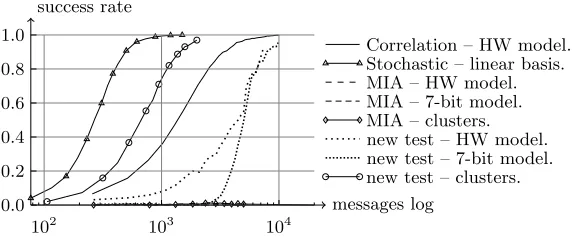
The evaluations we performed follow the proposal in [28]. As our goal is to compare distinguishers, we are mainly interested in the security analysis part of this framework. Hence, for each investigated context, we computed the success rate of the attacks, over a set of 100 to 500 independent experiments. The figures corresponding to these experiments have been reported in appendix. They allow a number of interesting observations. Observation 1. On different types of leakage functions.As expected, the different leakage functions considered imply very different constraints for the non-profiled adversaries. In the case of Hamming weight leakages (Figures 5, 6, 7), this function is purely linear, i.e.
L(k, p) =Pα
ivj,p[i], withvj,p[i] theith bit of the S-box output and allαicoefficients set to 1. In addition, as shown in [29], the bivariate distribution of the leakages conditioned on the key, for a masked S-box, is very accurately characterized by the correlation between the samplesL1
k,P andL2k,P in this case. As a result, all investigated attacks are extremely efficient. By contrast, when moving to the analysis of real measurements on a 65nm chip (Figures 8, 9, 10), the Hamming weight assumption becomes invalid, and the quadratic, cubic, . . . terms inL(k, p) =P
Observation 3. On the limits of non-profiled side-channel attacks. Another consequence of our experiments is to emphasize that, in the context of the dual-rail S-box (Figure 11), none of the non-profiled side-channel attacks could lead to successful key recoveries. Inter-estingly, the “on-the-fly” stochastic approach fails in this context, even when increasing the size of the basis (e.g. using not only linear, but quadratic, cubic, . . . terms). The failure of a stochastic model using linear base vectors is easily explained by the strongly non-linear nature of the simulated leakages produced by the dual-rail S-box. The un-successful results with larger bases just derive from the fact that these large bases allow refining the model for all key candidates (i.e. not only the correct one). In fact, also in this case, it is important that the base vectors are justified by a reasonable physical intuition. For example, in case of linear leakage functions, the regression is easy for the correct key candidate (because provided with a good basis) and difficult for the wrong key candidates (because the regression essentially has to capture the non-linearity of a modified S-boxS0
such thatS(x⊕kw) =S0(x⊕kg), withkg andkw the good and a wrong key candidate). But as soon as the base vectors do not have a connection with the actual leakages, the advantage of the correct key candidate in building a good stochastic model vanishes6. And when combining this dual-rail logic style with masking (in Figure 12), we see that only a bivariate template attack, similar to the ones in [29], allows recovering keys. In this respect, it is also worth noting that a leakage model that is sound in an unprotected setting (e.g. the one based on clustering in Figure 11) does not translate into a sound model for the corresponding masked implementation (in Figure 12).
Observation 4. MIA versus the new test.Finally, our new distinguisher compares favorably to MIA in all the investigated experiments. We note that the efficiency of MIA could possibly be improved, by exploiting pdf estimation based on Kernels, splines or parametric techniques [19]. However, more than the efficiency of the distinguisher, it is worth to notice that in certain settings, e.g. the masked 65nm CMOS S-boxes in Figures 9 and 10, it allows exploiting a leakage assumption while MIA cannot. It is an open question to determine whether these experiments can be formally confirmed (e.g. are they due to identified limitations as in the example of Section 3?) or are the result of measurement artifacts that would vanish with more intensive measurement efforts.
6
Conclusion and open problems
Generic distinguishers are a useful tool in the evaluation of leaking cryptographic de-vices. In this paper, we first proposed a new and efficient generic test that is fully non-parametric, based on a natural discriminating criterion, and exploits state-of-the-art sta-tistical tools. It can be useful in all scenarios where the previously introduced MIA shows significant advantages compared to other non-profiled distinguishers.
Next, we discuss the relevance of generic distinguishers in general. Based on experimen-tal validation in different implementation contexts, we put forward that such non-profiled attacks do not get rid of the need of sound assumptions during the partitioning step in a side-channel analysis. Similarly, when applied “on-the-fly”, the stochastic approach of
6
Schindler et al. is only sound when provided with meaningful based vectors, that may not be easy to guess for practical adversaries. This observation suggests that the gap between profiled and non-profiled side-channel attacks can be huge, when such assumptions are are not available. It re-emphasizes the need to consider two aspects in the security analysis of a leaking device, as advocated in [28]. First, the worst case security can only be evaluated with a profiled attack (e.g. using templates), and quantified with an information theoretic metric. Second, different types of non-profiled distinguishers can be compared with a se-curity metric, in order to measure how efficiently they can take advantage of the available information. In this respect, generic tests bring an interesting alternative to more specific (e.g. correlation-based) statistical tools. But they are not immune to model imprecisions, and resisting such attacks is not sufficient to conclude that an implementation is secure. Admittedly, the most critical examples we exhibit in this paper are based on simula-tions and practical implementasimula-tions usually show linear dependencies in their leakages. Nevertheless, this discussion underlines that the theoretical limits of present non-profiled attacks have to be properly understood. It also leads to interesting questions for the design and analysis of secure implementations. First, as non-profiled distinguishers published in the literature seem specially affected by non-linear leakage functions, designing hardware logic styles with this criterion in mind appears as an interesting scope for further research. Preliminary experiments reported in [23] suggest that the DDSLL logic style may not be the most suitable for this purpose. Second, the partitioning step of generic distinguish-ers is made specially easy when non-bijective S-boxes (or components) are used. Hence, such S-boxes should be avoided when designing ciphers to be secured against physical attacks. In the same lines, targeting the output of MixColumn in an AES implementation could be an interesting topic for further investigation. Depending on the architectures (e.g. 8-bit software or 32-bit hardware), it could also lead to leakage models that are sim-ple to exploit. Eventually, non-profiled security evaluations are typically misleading when randomization-based countermeasures such as masking are combined with the difficulty to make sound assumptions on the leakage model. Hence, developing new tools in order to get rid of this limitation, or showing that no such tools actually exist, appears as an important challenge for evaluating the security of future embedded cryptographic devices.
References
1. Lejla Batina, Benedikt Gierlichs, Emmanuel Prouff, Matthieu Rivain, Fran¸cois-Xavier Stan-daert, and Nicolas Veyrat-Charvillon. Mutual information analysis: a comprehensive study.
J. Cryptology, 24(2):269–291, 2011.
2. Eric Brier, Christophe Clavier, and Francis Olivier. Correlation power analysis with a leakage model. In Marc Joye and Jean-Jacques Quisquater, editors,CHES, volume 3156 ofLecture Notes in Computer Science, pages 16–29. Springer, 2004.
3. F. P. Cantelli. Sulla determinazione empirica della legge di probabilita. Giorn. Ist. Ital., 4:221–424, 1933.
4. Suresh Chari, Charanjit S. Jutla, Josyula R. Rao, and Pankaj Rohatgi. Towards sound approaches to counteract power-analysis attacks. In Michael J. Wiener, editor,CRYPTO, volume 1666 ofLecture Notes in Computer Science, pages 398–412. Springer, 1999. 5. Suresh Chari, Josyula R. Rao, and Pankaj Rohatgi. Template attacks. In Burton S. Kaliski
6. Julien Doget, Emmanuel Prouff, Matthieu Rivain, and Fran¸cois-Xavier Standaert. Univariate side channel attacks and leakage modeling. InCOSADE, pages 1–15, Darmstadt, Germany, February 2011.
7. Benedikt Gierlichs, Lejla Batina, Bart Preneel, and Ingrid Verbauwhede. Revisiting higher-order dpa attacks:. In Josef Pieprzyk, editor, CT-RSA, volume 5985 of Lecture Notes in Computer Science, pages 221–234. Springer, 2010.
8. Benedikt Gierlichs, Lejla Batina, Pim Tuyls, and Bart Preneel. Mutual information analysis. In Elisabeth Oswald and Pankaj Rohatgi, editors,CHES, volume 5154 ofLecture Notes in Computer Science, pages 426–442. Springer, 2008.
9. V. Glivenko. Sulla determinazione empirica della legge di probabilita. Giorn. Ist. Ital., 4:92–99, 1933.
10. Louis Goubin and Jacques Patarin. Des and differential power analysis (the ”duplication” method). In C¸ etin Kaya Ko¸c and Christof Paar, editors, CHES, volume 1717 of Lecture Notes in Computer Science, pages 158–172. Springer, 1999.
11. Ilham Hassoune, Fran¸cois Mac´e, Denis Flandre, and Jean-Didier Legat. Dynamic differential self-timed logic families for robust and low-power security ics. Integration, the VLSI Journal, Volume 40, Issue 3, April 2007, Pages 355-364.
12. Trevor Hastie, Robert Tibshirani, and Jerome Friedman.The Elements of Statistical Learn-ing, chapter 6. Springer Series in Statistics. Springer New York Inc., New York, NY, USA, 2001.
13. Paul C. Kocher, Joshua Jaffe, and Benjamin Jun. Differential power analysis. InCRYPTO, pages 388–397, 1999.
14. Kerstin Lemke-Rust and Christof Paar. Analyzing side channel leakage of masked implemen-tations with stochastic methods. In Joachim Biskup and Javier Lopez, editors,ESORICS, volume 4734 ofLecture Notes in Computer Science, pages 454–468. Springer, 2007. 15. Stefan Mangard, Elisabeth Oswald, and Thomas Popp. Power Analysis Attacks: Revealing
the Secrets of Smart Cards. Springer, 2007.
16. Stefan Mangard, Norbert Pramstaller, and Elisabeth Oswald. Successfully attacking masked aes hardware implementations. In Rao and Sunar [22], pages 157–171.
17. Thomas S. Messerges. Using second-order power analysis to attack dpa resistant software. In C¸ etin Kaya Ko¸c and Christof Paar, editors, CHES, volume 1965 of Lecture Notes in Computer Science, pages 238–251. Springer, 2000.
18. Roger B. Nelsen. An Introduction to Copulas (Lecture Notes in Statistics). Springer, 1 edition, October 1998.
19. Emmanuel Prouff and Matthieu Rivain. Theoretical and practical aspects of mutual in-formation based side channel analysis. In Michel Abdalla, David Pointcheval, Pierre-Alain Fouque, and Damien Vergnaud, editors,ACNS, volume 5536 ofLecture Notes in Computer Science, pages 499–518, 2009.
20. Emmanuel Prouff, Matthieu Rivain, and R´egis Bevan. Statistical analysis of second order differential power analysis. IEEE Trans. Computers, 58(6):799–811, 2009.
21. Ronald Pyke. Spacings revisited. InProceedings of the Sixth Berkeley Symposium on Math-ematical Statistics and Probability (Univ. California, Berkeley, Calif., 1970/1971), Vol. I: Theory of statistics, pages 417–427, Berkeley, Calif., 1972. Univ. California Press.
22. Josyula R. Rao and Berk Sunar, editors. Cryptographic Hardware and Embedded Systems -CHES 2005, 7th International Workshop, Edinburgh, UK, August 29 - September 1, 2005, Proceedings, volume 3659 ofLecture Notes in Computer Science. Springer, 2005.
23. Mathieu Renauld, Dina Kamel, Fran¸cois-Xavier Standaert, and Denis Flandre. Scaling trends for dual rail logic styles. Preprint, 2011.
25. Matthieu Rivain, Emmanuelle Dottax, and Emmanuel Prouff. Block ciphers implementations provably secure against second order side channel analysis. In Kaisa Nyberg, editor,FSE, volume 5086 ofLecture Notes in Computer Science, pages 127–143. Springer, 2008. 26. Werner Schindler, Kerstin Lemke, and Christof Paar. A stochastic model for differential side
channel cryptanalysis. In Rao and Sunar [22], pages 30–46.
27. David W Scott. On optimal and data-based histograms. Biometrika, volume 66, issue 3, pp 605-610, 1979.
28. Fran¸cois-Xavier Standaert, Tal Malkin, and Moti Yung. A unified framework for the analysis of side-channel key recovery attacks. In Antoine Joux, editor,EUROCRYPT, volume 5479 ofLecture Notes in Computer Science, pages 443–461. Springer, 2009.
29. Fran¸cois-Xavier Standaert, Nicolas Veyrat-Charvillon, Elisabeth Oswald, Benedikt Gierlichs, Marcel Medwed, Markus Kasper, and Stefan Mangard. The world is not enough: Another look on second-order dpa. In Masayuki Abe, editor,ASIACRYPT, volume 6477 ofLecture Notes in Computer Science, pages 112–129. Springer, 2010.
30. Alexandre Venelli. Efficient entropy estimation for mutual information analysis using b-splines. In Pierangela Samarati, Michael Tunstall, Joachim Posegga, Konstantinos Markan-tonakis, and Damien Sauveron, editors,WISTP, volume 6033 ofLecture Notes in Computer Science, pages 17–30. Springer, 2010.
31. Nicolas Veyrat-Charvillon and Fran¸cois-Xavier Standaert. Mutual information analysis: How, when and why? In Christophe Clavier and Kris Gaj, editors, CHES, volume 5747 ofLecture Notes in Computer Science, pages 429–443. Springer, 2009.
32. Carolyn Whitnall. An information theoretic assessment of first-order mia. First year PhD report, University of Bristol, 2010.
33. Carolyn Whitnall and Elisabeth Oswald. A comprehensive evaluation of mutual information analysis using a fair evaluation framework. To appear in the proceedings of Crypto 2011, Lecture Notes in Computer Science, vol xxxx, pp yyy-zzz, Santa Barbara, California, USA, August 2011.
A
Building the distance templates
The distance templates are built by convolution of independent uniform random variables. That is, for one dimension, the probability of a spacing of lengthuis the probability that two random variables X and X0 drawn from the n-valued discrete uniform distribution on the interval [0,1] (each value has probability n1) will differ by an amountu. That is:
Pr[U =u] =X x
Pr[X =x]·Pr[X0=x±u]
In our specific case, since the discrete uniform distribution results from an integral transform of continuous variables, it is impossible to have a spacing of 0. The spacing distribution is therefore Pr[U =u] = n−21 ×(1−u) foru >0, 0 otherwise.
As one considers higher dimensions, using the Manhattan distance to extend the notion of spacings, the distribution becomes a convolution of spacings on one dimension:
Pr[U =u] =X ui
d−1
Y
i=1
Pr[Ui=ui]·Pr "
Ud= u− d−1
X
i=1
ui !#
,
where the Ui are spacings taken along dimensioni. In the case of two dimensions, this formula simply gives :
Pr[U =u] =X u1
which is the integral of two affine functions, therefore a piecewise cubic polynomial since
U1 and U2 are only defined on the interval [0,1] while U ranges over [0,2]. While it
is possible to compute the sampling distribution analytically for higher dimensions, it quickly becomes cumbersome, and it is much more practical to build the distribution by composing lower-dimension distance histograms. This is done very efficient by following a method similar to the square-and-multiply algorithm, where for example the template for dimension 4 is built by convoluting the template for dimension 2 with himself.
B
Results of our experiments
Correlation – HW model.
Stochastic – linear basis.
MIA – HW model.
new test – HW model.
0.0 0.2 0.4 0.6 0.8 1.0
10 20 30 40 50 60 70 80
messages success rate
Fig. 5.Simulations, unprotected S-box, Hamming weight leakage function.
Correlation – HW model.
Stochastic – linear basis.
MIA – HW model.
new test – HW model.
0.0 0.2 0.4 0.6 0.8 1.0
500 1000 1500 2000
messages success rate
MIA – HW model.
new test – HW model.
0.0 0.2 0.4 0.6 0.8 1.0
500 1000 1500 2000 2500 3000
messages success rate
Fig. 7.Simulations, masked S-box, Hamming weight leakage function, bivariate leakages.
Correlation – HW model. Stochastic – linear basis. MIA – HW model. MIA – 7-bit model. MIA – clusters. new test – HW model. new test – 7-bit model. new test – clusters.
0.0 0.2 0.4 0.6 0.8 1.0
102 103 104
messages log success rate
Fig. 8.Measurements, unprotected S-box, 65nm CMOS chip.
Correlation – HW model. Stochastic – linear basis. MIA – HW model. MIA – 7-bit model. MIA – clusters. new test – HW model. new test – 7-bit model. new test – clusters.
0.0 0.2 0.4 0.6 0.8 1.0
102 103 104
messages log success rate
MIA – 7-bit model.
MIA – clusters.
new test – 7-bit model.
new test – clusters.
0.0 0.2 0.4 0.6 0.8 1.0
1000 2000 3000 4000 5000
messages success rate
Fig. 10.Measurements, masked S-box, 65nm CMOS chip, bivariate leakages.
Correlation – HW model.
Stochastic – linear basis.
MIA – clusters.
new test – clusters.
0.0 0.2 0.4 0.6 0.8 1.0
20 40 60 80 100
messages success rate
Fig. 11.Simulations, unprotected S-box, 65nm dual-rail logic style.
Bivariate Template – profiled.
MIA – clusters.
new test – clusters.
0.0 0.2 0.4 0.6 0.8 1.0
1000 2000 3000 4000 5000
messages success rate