© 2017, IJCSMC All Rights Reserved
63
Available Online atwww.ijcsmc.com
International Journal of Computer Science and Mobile Computing
A Monthly Journal of Computer Science and Information Technology
ISSN 2320–088X
IMPACT FACTOR: 6.017IJCSMC, Vol. 6, Issue. 6, June 2017, pg.63 – 72
IMAGE COMPRESSION USING DWT
Muskan Garg
1, Anuj Sharma
2M.Tech Scholar1, Associate Professor2
Department of Computer science and Engineering, Om Group of Institutions, Juglan (Hisar)1,2
Abstract— In the image processing image compression is very important. Because of image compression image quality may effect and CR may vary. Here DWT is used for compress the image i.e. used "haar wavelet” with decomposes level 2 which makes it more compressible.
Huffman encoding is used to decrease length of data and also changed threshold values and set it to 10.This is the only approach proposed for compression of image using parameters improving CR without losing the parameter PSNR and MSE. Keywords— DWT, HAAR, CR
INTRODUCTION
Image compression coding is to store the image into bit-stream as compact as possible and to display the decoded image in the monitor as exact as possible. When the encoder receives the original image file, the image file will be converted into a series of binary data, which is called the bit-stream. The decoder then receives the encoded bit-stream and decodes it to form the decoded image. If the total data quantity of the bit-stream is less than the total data quantity of the original image, then this is called image compression.
The compression ratio is defined as follows:
Wheren1is the data rate of original image and n2 is that of the encoded bit-stream.
METHODS OF COMPRESSION There are two methods for compression.
© 2017, IJCSMC All Rights Reserved
64
DCT:
The discrete cosine transform (DCT) is a technique for changing a signal into elementary frequency elements. Like different transforms, the discrete cosine transform (DCT) tries to de correlate the image statistics. Once decorrelate every transform coefficient are often encoded individually without losing compression efficiency.
DWT:
The wavelet transform (WT) is a way to represent a signal in time-frequency type. Wavelet transform are constructed on small waves, known as wavelets, of varying frequency and limited period wavelet transform uses multiple resolutions everywhere {different totally} frequencies are analysed with different resolutions. This provides a more elaborate image of the signal being analysed.
LITERATURE REVIEW
In this thesis analysis of numerous Image compression techniques for various images is done founded on parameters, compression ratio(CR), mean square error (MSE), peak signal to noise ratio (PSNR). Our simulation results from chapter 4 shows that we can achieve higher compression ratio using Hybrid technique but loss of evidence is more. DWT gives better compression ratio without losing more information of image. Pitfall of DWT is, it necessitates more processing power. DCT overcomes this disadvantage since it needs less dispensation power, but it gives less compression ratio. DCT based standard JPEG uses blocks of image, but there are still correlation departures across blocks. Block boundaries are obvious in some cases. Blocking artifacts can be seen at low bit rates. In wavelet, there is no need to divide the image. More robust under transmission errors. It facilitates liberal transmission of the image (scalability) [1].
Lossless image compression algorithm for both the binary images and gray-scale images is developed. Lossless image compression has extensive application in medical imaging, space shooting and film industry to archive and diffuse images. To efficiently compress images, we first decompose images into a set of binary images to reduce encoding symbols. The benefits lie in four aspects. First, the progressive image broadcast is achieved by image decay. Second, the encoding alphabet is reduced to the binary alphabet which is suitable for situation quantization and adaptive arithmetic coding. Third, decomposition provides a chance to use those partial future" information of non-causal pixels to help encoding. Finally, the failure provides a straight-forward way to encode bi-level images, considering that current gray-scale image compression algorithms usually have bad presentation on bi-level images [2].
This paper was motivated by the wish of improving the efficiency of lossless image compression by refining the BCH and LZW. We providing an overview of various existing coding values lossless image compression techniques. We have proposed a high effectual algorithm which is implemented using the BCH coding approach. The experimentations were carried on collection of dataset of 20 test images. The result valuated by using compression ratio and bits per pixel. The experimental results show that the proposed algorithm progresses the compression of images associating compared with the RLE, Huffman and LZW algorithms, the proposed method average compression ratio is 1.636383, which is better than the normal lossless image compression [3].
A single sensor information obtained is limited, often cannot meet the actual needs, in calculation, different sensors have the advantage of the imaging principle and its unique, as in color, shape features, band access, spatial resolution from the features of all have their own characteristics. Registration algorithm is proposed in this paper has better strength to image noise, and can achieve sub-pixel accuracy; the registering time has also been greatly improved. In terms of image fusion, the images to be attached through wavelet transform of different resolution sub image, using a new image fusion method based on energy and correlation coefficient [4].
In this paper, an image compression arrangement is proposed, based on discrete cosine transform (DCT). This scheme is a hybrid method, which association‟s vector quantization (VQ) and difference pulse code modulation (DPCM). This scheme begins with transforming image from altitudinal domain to frequency domain using DCT. Then the block data is distorted into a vector according to zigzag order, and then truncated. After that, the vector is split into DC coefficient and AC coefficients. After scale quantization, DC coefficient is coded using DPCM. AC coefficients are coded using multistage vector quantization (MSVQ). Then, entropy encoding is performed on index-tables and DC part, separately. The experimental results show that, compared to conventional VQ and DCTVQ schemes, proposed scheme has a better performance [5].
OBJECTIVES
Our objective is to design an efficient and effective progressive lossless image compression scheme.
Study of existing image compression techniques.
© 2017, IJCSMC All Rights Reserved
65
Implement the proposed algorithm in MATLAB Tool for Redundant data removal and image compression.
To Achieve a higher PSNR value, decomposes an image wavelet to level N=2
Evaluate results.
RESEARCH METHODOLOGY
Research methodology of the work is below:
Compress the image using dwt for lossless compression
Decompose the image using „harr‟ wavelet
Decomposes an image wavelet to level 2" and threshold values varied to get better results
Quantification of image and use idwt for calculating the errors.
Calculate and comparing the CR, PSNR, SNR for different types of images.
RESULTS AND ANALYSIS
Analysis is carried for four different human test images 1 to 4 namely neuron, skull, jaw and leg joints.
Test 1:
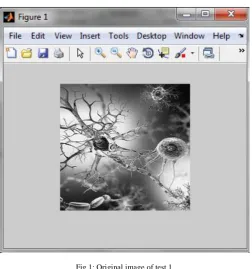
In the test 1 human neuron image taken for compression. Neuron helps to send the signals to the brain.
Fig 1: Original image of test 1
© 2017, IJCSMC All Rights Reserved
66
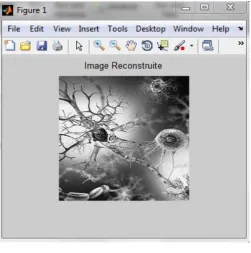
Fig 2: Decompressed image
Fig 2 shows the decompressed image after applying „harr‟ wavelet. Compressed image is further decompressed using dwt technique with level 2" and threshold value of 10.
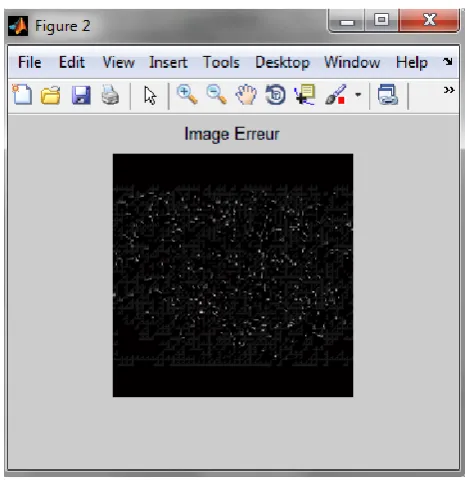
Fig 3: Error image
Fig 3 shows the Error image of the test 1.After the decomposing of image MSE and PSNR is calculated using dequantificatin and idwt.
Test 2
© 2017, IJCSMC All Rights Reserved
67
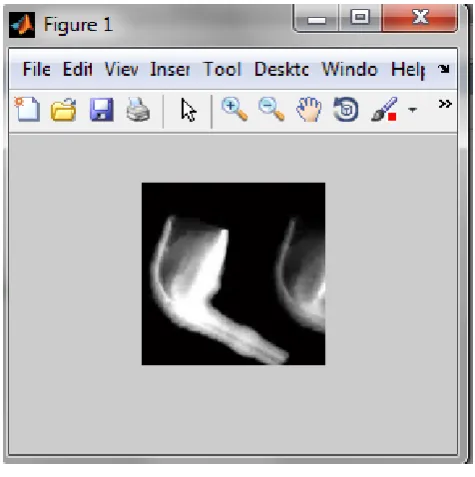
Fig 4 Original image of test 2
Fig 4 shows the original image of the test 2. This image is compressed using dwt technique. Remove redundancy data technique with DWT is used for lossless image compression. This technique provides the best compression ratio of the image.
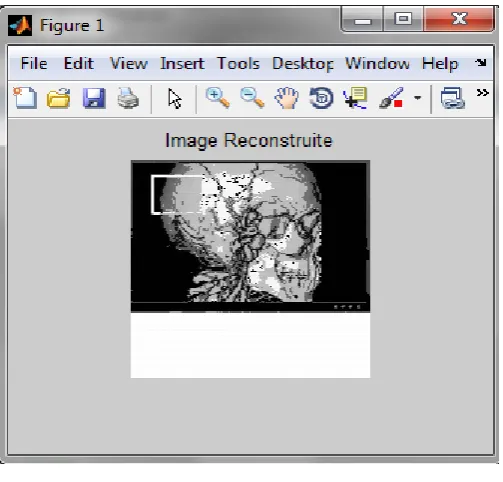
Fig 5: Decompressed image
© 2017, IJCSMC All Rights Reserved
68
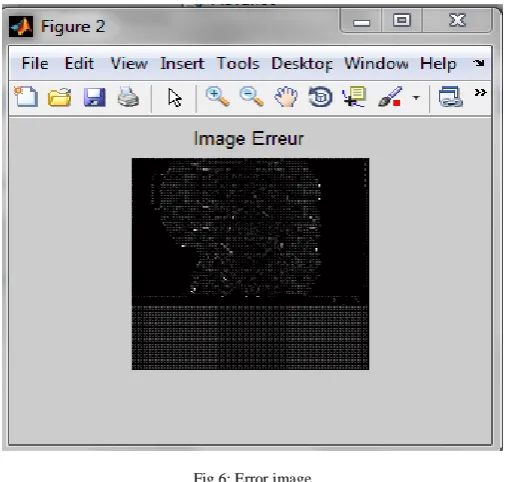
Fig 6: Error image
Fig 6shows the Error image of the test 1. After the decomposing of image MSE and PSNR is calculated using dequantificatin and idwt.
Test 3
In the test 3 human mouth image taken for compression. It shows the jaw structure
Fig 7: Original image of test 3
© 2017, IJCSMC All Rights Reserved
69
Fig 8: Decompressed image 3
Fig 8shows the decompressed image after applying „harr‟ wavelet. Compressed image is further decompressed using dwt technique with level 2" and threshold value of 10.
Fig 9 shows the Error image of the test 3
Fig 9 shows the Error image of the test 3. After the decomposing of image MSE and PSNR is calculated using dequantificatin and idwt.
Test 4
© 2017, IJCSMC All Rights Reserved
70
Fig 10: Original image of test 4
Fig 10 shows the original image of the test 4. This image is compressed using dwt technique. Remove redundancy data technique with DWT is used for lossless image compression. This technique provides the best compression ratio of the image.
`
Fig 11: Decompressed image 4
© 2017, IJCSMC All Rights Reserved
71
Fig 12: Error image
Fig 12 shows the error image of the test 4. After the decomposing of image MSE and PSNR is calculated using dequantificatin and idwt.
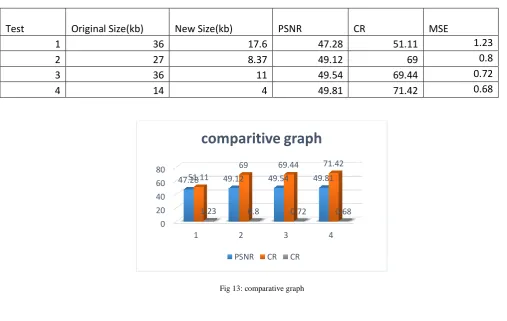
Table 1: comparative table of all results
Test Original Size(kb) New Size(kb) PSNR CR MSE
1 36 17.6 47.28 51.11 1.23
2 27 8.37 49.12 69 0.8
3 36 11 49.54 69.44 0.72 4 14 4 49.81 71.42 0.68
Fig 13: comparative graph
0 20 40 60 80
1 2 3 4
47.28 51.11 49.12 49.54 49.81
69 69.44 71.42
1.23 0.8 0.72 0.68
comparitive graph
© 2017, IJCSMC All Rights Reserved
72
CONCLUSION
In this paper „haar wavelet‟ transform is used with decomposes the image at level 2 for improving the parameters of image. It is clear that higher the CR ratio of the compression i.e. 71:1gives the better image quality. PSNR of image max goes to 49.8.Due to this compression ratio ,image quality is improved when MSE should be low for the better results as it goes to maximum1.23.These improved parameters make the compression lossless.
REFERENCES
[1]. Archana Deshlahra, “Analysis of Image Compression Methods Based On Transform and Fractal Coding”,2013 [2]. Hui Zha, “Progressive Lossless Image Compression Using Image Decomposition and
[3]. Context Quantization, 2007
[4]. A. Alarabeyyat,“ Lossless Image Compression Technique Using Combination Methods”, 2012
[5]. Zhang Ning,“ study on image compression and fusion based on the wavelet transform technology”, 2015
[6]. P. Halder, “an efficient image compression algorithm using dct- biorthogonal wavelet transform with arithmetic,”International Journal of Research in Engineering and Technology, ISSN: 2319-116,pp. 2319–2322, 2015. [7]. Rashmita Sahoo,Sangita Roy and Sheli Sinha Chaudhuri,“Harr wavelet Transform image compression using run length
encoding”,international conference on communication and signal processing,april3-5,2014.
[8]. P. Telagarapu, V. J. Naveen, A. L. Prasanthi, and G. V. Santhi, “Image Compression Using DCT and Wavelet Transformations,”International Journal of Signal Processing, Image Processing and Pattern Recognition vol. 4, no. 3, pp. 61–74, 2011.
[9]. K. M. July-december, K. Kaur, R. Chawla, and I. Kaur, “Image compression using wavelet transform,”I. Journal, I. Technology, vol. 5, no. 2, pp. 421–423, 2012.