University of South Carolina
Scholar Commons
Theses and Dissertations
Fall 2018
The Effect of Medicaid Expansion on Heart Attack
Mortality
Gabrielle Epelle
Follow this and additional works at:https://scholarcommons.sc.edu/etd
Part of theEconomics Commons
This Open Access Thesis is brought to you by Scholar Commons. It has been accepted for inclusion in Theses and Dissertations by an authorized administrator of Scholar Commons. For more information, please [email protected].
Recommended Citation
Epelle, G.(2018).The Effect of Medicaid Expansion on Heart Attack Mortality.(Master's thesis). Retrieved from
THE EFFECT OF MEDICAID EXPANSION ON HEART ATTACK
MORTALITY
by
Gabrielle Epelle
Bachelor of Science Winthrop University, 2015
Submitted in Partial Fulfillment of the Requirements
For the Degree of Master of Arts in
Economics
Darla Moore School of Business
University of South Carolina
2018
Accepted by:
Lindsey Woodworth, Director of Thesis
John McDermett Reader
ii
iii
ABSTRACT
The aim of this study is to estimate the effect of Medicaid expansion on the
number of deaths from heart attacks using a difference in differences model. We
modified the standard difference in differences framework to by including both state and
year fixed effects to account for the fact that states expanded Medicaid at different times.
Furthermore, we added state specific linear time trends as well as state unemployment
rates as controls to test the robustness of the model. We obtained our data from the
Center for Disease Control’s Underlying Causes of Death Database. We found that
Medicaid expansion had a statistically insignificant effect on heart attack mortality which
iv
TABLE OF CONTENTS
ABSTRACT ... iii
LIST OF TABLES ...v
LIST OF FIGURES ... vi
CHAPTER 1: INTRODUCTION………1
CHAPTER 2: LITERATURE REVIEW………....……….………5
CHAPTER 3: DATA……….……...………..………….9
CHAPTER 4: METHODS……….13
CHAPTER 5: RESULTS………..………….17
CHAPTER 6: DISCUSSION……….………22
CHAPTER 7: POLICY IMPLICATIONS…..…..………24
v
LIST OF TABLES
Table 3.1. Summary Statistics ...10
Table 3.2: Summary Statistics for Non Medicaid Expansion States ...11
Table 3.3: Summary Statistics for Medicaid Expansion States ...11
Table 5.1: Effect of Medicaid Expansion on Heart Attack Mortality ...17
Table 5.2: Effect of Medicaid Expansion on Heart Attack Mortality with a one year time lag added to the model. ……….18
vi
LIST OF FIGURES
1
CHAPTER 1
INTRODUCTION
According to the Center for Disease Control, every 40 seconds someone has a
heart attack. A heart attack, also known as a myocardial infarction occurs when the heart
muscle is deprived of blood flow. The greater the time it takes for treatment to restore
blood flow, the greater the damage to the heart muscle (“Heart Attack Facts & Statistics”,
2017).
The main cause of a heart attack is the buildup of plaque in the coronary arteries,
which supply blood to the heart, causing them to narrow over time. Another cause of
heart attacks is a spasm of the coronary artery that stops blood flow to part of the heart
muscle. A heart attack can lead to a myriad of complications including damaged heart
valves, abnormal heart rhythms, heart rupture and heart failure which can be fatal (“Heart Attack Facts & Statistics”, 2017). There are many risk factors that make
individuals more susceptible to heart attacks. These include diabetes, high blood pressure,
high blood cholesterol, and obesity (“Heart Attack - Symptoms and Causes”, 2018). A
lack of access to health insurance can also make individuals more susceptible to heart
attacks. For example, studies have shown that the uninsured are less likely to be screened
for heart attack risk factors such as diabetes, hypertension, and high cholesterol. Even
2
This is because research has shown that uninsured individuals who suffered a
heart attack received less aggressive care and have higher in hospital mortality rates than
individuals with insurance. Furthermore, studies have shown that adults without access to
health insurance are more likely to die after a heart attack than adults with insurance
(National Research Council, 2009).
Millions of Americans who cannot afford private insurance rely on Medicaid.
Created in 1965, Medicaid provides highly subsidized insurance to low income
individuals who are unable to afford private insurance. Medicaid is jointly run by the
federal and state governments, giving states the discretion to set eligibility rules and
budgets. As a result, Medicaid coverage and eligibility vary from state to state. The
federal government helps states finance Medicaid by matching state expenditures. In
addition, the government sets minimum levels of eligibility and coverage (Medicaid:
Changes Under the Affordable Care Act, 2017).
According to the American Heart Association and the American Stroke
Association 53% of individuals with Medicaid have a history of heart disease (“Critical
Coverage for Heart Health: Medicaid and Cardiovascular Disease”, 2012). Access to
Medicaid has many benefits. For example, studies have also shown that Medicaid
beneficiaries are twice as likely to take their medication appropriately compared to the
uninsured. Additionally, individuals with Medicaid are more likely to have their blood
pressure under control than those without health insurance (“Critical Coverage for Heart
Health: Medicaid and Cardiovascular Disease ”,2012In 2010, Congress passed the Patient
Protection and Affordable Care Act also known as Obamacare with the aim of increasing
3
Act was the expansion of Medicaid eligibility to cover uninsured individuals below 133%
of the poverty level, which amounts to an income of approximately $15,000 per annum.
Prior to Medicaid Expansion, the federal government only required states to provide
Medicaid to children, disabled individuals, pregnant women, parents of dependent
children, and certain qualifying individuals over 65. Medicaid Expansion extended
Medicaid coverage to childless, non-disabled, low income adults, a group not
traditionally covered by Medicaid prior to the Affordable Care Act.
The Affordable Care Act required all states to expand Medicaid to all adults with
income up to 133% of the FPL by 2014 or lose Medicaid funds. Several states sued the
federal government over the requirement to expand Medicaid. The Supreme Court ruled
that the federal government could not force states to expand Medicaid. As a result, many
states opted not to expand Medicaid (Medicaid :Changes Under the Affordable Care Act,
2017).
The Affordable Care Act also required states that expand Medicaid to cover ten
categories of Essential Health Benefits. These ten categories of services fall under
Essential Health Benefits include the following: “ambulatory patient services; emergency
services, hospitalization, maternity and newborn care, mental health and substance abuse
4
drugs, rehabilitative and habilitative services and devices, laboratory services,
preventative and wellness services, chronic disease management, and pediatric services,
including oral and vision care (Medicaid: Changes Under the Affordable Care Act, 2017).
Starting in 2014, Medicaid Expansion was implemented in 37 states. While many
studies have been conducted to measure the effect of Medicaid Expansion on various
conditions such as cardiovascular disease, diabetes, etc. we noticed a lack of research into
the effect of Medicaid expansion on the heart attack mortality rate hence the motivation
for our study.
Our aim is to estimate the effect of Medicaid Expansion on the number of deaths
from heart attacks using a difference in differences model. We modified the standard
difference in differences framework by including both state and year fixed effects to
account for the fact states expanded Medicaid at different times. Furthermore, we added
state specific linear time trends as well as state unemployment rates as controls to test the
robustness of the model. In addition, we performed regression analyses using a lagged
treatment variable and weighting the results by state year population.
We obtained our data on the heart attack mortality rate from the Center for Disease Control’s Underlying Causes of Death Database. We found that Medicaid
expansion had a statistically insignificant effect on heart attack mortality which implies
5
CHAPTER 2
LITERATURE REVIEW
Much research has been done into the effects on Medicaid Expansion on access to
health care and health outcomes. Li, Bruen, Lantz, and Mendez developed a state
transmission model to represent the health events of a population from ages 25 to 64.
They predicted that Medicaid Expansion would lead to 5.1% increase in the treatment
rate of patients suffering from hypertension. They forecast a decrease in new coronary
heart disease events by 110,000, a 63,000 fewer stroke events, and 95,000 fewer
cardiovascular disease related deaths. (Li, Bruen, Lantz, & Mendez, 2015).
Courtemanche, Marton, Ukert, Yelowitz, and Zapta used difference in difference
models that used the cross sectional variation in the intensity of treatment due to state
adoption of Medicaid Expansion and local area uninsured rates prior to the Affordable
Care Act. They found that the Affordable Care Act increased the proportion of
individuals with insurance by 5.9% compared to 2.8% in non Medicaid Expansion states.
(Courtemanche, Marton, Ukert, Yelowitz, & Zapta, 2017).
Rogers and Zhang used logistic regression models to analyze the 2014 Behavioral
Risk Factor Surveillance System. They found that people living in states that expanded
Medicaid have a lower chance of experiencing poor heart health compared to those living
6
Gosh, Simon, and Summers studied pharmacy transaction data from 2013 to
2015, comparing the number of prescriptions filled in Medicaid expansion versus non
Medicaid expansion states before and after Medicaid expansion was implemented, taking
into account the type of insurance for each prescription filled. Medications used to treat
diabetes, a condition linked to an increased risk of heart attack increased by 24% and
cardiovascular drugs increased by 21% (Gosh, Simon, & Summers, 2017).
Using difference in differences, Miller and Wherry compared changes in health
outcomes before and after Medicaid Expansion took effect in states that did and did not
expand Medicaid. They found that after the second year of implementation uninsurance
rates fell by 8.2% in Medicaid Expansion states vs non Medicaid Expansion states. Rates
of Medicaid coverage were increased by 15.6% in Medicaid vs non Medicaid Expansion
states. In addition, they found a 3.4% reduction in patients who reported an inability to
afford follow up care, 7.9% decrease in patients who worried about the cost of medical
bills in Medicaid Expansion vs non Medicaid Expansion states (Miller & Wherry, 2017).
Kaufman, Chen, Fonseca, and McPhaul, examined the effect of Medicaid
Expansion on the number of newly diagnosed cases of diabetes among Medicaid
enrollees aged 19-64. They observed a 1.6% increase in newly identified cases of
diabetes from the control period to the study period. Among Medicaid Expansion states,
they observed a 23% increase in the number of newly diagnosed cases of diabetes from
the control period to the study period. On the other hand, there was a much smaller
increase in newly diagnosed cases of diabetes in non Medicaid Expansion states. 11,612
patients were newly diagnosed with diabetes in the control period while there were
7
changes to access to healthcare among Medicare patients contributed to diabetes being
tested at earlier stages (Kaufman, Chen, Fonseca, & McPhaul, 2015).
On the other hand, the results from the Oregon Experiment are more ambiguous.
In 2008, Oregon expanded Medicaid based on a lottery. Two years after the lottery,
researchers obtained data from adults who had been selected to receive Medicaid and
from adults who were not selected. They used the random sampling of the lottery to
analyze the effect of Medicaid on measures such as blood pressure, cholesterol, etc. They
found that Medicaid did not have a statistically significant effect on the diagnosis or use
of medication for hypertension or high cholesterol. They also measured the effect of
Medicaid on the predicted 10 year risk of cardiovascular events and found that it was
statistically insignificant (Finkelstein et al., 2012).
Similarly, Kaestner replicated the findings from Sommers, Long, and Baicker and
presented p values for parameter estimates based on randomization inference rather than
difference in differences. Randomization inference is a nonparametric method of testing
the statistical significance of treatment effects. Kaestner argued that standard methods of
inference are invalid in cases where there are only one of two treated states (e.g.
Massachusetts, the state studied by Sommers, Long, and Baicker) and many control
states. This is because standard errors of estimates using popular methods such as cluster
robust standard errors may be biased causing an over rejection of the null hypothesis.
Kaestner found that the Affordable Care act did not have a statistically significant effect
8
In short, the sum of these findings suggests that Medicaid expansion has led to a
decrease in the uninsured rate and an improvement in diagnosis and treatment of
conditions such as hypertension, cardiovascular disease, and diabetes. This is important
for our research because hypertension, cardiovascular disease, and diabetes as well as a
lack of access to insurance increase the risk of a heart attack. Therefore, we hypothesize
9 CHAPTER 3
DATA
We obtained our dataset from publicly available data from the Center for Disease
Control’s Underlying Cause of Death Database. This database contains mortality and
population counts for every U.S. county. Data are based on death certificates for U. S.
residents. Each death certificate identifies a single underlying cause of death as well as
demographic data.
The database was queried for individuals below the age of 65 whose cause of
death was an acute myocardial infarction across all 50 states in each month from 2009 to
2016. Individuals over the age of 65 were excluded because they are eligible for
Medicare. Gender as well as race/ethnicity were not considered.
In addition, we obtained data from the Bureau of Labor Statistics’ website on the
seasonally adjusted unemployment rates for each state by month from 2009 to 2016.
Seasonal adjustment is a statistical method used to measure and eliminate the influence of
predictable seasonal patterns to determine how employment and unemployment changes
from month to month.
We obtained data from the Bureau of Economic Analysis’ website for the yearly
state per capita GDP and yearly state per capita income. The database was queried for the
10
Finally, we obtained data on state yearly population from the CDC Wonder Database.
The database was queried for state populations from 2009 to 2016.
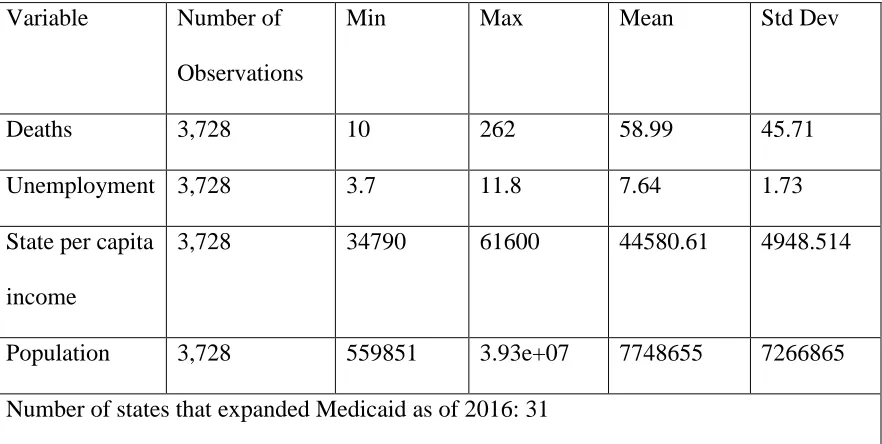
Table 3.1: Summary Statistics
Variable Number of
Observations
Min Max Mean Std Dev
Deaths 3,728 10 262 58.99 45.71
Unemployment 3,728 3.7 11.8 7.64 1.73
State per capita
income
3,728 34790 61600 44580.61 4948.514
Population 3,728 559851 3.93e+07 7748655 7266865
Number of states that expanded Medicaid as of 2016: 31
Table 3.1 shows that in the average state, there are approximately 59 heart attack
deaths among individuals less than 65 years old per month. The mean monthly
unemployment rate is 7.64%. The mean per capita income of each state is $44580.61.
The mean population of each state is 7748655.
Our treatment variable was constructed as a (0/1) indicator for whether the state’s
Medicaid income eligibility in the corresponding state-month was >= 133% of the
Federal Poverty Line (FPL). If the state’s Medicaid income eligibility in a particular
month was below 133% of the FPL then the treatment variable was given a value of 0. If
the state’s Medicaid income eligibility in a particular month was above 133% of the FPL
11
Treatment and Control states are very different. States that expanded Medicaid are
observably different from non Medicaid expansion states in terms of variables that might
affect heart attack mortality. Therefore we cannot simply control treatment and control
states in the post expansion period because they are fundamentally incomparable.
Because of this we used a difference in difference design.
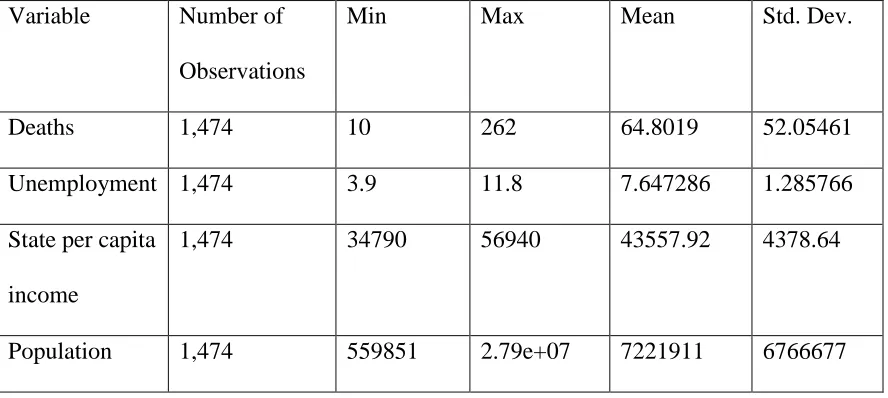
Tables 3.2 and 3.3 serve to illustrate the some of the differences between Non
Medicaid and Medicaid expansion states.
Table 3.2: Summary Statistics for Non Medicaid Expansion States
Variable Number of
Observations
Min Max Mean Std. Dev.
Deaths 1,474 10 262 64.8019 52.05461
Unemployment 1,474 3.9 11.8 7.647286 1.285766
State per capita
income
1,474 34790 56940 43557.92 4378.64
Population 1,474 559851 2.79e+07 7221911 6766677
Table 3.3: Summary Statistics for Medicaid Expansion States
Variable Number of
Observations
Min Max Mean Std Dev.
Deaths 2,254 10 212 55.19698 40.61577
12 State per capita
income
2,254 35486 61600 45249.4 5180.93
Population 2,254 674526 3.93e+07 8093118 7557763
Although both non Medicaid expansion and Medicaid expansion states have
similar unemployment rates, non Medicaid expansion states had a higher average of heart
attack deaths per month and lower average income than states that expanded Medicaid.
Non Medicaid expansion states also have a lower average population than Medicaid
13 CHAPTER 4:
METHODS
As previously stated, we hypothesize that Medicaid expansion will be negatively
correlated with heart attack mortality. Our reasoning is that since Medicaid expansion has
been shown to lead to an improvement in treatment for conditions such as diabetes and
cardiovascular disease which are linked to heart attacks then Medicaid expansion will
invariably reduce the heart attack mortality rate.
We used the difference in differences model to examine the effect of Medicaid
expansion on the number of deaths from heart attacks by comparing the number of people
who died in each state from 2009 to 2016. Traditionally, in difference in difference
models outcomes are observed for two groups, often referred to as the treatment and
control groups. The treatment group is exposed to the treatment in the second period and
the control group is not exposed to the treatment at all. The average gain in the control
group is subtracted from the average gain in the treatment group. This serves to remove
biases due to innate differences between the treatment control groups as well as biases
caused by time trends.
In our model, states that expanded Medicaid represent the treatment group while
14
Medicaid Expansion states did not expand Medicaid at the same time we deviated
from the standard difference in differences setup to account for the variation in treatment
timing by including time and state fixed effects.
We defined the post expansion period based on the date that each individual state
expanded Medicaid. Of the states included in our analysis 26 expanded Medicaid in
2014, 4 expanded Medicaid in 2015, and 1 expanded Medicaid in 2016.
We use the following equation to estimate the model:
ℎ𝑒𝑎𝑟𝑡 𝑎𝑡𝑡𝑎𝑐𝑘 𝑚𝑜𝑟𝑡𝑎𝑙𝑖𝑡𝑦𝑖𝑡 = 𝛽0+ 𝛽1𝑀𝑜𝑛𝑡ℎ 𝑡 + 𝛽2𝑆𝑡𝑎𝑡𝑒 𝑖 + 𝛽3𝑀𝑒𝑑𝑖𝑐𝑎𝑖𝑑𝑖𝑡 + 𝑢𝑖𝑡
Heart attack mortality is the dependent variable. It refers to the number of people
that died from heart attacks per 100,000 in the state per month. Month refers to month by
year fixed effects. This is a dummy variable that equals 1 for a given month and 0 for
every other month. State refers to state fixed effects. This is a dummy variable that equals
1 for a given state and 0 for every other state. By including state fixed effects we are able
to control for time invariant differences across states, which reduces the chance of
omitted variable bias. Likewise, the inclusion of time dummies allows us to account for
location independent shocks in mortality rates.
Medicaid is a treatment indicator that takes a value of 1 if an individual state
expanded Medicaid at time t (measured in months) and 0 otherwise. Medicaid serves as
the interaction term seen in traditional difference in difference models since it takes into
15
𝑢𝑖𝑡 is an error term and 𝛽3 is the difference in difference estimate that we are
interested in. It measures the change in heart attack mortality in expansion states net of
the change in non expansion states.
In addition, we added three control variables to test the robustness of our model.
This is represented by the following equation:
ℎ𝑒𝑎𝑟𝑡 𝑎𝑡𝑡𝑎𝑐𝑘 𝑚𝑜𝑟𝑡𝑎𝑙𝑖𝑡𝑦𝑖𝑡
= 𝛽0+ 𝛽1𝑀𝑜𝑛𝑡ℎ 𝑡 + 𝛽2𝑆𝑡𝑎𝑡𝑒 𝑖 + 𝛽3𝑀𝑒𝑑𝑖𝑐𝑎𝑖𝑑𝑖𝑡
+ 𝛽4𝑈𝑛𝑒𝑚𝑝𝑙𝑜𝑦𝑚𝑒𝑛𝑡𝑖𝑡 +𝛽6𝑆𝑡𝑎𝑡𝑒𝑃𝑒𝑟𝐶𝑎𝑝𝐼𝑛𝑐𝑜𝑚𝑒𝑖𝑡+ 𝑋𝑖𝑡 + 𝑢𝑖𝑡
Unemployment refers to the monthly unemployment rate of each state. It was
chosen as a control variable because it is a time varying factor that may predict heart
attack mortality and have a trend that overlaps with the place and timing of Medicaid
expansion.
We predict that it is positively correlated with heart attack mortality. This is
because individuals who are employed have access to better medical care than individuals
that are unemployed. Therefore, when the unemployment rate decreases, we predict heart
attack mortality will also decrease.
StatePerCapIncome refers to the yearly per capita personal income of individuals
in each state. It is measured in chained 2012 dollars. State per capita income is also an
indicator of the standard of living of a particular state and can be used to compare the
wealth of a state with others. We believe that it is negatively correlated with heart attack
mortality because people with higher incomes can afford better medical care which
16
𝑋𝑖𝑡 refers to state specific linear time trends for each state. It allows us to account
for the exogenous change in heart attack mortality.
These controls were added to further reduce the omitted variable bias by
accounting for changes in economic conditions and the linear passage of time, both of
which could independently affect heart attack mortality and move along different trends
in different states. Our model is estimated using Ordinary Least Squares with standard
errors clustered by state to account for the possibility of correlation between error terms
within state.
We decided to lag the treatment indicator Medicaid by one year. because we
assume that the effect of Medicaid Expansion on heart attack mortality will appear with a
delay. Our reasoning for this assumption is that some of the benefits of Medicaid that we
discussed previously such as increased access to primary care doctors may not have an
immediate effect on heart attack mortality. This is modeled by the following equation:
ℎ𝑒𝑎𝑟𝑡 𝑎𝑡𝑡𝑎𝑐𝑘 𝑚𝑜𝑟𝑡𝑎𝑙𝑖𝑡𝑦𝑖𝑡
= 𝛽0+ 𝛽1𝑀𝑜𝑛𝑡ℎ 𝑡 + 𝛽2𝑆𝑡𝑎𝑡𝑒 𝑖 + 𝛽3𝑀𝑒𝑑𝑖𝑐𝑎𝑖𝑑𝑖𝑡−1
+ 𝛽4𝑈𝑛𝑒𝑚𝑝𝑙𝑜𝑦𝑚𝑒𝑛𝑡𝑖𝑡 +𝛽6𝑆𝑡𝑎𝑡𝑒𝑃𝑒𝑟𝐶𝑎𝑝𝐼𝑛𝑐𝑜𝑚𝑒𝑖𝑡+ 𝑋𝑖𝑡 + 𝑢𝑖𝑡
𝑀𝑒𝑑𝑖𝑐𝑎𝑖𝑑𝑖𝑡−1 refers to the lagged treatment variable. It measures the change in heart
attack mortality one year from time t, if Medicaid Expansion was implemented at time t.
Finally, we constructed a model that weighed the results by the yearly state
population. This was done to account for the disparities in state populations which may
cause states with smaller populations to have an overly large effect on our results since
17 CHAPTER 5
RESULTS
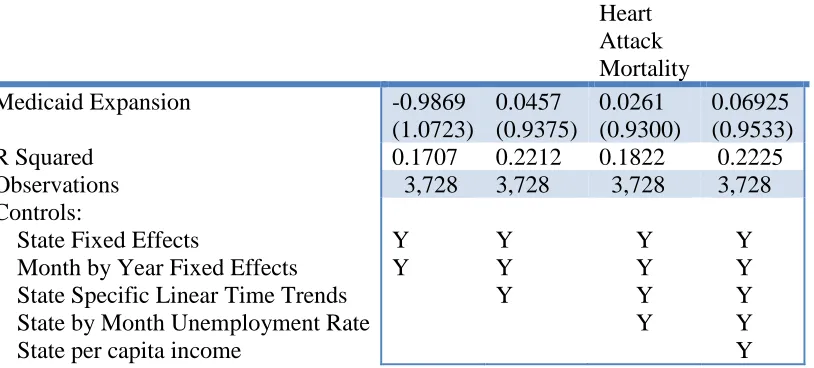
The adjusted difference-in differences estimate for changes in heart attack mortality for
our regression without controls is shown in Table 5.1.
Table 5.1: Effect of Medicaid Expansion on Heart Attack Mortality Heart Attack Mortality
Medicaid Expansion -0.9869
(1.0723) 0.0457 (0.9375) 0.0261 (0.9300) 0.06925 (0.9533)
R Squared 0.1707 0.2212 0.1822 0.2225
Observations 3,728 3,728 3,728 3,728
Controls:
State Fixed Effects
Month by Year Fixed Effects State Specific Linear Time Trends State by Month Unemployment Rate State per capita income
Y Y Y Y Y Y Y Y Y Y Y Y Y Y
Note: Standard errors appear in parenthesis and are clustered by state. Significance is at alpha = 0.05
With a coefficient of -0.9869, Medicaid expansion is shown to have reduced the
heart attack mortality rate by nearly one death per 100,000 per month. However, it is
statistically insignificant at the 5% significance level.
The sign of the coefficient of Medicaid becomes positive, when state specific
18
increase in the number of heart attack deaths per month. However, it remains
statistically insignificant at the 5% significance level.
When the state by month unemployment rate is added to the model, the
coefficient of Medicaid remains positive but falls slightly. Unemployment is positively
correlated with heart attack mortality which means that an increase in the unemployment
rate will lead to an increase in heart attack rates. Both coefficients are statistically
insignificant at the 5% significance level.
The coefficient of Medicaid remains positive and increases slightly when state
per capita income is added to the model. State per capita income is negatively correlated
with heart attack mortality implying that an increase in state per capita income will cause
a decrease in heart attack mortality.
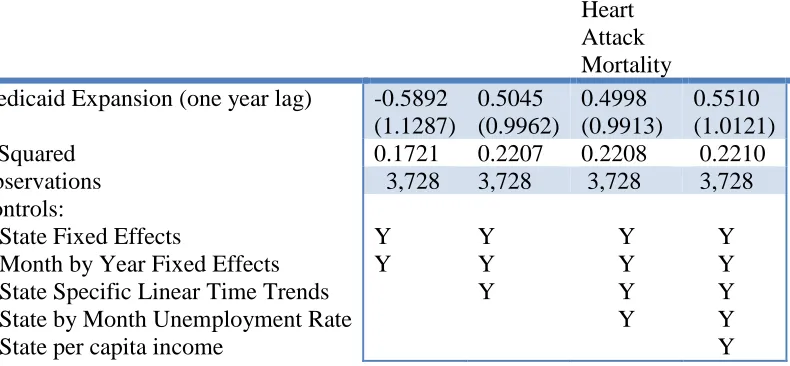
The results of our model with a lagged treatment variable are shown in Table
5.2:
Table 5.2: Effect of Medicaid Expansion on Heart Attack Mortality with a one year time lag added to the model.
Heart Attack Mortality Medicaid Expansion (one year lag) -0.5892
(1.1287) 0.5045 (0.9962) 0.4998 (0.9913) 0.5510 (1.0121)
R Squared 0.1721 0.2207 0.2208 0.2210
Observations 3,728 3,728 3,728 3,728
Controls:
State Fixed Effects
Month by Year Fixed Effects State Specific Linear Time Trends State by Month Unemployment Rate State per capita income
19
Note: Standard errors appear in parenthesis and are clustered by state. Significance is at alpha = 0.05
With a coefficient of -0.5892, Medicaid expansion is shown to have
reduced the heart attack mortality rate by nearly approximately 0.6 death per 100,000 per
month which is less than the value that we obtained without the time lag. It is statistically
insignificant at the 5% significance level.
Like in our model without the time lag, the sign of the coefficient of Medicaid
becomes positive, when state specific linear trends are added to the model. However, the
magnitude is much larger. It remains statistically insignificant at the 5% significance
level.
Similarly, when the state by month unemployment rate is added to the model, the
coefficient of Medicaid remains positive but falls slightly. It is not statistically significant
at the 5% significance level. State per capita income is also statistically insignificant at
the 5% significance level.
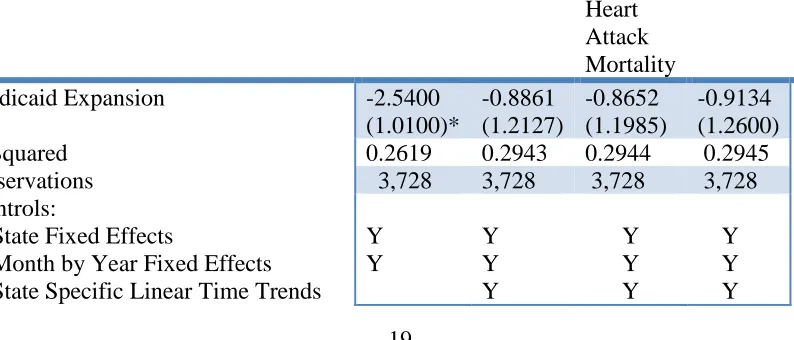
The results of our model with state populations used as weights are shown in Table 5.3:
Table 5.3: Effect of Medicaid Expansion on Heart Attack Mortality With State Populationsused as Weights
Heart Attack Mortality
Medicaid Expansion -2.5400
(1.0100)* -0.8861 (1.2127) -0.8652 (1.1985) -0.9134 (1.2600)
R Squared 0.2619 0.2943 0.2944 0.2945
Observations 3,728 3,728 3,728 3,728
Controls:
State Fixed Effects
Month by Year Fixed Effects State Specific Linear Time Trends
20 State by Month Unemployment Rate
State per capita income
Y Y
Y Note: Standard errors appear in parenthesis and are clustered by state. Significance is at
alpha = 0.05
With a coefficient of -2.5400, Medicaid expansion is shown to have reduced the
heart attack mortality rate by approximately 2.5 death per 100,000 per month. It is
statistically significant at the 5% significance level.
When state specific linear trends are added to the model the coefficient of
Medicaid falls to -0.8861. However, unlike in our previous two cases it remains negative.
It is statistically insignificant at the 5% significance level.
When the state by month unemployment rate is added to the model, the
coefficient of Medicaid remains negative but falls slightly. The coefficient if Medicaid
remains statistically insignificant at the 5% significance level/
The coefficient of Medicaid remains negative and increases slightly when state
per capita income is added to the model. However, it remains statistically insignificant at
the 5% significance level.
Figure 5.1 is a graphical representation of the number of heart attack
deaths per month in states that did not expand Medicaid and those that expanded
Medicaid. The vertical line represents the beginning of Medicaid Expansion in 2014.
From the graph we can see that Medicaid Expansion only had a slight effect on heart
21
22 CHAPTER 6:
DISCUSSION
Using difference in differences we modelled the effect of Medicaid expansion on
heart attack mortality. In order to reduce omitted variable bias we included state and time
fixed effects. In addition, we also included linear state specific time trends, the monthly
unemployment rate, and state per capita income for each state to check the robustness of
our model. In all cases we found that Medicaid expansion has a statistically insignificant
effect on heart attack mortality.
Furthermore, we conducted regression analysis that incorporated a lagged
treatment indicator and we weighted the results by the state year population. In the case
with the lagged treatment variable, we found that Medicaid Expansion had a statistically
insignificant effect on heart attack mortality. In the case where we weighted the results by
the state year population, we found that although Medicaid Expansion had a statistically
significant effect on heart attack mortality in our initial regression, the effect of Medicaid
Expansion becomes statistically insignificant when controls are added to the model.
However, our model is not without limitations. For example, the data we used
23
Medicaid or employment status. In addition, apart from Medicaid expansion there were
other provisions of the Affordable Care Act that allowed moderate and low income
individuals to purchase health insurance with the help of tax subsidies. This might have
lessened the effect of Medicaid expansion on heart attack mortality.
There is evidence to support our findings. For example, the Oregon Medicaid
Experiment found that increased access to Medicaid had no effect on the 10 year risk of
cardiovascular events. In addition, Niedzwiecki, Hsia, and Shen found that patients
insured by Medicaid are less likely to receive more effective but expensive treatments for
heart attacks such as percutaneous coronary intervention (PCI) or coronary artery bypass
graft. They also found that patients with Medicaid who suffered heart attacks have a
higher 30 day readmission rate and mortality rate, even when comparing patients within
the same hospital (Niedzwiecki, Hsia, & Shen, 2018).
Hannan et al obtained similar results. They found that Medicaid patients were less
likely to be admitted to hospitals that were certified to perform PCI than those with other
forms of insurance. This discrepancy in care could lessen the effect of Medicaid
24 CHAPTER 7
POLICY IMPLICATIONS
Although Medicaid expansion provided millions of people with access to
healthcare there are disparities in the treatment that Medicaid patients receive compared
to patients covered by private insurance. This is especially true for those who suffer heart
attacks. As previously stated, research has shown that those covered by Medicaid are less
likely to receive expensive treatments such as PCI or coronary artery bypass graft and
generally suffer worse health outcomes than those covered by private insurance. We
believe that this contributed to the negligible effect of Medicaid expansion on heart attack
mortality.
Policymakers should be made aware of these disparities in care and institute
healthcare reforms that focus on increasing both access to and quality of care for people
with heart disease. In conclusion, although Medicaid expansion gave millions of people
access to healthcare it did not affect heart attack mortality. Further research should be
25
WORKS CITED
Courtemanche, C., Marton, J., Ukert, B., Yelowitz, A., & Zapata, D. (2017). Early impacts of the Affordable Care Act on health insurance coverage in Medicaid expansion and non‐expansion states. Journal of Policy Analysis and Management, 36(1), 178-210.
Critical Coverage for Heart Health: Medicaid and Cardiovascular Disease. (2012, February). Retrieved May 11, 2018, from https://www.heart.org/idc/groups/heart-public/@wcm/@adv/documents/downloadable/ucm_426261.pdf
Finkelstein, A., Taubman, S., Wright, B., Bernstein, M., Gruber, J., Newhouse, J. P., ... & Oregon Health Study Group. (2012). The Oregon health insurance experiment: evidence from the first year. The Quarterly journal of economics, 127(3), 1057-1106.
Ghosh, A., Simon, K., & Sommers, B. D. (2017). The effect of state Medicaid expansions on prescription drug use: evidence from the Affordable Care Act (No. w23044). National Bureau of Economic Research
Hannan, E. L., Zhong, Y., Walford, G., Jacobs, A. K., Venditti, F. J., Stamato, N. J., ... & KING III, S. B. (2013). Underutilization of Percutaneous Coronary Intervention for ST‐E levation Myocardial Infarction in Medicaid Patients Relative to Private Insurance
Patients. Journal of interventional cardiology, 26(5), 470-481.
Heart Attack Facts & Statistics | cdc.gov. (2018). Cdc.gov. Retrieved 4 April 2018, from https://www.cdc.gov/heartdisease/heart_attack.htm
Heart Attack - Symptoms and Causes. (2018). Mayo Clinic. Retrieved 4 April 2018, from https://www.mayoclinic.org/diseases-conditions/heart-attack/symptoms-causes/syc-20373106
Robert Kaestner (2016) Did Massachusetts Health Care Reform Lower Mortality? No According to Randomization Inference, Statistics and Public Policy, 3:1, 1-6, DOI: 10.1080/2330443X.2015.1102667
Kaufman, H. W., Chen, Z., Fonseca, V. A., & McPhaul, M. J. (2015). Surge in newly identified diabetes among Medicaid patients in 2014 within Medicaid expansion states under the Affordable Care Act. Diabetes Care, dc142334.
26
Medicaid: Changes under the Affordable Care Act. (2017, May 03). Retrieved from http://www.healthreformtracker.org/medicaid-changes-under-the-affordable-care-act/#Before the ACA
Miller, S., & Wherry, L. R. (2017). Health and access to care during the first 2 years of the ACA Medicaid expansions. New England Journal of Medicine, 376(10), 947-956. National Research Council. (2009). America's uninsured crisis: consequences for health and health care. Washington, DC: The National Academic. Retrieved May 24, 2018 from Niedzwiecki, M. J., Hsia, R. Y., & Shen, Y. C. (2018). Not All Insurance Is Equal:
Differential Treatment and Health Outcomes by Insurance Coverage Among Nonelderly Adult Patients With Heart Attack. Journal of the American Heart Association, 7(11), e008152.
Rogers, C. K., & Zhang, N. J. (2017). An Early Look at the Association Between State Medicaid Expansion and Disparities in Cardiovascular Diseases: A Comprehensive Population Health Management Approach. Population health management, 20(5), 348-356