University of South Carolina
Scholar Commons
Theses and Dissertations
2017
Ninth-Grade Students’ Perceptions Of Social
Media Responsibility & Cyberbullying
Geoffrey A. Wagner
University of South Carolina
Follow this and additional works at:https://scholarcommons.sc.edu/etd Part of theCurriculum and Instruction Commons
This Open Access Dissertation is brought to you by Scholar Commons. It has been accepted for inclusion in Theses and Dissertations by an authorized administrator of Scholar Commons. For more information, please [email protected].
Recommended Citation
NINTH-GRADE STUDENTS’ PERCEPTIONS OF SOCIAL MEDIA RESPONSIBILITY & CYBERBULLYING
by
Geoffrey A. Wagner
Bachelor of Science Winthrop University, 2005
Master of Education Columbia College, 2011
Submitted in Partial Fulfillment of the Requirements
For the Degree of Doctor of Education in
Curriculum and Instruction
College of Education
University of South Carolina
2017
Accepted by:
Susan Schramm-Pate, Major Professor
Kenneth Vogler, Committee Member
Suha Tamim, Committee Member
Vic Oglan, Committee Member
ACKNOWLEDGEMENTS
Thank you to my wife, Brigitte, and our son, Anderson, for their patience with me
over the years as I partook in this journey. Also, thank you to Dr. Matthew Phillips for
allowing me to bend his ear on multiple occasions and his willingness to suffer through
reading rough drafts of my work. Thank you also to Mr. Gales Scroggs, Mrs. Bethann
Rohaly, and Mr. Bill Geiler for providing me with their time, space, and students.
Without them this study would not be possible. In addition, I would like to thank Dr.
Susan Schramm-Pate, and the other University of South Carolina faculty members who
have guided me through the Doctor of Education program. Thank you for your
ABSTRACT
At Upstate High School (pseudonym) in South Carolina, incidences of cyberbullying are on the
rise. This explanatory action research study was implemented with the purpose of raising
awareness of social media responsibility among ninth-grade high school students along with
determining what these students’ perceptions of social media responsibility and cyberbullying.
The study was conducted during the Fall semester of 2016 with a single group of 105 9th grade
students at a high school in the upstate of South Carolina. Students who participated in the study
completed an 85-item questionnaire to provide such quantitative information as their
demographics, social media usage, self-esteem, methods of cyber bullying, and attitudes toward
cyberbullying. Upon completion of the survey, four student participants were chosen based upon
their experiences with cyberbullying to participate in a semi-structured interview to gather
qualitative information about their opinions of social media, cyberbullying, and the safe usage of
social media. The findings of the study showed that most students struggled to provide examples
of responsible social media usage, yet most were aware of the harm that misuse of social media
may cause their peers. Upon completion of the study both teachers and school administrators
were presented with the findings and in turn an Action Plan was then designed to strengthen the
school’s policy on cyberbullying, in addition to raising awareness in the school community about
the dangers of irresponsible use of social media.
TABLE OF CONTENTS
ACKNOWLEDGEMENTS... iii
ABSTRACT ... iv
LIST OF TABLES ... viii
CHAPTER 1 INTRODUCTION ...1
PROBLEM OF PRACTICE STATEMENT ...2
RESEARCH QUESTION & OBJECTIVE ...3
PURPOSE OF THE STUDY ...3
SCHOLARLY LITERATURE ...3
KEY WORDS/GLOSSARY ...4
POTENTIAL WEAKNESSES...5
THE SIGNIFICANCE OF THE STUDY ...6
CONCLUSION ...6
CHAPTER 2 RELATED RESEARCH & LITERATURE REVIEW ...8
THEMES & IDEAS ...9
PROBLEM OF PRACTICE ...20
POINTS OF VIEW ...20
SUMMARIES OF LITERATURE ...21
PRIMARY & SECONDARY SOURCES ...25
METHODOLOGIES ...26
CONCLUSION ...26
CHAPTER 3 METHODOLOGY FOR QUANTITATIVE STUDIES ...28
ACTION RESEARCH DESIGN...28
RESEARCHER ...29
SAMPLE ...29
SETTING ...31
INSTRUMENTATION & MATERIALS ...32
DATA COLLECTION ...35
DATA ANALYSIS & REFLECTION ...37
CONCLUSION ...38
CHAPTER 4 FINDINGS & IMPLICATIONS ...39
DATA COLLECTION STRATEGY...39
ONGOING ANALYSIS & REFLECTION ...40
REFLECTIVE STANCE ...40
DATA ANALYSIS...41
CODING ...52
DATA INTERPRETATION...52
ANSWERING THE RESEARCH QUESTION ...57
CONCLUSION ...58
CHAPTER 5 SUMMARY, CONCLUSIONS, & ACTION PLAN ...59
ACTION RESEARCHER ...60
DEVELOPING AN ACTION PLAN ...61
ACTION PLAN ...62
FACILITATING EDUCATIONAL CHANGE ...68
SUMMARY OF RESEARCH FINDINGS ...69
SUGGESTIONS FOR FUTURE RESEARCH ...71
CONCLUSION ...72
REFERENCES ...74
APPENDIX A – ONLINE QUESTIONNAIRE ...82
APPENDIX B – SEMI-STRUCTURED INTERVIEW ...96
LIST OF TABLES
Table 3.1 Ethnicity & Gender of Participants ...30
Table 4.1 Impact of Cyberbullying Versus Traditional Bullying ...48
Table 4.2 Likelihood of Cyberbullying to be Noticed by Adults ...49
Table 4.3 Percentages of Participants Encountering Sexist Comments ...50
CHAPTER 1 INTRODUCTION
Online or off-line, ninth-grade students at Upstate High School (UHS) constantly
interact with their peers. School personnel see and hear them discussing everything from
their chemistry exams to plans for after the game on Friday night. These 14-year-olds
have a desire to connect with one another. Under Erik Erikson’s (1950; 1959) view of
psychosocial development this age group is categorized by building peer relations to help
develop a sense of identity. To establish identity requires individual effort in evaluating
personal assets and liabilities, and in learning how to use these to achieve a clear concept
of who one is and what one wants to become (Rice, 1999). Communication is one form
of adolescent identity development and in 2016, the students in the present study
communicate with each other using the internet connected to ‘apps’ or programs often
referred to at the time of the writing of this dissertation as ‘social media’.
Social media is often defined as people connecting with others using electronic
communication (Prevention Researcher, 2011). By using social media application such
as Twitter and Facebook, students are connected to each other today in a way that is
unprecedented. The advent of technology and social media has brought new ways to stay
connected around the globe. Going ‘online’, enables these teenagers to stay connected
with their friends and family, build relationships with people of similar interests, and
However, this migration into the digital realm is not without its drawbacks, the
most common of which is cyberbullying. Cyberbullying is often defined as
bullying through e-mail, instant messaging (IM), in a chat room, on a Web site,
on an online gaming site, or through digital messages or images sent to a cellular
phone. (Kowalski et al., 2012, p. 1)
To combat this trend many educators are now attempting to educate students in proper
social media responsibility, which is also known as digital citizenship. According to
Oxley, digital citizenship is defined as the “norms of appropriate, responsible behavior
with regard to technology use” (2010, p. 1). These norms can be found in multiple
aspects of social media use, from understanding the appropriate use of photographs to
knowing how shared content can be stored indefinitely in cyber space. By clearly
defining and reinforcing the expected norms, parents/guardians, and teachers at UHS can
help students be responsible on social media.
PROBLEM OF PRACTICE STATEMENT
The identified problem of practice for the present action research study involves a
high school in the upstate of South Carolina, referred to as “Upstate High School”
(pseudonym). Within this school ninth-grade students were found to have reported more
instances of being bullied and harassed online than in person, eight reports a year of
online bullying compared to only five listed as “traditional” bullying, where “traditional”
bullying is often defined as physical aggression, such as hitting/kicking, or verbal
aggression, such as teasing/taunting (Smith, 2008). While these reports are small
compared to a population of 595 ninth-grade students, they highlight the growing trend of
RESEARCH QUESTION & OBJECTIVE
Based upon this problem, the primary research question for this study is, What are
ninth-grade students’ perceptions of social media responsibility and cyberbullying? By
answering this research question, this study provides insight into the usage and awareness
that ninth-grade students have about social media. This understanding may influence the
ways in which UHS ninth-grade students view social media responsibility. The study
may also inform teachers, school administrators, and parents/guardians about the
experiences that these students have online and how to best keep them safe.
PURPOSE OF THE STUDY
The primary purpose of the present study is to describe the perceptions of
ninth-grade students, at UHS, views of social media responsibility. The secondary purpose is
to influence UHS policy to raise awareness of the dangers of cyberbullying and educate
students on social media responsibility. The tertiary purpose is to create an Action Plan
in conjunction with the ninth-grade students to raise awareness about cyberbullying and
to create strategies and tips to help students be responsible online.
SCHOLARLY LITERATURE
Prior to the implementation of this study background research was conducted on
related concepts that would also be crucial to the understanding of this study. These
themes and concepts assisted in providing context for the present Action Research study,
as well as providing scholarly literature in which to ground the theories and findings in.
These concepts include Rosenberg’s adolescent self-esteem (1965), social media usage
Smith, 2008). These themes are elaborated on in Chapter Two and provide the basis for
this study.
As an explanatory mixed-method Action Research study, as defined by Mertler
(2014), this study followed the framework and by using quantitative data ‘polyangulated’
with qualitative data. For example, this study first acquired quantitative data from a set
of 105 ninth-grade students, and then elaborated on this data by also collecting qualitative
data through semi-structured interviews. Mertler writes,
In an explanatory mixed-methods design, the educator-researcher first collects
quantitative data and then gathers additional qualitative data in order to help
support, explain, or elaborate on the quantitative results. (p. 104)
By collecting two sets of data, the research answered the question, What are ninth-grade
students’ perceptions of social media responsibility and cyberbullying?
KEY WORDS/GLOSSARY
Adolescence - a period of typically between 13- and 19-years of age in which a child
transitions into an adult (Rosenberg, 1965).
Cyberbullying – deliberately using digital media to communicate false, embarrassing, or
hostile information about another person. It is the most common online risk for all teens
and is a peer-to-peer risk (O’Keeffe& Clarke-Pearson, 2011).
Digital Citizenship - a concept, which helps teachers, technology leaders, and parents to
understand what students/children/technology users should know to use technology
appropriately (Ribble, 2010, p. 1).
Digital Native – people who are “native speakers” of the digital language of computers,
Digital Footprint – the collective, ongoing record of one’s activity as they visit various
sites on the Internet (O’Keeffe& Clarke-Pearson, 2011).
Self-concept - one’s description of one’s self and appraisals of competencies within
various domains (Kort-Butler & Hagewen, 2010).
Self-esteem – individual’s conscience beliefs, opinions, attitudes, values, and feelings
about themselves (Rosenberg, 1971).
Social Identity - an individual’s self-concept that derives from his knowledge of his
membership of a social group (or groups) together with the emotional significance
attached to that membership (Tajfel, 1978).
Social Media - involves people connecting with others using electronic communication
(Prevention Researcher, 2011).
Social Networking Sites (SNS) - web-based services that allow individuals to (1) construct
a public or semi-public profile within a bounded system, (2) articulate a list of other users
with whom they share a connection, and (3) view and traverse their list of connections
and those made by others within the system (Boyd & Ellison, 2007, p. 211).
POTENTIAL WEAKNESSES
Several potential weaknesses exist within this study, the first being the scope of
the study. As this study only examines 105 ninth-grade students at one specific high
school, it does not generalize their perceptions of social media responsibility on to a
larger population. This limitation on the sample size of the study was necessary based
upon time constraints of data collection and access to student participants. Another
weakness evident in this study, and addressed in later Chapters, is the assumption that all
weaknesses, the resulting Action Plan created from this study still has potential to
positively affect students at UHS and assist them in using social media in a responsible
manner.
THE SIGNIFICANCE OF THE STUDY
This study’s potential impact can reshape the views of UHS personnel including
teachers and administrators regarding educating students on the usage and dangers of
social media. By bringing to light the perceptions that students have about using social
media in a responsible manner, along with identify experiences that students have with
cyberbullying, this study will support the need to properly educate students about
responsible social media usage and how to stay safe online. This influence can be
applied in the creation of school policies, like student handbooks, as well as in the
curriculum that is taught in the classrooms.
Along with the potential to directly affect school policy and curriculum, this
study’s significance can also be felt among students. This study supports the theme of
social justice by bringing awareness to the digital environment where students may
encounter comments of a sexist, racist, or homophobic nature. Providing awareness of
the issues that adolescents face online, and by offering students strategies to deal with
offense content, this study can help students at UHS create a more positive online
environment for themselves.
CONCLUSION
This explanatory mixed-method Action Research study, as defined by Mertler
(2014), examines the perceptions that ninth-grade students have about social media
Chapters. Chapter Two contains a review of scholarly literature that provides context for
the study as well as the major themes present in the study. Chapter Three includes the
methodology for the study and details the sample, setting, and data collection of this
Action Research study. Chapter Four is comprised of the findings and implications of the
study, including analysis and interpretation of the data collected. Chapter Five contains
the summary, conclusion, and Action Plan of the study as well as discussion on the role
of an action researcher and suggestions for future research. Together these Chapters
detail the Action Research study conducted at Upstate High School and the purpose of
this study in understanding what student perceptions of social media responsibility and
CHAPTER 2
RELATED RESEARCH & LITERATURE REVIEW
Chapter Two of this Action Research study includes a discussion of the scholarly
literature to theoretically ground and historically contextualize the identified problem of
practice which involves an investigation into the use of responsible social media usage in
Upstate High School (pseudonym). The scholarly literature on social media and its
relationship to self-esteem provides a deeper understand of how teenage students today
are using social media and how it affects them, both positively and negatively (i.e.
self-esteem). Some of the social media studies concentrated on academic grades, gender or
race, some on attendance, and even others on the type of programs used. These previous
studies have helped in narrowing this research topic to focus solely on ninth-grade
student usage of social media and their perceptions of social media responsibility and
cyberbullying. Further research has also confirmed that the topic of social media is an
area of high interest for teachers and parents/guardians, and will continue to be a relevant
topic in the foreseeable future. The major themes found in this Chapter are Adolescence,
Self-Esteem, Contemporary Media & Identifies, Social Media, Social Media
Responsibility, and Cyberbullying. These themes provide the context and basis for this
Action Research study, which examines the perceptions of social media responsibility
THEMES & IDEAS
ADOLESCENCE THEORIES. Adolescence, by many people, is often seen as a
crucial time for development in children, and one that has many ups and downs. Along
with the physical changes that children go through, there are conflicts that happen
internally and externally that can shape a child’s personality and affect their ideas of
self-worth that have been studied for decades. For example, according to Jerslid over 50
years ago,
One of the tasks of the adolescent is a continuing endeavor to find himself [sic].
This means, among other things, a growing understanding of who and what he
[sic] is, of his [sic] resources and limitations, his [sic] prospects and his [sic]
hopes. (Jerslid, 1963, p. 17)
Based on this foundational study of adolescents Mitchell (1986) later observed that “the
adolescent is growing an identity, but for the most part, he [sic] is not sure what the
building blocks of that identity are or what the final product will be” (p. 24). In the 21st
century, the literature on adolescents includes the perceptions, conceptions, and attitudes
of teenagers regarding the World Wide Web and access to social media 24 hours a day
seven days a week. This continual access has changed the way adolescents develop their
identity and it has impacted their self-esteem. Issues such as cyberbullying and sexting
on websites such as Facebook, Twitter, and Instagram can be found in prominent
scholarly journals, such as Developmental Psychology, Journal of Social Psychology, and
Journal of Research on Adolescence.
Jerslid’s early literature on identity theory and his view of the ways in which
that a person thinks in the words: I, me, mine, and myself (Jerslid, 1963). As students’
progress through the stage of adolescence they are discovering themselves and who they
are. By not knowing who they are they can often seem confused by those looking from
the outside in on adolescents. For example, when “adults learn that young people do not
always want to be themselves. Even though they say that they want to let their real self
shine forth, many adolescents simply do not know what their real self is” (Mitchell, 1986,
p. 25). It is through their interactions with others that they come to develop more identity
about who they are.
Rosenberg (1965) is another early foundational scholar in the area of identity
development in adolescence. He said that one of the many challenges faced by
adolescents is that it’s a “period of unusual status ambiguity. Society does not have a
clear set of expectations for the adolescent” (Rosenberg, 1965, p. 4). This leads the child
to look outwards for support, which is satisfied by friends and family. “There are a few
things an adolescent prizes more than to be accepted by his peers” (Jerslid, 1963, p. 209).
Due to this need for acceptance the “peer group exerts greatest control during the early
adolescent years” (Mitchell, 1986, p. 23). This peer group may provide an advantage to
the adolescent by sharing interests and values, but could also be a disadvantage in that
some adolescents could feel the need to give up rights and their values to feel accepted
(Jerslid, 1963). “In facing the possibility of being accepted or rejected by others the
adolescent . . . usually has a certain amount of freedom in choosing where he [sic] will go
and whom he [sic] will seek out in order to gratify his [sic] need for approval and to
escape the pain of disapproval” (p. 20). This need for acceptance by others will continue
even while retaining a mind of his own, will be sensitive to what others think and feel
about him [sic]” (p. 19).
The process of adolescence in which a person “becomes a ‘socialized’ member of
his age group is essential to healthy development, but it may involve disadvantages” (p.
209). Even though the experiences will vary from person to person, “on the whole, we
may conclude that youth not only worry about what their peers expect of them, they also
worry about themselves because they often do not know what to expect from themselves”
(Mitchell, 1986, p. 25). This searching leads them to seek out peers to associate with;
sometimes this is through face-to-face extracurricular activities, or in today’s age of
technology this can also be done through social media. This identification through media
was even evident in this early literature on identity. For example, Sommer (1978)
observed that “in the search for identity the young person often tries out various roles and
engages in over-identification with . . . media idols” (p. 108).
Erik Erikson stated that puberty is like “precipitating a crisis of identity because
of the difficulty of maintaining a sense of continuity through change” (as cited in
Sommer, 1978, p. 109). This stage of life for students is marked with uncertainty and
confusion. One of the reasons for this confusion is that “the question ‘Who am I?’ takes
on an increased salience with the development of more abstract thought, and also because
interest in others is increasingly” (p. 109). This search for identity often leads
adolescents to look outwards for guidance and answers.
Even in 1978 this outward search for identify often led to media usage. Sommer
(1978) observed, “young people spend a great deal of time attending to the media” (p.
radio and movies of the 1970s. Not only have the ways in which teenagers accessed
media changed, but the values that they learn have as well, this is because “the values of
pubescents reflect in large part those of surrounding society” (Sommer, 1978, p. 112).
These values, regardless of what they are, help to shape their identity and their feelings of
self-worth.
SELF-ESTEEM THEORIES. The historical scholarly literature on teenagers’
search for identity, and their desire to be accepted by their peers has been studied since
the mid-20th century and can be connected to teenage life after World War II and the
Civil Rights Movement, both of which factor into how post- Cold War and post 9/11
adolescents view themselves today. For many adolescents, their self-esteem becomes
very dependent on the approval of their peers. Mitchell illustrated 30 years ago the fact
that “self-definition and self-esteem are unalterably linked with peer acceptance”
(Mitchell, 1986, p. 24). Rosenberg (1965) and Jerslid (1963) illustrated 50 years ago that
that “during adolescence, a person’s dealing with his peers becomes even more
significant” (Jerslid, 1963, p. 207) and that because of this desire to fit in, “the
individual’s self-opinion is largely determined by what others think of him [sic]”
(Rosenberg, 1965, p. 25). “Between about 15 and 18 years of age the individual tends to
be keenly concerned with his self-image” (p. 3). It is this idea of self-image that is linked
to self-esteem has been historically documented in the scholarly literature on adolescents
post-World War II.
For example, one of the most cited research reports on self-esteem measurement
is Rosenberg (1965) and the Rosenberg Self-esteem Scale. Rosenberg (1965) defined
(1971) states that measures of high self-esteem expresses feelings of self-satisfaction and
feelings of worth. In contrast, measures of low self-esteem convey the feelings of
inadequacy and being unworthy. This idea of “self” deals with the unconscious attitude
towards self, not any one individual aspect.
It is important to keep in mind that the views on identity from these researchers
came during a time of the civil rights movement in the mid 20th century. Julian Bond
(2014) writes that during that time “common identity comes from individual interaction
in formal and informal social and political networks” (p. 12). The civil rights movements
and the interactions that adolescents had with them would certainly have had an impact
on the researchers studying them and their findings.
More current theories on self-esteem in high school students indicate that students
with high levels of self-esteem also have higher levels of respect for others. Yelsma &
Yelsma (1998) using both the Rosenberg Esteem Scale and the Coopsmith
Self-Esteem Inventory found “evidence that people with high self-esteem are more
predisposed than those with low self-esteem to have positive affective orientations and
positive relationships” (p. 431). Another report from Wigfield, Eccles, Mac Iver,
Reuman, & Midgley (1991) points to changes in self-esteem of young adolescents due to
the changes in classroom environments of high school courses. Both older and current
research done on self-esteem in high school lead to the same conclusions, that it is a
challenging time for many students as they learn who they are and the levels of
self-esteem can vary greatly based upon experiences.
However, this search for self is not done in a vacuum. “Changes in self-esteem
friends, and school climate” (Kort-Butler, 2012, p. 13). These can all factor into
development of self-esteem during the high school years. The average high school
student “also desires one or more companions who will accept him [sic] as a person and
share his [sic] concerns” (Jerslid, 1963, p. 21). This desire to join others will often lead
to seeking out like-minded peers, in 2016, this can be done through social media.
CONTEMPORARY MEDIA AND IDENTITIES THEORIES. The engagement
in media today is much different than in 1978. Prior decades would have used radios and
movies, whereas today’s students use smart phones and the Internet. Also in today’s
world “teachers, parents, health providers, and child development experts all agree that
the media children use can have a profound impact – both positive and negative – on
learning, social development, and behavior” (Common Sense Media, 2013, p. 7). It is
because of changes in media formats and the fact that the users of social networking
websites continue to grow rapidly (Miah, Omar, & Allison-Golding, 2012), that it
becomes essential to understand the affects that social media can have on adolescents.
Today’s adolescents are sometimes referred to as “digital natives”, meaning,
“students today are all ‘native speakers’ of the digital language of computers, video
games and the Internet” (Prensky, 2001, p. 1). They are contrasted by “those of us who
were not born into the digital world but have, at some later point in our lives, become
fascinated by and adopted many or most aspects of the new technology are . . . digital
immigrants” (Prensky, 2001). The ‘digital natives’ in today’s high schools have different
experiences because of the technology around them. “A large part of this generation’s
social and emotional development is occurring while on the Internet and on cell phones”
Experiences that students have can change their thinking pattern (Prensky, 2001),
and this in turn changes how they interact with others and the world around them. “We
now know that brains that undergo different developmental experiences develop
differently, and that people who undergo different inputs from the culture that surrounds
them think differently. And while we haven’t yet directly observed ‘digital natives’
brains to see whether they are physically different (such as musicians’ appear to be) the
indirect evidence for this is extremely strong” (Prensky, 2001, p. 1). This would suggest
that students who have higher experiences on social media are going to think differently
about themselves and others.
The dependence on social media has potential to lead to negative effects for
adolescents. “Because of their limited capacity for self-regulation and susceptibility to
peer pressure, children and adolescents are at some risk as they navigate and experiment
with social media” (O’Keeffe & Clarke-Pearson, 2011, p. 800). Coupling this desire with
an unsupervised or unregulated social media account can be harmful. “Recent research
indicates that there are frequent online expressions of offline behaviors, such as bullying,
clique-forming, and sexual experimentation, that have introduced problems such as
cyberbullying, privacy issues, and ‘sexting.’ Other problems that merit awareness
include Internet addiction and concurrent sleep deprivation” (p. 800). Adolescence can
be a difficult time for many students, and with the rise of social media it can be made
even more difficult.
However, there are some positives that can arise from social media usage.
Ellison, Steinfield, and Lampe (2007) found that high usage of social media also related
social media has aided in creating higher feelings of closeness and connectedness in
relationships of people who use them. Lastly, Reich (2010) wrote that people who use
social media sites more frequently felt a stronger sense of community with the groups
they connected with. The ability to connect with others during adolescence is an
important step in helping high school students learn about who they are.
SOCIAL MEDIA. King (2015) defines social media’s brief history by stating
that “social media is somewhere between eleven and nineteen years old” (p. 6). Which
makes it much younger than the older topics of adolescence and self-esteem that are also
present in this Action Research project. King (2015) continues to show the sudden
growth and rise of Internet usage by stating that, “in about twenty-three years (1991
being the beginning of the publicly available web), web usage has morphed from a
handful of academics and researchers to most of the United States” (p. 6). King’s
statement and use to the word ‘most’ can be supported by the reports from Common
Sense Media’s 2012 report, Social Media, Social Life which confirms 90% of 13- to
17-year olds use social media.
Other sources, like the Pew Research Center with their 2011 report on teenage
usage of social media report the same. Lenhart, Madden, Smith, Purcell, Zickuhr, &
Rainie (2011) summarize their findings when they write that because of social
networking, “much of the social activity of teen life is echoed and amplified—in both
good and bad ways” (p. 2). Regardless of the positives or negatives, adolescent usage of
social media is on the rise and shows no sign of slowing down. With the topic of social
media being in its infancy, many researchers are trying to find the answers to how the
SOCIAL MEDIA RESPONSIBILITY. As this shift to social media occurs it
becomes important for teenagers to learn what is considered acceptable behavior in an
online space. Ribble (2014) writes that “All users of technology need to come to grips
with how to use the tools of today and how to become digital citizens” (p. 88). This idea
of digital citizenship is “a concept, which helps teachers, technology leaders, and parents
to understand what students/children/technology users should know to use technology
appropriately” (Ribble, 2010, p. 1). These guidelines can help ensure that student
behavior and actions in an online environment are appropriate for their development and
follow proper social norms. By exemplifying what it means to be a good digital citizen,
adolescents can use “technology in an appropriate way while enjoying its vast capabilities
and becoming more productive” (Ribble, 2014, p. 88).
The educational piece of digital citizenship is crucial since “all users of
technology need to come to grips with how to use the tools of today and how to become
digital citizens” (p. 88). If applied in a classroom, the concepts of digital citizenship are
typically broken into nine elements or themes. These elements are Digital Access,
Digital Commerce, Digital Communication, Digital Literacy, Digital Etiquette, Digital
Law, Digital Rights and Responsibilities, Digital Health and Wellness, and Digital
Security (Ribble, 2010). For this study the focus will be on the Digital Communication
and Digital Etiquette themes.
Ribble (2010) writes that Digital Communication is the electronic exchange of
information. To exemplify the values of a good digital citizenship adolescents should
understand the different avenues available to them in communicating with others, such as
which form of communication to use based upon the situations they are in. The other
element, Digital Etiquette is the standards and procedures of proper use of technology in
communication. Ribble (2010) states that this is often the most complicated because it is
easy to identify misuse and a challenge to educate about the proper use before it begins.
In many cases schools turn to banning the technology without teaching appropriate use of
it.
These themes then need to be taught in schools to ensure that the students are
learning about what it means to interact online appropriately in the 21st century.
Hollandsworth, Dowdy, and Donovan (2011) believe that the “K-12 professional
community must develop common ground that advocates the use of technology in the
classroom while preparing the student to make sound choices both for themselves and for
others in the digital world” (p. 39). Ribble (2014) warns educators against inaction when
stating that, “it is clear that technology use will increase within our schools. If you do not
have a plan for how to teach digital citizenship, it will become a larger issue within your
schools and district. It is important for our students, and for all of us, to understand this
world full of technology and how to work, play and interact within it” (p. 88).
For this to occur policies and standards must be implemented in school
curriculum. It is the “sudden emergence of cyber issues that . . . has created a dire need
for ethical clarity and behavioral policy” (Ohler, 2012, p. 16). Ribble, Bailey, and Ross
(2004) believe that “we must begin somewhere, and because the schools encompass our
future, this is where the discussion begins” (p. 11). These policies and guidelines, “if
aligned with character education, it would lend itself to becoming a good citizen in the
CYBERBULLYING. When the themes of good digital citizenship are not taught,
the possibility of negative consequences can occur. The most common one is
cyberbullying. “Research on this topic is still at an early stage of investigation; the
phenomenon only appeared a few years ago, as the use of electronic devices such as
computers and mobile phones by young people has increased” (Slonje & Smith, 2008, p.
147). Hinuja and Patchin (2008) define cyberbullying as “willful and repeated harm
inflicted through the use of computers, cell phones, and other electronic devices” (p. 5).
Early reports of cyberbullying cited the use of online chat rooms, however “in
recent years, most youth have been drawn to social networking websites (such as
Facebook) and video-sharing websites (such as YouTube). This trend has led to increased
reports of cyberbullying occurring in those environments” (p. 21). Slonjie and Smith
(2008) provide evidence of the four primary methods that are currently used in
cyberbullying. These are: text messaging, email, phone call and picture/video clip.
Despite these multiple avenues, reports of cyberbullying are relatively low, most research
indicates that 10% – 20% of adolescents report being the victim of cyberbullying (Slonjie
& Smith, 2008; Smith, Mahdavi, Carvalho, Fisher, Russell, & Tippett, 2008; Ybarra &
Mitchell, 2004).
Along with research on the methods and frequency of cyberbullying, studies have
also been conducted on the impact of cyberbullying on self-esteem. Patchin & Hinduja,
(2010) and Ybarra, et al. (2007) both found that cyberbullying had a significant negative
impact on student self-esteem. In addition, “while the majority of youth targets of
aggression report being relatively unaffected, a notable one-third of youth harassed online
following the incident” (Ybarra & Mitchell, p. 1308). These studies show that while not
every teenager who uses social media will be a victim of cyberbullying, those who are
will likely feel its effects.
PROBLEM OF PRATICE
The identified problem of practice for the present Action Research study focuses
on the high level of cyberbullying, meaning students who have reported being harassed
online, compared to “traditional” bullying at Upstate High School. Specifically,
administration at UHS reported cyberbullying outnumbered “traditional” bullying eight
to five. While these reports are minor compared to the overall population of the school,
595 students, they highlight the increased trend of student use of social media as a form
of communication.
POINTS OF VIEW
While no previous studies disputed the importance of raising awareness to social
media issues like cyberbullying, some research has touted the positives of social media
usage, while others have warned of the negative side effects. This Action Research study
relates to these previous studies by providing insight into student social media usage,
perceptions of responsible usage, and views of cyberbullying.
Positive views of social media come from studies such as Utz, Tanis, and
Vermeulen (2012) who examined the relationship between social media usage and
self-esteem. Within their study, they found that students who connected with their peers via
social media showed an increase needing of belonging. This “need to belong was found
to positively affect attitudes toward [Social Networking Sites] SNSs” (p. 37). While the
building relationships, there can also be negative that arise through this use of
communication.
To contrast this Valkenburg and Peters (2009) highlight the negative aspects of
social media usage. Within their study Valkenburg and Peters revealed that the
difference in online communication as compared with face-to-face communication can
have consequences. “For example, flaming (hostile and insulting interactions between
Internet users), online harassment, and cyberbullying may all be associated with the
disinhibition that results from the reduced auditory and visual cues in [Computer
Mitigated Communication] CMC” (p. 4). Regardless of the differing points of view, both
studies included disclaimers that more research should be conducted and that the use of
social media should not be categorized as an absolute.
SUMMARIES OF LITERATURE
The major themes found consistent throughout this Action Research study are
Adolescence, Contemporary Media & Identifies, Social Media, Social Media
Responsibility, and Cyberbullying. The data collected both in the quantitative online
questionnaire and the qualitative semi-structured interview, align with the framework
provided by the scholarly literature reviewed in this Chapter. The theories on
adolescence showed that ninth-grade students depended heavily on their peers for identity
formation. The research on contemporary media provided evidence that students use
social media to communicate and connect with their peers, and the social media theories
provided examples of how social media is used and its impact on adolescents who use it.
Reviewing literature about social media responsibility outlined the importance of using
consequences for what occurs when social media responsibility is not followed. This
reviewed literature coupled with this study supports the need for an Action Plan that
address social media awareness at UHS.
VARIABLES
While this Action Research study seeks to describe ninth-grade student
perceptions of social media responsibility, it also examines how these online interactions
may be affected by the race or gender of the student-participants. Previous studies “have
shown significant differences in media use patterns by adolescents’ basic social identities
such as age, gender, and race/ethnicity” (Brown & Bobkowski, 2011, p. 96). In some
situations, adolescents have a choice, and they may choose how they engage in social
media based upon how they view themselves or how their peers participate in social
media. “Indeed, there is fairly modest demographic variation in terms of where teen
social media users maintain their accounts” (Lenhart, Madden, Smith, Purcell, Zickuhr, &
Rainie, 2011, p. 20)
One difference in social media engagement comes in the form of gender. “Girls
prefer to use technology to communicate with each other, text, call, where boys preferred
to use their time to play video games” (Brown & Bobkowski, 2011, p. 96). Within this
aspect of social media, researchers have found that there are differences between male
and female engagements online. “Girls ages 12-13 have the most negative assessment of
social network spaces” (Lenhart et al., 2011, p. 27). This means they report more of the
cruelty they see and are more affected by the experiences they have online. Boys on the
add a new layer in student perceptions of responsible social media usage and suggest that
adolescents experience social media differently based upon their demographics.
Another difference in social media usage is based on race. Lenhart, Purcell,
Smith, and Zickuhr (2010) found in their research that among adolescents who stated
they use the Internet several times a day: 39% were White, 33% Black, and 26%
Hispanic or Latino. This engagement on social media was also different based upon race.
“White teens are more likely than black teens to post comments on their friends’ posts
(90% vs. 80%) and both white and black teens are more likely than Latino teens to post
status updates (among social media using teens 90% of whites, 84% of blacks, and 70%
of Latinos do this)” (Lenhart et al., 2011, p. 23).
Even when adolescents used the same social media platform, there was a
difference in their experience. “Black teens who use social media are more likely than
Latino teens (though not white teens) to say they witness mean behavior on social
network sites “frequently,” with 17% of black teens reporting seeing such behavior, along
with 4% of Latino youth and 11% of white teens” (Lenhart et al., 2011, p. 34). For
example, “black teens are less likely to say their experience is that people their age are
kind to one another on social network sites” (Lenhart et al., 2011, p. 27) and “black teens
are more likely to see others joining in harassment” (p. 42). This difference in race, like
the difference in gender contributes to the way students engage in social media and the
experiences they have with it.
Historically the characteristics of gender and race have been a dividing point both
in society and in the educational setting. The inclusion of these factors in this Action
on social media based upon the gender or race of students at UHS. Throughout this
country’s history “conscious and deliberate actions have institutionalized group identity
in the United States” (Lipsitz, 2013, p. 78) and created dominant and oppressed groups.
“These systems structure both our individual lives and our society” (Weber, 2010, p. 4)
and they also create the inequalities that we see in our world. One example of this is the
educational setting where in “high school, ability group tracking is pervasive and is
highly correlated with race and class” (p. 201). Not only in student academics, but also
“students’ interactions with one another create and reinforce race, class, gender” (p. 202).
Gender inequality has existed and continues to exist is many forms today. Even
after the 1965 Voting Rights Act, which gave women the right to vote, and the 1972 title
IX amendment, which opened “the way for increased participation of women and girls in
athletic programs” (p. 51); there are still defining roles that limit female empowerment.
“These roles form the basis for the structure of oppression of women and girls, or sexism,
in our society” (Hackman, 2013, p. 320). Within the societal created gender roles, it is
the male role that is characterized by strong dominant traits. When coupled with the idea
that men and women are opposite, a “system of gender inequality that benefits men” (p.
318) is created as men being strong and women being weak. However, even though
“women have steadily gained myriad rights regarding the control of their lives and
bodies” (p. 318) the separation still exists.
Racial inequality, like gender inequality, is also still prevalent in our society and
in our educational system. Even after the 1954 Brown v Board of Education decision,
which “strikes down separate but equal doctrine . . . and orders all schools desegregated”
deliberate actions have institutionalized group identity in the United States” (Lipsitz,
2013, p. 78) and created dominant and oppressed groups. This system of oppression
provides advantages to those who have power, and “race, regardless of how it came to be,
is a burden of our society” (Arminio, 2013, p. 126).
While this study has the purpose of describing ninth-grade student perceptions of
social media responsibility, it is imperative that the race and gender of the
participants are also considered. By examining the race and gender of
student-participants and how race and gender may affect social media experiences, this project
provides more insight into inequalities that persist today.
PRIMARY & SECONDARY SOURCES
While the study of social media and its effect on adolescents is still new in the
world of academia there has been a growth of literature written about it. The sources
listed in this Action Research study are based upon experts in the field who have
conducted research directly related to the impact of social media and who have had their
works published in peer reviewed journals such as, Journal of Social Psychology, Journal
of the American Society for Information Science and Technology, and Journal of
Computer-Mediated Communication. By using academic journals in the review of the
related literature, this Action Research study is better able to focus its own purpose and
design a study aligned with already identified themes and concepts. In addition, this
previously published literature can provide context for this Action Research study and
frame its findings with the current body of knowledge regarding responsible social media
METHODOLOGIES
In the creation of this Action Research study the primary reference for study’s
design came from Mertler (2014). Based upon Mertler’s term of ‘polyangulation’ which
means to gather data from multiple sources, Mertler’s definition of an explanatory
mixed-method design was determined to be most suitable for answering the research question,
What are ninth-grade students’ perceptions of social media responsibility and
cyberbullying? This design focuses on “the collection of two types of data” (p. 104),
quantitative and qualitative. “The quantitative data and analysis provide the main focus
for the overall study results; the qualitative data are used to elaborate on, refine, and
further explain the quantitative findings” (p. 104). For this study, the quantitative data
was collected by administering an online questionnaire, and from the results of the
questionnaire a semi-structured interview was designed to collect the qualitative data.
While this Action Research study is based upon previously published scholarly literature,
it is important to note that this study only “captures opinions and such, during a fleeting
moment in times” (p. 97) at UHS.
CONCLUSION
The quality and breadth of research already conducted about the topics of
adolescent development, social media, cyberbullying, and self-esteem show that this is an
area of high interest and concern for those in the field of education. This prior research
has also shown the validity of these concerns and that they are a factor in the
development of teenage identity. Therefore, this Action Research study fits into these
themes by combining student social media usage with perceptions of social media
of education, with a more comprehensive look at ninth-grade student online
communication. The results of this study, though focused specifically on UHS, can be
added to these fields of literature to further support the understanding of adolescent usage
of social media and perceptions of social media responsibility in contemporary
CHAPTER 3
METHODOLOGY FOR QUANTITATIVE STUDIES
In Chapter Three of this Action Research study an explanation of the
methodology, sample, setting, and data collection will be presented. In order to answer
the question, What are ninth-grade students’ perceptions of social media responsibility
and cyberbullying? an online questionnaire and a semi-structured interview was, was
designed and administered to collect data. The questionnaire, or survey, was used to
collect quantitative data and acquire information about ninth-grade student views on
social media usage and cyberbullying. Following the quantitative survey a qualitative
semi-structured interview was conducted among four of the student-participants for
clarification. These two sets of data were joined by artifacts collected from school
administrators to successfully “polyangulate” (Mertler, 2014) the findings. These
findings were then used to create an Action Plan that served to increase social media
awareness to students and educators at Upstate High School (UHS).
ACTION RESEARCH DESIGN
The design of this project is an explanatory mixed-method design based upon
Mertler’s (2014) definition, which focuses on gathering both quantitative and qualitative
data. This design was chosen due to knowledge that “both types of data may provide a
better understanding of the research problem than either type of data alone.” (p. 96). The
aim of the project is to provide a description of how students view the concept of social
Action Research study can accomplish that goal. Since this study is not attempting to
prove any correlation or make comparisons no other designs would suit this need.
RESEARCHER
As an Action Researcher, and leader of this project, my role was to develop
appropriate measures based upon previous studies, administer the questionnaire to collect
the data, reflect on the findings, and follow-up with specific student-participants for
clarification. By basing the measures of this study after examples that had already been
tested and proven reliable, this study can assume that the data collected will be reliable
and relevant to the study. In addition, my role as the leader in the Action Research study
requires reflection with the participants. In the case of this study four student-participants
were interviewed for clarification on answers from the questionnaire as well as the school
administration to review the findings and discuss a suitable Action Plan to address the
needs. As an Action Researcher for an explanatory mixed-method study it is also
important for me to remember that these opinions are a sampling of opinions from a
single moment in time, and as such could be subject to change if the study was replicated.
However, by using an explanatory mixed-method design, as defined by Mertler (2014),
this Action Research study serves its purpose in identify ninth-grade student perceptions
of social media responsibility at UHS.
SAMPLE
To gather data for this Action Research study a convenience sample of 105
ninth-grade students was taken from four High School 101 Course at UHS. Each student in
these four classes was given a parent permission slip which outlined the study as well as
students who wished to participate were required to have the permission slip signed and
returned within a two-week window. Only the students with signed and returned
permission slips could participate in the study. This convenience sampling was used
since involvement in the study was voluntary and had no bearing on student academics.
The only criteria involvement within the study was that students had to be enrolled in the
ninth-grade.
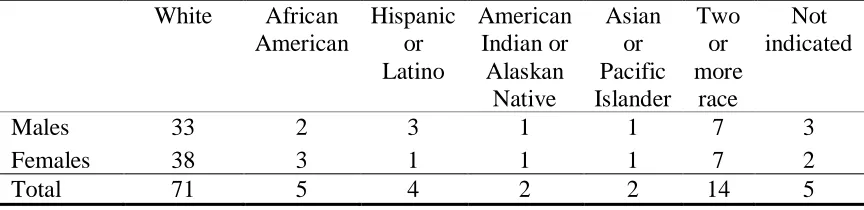
The sample of the study provided a mix of male and female participants and
races. While the gender makeup of the group was very similar between male and female
there was a considerable difference in race. As seen in Table 3.1, the primary ethnicity of
the group was White, however this is a fair representation of the entire school as Upstate
High School, which is made up of 81.4% White students, 11.2% African American
students, and 3.5% Hispanic or Latino students.
To ensure confidentiality and uphold the ethics of educational research, students
who participated in this study were required to have both a parent permission form and an
assent form completed. By making sure to “obtain permission from both the parents and
the students themselves” (Mertler, p. 151) this study ensured that both parents/guardians
and students were aware of their participation and the information they provided.
Student-participants were then provided with a survey ID with which to enter when
Table 3.1 Ethnicity and gender of participants
White African American Hispanic or Latino American Indian or Alaskan Native Asian or Pacific Islander Two or more race Not indicated
Males 33 2 3 1 1 7 3
Females 38 3 1 1 1 7 2
taking this questionnaire. This use of a number coding system to designate responses
provided anonymity to the student-participants. Mertler (2014) uses this strategy in
which participants are given a number as an identifier rather than a name to provide
confidentiality, because “an action researcher’s ability to ensure anonymity and
confidentiality of participants and their data is a vitally important component of the
action research process” (Mertler, p. 151). None of the information gathered was shared
with parents/guardians or teachers, so that student-participants could feel safe with
expressing their opinions and experiences.
SETTING
Upstate High School is a public high school that resides in suburban South
Carolina. The school is made up of approximately 1,860 students, with approximately
595 of those students being enrolled in the ninth-grade. The overall racial makeup of the
school is 81.4% White students, 11.2% African American students, and 3.5% Hispanic or
Latino students. More specifically, this Action Research study takes place across four
High School 101 classroom at UHS which were chosen primarily due to most students
enrolled in High School 101 Courses in the Fall of 2016 being ninth-graders.
Student-participants completed the online questionnaire in a single sitting during
class time. Mobile school devices were brought into the classroom so that students could
access the questionnaire, and no time limit was set for its completion. Four of these
student-participants, two males and two females, were selected for follow-up
semi-structured interviews. These interviews were conducted in the media center in a
one-on-one setting to encourage students to freely provide their opinion and to elaborate on their
research question, What are ninth-grade students’ perceptions of social media
responsibility and cyberbullying?
INSTRUMENTATION & MATERIALS
The instruments and materials used in collecting data for this Action Research
study took the form of an online questionnaire and a semi-structured interview. Both
tools were used to collect data from students to determine what their perspectives of
social media responsibly and cyberbullying were. The online questionnaire, or survey,
provided “students a space to share their thoughts and opinions” (Dana &
Yendol-Hoppey, 2014, p. 114). Mertler (2014) touts the advantages of using surveys by stating
that they are “very effective at gathering data concerning students’ attitudes, perceptions,
or opinions” (p. 144). The second tool, a semi-structured interview was used to collect
qualitative data from four student-participants. Mertler again confirms this choice by
writing, “when gathering truly qualitative data, interviews are probably best conducted
following semi-structured or open-ended formats” (p. 130). Both the quantitative online
questionnaire and the qualitative semi-structured interview worked in tandem to answer
the research question and provide insight into ninth-grade students’ perception of social
media responsibility and cyberbullying. The sections below detail these tools and how
they were applied in this study.
ONLINE QUESTIONNAIRE. As an explanatory mixed-method study, this
Action Research study based many of its findings on the online questionnaire that was
administered to 105 ninth-grade students. The questionnaire was administered online
using the software program Google Forms, and student-participants were provided school
of questions to be asked of student-participants to gain a descriptive understanding of
student perceptions of social media responsibility and cyberbullying. These questions
contained scales, checklists, and multiple choice formats.
Items in this online questionnaire were based upon previous research studies of
the same topics. This ensured the validity of the tool to produce findings that accurately
depicted the desired outcomes. The online questionnaire consisted of 85 total questions
spanning four distinct categories, Demographics, Self-esteem, Social Media Usage, and
Cyberbullying. (See Appendix A) The first segment of the questionnaire provides
demographic information about the student-participants. Student-participants were asked
their age, gender, race, grade level, school, estimated academic performance, number of
siblings, number of /guardians they live with, marital status of parents/guardians, and
how they access the Internet. This data assisted in providing variables in the data
analysis as well as ensuring that a fair representation of UHS students existed in the
sample.
The self-esteem segment of the questionnaire was based upon Rosenberg
Self-esteem Scale in which students answer ten Likert-scale questions about how they felt at
the time of taking the questionnaire (Rosenberg, 1965). Student-participants indicated
their level of agreement (strongly disagree, disagree, agree, strongly agree) on each of the
ten measures. Responses were coded 1, 2, 3, or 4 based upon the question. (See
Appendix A for full questionnaire) The questions were then tallied and a score of 10 – 40
was given with 40 indicating the highest level of self-esteem. The test has a “satisfactory
from the Rosenberg Self-esteem Scale were used to calculate a self-esteem variable of the
study.
The social media usage segment of the questionnaire was based on a national
survey conducted for the Social Media Social Life report (Common Sense Media, 2012).
This survey had a high internal constancy with a Cronbach’s alpha of .80, and questions
from it were used in this study’s questionnaire. A total of 37 questions were used and
provided such information as social media usage, number of accounts, frequency of
posts, and feelings toward social media. (See Appendix A) This segment of the
questionnaire provided insight into how and why ninth-grade student-participants use
social media. Responses from this section were also used in determining which
student-participants would be selected for semi-structured interviews.
The cyberbullying segment of the questionnaire was based upon a cyberbullying
study conducted by Slonje and Smith (2008). Questions from this segment reported on
five different categories of cyberbullying; email, phone call, text message, and
picture/video clip. Student-participants were asked to indicate the frequency in which
they have been the victim of cyberbullying using a five-point scale, 1 – I have not been
bullied/bullied others, 2 – only once or twice, 3 – two or three times a month, 4 – once a
week, and 5 – several times a week. Along with these frequency questions,
student-participants were also asked their views on these forms of cyberbullying and if they
consider this form of bullying more/same/less harmful than traditional bullying. In
addition, student-participants were asked if they feel that they are more/same/less likely
to be noticed by an adult. (See Appendix A) The questions regarding the frequency of
were used in the data analysis to compare different backgrounds of students to the
frequency or type of cyberbullying that they encountered.
SEMI-STRUCTURED INTERVIEWS. The semi-structured interviews provided
qualitative data for this explanatory mixed-method study and supported the quantitative
data collected in the online questionnaire. The interview was comprised of eight core
questions with each core question having one or two follow-up questions based upon the
answers. (See Appendix B) Questions were written by the Action Researcher and in a
language and tone that would be comprehended by ninth-grade students at UHS. In
addition, these questions were open-ended in nature to encourage student-participants to
provide more detail or even recall their own personal experiences related to social media
usage. Answers to these questions were recorded and compiled together. With a limited
number of questions and only four interviewees, the assembling of the responses was
simplified.
DATA COLLECTION
To provide a descriptive answer to the research question, What are ninth-grade
students’ perceptions of social media responsibility and cyberbullying? multiple sources
of data were collected. Mertler (2014) refers to this as ‘polyangulation. This Action
Research study utilizes quantitative data collected from an online questionnaire, along
with qualitative data collected from semi-structured interviews, and artifacts from the
school administration to clearly understand student perceptions of social media
responsibility at UHS. The quantitative data provides the framework for
student-participants’ opinions and views, while the qualitative data and artifacts supporting the
The data was collected within two separate windows of time. The first data
collection was the online questionnaire. Students who returned the parent permission slip
were provided with a survey ID number and a URL in which to access the questionnaire.
School issued mobile devices were available for students in the classroom to access and
respond to the questionnaire. Responses were collected and stored in a digital file housed
in a password protected online account accessible only by the Action Researcher.
Student-participants completed the questionnaire in a single class period, approximately
60 minutes.
The second data collection window was the semi-structured interview. Four
student-participants were selected from the original sample to participate in the interview,
and they were chosen based upon their gender and their responses to the questionnaire
about usage of social media and exposure to cyberbullying. The background of each
participant is detailed in Chapter Four. Student-participants were interviewed in a
face-to-face, one-on-one format with the Action Researcher which was held in the school’s
media center. Prior to being asked the questions the student-participants were provided
with a list of the core questions and asked if any of the items were unclear or ambiguous.
Any questions that arose about wording were clarified before proceeding. Throughout
the duration of the interview an audio recording device recorded the interview so that
answers could be used for reference later. The audio file of each response was stored in
the same password protected online account as the responses to the online questionnaire.
Each interview lasted approximately 15 minutes and all four interviews were conducted
DATA ANALYSIS & REFLECTION
After the online questionnaire and semi-structured interviews were completed the
data was analyzed to reveal common themes among the student-participant responses.
For the online questionnaire, the responses which were already collected in a digital
format were imported into R, a statistical computing software. Using R software allowed
the responses to become unique variables that could be categorized based upon different
parameters. For example, comparing perceived impact of cyberbullying among students
of different races and genders. Using this process, the data collected from the
quantitative online questionnaire could reveal trends that were then followed up with in
the semi-structured interview.
Data from the interview was qualitative in nature and as such was not analyzed
using statistical software. Rather, the students’ responses to the questions were coded
and tabulated. Since only four student-participants comprised the interview sample, with
a total of eight possible questions, analysis was simplified. The common themes pulled
from this qualitative data set were used to support the views that student-participants
indicated from the quantitative data set.
After the analysis of this data was complete, a summary of the findings was
shared with the school administration to reflect on the results. This discussion lead to
open dialogue about how gaps in understanding of responsible social media usage had
arisen at UHS and what procedures could be put in place to remedy the issue. From this
conversation, an Action Plan was created which focused on social media awareness and
CONCLUSION
By choosing Mertler’s (2014) explanatory mixed-method design, this Action
Research study accurately portrays student perceptions of social media responsibility and
cyberbullying. The study relies primarily on a quantitative online questionnaire to obtain
student opinions and perceptions, and then elaborates on the data with the qualitative
semi-structured interviews. To polyangulate these findings artifacts from school
administrators are also used to provide a complete pictures of social media perceptions at
UHS. These findings are then used in the creation of an Action Plan to address the
problem of high rates of cyberbullying among ninth-graders at UHS. By raising
awareness of this issue and putting a plan in place to address it, this Action Research