Self-Attention Networks for Intent Detection
Sevinj Yolchuyeva, Géza Németh, Bálint Gyires-Tóth
Department of Telecommunications and Media Informatics,
Budapest University of Technology and Economics, Budapest, Hungary
{syolchuyeva, nemeth, toth.b}@tmit.bme.hu
Abstract
Self-attention networks (SAN) have shown promising performance in various Natural Lan-guage Processing (NLP) scenarios, especially in machine translation. One of the main points of SANs is the strength of capturing long-range and multi-scale dependencies from the data. In this paper, we present a novel intent detection system which is based on a self-attention net-work and a Bi-LSTM. Our approach shows im-provement by using a transformer model and deep averaging network-based universal sen-tence encoder compared to previous solutions. We evaluate the system on Snips, Smart Speaker, Smart Lights, and ATIS datasets by different evaluation metrics. The performance of the proposed model is compared with LSTM with the same datasets.
1
Introduction and Related Work
Spoken dialogue systems are agents that are in-tended to help users to access information effi-ciently by speech interactions (Liu, et al., 2006). In doing so, spoken dialogue systems categorize most of the major fields of spoken language technology, including speech recognition and speech synthesis, language processing, and dialogue system (McTear, 2002). There are different areas of re-search in the field of spoken dialogue systems. Spoken language understanding (SLU) is one of the essential components of spoken dialogue sys-tems, and it aims to form a semantic frame that captures the semantics of user utterances or que-ries. Intent detection is one of the main tasks of SLU system. It can be treated as a semantic utter-ance classification task; since the dialogue system is created to answer a limited range of questions, there is a predefined finite set of intents (Balodis and Deksne, 2019). This task focuses on classify-ing the user’s intent and extractclassify-ing semantic
con-cepts as constraints for natural language. For ex-ample, the utterance “Switch off the garage lights” is related to switching the light off, as shown in Ta-ble 1.
Table 1. Example of utterance and a correspond-ing intent label.
Utterance Intent Switch off the garage lights.
SwitchLightOff
Get the room brighter, please.
IncreaseBrightness
Skip this song and go on to the next one.
NextSong
Intent detection has been an ongoing field of re-search in SLU, and similar to most NLP tasks, there are two main approaches to identify the intent of an utterance: rule-based and statistical methods (Hashemi, et al., 2016). The rule-based systems use predefined rules to match new utterances to their intents, and these rules need to be carefully engineered by human experts. Thus, the advance-ment of these systems requires a huge amount of human effort.
lay-3
Proposed Model
In this section, we introduce two models for intent detection:
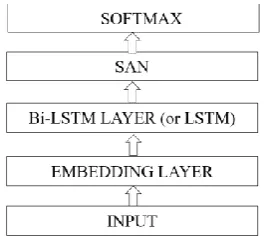
1. SAN and LSTM (SAN + LSTM) 2. SAN and Bi-LSTM (SAN + Bi-LSTM) Both proposed models encode each word to its em-bedding first. We carried out experiments with dif-ferent embeddings, as discussed in Section 4.3. As the next step, the contextual information in the in-put sentences (utterances) is encoded. In the first model, LSTM, in the second one, a Bi-LSTM was used to capture the left and right contexts of each word in the input. In the second model, Bi-LSTM combines two unidirectional LSTM layers that pro-cess the input from left-to-right and right-to-left, re-spectively. Both models are followed by the SAN (see Figure 1), which is based on an attention mechanism for selecting specific parts of a se-quence by relating its elements at different posi-tions (Vaswani, et al., 2017). In our work, we only perform input-input attention with self-attention. By using the self-attention, the semantics of the en-tire utterance can be extracted, and it can be helpful for the better classified. To score attention weight vectors we applied the method of (Xu, et al., 2018).
Figure 1. The architecture of the proposed model.
The goal of training is to minimize the loss function. For this purpose, we use multi-class cross-entropy loss,
𝐽 = − ∑ ∑ 𝑦𝑗𝑖𝑙𝑜𝑔𝑦̂𝑗𝑖+ 𝛾‖𝜃‖2 𝑗
𝑖
(1)
where 𝑖 is the index of utterance and 𝑗 is the in-dex of the intent label. 𝛾 is the 𝐿2regularization co-efficient and 𝜃 is the parameter set. 𝑦𝑗𝑖 is the ground-truth label indicator for 𝑖-th utterance, and
𝑦̂𝑗𝑖 is the predicted probability output of 𝑖-th utter-ance. At the output of the network, softmax func-tion was used to predict probabilities.
4
Experiments
4.1. Dataset
We used Natural Language Understanding bench-mark dataset (Snips) (Goo, et al., 2018), Spoken Language Understanding research datasets (Saade, et al., 2018) and Airline Travel Information System (ATIS) dataset (Hemphill, et al., 1990). Snips is a balanced dataset and collected from the Snips per-sonal voice assistant; the number of samples for each intent is approximately the same. The training set contains 13,084 utterances, the test and valida-tion (development set) set consist of 700 - 700 ut-terances. Vocabulary size is 11,241 and intent types are 7, as shown in Table 2.
Table 2. The intent labels and the number of ut-terances in each label in Snips.
Type of intent Number
PlayMusic 1914
GetWeather 1896
BookRestaurant 1881
RateBook 1876
SearchScreeningEvent 1851 SearchCreativeWork 1847 AddToPlaylist 1818
Smart Lights has 6 intents allowing to turn on or off the light or change its brightness or colour, as shown in Table 3. It has a vocabulary size of ap-proximately 400 words. Smart Speaker dataset has 9 intents and vocabulary size is approximately 1,270. The number of utterances in each intent la-bel is presented in Table 4. In these two datasets, we have split the data into 90 % training and 10% test sets. The validation dataset consists of 10% proportion of the training set.
Table 3. The intent labels and the number of utter-ances in each label in Smart Lights.
Table 4. The intent labels and the number of utter-ances in each label in Smart Speaker.
Type of intent Number
GetInfos 199
NextSong 200
PlayMusic 1508
PreviousSong 199
ResumeMusic 200
SpeakerInterrupt 172
VolumeDown 215
VolumeSet 100
VolumeUp 260
ATIS contains audio recordings of people making flight reservations. The training set contains 4,478 utterances, the test set contains 893 utterances; 500 utterances were used as development set. The intent types in ATIS are unbalanced. For example, the intent atis_flight equals about 73.8 % of the training data, while the number of some intents were less than 10.
4.2 Training setup
Data preprocessing may include data normali-zation, tokeninormali-zation, lower-casing, removal of punctuation, grammar correction, feature extrac-tion etc., by depending on the task and given da-taset. We have done tokenization, have removed punctuation and have converted the numbers to words for all investigated datasets. The word em-beddings are initialized with the pretrained 300-dimension Word2Vec or FastText word vectors and these are fixed during training. We also inves-tigated TA and DAN Universal Encoder model-based utterance vectors. The number of units in LSTM and Bi-LSTM is 64.
The L2-regularization coefficient λ in the loss is 0.01.
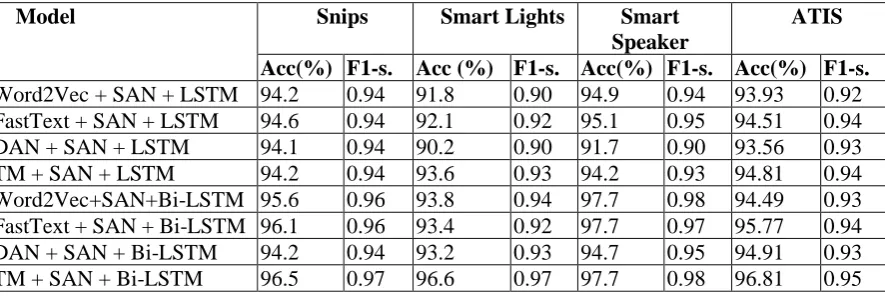
Table 5. Result of proposed models
ADAM (Kingma and Ba, 2015) is used as the op-timizer, with a learning rate of 0.001, and with the baseline values of β1, β2 and ε (0.9, 0.999 and 1e-08, respectively). The batch size is 16, the number of epochs is 25.
4.3 Evaluation and Results
We evaluated the performance of the models by accuracy, precision, recall, F1-score. The results are presented in Table 5.
By micro and macro averaged, overall F1-scores were computed, and their average was used (Sokolova and Lapalme, 2009). In Table 5, the first column describes the proposed models, and other columns show the overall accuracy and F1-score for each dataset.
For all datasets, SAN + Bi-LSTM consequently have shown better results than SAN + LSTM, as expected. For Snips, the accuracy of FastText + SAN +Bi-LSTM and TM +SAN +Bi-LSTM is al-most the same. The result of Word2Vec + SAN + Bi-LSTM, FastText + SAN + Bi-LSTM, and TM + SAN + Bi-LSTM is almost the same for Smart Speaker. The lowest accuracy score for Smart Lights was produced by DAN + SAN + LSTM, which is 90.2%. The highest accuracy score for ATIS was produced by TM + SAN + Bi-LSTM, which is 96.81. This result is comparable with (Goo, et al., 2018; Hakkani-Tür, et al., 2016). We observed that TM based universal encoder can help to improve accuracy.
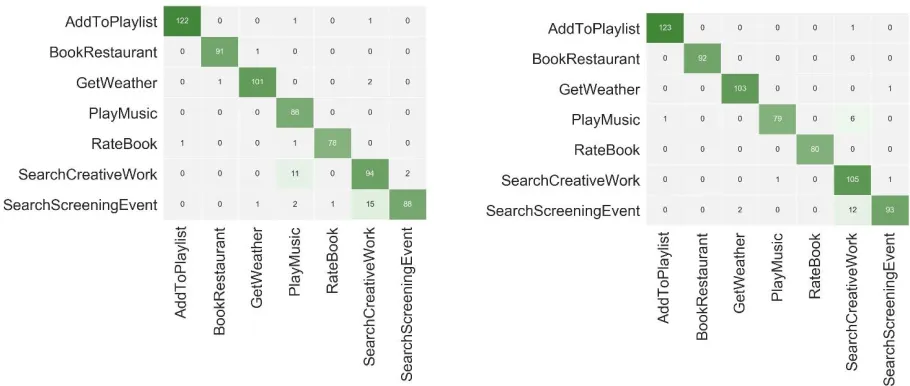
Furthermore, Figure 2 and Figure 3 show the confusion matrix of Smart Lights and Snips test dataset by using DAN and TM universal encoder vectors with SAN + Bi-LSTM. SAN + Bi-LSTM based DAN correctly classified 30 intents labels out of 31 for SetLightBrightness and 29 tokens out of 30 for SwitchLightOff, which is the same in SAN + Bi-LSTM based TM.
Model Snips Smart Lights Smart
Speaker
ATIS
Figure 3. Confusion matrix of Snips test dataset by using DAN and TM Universal encoder vectors with SAN + Bi-LSTM.
The intent of IncreaseBrightness was predicted correctly in case of 24 out of 30, while 4 intent labels were misclassified to the SwitchLightOn by SAN + Bi-LSTM based DAN.
For Snips, SAN + Bi-LSTM based DAN cor-rectly classified 88 intent labels out of 105 SearchScreeningEvent, while the TM-based ap-proach classified 93 intent labels correctly. The AddToPlaylist, GetWeather, RateBook labels achieved almost the same accuracy from both models. SearchCreativeWork intent labels were better predicted by TM based SAN + Bi-LSTM.
As reasons for the misclassification are that some words can belong to both intent classes, de-pending on the context, and the size of training data is not large enough.
Conclusion
In this paper, the combination of SAN and Bi-LSTM for intent detection were proposed. 300-di-mensional Word2Vec and FastText embeddings pretrained on English Wikipedia were used as word representations. Utterance vectors of DAN and TM based Universal sentence encoders were investigated. The results were evaluated with the help of accuracy and confusion matrices. Experi-ments were also carried out with SAN + LSTM, however, the accuracy was worse than with SAN + Bi-LSTM.
self-at-Kelvin Xu, Jimmy Ba, Ryan Kiros, Kyunghyun Cho, Aaron C Courville, Ruslan Salakhutdinov, Richard Szemel, and Yoshua Bengio. 2015. Show, Attend and Tell: Neural Image Caption Generation with Visual Attention. Proceedings of the 32nd Interna-tional Conference on Machine Learning, 2048-2057.
Marcelo Mendoza, Juan Zamora. 2009. Identifying the Intent of a User Query Using Support Vector Ma-chines. SPIRE 2009. Lecture Notes in Computer Science, vol 5721.
Marina Sokolova, and Guy Lapalme. 2009. A system-atic analysis of performance measures for classifi-cation tasks. Information Processing and Manage-ment 45, 427–437.
Michael McTear. 2002. Spoken dialogue technology: enabling the conversational user interface. ACM Computer Survey., 34, 90-169.
Minh-Thang Luong, Hieu Pham, Christopher D. Manning 2015. Effective Approaches to Attention-based Neural Machine Translation. Proceedings of the 2015 Conference on Empirical Methods in Nat-ural Language Processing, 1412-1421.
Piotr Bojanowski, Edouard Grave, Armand Joulin, and Tomas Mikolov. 2017. Enriching Word Vectors with Subword Information. Transactions of the Associa-tion for ComputaAssocia-tional Linguistics (TACL), 5, 135-146.
Raphael Schumann, Pongtep Angkititrakul. 2018. In-corporating ASR Errors with Attention-based, Jointly Trained RNN for Intent Detection and Slot Filling. 2018 IEEE International Conference on Acoustics, Speech and Signal Processing (ICASSP),685-689.
Tao Shen, Jing Jiang,Tianyi Zhou, Shirui Pan, Guodong Long, and Chengqi Zhang. 2018. DiSAN: Directional Self-Attention Network for RNN/CNN-Free Language Understanding. The Thirty-Second AAAI Conference on Artificial Intelligence, 5446-5455.
Tao Shen, Tianyi Zhou, Guodong Long, Jing Jiang, and Chengqi Zhang. 2018. Bi-Directional Block Self-Attention for Fast and Memory-Efficient Sequence Modeling. CoRR, abs/1804.00857.
Tomas Mikolov, Kai Chen, Greg Corrado, and Jeffrey Dean. 2013. Efficient Estimation of Word Represen-tations in Vector Space. Proceedings of the Interna-tional Conference on Learning Representations (ICLR), 1–12.
Vipul Raheja, Joel Tetreault. 2019. Dialogue Act Clas-sification with Context-Aware Self-Attention. 2019 Annual Conference of the North American Chapter of the Association for Computational Linguistics.
Yang Liu, Kun Han, Zhao Tan, Yun Lei. 2017. Using Context Information for Dialog Act Classification in DNN Framework. Proceedings of the 2017 Confer-ence on Empirical Methods in Natural Language Processing, 2170-2178.
Zheqian Chen, Rongqin Yang, Zhou Zhao, Deng Cai, Xiaofei He. 2018. Dialogue Act Recognition via CRF-Attentive Structured Network. 41st Interna-tional ACM SIGIR Conference on Research and De-velopment in Information Retrieval, 225-234. Zhouhan Lin, Minwei Feng, Cicero Nogueira dos