R E S E A R C H
Open Access
Nested game-based computation offloading
scheme for Mobile Cloud IoT systems
Sungwook Kim
Abstract
With an explosive growth of Mobile Cloud and Internet of Things (IoT) technologies, the Mobile Cloud IoT (MCIoT) concept has become a new trend for the future Internet. MCIoT paradigm extends the existing facility of computing process to different mobile applications executing in mobile and portable devices. In this research, we provide a new nested game model to design an effective MCIoT computation offloading algorithm. First, each mobile device determines the portion of remote offloading computation based on the Rubinstein game approach. Then, a computation resource in the cloud system is dynamically assigned for the requested offloading computation. Based on the nested game principle, our proposed scheme can approach an optimal solution for the offloading computation in the MCIoT system. The simulation results show that our game-based method is effective in distributed IoT environments while supporting application executions timely and ubiquitously.
Keywords: Mobile Cloud Computing; Computation offloading; Dynamic resource allocation; Game theory; Nested game; Rubinstein game; Internet of Things
1 Introduction
Recently, rapid technology development makes it possible for connecting various smart mobile devices together while providing more data interoperability methods for application purpose. Therefore, the diverse nature of applications has challenged communication and computation mechanisms to look beyond conventional applications for effective network policies, quality of service (QoS), and system performance. The Internet of Things (IoT) paradigm is based on intelligent and self-configuring mobile devices interconnected in a dynamic and global network infrastructure. It is enabling ubiqui-tous and pervasive computing scenarios in the real world [1, 2].
In the current decade, a growing number of researches have been conducted to acquire data ubiquitously, process data timely, and distribute data wirelessly in the IoT paradigm. To satisfy this requirement, mobile de-vices should have the capacity to handle the required processing and computation work. Unfortunately, the desire for rich, powerful applications on mobile devices conflicts with the reality of these devices’ limitations:
slow computation processors, little memory storage, and limited battery life. For this reason, mobile devices still lag behind desktop and server hardware to provide the experience that users expect [3, 4].
The Mobile Cloud (MC) is emerging as one of the most important branches of cloud computing and is ex-pected to expand mobile ecosystems. Usually, cloud computing has long been recognized as a paradigm for big data storage and analytics; it has virtually unlimited capabilities in terms of storage and processing power. MC is the combination of cloud computing, mobile computing, and wireless networks to bring rich compu-tational resources to mobile users and network opera-tors, as well as cloud computing providers. With the explosive growth of multimedia mobile applications, MC computing has become a significant research topic of the scientific and industrial communities [5–7].
The two fields of MC and IoT have been widely popu-lar as future infrastructures and have seen an independ-ent evolution. However, MC and IoT are complemindepend-entary technologies, and several mutual advantages deriving from their integration have been identified [3]. There-fore, a symbiosis has developed between mobile devices and MC and is expected to be combined for the future Internet. Generally, mobile devices can benefit from the Correspondence:[email protected]
Department of Computer Science, Sogang University, 35 Baekbeom-ro (Sinsu-d ong), Mapo-gu, Seoul 121-742, South Korea
virtually unlimited capabilities and resources of MC to compensate its storage, processing, and energy con-straints. Specifically, MC can offer an effective solution to implement IoT service management. On the other hand, MC can benefit from the IoT system by extending its scope to deal with real-world things in a more dis-tributed and dynamic manner [2]. Nowadays, the exten-sion of MC over dynamic IoT environments has been referred as a next generation communication and com-puting paradigm [5].
In this paper, we focus our attention on the integration of MC and IoT, which we call the MCIoT paradigm. MCIoT should support a wide variety of multimedia ap-plications with different QoS requirements; these appli-cations need different system resources. Therefore, the MCIoT platform can benefit from implementing QoS-aware service management algorithms to match applica-tion demand to IoT services, while guaranteeing to meet the respective QoS requirements. Such algorithms must take into account that mobile devices are generally char-acterized with limited storage and processing capacity. A possible way to dealing with this problem is to remotely execute some computation tasks on a more powerful cloud system, with results communicated back to the mobile devices. This method is the computation offload-ing [8]. Therefore, the synergy of MC and IoT lies at the junction of mobile devices, different wireless network providers, and cloud computing systems. As far as we know, there is no intensive research work considering the multi-interaction aspect of the MCIoT paradigm.
Although the computation offloading approach can significantly augment the computation capability of mo-bile devices, the task of developing a comprehensive and reliable computation offloading mechanism remains challenging. A key challenge is how to efficiently coord-inate multiple mobile devices and the MCIoT system. Usually, individual mobile devices locally make control decisions to maximize their profits in a distributed man-ner. This situation leads us into the game theory. The game theory is a conceptual and procedural tool to cap-ture the interaction among selfish players and has been successfully applied to typical network management problems, like resource allocation, routing, pricing, and load balancing. In particular, it has been largely applied in mobile and wireless network scenarios in the context of competition in the access to shared communication and computation resources [9].
In 1988, an American political scientist, George Tsebelis, introduced an important new concept, called nested games, to rational choice theory and to the study of com-parative politics [10]. Using the notion of nested games, he showed that game players are involved simultaneously in several games. He argued that the “nestedness” of the principal game explains why a player confronted with a
series of choices might not pick the alternative which ap-pears to be optimal. In other words, what seems to be ir-rational in one arena becomes intelligible when the whole network of games is examined. Originally, the nested game has been used by anyone interested in the effects of political context and institutions on the behavior of polit-ical actors. Nowadays, the nested game approach can be used to analyze a systematic, empirically accurate, and theoretically coherent account of apparently irrational ac-tions [11–13].
In this paper, we adopt a nested game approach to ad-dress the computation offloading algorithm in the MCIoT platform. The nested game model is a useful framework for designing decentralized mechanisms, such that the mobile devices can self-organize into the mutually satisfactory computation offloading decisions. Usually, different mobile devices may pursue different interests and act individually to maximize their profits. This self-organizing feature can add autonomics into MCIoT systems and help to ease the heavy burden of complex centralized control algorithms. The main con-tributions of our work are (i) the ability to analyze the interactions among multiple mobile devices, (ii) the abil-ity to effectively assign an available resource for the re-quested offloading computations, and (iii) the ability to respond to the current MCIoT system conditions while maximizing the performance.
A. Related work
In modern times, a lot of state-of-the-art work on cloud-based IoT management schemes has been con-ducted. In [14], an effective approach to intelligent plan-ning for mobile IoT applications was presented. This approach included a learning technique for dynamically assessing the users’mobile IoT application and a Markov decision process planning technique for enhancing effi-ciency of IoT device action planning. In [15], a highly lo-calized IoT-based cloud computing model was proposed. This model allowed clients to create ad hoc clouds using the IoT and other computing devices in the nearby phys-ical environment, while providing the flexibility of cloud computing. It also provided localized computation cap-ability from untapped computing resources. In [16], a novel framework for software-defined IoT cloud systems was developed. With feasibility and practical applicabil-ity, this framework handled two main tasks: (i) perform dynamic, on-demand provisioning of governance cap-abilities and (ii) remotely invoke such capcap-abilities in IoT cloud resources remotely, via dynamic APIs.
interaction system. This scheme provides a nested two-stage game model for the computation offloading. To maximize the network system performance, all the mo-bile devices compete for the allocated resources, which becomes a normal-form game. Based on the backward
induction principle, the NTGO scheme can derive the
near-optimal strategy for all the mobile devices using a convex optimization approach. Nash equilibrium always
exists and is unique in theNTGOscheme. The
decentra-lized computation offloading game (DCOG) scheme [7] was envisioned as a promising approach for an MCC algo-rithm. This scheme formulated a decentralized computa-tion offloading mechanism as a decentralized computacomputa-tion offloading game. As game players, mobile devices make computation offloading decisions locally, which can sig-nificantly reduce the controlling and signaling overhead of
the cloud. The DCOG scheme also can achieve a Nash
equilibrium of the game.
All of the abovementioned solutions in [7, 11] have attracted a lot of attention and introduced unique chal-lenges to efficiently solve the computation offloading decision problems. However, there are several disadvan-tages. First, these existing schemes rely on high complexity and extra overhead; this increased overhead can exhaust the computation capacity. Second, these schemes cannot adaptively estimate the current system conditions. Third, these schemes operate systems by fixed-system parame-ters. Under dynamic MCIoT environments, control mech-anisms by using static thresholds can cause potential erroneous decisions. Compared to these schemes [7, 11] in Section III, the proposed scheme attains a better system performance.
This paper is organized as follows. Section II explains the basic concept of the network model for computation offloading. Section III describes our proposed nested game-based computation offloading scheme in detail. In Section IV, performance evaluation results are presented along with comparisons with the schemes proposed in [7, 11]. Through simulation, we show the ability of the proposed scheme to achieve high accuracy and prompt-ness in dynamic network environments. Finally, con-cluding remarks are given in Section V.
2 Network model for computation offloading
Under competitive or cooperative environments, the be-haviors of game players have a direct influence on each other. Based on rational assumptions, the game theory is to study the decision-making mechanism and the bal-ance of decision-making interactions [9]. However, game players seem to act irrationally, but if treating the game as a part of a larger game, we can see their behaviors are rational [12]. From the view of a small independent game, each player’s strategy is not the optimal solution. However, from the view of a big game, players’reactions
are the best responses. Such games are called as nested games, and small games may be used as sub-games nested in the sequential game of a larger game [11–13]. In multiple fields of a nested game, game players try to optimize their payoffs in the principal game field which also involves a game about the rules of the game. It can lead to apparently suboptimal payoffs as the game player fails to see the other fields that provide context for the small game in the principal field. Several studies use nested game theory to explain political party behavior, budget ne-gotiations, electoral systems, and public policy [13].
In this work, we specify the nested game to design a new computation offloading algorithm. The key point of the MC offloading mechanism hinges on the ability to achieve enough computing resources with small energy consumption. In recent years, this technique has received more attention because of the significant rise of offload-available mobile applications, the availability of powerful clouds and the improved connectivity options for mobile devices. The main challenges to design an effective com-putation offloading algorithm lies in the adaptive division of applications for partial offloading, the mismatch control mechanism between how individual mobile devices de-mand and access computing resources, and how cloud providers offer them. To decide what, when, and how to be offloaded, we should consider the offload overhead and current MCIoT system conditions.
In the resource-rich MC environment, a mobile device must pay the price to take advantage of computation off-loading. To gain an extra benefit, idle computation re-sources in the MCIoT system compete to get the requested offloading task. Therefore, mobile devices can select the most adaptable computation resource to exe-cute their offloaded computations. In this work, our MCIoT environment can be described as follows:
1. D¼fD0;D1; …; Dngis the set of mobile devices,
andAi,i∈[1, n] is an application, which belongs to the mobile deviceDi.
2. Mobile device applications are elastic applications and can be split. For example,Ai¼XL
k¼1 ai
k, whereaik is
thekth module ofAi, and some parts (i.e., coded modules) ofAican be offloaded.
3. ℝ= {R0,R1,…,Rm} is the set of idle cloud
computing resources in the MCIoT environment, andRj,j∈[1, m] has a computation capacity (ℱRRj; CPU cycles per second) and expected price (ψRj; price per CPU cycle of theRj) to accomplish the offloaded computations.
4. Price in eachRj,1≤j≤mcan be dynamically adjustable
according to the auction mechanism. 5. For simplicity, we assume that there is no
In this paper, we develop a two-stage nested game model comprised of elastic applications, mobile de-vices, and computation resources in the MC. In the first stage, applications of mobile devices are divided into two parts: one part runs locally and the other part is run on the MC side. In the second stage, off-loaded tasks are matched to computing resources in the MCIoT system. Based on the auction mechanism, computation resources submit different offers to get the requested offload task, and the most adaptable offer is selected. According to the two-stage sequen-tial nested game approach, we can make decisions about whether to perform computation offloading, which portion of the application should be offloaded to the cloud, and which resource is selected to ac-complish the requested offload.
3 Proposed computation offloading algorithms
In this section, we introduce our proposed computation offloading scheme in detail. The computation offloading technique has been widely popular as the future infra-structure of utility computing and becomes an attract-ive tool to overcome the inherent limitations of mobile devices. Based on the nested game model, our proposed scheme consists of the Rubinstein game and auction game to approximate a globally desirable sys-tem performance while ensuring QoS for mobile ap-plication services.
A. Offloading communication and computation process
By taking into account both communication and computation aspects of MCIoT environments, we formulate a new decentralized computation offload-ing algorithm. In each mobile device, applications can be computed either locally on the mobile device or remotely on the cloud via computation offloading. For the local computing approach, each mobile
de-vice (e.g., Di) can execute some computation part of
Ai individually. The local computation execution
time (L CTAi Di
comp) of the application Ai on the mobile
device Di is given as
where ℱLDi is the computation capability of mobile de-vice Di. The local computation cost (L CCAcompi Di) of the
application Ai on the mobile device Di is calculated
based on the L CTAi Di
comp and consumed local
computa-tion energy (ρ).
where ρDi is the coefficient denoting the consumed
en-ergy cost per CPU cycle. The evaluation of the total local computation overhead (T OAi Di
local ) of the application Ai
on the mobile device Di is a non-trivial multi-objective
optimization problem. It is addressed as a weighted sum by considering normalized time and energy cost.
T OAi Di
Di is a parameter to control the relative weights
given to execution time and energy consumption. To satisfy Ai’s demand, λADii is adaptively decided. In Eq. (7),
theλAi
Di value decision process is explained in detail.
Next, we estimate the remote computation overhead through the MC offloading mechanism. Generally, the communication and computation aspects play a key role in MC offload. In this paper, we consider a delay-sensitive Wi-Fi model for offloading services; mobile de-vices are sensitive to delay and their payoff decreases as delay increases. As a wireless access base station (BS), a Wi-Fi access point manages the uplink/downlink com-munications of mobile devices. For the computation
off-loading, the mobile device Di would incur the extra
overhead in terms of time and energy to submit the computation offload via wireless access. Based on the communication model in [7], the offloading commu-nication time O CTAi Di
the application Ai on the mobile device Di are
com-puted as follows.
whereℬis the channel bandwidth andPiis the
trans-mission power of device Di. Hi, BS denotes the channel gain between the mobile deviceDiand the BS, andω
they may incur severe interference, leading to low data rates. It would negatively affect the performance of MC communication. Therefore, offloading decisions among mobile devices are tightly coupled to each other [7]. To address this conflicting situation, game theory can be adopted to achieve efficient computation offloading decisions.
After the offloading, the computation time C TAi Rj
remote
and payment PAi Rj
remote
of remote computation task
XL
k¼1 T ai
k aik
!
on the assigned computation resource
Rjcan be then given as
coefficient denoting the price per CPU cycle of Rj.
Ac-cording to Eqs. (4) and (5), the total offload overhead T OAi
off Rj
of application Ai on the computation
re-sourceRjis computed as a weighted sum by considering
execution time and consuming cost.
T OAi
According to Eqs. (3), (4), (5), and (6), the total
execu-tion time of Ai T CtotalAi Di; Rj
with partial offloading can be estimated considering between the local and re-mote computing times.
Finally, we can compute the total execution overhead ofAi SAi Di;Rjð ÞD
To meet the application-specific demand, different ap-plications have different evaluation criteria for time and energy consumption. For example, when a mobile device is running an application that is delay sensitive (e.g., real-time applications), it should put more weight on the execution time (i.e., a higher λ) in order to ensure the time deadline and vice versa. Therefore, a fixed value for
λcannot effectively adapt to the different application de-mands. In this work, the value ofλ for theAion mobile
deviceDi λADii is dynamically decided as follows.
λAi
where TDAi is the time deadline of Ai. Therefore,
through the real-time online monitoring, we can be more responsive to application demands.
B. Application partitioning game
An important challenge for partial offloading is how to partition elastic applications and which part of the parti-tioned application should be pushed to the remote clouds. In this section, we analyze how mobile devices can exploit a partial offloading between cloud computa-tion and local computacomputa-tion. To distribute computacomputa-tion tasks for partial offloading, we provide a non-cooperative bargaining game model by considering the consuming cost and computation time. Usually, a solution to the bargaining game model enables the game players to fairly and optimally determine their payoffs to make joint agree-ments [17, 18]. Therefore, the bargaining model is attract-ive for the partitioning problem.
computed at each player individually. Usually, the bar-gaining solution is strongly dependent on the barbar-gaining powers. If different bargaining powers are used, the player with a higher bargaining power obtains a higher benefit than the other players. In this study, players ne-gotiate with each other by proposing offers alternately. After several rounds of negotiation, players finally reach an agreement as follows [19, 20].
x1;x2
if theplayer1 offers first
δ
if theplayer 2 offers first
8
Traditionally, the bargaining power in the
Rubinstein-Stahl’s model is defined as follows [20].
δ¼e−ξΦ;s:t:; >0 ð11Þ
where Φ is the time period of a negotiation round.
Given thatΦis fixed,δis monotonically decreasing with
ξ. Therefore, ξ is an instantaneous discount factor to
adaptively adjust the bargaining power. Usually, the bar-gaining power represents the relative ability to exert in-fluence over other players; the more bargaining power a player has, the more payoff a player attains.
In this section, the Rubinstein-Stahl bargaining game
model is formulated to solve the application partitioning problem. In our game model, the cloud computation re-source and mobile device are assumed as players, which
are denoted as player_1 (i.e., mobile device for local
computation) and player_2 (i.e., cloud resource for
re-mote computation). In the scenario of the
Rubinstein-Stahl model, each player has a different discount factor
(ξ). Under various MCIoT situations, we dynamically
adjust ξ values to provide more efficient control over
system condition fluctuations. When the current local computation overhead is heavy, the mobile device does not have sufficient computation capacity to support the local computation service. In this case, a higher value of player_1’s discount factor (ξI) is more suitable. If the re-verse has been the case (i.e., the remote computation overhead is heavy), a higher value ofplayer_2’s discount factor (ξII) is suitable. At the end of each game period, player_1andplayer_2adjust their discount factor values (ξIandξII, respectively) as follows.
ξI¼ 1−ξII; s:t:; ξII¼
T OAi Rj
off
SAi Di;Rjð ÞD ð12Þ
For simplicity, we assume that the ξ values are fixed
within an offloading procedure for each application,
while they can be changed in different applications. Therefore, as system situations change after application partitioning, each player can adaptively adjust their ξI and ξII values for the next application execution while responding current MCIoT system conditions.
C. Cloud resource selection game
Recently, researchers have proposed various auction models to optimally match up the buyer and seller ac-cording to their desires. It is a significant and efficient market-based approach to solve the allocation problem with more requisitions. Therefore, the auction game model can provide a resource-selection mechanism in MC systems. In our computation resource-selection sce-nario, there are a requested offload task (i.e., buyer) and computation resources (i.e., sellers). Based on the se-quential offloading requests, our action model is de-signed as the one-to-many auction structure. As sellers,
computation resources (ℝ) in the MC system offer bids
(i.e., the expected selling prices) for the remote offload computation. To show their preference to get the off-loading computation, sellers (ℝ) can adjust their
sell-ing prices periodically. For the tth auction stage, the
seller (i.e., Rj∈ℝ) bids his price ðψRjð Þt Þ per CPU
where εRj is a random variable to present the price
ad-justment. Because the sellers are not interrelated, the random variable (ε) of each seller is independent of each other. According to Eq. (13), each seller (i.e.,Rj∈ℝ) bids
his offer ψRj; ℱR
Rj
at each auction round, and then,
the buyer (i.e.,Di∈D) selects the most adaptable offer. In
this work, the minimum price-offering resource while satisfying the computation deadline (T_D(·)) is selected. This dynamic auction procedure is repeated sequentially for each auction round. In each auction round, sellers can learn the buyer’s desire with incoming information and can make a better price decision for the next auction.
D. The main steps of proposed algorithm
would not exist. The complementary characteristics of MC and IoT inspire a new MCIoT paradigm. This inte-gration realizes a new convergence scenario and will impact future application development where new op-portunities arise for data aggregation, integration, and sharing with third parties. Although the MC and IoT may seem to be a mature technology, this work is only at the very beginning of exploiting the potential ap-proach of the MC and IoT integration.
In this paper, we present a two-stage nested game model for the interaction of game players such as elastic applications, mobile devices, and MC compu-tation resources. Applications are involved in the ap-plication partitioning game in the first stage, and mobile devices and MC resources are involved in the resource selection game in the second stage. This two-stage nested game reflects the sequential depend-encies of decisions in each stage. Based on the feed-back interaction process, players can capture how to adapt their decisions to maximize their payoffs in an entirely distributed fashion. It is a practical and suit-able approach in real-world MCIoT system opera-tions. The main steps of our proposed nested game
algorithm are given next and described as a flowchart in Fig. 1.
Step 1: At the initial time, applications in each mobile device are equally partitioned for local and remote offloading computations. At the beginning of the game, this starting guess is useful to monitor the current MCIoT situation.
Step 2: According to Eqs. (1)–(9), mobile devices can estimate their total offload overhead T Oð Þoff
and the total execution overheadðSð Þð ÞÞD individually.
Step 3: Based on Eqs. (10)–(12), each mobile device adaptively re-partitions its application based on the
Rubinstein-Stahl bargaining game model.
Step 4: One part is computed locally on the mobile device. In the MC side, the other part is computed remotely on the computation resource, which is selected according to the auction game.
Step 5: For the next resource selection process, computation resources periodically adjust their selling prices (ψ(·)) according to Eq. (13).
Step 6: As game players, elastic applications, mobile devices, and MC computation resources are
interrelated and interact with each other in a two-stage nested game. In each stage game, game players try to maximize their payoffs while they are involved in a bigger game.
Step 7: Under widely diverse MCIoT environments, mobile devices and computation resources are self-monitoring constantly for the next iterative feedback processing. This iterative feedback procedure continues under the MCIoT system dynamics.
Step 8: When a new application service is requested, it can re-trigger another computation offloading process; the service proceeds to Step 1 for the next game iteration.
4 Performance evaluation
In this section, the effectiveness of our proposed scheme is validated through simulation. Using a simulation model, the performance of our proposed scheme is compared with two existing computation offload schemes [7, 11]. The assumptions implemented in our simulation model are as follows.
There are 10 mobile devices and 15 computation
resources in our MCIoT system.
Applications can be split differently according to application type.
The application generation rate is a Poisson with rateΔ(applications/s), and the range of offered computation load was varied from 0 to 3.0. Different applications are assumed based on
computation requirement, duration, and required QoS (i.e.,T_D).
TheT_Dof each application is exponentially distributed with different means for different applications.
The performance measures obtained on the basis of
50 simulation runs are plotted as a function of the offered applications per second at each mobile device (applications/s/D).
The MCIoT system performance is estimated in
terms of the normalized energy consumption, application execution time, and QoS satisfaction probability under various offered computation loads.
In order to emulate a real MCIoT system environment and for a fair comparison, application types, characteris-tics, and system parameters are carefully selected for a realistic simulation scenario. Table 1 shows the application types and system parameters used in our simulation.
As mentioned earlier, theDCOG and NTGOschemes
[7, 11] have been recently published and introduced unique challenges to efficiently solve the computation offloading decision problems. However, they are successful only in certain circumstances. In addition, it is observed
that theDCOGandNTGOschemes [7, 11] require higher
control overhead for computation offloading via wireless communication. Compared to these schemes, we can con-firm the superiority of our proposed approach.
Figure 2 shows the normalized energy consumption of each scheme. To effectively operate the MCIoT system, energy consumption is an important performance metric. All the schemes have similar trends. However, under vari-ous offered loads, effective strategic decisions based on
Table 1Application and system parameters used in the simulation experiment
Application type Applications Computation requirement Computation duration average/sec
I Voice telephony, video phone 128 K cycle/s 180 s (3 min)
II Remote login, tele-conference 512 K cycle/s 120 s (2 min)
Parameter Value Description
n 10 The number of mobile devices in MCIoT
m 15 The number of computation resources in MCIoT
L 6 or 10 The number of split coded modules in applications
ℱL
64 K cycle/s A computation capacity of mobile device
ℱR
{128, 256, 512 K cycle/s} A computation capacity of computation resource
ρ 1 The price per CPU cycle of mobile device
ℬ 1 MHz The channel bandwidth
P 100 mW The transmission power of mobile device
ω 100 dBm The interference power
μ 1 The mean of the normal distribution
σ 1 The standard deviation of the normal distribution
Parameter Initial Description Values
ψ 1 The price per CPU cycle of resources Dynamically adjustable
our nested game model could lead to higher energy
effi-ciency than the DCOG and NTGO schemes. When
de-signing an effective computation offloading scheme, it is a highly desirable property.
Figure 3 presents the performance comparison in terms of QoS satisfaction probability. In this work, it is estimated as an application’s complete ratio within each deadline. As the offered load in MCIoT system increases, the average amount of available computation resources
decreases. Thus, the required QoS of applications is likely to be not satisfied; QoS satisfaction probability de-creases. Under widely diverse MCIoT environments, our proposed scheme can provide a higher satisfaction prob-ability for target QoS than the other schemes.
The curves in Fig. 4 show the normalized application execution time in the dynamic MCIoT platform. Usually, computation offloading trades off communication cost
for computation gain. The DCOG and NTGO schemes
Fig. 2Normalized energy consumption
assume stable network connectivity and adequate cloud computation resources. However, in dynamic system en-vironments, a mobile device may experience communi-cation congestions, while cloud resources may be temporarily unavailable or occupied. Therefore, the communication cost may be higher, while the computa-tion gain will be lower. Moreover, the network and exe-cution time prediction may be inaccurate, causing the performance of MCIoT systems to be degraded. To
effectively adapt the unpredictable environment, our scheme constantly monitors the current system condi-tions. Based on the feedback interaction process, we can maintain a lower application execution time than other existing schemes.
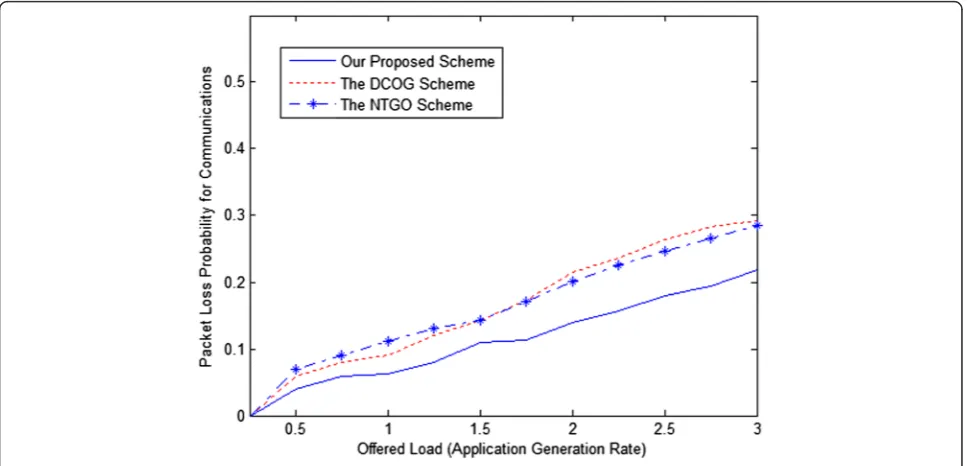
In Fig. 5, the packet loss probabilities are presented. When the offered load is low (below 0.3), the performance of all the schemes is identical. However, as the offered load increases, data packets are likely to be dropped; the packet
Fig. 4Normalized application execution time
loss probability increases linearly with the offered system load. Under various load intensities, the proposed scheme achieves a lower packet loss rate than other schemes.
From the simulation results in Figs. 2, 3, 4, 5, it can be seen that the proposed scheme, as expected, achieves
better performance than theDCOGandNTGOschemes.
Traditionally, energy consumption and total computation time are the key performance indicators for offloading computation. However, there is a trade-off. Based on the nested game model, our approach allows that each mobile device can make decisions individually, while pursuing the minimization of the computation time with a constraint over the energy consumption. It is essential in order to be close to the optimized system performance. Perform-ance evaluation results indicate that our proposed scheme can attain appropriate performance balance, while other schemes [7, 11] cannot offer such an at-tractive system performance.
5 Summary and conclusions
Over the recent past years, a novel paradigm where cloud and IoT are merged is expected to be an import-ant component of the future Internet. In this paper, we review the integration of MC and IoT and design a new computation offloading scheme in the MCIoT platform. Based on the nested game model, the main goal of our proposed scheme is to maximize mobile device perform-ance while providing service QoS. To satisfy this goal, the proposed nested game model consists of an applica-tion partiapplica-tioning game and cloud resource-selecapplica-tion game. In our partitioning game, applications are
adap-tively partitioned according to the Rubinstein-Stahl
bargaining model. In our resource-selection game, computation resources in the MC system are selected based on the one-to-many auction game model. Based on the nested game principle, these game models are interrelated to each other and operated as a two-stage sequential game. The simulation results show that our nested game approach can outperform existing compu-tation offloading schemes. For the future work direc-tion in this promising field, novel system architectures that seamlessly integrate MC and IoT and protocols that facilitate big data streaming from IoT to MC should be addressed when adopting a multi-MCIoT en-vironment. In addition, QoS and QoE, as well as data security, privacy, and reliability issues, are critical con-cerns for the further research.
Competing interests
The author declares that he has no competing interests.
Acknowledgements
This research was supported by the Ministry of Science, ICT and Future Planning (MSIP), Korea, under the Information Technology Research Center (ITRC) support program (IITP-2015-H8501-15-1018) supervised by the Institute
for Information & communications Technology Promotion (IITP) and by the Sogang University Research Grant of 2014(201410020.01).
Received: 20 May 2015 Accepted: 1 October 2015
References
1. KS Kim, S Uno, MW Kim, Adaptive QoS mechanism for wireless mobile network. JCSE4(2), 153–172 (2010)
2. A Botta, W de Donato, V Persico, A Pescape, On the integration of cloud computing and internet of things. IEEE FiCloud2014, 23–30 (2014) 3. D Singh, G Tripathi, AJ Jara, A survey of internet-of-things: future vision,
architecture, challenges and services. IEEE World Forum on Internet of Things (WF-IoT)2014, 287–292 (2014)
4. O Vermesan, P Friess,Internet of Things - Global Technological and Societal Trends from Smart Environments and Spaces to Green Ict, ed. by O Vermesan, P Friess (River Publishers, Denmark, 2011)
5. AS Sabyasachi, S De, S De, On the notion of decoupling in Mobile Cloud Computing. IEEE HPCC_EUC2013, 450–457 (2013)
6. W Zhu, C Lee, A new approach to web data mining based on cloud computing. JCSE8(4), 181–186 (2014)
7. C Xu, Decentralized computation offloading game for Mobile Cloud Computing. IEEE Transactions on Parallel and Distributed Systems26(4), 974–983 (2015)
8. K Sinha, M Kulkarni, Techniques for fine-grained, multi-site computation offloading. IEEE CCGRID2011, 184–194 (2011)
9. Sungwook Kim, Game theory applications in network design, (IGI Global, Hershey, Pennsylvania (USA), 2014)
10. G Tsebelis, Nested games: the cohesion of french electoral coalitions. British Journal of Political Science18(2), 145–170 (1988)
11. W Yanzhi, L Xue, M Pedram, A nested two stage game-based optimization framework in Mobile Cloud Computing system. IEEE SOSE2013, 494–502 (2013) 12. P Yongshia, S Xie, J Shasha, The application of nested-game theory in the
public participation mechanism in the decision-making of large engineering projects. Systems Engineering Procedia1, 142–146 (2011)
13. NG Jesse, U Heo, K DeRouen Jr, A nested game approach to political and economic liberalization in democratizing states: the case of South Korea. International Studies Quarterly46(3), 401–422 (2002)
14. SS Yau, AB Buduru, Intelligent planning for developing mobile IoT applications using cloud systems. IEEE MS’2014, 55–62 (2014)
15. R Hasan, MM Hossain, R Khan, Aura: an IoT based cloud infrastructure for localized mobile computation outsourcing. IEEE MobileCloud2015, 183–188 (2015)
16. S Nastic, M Vogler, C Inzinger, T Hong-Linh, S Dustdar, rtGovOps: a runtime framework for governance in large-scale software-defined IoT cloud systems. IEEE MobileCloud2015, 24–33 (2015)
17. H Park, M van der Schaar, Bargaining strategies for networked multimedia resource management. IEEE Trans. on Signal Processing55(7), 3496–3511 (2007) 18. JE Suris, LA DaSilva, Z Han, AB MacKenzie, Cooperative game theory for
distributed spectrum sharing. IEEE ICC2007, 5282–5287 (2007) 19. Z Yu, H Zhao, Study on negotiation strategy. International Conference On
Power System Technology2002, 1335–1338 (2002)
20. M Pan, Y Fang, Bargaining based pairwise cooperative spectrum sensing for cognitive radio networks. IEEE MILCOM2008, 1–7 (2008)
Submit your manuscript to a
journal and benefi t from:
7Convenient online submission 7Rigorous peer review
7Immediate publication on acceptance 7Open access: articles freely available online 7High visibility within the fi eld
7Retaining the copyright to your article