Temperature Effects on Adventitious Root
Development in Blue Grama Seedlings
D. D. BRISKE AND A. M. WILSON
Highlight: Adventitious root initiation and development of six blue grama (Bouteloua gracilis (H.B.K.) Lag. ex Steud.) accessions were evaluated at seven temperatures in controlled environment conditions. During a 4-day growth performance test, individual growth responses of 21-day-old seedlings exhibited different temperature optima within the 5 to 35°C temperature range. The largest number of adventitious roots, 3.8 per seedling, were initiated at 20°C. Temperatures less than 15°C probably would not be adequate for adventitious root establishment in the field.
Precipitation probabilities and rates of adventitious root growth at constant temperatures suggest two possible alternatives for establishment of blue grama in the Central Plains: (1) plant in early May when temperatures for root growth are marginal, but probabilities of 2 or more consecutive wet days are relatively high; and (2) plant in mid-summer when temperatures are favorable for emergence and root growth, but probabilities of 2 or more consecutive wet days are very low. Modification of the micro- environment and development of improved seedlings will be needed before either of these alternatives provides a reliable method for blue grama establishment.
Blue grama (Bouteloua gracilis (H.B.K.) Lag. ex Steud.) is the dominant perennial grass throughout much of the Great Plains. However, it is poorly adapted for natural regeneration from seed on the rangelands where it is the ecological dominant (Hyder et al. 1971). Blue grama revegetates disturbed areas very slowly (Riegel 1941). Consequently, on the shortgrass plains of Colorado, abandoned fields have remained in the early Aristida stage of secondary succession for the last 20 years (Hyder et al. 1971).
Blue grama generally emerges quickly and abundantly from seed planted in moist, warm soil. However, seedlings often die at about 6 to 10 weeks of age (Hyder et al. 197 1). Blue grama seedlings have a single seminal root which is short lived. Therefore, seedling establishment requires the development and extension of adventitious roots (Esau 1960).
Blue grama seedling failures have been related to its seedling morphology. Two types of grass seedlings are recognized (Hyder et al. 197 1). Crested wheatgrass (Agropyron desertorum (Fisch. ex Link) Schult.) is an example of the form that has a long coleoptile. In this form, the origin of adventitious roots remains near planting depth. The blue grama form has a short coleoptile and an elongated subcoleoptile internode, which
The authors are graduate research assistant, Department of Range Science, Colorado State University, and plant physiologist, U.S. Department of Agriculture, Agricultural Research Service, Crops Research Laboratory, Colorado State University, Fort Collins. The study involved cooperative investigations of the Agr. Res. Serv., U.S. Dep. Agr., and the Colorado State Univ. Experiment Station, Fort Collins 80523. (Scientific Series Paper No. 2191.)
Manuscript received September I I, 1976.
places the coleoptilar node and all tillering crowns, from which adventitious roots may arise, on or very near the soil surface. At the soil surface, there is adequate soil moisture for adventitious root development only during and immediately after a rain. Consequently, adventitious roots are initiated only when damp, cloudy weather persists for 2 or 3 days (van der Sluijs and Hyder
1974).
During favorable conditions, adventitious roots may develop as early as 11 days after planting, and all seedlings capable of rooting do so by the 20th day (van der Sluijs and Hyder 1974). When tillering crowns of 2 1 -day-old seedlings were exposed to moist soil, roots developed within a few hours. The average maximum rate of adventitious root growth was 3 cm in 24 hours. In 1973 and 1974, seedlings that emerged in late summer on the Central Plains Experimental Range near Nunn, Colo., did not initiate adventitious roots during the fall growing season and did not survive through the winter (Briske and Wilson, un- published data). Therefore, we examined the effects of tempera-
ture on adventitious root development in controlled environ- ments to determine whether low temperatures contributed to seedling failures in the field.
Methods
Seed of six blue grama accessions, which originated in Nebraska, Kansas, and Texas, were obtained from the Soil Conservation Service (Table 1). They were selected from a collection of 129 accessions on the basis of superior forage and seed production. Seed were produced during 1970 at the Manhattan Plant Materials Center, Manhattan, Kan. it was cleaned with an aspirator to remove inert material and to
insure a uniform seed size. Average seed weights were similar for the -
various accessions (Table 1).
Plastic pots, 15 cm in diameter by 15 cm in depth, were filled with 12 cm of autoclaved and screened sandy loam soil and then irrigated with a measured amount of water to approximately field capacity. Forty uniformly spaced seed Per pot were pressed into the moist soil
surface and covered with 1.5 cm of air-dry soil.
Table 1. Origin of blue grama accessions, and air-dry weight of seed (g/ 100 seed) used for determining the effects of temperature on adventitious root growth.
Accession County and state Air-dry seed
number of origin weight
625 Clay, Neb. 0.047’
650 Adams, Neb. 0.046
658 Comanche, Kan. 0.043
913 Osborne, Kan. 0.046
921 Ochiltree, Tex. 0.044
922 Hartley, Tex . 0.048
’ Analysis of variance indicated no significat difference among seed lots.
The pots were placed in a growth chamber set for a temperature of 25°C) day length of 15 hours, and light intensity of 2,100 foot-candles. After emergence, seedlings were thinned to 8 per pot. During a 2 1 -day period of seedling development, the pots were sub-irrigated twice weekly to keep soil moisture conditions at an optimum for seedling growth, but still maintain a dry surface layer that would prevent initiation of adventitious roots. Uniform growth conditions during this period ensured that all seedlings would be at comparable stages of development when they were subjected to growth-performance tests at different temperatures. At 21 days after planting, when the seedlings were morphologically and physiologically prepared to initiate adventi- tious roots, we counted the number of tillers per plant, measured green leaf-blade length, irrigated all pots by surface application, and placed the pots in a growth chamber set for a constant temperature of 5, 10, 15, 20, 25, 30, or 35°C. The soil surface was covered with 0.5 cm of fine gravel to reduce evaporation, and pots were irrigated daily by surface application to promote growth of adventitious roots.
After 4 days, we removed the pots, counted the number of tillers, and measured green leaf-blade length. The soil containing the seed- lings was removed from the pots, placed on a screen, and washed from the roots with a fine spray of water. All adventitious roots were counted and measured; and shoots and roots were separated, dried, and weighed.
Seedling growth performance was tested one temperature at a time,
with the seven temperatures arranged in a random sequence. Each temperature treatment included four pots for each of the six accessions. After tests at all seven temperatures had been completed, the entire experiment was repeated.
The experiment was conducted in a split-plot design. An observa- tion was the mean of eight seedlings growing in a pot. Analysis of variance and Duncan’s multiple range test were used to determine significant differences among means.
We computed weekly means (years 197 1 through 1975) of average soil temperature at a depth of 2.5 cm for the Central Plains Experi- metal Range to further evaluate the role of temperature in terms of seedling establishment in the field. Temperature data were provided by the Natural Resource Ecology Laboratory, Colorado State Uni- versity. Average monthly precipitation amounts (years 1939 through 1968) at the Central Plains Experimental Range were obtained from U. S . Department of Agriculture records. The probability of 2 or more consecutive wet days (0.25 cm or more precipitation each day) during 7-day periods of the growing season was computed with the use of tables and procedures of Heermann et al. (197 1). These probabilities were based on long-term precipitation data at Fort Collins, Colo. We also estimated the probabilities (number of years out of 10) of getting 2 or more consecutive wet days during a 6-week period in the spring or summer by summing the computed probabilities for six 7-day periods.
Table 2. Number of adventitious roots, total length of adventitious roots (cm), longest adventitious root/seedling (cm), dry weight of adventitious roots (mg), and weight per unit length of adventitious roots (mglcm) produced by 21-day-old blue grama seedlings during a 4-day test at seven temperatures.
Growth response
Accession
number 5°C 10°C
Temperature treatment
15°C 20°C 25°C 30°C 35°C
Accession means’
Number of adventitious roots 625 1.4 2.7 3.3 3.6 3.6 3.4 3.0
650 1.8 2.7 3.3 4.0 3.6 3.6 2.7
658 1.5 2.6 3.2 3.7 3.3 3.4 2.6
913 1.4 2.7 3.0 3.8 3.5 3.4 2.9
921 1.7 2.7 3.2 3.9 3.5 3.2 2.8
922 1.8 2.9 3.2 3.9 3.2 3.2 2.7
Means’ 1.6a 2.7b 3.2~ 3.8e 3.4d 3.4d 2.8b
3.0a 3.1 a 2.9a 3.0a 3.0a 3.0a
Total length of adventitious roots 625 0.2 1.4 4.5 13.8 21.5
650 0.2 1.4 5.1 15.9 22.2
658 0.2 1.4 4.8 14.9 21.8
913 0.2 1.5 4.4 15.5 23.6
921 0.2 1.5 4.9 17.9 24.9
922 0.3 1.8 5.8 18.2 23.3
Means 0.2 a 1.5a 4.9b 16.0~ 22.9e
25.0 27.1 27.4 27.9 26.3 29.0
12.3 a 12.8 ab 12.8 ab 13.0abc 13.4bc 13.8c
27.1 f
19.3 17.4 19.1 18.0 18.3 18.2
18.4d
Longest adventitious root/seedling 625 0.1 0.7 2.0 5.4 8.6 9.3
650 0.1 0.7 2.2 5.8 8.3 10.1
658 0.1 0.7 2.2 6.0 9.2 10.6
913 0.1 0.7 2.1 6.0 9.1 10.6
921 0.1 0.8 2.2 6.5 10.1 10.7
922 0.2 0.8 2.5 6.6 9.8 11.7
Means 0.1 a 0.7b 2.2c 6.1 d 9.2e 10.5 f
9.1 5.0a
8.3 5.1 a
9.5 5.5 bc
7.9 5.2ab
8.6 5.6cd
9.1 5.8d
8.8e
Weight of adventitious roots 625 0.07 0.75 1.86 3.52 4.06 4.23 2.54 2.43 a
650 0.08 0.75 2.19 4.58 4.19 5.64 1.99 2.77 a 658 0.09 0.58 2.06 4.19 4.40 4.92 2.30 2.65 a 913 0.08 0.68 1.94 4.09 5.47 5.22 2.28 2.82 a 921 0.09 0.72 2.02 5.79 7.15 5.91 2.79 3.49b 922 0.09 0.95 2.49 6.44 6.24 7.76 2.66 3.80~
Means 0.08 a 0.74 b 2.09c 4.77 e 5.25 f 5.61 g 2.43 d
Weight/unit length of adventitious roots 625 0.36 0.51 0.40 0.25 0.19 0.17 0.13 0.29a 650 0.35 0.52 0.41 0.29 0.18 0.20 0.12 0.29 a 658 0.39 0.41 0.43 0.28 0.20 0.18 0.12 0.29a 913 0.46 0.44 0.41 0.27 0.23 0.19 0.13 0.30a 921 0.40 0.48 0.41 0.32 0.27 0.22 0.16 0.32 a 922 0.33 0.52 0.42 0.35 0.27 0.27 0.15 0.33 a
Means 0.38 e 0.48 g 0.41 f 0.29d 0.22 c 0.20 b 0.13a
’ Means associated with the same letters are not significantly different at the 0.05 level.
Number of Roots
Results
The maximum number of adventitious roots, 3.8 per seed- ling, were initiated at 20°C (Table 2). Numbers of adventitious mots averaged more than 3 per seedling over the temperature range of 15 to 30°C. Since the average number of tillers per seedling was only 0.2 at the beginning of the temperature treat- ments, most of the adventitious roots developed from the main shoot.
Although significant differences were observed, numbers ot adventitious roots were not very sensitive to the effects of temperature. This, in part, may have been the result of differ- entiation of root primordia during the favorable conditions (25°C) of the pretest period. In fact, prior to the temperature treatments, areas of swelling were observed on the seedling crowns, just below the soil surface.
In contrast with our results, Smoliak and Johnston (1968), working with seed that originated in southern Alberta, Canada, Rported that root numbers in blue grama seedlings were not significantly affected by temperature. However, they did ob- serve significant temperature effects on leaf and root lengths. Length of Roots
The greatest total length of adventitious roots per seedling and longest adventitious root per seedling were produced at
30°C (Table 2). Total length and longest root at 30°C were 27.1 and 10.5, resepctively. Both growth responses decreased at higher and lower temperatures.
‘l’otal adventitious root length did not appear to be limited by either number of tillers or adventitious roots. Both of these growth responses decreased less rapidly with a decrease in
temperature than did total length of adventitious roots (Tables 2 and 3).
Regardless of temperature treatment, the longest adventitious mot per seedling never accounted for more than one-half the total length of adventitious roots. Longest adventitious root per seedling is more crucial to seedling survival than total length of adventitious roots because it is important that at least one root extend rapidly into moist soil.
Smoliak and Johnston (1968) reported that blue grama seedlings produced the longest roots at a root-zone temperature
of 18°C. This contrasts with our findings of longest roots produced at 30°C. These differences may have resulted from dissimilarities in the origin of seed or in methods used in the two studies. They maintained an air temperature of about 2 1°C and controlled soil temperature independently of air temperature. Weight of Roots
The greatest weight of adventitious roots per seedling, 5.6 mg, was produced at 30°C (Table 2). Temperatures of 20 to 30°C were optimum, and root weights decreased sharply with lower and higher temperatures. Root weight decreased 57% with an increase in temperature from 30 to 35°C.
Weight per unit length of root reached a maximum of 0.5 mg/cm at IOOC, then steadily decreased as temperature in- creased (Table 2). Correspondingly, the roots at lower tempera- tures appeared thicker than those at higher temperatures. Shoot Growth
Seedlings produced the greatest shoot weight at 30°C (Table 3). However, these weights represent growth during the entire 25-day period, including 2 1 days at 25°C and 4 days at one of the seven temperatures. Leaf growth during the 4-day test period was also greatest at 30°C.
Average tiller production for all accessions was greatest at 25 and 30°C (Table 3). During the 4-day test period, the maximum number of tillers initiated was 0.7 per seedling.
Differences Among Accessions and Among Seedlings
Significant differences among accessions occurred in total length of adventitious roots, longest adventitious root per seedling, and weight of adventitious roots (Table 2). Seminal root weights also differed among accessions. These weights were 1.5, 1.6, 1.7, 1.4, 1.7, and 2.0 mg per seedling for accessions 625, 650,658, 913,921, and 922, respectively. No accession differences were observed in number of adventitious roots (Table 2) or in leaf growth (Table 3). The selection of superior accessions for use in this study probably explains why we observed only small differences among accessions.
Significant interactions between temperature and accessions occurred for both longest root per seedling and total weight of adventitious roots. In general, the Texas accessions were Table 3. Shoot weights (mg) produced by blue grama seedlings during a 25day growth period, including 21 days at 25°C and 4 days at one of the seven
temperatures; and leaf length (cm) and number of tillers produced by 21-day-old seedlings during a 4-day test at seven temperatures.
Temperature treatment Accession
Growth response number 5°C 10°C 15°C 20°C 25°C
Shoot weight 625 10.7 13.1 15.9 16.6 18.9
650 11.0 13.6 15.6 17.2 18.7
658 10.6 13.5 16. I 17.1 17.2
913 10.3 14.2 15.8 16.9 18.2
921 9.7 14.3 15.6 17.1 18.6
922 12.0 16.7 17.8 20.2 19.1
Means l 10.8 a 14.2 b 16.1 c 17.5d 18.4e
Leaf length 625 0.2 1.5 3.0 9.7 18.6
650 0.2 1.2 3.3 10.0 16.8
658 0.4 1.4 3.3 9.1 16.0
913 0.4 1.1 3.9 9.9 18.1
921 0.0 1.1 4.0 9.5 17.2
922 0.4 1.6 3.5 10.0 17.6
Means 0.1 a 1.3b 3.5 c 9.7d 17.4e
Tiller number Means2 O.Oa 0.1 ab 0.2 abc 0.4 cd 0.6de
’ Accession or treatment means associated with the same letters are not significantly different at the 0.05 level. ’ Tiller means are an average of all 6 accessions.
30°C 35°C
23.2 17.8
23.2 16.3
23.9 17.3
25.5 16.5
23.2 16.0
26.4 18.1
24.2 f 17.0cd
25.0 21.8
23.0 19.2
23.1 18.9
26.0 18.7
24.8 19.0
24.3 19.2
24.48 19.5 f
0.7e 0.3 bc
Accession means’
16.6a 16.5 a 16.6 a 16.7 a 16.4a
18.6b
11.4a 10.5 a 10.3 a 11.0a 10.8 a 10.9 a
superior in longest root per seedling at 25 and 3O”C, and in adventitious root weight at 20, 25, and 30°C.
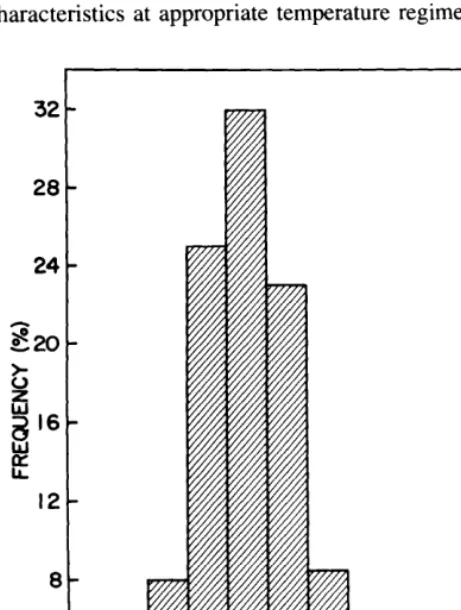
Even though accession differences were not large, great variability occurred among seedlings. The average longest root per seedling at 15°C was 2.2 cm (Fig. 1). At this temperature,
11.6% of the seedlings had roots exceeding 3 cm and 0.7% had roots exceeding 4 cm. The frequency distribution of longest adventitious root per seedling at 15°C (Fig. 1) shows sufficient variation to indicate that certain seedlings possess superior root elongation characteristics. Consequently, it would be possible to select for seedlings exhibiting superior root elongation characteristics at appropriate temperature regimes.
r
FREQUENCY CLASS FOR LONGEST ROOT/SEEDLING km)
Fig. 1. Frequency distribution of longest root per seedling at 15°C. Data are from a population of 376 seedlings.
Soil Temperatures on the Central Plains
Soil temperatures on the Central Plains remain adequate for adventitious root development from early May to the end of September (Fig. 2). This is based on the assumption that 15°C is the lowest temperature that is adequate for adventitious root establishment in the field. At 10°C, the average rate of root elongation is 0.2 cm per day, a rate that is probably insufficient for adventitious root establishment because the soil surface would often dry more rapidly than roots would extend.
The influences of soil and air temperatures on seedling growth could not be distinguished because they were not controlled separately. In the field, soil temperatures are not constant throughout, but decrease with depth in the spring of the year because of a temperature lag. Therefore, elongation rates in the spring may decrease as roots extend into soil zones that are at a lower temperature. Conversely, soil temperatures at the depth of root initiation sometimes may be higher than air temperatures because of the proximity of seedling crowns to the soil surface.
.
26 - .@ a
em* 0
24 - l @
G*
SOIL -. TEMPERATURE ’
l I 20
t x I6
I 16- g __-_-_-_-___-
d 14-
_---- ____ ---‘-__-~--_-_---‘__
k 12- w
; IO- .
i! 6- !!
0
56
I- .
-1 4-
8
.*
2- l l
l
o- l 0
l . 0 l
-2- . ”
. -4 .a
J’F M’A’MlJ’J’A S’O’N D
WINTER SPRING SUMMER FALL WINTER
Fig. 2. Probabilities of 2 or more consecutive wet days in a 7-day period calcu- lated from long-term precipitation data at Fort Collins, Colo.; and soil temperatures at a depth of 2.5 cm for the Central Plains Experimental Range, Nunn, Cola., during the years 1971 through 1975.
However, adventitious root development can not be ex- plained on the basis of soil temperature alone (Black 1970). If only brief periods of favorable soil moisture occur, adventitious roots may extend a few millimeters and then die because of high evaporation rates at shallow depths. Therefore, favorable tem- perature and moisture conditions of adequate duration must occur at the same time for seedlings to become established. Precipitation on the Central Plains
Monthly average precipitation amounts on the Central Plains are highest during the months of May through August (Table 4).
Table 4. Average monthly precipitation (cm), for years 1939 through 1968, at the Central Plains Experimental Range near Nunn, Colo.
Month Precipitation
January 0.74
February 0.56
March 1.45
April 2.59
May 5.56
June 6.17
July 4.78
August 3.89
September 2.59
October 1.79
November 0.69
December 0.41
But a single precipitation event often is inadequate for adventi- tious root initiation and extension. The soil surface may become too dry for root development within a few hours after a brief precipitation event associated with a thunderstorm. Therefore, 2 or more consecutive wet days (i.e., a period of damp, cloudy weather), as well as adequate precipitation amounts, are re- quired for adventitious root establishment. The probability of 2 or more consecutive wet days in a given 7-day period is greatest in early May, when soil temperatures are approximately 15°C (Fig. 2). Therefore, selection of blue grama seedlings for use on the Central Plains should be directed toward those that have the capacity for rapid root extension at 15°C.
Discussion Alternatives for Planting
Rates of adventitious root growth and precipitation probabili- ties suggest two possible alternatives for planting and establish- ment of blue grama: (1) plant during early May when tempera- tures for seedling growth are marginal, but probabilities of 2 or more consecutive wet days are relatively high; and (2) plant in mid-summer when temperatures are favorable for emergence and root growth, but probabilities of 2 or more consecutive wet days are very low. Problems of blue grama seedling establish- ment are complex and, with present technology, neither of these alternatives provides a reliable solution.
Spring Planting
Detailed information concerning the effects of temperature on emergence and seminal root growth of blue grama is lacking. Temperatures lower than 15°C would probably inhibit gerrni- nation (Smoliak and Johnston 1968; Bokhari et al. 1975) and seminal root growth just as severely as they inhibit growth of adventitious roots. Therefore, planting dates earlier than the first of May, when average soil temperatures are less than 15”C, probably would not be advisable.
We used data of Figure 2 to make an estimate of the probability of a successful spring planting. Summing the probabilities for 2 or more consecutive wet days during six 7-day periods in late spring ( 1st of May to mid-June) suggests
that, in about 10 out of every 10 years, one might expect one sequence of wet days that would be adequate for either emergence or development of adventitious roots. However, seedling establishment requires two properly spaced periods of damp, cloudy weather-one for emergence and one for devel- opment of adventitious roots. The probability of getting two periods of damp, cloudy weather would be one-half the proba- bility of getting one period. Therefore, the probability of a successful spring planting would be 5 years or less out of 10. That estimate is made without regard to the proper spacing of precipitation events, which may depend on growing conditions. Under favorable temperature and moisture conditions, about 11 days after planting are required for seedlings to develop the capacity for adventitious roots (van der Sluijs and Hyder 1974). But at 15”C, the time required for development of this capacity may be longer than 11 days. Generally, the second period of damp, cloudy weather must occur within 2 to 6 weeks after the first period to effectively promote initiation and extension of adventitious roots (Hyder et al. 1975). Seedlings seldom survive longer than about 6 weeks if adventitious roots do not develop.
Summer Planting
Advantages of mid-summer planting of blue grama on the Central Plains include: (1) optimum temperatures foremergence and root growth, (2) low probability of overexpansion of seedling leaf area (Wilson et al. 1976), (3) decreasing seasonal trend in transpirational stress, and (4) precipitation amounts that are about equal to those received in the spring. Disadvantages of mid-summer planting are high rates of evaporation from the soil surface and very low probabilities of 2 or more consecutive wet days.
Summing the probabilities of 2 or more consecutive wet days during six 7-day periods (1st of July to mid-August) indicates
that in about 4 years out of 10 one might expect one period of damp, cloudy weather that would be adequate for either emergence or development of adventitious roots. The probabili- ty of two such periods during this interval, without regard to the proper spacing of precipitation events, would be about 2 out of 10 years. Therefore, without a mulch to conserve water at the soil surface, one could rarely expect emergence and establish- ment of blue grama from mid-summer plantings. Even when temperatures are favorable, 2 consecutive wet days may be inadequate for seedling establishment because of insufficient water in the soil profile, improperly spaced precipitation events, or lack of capacity for adventitious roots because of exposure of seedlings to environmental stress prior to the sequence of wet days.
Ecological and Management Implications
In contrast with the problems of seedling establishment, the persistence of mature blue grama plants on the Central Plains is a seeming paradox. Hyder et al. (1975) suggested that new tillers on established plants may derive support from the parent crown for a much longer time than 6 weeks. Therefore, the timing of precipitation events is not as critical with mature plants as with seedlings. Moreover, crowns of mature plants are often covered with litter and wind-blown soil, which serve as a mulch to conserve water.
Blue grama has not become reestablished on abandoned homestead fields of the Central Plains since they were last plowed, approximately 40 years ago. This suggests that weather conditions favoring establishment are, indeed, rare occur- rences, and that the history of blue grama on the Central Plains began many years ago when weather patterns were more favorable than they are today.
The results of this study suggest opportunities for continued research to develop improved seedlings, modify the micro- environment, and define lowest-risk seasons for planting. All of these approaches are needed to develop reliable methods for establishing blue grama seedlings on the Central Plains.
Literature Cited
Black, A. L. 1970. Soil water and soil temperature influences on dry- land winter wheat. Agron. J. 62:797-801.
Bokhari, U. G., J. S. Singh, and F. M. Smith. 1975. Influence of temperature regimes and water stress on the germination of three range grasses and its possible ecological significance to a shortgrass prairie. J. Appl. Ecol.
12:153-163.
Esau, K. l%O. Anatomy of seed plants. John Wiley and Sons, Inc., New York. 170 p.
Heermann, D. F., M. D. Finkner, and E. A. Hiler. 1971. Probability of sequences of wet and dry days for eleven western states and Texas. Colorado State Univ. Exp. Sta. Tech. Bull. 117. 303 p.
Hyder, D. N., A. C. Everson, and R. E. Bement. 1971. Seedling morphology and seeding failures with blue grarna. J. Range Manage. 24:287-292.
Hyder, D. N., R. E. Bement, E. E. Remmenga, and D. F. Hervey. 1975.
Ecological responses of native plants and guidelines for management of short- grass range. U.S. Dep. Agr. Tech. Bull. 1503. 87 p.
Riegel, A. 1941. Life history and habits of blue grama. Trans. Kans. Acad. of Sci. 4476-83.
Smoliak, S., and A. Johnston. 1968. Germination and early growth of grasses at four root-zone temperatures. Can. J. Plant Sci. 48:119-127.
van der Sluijs, D. H., and D. N. Hyder. 1974. Growth and longevity of blue grama seedlings restricted to seminal roots. J. Range Manage. 27: 117-I 19.
Wilson, A. M., D. N. Hyder, and D. D. Briske. 1976. Drought resistance characteristics of blue grama seedlings. Agron. J. 68:479-484.