Recent Results from the CMS Experiment at the LHC
Bora Isildak1,2,a
1Ozyegin University, Department of Natural and Mathematical Sciences, Nisantepe District, Orman Street,
34794 Cekmekoy - ISTANBUL
2The CMS Experiment
Abstract. Numerous studies on Jet Production, Vector Boson Production, V+Jets Production and Multi-Boson Production have been carried out by the Compact Muon Solenoid (CMS) Collaboration to test perturbative quantum chromodynamics (QCD) pre-dictions, and to put more stringent constraints on PDFs (Parton Distribution Functions). In this paper, some of these experimental results will be presented, and their possible impacts on Higgs physics and new physics searches will be discussed.
1 Introduction
The LHC is the worlds largest and the most powerful collider which is 27 km circumference long, and has been run at 7 TeV and 8 TeV of pp center of mass energies so far. The collider hosts four main detectors (ALICE, ATLAS, CMS, LHCb). The first pp collisions have taken place in March 2010, the first Pb-Pb collisions have taken in November 2010, and the first p-Pb collisions have taken in September 2012. The Compact Muon Solenoid (CMS) is a multi purpose detector at the LHC which consists of several layers where each one is specialized to measure and identify different classes of particles. The detector requirements for the CMS along with its scientific targets can be given as; a good muon identification and momentum resolution, a good charged particle momentum resolution and reconstruction efficiency in the inner tracker, a good electromagnetic energy resolution, good di-photon and di-electron mass resolution, and good missing transverse energy (MET) and dijet mass resolution, having the wordgoodas the maximum possible excellence with the current technology. LHC pp collisions covers an extensive and unexplored kinematic region. In these pp collisions at LHC, QCD processes are the dominant processes. They affect all measurements; as signal or as background. Hence, it must be understood in great detail. A more precise knowledge of QCD is important for new physics searches as well as for SUSY searches where the multijet production plays an important role.
2 Higgs Discovery at CMS
CMS Collaboration has investigated for an evidence of a Standard Model Higgs boson in five different predicted decay channels:H→γγ,H→ZZ,H→WW,H→ττ,H→bb. The searches have been performed with the data samples recorded in 2011 and 2012 corresponding to integrated luminosities
DOI: 10.1051/ C
Owned by the authors, published by EDP Sciences, 2014
/2 0148000020
γ γ
!"#"
σ ±
σ
±
$ %&'()%*+
$ %,'()% *+
γ γ
./
(GeV)
H
m
110 115 120 125 130 135 140 145
of
S
M Higgs hypothesis
S
C
L
-7
10
-6
10
-5
10
-4
10
-3
10
-2
10
-1
10 1
99.9% 95%
99%
Observed Expected (68%) Expected (95%) CMS s = 7 TeV, L = 5.1 fb-1 s = 8 TeV, L = 5.3 fb-1
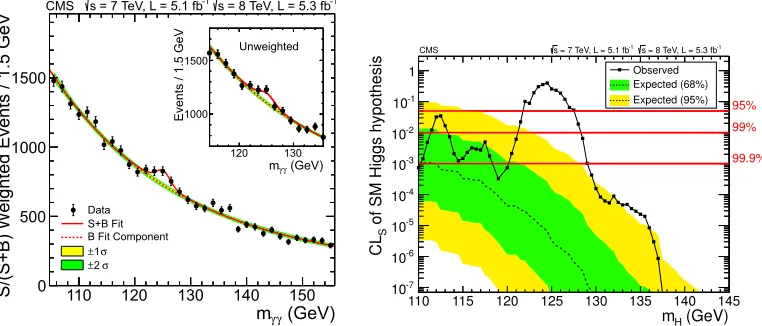
Figure 1: The diphoton invariant mass distribution with each event weighted by theS/(S +B) value of its category (left). The CLsvalues for the SM Higgs boson hypothesis as a function of the Higgs boson mass in the range 110–145 GeV. The background-only expectations are represented by their median (dashed line) and by the 68% and 95% CL bands (right).
of up to 5.1 fb−1at √s=7 TeV and 5.3 fb−1at √s=8 TeV [1]1. An excess of events is observed above the SM background which indicates the existence of a new particle. This excess has a local significance of 5.0σ, at a mass value of near 125 GeV where the expected local significance for a SM Higgs boson of that mass is 5.8σ. The global p-value in the search range of 115–130 (110–145) GeV corresponds to 4.6σ(4.5σ). The excess is most significant in the two decay modes with the best mass resolution,γγand ZZ, and a fit to these signals gives a mass of 125.3±0.4(stat.) ±0.5(syst.) GeV. Studies on the spin and the parity of this newly discovered particle indicate that it is the foreseen scalar boson [3] .
3 QCD Results from the CMS
3.1 Jet Reconstruction and Calibration
Jets are invaluable objects to probe QCD. They are experimental signatures of quarks and gluons. A jet is an object that is clustered out of collimated spray of particles by using a set of mathematical rules. CMS’s default jet reconstruction algorithm is “anti-kT jet” algorithm which is a successive recombination algorithm (belongs to thekT family). It is an infrared and collinear safe algorithm that tends to cluster around the hard energy depositions resulting geometrically cone-like jets. The jet reconstruction in CMS follows the “E-Scheme” such that addition of Lorentz vectors of massless particles ends up with massive jets. Details of the CMS jet reconstruction and calibration can be found in the related CMS publicaton [4].
3.2 Strong Coupling Constant Measurements
Running of the strong coupling constantαS is a defining property of QCD physics phenomena. Hence, the determination of its evolution becomes very essential for LHC physics and for the future collider
1A recent study on the observation of the Higgs boson with 19.7 fb−1at √s=8 TeV was published after the talk was
Α
Q (GeV)
10 2
10 3
10
(Q)
S
α
0.06 0.08 0.1 0.12 0.14 0.16 0.18 0.2 0.22
0.24 CMS Preliminary
+0.0065 -0.0041
)=0.1185
Z
(M
S
α CMS Incl. Jets :
32
CMS R cross section t CMS t CMS 3-Jet mass CMS Incl. Jets
D0 inclusive jets D0 angular correlation H1
ZEUS
Figure 2: Change inαS induced by a new fermion of mass 500 GeV in various representations of the color gauge group (left)[5]. Summary of measurements ofαS as a function of the respective energy scaleQ[7] (right).
projects. Apart from that, new physics may affect the running of the strong coupling constant [5, 6]. Using predictions from theory at next-to-leading order, complemented with electroweak corrections, the strong coupling constant is determined from the inclusive jet cross section to beαS(MZ)=0.1185 ±0.0019 (exp.) ±0.0028 (PDF)±0.0004 (NP) +0.0055 (scale), which is in agreement with the world average. All fits have also been carried out for six bins in inclusive jetpT separately in order to test the running of the strong coupling, where the scaleQof αS(Q) is identified with pT. The observed behaviour ofαS(Q) is consistent with the momentum scale dependence predicted by the renormalization group equation of QCD and extend the H1, ZEUS, and D0 results to the 1 TeV region [7].
3.3 Dijet Mass Production Cross Section at 8 TeV
The invariant mass of the two jets can be given in terms of proton momentum fractionsx1,2. The dijet cross section as a function ofMj j can be precisely calculated in perturbative QCD and it also allows sensitive searches for physics beyond the Standard Model, such as dijet narrow resonances or contact interaction searches. A measurement of dijet production cross section has been performed by CMS with the data taken from LHC proton-proton collisions at √s=8 TeV, corresponding to an integrated luminosty of 9.2 fb−1. The spectra measured in five different rapidity bins from 0.0 to 2.5 by 0.5 intervals and the comparison with the theory predictions reported [8].
3.4 Z Boson and b Jet(s) Cross Section
The production of a Z boson, decaying into two leptons and produced in association with at least one b jet, is studied using ppcollisions in LHC at √s=7 TeV. The study was done with the 5.0 fb−1of data recorded in 2011 with the CMS detector. TheZ(ll)+b-jets cross sections (wherell = μμor
(GeV) jj M 3 10 (pb/GeV) max d|y|jj /dM σ 2d -7 10 -6 10 -5 10 -4 10 -3 10 -2 10 -1 10 1 10 2 10 3 10 4 10 5 10 6 10 7 10 8 10 9 10 R=0.7 T anti-k -1
= 8 TeV L = 9.2 fb s CMS Preliminary ave T = p F μ = R μ < 0.5 max 0.0 < |y|
) 1 < 1.0 (x 10 max 0.5 < |y|
) 2 < 1.5 (x 10 max 1.0 < |y|
) 3 < 2.0 (x 10 max 1.5 < |y|
) 4 < 2.5 (x 10 max 2.0 < |y|
NP corrections ⊗ pQCD at NLO NNPDF 2.1
(GeV)
jj
M
500 1000 1500 2000 2500 3000 3500 4000 4500
R at io to NNPDF 2.1 0 0.2 0.4 0.6 0.8 1 1.2 1.4 1.6 1.8 2 2.2 R=0.7 T anti-k -1
= 8 TeV L = 9.2 fb s
CMS Preliminary
< 0.5 max 0.0 < |y|
Data MSTW2008 HERA 1.5 CT10 ABM11 Theor. Unc. Exp. Unc.
Figure 3: Dijet cross sections for the five different bins, for data (black markers) and theory (red lines) using the NNPDF2.1 PDF set (right). Summary of measurements ofαS as a function of the respective energy scaleQ[9] (left).
This study is of interest since it is a background in many searches for yet unobserved processes, such as the production of heavier SUSY-like Higgs bosons via vector boson fusion, and in studies of the standard model Higgs boson produced in association with a Z boson and decaying to b quark [11][12].
(GeV) bb T p
0 50 100 150 200 250 300
Events / 20 GeV
0 20 40 60 80 100 120 140 160 180 -1
= 7 TeV, L = 5.0 fb s CMS Data Z+b Z+c Z+l ZZ t t
JES + b-tag + stat. Data Z+b Z+c Z+l ZZ t t
JES + b-tag + stat.
(GeV)
bb T
p
0 50 100 150 200 250 300
Data/MC 0 1 2 (GeV) Z T p
0 50 100 150 200 250 300
Events / 20 GeV
0 20 40 60 80 100 120 140 160 180 200 -1 = 7 TeV, L = 5.0 fb s CMS Data Z+b Z+c Z+l ZZ t t
JES + b-tag + stat. Data Z+b Z+c Z+l ZZ t t
JES + b-tag + stat.
(GeV)
Z T
p
0 50 100 150 200 250 300
Data/MC 0 1 2
Cross section Measured MADGRAPH aMC@NLO MCFM MADGRAPH aMC@NLO
(5F) (5F) (parton level) (4F) (4F)
σZ+1b(pb) 3.52±0.02±0.20 3.66±0.22 3.70−+0.230.26 3.03+0.30−0.36 3.11+0.47−0.81 2.36+0.47−0.37
σZ+2b(pb) 0.36±0.01±0.07 0.37±0.07 0.29−+0.040.04 0.29+0.04−0.04 0.38+0.06−0.10 0.35+0.08−0.06
σZ+b(pb) 3.88±0.02±0.22 4.03±0.24 3.99−+0.250.29 3.23+0.34−0.40 3.49+0.52−0.91 2.71+0.52−0.41
σZ+b/Z+j(%) 5.15±0.03±0.25 5.35±0.11 5.38−+0.340.39 4.75+0.24−0.27 4.63+0.69−1.21 3.65+0.70−0.55
3.5 γγDifferential Cross Section
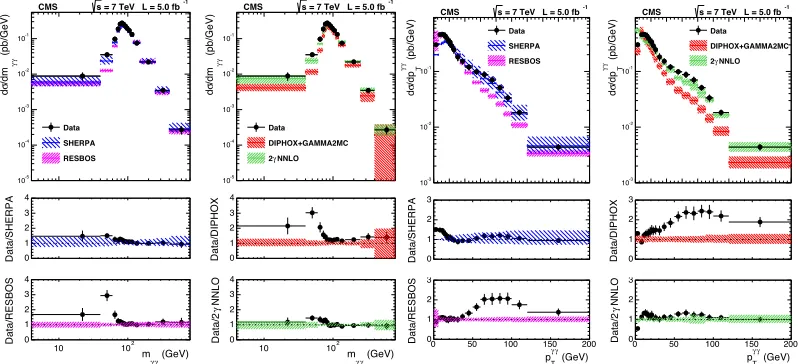
The measurement of differentialγγproduction cross sections provides an important test of pertur-bative and non-perturpertur-bative QCD. Diphoton production creates the major source of background in theγγdecay channel of the newly discovered Higgs boson [1], as well as to searches for physics beyond the standard model. New physics processes may also appear as non-resonant deviations from the predicted diphoton spectrum in events with large missingET. Alternatively, some models such as the graviton in the Randall–Sundrum model for warped extra dimensions even predict narrow res-onances. In CMS, such cross section measurement for the production of a pair of isolated photons inppcollisions has been done with 5.0 fb−1of data as an update of a previous measurement [13]. It probes a phase space defined by a highly asymmetric selection for the transverse energy (ET) of the two photons. This is the first time that such a phase space is probed at hadron colliders.
2
(pb/GeV)
γγ
/dm
σ
d
-5 10
-4 10
-3 10
-2 10
-1 10
Data
SHERPA
RESBOS
-1
= 7 TeV L = 5.0 fb s
CMS
10 102
Data/SHERPA 0 1 2 3 4
(GeV) γ γ m
10 102
Data/RESBOS 0 1 2 3 4
2
(pb/GeV)
γγ
/dm
σ
d
-5 10
-4 10
-3 10
-2 10
-1 10
Data
DIPHOX+GAMMA2MC
NNLO
γ
2
-1
= 7 TeV L = 5.0 fb s
CMS
10 102
Data/DIPHOX 0 1 2 3 4
(GeV) γ γ m
10 102
NNLO
γ
Data/2 0 1 2 3 4
0 20 4060 80 100 120 140 160 180 200
(pb/GeV)
γγ T
/dp
σ
d
-3 10
-2 10
-1 10
Data
SHERPA
RESBOS
-1
= 7 TeV L = 5.0 fb s
CMS
0 50 100 150 200
Data/SHERPA 0 1 2 3
(GeV) γ γ T p
0 50 100 150 200
Data/RESBOS 0 1 2 3
0 20 40 6080 100 120 140 160 180 200
(pb/GeV)
γγ T
/dp
σ
d
-3 10
-2 10
-1 10
Data
DIPHOX+GAMMA2MC
NNLO
γ
2
-1
= 7 TeV L = 5.0 fb s
CMS
0 50 100 150 200
Data/DIPHOX 0 1 2 3
(GeV) γ γ T p 0 50 100 150 200
NNLO
γ
Data/2 0 1 2 3
Figure 5: The comparisons of the differential cross section between data and thesherpa,diphox+
gamma2mc,resbosand 2γγnnlopredictions.
Table 1: Cross sections for the production of a Z boson with only one b jet, with at least two b jets, with at least one b jet, and the ratio with respect to at least one jet of any flavor, showing the statistical and systematic uncertainties. The expectations from MadGraph,mcfmandaMC@NLOinclude uncertainties
3.6 WZ and ZZ production in final states with b-tagged jets
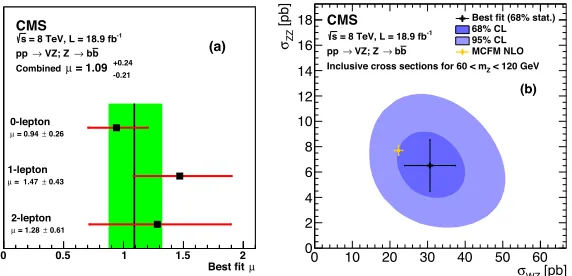
Measurements are reported of the WZ and ZZ production cross sections in proton√s=8 TeV in final states where one Z boson decays to b-tagged jets [14]. The other gauge boson, either W or Z, is detected through its leptonic decay (either W→eν,μνor Z→e+e−,μ+μ−, orνν). The results are based on data corresponding to an integrated luminosity of 18.9 fb−1collected with the CMS detector at LHC. The measured cross sections,σ(pp→WZ)=30.7±9.3 (stat.) ±7.1(syst.) ±4.1 (th.) ±1.0 (lum.) pb andσ(pp→ZZ)=6.5±1.7 (stat.)±1.0 (syst.)±0.9 (th.)±0.2 (lum.) pb, are consistent with NLO QCD calculations.
μ
Best fit
0 0.5 1 1.5 2
0.61
±
= 1.28
μ
2-lepton 0.43
±
= 1.47
μ
1-lepton 0.26
±
= 0.94
μ
0-lepton
-1
= 8 TeV, L = 18.9 fb s
+0.24 -0.21
= 1.09
μ Combined
CMS
b b → VZ; Z →
pp (a)
[pb] WZ σ 0 10 20 30 40 50 60
[pb]
ZZ
σ
0 2 4 6 8 10 12 14 16
18 Best fit (68% stat.)
68% CL 95% CL MCFM NLO
CMS
-1
= 8 TeV, L = 18.9 fb s
b b → VZ; Z → pp
< 120 GeV
Z
Inclusive cross sections for 60 < m
(b)
Figure 6: (a) Best-fit values of the ratios of the VZ production cross sections, relative to SM pre-dictions for individual channels, and for all channels combined (hatched band). (b) Contours of 68% and 95% confidence level for WZ and ZZ production cross sections. The large cross indicates the best-fit value including its 68% statistical uncertainty, and the light small cross shows the result for
theMCFM NLOcalculation.
4 QCD Related New Physics Searches
4.1 Search for Narrow Resonances in Dijet Mass Spectrum
As it was mentioned before, new physics may show up in the dijet mass spectrum as a bump. A search for the production of new particles decaying to pairs of partons (quarks, antiquarks, or gluons), in the dijet mass spectrum in pp collisions at √s=8 TeV has been performed with the 4.0 fb−1of data collected with the CMS in 2012 [15]. No significant evidence for narrow resonance production is observed. Upper limits are set at the 95% confidence level on the production cross section of hypo-thetical new particles decaying to quark- quark, quark-gluon, or gluon-gluon final states (cf. Fig.7). These limits are then translated into lower limits on the masses of new resonances in specific scenarios of physics beyond the standard model. For the first time mass limits are set for the Randall–Sundrum graviton model in the dijet channel.
4.2 Three-Jet Resonances
light-/ / ! - 1 -1 -1 -1 -1 -1 1 1 C L b
eV s
D
F
QD
J"#$%&'()#'$#
< 1*+ , . <0*2 3 4 ,
5i6ua rk7 8 9:eV; =
E
WÕ7>9:eV;
?@@@ ?A@@ B@@@BA@@ G@@@ GA @@ H@@@ HA@@ IKM NOP RSSTUNXY
Z[ Z\ Z] ^ ] \ [ _ ` c d fd g h jf l m n o po qq
11223344
A ! B ! C -1 -1 -1 -1 -1 1 1 1
Obs "# $95%&'U( ("' L) L* E+ (,* $95%&'U(( "' L) L*
. ± E+ (,*$' L) L*
/ ± E+ (,*$' L) L*
06 78:;<=>? < :<@ <= D7F;G@H I J &KM
NP 'QRf b sQSTV
qW
11223344
A ! B ! C -1 -1 -1 -1 -1 1 1 1 Obs"#$9 5%&'U(("'L)L* E+(,*$9 5%&'U(("'L) L*
. ± E+(,* $'L)L* / ± E+(,* $'L)L* XY@ 7=8 J6Z7Y[\];G@H &KM NP 'QRf b sQSTV
WW
11223344
A ! B ! C -1 -1 -1 -1 -1 1 1 1 Obs"#$95%&'U(("'L)L* E+(,*$9 5%&'U(("'L)L* . ± E+(,*$'L)L* / ± E+(,*$'L)L* X^_ [`<=G=Z[ &KM NP 'QRf b sQSTV
a cd eg 1 11 12 13 14 1 1h
A ! B ! C -1 1 1 &KM NP 'QRf b sQSTV _Xi@Gj7Y<=
Obs"#$9 5%&'U( ("'L)L* E+(,*$95 %&'U(("' L )L*
. ± E+(,*$'L)L* / ± E+(,*$'L)L*
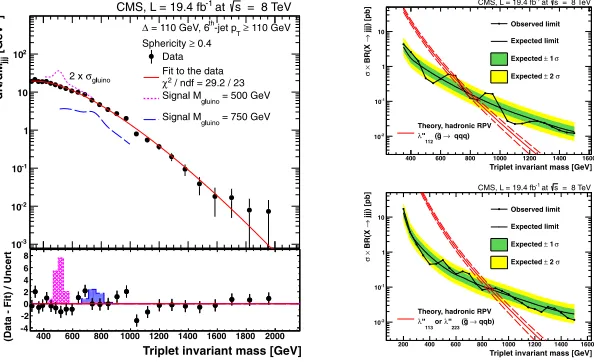
Figure 7: The dijet mass spectrum from wide jets (points) compared with a smooth fitted curve (solid line) and with the predicted QCD background (left). Observed upper limits at 95% C.L. onσ× B ×
Afor resonances decaying to qq,qgandggfinal states (points and solid lines) compared with the expected limits (dot-dashed dark lines) and their variation at the 1σand 2σlevels (shaded bands) (right).
and heavy-flavor jets. No significant deviation is found between the selected events and the expected standard model multijet andtt¯background. For a gluino decaying into light-flavor jets, a lower limit of 650 GeV on the gluino mass is set at a 95% confidence level, and for a gluino decaying into one heavy and two light-flavor jets, gluino masses between 200 and 835 GeV are, for the first time, excluded.
References
[1] S. Chatrchyan, V. Khachatryan, A. Sirunyan, A. Tumasyan, W. Adam, E. Aguilo, T. Bergauer, M. Dragicevic, J. Erö, C. Fabjan et al., Physics Letters B716, 30 (2012)
[2] V. Khachatryan et al. (CMS Collaboration) (2014),arxiv.1407.0558
[3] S. Chatrchyan, V. Khachatryan, A.M. Sirunyan, A. Tumasyan, W. Adam, E. Aguilo, T. Bergauer, M. Dragicevic, J. Erö, C. Fabjan et al. (CMS Collaboration), Phys. Rev. Lett.110, 081803 (2013) [4] S. Chatrchyan, V. Khachatryan, A. Sirunyan, A. Tumasyan, W. Adam, E. Aguilo, T. Bergauer,
M. Dragicevic, J. Erö, C. Fabjan et al., Journal of Instrumentation6, P11002 (2011) [5] D. Becciolini, M. Gillioz, M. Nardecchia, F. Sannino, M. Spannowsky (2014),1403.7411 [6] K.R. Dienes, E. Dudas, T. Gherghetta, Phys.Lett.B436, 55 (1998),hep-ph/9803466 [7] Tech. Rep. CMS-PAS-SMP-12-028, CERN, Geneva (2013)
[8] Tech. Rep. CMS-PAS-SMP-14-002, CERN, Geneva (2014)
[9] J. Beringer, J.F. Arguin, R.M. Barnett, K. Copic, O. Dahl, D.E. Groom, C.J. Lin, J. Lys, H. Mu-rayama, C.G. Wohl et al. (Particle Data Group), Phys. Rev. D86, 010001 (2012)
[10] S. Chatrchyan, V. Khachatryan, A. Sirunyan, A. Tumasyan, W. Adam, T. Bergauer, M. Dragice-vic, J. Erö, C. Fabjan, M. Friedl et al., Journal of High Energy Physics2014, 120 (2014) [11] J. Campbell, R.K. Ellis, F. Maltoni, S. Willenbrock, Phys. Rev. D73, 054007 (2006)
[12] S. Chatrchyan, V. Khachatryan, A.M. Sirunyan, A. Tumasyan, W. Adam, T. Bergauer, M. Drag-icevic, J. Erö, C. Fabjan, M. Friedl et al. (CMS Collaboration), Phys. Rev. D89, 012003 (2014) [13] S. Chatrchyan, V. Khachatryan, A. Sirunyan, A. Tumasyan, W. Adam, T. Bergauer, M.
Dragice-vic, J. Erö, C. Fabjan, M. Friedl et al., Journal of High Energy Physics2012, 133 (2012) [14] S. Chatrchyan et al. (CMS Collaboration), Eur.Phys.J.C74, 2973 (2014),1403.3047
![Figure 2: Change in αscaleS induced by a new fermion of mass 500 GeV in various representations of thecolor gauge group (left)[5]](https://thumb-us.123doks.com/thumbv2/123dok_us/8189919.1367848/3.482.64.423.82.195/figure-change-ascales-induced-fermion-various-representations-thecolor.webp)