Key-guessing Techniques
Kexin Qiao1,2, Lei Hu1,2, Siwei Sun1,2 1State Key Laboratory of Information Security,
Institute of Information Engineering, Chinese Academy of Sciences, Beijing 100093, China
2
Data Assurance and Communication Security Research Center, Chinese Academy of Sciences, Beijing 100093, China
{qiaokexin,hulei,sunsiwei}@iie.ac.cn
Abstract. The Simeck family of lightweight block ciphers was proposed in CHES 2015 which combines the good design components from NSA designed ciphers SIMON and SPECK. Dynamic key-guessing techniques were proposed by Wanget al.to greatly reduce the key space guessed in differential cryptanalysis and work well on SIMON. In this paper, we implement the dynamic key-guessing techniques in a program to automatically give out the data in dynamic key-guessing procedure and thus simplify the security evaluation of SIMON and Simeck like block ciphers regarding differential attacks. We use the differentials from K¨olbl
et al.’s work and also a differential with lower Hamming weight we find using Mixed Integer Linear Programming method to attack 22-round Simeck32, 28-round Simeck48 and 35-round Simeck64. Besides, we launch the same attack procedure on four members of SIMON family by use of newly proposed differentials in CRYPTO2015 and get new attack results on 22-round SIMON32/64, 24-22-round SIMON48/96, 28, 29-22-round SIMON64/96 and 29, 30-22-round SIMON64/128. As far as we are concerned, our results on SIMON64 are currently the best results.
Keywords: Simeck, SIMON, Dynamic Key-guessing, Differential Cryptanalysis
1
Introduction
SIMON and SPECK [6] are two lightweight block cipher families designed by NSA that have attracted numerous cryptanalysis since their publication in 2013 [9,18,2,4,3,23,24,21]. SIMON is optimized for hardware implementation and SPECK is optimized for software. In CHES 2015, Yang et al. combine their good components and get a new design of block cipher family, called Simeck [26]. The Simeck family applies a slightly modified version of SIMON’s round function and reuses it in the key schedule like SPECK does. The hardware implementations of Simeck block cipher family are even smaller than that of SIMON in terms of area and power consumption [26].
improve the best previous cryptanalysis results by 2 to 4 rounds on family of SIMON block ciphers [23].
As dynamic key-guessing techniques were newly proposed, the designers of Simeck did not consider its security regarding this technique. The designers of Simeck give some other security analysis results including differential attacks [8], linear attacks [14], impossible differential attacks [7], etc., mainly following the attack procedure of SIMON due to their similarity. Recently, cryptanalysis covering more rounds are given [5,12]. K¨olbl and Roy give differentials with high probability of all three versions and launch differential attacks covering 19, 26 and 33 rounds of Simeck32/64, Simeck48/96 and Simeck64/128 respectively [12]. Though they noticed the dynamic key-guessing method, they did not implement it.
Differential cryptanalysis is closely related to diferentials. Differentials that cover more rounds or are with higher probability result in improved attacks with lower data and time complexity and more rounds. In CRYPTO2015, K¨olbler al.[11] found out new differentials on round-reduced versions of SIMON32, SIMON48 and SIMON96 which can be used to improved previous differential attacks in terms of rounds attacked or time and data complexity.
In this paper, we reveal some details in implementing the dynamic key-guessing techniques and thus make it easy to launch a differential attack with these techniques on SIMON and Simeck like block ciphers. Specifically, we write a program to calculate the complexity in dynamic key-guessing procedure and then estimate the complexities in differential cryptanalysis on family of Simeck and four members of SIMON family block ciphers. We find a 13-round differential of Simeck32/64 with lower hamming weight with probability 2−29.64. Applying this differential and differentials from K¨olblet al.’s work [12] to attack Simeck with dynamic key-guessing techniques, we give out differential cryptanalysis results on 21, 22-round Simeck32/64, 28-round Simeck48/96 and 34, 35-round Simeck64/128. Besides, with newly proposed differentials [11], we launch the same attack on 22-round SIMON32/64, 24-round SIMON48/96, 29-round SIMON64/96 and 30-round SIMON64/128. The comparison of the cryptanalysis results for Simeck and SIMON is in Table1
and Table2respectively.
The organization of the paper is as follows. In Section 2 we give a brief introduction of the Simeck and SIMON block ciphers. In Section 3 we describe Wang et al.’s dynamic key-guessing techniques in a general way and provide some details in implementing the techniques. In Section4
we give a 13-round differential of Simeck32/64 found by Mixed Integer Linear Programming (MILP) method and use it as well as differentials in references to launch differential attack with dynamic key-guessing techniques on Simeck. In Section5we give our results on SIMON32/64, SIMON48/96, SIMON64/96 and SIMON64/128 by applying the same method. We conclude the paper in Section
Table 1: Comparison of Cryptanalysis Results of Simeck
Versions Total Attacked Time Data SuccessReference Rounds Rounds Complexity Complexity Prob.
Simeck32/64 32
18 263.5 231 47.7% [5]
19 236 231 - [12]
20 262.6 232 - [26]
20 256.65 232 - [27]
21 248.5 230 41.7% Sec. 4.2
22 257.9 232 47.1% Sec. 4.2
23 261.78 231.91 - [17]
Simeck48/96 36
24 294 245 47.7% [5]
24 294.7 248 - [26]
24 291.6 248 - [27]
26 262 247 - [12]
28 268.3 246 46.8% Sec. 4.2
30 292.2 247.66 - [17]
Simeck64/128 44
25 2126.6 264 - [26]
27 2120.5 261 47.7% [5]
27 2112.79 264 - [27]
33 296 263 - [12]
Table 2: Comparison of Cryptanalysis Results of SIMON
Cipher Key Total Attacked Time Data SuccessReference Size Rounds Rounds Complexity Complexity Prob.
SIMON32 64 32
21 255.25 231 51% [23]
22 258.76 232 31.5% Sec.5
23 250 230.59 - [1]
SIMON48 96 36
24 287.25 247 48% [23]
24 283.10 247.78 - [1]
24 278.99 248 47.5% Sec.5
SIMON64
96 42
28 284.25 263 46% [23]
28 275.39 260 50.3% Sec.5
29 286.94 263 47.5% Sec.5
128 44
29 2116.25 263 46% [23]
29 2101.40 260 50.3% Sec.5
30 2110.99 263 47.5% Sec.5
2
The Simeck and SIMON Lightweight Block Cipher
2.1 Notations
In this paper, we use notations as follows.
Xr−1 input of ther-th round Lr−1 left half ofXr−1 Rr−1 right half ofXr−1
Kr−1 subkey used inr-th round
Xi i-th bit of X, indexed from left to right
X ≫r right rotation ofX byrbits
⊕ bitwise exclusive OR (XOR)
∧ bitwise AND
∆X X⊕X0, difference ofX andX0
+ addition operation
% modular operation
2.2 Description of Simeck and SIMON
Simeck and SIMON both apply Feistel structure and are denoted by Simeck2n/mnand SIMON2n/mn respectively where 2n is the block size and mnthe master key size. Simeck family includes three members: Simeck32/64, Simeck48/96 and Simeck64/128 with number of rounds nr=32, 36 and
44 respectively. SIMON family includes 10 members among which we focus on SIMON32/64, SIMON48/96, SIMON64/96 and SIMON64/128 in this paper. The round function of Simeck and SIMON are very similar. Suppose the left half of input texts to the i-th round is Li−1 = {Xi−1
n , X i−1
n+1,· · ·, X
i−1
2n−1}and the right half is Ri−1={X
i−1 0 , X
i−1 1 ,· · ·, X
i−1
n−1} and the subkey is Ki−1={Ki−1
0 , K
i−1 1 ,· · · , K
i−1
n−1}.The round function is
(Li, Ri) = (Ri−1⊕F(Li−1)⊕Ki−1, Li−1) where
F(x) = ((x≪a)∧(x≪b))⊕(x≪c)
fori= 1,· · ·nrwhere in Simeck, a= 0, b= 5, c= 1 and in SIMONa= 1, b= 8, c= 2.
The key schedule is irrelevant to our differential analysis as our method concentrate on single key model where all plaintexts are encrypted under same master key. We refer the readers to [26] and [6] for details of the ciphers.
3
Differential Attack with Dynamic Key-guessing Techniques
Differential attack [8] is one of the most powerful attacks on iterative block ciphers. If there is an input difference that results in an output difference with high probability against a reduced-round block cipher (called a differential), by adding extra rounds before and after the differential, an attacker can choose and encrypt an amount of plaintext pairs that may satisfy the input difference, and then guess the subkey bits in the added rounds that influence the differential. Right guess will lead conspicuous number of plaintext and ciphertext pairs to the differential.
In 2014, Wang et al.proposed dynamic key-guessing techniques to greatly reduce the number of secret key bits that need to be guessed in differential cryptanalysis [23]. These techniques were based on observations that some subkey bits can be deduced from equations invoked by certain input differences of AND operator. Different input differences of AND operator result in different conditions of subkey bits involved in the equations. Before using these observations, attackers should find out the sufficient bit conditions that act as equations in the extended rounds to make the differential hold. Thus the preprocessing phase of differential cryptanalysis with dynamic key-guessing techniques is divided into two stages when a differential with high probability of the cipher has been found: firstly, generate the extended path and identify the sufficient bit conditions to be processed and secondly generate the related subkey bits corresponding to each bit condition in the first stage. In the following we illustrate the differential attacks with dynamic key-guessing techniques in a general way and reveal some details of the implementation of the technique. We refer the readers to Wanget al.’s work [23] for some principles of the technique.
3.1 Generate the Extended Path with Sufficient Bit Conditions
“decrypt” the input difference of the differential according to the rules that the output differences of AND operator is 0 if and only if its input differences are (0,0). Otherwise set the output difference of AND operator to∗. For the appendedr1 rounds, “encrypt” the output difference of the differential according to the same rules.
The bit conditions to be processed in the extended path are sufficient bit-difference conditions to make the differential path hold. Specifically, when the input differences of AND operator are not (0,0) and its output difference is definite (0 or 1, not∗), then this output difference is a sufficient bit condition. Note that the prefixedr0rounds should be processed in encryption direction to lable sufficient bit conditions and the appendedr1rounds should be processed in decryption direction. In this step, we get an extended path table with sufficient conditions labeled (see Table5for example).
3.2 Data Collection
Suppose there arel0 definite conditions in the plaintext differences andl1 sufficient bit conditions in∆X1according to the the extended path table. Divide the plaintexts into 2l0+l1 structures with 22n−l0−l1 plaintexts in each structure. In each structure, the (l
0+l1) bits are constants.
For two structures with different bits in positions where the differences are 1 in the above (l0+l1) bits in the extended path table, save the corresponding ciphertexts into a table indexed by ciphertext bits in positions where the differences are 0 in the last row of the path table. Suppose there are l2 ciphertext bits with difference 0, then for each such structure pair, there are about 22(2n−l0−l1)−l2 plaintext pairs remaining.
We build 2t plaintext structures, and filter out the remaining pairs by decrypting one round. Suppose there are another k bit conditions to be satisfied in ∆Xr0+R+r1−1 after one round decryption of the ciphertexts, then there are 2t−1+2(2n−l0−l1)−l2−k pairs left. Store them in a table T. At the same time, we expect to getλr= 2t−1+2n−l0−l1·pright pairs.
The plaintext pairs in the tableTcan still be filtered by bit conditions in∆X2and∆Xr0+R+r1−2 as some plaintext pairs may result in no subkey bit solution to equations regarding sufficient bit conditions in ∆X2 and ∆Xr0+R+r1−2. The procedure of generating subkey bits related to each sufficient bit condition is described in next subsection.
3.3 Generate Related Subkey Bits for Each Sufficient Bit Condition
For each sufficient bit condition, we get two kinds of subkey bits related to this bit - the subkey bits as variables of the equation and subkey bits that need to be guessed to get the specific equation. In encryption direction, we have an equation for sufficient bit condition ∆Xi
j+n = 0 or 1 where
j∈[0, n−1] and
∆Xji+n =∆X i−1
(j+a)%n+n∧X i−1
(j+b)%n+n⊕∆X i−1 (j+b)%n+n
∧X(ij−+1a)%n+n⊕∆X(ij−+1a)%n+n∧∆X(i−j+1b)%n+n ⊕∆X(ij−+1c)%n+n⊕∆Xji−+2n,
(1)
where
X(ij−+1b)%n+n =X(ij−+2b+a)%n+n∧X(ij−+2b+b)%n+n
⊕X(i−j+2b+c)%n+n⊕X(i−j+2b)%n⊕K(ij−+2b)%n, X(ij−+1a)%n+n =X(ij−+2a+a)%n+n∧X(ij−+2a+b)%n+n
⊕X(i−j+2a+c)%n+n⊕X(ij−+2a)%n⊕K(ij−+2a)%n.
When (∆X(ij−+1a)%n+n, ∆X(i−j+1b)%n+n) = (0,0) and ∆X(ij−+1c)%n+n⊕∆Xji−+2n 6=∆Xi
j+n, it is an
invalid equation and we get no subkey bit solution. Therefore, for sufficient bit conditions in∆X2 and∆Xr0+R+r1−2, this property can be used to filter out the wrong plaintext pairs as∆X1, ∆X0 and∆Xr0+R+r1−1, ∆Xr0+R+r1 are independent of keys. For remaining plaintext pairs in the table T, filter out the wrong ones with sufficient bit conditions in ∆X2 and ∆Xr0+R+r1−2. Put the remaining plaintext pairs in a tableT1.
We refer to∆X(ij−+1a)%n+n, ∆X(ij−+1b)%n+n, ∆X(ij−+1c)%n+n ⊕∆Xji−+2n as parameter differences for equation ∆Xi
j+n = 0 or 1. For valid equations, the subkey
bits related to the equation∆Xi
j+n = 0 or 1 are divided into the following 3 conditions:
1. When
(∆X(ij−+1a)%n+n, ∆X(ij−+1b)%n+n) = (1,0),
the variables of the equation are the subkey bits that are linear toX(ij−+1b)%n+n and the subkey bits to be guessed are those that influence
X(i−j+2b+a)%n+n, X(ij−+2b+b)%n+n, X(ij−+2b+c)%n+n, X(ij−+2b)%n and have not been deduced or guessed before;
2. When
(∆X(ij−+1a)%n+n, ∆X(ij−+1b)%n+n) = (0,1),
the variables of the equation are the subkey bits that are linear toX(ij−+1a)%n+n and the subkey bits to be guessed are those that influence
X(ij−+2a+a)%n+n, X(ij−+2a+b)%n+n, X(ij−+2a+c)%n+n, X(ij−+2a)%n and have not been deduced or guessed before;
3. When
(∆X(ij−+1a)%n+n, ∆X(ij−+1b)%n+n) = (1,1),
the variables of the equation are the linear combination of subkey bits linear toX(ij−+1b)%n+n and subkey bits linear toX(ij−+1a)%n+n and the subkey bits to be guessed are those that influence
X(i−j+2b+a)%n+n, X(ij−+2b+b)%n+n, X(ij−+2b+c)%n+n, X(i−j+2b)%n, X(ij−+2a+a)%n+n, X(ij−+2a+c)%n+n, X(ij−+2a)%n and have not been deduced or guessed before.
For each text bit, we use a recursive algorithm to determine the subkey bits that influence it and subkey bits that are linear to it. The pseudo code is in Algorithm1.
For sufficient key bits in the appendedr1rounds, we process each bit in the decryption direction and give the formulas and pseudo code in Appendix6. After processing all sufficient bit conditions in the prefixed and appended rounds, we get a table of subkey bits variables corresponding to different parameter conditions for each sufficient bit condition (see Table6for example).
Algorithm 1Generate related key bits forXji in encryption direction
1: InputRoundiand bit position j
2: Output:[Inf luen keys, Linear keys]
3: functionRelatedKeys(i, j)
4: Inf luent keys= [ ],Linear keys=[ ]
5: if i= 0 then
6: return[Inf luent keys, Linear keys]
7: else
8: if j < nthen
9: returnRelatedKeys(i−1, j+n)
10: else
11: [I0, L0]=RelatedKeys(i−1,(j+a)%n+n)
12: [I1, L1]=RelatedKeys(i−1,(j+b)%n+n)
13: [I2, L2]=RelatedKeys(i−1,(j+c)%n+n)
14: [I3, L3]=RelatedKeys(i−1, j%n)
15: Linear keys=L2∪L3∪Kji−%1n
16: Inf luent keys=I0∪I1∪I2∪I3∪Kji−%1n
17: return[Inf luent keys, Linear keys]
18: end if
19: end if
20: end function
such sufficient bit conditions together. Specifically, we gather sufficient bit conditions with related parameters into one group and calculate the average number of subkey bits values for the group. In each round, suppose we put the original order of sufficient bit conditions in Index order and the corresponding parameter sets inP ara sets, we use Algorithm2 to group sufficient bit conditions.
In an actual attack, for each round, firstly guess the subkey bits to get the specific equations in this round. Then deduce the values of subkey bit variables in the equations according to parameter difference values group by group. In thej-th group, if we guessgjsubkey bits to get specific equations
that totally involvekj subkey bit variables and there aretj,iparameter conditions in each of which
we correspondingly getvj,i values of the subkey bit variables, the average number of values for the
(gj+kj) subkey bits in this group is 2gj·
P
itj,ivj,i
P
itj,i . For all groups, we get Q
j(2 gj·
P
itj,ivj,i
P
itj,i ) values
of P
j(gj +kj) subkey bits. For all extended rounds (or say groups), if the number of involved
subkey bits (include the guessed ones and deduced ones) is less than the length of the master key, we are able to launch an attack with time complexity less than exhaustive search.
Algorithm 2Group sufficient bit conditions in one round
1: procedureGroup(Index order, P ara sets)
2: Assertlength(Index order)=length(P ara sets)
3: k=0
4: whilek <length(Index order)do
5: flag=0
6: j=k+1
7: whilej <length(Index order)do
8: if P ara sets[j]∩P ara sets[k] is not empty then
9: Index order[k]=Index order[k]∪Index order[j]
10: RemoveIndex order[j] fromIndex order
11: P ara sets[k] =P ara sets[k]∪P ara sets[j]
12: RemoveP ara sets[j] fromP ara sets
13: flag=1
14: else
15: j++
16: end if
17: end while
18: if flag=0then
19: k++
20: end if
21: end while
average number of solutions for key bits stays the same as that when we eliminate the repeated bits. In our program we only eliminate the repeats of the first type.
3.4 Calculate Complexity of the Attacks
Given the differential with high probability and number of rounds that we add before and after the differential, the program can give out the number of all subkey bits involved in the extended rounds |sk|and the number of solutions to these subkey bits for each pair inT1, sayCs. A wrong subkey
occurs with probabilitype = 2C|sks| and the expected count of a wrong subkey for all pairs inT1 is λe =Nr×pe. Combining the complexity of searching subkey bits involved in the extended paths
that get more thans=bλrchits and the complexity of traversing the remaining subkey bits, the
time complexity of the attack is dominated by
Tes= 2mn×(1−P oisscdf(s, λe)), (3)
whereP oisscdf(·, y) is the cumulative distribution function of Poisson distribution with expectation y. The success probability is
1−P oisscdf(s, λr), (4)
whereP oisscdf(s, λr) denotes the probability that there is no subkey bits with more than shits.
4
Differential Attacks on Simeck with Dynamic Key-guessing
Techniques
4.1 A Differential of Simeck32/64
Though several differentials with high probability of Simeck family were given [12], we want to get new differentials with lower hamming weight. Using automatic search method with MILP techniques [16,19,20,21], we find a 13-round differential characteristic of Simeck32/64 with probability 2−38 (see Table 3). Then we search for all differential characteristics with the same input and output differences and with probability qsuch that 2−50 ≤q ≤2−38. The distribution of the differential characteristics is given in Table 4. Combing all the differential characteristics we get that the probability of the differential (0x0,0x2)→(0x2,0x0) is about 2−29.64.
4.2 Results on Simeck
We use differentials with high probability to evaluate the security of Simeck family regarding differential attacks with dynamic key-guessing techniques. The outputs of our program provide all information about the subkey bits corresponding to all sufficient bit conditions. Due to page limits, we give the details of dynamic key-guessing data in http://pan.baidu.com/s/1jGyBwj0 and give basic information of the attacks in the following.
Table 3: A differential characteristic of 13-round Simeck32/64 with probability 2−38 Rnds The input differences
0 0000000000000000 0000000000000010 1 0000000000000010 0000000000000000 2 0000000000000100 0000000000000010 3 0000000000001010 0000000000000100 4 0000000000010000 0000000000001010 5 0000000000111010 0000000000010000 6 0000000000001100 0000000000111010 7 0000000000101010 0000000000001100 8 0000000000010000 0000000000101010 9 0000000000001010 0000000000010000 10 0000000000000100 0000000000001010 11 0000000000000010 0000000000000100 12 0000000000000000 0000000000000010 13 0000000000000010 0000000000000000
Table 4: The distribution of the characteristics of Simeck32 in the differential with input and output difference (0000,0002)→(0002,0000). The invalid characteristics is due to the special property of the dependent inputs of the AND operations in Simeck [9,20,21].
Prob. 2−382−402−41 2−42 2−432−44 2−45 2−46 2−47 2−48 2−49 2−50 Invalid #Char. 4 62 52 427 637 2427 4384 12477 22742 48324 62039 50411 169458
Table 5: Sufficient Conditions of Extended Differential Path of 21-round Simeck32/64
Rounds Input Differences of Each Round
0 1,∗,0,0,0,∗,∗,∗,0,∗,∗,∗,∗,1,∗,∗,∗,∗,∗,0,∗,∗,∗,∗,∗,∗,∗,∗,∗,∗,∗,∗ 1 0,∗,0,0,0,0,∗,0,0,0,∗,∗,∗,0,1,∗,1,∗,0,0,0,∗,∗,∗,0,∗,∗,∗,∗,1,∗,∗ 2 0,1,0,0,0,0,0,0,0,0,0,1,0,0,0,1,0,∗,0,0,0,0,∗,0,0,0,∗,∗,∗,0,1,∗ 3 1,0,0,0,0,0,0,0,0,0,0,0,0,0,0,0,0,1,0,0,0,0,0,0,0,0,0,1,0,0,0,1
3→16 13-round differential
Table 6: Solutions of Subkey Bits in Round 2 of 21-round Simeck32/64
Rounds Bit Conditions Solutions of Key Conditions Leading Pr PrF
Bits to Equations to Solutions
2(10)
Discard the pair (∆X1
17, ∆X221 , ∆X170) = (0,0,0)
1 8 ∆X172 = 1⇔ * (∆X171 , ∆X221 , ∆X170) = (0,0,1) 18 ∆(X1
17∧X221) K10 (∆X171 , ∆X221) = (0,1)
1 4 ⊕∆X0
17= 1 K
0
6 (∆X
1 17, ∆X
1
22) = (1,0)
1 4 k0
1⊕K60 (∆X171 , ∆X221) = (1,1) 14 ∆X2
27= 1⇔ Discard the pair (∆X271 , ∆X281 ⊕∆X270 ) = (0,0)
1 4 ∆X271 ∧X161 ∗ (∆X271 , ∆X281 ⊕∆X270 ) = (0,1) 14 ⊕∆X1
28⊕∆X270 = 1 K00 ∆X271 = 1 12
Discard the pair (∆X1
28, ∆X171 , ∆X280) = (0,0,1)
1 8 ∆X282 = 0⇔ ∗ (∆X281 , ∆X171 , ∆X280) = (0,0,0) 18 ∆(X1
28∧X171) K120 (∆X281 , ∆X171) = (0,1)
1 4 ⊕∆X0
28= 0 K
0
1 (∆X
1 28, ∆X
1
17) = (1,0)
1 4 K0
1⊕K120 (∆X281 , ∆X171) = (1,1) 14 Discard the pair (∆X1
22, ∆X271 , ∆X220) = (0,0,1)
1 8 ∆X222 = 0⇔ ∗ (∆X221 , ∆X271 , ∆X220) = (0,0,0) 18 ∆(X1
22∧X271) K60 (∆X221 , ∆X271) = (0,1) 14 ⊕∆X0
22= 0 K110 (∆X221 , ∆X271) = (1,0)
1 4 K60⊕K110 (∆X221 , ∆X271) = (1,1) 14 ∆X2
23= 0⇔ Discard the pair (∆X281 , ∆X230) = (0,1)
1 4 ∆X281 ∧X231 ∗ (∆X281 , ∆X230) = (0,0) 14 ⊕∆X0
23= 0 K70 ∆X281 = 1 12
Discard the pair (∆X1
26, ∆X311, ∆X271 ⊕∆X260 ) = (0,0,1) 1 8 ∆X262 = 0⇔ ∗ (∆X261 , ∆X311, ∆X271 ⊕∆X260 ) = (0,0,0) 18 ∆(X1
26∧X311) K100 (∆X261 , ∆X311) = (0,1)
1 4 ⊕∆X1
27⊕∆X260 = 0 K150 (∆X261 , ∆X311) = (1,0)
1 4 K100 ⊕K150 (∆X261 , ∆X311) = (1,1) 14 ∆X2
21= 0⇔ Discard th pair (∆X261 , ∆X221 ⊕∆X210 ) = (0,1)
1 4 ∆X261 ∧X211 ∗ (∆X261 , ∆X221 ⊕∆X210 ) = (0,0) 14 ⊕∆X1
22⊕∆X210 = 0 K50 ∆X261 = 1 12
∆X2
31= 1⇔ Discard th pair (∆X311 , ∆X310) = (0,0)
1 4 ∆X311 ∧X201 ∗ (∆X311 , ∆X310) = (0,1) 14 ⊕∆X0
31= 1 K40 ∆X311 = 1
1 2 ∆X2
25= 0⇔
K0
9 1
X1 25 ⊕∆X1
26⊕∆X250 = 0 ∆X302 = 0⇔
K0
3 1
X1 19 ⊕∆X1
31⊕∆X300 = 0
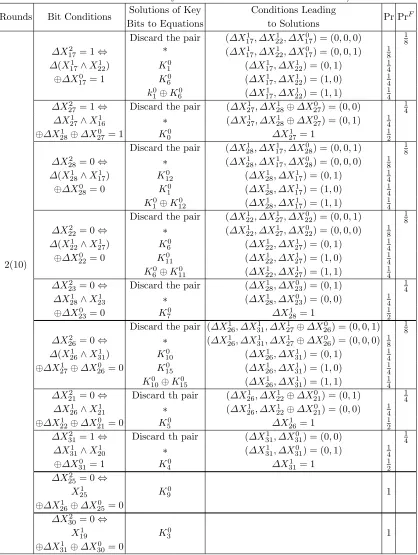
path of the 21-round Simeck32/64 is in Table 5. We demonstrate the solutions of subkey bits in Round 2 in Table6.
The second differential we use is the one from Section 4.1. We add 4 rounds on the top and 5 rounds at the bottom. With 218 structures containing 214 plaintexts each, we are expected to get 231.9pairs inT1and finally 2.56 right pairs. We are expect to get 221.09 values of 54 subkey bits in dynamic key-guessing procedure. The time complexity and success probability are 257.88and 47.1%. The extended differential path of 22-round Simeck32/64 is in Table9 in Appendix.
For Simeck48/96, we use the differential (0x400000,0xe00000) → (0x400000,0x200000) that covers 20 rounds with probability 2−43.65[12]. We append 4 rounds on top and 4 rounds at bottom. With 218 structures with 228 plaintexts in each, we are expected to get 250.46 plaintext pairs in T1 and finally 2.54 right pairs. There are 232.89 values of 75 subkey bits in dynamic key-guessing procedure and the time complexity and success probability are 268.31 and 46.8%. The extended differential path of the 28-round Simeck48/96 is in Table10in Appendix.
For Simeck64/128, we use the differential (0x0,0x4400000)→(0x8800000,0x400000) that covers 26 rounds with probability 2−60.02[12] . We append 4 rounds on top and 4 rounds at bottom. With 242 structures with 221 plaintexts in each, we are expected to get 238.59 plaintext pairs in T1 and finally 3.94 right pairs. There are 241.72values of 82 subkey bits in dynamic key-guessing procedure and the time complexity and success probability are 2116.27and 55.5%. If we add one more round on top, we are able to attack 35-round Simeck64/128 with the same data and time complexity and success probability. The difference is that we choose 231structures of 232plaintexts in each to encrypt, and expect to get 249.05 pairs in T1 and 267.26 values of 118 subkey bits in the dynamic key guessing procedure. The extended differential path of the 35-round Simeck64/128 is in Table
11in Appendix.
The data of the attacks on all reduced versions of Simeck are summarized in Table7.
Table 7: Differential Attacks on Reduced Simeck
Versions Attacked|sk| λe λr
Chosen Data Time Success
Rounds Count Complexity Complexity Prob.
Simeck32/64 21 53 2
−2.6783.29 4 230 248.52 41.7%
22 54 2−1 2.56 3 232 257.88 47.1%
Simeck48/96 28 75 2−8.3652.54 3 246 268.31 46.8% Simeck64/128 34 82 2
−1.6783.94 4 263 2116.34 55.5% 35 118 2−1.6783.94 4 263 2116.34 55.5%
5
Results on SIMON
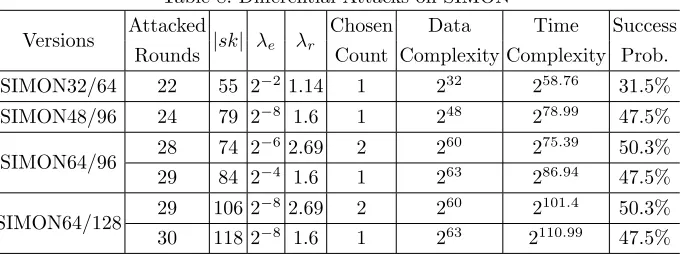
Table 8: Differential Attacks on SIMON
Versions Attacked|sk| λe λr
Chosen Data Time Success
Rounds Count Complexity Complexity Prob.
SIMON32/64 22 55 2−21.14 1 232 258.76 31.5%
SIMON48/96 24 79 2−8 1.6 1 248 278.99 47.5%
SIMON64/96 28 74 2
−62.69 2 260 275.39 50.3%
29 84 2−4 1.6 1 263 286.94 47.5%
SIMON64/128 29 106 2
−82.69 2 260 2101.4 50.3%
30 118 2−8 1.6 1 263 2110.99 47.5%
For SIMON32/64, we add 3 rounds before and 5 rounds after the differential (0x0,0x8) → (0x800,0x0) that covers 14 rounds with probability 2−30.81. With 225 structures of 27 plaintexts, we expect to get 243.58 plaintext pairs inT
1 and finally 1.14 right pairs. There are 226.33 values of 55 subkey bits in dynamic key-guessing procedure.
For SIMON48/96, we add 3 rounds before and 5 rounds after the differential (0x80,0x222)→ (0x222,0x80) that covers 17 rounds with probability 2−46.32. With 230structures of 218plaintexts, we expect to get 245.43 plaintext pairs inT
1and finally 1.6 right pairs. There are 225.56values of 79 subkey bits in dynamic key-guessing procedure.
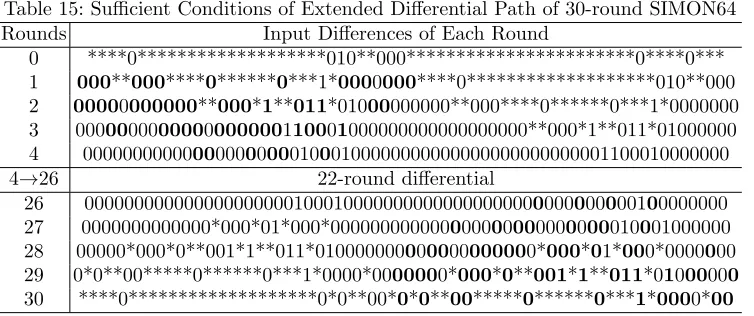
For SIMON64, we firstly apply the differential (0x4000000,0x11000000)→(0x11000000,0x4000000) that covers 21 rounds with probability 2−57.57. By adding 3 rounds before and 4 rounds after the differential, we are able to launch an attack on 28-round SIMON64/96 with 248 structures of 212 plaintexts. We are expected to get 230.49plaintext pairs inT1and finally 2.69 right pairs. There are 237.5 solutions of 74 subkey bits in dynamic key-guessing procedure. If we add one more round on top, by constructing 233 structures of 227 plaintexts, we are able to launch an attack on 29-round SIMON64/128. There are 253.35values of 106 subkey bits in dynamic key-guessing procedure. These results on SIMON64 are better than previous best results [23] in terms of time and data complexity. Another differential (0x440,0x1880)→ (0x440,0x100) that covers 22 rounds with probability 2−61.32 will result in one more round attack on both SIMON64/96 and SIMON64/128. By adding 3 rounds before and 4 rounds after the differential, we are able to launch an attack on 29-round SIMON64/96 by constructing 241structures of 222plaintexts. There are 237.41 values of 84 subkey bits in dynamic key-guessing procedure. By adding one more round on the top, we are able to launch an attack on 30-round SIMON64/128 with 222 structures of 241plaintexts. There are about 250.77 solutions of 118 subkey bits in dynamic key-guessing procedure. Thus we are able to attack one more round on SIMON64 than previous best results [23].
6
Conclusion
regarding differential attacks. As far as we are concerned, our results on SIMON64 are the best results in terms of rounds attacked. Future work includes finding differentials with lower hamming weight that is more adaptable to dynamic guessing techniques and expand the dynamic key-guessing techniques to block ciphers of other structures.
Acknowledgment
Thanks to anonymous reviewers for their helpful comments and also organizers and audiences of ICISSP2016. The work of this paper was supported by the National Key Basic Research Program of China (2013CB834203), the National Natural Science Foundation of China (Grants 61472417, 61472415 and 61402469), the Strategic Priority Research Program of Chinese Academy of Sciences under Grant XDA06010702, and the State Key Laboratory of Information Security, Chinese Academy of Sciences.
References
1. Abdelraheem, M.A., Alizadeh, J., Alkhzaimi, H.A., Aref, M.R., Bagheri, N., Gauravaram, P.: Improved Linear Cryptanalysis of reduced-round SIMON-32 and SIMON-48. In: Progress in Cryptology– INDOCRYPT 2015, pp. 153–179. Springer (2015)
2. Abed, F., List, E., Lucks, S., Wenzel, J.: Differential and linear cryptanalysis of reduced-round SIMON. IACR Cryptology ePrint Archive, Report 2013/526 (2013),http://eprint.iacr.org/2013/526 3. Alizadeh, J., Bagheri, N., Gauravaram, P., Kumar, A., Sanadhya, S.K.: Linear cryptanalysis of round
reduced SIMON. IACR Cryptology ePrint Archive, Report 2013/663 (2013), http://eprint.iacr. org/2013/663
4. Alkhzaimi, H.A., Lauridsen, M.M.: Cryptanalysis of the SIMON family of block ciphers. IACR Cryptology ePrint Archive, Report 2013/543 (2013),http://eprint.iacr.org/2013/543
5. Bagheri, N.: Linear Cryptanalysis of Reduced-Round SIMECK Variants. Cryptology ePrint Archive, Report 2015/716 (2015),http://eprint.iacr.org/2015/716
6. Beaulieu, R., Shors, D., Smith, J., Treatman-Clark, S., Weeks, B., Wingers, L.: The SIMON and SPECK families of lightweight block ciphers. IACR Cryptology ePrint Archive, Report 2013/404 (2013), http://eprint.iacr.org/2013/404
7. Biham, E., Biryukov, A., Shamir, A.: Cryptanalysis of Skipjack Reduced to 31 Rounds Using Impossible Differentials (1999)
8. Biham, E., Shamir, A.: Differential cryptanalysis of DES-like cryptosystems. Journal of Cryptology 4(1), 3–72 (1991)
9. Biryukov, A., Roy, A., Velichkov, V.: Differential analysis of block ciphers SIMON and SPECK. In: Fast Software Encryption. Springer (2014)
10. Canni`ere, C.D., Rechberger, C.: Finding SHA-1 Characteristics: General Results and Applications. In: Advances in Cryptology–ASIACRYPT 2006, pp. 1–20. Springer (2006)
11. K¨olbl, S., Leander, G., Tiessen, T.: Observations on the SIMON block cipher family. In: Advances in Cryptology–CRYPTO 2015, pp. 161–185. Springer (2015)
12. K¨olbl, S., Roy, A.: A Brief Comparison of Simon and Simeck. Cryptology ePrint Archive, Report 2015/706 (2015),http://eprint.iacr.org/2015/706
13. Leurent, G.: Construction of Differential Characteristics in ARX Designs Application to Skein. In: Advances in Cryptology–CRYPTO 2013, pp. 241–258. Springer (2013)
15. Mendel, F., Nad, T., Schl¨affer, M.: Finding SHA-2 Characteristics: Searching Through a Minefield of Contradictions. In: Advances in Cryptology–ASIACRYPT 2011, pp. 288–307. Springer (2011)
16. Qiao, K., Hu, L., Sun, S., Ma, X., Kan, H.: Improved MILP Modeling for Automatic Security Evaluation and Application to FOX. IEICE Transactions on Fundamentals of Electronics, Communications and Computer Sciences E98-A(1), 72–80 (2015)
17. Qin, L., Chen, H.: Linear Hull Attack on Round-Reduced Simeck with Dynamic Key-guessing Techniques. Cryptology ePrint Archive, Report 2016/066 (2016),http://eprint.iacr.org/2016/066 18. Shi, D., Hu, L., Sun, S., Song, L., Qiao, K., Ma, X.: Improved Linear (hull) Cryptanalysis of Round-reduced Versions of SIMON. Cryptology ePrint Archive, Report 2014/973 (2014), http://eprint. iacr.org/2014/973
19. Sun, S., Hu, L., Song, L., Xie, Y., Wang, P.: Automatic security evaluation of block ciphers with S-bP structures against related-key differential attacks. In: Inscrypt 2013 (2014)
20. Sun, S., Hu, L., Wang, M., Wang, P., Qiao, K., Ma, X., Shi, D., Song, L., Fu, K.: Towards Finding the Best Characteristics of Some Bit-oriented Block Ciphers and Automatic Enumeration of (Related-key) Differential and Linear Characteristics with Predefined Properties. Cryptology ePrint Archive, Report 2014/747 (2014),http://eprint.iacr.org/2014/747
21. Sun, S., Hu, L., Wang, P., Qiao, K., Ma, X., Song, L.: Automatic Security Evaluation and (Related-key) Differential Characteristic Search: Application to SIMON, PRESENT, LBlock, DES(L) and Other Bit-oriented Block Ciphers. In: Advances in Cryptology–ASIACRYPT 2014 (2014)
22. Theobald, T.: How to break Shamir’s asymmetic basis. In: Advances in Cryptology–CRYPTO 1995, pp. 136–147. Springer (1995)
23. Wang, N., Wang, X., Jia, K., Zhao, J.: Differential Attacks on Reduced SIMON Versions with Dynamic Key-guessing Techniques. Cryptology ePrint Archive, Report 2014/448 (2014),http://eprint.iacr. org/2014/448
24. Wang, N., Wang, X., Jia, K., Zhao, J.: Improved differential attacks on reduced SIMON versions. IACR Cryptology ePrint Archive, Report 2014/448 (2014),http://eprint.iacr.org/2014/448
25. Wang, X., Yin, Y.L., Yu, H.: Finding Collisions in the Full SHA-1. In: Advances in Cryptology– CRYPTO 2005, pp. 17–36. Springer (2005)
26. Yang, G., Zhu, B., Suder, V., Aagaard, M.D., Gong, G.: The Simeck Family of Lightweight Block Ciphers. Cryptology ePrint Archive, Report 2015/612 (2015),http://eprint.iacr.org/2015/612 27. Zhang, K., Guan, J., Hu, B., Lin, D.: Security Evaluation on Simeck against Zero Correlation Linear
Appendix
Related Keys in Decryption Direction
For sufficient bit condition∆Xi
j= 0 or 1 andj ∈[0, n−1], in decrypt direction we have
∆Xji=∆X i+1
(j+b)%n∧X i+1
(j+a)%n⊕∆X i+1
(j+a)%n∧X i+1 (j+b)%n
⊕∆Xji+1+b∧∆X(ij+1+a)%n⊕∆X(ij+1+c)%n⊕∆Xji+2, (5) where
X(ij+1+a)%n=X(ij+2+a+b)%n∧X(ij+2+a+a)%n⊕X(ij+2+a+c)%n⊕ X(i+3j+a)%n⊕K(ij+1+a)%n,
X(ij+1+b)%n=X(ij+2+b+b)%n∧X(ij+2+b+a)%n⊕X(ij+2+b+c)%n⊕ X(i+3j+b)%n⊕K(ij+1+b)%n.
(6)
Algorithm3demonstrates how to get subkey bits that influenceXi
j and that are linear toXji.
Algorithm 3Generate related key bits forXi
j in decryption direction 1: Input:Roundiand bit positionj
2: Output:[Inf luen keys, Linear keys] 3: functionRelatedKeys(i, j)
4: Inf luent keys= [ ],Linear keys=[ ] 5: if i=r0+R+r1 then
6: return[Inf luent keys, Linear keys]
7: else
8: if j≥nthen
9: returnRelatedKeys(i+ 1, j%n)
10: else
11: [I0, L0]=RelatedKeys(i,(j+a)%n+n) 12: [I1, L1]=RelatedKeys(i,(j+b)%n+n) 13: [I2, L2]=RelatedKeys(i,(j+c)%n+n) 14: [I3, L3]=RelatedKeys(i+ 1, j+n) 15: Linearkeys=L2∪L3∪Kji
16: Inf luent keys=I0∪I1∪I2∪I3∪Ki j
17: return[Inf luent keys, Linear keys] 18: end if
19: end if
20: end function
Sufficient Conditions of Extended Differential Path for Simeck
Table 9: Sufficient Conditions of Extended Differential Path of 22-round Simeck32/64
Rounds Input Differences of Each Round
0 0,0,0,∗,∗,0,0,∗,∗,∗,0,1,∗,∗,∗,∗,0,0,∗,∗,∗,0,∗,∗,∗,∗,∗,∗,∗,∗,∗,∗ 1 0,0,0,0,∗,0,0,0,∗,∗,0,0,1,∗,∗,0,0,0,0,∗,∗,0,0,∗,∗,∗,0,1,∗,∗,∗,∗ 2 0,0,0,0,0,0,0,0,0,∗,0,0,0,1,∗,0,0,0,0,0,∗,0,0,0,∗,∗,0,0,1,∗,∗,0 3 0,0,0,0,0,0,0,0,0,0,0,0,0,0,1,0,0,0,0,0,0,0,0,0,0,∗,0,0,0,1,∗,0 4 0,0,0,0,0,0,0,0,0,0,0,0,0,0,0,0,0,0,0,0,0,0,0,0,0,0,0,0,0,0,1,0
4→17 13-round differential
17 0,0,0,0,0,0,0,0,0,0,0,0,0,0,1,0,0,0,0,0,0,0,0,0,0,0,0,0,0,0,0,0 18 0,0,0,0,0,0,0,0,0,∗,0,0,0,1,∗,0,0,0,0,0,0,0,0,0,0,0,0,0,0,0,1,0 19 0,0,0,0,∗,0,0,0,∗,∗,0,0,1,∗,∗,0,0,0,0,0,0,0,0,0,0,∗,0,0,0,1,∗,0 20 0,0,0,∗,∗,0,0,∗,∗,∗,0,1,∗,∗,∗,∗,0,0,0,0,∗,0,0,0,∗,∗,0,0,1,∗,∗,0 21 0,0,∗,∗,∗,0,∗,∗,∗,∗,∗,∗,∗,∗,∗,∗,0,0,0,∗,∗,0,0,∗,∗,∗,0,1,∗,∗,∗,∗ 22 0,∗,∗,∗,∗,∗,∗,∗,∗,∗,∗,∗,∗,∗,∗,∗,0,0,∗,∗,∗,0,∗,∗,∗,∗,∗,∗,∗,∗,∗,∗
Table 10: Sufficient Conditions of Extended Differential Path of 28-round Simeck48/96 Rounds Input Differences of Each Round
0 ***000000***0**************0***0**************** 1 ***00000000000***0****1****000000***0*********** 2 ***0000000000000000***01***00000000000***0****1* 3 111000000000000000000000***0000000000000000***01 4 010000000000000000000000111000000000000000000000
4→24 20-round differential
24 010000000000000000000000001000000000000000000000 25 1*100000000000000000*000010000000000000000000000 26 ***000000000000*000***011*100000000000000000*000 27 ***0000000*000***0****1****000000000000*000***01 28 ***00*000***0**************0000000*000***0****1*
Table 11: Sufficient Conditions of Extended Differential Path of 34-round Simeck64/128
Rounds Input Differences of Each Round
0 **********0000000*000**00***0*************00*000**00***0******** 1 *0****1***000000000000*000**00************0000000*000**00***0*** 2 *00***01**00000000000000000*000**0****1***000000000000*000**00** 3 *000**001*0000000000000000000000*00***01**00000000000000000*000* 4 00000100010000000000000000000000*000**001*0000000000000000000000 5 0000000000000000000000000000000000000100010000000000000000000000
5→31 26-round differential
Sufficient Conditions of Extended Differential Path for SIMON
We provide the sufficient conditions of extended differential paths of 22-round SIMON32, 24-round SIMON48 and 29, 30-round SIMON64 in Table12,13,14and15.
Table 12: Sufficient Conditions of Extended Differential Path of 22-round SIMON32 Rounds Input Differences of Each Round
0 00**00001**0*000***0*01*****0000 1 0000*000001*000000**00001**0*000 2 00000000000010000000*000001*0000 3 00000000000000000000000000001000 3→17 14-round differential
17 00001000000000000000000000000000 18 001*00000000*0000000100000000000 19 1**0*00000**0000001*00000000*000 20 ****0000***0*01*1**0*00000**0000 21 ***0*0******1*******0000***0*01* 22 *******************0*0******1***
Table 13: Sufficient Conditions of Extended Differential Path of 24-round SIMON48 Rounds Input Differences of Each Round
0 00*0***01*1***11*00**0*0****************0******0 1 000000*000*01**00*001*0000*0***01*1***11*00**0*0 2 000000000000001000100010000000*000*01**00*001*00 3 000000000000000010000000000000000000001000100010
3→20 17-round differential
Table 14: Sufficient Conditions of Extended Differential Path of 29-round SIMON64
Rounds Input Differences of Each Round
0 *0***1*0000*000*0**00*****0***********0*0**00*****0************* 1 **011*0100000000000*000*0**001*1*0***1*0000*000*0**00*****0***** 2 01*000*00000000000000000000*000***011*0100000000000*000*0**001*1 3 0001000100000000000000000000000001*000*00000000000000000000*000* 4 0000010000000000000000000000000000010001000000000000000000000000
4→25 21-round differential
25 0001000100000000000000000000000000000100000000000000000000000000 26 01*000*00000000000000000000*000*00010001000000000000000000000000 27 **011*0100000000000*000*0**001*101*000*00000000000000000000*000* 28 *0***1*0000*000*0**00*****0*******011*0100000000000*000*0**001*1 29 ******0*0**00*****0**************0***1*0000*000*0**00*****0*****
Table 15: Sufficient Conditions of Extended Differential Path of 30-round SIMON64
Rounds Input Differences of Each Round
0 ****0*******************010**000***********************0****0*** 1 000**000****0******0***1*0000000****0*******************010**000 2 00000000000**000*1**011*01000000000**000****0******0***1*0000000 3 0000000000000000000110001000000000000000000**000*1**011*01000000 4 0000000000000000000001000100000000000000000000000001100010000000
4→26 22-round differential