Advances in Medical Education and Practice
Dovepress
R E V I E W open access to scientific and medical research
Open Access Full Text Article
Use of a problem-based learning teaching model
for undergraduate medical and nursing education:
a systematic review and meta-analysis
Mehdi Sayyah1
Kiarash Shirbandi2
Amal Saki-Malehi3
Fakher Rahim4
1Department of Medical Education,
Ahvaz Jundishapur of Medical Sciences, Ahvaz, Iran; 2Department
of Radiology, Allied Health Sciences School, Ahvaz Jundishapur University of Medical Sciences, Ahvaz, Iran;
3Department of Biostatistics and
Epidemiology, Faculty of Health, Ahvaz Jundishapur University of Medical Sciences, Ahvaz, Iran;
4Research Center of Thalassemia and
Hemoglobinopathy, Health Research Institute, Ahvaz Jundishapur University of Medical Sciences, Ahvaz, Iran
Objectives: The aim of this systematic review and meta-analysis was to evaluate the problem-based learning (PBL) method as an alternative to conventional educational methods in Iranian undergraduate medical courses.
Materials and methods: We systematically searched international datasets banks, including
PubMed, Scopus, and Embase, and internal resources of banks, including MagirIran, IranMe-dex, IranDoc, and Scientific Information Database (SID), using appropriate search terms, such as “PBL”, “problem-based learning”, “based on problems”, “active learning”, and“ learner centered”, to identify PBL studies, and these were combined with other key terms such as “medical”, “undergraduate”, “Iranian”, “Islamic Republic of Iran”, “I.R. of Iran”, and “Iran”. The search included the period from 1980 to 2016 with no language limits.
Results: Overall, a total of 1,057 relevant studies were initially found, of which 21 studies were included in the systematic review and meta-analysis. Of the 21 studies, 12 (57.14%) had a high methodological quality. Considering the pooled effect size data, there was a significant differ-ence in the scores (standardized mean differdiffer-ence [SMD]=0.80, 95% CI [0.52, 1.08], P<0.000) in favor of PBL, compared with the lecture-based method. Subgroup analysis revealed that using PBL alone is more favorable compared to using a mixed model with other learning methods such as lecture-based learning (LBL).
Conclusion: The results of this systematic review showed that using PBL may have a positive effect on the academic achievement of undergraduate medical courses. The results suggest that teachers and medical education decision makers give more attention on using this method for effective and proper training.
Keywords: problem-based learning, education, meta-analysis, traditional learning
Introduction
Continuing advances in medical science, technology, and health care delivery have introduced medicine and related fields as a complex, challenging profession.1 The
efficient medical profession requires advanced and reliable skills such as problem solving and the ability of clinical decision making.2 Today, more than ever, most
universities in the world try to find teaching methods that can lead to the expansion of the educational capacity, continuous learning, and self-centered clinical decisions among their students. The use of active-learning strategies significantly improves the correlation between the educational and clinical performances of students.3 One of
the proposed ways to eliminate the gap between academic and clinical performances is changing the traditional educational system to problem-based learning (PBL). PBL was presented as a new teaching method for the first time at McMaster University
Correspondence: Fakher Rahim Research Center of Thalassemia and Hemoglobinopathy, Health Research Institute, Ahvaz Jundishapur University of Medical Sciences, P.O. Box 61537-15794, Ahvaz, Iran
Tel/fax +98 61 3336 7652 Email [email protected]
Journal name: Advances in Medical Education and Practice Article Designation: REVIEW
Year: 2017 Volume: 8
Running head verso: Sayyah et al
Running head recto: PBL teaching model for medical courses DOI: http://dx.doi.org/10.2147/AMEP.S143694
Advances in Medical Education and Practice downloaded from https://www.dovepress.com/ by 118.70.13.36 on 19-Aug-2020
For personal use only.
This article was published in the following Dove Press journal: Advances in Medical Education and Practice
3 October 2017
Dovepress
Sayyah et al
in Canada in the 1960s to enhance the ability of students in independently conducting a study and problem-solving and analytical skills.4 If the effectiveness of this method can
extend, it may lead to enhanced critical thinking skills and attitudes of undergraduate medical students.
In PBL, the training method is based on the principle of using problems as the starting point; students are divided into several groups and do research on the topic of inter-est, and the questions are then put to discussion.5 PBL is a student-centered approach, which enables individuals to design, implement, and assess solutions for the problems in their own courses.6 Solving a problem as a mental activity
increases the level of knowledge and new skills.7 Although
based on World Health Organization (WHO) data,8 PBL is
growing worldwide, this model is still controversial.9,10
There is growing concern among educators that the con-ventional educational methods may not lead to the appropriate quality to encourage medical students to learn and impart a lifelong respect for learning. However, Iran has not yet devel-oped a suitable approach to replace the conventional teaching methods. In addition, cultural differences influence the effec-tiveness of PBL methods;11 consequently, the target population
must be limited to Iranian medical students of the education system to observe the possible efficacy of the PBL method in Iran. Therefore, the aim of this systematic review and meta-analysis was to evaluate the PBL method as an alternative to conventional educational methods such as lecture-based learn-ing (LBL) method in Iranian undergraduate medical courses.
Materials and methods
Iranian medical education capacity
Medical education in Iran includes 47 medical universi-ties. These 47 universities contain 14 schools of medical sciences, 36 dental schools, 20 pharmacy schools, and 42 nursing schools. These universities include 157,226 students, of whom 29,975 are medical students, 6,966 are pharmacy students, 8,081 are dentistry students, 60,641 are nursing students, and 51, 563 belong to other fields. There are 27 international branches of universities of medical sciences that include 1,341 students. These meta-analysis covers 21 different universities, including 10 (10/42=23.8%) nurs-ing schools, eight (8/14=57.2%) medical schools, and five (5/36=13.8%) dental schools.
Study design
This is a systematic review and meta-analysis comparing the use of PBL and LBL teaching models in introductory
undergraduate medical courses in Iran and providing a sci-entific basis for evaluating the need and possibility of PBL application in undergraduate medical courses.
Study selection criteria
We considered the definition of PBL according to Fan et al.12
In short, students schedule to work in small-group activi-ties, make hypotheses about the case of interest and learn-ing subjects, work outside of scheduled hours to meet the learning objectives, and then attempt to solve the problem. The selected studies should fulfill the following criteria, including examination of the PBL application as a teaching method alone or in combination with the traditional LBL teaching model in Iranian medical students, as randomized or non-randomized controlled trials (RCTs). Studies that did not cite the examination data about courses of interest and republished studies were excluded.
Search strategy
We systematically searched international datasets to identify relevant studies, including PubMed, Scopus, and Embase, and internal resources, including Magiran, IranMedex, IranDoc, and Scientific Information Database (SID) using appropri-ate search terms, such as “problem-based learning”, “PBL”, “learning based on problems”, “learner centered”, and “active learning”. These search terms were used to identify studies that used PBL and were combined with other key terms such as “Iranian”, “Islamic Republic of Iran”, “I.R. of Iran”, “Iran”, “medical”, and “undergraduate”. The search included the period from 1980 to 2016 with no language limits. We also manually searched through the reference lists of potentially selected studies to find relevant papers.
Data extraction method and quality
assessment
Screening was done by two reviewers (FR and MS) inde-pendently, considering selection criteria; then, the data were extracted and cross-checked. Any inconsistencies were resolved by consultation with a third reviewer (BL). The information including author name, publication year and location, study sample size, participant characteristics, course name and type, study type, intervention process, and outcome scores was extracted. Quality assessments of the selected studies were individually performed by two researchers using the modified Jadad scale that included
eight items13 and RevMan 5.3 (Cochrane Collaboration,
Copenhagen, Denmark).
Advances in Medical Education and Practice downloaded from https://www.dovepress.com/ by 118.70.13.36 on 19-Aug-2020
Dovepress PBL teaching model for medical courses
Statistical methods
The outcome measures of interest were a continuous out-come (i.e., examination scores). For the meta-analysis, RevMan version 5.2 and Stata 10.0 (StataCorp LP, College Station, TX, USA) were used. The analytical statistics of standardized mean difference (SMD) at 95% confidence intervals (CIs) were used to determine the efficacy of the PBL model for outcomes of interest. The method proposed by Zhang et al.14 was used to assess the heterogeneity of
selected studies; consequently, the I2 statistic and the
chi-square test were used to assess the statistical heterogeneity of the selected studies. I2 value of >50% or P-value of
<0.10 was assumed as significant heterogeneity across the included studies. When moderate to high heterogeneity was present, a random-effects model was used to calculate the total SMD score at 95% CI; otherwise, a fixed-effects model was applied. Meta-regression was used to examine the effect of confounding factors. Subgroup analysis was performed considering teaching patterns, the course type, and the inter-vention type. To assess the degree of publication bias, we used funnel plots and Egger’s tests. A sensitivity analysis was performed by exchanging the combined model (fixed-effects model and random-effects model). We performed subgroup analysis considering three different categories, including the comparison method (PBL vs. LBL or PBL plus LBL vs. LBL), disciplines (nursing, medicine, dentistry, medicine
plus dentistry, and other), and grade (freshman, sophomore, junior, senior, and other).
Ethical approval
This research was approved by the ethics committee of Wel-fare Organization, Ahvaz, Iran.
Results
Overall, a total of 1,057 relevant studies were initially found. After the title–abstract screening, 1,034 studies were excluded, and 23 studies were used for the systematic review and meta-analysis.15–37 The literature screening process and
results are illustrated in Figure 1.
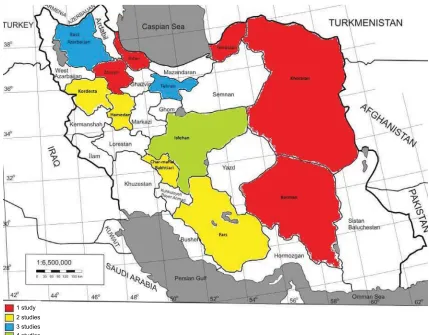
The distributions of available literature across the country are illustrated in Figure 2.
The general characteristics of the included studies are shown in Table 1. The 23 studies covered four different medi-cal disciplines, including nursing (10 studies), medicine (six studies), dentistry (four studies), and others (three studies). Of the 11 courses examined, including those in anatomy, pharmacology, and biochemistry, only two were laboratory based.27,28
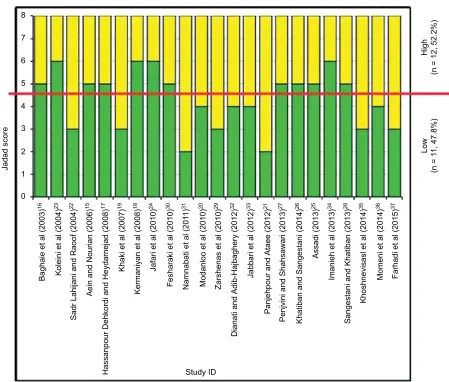
The quality of 23 studies was evaluated using the modified Jadad scale. The assessment revealed that only four (17.4%) studies were assigned scores >5,18,23,24,34 eight (34.8%)
stud-ies were assigned score 5,15–17,25–28,30 and 11 (47.8%) studies
Figure 1 Literature screening process and results.
Abbreviations: ERIC, Education Resources Information Center; SID, Scientific Information Database.
Records identified through searches of ERIC (n=397) Embase (n=5), SID (n=661), PubMed (n=21), and Magiran
(n=4) databases
Records after duplicates removed (n=1,057)
Records excluded without addressing basic medical courses (n=938)
Records excluded with reasons (n=88): Studies without complete assessment data (n=69) Studies without addressing medical education (n=2) Studies without addressing basic medical courses (n=17)
Records screened by title (n=1,049)
Records screened by reviewing abstracts or full text (n=111)
Studies included in qualitative synthesis (n=23)
Advances in Medical Education and Practice downloaded from https://www.dovepress.com/ by 118.70.13.36 on 19-Aug-2020
Dovepress
Sayyah et al
were assigned scores 2–419–22,29,31–33,35–37 (Figure 3). The mean
modified Jadad scale score was 4.3, and the standard devia-tion was 1.25. The modified Jadad scores collected for each study are shown in the Supplementary materials.
There was high heterogeneity (I2=81%, P<0.001); hence,
the random-effects model was used. Considering the pooled effect size data, there was a significant difference in the scores (SMD=0.80, 95% CI [0.52, 1.08], P<0.000) in favor of PBL, compared with the lecture-based method (Figure 4).
Besides, a sensitivity analysis was done to verify the reliability of the results (Supplementary materials). This was performed using sequential omission of individual studies. After excluding a single,17 with inadequate generation of a
randomized sequence, the effects observed in the primary analysis did not change considering that the pooled effect size favored the PBL group (SMD=0.72, 95% CI [0.46, 0.97],
P<0.000). The funnel plot for the 17 studies was symmetrical, indicating no significant publication bias (Figure 5).
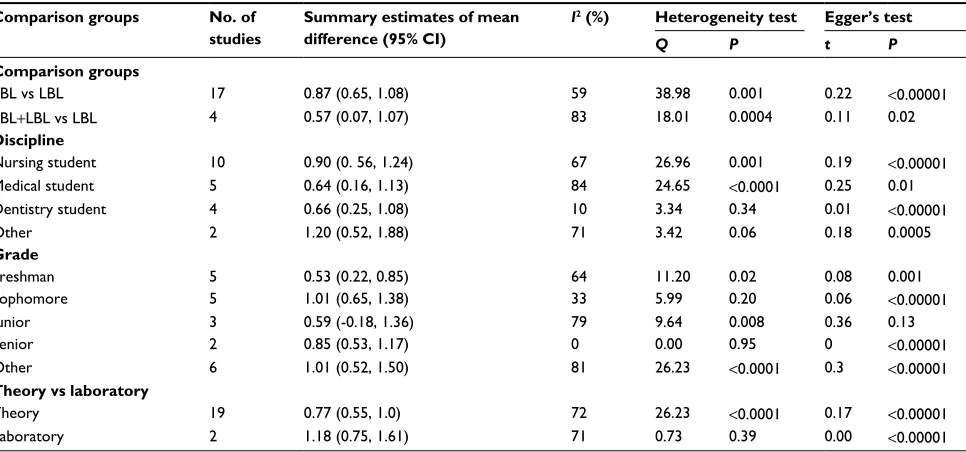
Subgroup analysis considering three different comparison learning methods is shown in Table 2. Subgroup analysis revealed that using PBL alone is more favorable compared
to using a mixed model with other learning methods such as LBL (Figure S1). In addition, PBL and LBL learning methods were compared within each stratum, which was specified by various disciplines (i.e., nursing, medicine, dentistry, and other discipline). The result showed that PBL is a more appro-priate method in another discipline and an acceptable method in medicine compared to nursing and dentistry (Figure S2). We also compared the SMD for evaluating PBL in five sub-groups with respect to various grades. Based on our result, implementation of PBL in sophomore students exhibited a better performance (Figure S3). Finally, subgroup analysis in study subjects (i.e., theory and laboratory) exhibited that PBL is a more proper method in laboratory subjects (Figure S4).
Other discipline that was stated covers the health courses such as occupational health courses. Laboratory courses were newborn and hematology–oncology nursing cares.
Discussion
This systematic review and meta-analysis aiming to evaluate the PBL method as an alternative to conventional educational methods in Iranian undergraduate medical courses showed Figure 2 The distribution of the available studies across the country.
1 study
2 studies
3 studies 4 studies
Advances in Medical Education and Practice downloaded from https://www.dovepress.com/ by 118.70.13.36 on 19-Aug-2020
Dovepress PBL teaching model for medical courses
Table 1
General characteristics of the included studies
Study ID
Study design
Random allocation
Population
Course name
Course type
Number of cases
Study groups Grade Outcome, mean ± SD Arm 1 Arm 2 Arm 1 Arm 2 Arm 1 Arm 2 Baghaie et al 16 Quasi-experimental Yes Nursing student
Pathology and hematologic
Theory course 14 15 PBL LBL Sophomore 14.66 ± 2.46 13.64 ± 3.17 Koleini et al 23 Quasi-experimental Yes Medical student Biology Theory course 32 32 PBL LBL Freshman 14.3 ± 1.7 12.8 ± 1.8
Sadr Lahijani and Raoof
22
Descriptive–analytic
No
Dentistry student Endodontics and musculofascial surgery
Theory course 19 19 PBL LBL Senior 16.2 ± 1.6 14.8 ± 1.7
Aein and Nourian
15 Quasi-experimental Yes Nursing student Pediatric nursing Theory course 30 30 PBL LBL NA 15.5 ± 1.6 12.6 ± 1.7
Hassanpour Dehkordi and Heydarnejad
17 Quasi-experimental Yes Nursing student Internal surgery Theory course 20 20 PBL LBL Sophomore 6.15 ± 2.10 3.64 ± 1.63 Khaki et al 19 NA No Medical student Gross anatomy Theory course 83 76 PBL + LBL LBL Freshman 14.32 ± 4.36 12.66 ± 5 Kermaniyan et al 18 Quasi-experimental Yes Medical student Anatomy Theory course 20 20 PBL LBL Freshman 10.9 ± 2.6 9.9 ± 1.8 Jafari et al 24 Quasi-experimental Yes Dentistry student Community dentistry Theory course 32 32 PBL LBL NA 12.98 ± 1.22 12.36 ± 1.7 Fesharaki et al 30 Quasi-experimental No Nursing student
Internal surgery 4
Theory course 22 22 PBL LBL NA 15.96 ± 2.98 14.72 ± 2.82 Namnabati et al 31 Quasi-experimental No Nursing student Pediatrics 2 Theory course 52 50 PBL + LBL LBL Sophomore 13.63 ± 2.61 10 ± 2.82 Modanloo et al 20 Quasi-experimental Yes Nursing student Mental health Theory course 8 24 PBL LBL Sophomore 4.074 ± 0.318 3.858 ± 0.208 Zarshenas et al 29 Interventional No Dentistry student Orthodontia Theory course 64 64 PBL LBL Senior 3.41 ± 0.49 2.9 ± 0.68
Dianati and Adib-Hajbaghery
32 Interventional Yes Nursing student Critical care Theory course 13 14 PBL LBL Junior 12.76 ± 2.2 12.21 ± 2.77 Jabbari et al 33 Cross-sectional No
Medical student/ dentistry student/ pharmacy student
Public health Theory course 112 54 PBL LBL Freshman 16.02 ± 2.03 14.25 ± 1.72
Penjvini and Shahsawari
27
Quasi-experimental
Yes
Nursing Student
Newborn nursing care
Laboratory course 14 15 PBL LBL Sophomore 8.5 ± 0.51 7.93 ± 0.70
Khatiban and Sangestani
26
Quasi-experimental
Yes
Midwifery student Pregnancy and childbirth
Theory course 34 36 PBL + LBL LBL NA 16.21 ± 0.98 15.71 ± 0.92 Assadi 25 Cross-sectional Yes
Occupational health student
Epidemiology Theory course 22 25 PBL LBL NA 18.52 ± 1.03 16.71 ± 1.16 Imanieh et al 34 NA Yes Medical student
Pediatric gastroenterology
ward Theory course 60 60 PBL LBL NA 5.504 ± 0.944 4.24 ± 0.814
Sangestani and Khatiban
28
Quasi-experimental
Yes
Nursing Student
Hematologic and oncologic nursing care
Laboratory course 34 36 PBL LBL Junior 12.32 ± 1.73 10.12 ± 1.61 Momeni et al 36 Quasi-experimental No Medical student Embryology Theory course 42 40 PBL + LBL LBL Freshman 14.83 ± 1.87 14.64 ± 1.56 Farhadi et al 37 Interventional No
Dentistry student Oral and maxillofacial pathology
Theory course 24 24 PBL LBL Junior 9.6 ± 3.164 8.55 ± 2.446 Abbreviations:
SD, standard deviation; PBL, problem-based learning; LBL, lecture-based learning; NA, not applicable.
Advances in Medical Education and Practice downloaded from https://www.dovepress.com/ by 118.70.13.36 on 19-Aug-2020
Dovepress
Sayyah et al
that academic achievement was relatively higher in PBL method compared to traditional methods such as LBL.
It was shown that the academic achievements of students in the methods such as PBL are significantly higher than those in LBL.38,39 Furthermore, the results of a systematic review
and meta-analysis in China on dental education showed that the PBL method has a positive effect on theoretical and practi-cal test grades and that introducing this learning method is considered superior to the traditional lecture-based method according to the faculty conditions.40 Another systematic
review and meta-analysis in Korea on nursing education found that PBL in nursing education has positive effects on the outcome domains of satisfaction with training, clinical education, and skill course; thus, PBL is more effective than traditional learning methods.41 Another systematic
review and meta-analysis from China on nursing students indicated that PBL might help nursing students to improve their critical thinking.42 Our analysis was in line with these
meta-analyses and showed that PBL has beneficial effects on the nursing education.
Zhang et al conducted a systematic review and meta-analysis on the PBL use in Chinese undergraduate medical education; this teaching method can rise course examina-tion excellence rates and scores, as well as it is more effec-tive when used in laboratory courses than in theory-based courses.14 Though our meta-analysis showed a nonsignificant
effect of PBL on medical education, it showed that PBL has positive effects on the outcome domains of laboratory courses compared to theory ones.
In addition, the results of a systematic review and meta-analysis conducted on medical students to evaluate the effect of PBL on the postgraduate physician’s abilities showed that PBL has a positive effect on the physician’s abilities, particu-larly on their cognitive abilities and social skills.43
Unfortu-nately, in most medical schools, there is more emphasis on multiple-choice tests as well as the mnemonic and recall Figure 3 Evaluation of the methodological quality of the included studies.
Baghaie et al (2003)
16
Koleini et al (2004)
23
Sadr Lahijani and Raoof (2004)
22
Aein and Nourian (2006)
15
Hassanpour Dehkordi and Heydarnejad (2008)
17
Khaki et al (2007)
19
Kermaniyan et al (2008)
18
Jafari et al (2010)
24
Fesharaki et al (2010)
30
Namnabati et al (201
1)
31
Modanloo et al (2010)
20
Zarshenas et al (2010)
29
Dianati and Adib-Hajbaghery (2012)
32
Jabbari et al (2012)
33
Panjehpour and Ataee (2012)
21
Penjvini and Shahsawari (2013)
27
Khatiban and Sangestani (2014)
26
Assadi (2013)
25
Imanieh et al (2013)
34
Sangestani and Khatiban (2013)
28
Khoshnevisasl et al (2014)
35
Momeni et al (2014)
36
Farhadi et al (2015)
37
Low
(n = 1
1, 47.8%)
8 7 6 5 4 3
Jadad score
Study ID 2
1 0
High
(n = 12, 52.2%)
Advances in Medical Education and Practice downloaded from https://www.dovepress.com/ by 118.70.13.36 on 19-Aug-2020
Dovepress PBL teaching model for medical courses
Figure 4
Meta-analysis and forest plot of theoretical scores for PBL compared with the lecture-based method.
Abbreviations:
PBL, problem-based learning; LBL, lecture-based learning; SMD, standardized mean difference; SD, standard deviation.
Aein and Nourian (2006)
15
Study or subgroup
Mean 15.5 1. 63 01 2. 61 .7 30 4.5%
1.73 (1.13, 2.33
)
1.62 (0.95, 2.28
)
0.35 (–0.39, 1.08) 0.02 (–0.74, 0.77) 0.37 (–0.21, 0.94) 0.42 (–0.18, 1.02) 1.31 (0.62, 2.00
)
1.43 (1.02, 1.83
)
0.91 (0.57, 1.25
)
0.41 (–0.08, 0.91) 0.44 (–0.19, 1.07) 0.35 (0.04, 0.67
)
0.52 (0.04, 1.00
)
0.85 (0.33, 1.36
)
0.85 (0.02, 1.68
)
0.1
1 (–0.32, 0.54)
1.33 (0.90, 1.76
)
0.90 (0.13, 1.67
)
0.83 (0.16, 1.50
)
1.30 (0.78, 1.82
)
0.86 (0.49, 1.22
)
4.2% 3.8% 3.7% 4.7% 4.5% 4.0% 5.7% 6.0% 5.1% 4.4% 6.2% 5.2% 5.0% 3.4% 5.5% 5.5% 3.6% 4.2% 5.0% 5.9%
25 15 14 24 22 20 60 54 32 20 76 36 32 24 40 50 15 19 36 64
1.16 3.17 2.77 2.45 2.82 1.83 0.81 1.72 1.
7
1.
8 5 0.92 1.
8
0.21 1.56 2.82 0.
7 1. 7 1.61 0.68 16.7 1 13.6 4 12.7 1 8.55 14.7 2
3.64 4.24 14.2
5 12.3 6 9. 9 12.6 6 15.7 1
12.8 3.86 14.6 4 10
7.93 14.8 10.1
2
2.
9
22 14 13 24 22 20 60 112 32 20 83 34 32 8 42 52 14 19 34 64
75
1
708
100.0%
0.81 (0.60, 1.02
) –2 –1 0 Favors (LBL) Favors (PBL) 12
1.03 2.46 2.
2
3.16 2.98 2.
1
0.94 2.03 1.22 2.
6
4.36 0.98 1.
7
0.32 1.87 2.61 0.51 1.
6 1.73 0.49 18.5 2 14.6 6 12.7 6 9. 6 15.9 6 6.15 5. 5 16.0 2 12.9 8 10.9 14.3 2 16.2 1 14.3 4.07 14.8 3 13.6 3 8. 5 16.2 12.3 2 3.41 PBL LB L SD To ta lM ea nS DT otal W eigh t SMD dif ference IV
, random, 95% CI
SMD dif
ference
IV
, random, 95% CI
Assadi (2013)
25
Baghaie et al (2003
)
16
Hassanpour Dehkordi and Heydarnejad (2008)
17
Imanieh et al (2013)
34
Jabbari et al (2012)
33
Fesharaki et al (2010
)
30
Dianati and Adib-Hajbaghery (2012)
32
Farhadi et al (2015)
37
Khaki et al (2007)
19
Kermaniyan et al (2008)
18
Jafari et al (2010)
24
Koleini et al (2004)
23
Khatiban and Sangestani (2014
)
26
Namnabati et al (201
1)
31
Momeni et al (2014)
36
Penjvini and Shahsawari (2013
)
27
Modanloo et al (2010)
20
Sadr Lahijani and Raoof (2004)
22
Sangestani and Khatiban (2013
)
28
Zarshenas et al (2010)
29
To
tal (95% CI
)
Heterogeneity:
t
2=0.16:
c
2=68.31, df=20
( P <0.00001): I 2=71% Te
st for overall ef
fect: Z=7.53
(
P
<0.00001)
Advances in Medical Education and Practice downloaded from https://www.dovepress.com/ by 118.70.13.36 on 19-Aug-2020
Dovepress
Sayyah et al
Figure 5 The funnel plot for the studies on PBL, compared with the lecture-based method.
Abbreviations: PBL, problem-based learning; SMD, standardized mean difference; SE, standard error.
0
SE (SMD)
0.1
0.2
0.3
0.4
0.5
–2 –1 0 1 2
SMD issues learning, although memorization cannot lead to the development of effective problem-solving skills. Besides, the study results were positive in using PBL in all educational levels of students describing the possible effectiveness of this method in undergraduate medical courses.
Recently, Zhou et al44 evaluated the effectiveness of
PBL in Chinese pharmacy education in a meta-analysis and reported that this teaching method is superior to the tradi-tional lecture-based teaching. We did not find even a single study describing the effect of PBL on pharmacy education compared to traditional learning method.
It was reported that clinical education courses had greater impacts and better outcomes than courses on health perspectives
and nursing. Similarly, the clinical approach has larger impact than the theoretical approach.41 This supports our findings
and previous reports,45,46 which found that PBL has a positive
effect on medical and nursing students’ work-based skills and increases their problem-solving skills. High-level cognitive skills is crucial to develop in clinical practice, which allows students to reach at clinical judgments on the basis of available information when they face unresolved problems, unique cases, ambiguous situations, or cases not present in their textbooks.47
PBL is among the techniques considered to be effective in increasing the ability of integrating theory and practice in the students by pursuing and acquiring missing knowledge during clinical practice.48,49 Consequently, our findings along with
previous evidences may provide educators with evidence that demonstrates the usefulness of PBL in clinical practice.
It is suggested that further experimental studies with regard to standard methods of evaluating and presenting a full report with a complete description of the test interventions in this area to investigate the effects of using PBL are required.
Conclusion
The results of this systematic review showed that using PBL has a positive effect on the academic achievement of under-graduate medical courses. The results suggest that teachers and medical education decision makers give more attention on using this method for effective and appropriate training. In addition, using suitable methods of evaluation designed for high levels of cognitive tests may encourage students to acquire higher level abilities.
Table 2 Subgroup analysis of selected studies according to various disciplines
Comparison groups No. of
studies
Summary estimates of mean difference (95% CI)
I2 (%) Heterogeneity test Egger’s test
Q P t P
Comparison groups
PBL vs LBL 17 0.87 (0.65, 1.08) 59 38.98 0.001 0.22 <0.00001
PBL+LBL vs LBL 4 0.57 (0.07, 1.07) 83 18.01 0.0004 0.11 0.02
Discipline
Nursing student 10 0.90 (0. 56, 1.24) 67 26.96 0.001 0.19 <0.00001
Medical student 5 0.64 (0.16, 1.13) 84 24.65 <0.0001 0.25 0.01
Dentistry student 4 0.66 (0.25, 1.08) 10 3.34 0.34 0.01 <0.00001
Other 2 1.20 (0.52, 1.88) 71 3.42 0.06 0.18 0.0005
Grade
Freshman 5 0.53 (0.22, 0.85) 64 11.20 0.02 0.08 0.001
Sophomore 5 1.01 (0.65, 1.38) 33 5.99 0.20 0.06 <0.00001
Junior 3 0.59 (-0.18, 1.36) 79 9.64 0.008 0.36 0.13
Senior 2 0.85 (0.53, 1.17) 0 0.00 0.95 0 <0.00001
Other 6 1.01 (0.52, 1.50) 81 26.23 <0.0001 0.3 <0.00001
Theory vs laboratory
Theory 19 0.77 (0.55, 1.0) 72 26.23 <0.0001 0.17 <0.00001
Laboratory 2 1.18 (0.75, 1.61) 71 0.73 0.39 0.00 <0.00001
Abbreviations: PBL, problem-based learning; LBL, lecture-based learning.
Advances in Medical Education and Practice downloaded from https://www.dovepress.com/ by 118.70.13.36 on 19-Aug-2020
Dovepress PBL teaching model for medical courses
Acknowledgment
This research was the result of a project affiliated by Deputy of Research Affairs, Ahvaz Jundishapur University of Medi-cal Sciences. The abstract of this paper was presented at the 18 Conference of Medical Education in Iran 2017 as a poster presentation/conference talk with interim findings.
Disclosure
The authors report no conflicts of interest in this work.
References
1. Institute of Medicine (US) Committee on the Health Professions Edu-cation Summit. Challenges facing the health system and impliEdu-cations for educational reform. In: Greiner AC, Knebel E, editors. Health
Professions Education: A Bridge to Quality. Washington, DC: National
Academies Press (US); 2003:192.
2. MacKinnon K, Marcellus L, Rivers J, Gordon C, Ryan M, Butcher D. Student and educator experiences of maternal-child simulation-based learning: a systematic review of qualitative evidence protocol. JBI
Database System Rev Implement Rep. 2015;13(1):14–26.
3. Lucas KH, Testman JA, Hoyland MN, Kimble AM, Euler ML. Correla-tion between active-learning coursework and student retenCorrela-tion of core content during advanced pharmacy practice experiences. Am J Pharm
Educ. 2013;77(8):171.
4. Servant VF, Schmidt HG. Revisiting ‘Foundations of problem-based learning: some explanatory notes’. Med Educ. 2016;50(7):698–701. 5. Puri D. An integrated problem-based curriculum for biochemistry
teaching in medical sciences. IJCB. 2002;17(2):52–59.
6. Yuan H, Kunaviktikul W, Klunklin A, Williams BA. Improvement of nursing students’ critical thinking skills through problem-based learning in the People’s Republic of China: A quasi-experimental study. Nurs
Health Sci. 2008;10(1):70–76.
7. Sherwood AL. Problem-based learning in management education: a framework for designing context. J Manage Educ. 2004;28(5):536–557. 8. Yang L, Xin F. On PBL teaching model in Chinese medical education.
J Liaoning Med Univ. 2007;1:010.
9. Farrow R, Norman G. The effectiveness of PBL: the debate continues. Is meta-analysis helpful? Med Educ. 2003;37(12):1131–1132. 10. Schmidt HG, Cohen-Schotanus J, Arends LR. Impact of problem-based,
active learning on graduation rates for 10 generations of Dutch medical students. Med Educ. 2009;43(3):211–218.
11. Frambach JM, Driessen EW, Chan LC, van der Vleuten CP. Rethinking the globalisation of problem-based learning: how culture challenges self-directed learning. Med Educ. 2012;46(8):738–747.
12. Fan AP, Kosik RO, Tsai TC, et al. A snapshot of the status of problem- based learning (PBL) in Chinese medical schools. Med Teach. 2014;36(7):615–620.
13. Oremus M, Wolfson C, Perrault A, Demers L, Momoli F, Moride Y. Interrater reliability of the modified Jadad quality scale for systematic reviews of Alzheimer’s disease drug trials. Dement Geriatr Cogn Disord. 2001;12(3):232–236.
14. Zhang Y, Zhou L, Liu X, et al. The effectiveness of the problem-based learning teaching model for use in introductory Chinese undergraduate medical courses: a systematic review and meta-analysis. PLoS One. 2015;10(3):e0120884.
15. Aein F, Nourian K. Problem–based learning: a new experience in educa-tion of pediatric nursing course to nursing students. J Shahrekord Univ
Med Sci. 2006;8(2):16–20.
16. Baghaie M, Atrkar Roushan Z. A comparison of two teaching strate-gies: lecture and PBL, on learning and retaining in nursing students.
J Guilan Univ Med Sci. 2003;12(47):86–94.
17. Hassanpour Dehkordi A, Heydarnejad M. The effects of problem-based learning and lecturing on the development of Iranian nursing students’ critical thinking. Pak J Med Sci. 2008;24(5):740–743.
18. Kermaniyan F, Mehdizadeh M, Iravani S, Markazi Moghadam N, Shayan S. Comparing lecture and problem-based learning methods in teaching limb anatomy to first year medical students. Iran J Med Educ. 2008;7(2):379–388.
19. Khaki AA, Tubbs RS, Zarrintan S, et al. The first year medical students’ perception of and satisfaction from problem-based learning compared to traditional teaching in gross anatomy: introducing problem-based anat-omy into a traditional curriculum in Iran. Int J Health Sci. 2007;1(1):113. 20. Modanloo M, Khoddam H, Kolagaree S, Bastani F, Parvizi S, Abdollahi H. The effect of problem-based learning on nursing students’ learning level. Strides Dev Med Educ. 2010;7(1):17–25.
21. Panjehpour M, Ataee N. Comparison the effectiveness of problem solving method with lecture-based method in the teaching of metabolic biochemistry. Iran J Med Educ. 2012;11(9):1318–1325.
22. Sadr Lahijani M, Raoof K. The effect of PBL and film showing, fre-quent quizzes and lecture-based method on short-term performance of dentistry students. J Med Educ. 2004;4(2):7–80.
23. Koleini N, Farshidfar F, Shams B, Salehi M. Problem based learning or lecture, a new method of teaching biology to first year medical students: an experience. Iran J Med Educ. 2003;3(2):57–63.
24. Jafari A, Khami M, Yazdani R, Mohamadi M. Presenting the course of community dentistry as problem based learning workshop and compar-ing it to learncompar-ing through lecture. Iran J Med Educ. 2010;9(3):216–224. 25. Assadi SN. Comparing the influence of three educational methods on
the epidemiology of occupational diseases’ learning qualities. Future
Med Educ J. 2013;3(4):15–19.
26. Khatiban M, Sangestani G. The effects of using problem-based learning in the clinical nursing education on the students’ outcomes in Iran: a quasi-experimental study. Nurse Educ Pract. 2014;14(6):698–703. 27. Penjvini S, Shahsawari S. Comparing problem based learning with
lecture based learning on medicine giving skill to newborn in nursing students. J Nurs Educ Prac. 2013;3(9):53.
28. Sangestani G, Khatiban M. Comparison of problem-based learn-ing and lecture-based learnlearn-ing in midwifery. Nurse Educ Today. 2013;33(8):791–795.
29. Zarshenas L, Momeni Danaei S, Oshagh M, Salehi P. Problem based learning: an experience of a new educational method in dentistry. Iran
J Med Educ. 2010;10(2):171–179.
30. Fesharaki M, Islami M, Moghimian M, Azarbarzin M. The effect of lecture in comparison with lecture and problem based learning on nursing students self-efficacy in Najafabad Islamic Azad University.
Iran J Med Educ. 2010;10(3):262–268.
31. Namnabati M, Fathi Azar E, Valizadeh S, Tazakori Z. Lecturing or problem-based learning: comparing effects of the two teaching methods in academic achievement and knowledge retention in pediatrics course for nursing students. Iran J Med Educ. 2011;10(4):474–482. 32. Dianati M, Adib-Hajbaghery M. Comparison of lecture and
problem-based learning on learning of nursing students. Future Med Educ J. 2012;2(1):7–11.
33. Jabbari H, Bakhshian F, Alizadeh M, Alikhah H, Naghavi Behzad M. Lecture-based versus problem-based learning methods in public health course for medical students. Res Dev Med Educ. 2012;1(2):31–35. 34. Imanieh M, Dehghani S, Sobhani A, Haghighat M. Evaluation of
problem-based learning in medical students’ education. J Adv Med
Educ Prof. 2013;2(1):1–5.
35. Khoshnevisasl P, Sadeghzadeh M, Mazloomzadeh S, Hashemi Feshareki R, Ahmadiafshar A. Comparison of problem-based learning with lecture-based learning. Iran Red Crescent Med J. 2014;16(5):e5186. 36. Momeni S, Abdolmaleki M, Zarezadeh Y, Rezaie M. Effects of
problem based learning approach on medical students’ learning, sat-isfaction and engagement in embryology course. Future Med Educ J. 2014;4(1):27–31.
Advances in Medical Education and Practice downloaded from https://www.dovepress.com/ by 118.70.13.36 on 19-Aug-2020
Advances in Medical Education and Practice
Publish your work in this journal
Submit your manuscript here: http://www.dovepress.com/advances-in-medical-education-and-practice-journal
Advances in Medical Education and Practice is an international, peer- reviewed, open access journal that aims to present and publish research on Medical Education covering medical, dental, nursing and allied health care professional education. The journal covers undergraduate education, postgraduate training and continuing medical education
including emerging trends and innovative models linking education, research, and health care services. The manuscript management system is completely online and includes a very quick and fair peer-review system. Visit http://www.dovepress.com/testimonials.php to read real quotes from published authors.
Dovepress
Dovepress
Sayyah et al37. Farhadi S, Jahanbani J, Kakui Nejad M, Bashiri S. The view point of dentistry students to achievement of educational objectives: comparison of teacher-oriented and problem-based learning methods. J Adv Med
Educ. 2015;1(1):22–27.
38. Michel MC, Bischoff A, Jakobs KH. Comparison of problem-and lec-ture-based pharmacology teaching. Trends Pharmacol Sci. 2002;23(4): 168–170.
39. Li J, Li QL, Li J, et al. Comparison of three problem-based learning conditions (real patients, digital and paper) with lecture-based learning in a dermatology course: a prospective randomized study from China.
Med Teach. 2013;35(2):e963–e970.
40. Huang B, Zheng L, Li C, Li L, Yu H. Effectiveness of problem-based learning in Chinese dental education: a meta-analysis. J Dent Educ. 2013;77(3):377–383.
41. Shin IS, Kim JH. The effect of problem-based learning in nursing educa-tion: a meta-analysis. Adv Health Sci Educ Theory Pract. 2013;18(5): 1103–1120.
42. Kong LN, Qin B, Zhou YQ, Mou SY, Gao HM. The effectiveness of prob-lem-based learning on development of nursing students’ critical thinking: a systematic review and meta-analysis. Int J Nurs Stud. 2014;51(3):458–469.
43. Koh GC, Khoo HE, Wong ML, Koh D. The effects of problem-based learning during medical school on physician competency: a systematic review. CMAJ. 2008;178(1):34–41.
44. Zhou J, Zhou S, Huang C, et al. Effectiveness of problem-based learning in Chinese pharmacy education: a meta-analysis. BMC Med Educ. 2016; 16:23.
45. Albanese M. Problem-based learning: why curricula are likely to show little effect on knowledge and clinical skills. Med Educ. 2000;34(9): 729–738.
46. Murphy JI. Using focused reflection and articulation to promote clinical reasoning: an evidence-based teaching strategy. Nurs Educ Perspect. 2004;25(5):226–231.
47. Walker SE. Active learning strategies to promote critical thinking.
J Athl Train. 2003;38(3):263–267.
48. Forbes H, Duke M, Prosser M. Students’ perceptions of learning outcomes from group-based, problem-based teaching and learning activities. Adv Health Sci Educ Theory Pract. 2001;6(3):205–217. 49. Barrows H. Is it truly possible to have such a thing as dPBL? Dist Educ.
2002;23(1):119–122.
Advances in Medical Education and Practice downloaded from https://www.dovepress.com/ by 118.70.13.36 on 19-Aug-2020