Gender-Age based Classification and Motion
based Security
Prasuryya Priyadarshan
UG Student (3rd Year), Department of Computer Science and Engineering, Chandigarh University, Punjab, India
ABSTRACT: Machine Learning is the base of almost every technological innovation in the modern era. It is basically
training a machine or a system to imitate a human being in functionality. Real-time image classification is a popular application of machine learning. This paper discusses a real-time project on gender-age based classification and motion detection based security.
KEYWORDS: Convolutional Neural Network (CNN), Deep Learning, Gaussian Mixture, Background Subtraction,
OpenCV, NumPy array, PyQt.
I. INTRODUCTION
Machine Learning is all about making a machine perform functions of human beings. This requires the machine to learn from its experiences. Based on its experiences, it increases its accuracy in its functionality. The basic idea is to automate things and to reduce human burden in execution of tasks. Machine Learning is a sub-part of artificial intelligence, which as its name suggests, is providing a machine with intelligence to decide and execute its functions based on the training or learning it has done.
Image classification has become quite a popular application of machine learning technology. It has been in use in a wide range of biometric, facial recognition and authentication models. For instance, almost every new generation smart phone comes with the „face-unlock‟ feature which is real-time image recognition.
This project basically focuses on using real-time image recognition to classify gender and age of an individual and also includes a module to detect security infringement based on motion detection. Both the functionalities will come in separate modules as discussed in further sections of this paper.
II. THE PROBLEM
The project addresses two problems. One is concerned with classification and the other with security.
Talking about the classification problem, the idea is to classify individuals based on their gender and age and using the classified data as a tool of guidance. Coming to the problem, we have often seen that, in multiplex shopping centres, people often struggle to find products meeting their gender and age requirements. They need to manually search throughout the mall to come up with desired products. This is quite a time consuming process. This can be partially solved by the usage of sign boards guiding the product placement according to a range of gender and age. But this again will not be much effective and feasible when it comes to quickly locating exactly matching products based on the age and gender of the customer. Thus, this project provides an innovative solution to this problem. The solution is to have a model that will instantly classify an individual‟s age and gender based on the real-time image of the individual and will direct him by specifying the section of the mall which contains the products based on his age and gender. A camera at the entrance of the mall may feed the model with the real-time image. Multiple such units may be used in case of busy malls.
III.THE APPLICATION
The application is designed to provide a user-friendly interface for smooth interaction with the modules mentioned in the previous sections.
A. Interface
The application will feature a welcome screen with a button to enter classification mode. In classification window, the user will have two selection modes, gender detection and motion detection. The user may choose one that suits his current need.
B. Algorithm
Gender/Age Detection: The process starts with training the model. For
training-1. A dataset of 10000 images was input.
2. One image at a time was read.
3. The facial area was isolated from the images.
4. Skin was detected based on pre-defined contour values.
5. Features around, eyes, mouth are checked for age.
6. Facial hair also becomes a contributing factor for gender classification.
7. Database was created and updated with detected values and updated each time. The accuracy increases with the number of images.
8. This database will be referred to in each detection cycle when in use.
After training, the model was tested for live video sequences and the detected values were checked and verified.
Motion Detection: In this, the Gaussian mixture background subtraction method has been used to isolate the subject in motion from the background. The human body threshold values as an object are defined so as to ignore other minor movement values. A number of video sequences were used to test the accuracy of the model.
C. Concepts and tools used
This section explains certain concepts and modules used in the project.
Gaussian Mixture: When certain data points need to be brought together based on their resemblance, certain clustering techniques are used in machine learning [1]. Gaussian mixture is a technique to determine subpopulation of a data point based on probability. This technique is used in isolating the data points in a frame in which motion occur, from the data points for stagnant objects in a single video sequence frame [2]. Isolating these data points basically allows for background subtraction and focus only on the movements for accurate motion detection. The Gaussian blur image will also be shown when the project is in use. Gaussian blur image basically shows only the moving objects isolating them from the background.
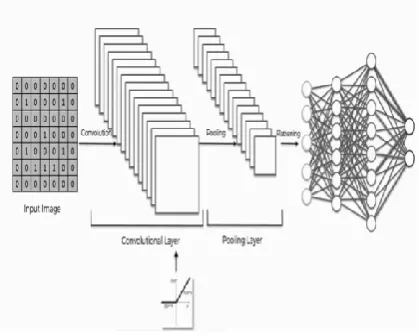
Convolutional Neural Network (CNN): It is an algorithm based on Deep Learning used for the purpose of image classification. This algorithm takes an image as input and marks the important sections in the image and assigns priorities of objects in detection and differentiates the objects [3]. This algorithm is used in training the model for the purpose of gender and age detection through image classification. The concept involved behind this technique of image classification is that it reduces an image in its quality to an extent that it becomes easy to classify and at the same time it doesn‟t lose features. Then by application of filters, it captures the dependencies of the image. With layers of CNN, level of classification increases. For instance, 1st layer reads low level features like colour and edge and then further layers proceed to higher levels of classification.
Fig. 2: CNN process Outlined
OpenCV: Open Source Computer Vision library is a library for machine learning in image classification models [4]. It contains a collection of algorithms each for a specific use in image classification. The library is used in both the gender-age and security modules of the project as a tool to facilitate smooth detection. It has multiple language support. This project uses the python integration of OpenCV.
Numpy Array: Scientific computing is facilitated in python with the help of the numpy library. A numpy array is a matrix of values of same type. In this project, numpy arrays are used to assign values to pixels of an image and index them accordingly. Doing so will help in determining the location of objects in the image/ video sequence and thus enhance effective detection and classification. Pixels can be referred to on the basis of their values. Thus, control can be administered over individual pixels by referring to their values.
PyQt: It is a tool used for designing the graphical user interface (GUI) of the project. The GUI used in this
project include a splash screen, two window prompts for selection mode. While using the gender-age detection module, a rectangular box encloses the face of the individual in the real-time video sequence while displaying the gender, age and the section of mall containing the products. On the other hand, in the motion detection module, multiple rectangular boxes line up in the direction of motion (if detected) and in case of detection of motion, an alert message is displayed.
D. Implementation
The complete code of the software is designed in python 3.7. The application is designed to work in windows environment. The system requirements for smooth running of the software are as follows:
1. A Windows operating system based device.
2. 4GB or greater RAM required for smooth functioning.
For the gender-age detection, a camera maybe installed at any multiplex mall along with a screen displaying the functional gender-age module. When a customer visits the mall, he/she may put his/her face in front of the camera, check the live monitoring in the display and know the section containing products based on his/her attributes. This will allow the customer to easily locate the products suiting his attributes. In case of busy multiplexes, multiple such device combinations maybe installed.
Fig. 3: Snapshot of gender-age detection
For the motion detection module, the user may install camera(s) at vulnerable points of a secured facility and monitor the device screen at a different location. In case of any human motion detection, an alert will pop up on the monitoring screen and the user may take the desired action.
IV.CONCLUSION
This application is a unique innovative solution to two problems at the same time. The gender-age module will allow the customers for a hassle-free, efficient product location in a multiplex mall and the motion detection module on the other hand will provide an efficient security mechanism based on continuous monitoring. The application comes with both the modules in a single interface and works on every windows based environment. It also has a very user-friendly user-interface for easy usage.
V. FUTURE SCOPE
This application may be made available for android and other mobile platforms for more easy access to the application. The gender-age classification module maybe upgraded to prediction of more attributes like body size, etc to give further flexibility in product placement and location.
The security module can be upgraded to send alert messages to the user via a GSM module in case of detection of infringement when the user is not available for monitoring the secured facility.
REFERENCES
[1] A.R. Runnalls, “Kullback-Leibler Approach to Gaussian Mixture Reduction”, IEEE Transactions on Aerospace and Electronic Systems,
Volume 43 issue 3,pp. 989 – 999,19 November 2007.
[2] Ming-Hsuan Yang; Narendra Ahuja, ”Gaussian mixture model for human skin color and its applications in image and video databases.”,
Proceedings Volume 3656, Storage and Retrieval for Image and Video Databases VII,1998
[3] Devis Tuia ; FrÉdÉric Ratle ; Fabio Pacifici ; Mikhail F. Kanevski ; William J. Emery,”Active Learning Methods for Remote Sensing Image
Classification”, IEEE Transactions on Geoscience and Remote Sensing,Volume 47 issue 7,pp.2218 – 2232, July 2009.
[4] Ivan Culjak, David Abram, Tomislav Pribanic, Hrvoje Dzapo, Mario Cifrek ,”A brief introduction to OpenCV”, Proceedings of the 35th