(RLWE) key
Jintai Ding1, Saraswathy RV1, Saed Alsayigh1, and Crystal Clough1 University of Cincinnati
Abstract. We use the signal function from the RLWE key exchange in [26] to derive an efficient zero knowledge authentication protocol to validate an RLWE keyp=as+e with secrets and errorein the Random Oracle Model (ROM). With this protocol, a verifier can validate that a keyppresented to him by a proverP is of the formp = as+ewiths, esmall and that the prover knowss. We accompany the description of the protocol with proof to show that it has negligible soundness and completeness error. The soundness of our protocol relies directly on the hardness of the RLWE problem. The protocol is applicable for both LWE and RLWE but we focus on the RLWE based protocol for efficiency and practicality. We also present a variant of the main protocol with a commitment scheme to avoid using the ROM.
Keywords: RLWE, key exchange, post-quantum, key reuse, key validation, active attacks.
1
Introduction
Lattice-based cryptographic primitives are promising for use as a post-quantum alternative for existing cryptosystems that are based on classical hard problems. The search for quantum-resistant primitives has become intense in the recent year after the NSA announced its plan to transition to quantum resistant ciphersuites and NIST is calling for proposals of post-quantum primitives [50]. Due to its appealing properties like provable security, efficiency and versatil-ity, most of the recent lattice-based schemes designed are based on the Ring-Learning with Errors (RLWE) problem. However, one of the challenges with RLWE, as pointed out in [37], [29], [25] is that, in an interaction with a malicious user not following the instructions of a protocol, the malicious user could pretend to use a RLWE key while actually using a differ-ent form to extract our secret key. This is due to the indistinguishability of RLWE samples from uniform ones. To avoid this, we need an efficient and secure authentication technique that can validate such keys to be of the correct form and that the user presenting the key knows the corresponding secret. The need for such validation protocols was also reiterated in PQCrypto2017 in the invited talk by Lyubashevsky [45]. The protocol presented in this work aims to contribute towards such a key validation technique for RLWE using simple operations in the ring. Some of the other related work includes [10, 46, 63, 42, 7]. Our protocol has a simpler structure and better adaptability for a KE protocol with key reuse, without using any additional techniques such as rejection sampling.
Authentication plays a vital role in security and can also be used to verify the identity of a process, server or network device. In the process of authentication, it is also important for a malicious verifier to not gain information about the secret of the prover that he can use to impersonate.
knowledge. Informally, Completeness means that with overwhelming probability, an honest prover is able to successfully make a proof to the verifier. Soundness means that the proba-bility that a malicious prover (without the secret) can make a valid proof is negligible. Zero knowledge is shown by the ability to construct a simulator that creates transcripts of the proof that are indistinguishable from a real transcript between a prover and verifier. More details and formal mathematical definitions for these properties are included in the preliminaries section of the paper.
1.1 Previous Work
There are some lattice-based Identification (ID) schemes that has its security based on Witness Indistinguishability. Lyubashevsky in [43] introduced an ID scheme based on the hardness of SIS (Shortest Integer Solutions) problem. This scheme was shown to be witness indistin-guishable and used this to prove security under the active attack model. The drawback of this scheme however, is to be able to implement the scheme for practical parameter choices retaining security of the protocol. Another work in [44] presented an ID scheme with lower communication complexity based on hardness of approximate shortest vector problem in lat-tices. This work also described a way to convert the ID scheme into a signature in the Random oracle model using the Fiat-Shamir transform [1].
[36] describes a variant of the ID scheme proposed by [58] in the lattice setting and proves its security under concurrent attacks. A zero knowledge proof for commitments from RLWE was described in [11] that verifies that the commitments are from the ring defined in RLWE problem but does not verify that a sample is of RLWE form or the secret of a RLWE sam-ple.This is a generalization of the protocol from Xie et al. [63] improving its knowledge error. A previous work on group signatures [10] also proposes a zero knowledge proof for LWE samples of the form y = as+eto prove the knowledge of secret s. An advantage with this protocol is a reduced soundness error of1/2n, however this protocol relies on rejection sampling to ensure thatsandefollows the Discrete Gaussian distribution that leads to lower efficiency and increased completeness error.
Key leakage was pointed out by Kirkwood et al. in [37], which discusses about elliptic point off the curve attack [12] that results in key leakage and using public key validation to avoid such attacks by checking that the public key is a valid point on the specified curve. They also discuss about the unavailability of such validation in the case of lattice-based key ex-change. For RLWE-based Key agreement, they proposed an indirect key validation technique using the Fujisaki-Okamoto transformation. The transformation derives a hybrid IND-CCA (Indistinguishability Chosen Cipherext Attack) secure scheme from weakly secure symmetric and asymmetric encryption schemes. This is adapted in [54] to derive an actively secure KEM (Key Encapsulation Mechanism) but with efficiency limitations in the implementation. The indirect validation is also more complicated and limits the ability of the party being authenti-cated to choose a public key since it has to be generated from the private key derived from the seed. Another disadvantage with indirect validation is that it does not allow key reuse since the private key of the party being authenticated is revealed during the validation. In [20], a cut and choose protocol for RLWE is proposed. The protocol involves generatingN ≈ 32 samples for each RLWE instantiation and revealing at random all but one of the instances to the verifier. So the provers probability of convincing the verifier is at most1/N if the prover doesnt know the secret.
does not apply to the exact relation to be verified. LetB ∈Rlq×k be a matrix with the
rela-tionBm =u modq, wherem ∈ Rk
q is secret, and let(v, w) ∈ Rkq ×Rkq be a ciphertext
of m obtained using an RLWE encryption scheme. Then, the protocol verifies that the ci-phertext decrypts to am,¯ ¯c such thatBm¯ = ¯cu modq. In order to recoverm¯, the idea is to guess values for ¯c from a defined challenge space. This also uses rejection sampling in the protocol. A statistical zero knowledge argument of knowledge for message-signature pair, that can be applied to group signatures is proposed in [42]. The protocol verifies the knowl-edge of a pair(d, z) ∈ {0,1}l×
Z2m that satisfies kzk∞ ≤ β, and A(d)z = u modq, whereA(d) = [A|A0+P
l
i=1diAi] ∈ Zqn×2m. Here, uniformly random(A, A0, . . . Al, u),
where eachAi ∈Znq×mandu∈Znq form the verification key of Boyen’s signature scheme.
This protocol has a communication complexity of(O(lm)log β+O(k2)log b)log q(where
nis the security parameter,lis the message length,m ≥2nlog q,σ=Ω(√lnlog qlog n),
β =σω(√log m), k2, bare parameters of underlying encryption scheme), with a soundness error of2/3and perfect completeness. The work in [7] discusses a zero knowledge proof for the preimage of a ivOWF(one way function over integer vectors). This proof can be applied to the context of learning with errors considering the encryption function as a ivOWF. This ZK protocol is honest verifier computational ZK and uses rejection sampling and cut and choose technique for its proof.
1.2 Our Contributions
The main contributions of this paper are the design and analysis of an efficient zero knowledge authentication protocol that can be used to validate a samplepto be of the formas+ewith
s, esmall and the knowledge ofsof the party presenting the sample. This is accomplished by making use of the signal function defined in the key exchange protocol using RLWE [26]. The
Sigfunction has a significant role in the key exchange protocol, since it allows us to extract a shared key material from approximately equivalent keys and can be leveraged to derive other applications as in this work with respect to the RLWE-based key exchange. In this authenti-cation protocol, the prover uses a challenge/response interactive proof to prove to the verifier that he has the secretsand the verification is done with the help of theSigfunction. We show that the soundness error of the protocol is1/2and we can achieve negligible soundness error by sequentially running the protocol enough number of times.
The relevance of this protocol comes from the observation that key reuse can be exploited in RLWE-based key exchange [29],[25] when implemented in practice. This aims to serve as a simple and direct key validation technique for RLWE keys and helps to protect against active attacks in RLWE-based key exchange with malformed keys. The advantage of using this direct validation of RLWE key over the indirect key validation using the Fujisako-Okamoto transformation is the simplicity and efficiency of the protocol and the ability to build more efficient systems and reuse keys in practice. In section 5, we provide a variant of the protocol that does not rely on the ROM for its zero knowledge, by including a commitment scheme. We also remark that when a keypis validated with this protocol,pis verified to be of the form
be applied to RLWE verifiable encryption and can also be used to obtain efficient signatures using the Fiat Shamir transform.
2
Preliminaries
The Learning with Errors (LWE) problem was first introduced by Regev in 2005 along with a quantum reduction from solving hard lattice problems in the worst case to solving LWE in the average case. Since the introduction of LWE and the reduction, it has allowed the design of many versatile applications in Key Exchange, Digital Signatures , FHE (Fully Homomorphic Encryption) schemes [15], Identity Based Encryption (IBE) schemes [2] and more. LWE is a generalization of the parity-learning problem in computer science. In 2009, Peikert showed a classical reduction from variants of the shortest vector problem to corresponding versions of LWE [53]. The decision version of the LWE problem is to distinguish the following two distributions givenpoly(n)samples: (a,a.s+ e) and (a,b), wherea,s,b∈Znq uniformly at
random andeis sampled from an error distribution onZq. The search version of the problem
is to solve forsgiven (a,a.s+ e). The Ring-LWE problem was designed by Lyubashevsky et al. in [47] where the efficiency limitations of LWE are overcome by defining the cryptographic operations over a ringR =Z[x]/φ(x), (analogouslyRq = Zq[x]/φ(x)) whereφ(x)is the
m-th cyclotomic polynomial. In practice, we often use the2-power cyclotomics for efficiency and controlling the noise. By considering polynomials from the ringRq, one samplea, a.s+e
by choosinga, suniformly fromRq andefrom an error distribution ofRq providesnLWE
samples corresponding to each coefficient of the polynomial.
We provide the definition of the Discrete Gaussian distribution (error distribution) here:
Discrete Gaussian Distribution
Definition 1. [64] For any positive realα∈R, and vectorsc∈Rn, the continuous Gaussian
distribution over Rn with parameter αcentered atc is defined by the probability function
ρα,c(x) = (α1)nexp(−πkx−ck
2
α2 ). For integer vectorsc∈Rn, letρα,c(Zn) =Px∈Znρα,c(x). Then, we define the discrete Gaussian distribution overZnasDZn,α,c(x) = ρρα,c(x)
α,c(Zn), where
x∈Zn. The subscriptsαandcare taken to be1and0(respectively) when omitted.
For a vectorv = (v0, . . . , vn−1)inRn orCn andp∈[1,∞), we define the`p norm as
kvkp= (Pn−1
i=0 |vi|
p)1/pand the`
∞norm askvk∞=maxi∈[n]|vi|. The`2norm corresponds to the`pnorm withp= 2and is denoted ask.kin this paper. In applying the norms, we assume
the coefficient embedding of elements fromRtoRn. For any elements=Pni=0−1six
iofR,
we can embed this element intoRnas the vector(s0, . . . sn−1). We recall two useful lemmas here:
Lemma 1 ([64]). Let f(x) and R be defined as above. Then, for any s, t ∈ R, we have ks·tk ≤√n· ksk · ktkandks·tk∞≤n· ksk∞· ktk∞.
Lemma 2 ([48, 30]).For any real numberα=ω(√logn), we havePrx←χα[kxk> α
√ n]≤
2−n+1.
The Hermite Normal Form (HNF)-LWE is a reduction of the LWE problem in which the secretsis also derived from the error distribution. It has also been shown that solving HNF-LWE problem has the same reduction to solving hard lattice problems in the worst case [4] and hence can be safely used in cryptographic applications.
Lets← Rq be a uniformly chosen element of the ringRq, as defined above. We define
Definition 2 (Ring-LWE Assumption).LetRq, χαbe defined as above, and lets←Rq be
uniformly chosen. The (special case) ring-LWE assumptionRLW Eq,αstates that it is hard
for any PPT (Probabilistic Polynomial Time)algorithm to distinguishAs,χαfrom the uniform
distribution onRq×Rq with only polynomially many samples.
The search version of RLWE is to modify the above definition by requiring the PPT algo-rithm to findsrather than distinguish the two distributions. For certain parameter choices, the two forms are polynomially equivalent [47].
Proposition 1 ([47]).Letnbe a power of2, letαbe a real number in(0,1), andqa prime such thatqmod 2n = 1andαq > ω(√logn). DefineR =Z[x]/hxn+ 1ias above. Then
there exists a polynomial time quantum reduction fromO˜(√n/α)-SIVP (Short Independent Vectors Problem) in the worst case to average-case RLWEq,β with` samples, where β =
αq·(n`/log(n`))1/4.
It has been proven that the RLWE assumption still holds even if the secretsis chosen according to the error distributionχαrather than uniformly [4, 47]. This variant is known as
thenormal form, and is preferable for controlling the size of the error term [16, 14].
2.1 Zero Knowledge definitions
We focus here on the interactive proof system with zero knowledge. LetP andV denote the honest prover and verifier respectively.P∗ andV∗ are usually used to denote the cheating prover and verifier respectively.
Definition 3. [35](P, V)is an Interactive Proof System (IPS) for a languageL, and security parameter k if:
1. Completeness :∀x∈L,P r[OutV(P ↔V)[x] =accept]≥1−negl(k).
2. Soundness :∀x /∈L,∀P∗,P r[OutV(P∗↔V)[x] =accept]≤negl(k).
Here negl() denotes a negligible function and OutV(P ↔ V)[x] is the final output
(ac-cept/reject) of the verifier on interaction with the prover.
The Statistical distance is defined for two random variablesX, Y of a discrete distribution as
∆(X, Y) =1 2
X
x
|P r[X =x]−P r[Y =x]|
LetX ={Xn}n∈NandY ={Yn}n∈Nbe sequences of probability distributions, called
ensembles. We say thatXandYare statistically indistinguishable, if∆(Xn, Yn) =negl(n).
An interactive proof system needs to satisfy an additional property to be considered zero knowledge.
Definition 4. [6] An interactive proof system(P, V)for a languageL is (statistical) zero-knowledge (SZK) if for any PPT verifierV∗, there exists an expected PPT simulatorS such that for every valid public inputxand private inputw, the statistical distance of the following two random variables is negligible:
– V iewV∗< Px,w, V∗>
– S(x). (Note thatScan be probabilistic and so this is a random variable).
That is,Sonly gets the public input and has no interaction withP, but still manages to output something indistinguishable from whateverV∗ learned in the interaction. Here, the notationV iewA < B, A > denotes the view of A during the interaction with B: all the
An NP-relationR ⊆ {0,1}∗× {0,1}∗is given by a deterministic algorithmW(,)that runs in time polynomial in the length of its first input. The relation isR={(x, w) :W(x, w) accepts}. The associated NP-languageLR={x:∃wsuch thatW(x, w)accepts}. The witness
set for anx∈ {0,1}∗isR(x) ={w:W(x, w) = 1}.
2.2 Notation
Let the integernbe a power of2, and define f(x) = xn+ 1 and consider the ringR :=
Z[x]/hf(x)i. For any positive integerq, we define the ringRq :=Zq[x]/hf(x)ianalogously,
where the ring of polynomials overZ(respectivelyZq :=Z/qZ) we denote byZ[x]
(respec-tivelyZq[x]). For any polynomialy(x)inR(orRq), we identifyywith its coefficient vector
inZn(orZnq). Letχαdenote the discrete Gaussian distribution onRq with parameterα. The
norm of yis computed as the norm of its coefficient vector. We say a functionf(κ)is neg-ligible if for everyc>0, there exists anN ∈ Nsuch thatf(κ)<1/κcfor allκ>N. We use
negl(κ)to denote a negligible function ofκ, and we say a probability is overwhelming if it is 1−negl(κ). LetH :Rq→ {0,1}τbe a hash function whereτis the bit length of the output.
2.3 Pseudorandomness
Lemma 3. Ifx1is sampled from the uniform distribution onRq, thenx¯=x1+xis uniform
overRq even ifxfollows an arbitrary probability distribution.
Proof. Refer to Appendix A
We can show thatx¯is statistically pseudorandom assuming thatx1is statistically pseu-dorandom andxfollows arbitrary distribution, whenx, x1are distributed independently. For more details, refer to Appendix. Statistical indistinguishability implies computational indis-tinguishability but it can also be shown directly here as follows.
Lemma 4. x¯ = x1+xis almost uniform (computationally pseudorandom) in Rq if x1 is
computationally pseudorandom inRqandxfollows an arbitrary probability distributionφ.
Proof. Refer to Appendix B
3
Random Oracle Model (ROM)
The random oracle model was introduced by Bellare and Rogaway in 1993 to bridge the gap between theoretical security and practical cryptography. Protocols using ROM to prove secu-rity, model hash functions as public random oracles [9]. This allows for more efficient pro-tocols with security proofs, compared to the standard model (referring to propro-tocols not using random oracles or Common Reference Strings (CRS)). The approach of ROM as described in their work is as follows:
LetQ
be a protocol problem. SupposeP is a protocol for problemQ
.
1. Define problemQ
under the computational model that allows all parties in the protocol to access a random public oracleR.
2. Devise an efficient protocolPforQ
in this random oracle model. 3. Prove thatPsatisfies the definition forQ.
There has been a lot of serious discussion about the actual security of protocols using ROM. Some of the related work include [40, 39] in favor of ROM and [8, 19] against its use. But it has been widely used for building efficient protocols with provable security. We also present a variant of our protocol without using the random oracle model. With respect to Zero knowledge protocols, the random oracle model changes the deniability property of these protocols. Deniability is the property that guarantees that the transcript of the zero knowledge proof does not leave any evidence of the interaction. Thus, Zero knowledge protocols that does not have the deniability property may no longer be zero knowledge under sequential execution. This stems from the fact that the simulator is allowed to choose the random oracle and can reuse the output, thus violating the assumption that a verifier interacting with the prover learns nothing more than his interaction with the simulator. However, we can still achieve deniable zero knowledge proofs by adopting a weaker simulator, that is no longer allowed to choose the random oracle, but should be able to perform the simulation for all but a negligible fraction of random oracles. We adopt this same approach for our protocol in this work in restricting the simulator. For more details, please refer to [52], [62].
Definition 5. An interactive proof system (P, V) for a languageL is (statistical) deniable zero-knowledge in the random oracle model if for any PPT verifierV∗, there exists an expected
PPT simulatorSsuch that for every valid public inputxand private inputw, the statistical distance of the following two ensembles is negligible:
– {RO, V iewV∗RO< Px,wRO, V∗RO>}
– {RO, SRO(x)}. (Note thatScan be probabilistic and so this is a random variable).
Here,ROis a uniformly distributed random variable corresponding to the random oracle. By includingROvariable in the ensemble, it is possible to verify that the simulator uses the pre-specified public random oracle for its execution.
4
The Protocol
4.1 Signal Function
GivenZq ={−q−21, . . . ,q−21}and the middle subsetE:={−bq4c, . . . ,bq4e}, we defineSigd
as the characteristic function of thecomplementofE:Sigd(v) = 0ifv∈Eand1otherwise.
In order to avoid any bias in theSigfunction, we use the randomized signal function in the following way. We define two functionsSigd0,Sigd1:Zq→ {0,1}as follows:
d Sig0(v) =
(
0 v∈[−bq
4c,b
q
4e], 1 otherwise.
d Sig1(v) =
(
0 v∈[−bq4c+ 1,b4qe+ 1],
1 otherwise.
Note that Sigd0 is defined to be the same function as Sigd above, while Sigd1 is a slightly shifted variant. By definition,Sig0 causes a bias in the final shared key derived. This bias is balanced by the functionSig1. Thus, we combine these into a randomized functionSigd∗, whereSigd∗(v)is found by randomly samplingb← {0,1}and returningSigdb(v).
Now, we can extend the functionSigd∗toRq by applying the function coordinate-wise.
For ring elementv= (v0, v1, . . . , vn−1)∈Rq, we define the functionSig∗:Rq → {0,1}n,
4.2 The Protocol Itself
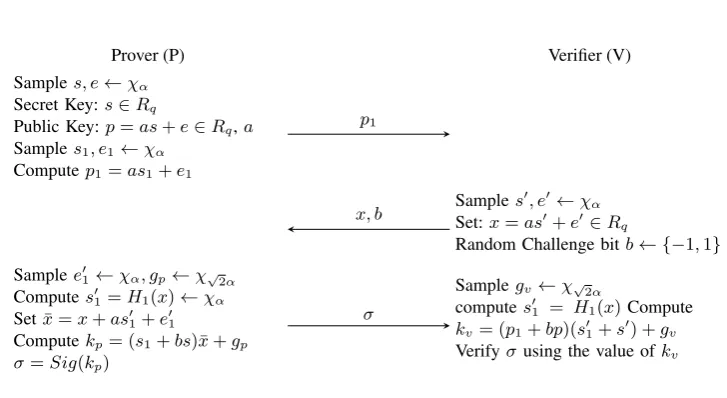
As a first step in the protocol,P choosesa ← Rq uniformly ands, e ← χαand computes
p=as+e.P then publishes(a, p)as its public key.P also publishes its parameter choice
n, q, α. The secret ofPissand the protocol letsPprove to a verifier thatpis of the formas+e
and thatP knowsscorresponding toppublished. This set up is assuming thatP is honest. If
P is malicious, thenpneed not be of the formp=as+eand the verifier accepts the prover in the protocol with only negligible probability. LetM denote the set{−bq
8c, . . . ,b
q
8e} ∪
{−b3q
8c, . . . ,b 3q
8e}(refer Figure 1).
Fig. 1.The regionMused for verifying the signal sent by the prover.
The interactive zero knowledge protocol is described as follows: LetH1:Rq →χαbe a hash function modeled as a random oracleH1.
P :Pcomputesp1=as1+e1wheres1, e1←χαand revealsp1to the verifierV.
V : On receivingp1fromP, the verifier now generates an RLWE samplexasx=as0+e0 wheres0, e0 ←χαand randomly chooses a challenge bitb∈ {−1,1}.V sendsb, xto the
proverP.
P : In order to complete the proof, the prover computess0
1=H1(x). Prover setsx¯=as01+
e01+x, wheree10 ←χα. Then computeskp= (s1+bs)(¯x) +gpwheregp←χ√2αand
σ=Sig(kp).P sendsσtoV. Here, the errorgpis sampled from error distribution with
parameter√2αto have the same standard deviation as the secrets0+s01. Since each secret
s0 ands01are sampled from the error distribution (Discrete Gaussian) with parameterα, the sum follows the same error distribution with parameter√2α.
V : The verifierV computess01=H1(x)andkv= (s01+s0)(p1+bp)+gvwheregv←χ√2α.
The proof is accepted byV if the signalσis verified to be correct using the computed value kv and rejected if the signal is incorrect. The verifier only checks the indexes i
of σ for whichkv[i] ∈ M. If kv[i] ∈ {−bq8c, . . . ,bq8e}, then σ[i] is expected to be
0 and if kv[i] ∈ {−b38qc, . . . ,b38qe},σ[i] is expected to be 1. Since for any d ∈ Zq,
P r(d ∈ M) = 1/2, there are enough number ofσ[i] for the verifier to validate the correctness.
The idea behind usingx¯for computingkpis to avoid leaking information aboutsthrough
the signal to a malicious verifierV∗since it uses information from both the prover and verifier to perform the computation. IfV∗is malicious and chooses anxdeviating from the protocol, by usingx¯, we ensurekphas the form of an RLWE sample, which is indistinguishable from
Prover (P) Verifier (V) Samples, e←χα
Secret Key:s∈Rq
Public Key:p=as+e∈Rq,a
Samples1, e1←χα
Computep1 =as1+e1
Samples0, e0←χα
Set:x=as0+e0∈Rq
Random Challenge bitb← {−1,1}
Samplee01←χα, gp←χ√2α
Computes01=H1(x)←χα
Setx¯=x+as01+e
0
1
Computekp= (s1+bs)¯x+gp
σ=Sig(kp)
Samplegv←χ√2α
computes01 = H1(x)Compute
kv= (p1+bp)(s01+s
0 ) +gv
Verifyσusing the value ofkv
p1
x, b
σ
Fig. 2.Authentication Protocol
H1(x)modeled as a random oracle. Random oracle queries are answered in the usual way: new queries are answered with uniformly random values, and previously made queries are answered identically to the past response.
Lemma 5. Let q be an odd prime such that q= 1 mod2nand q > 80α2n3/2. Then the
probability of an honest verifier accepting a signalσ from an honest prover P is at least
1−2−n+1.
Proof. We see the following relation betweenkvandkp
kp−kv= (s1+bs)¯x+gp−((p1+bp)(s01+s 0) +g
v)
=as01s1+bass01+as0s1+bas0s+bse0+e0s1+e10s1+bse01+gp
−(as1s01+bass10 +as0s1+bas0s+bes01+bes0+e1s10 +e1s0+gv)
=e0s1+be0s+e01s1+bse01−bes 0 1−bes
0−e
1s01−e1s0+gp−gv =ek
Here,ekis used to denote the valuee0s1+be0s+e01s1+bse10−bes01−bes0−e1s10−e1s0+gp−gv.
Since the challenge bitbis either−1or1, we have|b| = 1. So,kekk ≤ ke0s1k+ke0sk+
ke0
1s1k+kse01k+kes01k+kes0k+ke1s01k+ke1s0k+kgpk+kgvk. Then, using Lemma 2,
each error term has norm less thanα√nwith overwhelming probability. Combining this with lemma 1, we get|ek| ≤10α2n3/2<q/8with probability1−2−n+1.
Since we know thatkekk∞≤ kekk, we havekekk∞<q/8with the same probability. So, we haveek[i]<q/8, for eachiin0, . . . n−1. Then from the analysis above, we can see that if
the verifier’s computationkv[i]for theithcoefficient is inM, thenσ[i]is accepted using the
value ofkv[i]with probability1−2−n+1.
We now prove that the protocol described in Figure 2 satisfies the following properties of a zero knowledge protocol.
Completeness: Letqbe an odd prime such thatq=1mod2nandq >80α2n3/2. For every honestP with knowledge ofs for an RLWE samplep = as+e,P r[OutV(P ↔ V) =
accept]≥1−2−n+1.
Computational Soundness: 1 Computational Soundness means that if a PPT malicious proverP∗does not know the secretscorresponding top, then regardless of whatP∗ does, the verifier will accept the proof with probability at most1/2 +negl(n). This is equivalent to saying that the advantage ofP∗in making the proof is negligible with advantage defined as follows:
AdvP∗=P r[OutV(P ↔V) =accept|b0 ← {0,1}:b0 6=b]−1/2
Proof. The soundness of the protocol is proven in the random oracle model. IfP∗can guess the challenge bit of the verifier correctly, thenP∗ can sendp1+p(resp.p1−p) instead of an honestp1 if the guess of the challenge bit is−1(resp.1). This is explained and used in the construction of the simulator in the zero knowledge part. SinceP∗ can only guess this challenge bit with probability1/2, the probability of success forP∗is at least1/2. Assuming
P∗to be a malicious prover that can make a valid proof without the knowledge ofswith non-negligible advantage, we considerP∗as an oracle that gives valid proof with non-negligible advantage, irrespective of whetherP∗knows the correspondingsor not, whenpis of the form
p=as+e, withs, esmall.
The signalσsent by a prover is accepted by an honest verifier when the noise terms are small so that the difference between the verifier’s computationkvand the prover’s computationkp
is small (the error bounded byq/8 in the`2 norm). Thus,P∗ gives valid proof for RLWE samples with non-negligible advantage since RLWE samples are of the formp=as+ewith
s, esmall, usually sampled from the discrete gaussian distribution. We define gamesGame0 throughGame2that can played between a cheating proverP∗and a verifier and use them to show that ifP∗can make a valid proof with success probability1/2 +AdvP∗ withAdvP∗ non-negligible, thenP∗can be used to build an RLWE distinguisher with the same advantage asP∗. On interaction with the prover, the verifier’s acceptance decision can be regarded as the decision bit0or1for rejection or acceptance respectively. Every game is played between the prover strategyP∗and a verifier oracle that honestly performs the verifier side of the protocol.
Game0 This is the original protocol in whichphas the formp=as+eandp1=as1+e1 according to the protocol. The transcript of the protocol is generated as p1, x, b, σ and output is the decision bitbdof the verifier. This decision bitbdis1if the verifier accepts
the proof and0if he rejects.
Game1 : This game is identical toGame0except thatpis chosen uniformly overRq.
Game2 : The game is identical toGame1except thatxis chosen uniformly.
Lemma 6. IfP∗can make a valid proof for an RLWE samplep= as+ewiths, e← χα
without the knowledge ofsto an honest verifierV with non-negligible advantage, then there is a distinguisher for RLWE samples from uniform with the same advantage.
Proof. LetBbe the RLWE distinguisher that we will construct using the prover strategyP∗. On receiving the challenge(a, p)from the RLWE challenger,Bsends the challenge toP∗. Here,Bperforms the role of the honest verifier. Ifpis an RLWE samplep = as+e, the interaction betweenP∗ andBis exactlyGame0andBthen outputs1since by assumption,
P∗ is capable of making valid proofs for any RLWE sample p. If pis uniform, then the interaction betweenP∗andBis exactlyGame1(Assuming thatP∗cannot make valid proofs for uniformpexcept with negligible advantage, which we will prove later). Thus, an output of1concludes thatpis RLWE and the game played isgame0; an output of0concludes that
pis uniform and the game played isGame1.
1
Suppose P∗ can also make valid proofs for uniform p with non-negligible advantage, then the distinguisher as defined above would not be successful. We claim that this cannot be the case unless P∗ can solve the search version of the RLWE problem with the same advantage. Suppose P∗ can generate a signal σ that is accepted by the verifier for anyp
without the knowledge of correspondings. Here, the key computation of the verifier iskv =
(p1+bp)(s0+s10)+gv= (p1+bp)s0+(p1+bp)s01+gv, in which(p1+bp)s01can be computed by the malicious prover himself. Also, since the verifier accepts the signalσ, it implies that
P∗is able to generate the signal for(p1+bp)(s0+s10) +epfor anyp, whereep =gv−ek
andek=kv−kpfrom lemma 5. Now, we recall the signal function attack in [25]. This attack
allows an adversary to initiate multiple key exchange sessions with a party with a fixed public keyp=as+ 2eand gain information about the secret from the signal by creating malformed public keys of the formpA=asA+k, wherekranges through all values ofZq. The number
of signal changes askvaries over values ofZq is exactly2s[i]for every coefficientiof the
secrets.
Setup: IfP∗can generate the signal of(p1+bp)(s0+s01) +ep, then he can initiate multiple
key exchange sessions such that he plays both the initiator and the responder roles of the KE protocol. LetP∗
I andPR∗denote the initiator and responder role played byP∗respectively.PR∗
queries the random oracleH1with inputxto obtains01and fixes his public key asx+as01=
a(s0+s01) +e0. Note that this is possible sincea, xare known toP∗.PI∗creates his public key aspI =p1+bpwherep1is malformed asp1=as1+ke1, sopI =as1+k+bpwith
e1= 1∈Rqand initiates a key exchange session withPR∗. SincePR∗is capable of generating
the signal of(pIs0 +ep), he responds withx, σR, whereσR = Sig(pI(s0+s01) +ep) =
Sig((p1+bp)(s0+s10) +ep) =Sig(k(s0+s01) +as1(s0+s10) +bps0+ep). The initiatorPI∗
can choose to drop the session at this stage or continue to create an unsuccessful KE session.
PI∗repeats this processqtimes varyingkthrough0toq−1and recoverss0+s01as described in the attack in [25] by looking at the number of signal changes for each coefficient. The process is repeated for varyingkfixingb= 1or−1andP∗can computeσRfor both values
ofb. Here,as1(s0+s01) +bps0is fixed for each coefficient across allqqueries for varyingk if we fixb = 1or−1. Also, sinceP∗can obtains01fromxby querying the random oracle
H1, he can recovers0froms0+s01. Thus, given an RLWE samplex=as0+e0,P∗can solve fors0, thus solving the search version of the RLWE problem with the same advantage that he has in generating the signal corresponding to a uniformpthat is accepted by a verifier in the authentication protocol.
Note that if bothpand the verifier’s choice ofxis uniform, then the verification of the signal is no longer valid. Thus,Game2is never played between the cheating prover and the verifier in the course of the proof.
This shows that the soundness error of the protocol is1/2 +negl(n). We can use the trick in [31], explained in [59], page69to slightly modify the protocol to obtain a soundness error of1/2. The soundness error becomes negligible as the protocol is executedntimes.
Zero knowledge: We first show that the proposed protocol is Honest Verifier Statistical Zero knowledge (HVSZK) and construct a probabilistic polynomial time simulatorSthat has black box oracle access to an honest verifierV and outputs transcripts that are statistically close to the transcripts between the real prover and verifier. We also assume that the simulator has access to the random oracle H1, proving zero knowledge in the random oracle model. Later, using [22], we transform the HVSZK into a general SZK protocol. LetV iewVRO <
PRO
p,s , VRO >andSRO(p)denote the view of the honest verifierV in an interaction with a
The idea behind the construction of a simulator is to show that a verifier can simulate the interaction it has with a real prover by itself, thereby establishing that the prover does not leak any useful information by performing a proof with the verifier. The simulatorSfor our authentication protocol described in Figure 2 is constructed as follows:
1. Input:a, psuch thata ←Rq andp=as+ewheres, e←χα. However, the simulator
does not get the value ofs, e. 2. Chooseb0← {−1,1}.
3. Choosepˆ1aspˆ1=as1+e1wheres1, e1←χα. Setp1= ˆp1−b0p.
4. InvokeV from the state in step2on the messagep1to obtain a challenge bitbandx. 5. Ifb=b0, query the random oracleH1with inputxto obtains01and outputσ=Sig((s1)(as01+
e01+x), otherwise go to step2.
In the construction, the simulator throws away the instances when the predicted random challenge bit of the simulator does not match the random challenge bit received by invoking the verifier oracle. Whenb =b0 = 1, the verifier’s computationkv = (s01+s0)(p1+p) = (s01+s0)( ˆp1), andkvstill has<q/8difference fromkp, preserving the acceptance probability
and hence the distribution thatV views. The same applies to the case whenb = b0 = −1. Here, the messagep1 is an RLWE sample irrespective of whetherb0 = 1orb0 = −1. So, the distribution is the same as in the case of the interaction with a real prover, regardless of whetherb0 = 1orb0 =−1. Also, the challenge bitbandxare independent ofb0 and follow the same distribution as in the protocol withP r[b = b0] = 1/2. The difference here comes from the final step of the simulator as we repeat the protocol when the challenge bits do not match. If we set the simulator to stop afterntries to matchb, b0and output a random uniform
σafter that, to obtain a strict polynomial time simulator, then the distribution of the simulator is at a statistical distance of at most2−nfrom the distribution of the real interaction.
In order to prove zero knowledge with respect to any arbitrary verifier (including cheating verifiers that deviate from the protocol), we use the results from section 2.3 onx¯in the proto-col. We observe that irrespective of the distribution ofx,x¯is pseudorandom inRq due to the
addition ofas01+e01which is an RLWE sample and is pseudorandom inRq. So,kphas the
RLWE formkp = ¯x(s1+bs) +gpsinces1+bs, gp←χ√2αand so is pseudorandom.
Thus, the keykp computed byP has the RLWE form and is pseudorandom, resulting in
a uniform signalσthat does not leak information aboutsto an arbitrary cheating verifier by running the protocol. To ensure zero knowledge and to provide a more rigorous analysis, we can use the second transform in [22] to adapt the above simulator to one for SZK with an arbitrary verifier that preserves negligible completeness and soundness error of the protocol. The transform ensures that the challenge bitbfrom the verifier is uniform using a commitment protocol. Forxsent by the verifier, we don’t require this since the prover’s computation ofkp
usesx¯as already mentioned.
Even though technically the cheating verifier knows the value of s01and can computex¯ himself, he cannot create anxto exploit this because of the commitment scheme. Thus, even ifxis formed deviating from the protocol, the honest prover uses¯xwhich is indistinguishable from uniform to perform its computations and hence does not leak information about the secret
s.
5
Variant of the authentication protocol
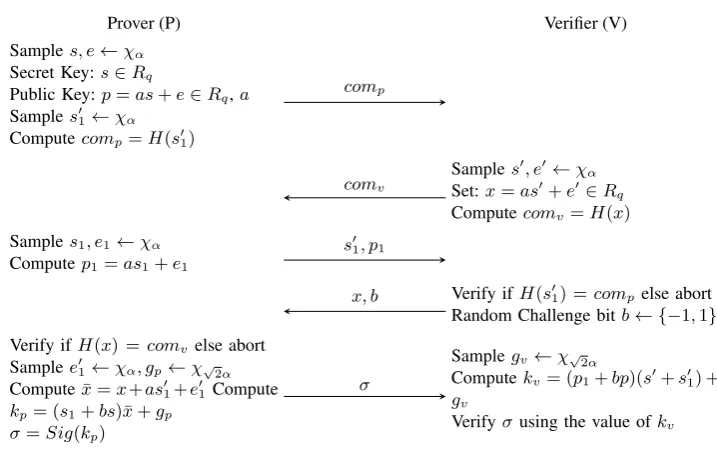
P :Pgenerates ans01←χαand sendscomp=H(s01)to the verifierV.
V : On receivingH(s01)fromP, the verifier now generates an RLWE samplexasx=as0+e0
wheres0, e0 ←χα.V sendscomv=H(x)to the proverP.
P :Pcomputesp1=as1+e1wheres1, e1←χαand revealsp1, s01to the verifierV.
V : On receivings01, p1fromP, the verifier checks ifH(s01) =compelse, aborts the protocol.
The verifier now randomly chooses a challenge bitb ∈ {−1,1}and reveals the RLWE samplexasx=as0+e0generated before and the challenge bitbto the proverP.
P : The prover checks if xmatches with the hash commitment sent by the verifier in the previous step, H(x) = comv else aborts the protocol. In order to complete the proof,
the prover computes x¯ = x+as01 +e10, where e01 ← χα and then computes kp =
(s1+bs)(¯x) +gpwheregp←χ√2αandσ=Sig(kp).P sendsσtoV.
V : The verifierV computeskv = (s01+s0)(p1+bp) +gvwheregv ← χ√2α. The proof
is accepted byV if the signalσis verified to be correct using the computed valuekvand
rejected if the signal is incorrect. Similar to the main protocol, the verifier only checks the indexesiofσfor whichkv[i]∈M. Ifkv[i]∈ {−bq8c, . . . ,bq8e}, thenσ[i]is expected to
be0and ifkv[i]∈ {−b38qc, . . . ,b38qe},σ[i]is expected to be1.
Prover (P) Verifier (V)
Samples, e←χα
Secret Key:s∈Rq
Public Key:p=as+e∈Rq,a
Samples01←χα
Computecomp=H(s01)
Samples0, e0←χα
Set:x=as0+e0∈Rq
Computecomv=H(x)
Samples1, e1←χα
Computep1 =as1+e1
Verify ifH(s01) =compelse abort
Random Challenge bitb← {−1,1}
Verify ifH(x) = comvelse abort
Samplee01←χα, gp←χ√2α
Compute¯x=x+as01+e
0
1 Compute
kp= (s1+bs)¯x+gp
σ=Sig(kp)
Samplegv←χ√2α
Computekv= (p1+bp)(s0+s01) +
gv
Verifyσusing the value ofkv
comp
comv
s01, p1
x, b
σ
Fig. 3.Authentication Protocol - Variant
com-pleteness, soundness and zero knowledge properties of this variant can be replicated from the above proofs replacingH1(x)withs01.
5.1 Commitment Scheme:
In order to establish the zero knowledge and soundness properties of our variant protocol (Figure 3), the commitment scheme plays an important role. Note that the commitment of the prover and verifier in the first two message exchanged in the protocol uses standard hash func-tions on the committed value. The hiding property ensures zero knowledge since otherwise a malicious verifier can gain the knowledge ofs01from the commitment and fromxaccordingly. The binding property restricts the malicious prover to the use of the committed values01in the proof. The commitment scheme can be separately executed to agree ons01andxvalues before running the validation part of the protocol and thus can be replaced with a secure commitment scheme that satisfies the required binding and hiding properties. We use Hash functionH for the presentation of the commitment scheme for simplicity. Assuming one way functions and collision intractable functions exist, many commitment schemes with the required properties have been proposed [23, 34, 33].
5.2 Communication Complexity:
The communication complexity of a single execution of the first protocol, involves the mes-sagesx, p1, b, σexchanged between the prover and the verifier. This amounts to2nlog q+n+1 bits of data exchanged. This does not include the complexity of the messages exchanges when we apply the transform in [22] to derive a uniform challenge bitb. The commitment scheme in the variant presented would add a complexity of2τ+O(nlog α)bits of the data exchanged.
6
Protocol for LWE
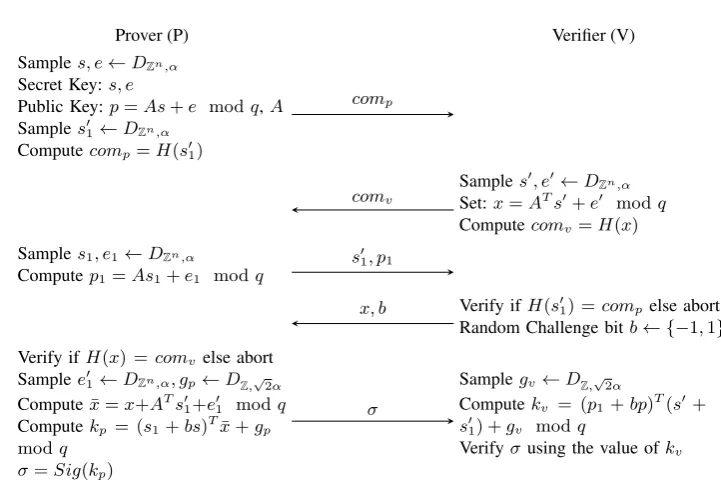
We also present a general authentication protocol for LWE form keys here for completeness of this work. Generate public parameters n, q, α. Let DZn,α denote the Discrete Gaussian distribution overZn. LetS
∗be the signal function defined analogous toSigasS∗ : Zqn →
{0,1}n,S
∗(v) = (Sigd∗(v0),Sigd∗(v1), . . . ,Sigd∗(vn−1)). We choose a uniform matrixA←
Znq×n instead of the public a ∈ Rq in the case of the RLWE based protocol. We use the
Hermite Normal Form (HNF) - LWE to ensure that the secret and error ofp=As+eis small for security and correctness of the protocol. In the HNF-LWE problem, boths, eare sampled according toDZn,α. The protocol is described as follows:
P :Pgenerates ans01←DZn,αand sendscomp=H(s01)to the verifierV.
V : On receiving H(s01)from P, the verifier now generates an RLWE samplex as x =
ATs0+e0 modqwheres0, e0 ←D
Zn,α.V sendscomv =H(x)to the proverP.
P :P computesp1 = As1+e1 modqwheres1, e1 ← DZn,α and revealsp1, s01 to the verifierV.
V : On receivings01, p1fromP, the verifier checks ifH(s01) =compelse, aborts the protocol.
The verifier now randomly chooses a challenge bitb ∈ {−1,1}and reveals the RLWE samplexasx=ATs0+e0 modqsgenerated before and the challenge bitbto the prover
P.
P : The prover checks if xmatches with the hash commitment sent by the verifier in the previous step,H(x) =comvelse aborts the protocol. In order to complete the proof, the
prover computesx¯ = x+ATs0
1+e01 modq, wheree01 ← DZn,α and then computes
Prover (P) Verifier (V) Samples, e←DZn,α
Secret Key:s, e
Public Key:p=As+e modq,A Samples01←DZn,α
Computecomp=H(s01)
Samples0, e0←DZn,α Set:x=ATs0+e0 modq Computecomv=H(x)
Samples1, e1←DZn,α
Computep1 =As1+e1 modq
Verify ifH(s01) =compelse abort
Random Challenge bitb← {−1,1}
Verify ifH(x) = comvelse abort
Samplee01←DZn,α, gp←DZ,√2α
Compute¯x=x+ATs01+e
0
1 modq
Computekp = (s1+bs)Tx¯+gp
modq σ=Sig(kp)
Samplegv←DZ,√2α
Computekv = (p1 +bp)T(s0+
s01) +gv modq
Verifyσusing the value ofkv
comp
comv
s01, p1
x, b
σ
Fig. 4.Authentication Protocol for LWE
V : The verifierV computeskv = (p1+bp)T(s01+s0) +gv modqwheregv ←DZ,√2α.
The proof is accepted byV if the signalσis verified to be correct using the computed valuekvand rejected if the signal is incorrect.
The zero knowledge, completeness and soundness can be similarly extended to the LWE case assuming that the HNF-LWE assumption holds and are skipped in this paper.
7
Conclusion
[1] M. Abdalla, J. H. An, M. Bellare, and C. Namprempre. From identification to signatures via the fiat-shamir transform: Minimizing assumptions for security and forward-security. In Proceedings of Eurocrypt 2002, volume 2332 of LNCS, pages 418–433. Springer-Verlag, 2002.
[2] S. Agrawal, D. Boneh, and X. Boyen. Efficient lattice (h)ibe in the standard model. In
Proceedings of the 29th Annual International Conference on Theory and Applications of Cryptographic Techniques, EUROCRYPT’10, pages 553–572, Berlin, Heidelberg, 2010. Springer-Verlag.
[3] E. Alkim, L. Ducas, T. Pppelmann, and P. Schwabe. Post-quantum key exchange - a new hope. Cryptology ePrint Archive, Report 2015/1092, 2015.http://eprint.iacr.
org/2015/1092.
[4] B. Applebaum, D. Cash, C. Peikert, and A. Sahai. Fast cryptographic primitives and circular-secure encryption based on hard learning problems. In S. Halevi, editor, Ad-vances in Cryptology – CRYPTO 2009, volume 5677 of Lecture Notes in Computer Science, pages 595–618. Springer Berlin Heidelberg, 2009.
[5] A. Banerjee, C. Peikert, and A. Rosen. Pseudorandom Functions and Lattices, pages 719–737. Springer Berlin Heidelberg, Berlin, Heidelberg, 2012.
[6] B. Barak. Zero knowledge proofs, 2007. https://www.cs.princeton.edu/
courses/archive/fall07/cos433/lec15.pdf.
[7] C. Baum, I. Damg˚ard, K. G. Larsen, and M. Nielsen. How to Prove Knowledge of Small Secrets, pages 478–498. Springer Berlin Heidelberg, Berlin, Heidelberg, 2016.
[8] M. Bellare, A. Boldyreva, and A. Palacio. An Uninstantiable Random-Oracle-Model Scheme for a Hybrid-Encryption Problem, pages 171–188. Springer Berlin Heidelberg, Berlin, Heidelberg, 2004.
[9] M. Bellare and P. Rogaway. Random oracles are practical: A paradigm for designing efficient protocols. InProceedings of the 1st ACM Conference on Computer and Com-munications Security, CCS ’93, pages 62–73, New York, NY, USA, 1993. ACM. [10] F. Benhamouda, J. Camenisch, S. Krenn, V. Lyubashevsky, and G. Neven. Better
Zero-Knowledge Proofs for Lattice Encryption and Their Application to Group Signatures, pages 551–572. Springer Berlin Heidelberg, Berlin, Heidelberg, 2014.
[11] F. Benhamouda, S. Krenn, V. Lyubashevsky, and K. Pietrzak. Efficient zero-knowledge proofs for commitments from learning with errors over rings. InProceedings, Part I, of the 20th European Symposium on Computer Security – ESORICS 2015 - Volume 9326, pages 305–325, New York, NY, USA, 2015. Springer-Verlag New York, Inc.
[12] I. Biehl, B. Meyer, and V. M¨uller. Differential fault attacks on elliptic curve cryptosys-tems. InProceedings of the 20th Annual International Cryptology Conference on Ad-vances in Cryptology, CRYPTO ’00, pages 131–146, London, UK, UK, 2000. Springer-Verlag.
[13] J. W. Bos, C. Costello, M. Naehrig, and D. Stebila. Post-quantum key exchange for the tls protocol from the ring learning with errors problem. Cryptology ePrint Archive, Report 2014/599, 2014. http://eprint.iacr.org/2014/599.
[14] Z. Brakerski, C. Gentry, and V. Vaikuntanathan. (leveled) fully homomorphic encryption without bootstrapping. InProceedings of the 3rd Innovations in Theoretical Computer Science Conference, pages 309–325. ACM, 2012.
[16] Z. Brakerski and V. Vaikuntanathan. Fully homomorphic encryption from ring-lwe and security for key dependent messages. In P. Rogaway, editor, Advances in Cryptology – CRYPTO 2011, volume 6841 ofLecture Notes in Computer Science, pages 505–524. Springer Berlin Heidelberg, 2011.
[17] G. Brassard, D. Chaum, and C. Cr´epeau. Minimum disclosure proofs of knowledge. J. Comput. Syst. Sci., 37(2):156–189, Oct. 1988.
[18] A. Broadbent, Z.-F. Ji, F. Song, and J. Watrous. Zero-knowledge proof systems for qma.
2016 IEEE 57th Annual Symposium on Foundations of Computer Science (FOCS), pages 31–40, 2016.
[19] R. Canetti, O. Goldreich, and S. Halevi. The random oracle methodology, revisited. J. ACM, 51(4):557–594, July 2004.
[20] E. Crockett and C. Peikert. Challenges for ring-lwe. Cryptology ePrint Archive, Report 2016/782, 2016.http://eprint.iacr.org/2016/782.
[21] I. Damg˚ard, S. Fehr, and L. Salvail. Zero-Knowledge Proofs and String Commitments Withstanding Quantum Attacks, pages 254–272. Springer Berlin Heidelberg, Berlin, Heidelberg, 2004.
[22] I. Damg˚ard, O. Goldreich, T. Okamoto, and A. Wigderson.Honest Verifier vs Dishonest Verifier in Public Coin Zero-Knowledge Proofs, pages 325–338. Springer Berlin Heidel-berg, Berlin, HeidelHeidel-berg, 1995.
[23] I. B. Damgard, T. P. Pedersen, and B. Pfitzmann. Statistical secrecy and multibit com-mitments. IEEE Transactions on Information Theory, 44(3):1143–1151, May 1998. [24] I. Damgrd, O. Goldreich, and A. Wigderson. Hashing functions can simplify
zero-knowledge protocol design (too). Technical report, BRICS TECHNICAL RERPORT, 1994.
[25] J. Ding, S. Alsayigh, S. RV, S. Fluhrer, and X. Lin. Leakage of signal function with reused keys in rlwe key exchange. Cryptology ePrint Archive, Report 2016/1176, 2016.
http://eprint.iacr.org/2016/1176.
[26] J. Ding, X. Xie, and X. Lin. A simple provably secure key exchange scheme based on the learning with errors problem. Cryptology ePrint Archive, Report 2012/688, 2012.
http://eprint.iacr.org/.
[27] U. Feige, A. Fiat, and A. Shamir. Zero-knowledge proofs of identity. Journal of Cryp-tology, 1(2):77–94, 1988.
[28] A. Fiat and A. Shamir.How To Prove Yourself: Practical Solutions to Identification and Signature Problems, pages 186–194. Springer Berlin Heidelberg, Berlin, Heidelberg, 1987.
[29] S. Fluhrer. Cryptanalysis of ring-lwe based key exchange with key share reuse. Cryptol-ogy ePrint Archive, Report 2016/085, 2016. http://eprint.iacr.org/2016/ 085.
[30] C. Gentry, C. Peikert, and V. Vaikuntanathan. Trapdoors for hard lattices and new cryp-tographic constructions. InProceedings of the 40th annual ACM symposium on Theory of computing, STOC ’08, pages 197–206, New York, NY, USA, 2008. ACM.
[31] O. Goldreich. Some useful trivial tricks, September 1999. http://www.wisdom.
weizmann.ac.il/˜oded/tricks.html.
[32] O. Goldreich, A. Sahai, and S. Vadhan. Honest-verifier statistical zero-knowledge equals general statistical zero-knowledge. InProceedings of the Thirtieth Annual ACM Sympo-sium on Theory of Computing, STOC ’98, pages 399–408, New York, NY, USA, 1998. ACM.
[33] I. Haitner and O. Reingold. Statistically-hiding commitment from any one-way function. In Proceedings of the Thirty-ninth Annual ACM Symposium on Theory of Computing, STOC ’07, pages 1–10, New York, NY, USA, 2007. ACM.
Conference on Advances in Cryptology, CRYPTO ’96, pages 201–215, London, UK, UK, 1996. Springer-Verlag.
[35] S. Hohenberger. Special topics in theoretical cryptography, 2007. http://www.cs.
jhu.edu/˜susan/600.641/scribes/lecture2.pdf.
[36] A. Kawachi, K. Tanaka, and K. Xagawa. Concurrently secure identification schemes based on the worst-case hardness of lattice problems, 2008.
[37] D. Kirkwood, B. C. Lackey, J. McVey, M. Motley, J. A. Solinas, and D. Tuller. Failure is not an option: Standardization issues for post-quantum key agree-ment, 2016. http://csrc.nist.gov/groups/ST/post-quantum-2015/
presentations/session7-motley-mark.pdf.
[38] H. Kobayashi.General Properties of Quantum Zero-Knowledge Proofs, pages 107–124. Springer Berlin Heidelberg, Berlin, Heidelberg, 2008.
[39] N. Koblitz and A. J. Menezes. Another look at ”provable security”.J. Cryptol., 20(1):3– 37, Jan. 2007.
[40] N. Koblitz and A. J. Menezes. The random oracle model: a twenty-year retrospective.
Des. Codes Cryptography, 77(2-3):587–610, 2015.
[41] Y. Lindell. How to simulate it - A tutorial on the simulation proof technique. IACR Cryptology ePrint Archive, 2016:46, 2016.
[42] S. Ling, K. Nguyen, and H. Wang. Group Signatures from Lattices: Simpler, Tighter, Shorter, Ring-Based, pages 427–449. Springer Berlin Heidelberg, Berlin, Heidelberg, 2015.
[43] V. Lyubashevsky. Lattice-Based Identification Schemes Secure Under Active Attacks, pages 162–179. Springer Berlin Heidelberg, Berlin, Heidelberg, 2008.
[44] V. Lyubashevsky.Fiat-Shamir with Aborts: Applications to Lattice and Factoring-Based Signatures, pages 598–616. Springer Berlin Heidelberg, Berlin, Heidelberg, 2009. [45] V. Lyubashevsky. Standardizing lattice crypto and beyond, 2017. https://2017.
pqcrypto.org/conference/slides/pqc_2017_lattice.pdf.
[46] V. Lyubashevsky and G. Neven. One-Shot Verifiable Encryption from Lattices, pages 293–323. Springer International Publishing, Cham, 2017.
[47] V. Lyubashevsky, C. Peikert, and O. Regev. On ideal lattices and learning with errors over rings. In H. Gilbert, editor,Advances in Cryptology – EUROCRYPT 2010, volume 6110 ofLNCS, pages 1–23. Springer Berlin / Heidelberg, 2010.
[48] D. Micciancio and O. Regev. Worst-case to average-case reductions based on gaussian measures. SIAM J. Comput., 37:267–302, April 2007.
[49] D. Micciancio and S. P. Vadhan. Statistical Zero-Knowledge Proofs with Efficient Provers: Lattice Problems and More, pages 282–298. Springer Berlin Heidelberg, Berlin, Heidelberg, 2003.
[50] NIST. Post quantum cryptography:nist’s plan for the future, 2016. http: //csrc.nist.gov/groups/ST/post-quantum-crypto/documents/
pqcrypto-2016-presentation.pdf.
[51] K. Ohta and T. Okamoto. On concrete security treatment of signatures derived from identification, pages 354–369. Springer Berlin Heidelberg, Berlin, Heidelberg, 1998. [52] R. Pass. On Deniability in the Common Reference String and Random Oracle Model,
pages 316–337. Springer Berlin Heidelberg, Berlin, Heidelberg, 2003.
[53] C. Peikert. Public-key cryptosystems from the worst-case shortest vector problem: ex-tended abstract. InProceedings of the 41st annual ACM symposium on Theory of com-puting, STOC ’09, pages 333–342, New York, NY, USA, 2009. ACM.
[54] C. Peikert.Lattice Cryptography for the Internet, pages 197–219. Springer International Publishing, Cham, 2014.
[56] O. Regev. On lattices, learning with errors, random linear codes, and cryptography. InProceedings of the thirty-seventh annual ACM symposium on Theory of computing, STOC ’05, pages 84–93, New York, NY, USA, 2005. ACM.
[57] C. R. Shafi Goldwasser, Silvio Micali. The knowledge complexity of interactive proof systems. SIAM Journal on Computing, 18(1):186–208, 1989.
[58] J. Stern. A new paradigm for public key identification. InIEEE Transactions on Infor-mation Theory, pages 13–21, 1996.
[59] S. P. Vadhan. A Study of Statistical Zero-knowledge Proofs. PhD thesis, Cambridge, MA, USA, 1999. AAI0801528.
[60] J. Watrous. Limits on the power of quantum statistical zero-knowledge. InThe 43rd An-nual IEEE Symposium on Foundations of Computer Science, 2002. Proceedings., pages 459–468, 2002.
[61] J. Watrous. Zero-knowledge against quantum attacks. InProceedings of the Thirty-eighth Annual ACM Symposium on Theory of Computing, STOC ’06, pages 296–305, New York, NY, USA, 2006. ACM.
[62] H. Wee. Zero Knowledge in the Random Oracle Model, Revisited, pages 417–434. Springer Berlin Heidelberg, Berlin, Heidelberg, 2009.
[63] X. Xie, R. Xue, and M. Wang. Zero Knowledge Proofs from Ring-LWE, pages 57–73. Springer International Publishing, Cham, 2013.
[64] J. Zhang, Z. Zhang, J. Ding, M. Snook, and ¨O. Dagdelen. Authenticated key exchange from ideal lattices. In Advances in Cryptology-EUROCRYPT 2015, pages 719–751. Springer, 2015.
A
Proof of Lemma 3
Proof. Supposexhas an arbitrary distribution, we show that every coordinate of x¯ is uni-formly distributed overZq. Here, the choice ofxandx1are independent of each other. Let
X1 denote the random variable with uniform distribution onZq andX2 denote the random variable with the distribution of x. Then, we show that the probability ofX1+X2 equals
z∈Zqis1/q, implying thatx¯is uniform.
P r(X1+X2=z) = q−1
2 X
i=−q−1 2
P r(X1=i)P r(X2=z−i)
= q−1
2 X
i=−q−1 2
1
qP r(X2=z−i)
=1
q
q−1 2 X
i=−q−21
P r(X2=z−i)
=1
q
We can show thatx¯is statistically pseudorandom assuming thatxis statistically pseudo-random. Recall that the statistical distance between two distributions with random variables
X, Y is defined as ∆(X, Y) = 12P
x|P r[X = x]−P r[Y = x]|. Two distributions are
qi∈Zq, we haveP r(X1 =qi) = 1/q+, whereis negligible. LetX2denote the random variable with the distribution ofx. Then,X1, X2are independent random variables. We show that forz∈Zq, the probabilityP r(X1+X2=z)≤1q +, whereis negligible andX2is a random variable of an arbitrary distribution.
P r(X1+X2=z) = q−1
2 X
i=−q−1 2
P r(X1=i)P r(X2=z−i)
= q−1
2 X
i=−q−1 2
(1
q+i)P r(X2=z−i)
=1
q
q−1 2 X
i=−q−1 2
P r(X2=z−i) + q−1
2 X
i=−q−1 2
iP r(X2=z−i)
<1 q +
q−1 2 X
i=−q−1 2
i
So, we haveP r(X1+X2 =z)<1q +, where=P q−1
2
i=−q−1 2
iis negligible. Here, we
have used a well known fact that the finite sum of negligible functions is negligible. This can be shown using the definition of negligible function from section 2.2. If we show that the sum of two negligible functions is negligible, then the result follows by induction. Suppose
1and2are two negligible functions, then let12 =1+2. Since1and2are negligible functions, for an arbitrary c > 0, we havec+ 1 > 0 and there exists n1, n2 such that
for all n ≥ n1,1(n) ≤ n
−c+1 and for alln ≥ n
2,2(n) ≤ n
−c+1. Now if we take
n12 =max{n1, n2}, we have for alln≥n12, both1(n)≤n
−c+1and
2(n)≤n−c+1. So,12(n) =1(n) +2(n)≤2.n−c+1≤n.n−c+1=n−c.
We recall the definition of computational pseudorandomness here: A probability distribu-tionX onRq is said to be computationally pseudorandom if there exists no efficient
distin-guisherDthat distinguishesX fromU, the uniform distribution onRq with non-negligible
advantage. i.e,
|P r[t←X, D(t) = 1]−P r[t←U, D(t) = 1]|<(n)
for a negligible function(n), for alln∈N.
B
Proof of Lemma 4
Proof. SupposeD is a distinguisher for the distribution ofx¯ from uniform onRq, we can
then use oracle access toD to build a distinguisherD0 for RLWE, hence proving thatx¯ is pseudorandom.D0is constructed as follows: On receiving an RLWE samplepfrom a RLWE challenger,D0samplesxfrom the distributionφand computesp¯=p+x.D0then invokes the distinguisherDwith inputp¯.D0 is then set to output the output of the distinguisherD. Note that from lemma 3, ifpis uniform, thenp¯is uniform. Thus, ifDcan distinguishp¯from uniform with non-negligible advantageAdvD, thenD0can distinguish RLWE samplepfrom