Which numbers do you have in mind?
Number generation is influenced by reading direction
Silke M. Göbel¹, Carolin A. Maier¹,², Samuel Shaki³
¹University of York, UK ²University of Tübingen, Germany ³Ariel University, Israel
Corresponding author:
Silke M. Göbel
Department of Psychology University of York
Heslington York YO10 5DD
Abstract
In Western participants small numbers are associated with left and larger numbers with right space. A biological account proposes that brain asymmetries lead to these attentional
asymmetries in number space. In contrast, a cultural account proposes that the direction of this association is shaped by reading direction. We explored whether number generation is influenced by reading direction in participants from a left-to-right (UK) and a right-to-left (Arab) reading culture. Participants generated numbers randomly while lying on their left and right side. The mean number generated by participants from a left-to-right reading culture was smaller when they lay on their left than on their right side, the opposite was found for participants from a right-to-left reading culture. Asymmetries in number space observed in number generation are more compatible with a cultural than biological account.
Which numbers do you have in mind?
Number generation is influenced by reading direction
Spatially directional motor actions can influence higher cognition, for example number generation. Leftward headturns led to smaller numbers being generated than rightward headturns (Loetscher et al., 2008), leftward passive movement of participants facilitated smaller number generation (Hartmann, Grabherr, & Mast, 2012) and turning left when walking led to smaller numbers being generated (Shaki & Fischer, 2014). These effects are further examples of the well-known association between space and number. The most famous spatial numerical association (SNA) is the SNARC effect (Dehaene, Bossini, & Giraux, 1993): in parity judgment participants are faster to respond with the left to small and the right hand to larger numbers.
The biological account of SNAs proposes that innate brain asymmetries lead to attentional asymmetries in number space. Support for this account comes from neglect patients who show shifts in number bisection towards larger numbers after a right hemisphere lesion (Zorzi, Priftis, & Umiltà, 2002), healthy participants who generate smaller numbers during a task that increases right hemisphere activation (Loetscher & Brugger, 2007), and 3-day-old chicks who prefer small numerosities on the left side (Rugani, Vallortigara, Priftis, & Regolin, 2015).
the influence of recent reading direction on the direction of the SNARC effect for bilingual participants (Shaki & Fischer, 2008).
Recently, Rashidi-Ranjbar et al. (2014) tested the influence of spatially directional motor actions (left and right headturns; Loetscher et al., 2008) on number generation in right-to-left Farsi readers. The authors interpret their failure to find an influence of spatially directional motor actions on number generation as further evidence that mixed directional reading habits of text and numbers (Farsi: text is read right-to-left, numbers left-to-right) cancel each other out (Shaki et al., 2009).
Method Participants
We tested 55 British (Mage = 20.13 years, SD = 2.26, 45 female), 65 Arab adults (Mage = 24.31
years, SD = 3.4, 43 female), 89 British (range: 5-10 years, Mage = 8.04, SD = 1.64, 45 female)
and 63 Arab children (range: 5-11 years, Mage = 7.54, SD = 1.24, 44 female). All participants
were native English or Arabic speakers and tested in their native language.
Procedure
Participants were tested individually and started with a number generation task. Adults then performed a computerized parity judgment task. Finally, all adults and British children were tested on a standardized arithmetic test (WRAT 4).
Number generation task. Participants lay on the floor on their left, on their back (neutral) and on their right side. In each position, eyes closed, participants generated 40 numbers randomly from 1-50, one every 2s to the sound of a metronome. The order of body position was
counterbalanced between participants. We recorded each number and analysed the mean numbers generated with a repeated-measures ANOVA with body position (left/right) as within-subject factor and two between subject factors (country: UK, Arab; age group: adults, children).
odd/even numbers changed halfway through the task. We measured RT and accuracy and report results for digits 1-9.
Results Number generation
Twenty-four participants were excluded because of missing data or because more than 25 % of their numbers generated were part of systematic number sequences. We report data from the remaining 55 British adults (Mage = 20.13, SD = 2.26, 45 female), 60 Arab adults (Mage =
24.38, SD = 3.45, 41 female), 81 British children (Mage = 8.19, SD = 1.63, 43 female) and 52
Arab children (Mage = 7.73, SD = 1.14, 34 female).
The overall mean generated number was 19.2 (SD = 6.1, range 4.7 - 29.8). The average number generated was significantly higher in adults (M = 21.8) than in children (M = 16.9, F(1,244) = 35.77, p < 0.001) and also significantly higher in British (M = 22.4) than Arab participants (M = 15.4, F(1,244) = 19.23, p < 0.001). The difference between the overall average number generated by British versus Arab participants was significantly larger for children than adults (F(1,244) = 22.9, p < 0.001).
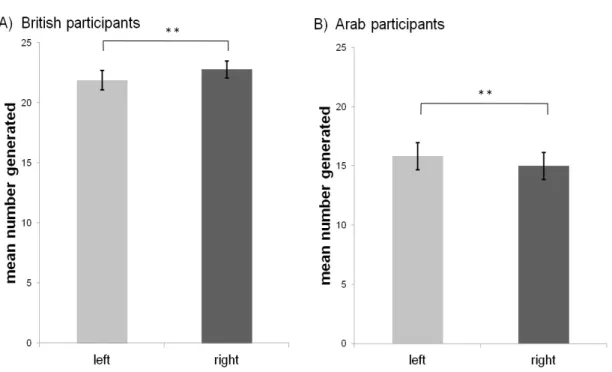
As predicted, the effect of body location on number generation differed significantly between British and Arab participants (F(1,244) = 11.14, p = 0.001, see Figure 1): while Arab
participants generated significantly lower numbers lying on their right (Mright = 15.0) than left
side (Mleft = 15.8, t = 2.83, df = 111, p = 0.006), this effect was reversed for British
participants (Mright = 22.8, Mleft = 21.9, t = -2.68, df = 135, p = 0.008). This effect was not
Figure 1. Mean number generated lying on the left versus right side by country (error bars are confidence intervals)
Parity judgment
Six participants had to be excluded because accuracy rates were not significantly different from chance for at least three numbers. We report data from the remaining 55 British adults (Mage = 20.13, SD = 2.26, 45 female) and 59 Arab adults (Mage = 24.29, SD = 3.44, 40 female).
Mean accuracy was high (M = 0.95, SD = 0.04). The mean RT after outlier correction (1.8% of correct trials) was 686 ms (SD = 223). We analyzed SNARC regression slopes for
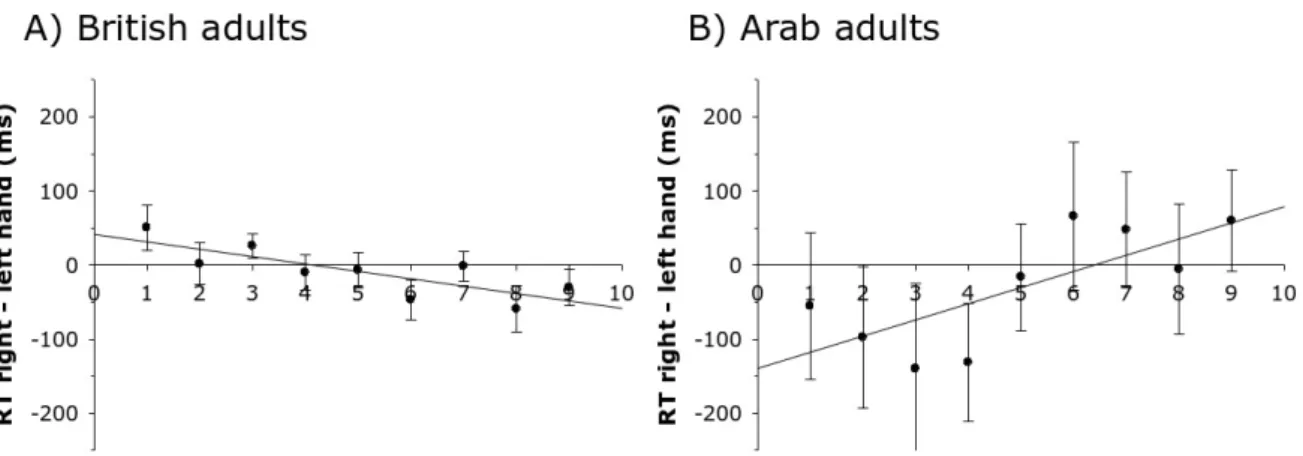
individual participants (for method see Fias et al., 1996). British adults showed a typical SNARC effect: they were significantly faster to respond to small numbers with the left and larger numbers with the right hand (b = -9.97, SD = 12.5, t = -5.91, df = 54, p < 0.001), while Arab adults showed the opposite association: they were significantly faster to respond to small numbers with their right and larger numbers with their left hand (b = 21.8, SD = 83.1, t
**
= 2.02, df = 58, p = 0.048). The SNARC slopes differed significantly between British and Arab adults (t = -2.90, df = 60.81, p = 0.005, see Figure 2).
Figure 2. The difference between RTs of right and left hand plotted against number
magnitude for (A) British and (B) Arab adults.
Arithmetic ability
British adults had significantly higher WRAT raw scores (range 35-55, M = 47.3, SD = 5.2) than British children (range 13-36, M = 26.6, SD = 5.2; t = 24.40, df = 125.23, p < 0.001). British adults also outperformed Arab adults (range 29-53, M = 41.0, SD = 6.7; t = -5.92, df = 104.75, p < 0.001) who outperformed British children (t = 13.80, df = 107.68, p < 0.001).
Relationship between tasks
Discussion
We found a significant effect of body position on the mean size of numbers generated. This effect was culture-dependent and determined by the culturally predominant reading direction. While Arab participants produced significantly smaller numbers when they were lying on their right side, British participants produced significantly larger numbers on their right side. Our findings replicate previous findings showing an influence of lateral head turns (Loetscher et al., 2008) and passive body movement on number generation (Hartmann et al., 2012) and suggest that passive spatial cues from the vestibular system are enough to shift attentional allocation in SNAs.
Our study goes beyond previous research by showing for the first time that the same spatially directional cues lead to the reverse effect on number generation in participants from a right-to-left reading culture. In addition, we demonstrate that the effect is already present in
children. Interestingly, the broad level of reading experience did not influence the strength of this effect: children did not show a weaker effect than adults. However, the children tested here already had several years of reading instruction. A more powerful test of reading experience would be to investigate the effect in beginning readers and preliterate children.
the magnitude of SNAs can be changed easily by contextual and strategic factors (Fischer,
Shaki, & Cruise, 2009; Bächtold, Baumüller, & Brugger, 1998).
Independent of body position, participants generated more numbers smaller than 25 than numbers larger than 25, i.e. they showed a small number bias (SNB, Loetscher & Brugger, 2007). Reading direction has been suggested as a possible cause of this SNB in Western participants (Loetscher et al., 2008) predicting a large number bias (LNB) in right-to-left reading cultures. In our study there was no evidence for an LNB in right-to-left reading participants. In contrast, the SNB was even stronger in Arab participants. However, this effect is probably driven by the association between overall number magnitude and performance on the mathematics test. Participants with higher mathematics test scores generated overall larger numbers. This result is in contrast to recent findings by Towse, Loetscher & Brugger (2014) who found an LNB in children and showed that a SNB emerges in children with increasing age. This difference between their and our results might be due to the number intervals used: Towse et al. (2014) used number intervals up to 1-9 while we used a much larger interval (1-50). We argue that for the larger number interval familiarity and expertise with numbers in the interval might be the driving factor while most children tested by Towse et al. (2014) will have been highly familiar with numbers 1 to 9.
Acknowledgements
References
Bächtold, D., Baumüller, M., & Brugger, P. (1998). Stimulus–response compatibility in representational space. Neuropsychologia, 36, 731–735.
Dehaene, S., Bossini, S., & Giraux, P. (1993). The mental representation of parity and number magnitude. Journal of Experimental Psychology: General, 122, 371-396.
Fias, W., Brysbaert, M., Geypens, F., & d'Ydewalle, G. (1996). The importance of magnitude
information in numerical processing: Evidence from the SNARC effect. Mathematical
Cognition, 2, 95-110.
Fischer, M. H., Shaki, S., & Cruise, A. (2009). It takes just one word to quash a SNARC.
Experimental Psychology, 56(5), 361-366.
Hartmann, M., Grabherr, L., & Mast, F. W. (2012). Moving along the mental number line: Interactions between whole-body motion and numerical cognition. Journal of Experimental Psychology: Human Perception and Performance, 38(6), 1416.
Loetscher, T., & Brugger, P. (2007). Exploring number space by random digit generation. Experimental Brain Research, 180(4), 655-665.
Loetscher, T., Schwarz, U., Schubiger, M., & Brugger, P. (2008). Head turns bias the brain's internal random generator. Current Biology, 18(2), R60-R62.
Rashidi-Ranjbar, N., Goudarzvand, M., Jahangiri, S., Brugger, P., & Loetscher, T. (2014). No horizontal numerical mapping in a culture with mixed-reading habits. Frontiers in Human Neuroscience 8, 72. doi: 10.3389/fnhum.2014.00072
Rugani, R., Vallortigara, G., Priftis, K. and Regolin, L. (2015). Number-space mapping in the newborn chick resembles humans’ mental number line. Science, 347, 534-536.
Shaki, S., & Fischer, M. H. (2014). Random walks on the mental number line. Experimental Brain Research, 232(1), 43-49.
Shaki, S., & Fischer, M. H. (2008). Reading space into numbers–a cross-linguistic comparison of the SNARC effect. Cognition, 108(2), 590-599.
Shaki, S., Fischer, M. H., & Göbel, S. M. (2012). Direction counts: A comparative study of spatially directional counting biases in cultures with different reading directions. Journal of Experimental Child Psychology, 112, 275–281. doi:
10.1016/j.jecp.2011.12.005
Shaki, S., Fischer, M. H., & Petrusic, W. M. (2009). Reading habits for both words and numbers contribute to the SNARC effect. Psychonomic Bulletin & Review 16, 328– 331.
Towse, J. N., Loetscher, T., & Brugger, P. (2014). Not all numbers are equal: preferences and biases among children and adults when generating random sequences. Frontiers in Psychology, 5.
Viarouge, A., Hubbard, E. M., & McCandliss, B. D. (2014). The Cognitive Mechanisms of the SNARC Effect: An Individual Differences Approach. PloS one, 9(4), e95756. Zorzi, M., Priftis, K., & Umiltà, C. (2002). Brain damage: neglect disrupts the mentalnumber