Article
1
Thermoplastic Elastomer based Phase Change
2
Materials with Enhanced Mechanical Property,
3
Thermal
Conductivity
and
Photo-thermal
4
Performance
5
Fuxian Wang1*, Xuelin Zou2, Yanfeng Chen 2, Jian Liu2*
6
1Guangdong Provincial Key Laboratory of Emergency Test for Dangerous Chemicals, Guangdong Institute of
7
Analysis, Guangzhou 510070, China; [email protected] (F.W.)
8
2Guangdong Provincial Key Laboratory of Distributed Energy Systems, School of Chemical Engineering and
9
Energy Technology, Dongguan University of Technology, Dongguan 523808, China;
10
[email protected](X.Z); [email protected](Y.C); [email protected](J.L)
11
* Correspondence: [email protected] (F.W.); [email protected]; Tel.: +86-0769-22861808
12
13
Abstract: Traditional phase change composites usually suffer poor mechanical property and easy
14
collapsing in the phase changing process. Herein, a highly flexible phase change composite is
15
fabricated using thermoplastic elastomer as the basic gel and the expanded graphite/paraffin as the
16
filler. This new phase change composite shows a tensile strength of 2.1 MPa and a breaking
17
elongation of 220%. It has a melting enthalpy of 145.4 J·g-1 and a thermal conductivity of 2.2
18
W·m-1·K-1 with 70% of expanded graphite/paraffin. The thermoplastic elastomer based phase
19
change composite exhibits great reversible property after 200 heating/cooling cycles. This flexible
20
phase change composite demonstrates good photo-thermal energy charging/discharging property
21
and shows great potential to be applied in the solar thermal energy systems.
22
Keywords: Solar thermal systems, phase change materials, thermoplastic elastomer, mechanical
23
property, photo-thermal performance
24
25
1. Introduction
26
Solar thermal energy (STE) is considered to be one of the most prospective renewable energy
27
source. Solar thermal technologyis by far the cheapest method for solar energy utilization[1]. It is
28
widely used in solar thermal water heater[2], solar evaporation[3], solar power generation[4] and
29
solar cooker[5]. Since solar energy is distributed, low thermal grade and intermittent, the large-scale
30
practical application of STE requires effective technology for its capture, conversion and storage.
31
One prospective approach is to use phase change materials (PCMs) with narrow melting
32
temperature and large enthalpy as both light absorber and heat transfer media[6] [7].
33
Using PCMs to directly absorb the solar energy could decrease the heat lost between the solar
34
energy and absorptive medias[9]. The PCMs with melting temperature above 70℃ have high
35
thermal grade of energy and large enthalpy[8], hence could be used to be a media to absorb solar
36
thermal energy and transfer to another media for heating systems. The photo-thermal charging
37
capacity of PCMs depends on the optical property, thermal storage capacity and thermal
38
conductivity. In addition, the PCMs need to have good mechanical property since the heat exchange
39
process is usually accompanied by pumping systems[10]. However, most of the PCMs suffer poor
40
optical property, low thermal conductivity and poor mechanical property. To address this, carbon
41
materials such as expanded graphite(EG)[11], graphene[12], carbon nanotubes[13], carbon forms[14]
42
were used to absorb the PCMs to form phase change composites. Among these porous materials, EG
43
could largely increase the thermal conductivity and optical property of the PCMs, the EG based
44
phase change composites showed high photo-thermal performance[15]. Nevertheless, the reported
45
EG based phase change composites are in the form of powders with poor mechanical property in the
46
phase changing process. The composites could easily collapse when heat transfer fluid flow past it.
47
To enhance the mechanical property of EG based PCMs, polymers are used as the basic gel to
48
encapsulate the powders with mixing method. Various polymers such as polyethylene[16],
49
Ethylene-Propylene-Diene mischpolymer[17], polymethyl methacrylate[18] and melamine resin[19]
50
were applied as the basic gel for encapsulating the EG based PCMs. The polymer based PCMs
51
demonstrated good mechanical property to resist the impact of heat transfer fluids. Nevertheless,
52
the aforementioned polymers are rigid materials with high stiffness whereas the PCMs have volume
53
expansion (~10%) in the solid-liquid process[20]. This results in unexpected leakage or shape
54
changing in the solid-liquid process. Therefore, developing flexible polymers is essential for
55
encapsulating EG based PCMs. Thermoplastic elastomer (TPE) is a kind of flexible, high elastic
56
polymer with large tensile strength and elongation, which is widely used as the basic gel for flexible
57
device [21,22].
58
In this work, we first adopt TPE gel to encapsulate the EG based PCMs to form a EG/PCM-TPEs
59
composite through a simple mixing method. The EG/PCM-TPEs composite EG/PCM-TPE have high
60
tensile strength and breaking elongation, large thermal storage capacity, high thermal conductivity,
61
and good reversible property. The EG/PCM-TPEs composite EG/PCM-TPE shows great
62
photo-thermal charging/discharging capacity and exhibits great potential for STE application.
63
2. Materials and Methods
64
2.1. Materials
65
Technical grade paraffin (OP70, Tm of ~65℃) was purchased from Shanghai Joule wax Co, Ltd,
66
PR. China. Expanded graphite (EG) was obtained from Qingdao Herita graphite product Co, Ltd.,
67
PR. China. The thermoplastic elastomer (TPE) was provided by The Dow Chemical Company. All
68
chemicals were used as received without further purification.
69
2.2. Preparation of EG/PCM-TPE
70
The EG was added to absorb the liquid OP70 with mass ratio of 1:9. Then, different mass
71
fraction of the obtained EG/OP70 composite was blended with a fixed ration of TPE gel by open
72
milling (XH-401, Dongguan Xihua Co., Ltd., PR. China), as shown in Table 1. The as-prepared
73
form-stable PCMs were made into sheets by a hot press (XH-406B, Dongguan Xihua Co., Ltd., PR.
74
China). For the leakage test, the samples were placed on a filter paper and kept in an oven with
75
temperature controlling from 40-100-40℃for 24 h. The weight of samples was measured to calculate
76
the leakage percentage of the samples.
77
Table 1. The mass fraction of as-prepared EG/PCM-TPE
78
Samples EG/OP70 (%) TPE (%)
S1 30 70
S2 40 60
S3 50 50
S4 60 40
S5 70 30
79
2.3. Characterizations of EG/PCM-TPE
80
The morphology and microstructure of EG/PCM-TPE were observed by a field emission
81
scanning electron microscopy (SEM SU8020, Hitachi, Tokyo, Japan). The structure of the
82
EG/PCM-TPE was characterized by XRD(D8, ADVANCE, Bruker, Karlsruhe, Germany). The XRD
83
pattern was scanned from 10–70° with an interval of 0.2°. The phase change temperature and latent
84
heat of the EG/PCM-TPE were measured using a differential scanning calorimeter (Q200, TA
85
Instruments, New Castle, Pennsylvania, USA). Specifically, 5~8 mg of each sample was sealed in an
86
aluminum pan. The heating rate was 10 °C·min−1 and the N2 flow rate was 50 mL·min−1. The
thermal conductivity of the EG/PCM-TPE was tested using a thermal constants analyzer (Hot Disk
88
TPS 2500 S, Hot Disk AB, Gothenburg, Sweden).
89
2.4. Photo-thermal performance management of EG/PCM-TPE
90
The photo-thermal performance of the EG/PCM-TPE was conducted with solar simulator. The
91
experimental devices contain solar simulator (Microsolar300, Perfectlight, Beijing, China), samples,
92
thermocouples and data acquisition systems (Agilent, 34970A, Agilent Technologies Inc, Santa
93
Clara, CA, USA). The EG/PCM-TPE were placed 10 cm under the solar simulator. The
94
thermocouples were used to record the temperature of the samples. When the light was turned on,
95
the composites underwent the heating storage process, followed by the heating release process when
96
the light was turned off. The irradiance of solar simulator was measured with an irradiatometer
97
(ST-80C, Photoelectric Instrument Factory of Beijing Normal University, Beijing, China).
98
3. Results and discussion
99
3.1. Mechanical property of EG/PCM-TPE
100
The tensile strength and elongation of EG/PCM-TPE were shown in Figure 1. As shown in
101
Figure 1a, the tensile strength of S1~S5 is 0.7, 0.9, 1.2, 1.6 and 2.1 MPa, which increases with the mass
102
ratio of the EG/OP70. While the elongation of S1~S5 is 220%, 170%, 75%, 27% and 11%, decreasing
103
with the mass ratio of EG/OP70. Increasing the mass ratio of EG/OP70 could largely improve the
104
tensile strength since the TPE is a flexible gel with low tensile strength and large elongation, the filler
105
in the samples has an advantage to avoid impact and shape change. As the mass ratio of EG/OP70
106
increases, the flexibility of samples decrease, since the EG/OP70 powders are irregular. The TPE gel
107
could not encapsulate the EG/OP70 powders completely when the mass ratio reached 70%.
108
0.0 0.4 0.8 1.2 1.6 2.0 2.4
0.0 0.5 1.0 1.5 2.0 2.5
Te
nsile st
re
ng
th
(MPa
)
Strain (mm/mm) 30% EG/OP70 40% EG/OP70 50% EG/OP70 60% EG/OP70 70% EG/OP70
30 40 50 60 70
0 50 100 150 200 250 300
Te
nsile st
ra
in a
t b
re
ak (
%)
Mass fraction of EG/OP70 (%)
(B) (A)
109
Figure 1. Tensile strength (A) and tensile strain at break (B) of the as-prepared EG/OP70-TPE.
110
The flexibility of the as-prepared EG/OP70-TPE is important for universal application in solar
111
thermal systems, thermal management systems and waste heat recovery systems. In addition, the
112
OP70 showed a large volume expansion in the melting/freezing process, using the polymer with
113
flexibility could prevent leakage of OP70 in the PCMs. Figure 2 shows that the samples exhibited
114
good flexibility, all samples could be stretched and folded without breakage at 70℃.
116
Figure 2. Flexibility test of the as-prepared EG/OP70-TPE.
117
3.2. Morphology and Structure of EG/PCM-TPE
118
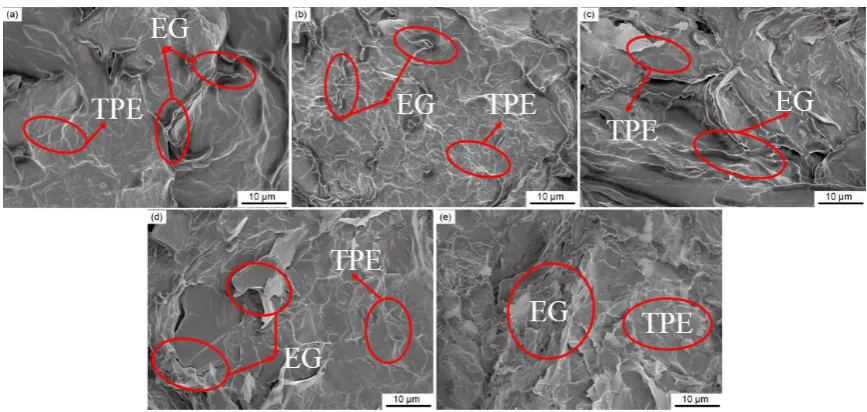
To verify the mechanical property of EG/PCM-TPE, the morphology was tested by SEM and the
119
images were shown in Figure 3. As described in the experimental section, the OP70 was absorbed in
120
the EG powders, and the EG/OP70 was encapsulated with the TPE gel. Figure 3 showed that the TPE
121
gel covered the EG/OP70 with smooth surface. The scaly EG was observed under the TPE gel. For
122
sample S1, most of the EG/OP70 powders were covered by TPE gel, and the surface was smooth.
123
When increasing the mass ratio of the EG/OP70, the surface became coarse. For sample S3, the scaly
124
EG could be seen obviously. While for sample S5, a lot of EG/OP70 powders was observed, implying
125
that the TPE gel could not completely encapsulate the EG/OP70. The morphology changes provided
126
further explanation of the positive correlation between the mechanical property of the S1-S5 and the
127
mass ratio of the TPE gel.
128
129
Figure 3. SEM images of the as-prepared samples 30%-EG/OP70- TPE (a), 40%-EG/OP70- TPE (b),
130
50%-EG/OP70- TPE (c), 60%-EG/OP70-TPE (d) and 70%-EG/OP70-TPE (e).
131
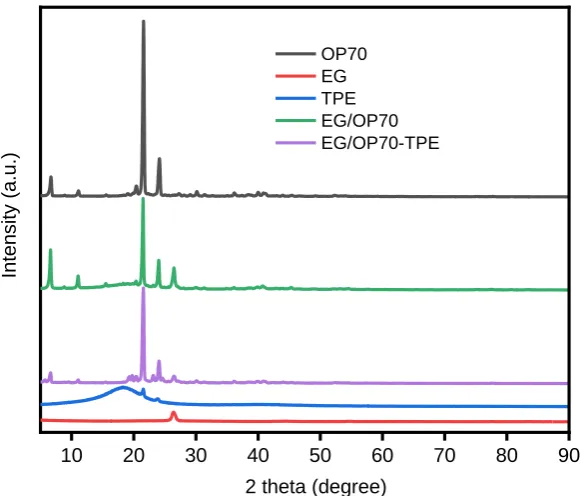
To further investigate the microstructure of EG/PCM-TPE, XRD was carried out and the
132
patterns of the samples were shown in Figure 4. The EG appeared only one peak at 26.5°, while the
133
TPE showed not obvious peak since it is an amorphous gel. For OP70, peaks appeared at 4.2°, 11.3°,
134
19.7°, 21.3° and 23.8°, which correspond to different lattice planes. For EG/OP70showed all peaks
135
of OP70 and EG appear and the intensity did not obviously decrease, because the EG powders with
136
macropores range from several micrometer to hundreds of micrometer did not affect the
137
crystallization of OP70. For EG/OP70/TPE, all peaks also appeared, while the intensity decreased
largely as compared to the OP70 and EG/OP70, which is due the coverage of the EG/OP70 by the
139
TPE gel. The XRD results demonstrated that the EG/PCM-TPE had a compact structure with
140
physical combination.
141
10 20 30 40 50 60 70 80 90
2 theta (degree)
Int
en
sity (a
.u.
)
OP70 EG TPE EG/OP70 EG/OP70-TPE
142
Figure 4. XRD patterns of the as-prepared EG/OP70-TPE.
143
3.3. Thermal property of EG/PCM-TPE
144
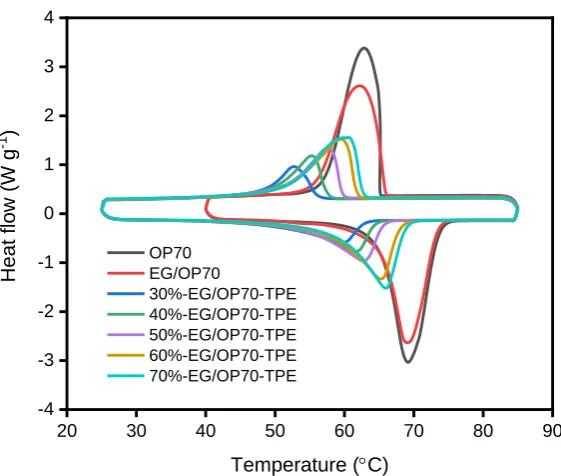
Figure 5 and Table 2 showed the melting and freezing property of EG/PCM-TPE. For OP70 and
145
EG/OP70, the melting temperature was 65.2 and 65.3℃and the melting enthalpy was 230.8 and 207.7
146
J·g-1. For S1~S5, the melting temperature was 50.4, 50.4, 53.8, 57.8 and 59.0℃and the melting
147
enthalpy was 62.3, 83.1, 103.5, 124.6 and 145.4 J·g-1, respectively. It can be clearly seen that the
148
melting temperature of EG/PCM-TPE was lower that of the OP70 and EG/OP70. This is because the
149
TPE is composed of alkanes with low melting temperature, these alkanes could be well coupled with
150
the OP70 to form a mixture with lower melting temperature. The melting enthalpy of EG/PCM-TPE
151
was also lower than that of the OP70 (equivalent mass), because the alkanes in the mixtures have
152
low melting enthalpy than OP70. Nevertheless, the melting enthalpy decreased less than 5%, sample
153
S5 showed the largest melting and freezing enthalpy and good mechanical property.
154
155
Table 2. Melting−freezing properties for OP70/EG/TPE with different addition of TPE
156
Samples Tm/ ºC △Hm/J g-1 Tf/ ºC △Hf/J g-1
OP70 65.2 230.8 65.9 230.5
EG/OP70 65.3 207.7 65.2 207.5
S1 50.4 62.3 56.0 61.9
S2 53.0 83.1 57.4 83.8
S3 53.8 103.5 59.6 102.4
S4 57.8 124.6 61.7 123.8
S5 59.0 145.4 62.5 144.6
20 30 40 50 60 70 80 90 -4
-3 -2 -1 0 1 2 3 4
Heat
flow
(W g
-1 )
Temperature (°C)
OP70 EG/OP70
30%-EG/OP70-TPE 40%-EG/OP70-TPE 50%-EG/OP70-TPE 60%-EG/OP70-TPE 70%-EG/OP70-TPE
159
Figure 5. DSC curves of the as-prepared EG/OP70-TPE.
160
The thermal conductivity of EG/PCM-TPE was also measured and the results were shown in
161
Figure 6. The thermal conductivity of EG/PCM-TPE increases from 0.6 to 2.2 W·m-1·K-1 as the mass
162
ratio of EG/OP70 increased from 30 to 70%. The thermal conductivity increased linearly with the
163
mass ratio of EG/OP70. The equivalent mass ratios of EG was 3~7% for S1~S5, adding small mass
164
fraction of EG could largely increase the thermal conductivity. The polymer based PCMs with large
165
thermal conductivity had great advantage of increasing the thermal energy charging/discharging
166
rate in thermal utilization systems. The polymers and paraffin usually poses thermal conductivity
167
lower than 0.2 W·m-1·K-1, therefore adding EG could largely improve the thermal conductivity.
168
30 40 50 60 70
0.6 0.8 1.0 1.2 1.4 1.6 1.8 2.0 2.2 2.4
The
rmal
co
nd
uc
tivi
ty
(W
m
-1 K -1 )
Mass fraction of OP70/EG (%)
169
Figure 6. Thermal conductivity of the as-prepared EG/OP70-TPE.
170
3.4. Reversible property of EG/PCM-TPE
171
To test the reversible property of EG/PCM-TPE, 200 heating/freezing cycles(30-90-30 ºC) of
172
sample S4 was carried out on the filter paper, after which the morphology and thermal property
173
were investigated. The filter paper did not impregnate the liquid paraffin and no weight loss of the
174
samples was observed, indicating that the samples have no leakage after heating/cooling cycles.
175
Figure 7a showed the SEM image of S4 after 200 heating/freezing cycles. Obviously, sample S4
showed almost the surface appearance before and after the heating/freezing cycles(Figure 3d),
177
indicating that there was no leakage in the heating/freezing process. To further verify the reversible
178
property, the melting/freezing property of S4 was measured by DSC. As shown in Figure 7b, the
179
results showed that the melting temperature and enthalpy were 57.6 ºC and 124.1 J·g-1, respectively
180
which were approximately the same to the values before the heating/freezing cycles. The
181
EG/PCM-TPE exhibited good reversible property for long term application in thermal systems.
182
183
Figure 7. SEM images, melting-freezing curves of sample S4 before and after 200 heating-cooling
184
cycles.
185
186
3.5. Photo-thermal performance of EG/PCM-TPE
187
The photo-thermal performance of EG/PCM-TPE was shown in Figure 8. In the photo-thermal
188
charging process, the temperature of EG/PCM-TPE increased from 30 to 65 ºC quickly, then trended
189
to a temperature stage, and further increased to 95℃. The sample S1 took the shortest time since it
190
contained only 30% of the EG/OP70, and sample S5 with 70% of EG/OP70 took the longest time to
191
increase from room temperature to 95℃. The photo-thermal charging property is dependent on the
192
optical absorptive property and thermal conductivity. The TPE and OP70 have poor optical
193
absorptive property, adding EG powders could largely improve the light absorption. Among these
194
samples, the equivalent mass fraction of EG was 3%, 4%, 5%, 6% and 7% for S1~S5, respectively. To
195
further evaluate the photo-thermal charging capacity of the EG/PCM-TPE, The thermal storage
196
capacity of EG/PCM-TPE was calculated by the following equations:
197
9530
=
+
T
T T
Q
m
Cp
H dT
(1)198
0
( )
= ( )
( ) 1
m m
m f
f m
f
T T
T T
T T T
T T
T T
(2)
199
Where QT is thermal storage capacity of EG/PCM-TPE, m is the mass of TPE based PCMs, Cp is the
200
heat capacity of PCMs, β is the liquid rate, ΔH is the enthalpy of PCMs, T is the temperature, Tm and
201
Tf is the melting and freezing temperature. The receiver efficiency of the EG/PCM-TPE was
202
calculated by Equation 3.
203
=
T100%
s
Q
G At
(3)
204
Where η is the receiver efficiency, Gs is the irradiance of solar radiation, A is the irradiation area, t is
205
the irradiation time. The receiver efficiency of all samples decreased with the temperature. The
206
receiver efficiency of S1 was 70% at room temperature, and decreased to 56% at 60 ℃,then stagnated
207
at 48% as the temperature increased to 90℃. For S5, the receiver efficiency decreased from 80% to
208
75.2% as the temperature ranged from room temperature to 60 ℃,then leveled at 72% at 90 ℃.
Sample S5 had larger mass fraction of EG and OP70 that could effectively absorb the solar radiation,
210
and hence showed much higher receiver efficiency than S1. The results indicate that the
211
EG/PCM-TPE has great photo-thermal performance, effective thermal storage capacity, and great
212
potential to be applied in solar thermal utilization.
213
214
Figure 8. Photo-thermal performance of as-prepared EG/OP70-TPE(a) and receiver efficiency of
215
as-prepared EG/OP70-TPE(b).
216
4. Conclusions
217
In this work, a flexible polymer based PCMs were synthesized with TPE as the basic gel and
218
EG/OP70 as the filler. The EG/PCM-TPE shows tensile strength of 1.6 MPa and elongation of 27%
219
with 60% of EG/OP70. The obtained EG/PCM-TPE are highly flexible and could be folded without
220
breakage. The SEM images showed that the TPE gel could completely encapsulate the EG/OP70
221
powders with continuous smooth surface. The TPE based PCMs with 70% of EG/OP70 has thermal
222
conductivity of 2.2 W·m-1·K-1, melting enthalpy of 145.4 J·g-1. In addition, The TPE based PCMs with
223
70% of EG/OP70 demonstrated great photo-thermal performance and reached a receiver efficiency
224
of 72% at 90℃. The flexible EG/PCM-TPE showed great potential in solar thermal utilization.
225
Author Contributions: W.F. and J.L. conceived the idea. W.F. performed the samples preparation,
226
characterization and measurement of PCMs and wrote the manuscript. X.Z. and Y.C. finished a part of
227
characterization and measurement of PCMs. F.W., X.Z., Y.C. and J.L. discussed and analyzed the results. J.L.
228
revised the manuscript. J.L. supervised the whole research work. All authors read and approved the final
229
version of the manuscript.
230
Funding: This work was supported by Research Start-up Funds of Dongguan University of Technology
231
(GC300502-40).
232
Conflicts of Interest: The authors declare no conflict of interest.
233
References
234
1. Lewis, N.S.; Nocera, D.G. Powering the planet: Chemical challenges in solar energy utilization.
235
Proceedings of the National Academy of Sciences of the United States of America 2006, 103, 15729-15735.
236
2. Dubey, S.; Tiwari, G.N. Thermal modeling of a combined system of photovoltaic thermal (pv/t) solar
237
water heater. Solar Energy 2008, 82, 602-612.
238
3. Tao, P.; Ni, G.; Song, C.; Shang, W.; Wu, J.; Zhu, J.; Chen, G.; Deng, T. Solar-driven interfacial
239
evaporation. Nature energy 2018, 1.
240
4. Omer, S.A.; Infield, D.G. Design optimization of thermoelectric devices for solar power generation. Solar
241
Energy Materials & Solar Cells 1998, 53, 67-82.
242
5. Sharma, S.D.; Iwata, T.; Kitano, H.; Sagara, K. Thermal performance of a solar cooker based on an
243
evacuated tube solar collector with a pcm storage unit. Solar Energy 2005, 78, 416-426.
244
6. Kenisarin, M.; Mahkamov, K. Solar energy storage using phase change materials ☆. Renewable &
245
Sustainable Energy Reviews 2007, 11, 1913-1965.
7. Choon, H.D.; Levinson, N.S.; Unyong, J.; Younan, X. Emerging applications of phase-change materials
247
(pcms): Teaching an old dog new tricks. Angewandte Chemie International Edition 2014, 53, 3780-3795.
248
8. Koca, A.; Oztop, H.F.; Koyun, T.; Varol, Y. Energy and exergy analysis of a latent heat storage system
249
with phase change material for a solar collector. Renewable Energy 2008, 33, 567-574.
250
9. Yin, H.; Cao, S.; Liu, J. Enhanced optical absorptive property and effective thermal storage capacity
251
charging rate of phase change material based photo-thermal cells. Solar Energy Materials and Solar Cells
252
2019, 194, 252-258.
253
10. Agyenim, F.; Hewitt, N.; Eames, P.; Smyth, M. A review of materials, heat transfer and phase change
254
problem formulation for latent heat thermal energy storage systems (lhtess). Renewable & Sustainable
255
Energy Reviews 2010, 14, 615-628.
256
11. Fang, X.; Zhang, Z.; Chen, Z. Study on preparation of montmorillonite-based composite phase change
257
materials and their applications in thermal storage building materials. Energy Conversion and
258
Management 2008, 49, 718-723.
259
12. Li, G.; Hong, G.; Dong, D.; Song, W.; Zhang, X. Multiresponsive graphene-aerogel-directed phase-change
260
smart fibers. Advanced Materials 2018, e1801754.
261
13. Chen, Y.; Zhang, Q.; Wen, X.; Yin, H.; Liu, J. A novel cnt encapsulated phase change material with
262
enhanced thermal conductivity and photo-thermal conversion performance. Solar Energy Materials and
263
Solar Cells 2018, 184, 82-90.
264
14. Zhang, Q.; Liu, J. Sebacic acid/cnt sponge phase change material with excellent thermal conductivity and
265
photo-thermal performance. Solar Energy Materials & Solar Cells 2017.
266
15. Qi, Z.; Wang, H.; Ling, Z.; Fang, X.; Zhang, Z. Rt100/expand graphite composite phase change material
267
with excellent structure stability, photo-thermal performance and good thermal reliability. Solar Energy
268
Materials & Solar Cells 2015, 140, 158-166.
269
16. Li, J.; Ping, X.; Ding, W.; Han, J.; Sun, G. Micro-encapsulated paraffin/high-density polyethylene/wood
270
flour composite as form-stable phase change material for thermal energy storage. Solar Energy Materials
271
& Solar Cells 2009, 93, 1761-1767.
272
17. Chen, Y.; Wu, X.; Situ, Y.; Liu, J.; Huang, H. Ethylene-propylene terpolymer-modified polyethylene-based
273
phase change material with enhanced mechanical and thermal properties for building application.
274
Industrial & Engineering Chemistry Research 2019, 58, 179-186.
275
18. Wang, L.; Meng, D. Fatty acid eutectic/polymethyl methacrylate composite as form-stable phase change
276
material for thermal energy storage. Applied Energy 2010, 87, 2660-2665.
277
19. Chen, Z.H.; Wang, J.; Fei, Y.; Zhang, Z.G.; Gao, X. Preparation and properties of graphene oxide-modified
278
poly(melamine-formaldehyde) microcapsules containing phase change materials n-dodecanol for thermal
279
energy storage. Journal of Materials Chemistry A 2015, 3, 11624-11630.
280
20. McGann, M.R.; Lacks, D.J. Chain length effects on the thermodynamic properties of n-alkane crystals.
281
Journal of Physical Chemistry B 1999, 103, 2796-2802.
282
21. Hilmar, K.; Gary, P.; Pearce, N.A.; Vaia, R.A. Remotely actuated polymer
283
nanocomposites--stress-recovery of carbon-nanotube-filled thermoplastic elastomers. Nature Materials
284
2004, 3, 115.
285
22. Miedzianowska, J.; Masłowski, M.; Strzelec, K. Thermoplastic elastomer biocomposites filled with cereal
286
straw fibers obtained with different processing methods—preparation and properties. Polymers 2019, 11.