Electronic Theses and Dissertations Theses, Dissertations, and Major Papers
2009
Object Segmentation Using Active Contours: A Level Set
Object Segmentation Using Active Contours: A Level Set
Approach
Approach
Farnaz Shariat
University of Windsor
Follow this and additional works at: https://scholar.uwindsor.ca/etd
Recommended Citation Recommended Citation
Shariat, Farnaz, "Object Segmentation Using Active Contours: A Level Set Approach" (2009). Electronic Theses and Dissertations. 336.
https://scholar.uwindsor.ca/etd/336
This online database contains the full-text of PhD dissertations and Masters’ theses of University of Windsor students from 1954 forward. These documents are made available for personal study and research purposes only, in accordance with the Canadian Copyright Act and the Creative Commons license—CC BY-NC-ND (Attribution, Non-Commercial, No Derivative Works). Under this license, works must always be attributed to the copyright holder (original author), cannot be used for any commercial purposes, and may not be altered. Any other use would require the permission of the copyright holder. Students may inquire about withdrawing their dissertation and/or thesis from this database. For additional inquiries, please contact the repository administrator via email
By
Farnaz Shariat
A Thesis
Submitted to the Faculty of Graduate Studies
through the School of Computer Science
in Partial Fulfilment of the Requirements for
the Degree of Master of Science at the
University of Windsor
Object Segmentation Using Active
Contours:
A Level Set Approach
Windsor, Ontario, Canada
2009
Object Segmentation Using Active Contours: A Level Set
Approach
By:
Farnaz Shariat
APPROVED BY:
______________________________________________ Dr. Yung Tsin, Internal Reader
School of Computer science
______________________________________________ Dr. Jonathan Wu, External Reader
Electrical Engineering Department
_____________________________________________ Dr. Boubakeur Boufama, Advisor
School of Computer science
_____________________________________________ Dr. Imran Ahmad Chair of Defense
School of Computer science
Author’s Declaration of Originality
This thesis includes one original paper that has been previously published
for publication in peer reviewed journals, as follows:
I certify that I have the copyright of the paper so that I can include
the above published material(s) in my thesis. I certify that the above
material describes work completed during my registration as graduate
student at the University of Windsor.
I declare that, to the best of my knowledge, my thesis does not
infringe upon anyone’s copyright nor violate any proprietary rights and
that any ideas, techniques, quotations, or any other material from the
work of other people included in my thesis, published or otherwise, are
fully acknowledged in accordance with the standard referencing
practices. Furthermore, to the extent that I have included copyrighted
material that surpasses the bounds of fair dealing within the meaning of
the Canada Copyright Act, I certify that I have obtained a written
permission from the copyright owner(s) to include such material(s) in my
thesis.
I declare that this is a true copy of my thesis, including any final
revisions, as approved by my thesis committee and the Graduate Studies
office, and that this thesis has not been submitted for a higher degree to
any other University or Institution.
Thesis Chapter Publication title/full citation Publication status*
Chapter4 R. Ksantini, F. Shariat, B. Boufama, “An
Efficient and Fast Active Contour Model for
Salient Object Detection”, Canadian Conference
on Computer and Robot Vision (CRV 2009), June
2009
Abstract
Image segmentation is responsible for partitioning an image into
sub-regions based on a preferred feature. Active contour models have widely
been used for image segmentation. The use of level set theory has
enriched the implementation of active contours with more flexibility and
simplicity. The past models of active contours rely on a gradient based
stopping function to stop the curve evolution. However, when using
gradient information for noisy and textured images, the evolving curve
may pass through, or stop far from the salient object boundaries.
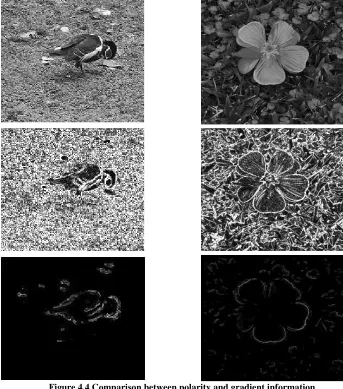
Therefore, we propose using a polarity based stopping function.
Comparing to the gradient information, the polarity information
accurately distinguishes the boundaries or edges of the salient objects
more precisely. Hence, with combining the polarity information with the
active contour model, we obtain a fast and efficient active contour model
for salient object detection. Experiments are performed on several images
to show the advantage of the polarity based active contour.
Keywords: Computer vision, image segmentation, active contours, level
Acknowledgements
First I would like to thank Dr. Boubakeur Boufama, my advisor and
thesis supervisor. A special acknowledgement goes to Dr. Riadh Ksantini
for his guidance and assistance as co-supervisor. I would also like to
thank Dr. Tsin, Dr. Wu and Dr. Ahmad for serving on my committee.
Lastly, and most importantly, I wish to thank my parents. They bore
me, raised me, supported me, taught me, and loved me. To them, I
Table of Contents
AUTHOR’S DECLARATION OF ORIGINALITY ...iii
ABSTRACT ... iv
ACKNOWLEDGEMENT ... v
1 INTRODUCTION ... 1
1.1 Overview of computer vision ... 1
1.2 Definition of computer vision ... 2
1.3 Motivations of the thesis ... 2
1.4 Overview of the thesis ... 4
2 IMAGE SEGMENTATION ... 6
2.1 Definition ... 7
2.2 What is a good segmentation? ... 7
2.3 Classification of algorithms ... 8
2.3.1 Thresholding ... 9
2.3.2 Edge-based segmentation ... 12
2.3.4 Hybrid methods ... 19
2.4 Summary ... 21
3 ACTIVE CONTOURS ... 22
3.1 Snakes ... 22
3.2 Level set methods ... 27
3.2.1 Level set concept ... 27
3.2.2 Level set dictionary and technology ... 29
3.2.3 Numerics ... 31
3.2.4 Level set in segmentation ... 31
3.3 Summary ... 37
4 AN IMPROVED TEXTURE-RESISTANT ACTIVE CONTOUR MODEL ... 39
4.1 Polarity definition ... 40
4.2 Method description ... 43
4.3 Summary ... 46
5.1 Comparison results ... 48
5.2 Summary ... 60
6 CONCLUSION ... 61
REFERENCES ... 63
List of Figures
Figure 1.1 objects on a uniform background ... 3
Figure 1.2 Object on a noisy background ... 3
Figure 1.3 Object on a textured background ... 4
Figure 2.1 Different ways to segment an image ... 8
Figure 3.1 Active contour’s movement ... 23
Figure 3.2 The construction of level set function ... 28
Figure 3.3 showing all the cases for the Chan & Vese method. ... 34
Figure 4.1 Active contour result using Li’s algorithm (clear Background) ... 39
Figure 4.2 Active contour result using Li’s algorithm (not clear background) .. 40
Figure 4.3 Different values of polarity ... 41
Figure 4.4 Comparison between polarity and gradient information ... 42
Figure 5.1 Comparison Results set no.1 ... 49
Figure 5.2 Comparison Results set no.2 ... 50
Figure 5.3 Comparison Results set no.3 ... 51
Figure 5.4 Comparison Results set no.4 ... 52
Figure 5.5 Comparison Results set no.5 ... 52
Figure 5.6 Comparison Results set no.6 ... 53
Figure 5.7 Comparison Results set no.7 ... 53
Figure 5.8 Comparison Results set no.8 ... 54
Figure 5.10 Comparison Results set no.10 ... 54
Figure 5.11 Comparison Results set no.11 ... 55
Figure 5.12 Comparison Results set no.12 ... 55
Figure 5.13 Comparison Results set no.13 ... 56
Figure 5.14 Comparison Results set no.14 ... 56
Figure 5.15 Comparison Results set no.15 ... 56
Figure 5.16 Comparison Results set no.16 ... 57
Figure 5.17 Comparison Results set no.17 ... 57
Figure 5.18 Comparison Results set no.18 ... 58
Figure 5.19 Comparison Results set no.19 ... 58
Figure 5.20 Comparison Results set no.20 ... 58
Figure 5.21 Comparison Results set no.21 ... 59
1
Introduction
1.1
Overview of computer vision
Computer vision, as a relatively new discipline, has the goal to enable
computers to “see”. The focused study of computer vision started in 1970
and it is still being investigated today. Computer vision is regarded as one
of the branches of artificial intelligence. Artificial intelligence intends to
simulate human behaviour in such a way that computer systems become
capable of performing functions that normally require human intelligence
e.g. reasoning, problem solving and learning from experience. Artificial
intelligence researches combine the elements of computer science and
cognitive psychology. Because of the difficulty of cognitive psychology
and human intelligence, most of the times computation stream is an
alternative which makes the machine to look intelligent. In computer
vision the aim is developing artificial vision systems that simulate human
vision.
Computer vision is a multidisciplinary research field and has been
overlapping with other fields such as computer graphics, image
processing, pattern recognition, and photogrammetry. These fields have
significant techniques and applications in common, while more briefly
computer graphics deals with creating images, image processing concerns
low level processing, pattern recognition extracts information from
signals mainly based on statistical approaches and photogrammetry is
obtaining highly accurate measurement using photographic images.
A growing number of applications exist for computer vision. One
prominent usage is in medical image analysis where data is in the form of
examples are detecting malign changes in samples or measuring the organ
dimensions. Military fields have been vastly improved by computer
vision advances. Missile guidance and autonomous vehicles are two
instances for this application. Also, computer vision is highly used in
industry for supporting a manufacturing process. An example could be
automatic quality control. Some of the other applications of computer
vision are robotic, surveillance and security, image data bases, virtual
reality, view synthesis and so on.
1.2
Definition of computer vision
Forsyth [Forsyth, 2003] described computer vision term as “Extracting
descriptions of the world from pictures or sequences of pictures”.
More detailed, computer vision can be defined as the study of
enabling the computers to acquire visual information, interpret this
information and act in response to this information. Computer vision
studies first deal with what kind of information is appropriate for the
system and should be captured from the input data i.e. from images.
Second, should find out how to extract this information. Next, come
across what is the most proper way to represent this information. At last
decide how to use this information in a system to perform its task
[Faugeras, 1993].
1.3
Motivations of the thesis
Segmentation is one of the sub domains of computer vision which has
been the subject of numerous researches. In object segmentation the main
purpose is to distinguish between the objects of interest and the rest of the
image. Most of the existing methods do this task while the object is
of techniques, as well as active contours assume that background has
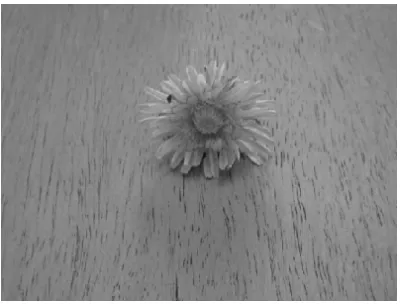
uniform intensity. Figure 1.1 shows an example of an object on a uniform
background.
Figure 1.1 object on a uniform background
Since the gradient in background of figure 1.1 is almost zero so the
contours are attracted to the edges of the flower without any problem.
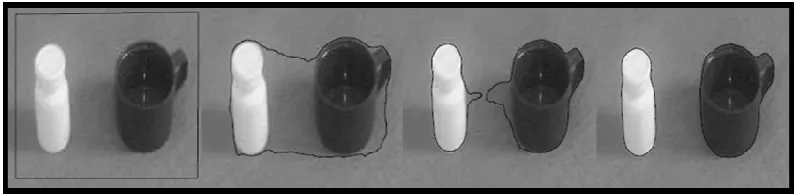
One main problem in this field is the presence of noise and texture
outside the object. This means that, if the background is not clear enough,
the problem of object segmentation becomes more difficult. As we can
see in figure 1.2, the background has noise. The contour will be deviated
since it there are high gradient values in some regions other than the
objects borders.
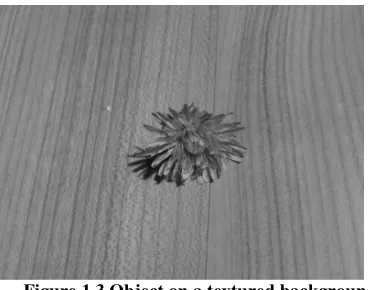
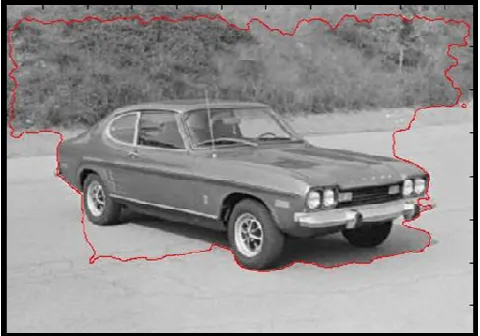
Figure 1.3 shows an example on a textured background. Same
problem may occur here. The active contour stops in the textured area
before reaching the salient object.
Figure 1.3 Object on a textured background
This thesis proposes a new technique, based on active contours, that
can detect objects' boundaries even when the background has noise
and/or texture. The proposed active contour model is aimed at providing
robust segmentation results for complicated cases with non-uniform
backgrounds. They are also applicable to any image segmentation
problem with clear and uniform background.
1.4
Overview of the thesis
The structure of the thesis is as follows: first image segmentation in
literature is studied. Different types of segmentation methods are
categorized in four groups: thresholding techniques, edge-based
techniques, region-based techniques and hybrid ones. In each group main
contributions are introduced and explained. The Third chapter discusses
active contours which are curves that deform and
move toward the objects' boundaries. In the context of active contours,
snakes and level set methods are studied. Chapter four represents our new
contains the experiments that show the robustness of the thesis proposed
2
Image segmentation
Objects need to be separated from the rest of the image. This is the first
step in image analysis which is the task of “image segmentation”. Image
segmentation is a long standing problem in computer vision.
Segmentation means organizing image content into semantically related
groups which are connected and homogenous. Some of the practical
applications of image segmentation are:
• Medical Imaging
o Locate tumors and other pathologies
o Measure tissue volumes
o Computer-guided surgery
o Diagnosis
o Treatment planning
o Study of anatomical structure
• Locate objects in satellite images (roads, forests, etc.)
• Face recognition
• Fingerprint recognition
• Traffic control systems
• Brake light detection
The result of image segmentation- the description of these objects-
will be used later in object representation and in feature measurement
process.
In this chapter after a brief description of image segmentation and
investigating “good” segmentation, classification of image segmentation
is studied. This classification is grouped in four main categories:
2.1
Definition
Formal definition for segmentation is [Horowitz, 1976]:
Segmentation of a grid X into X1,X2,...Xn subsets must satisfy the
following conditions, where P(Ri) is a uniformity predicate for all
elements in set R:
• Uni=1 Xi = X
• For i and j, if i≠ j, Xi ∩Xj =Ø
• P(Xi) = TRUE for all i
• P(Xi ∪Xj)= FALSE if i≠ j
The first condition implies that the collection of all the segments will
make the whole image. The second condition shows that two different
segments should not overlap. The third condition points out that the
pixels in one segment have the same properties all over the segment, and
the last condition presents that two different segments have dissimilar
properties.
Segmentation methods may use this definition or a variation of this.
However, there are cases that all these definitions are not enforced in the
algorithms.
2.2
What is a good segmentation?
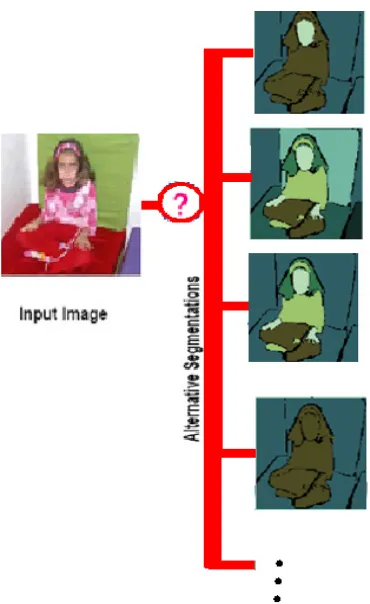
There are exponentially many possibilities to partition an image (figure
2.1). There is no single answer to the question: “What is a good
segmentation?”. It depends on what application we want to use
Figure 2.1 Different ways to segment an image
2.3
Classification of algorithms
By introducing the first edge detector, the image was officially
decomposed into its components. This could be considered as the first
image segmentation technique. The first edge detector, Roberts [Roberts,
1963], worked based on applying a 2×2 filter in sequence. The input for
this operator was a gray scale image and in the output each pixel was
showing estimated magnitude of the gradient. Although this detector is
fast but it is very sensitive to noise. A great number of methods have
emerged in segmentation since 1963, and still this topic is considered as a
challenging research topic.
There are many developed algorithms and there is more than one
classification of these algorithms. Image segmentation methods can be
use the traditional classification which classifies the image segmentation
methods into four categories: thresholding methods, edge-based
methods, region-based methods and hybrid methods that integrate-edge
and region-based ones.
2.3.1Thresholding
Among all the techniques in image segmentation, thresholding is
conceptually the simplest approach that we can take to separate the
objects from the background. Thresholding convert an image into a
binary image based on a threshold value ‘T’. Pixels are going to be
marked as object pixels if their intensity is greater than ‘T’. Otherwise, if
their intensity is less than ‘T’, they will be set as background.
Thresholding works well when objects and background have dissimilar
intensity distributions.
The goal in thresholding algorithms is to find an ideal threshold value
for getting the best segmented image. Thresholds can be adjusted either
manually or automatically. In manual threshold selection, a person should
give comments whether the threshold value is correct enough or not. This
process is time-consuming and objective. Errors may happen in selection
of ‘T’ and later more problems are produced in image analysis. For this
reason, a great number of methods have been introduced to automate the
thresholding process like [Melgani, 2006] [Sezgin, 2004] [Sauvola,
2000]. We are going to review some of the automatic methods in
followings.
One of the simplest thresholding methods is to find peaks and valleys
in histogram and set the threshold according to them. This approach is
robust because peaks can be easily found since their shape is well
and maximum are detectable. To avoid false peaks and valleys, the
histogram usually is smoothed. One algorithm based on peaks detection is
[Sezan, 1985] which at first finds zero-crossings and later uses a peak
detection signal to estimate significant peaks. One advantage of this
method is that we can adjust how fine the peaks are going to be. In
[Boukharouba, 1985] a variation of this method is used where the
cumulative distribution function of the image is first extended; pursued
by the curvature examination. More related methods can be found in
[Tsai, 1995] [Carlotto, 1987] [Olivo, 1994].
Rosenfeld [Rosenfeld, 1983] finds the optimal threshold through an
analysis of the convex deficiency which is calculating from deducting the
histogram from its convex hull. Some other modifications of this idea are
[Whatmough, 1991] [Sahasrabudhe, 1992].
One famous thresholding algorithm is Otsu’s [Otsu, 1979] method. In
this automatic unsupervised thresholding algorithm, distribution of pixels
value is analyzed. The basic idea here is that the pixels in each class
(cluster) should be as similar as possible. This means that the variance
inside each class should be minimized. Otsu defined the within-class
variance as the weighted sum of the variances of each cluster. Because
calculating within-class variance is expensive, we can use between-class
variance in computation instead. Minimizing within-class variance is
equivalent with maximizing between-class variance. Otsu’s method is
most widely employed in literature and its result is robust and
satisfactory. Many papers use Otsu’s method with slight modifications.
Two-Stage Multi-threshold Otsu method is introduced in [Huang, 2009]
developed to overcome the inefficiency of original Otsu by reducing the
iterations so that, the computation time will be much more less. In [Wu,
feasible and faster also, resulted better segments in image. More
applications can be found in [Wang, 2007] [Ali, 2004] [Junwei, 2007].
The Iterative Self -Organizing Data Analysis Technique (ISODATA)
[Ridler, 1978] was developed by Ridler and Calvard. Like Otsu, they use
the means of foreground and background but here search for the optimum
is locally, unlike in Otsu which is global. The algorithm starts by an
initial threshold which is equal to the half of the maximum gray level.
Binary image is generated based on this threshold. The mean value then
is computed for the current background and foreground. The new
threshold is then replaced with the average of the calculated means. This
process is repeated until the threshold reaches convergence. This method
is quite popular and does not need initial training for segmentation
process. However, convergence in short period of time sometimes is
inaccessible. DYNO (Dynamic Optimal Cluster seeking) algorithm [Tou,
1979] is a modification of ISODATA, with the ability of split and merge.
In [Jiang, 2008], they employ ISODATA technique for building
extraction in remote sensing. In medical image processing [Ding, 2004]
Self-Organizing Data Analysis Technique Algorithm was applied to
detect tissue damage in MRI images.
Niblack [Niblack, 1986] introduced a local thresholding algorithm
which moves a window across the image and calculates the local mean
and local deviation for the canter of window each time. He achieved the
threshold value by developing a function of the mean and the standard
deviation of the neighbourhood. Trier and Jain [Trier, 1995] tested
Niblack’s method and proved that it has best results comparing to any
other local thresholding methods. In [Sauvola, 2000], a heuristic variation
of Niblcack’s formula is used in which the standard deviation is
window size. The size of the window should be set so that it saves the
local details and suppresses noises. In [Zhao, 2008] Niblack’s method is
used in video text processing.
Some algorithms for thresholding are based on information theoretic
approach which was introduced by [Pun, 1980]. The entropy-based
techniques have proven to be successful and convincingly robust [Kapur,
1985] [Chang, 1994] [Luthon, 2004]. These techniques rely on
maximising the total entropy of both the object and background regions
to discover the suitable threshold. Some of these methods also use the
pixels' spatial information. More examples are in [Chang, 2006] [Sezgin,
2004].
Although Gray level thresholding is the simple, easy to grasp and fast,
but threshold selection is not always straightforward. The major
drawback of threshold-based approaches is that they often fail to find the
best separation between true positive signals and false positive signals
(noise), e.g. if the threshold is kept too low, a lot of true positive signals
maybe are not detected. Another alternative way to segment the image is
edge-based segmentation.
2.3.2Edge-based segmentation
Edge-based segmentation approaches relies on the edges found in images.
These edges represent the location of the discontinuities in gray level,
colour, texture, etc. Edge-based methods are based on the information
previously achieved by the edges in the image.
A variety of edge detector operators, which usually are named after
their inventors, exist in literature. The most famous ones are Prewitt
[Prewitt, 1970], Sobel [Sobel, 1978], Laplacian [Pratt, 1991], Canny
always showing the objects boundaries, the images which are resulted
from edge detection could not be an appropriate segmentation result by
itself. Therefore, edge detection is regarded as a prepossessing step. The
goal is to connect the relevant edges in such a way that the object
boundaries are produced.
There exist many methods which use different approaches to locate
the objects borders. These methods also use different quantity of former
information. The more former information is available, the better the
segmentation results will be. Otherwise, if there is not enough
information about boundaries, methods should employ more local
information about the image.
Sometimes some small edges appear in images, because of noise or
illumination changes. One group of methods try to use threshold to
eliminate these edges. The original idea is from Kundu and Mitra
[Kundu, 1987]. Finding a global threshold that works all over the image
is not achievable. Edges are usually thick as well. For the solution,
non-maximum suppression and hysteresis thresholding can be used as it was
introduced by the Canny [Canny, 1983] edge detector. Non-maximum
process checks if each pixel is local maximum along gradient direction.
Then suppress the points which are not local maximum. Hysteresis
checks if that maximum value of gradient value is large enough. If the
gradient of a pixel is above the high threshold, it will be declared as edge
pixel. Otherwise, if the gradient of a pixel is less than the low threshold, it
would be non –edge pixel. Any value between these two ranges is going
to be edge pixel if it is connected to any edge pixel. These papers use the
same ideas in image segmentation [Liu, 2000] [Tefera, 2002].
Using thresholds in finding edges usually ends in noisy results, and
considers the edges properties’ in the context of both ends of edges. Local
edge strength is raised if there are adequate evidences that borders may
exist. Studying the context hear, means investing the local neighbourhood
of the edge. Weak edges, which are located between two strong edges,
are considered as a boundary. An isolated edge, even strong one, without
a supporting context will not be considered as border. Hanson et al.
[Hanson, 1978] introduced a conventional edge context assessment. Later
Prager [Prager, 1980] modified his algorithm. According to Prager’s
method, three groups of edge patterns exist, which cause the confidence
in an edge to be modified: patterns in which the confidence of edge
would be increased, decreased or remain unchanged. The initial
confidence of an edge will be set as the normalized gradient value. Then,
“edge type” would be recognized based on the confidence of edge
neighbours. At last, the confidence of the edge will be modified based on
previous confidence and its type. This process will be repeated until the
confidence value converges to either 0 or 1. This method is comparatively
simple and noise robust. However, it often slowly flows and after larger
numbers of iterations, giving worse results than expected. In [Sher, 1992]
another approach, which is using probabilistic distribution of edge
neighbourhood, is presented. More recent applications of edge relaxation
can be found in [Czuni, 2001] [Moro, 2008].
Another edge-based technique is called boundary tracing. This
technique is performable after the image is over segmented; means that
the background and the foreground are already separated. Tracing inner
and outer boundary is part of this algorithm. Inner region border is part of
the region but outer border is not. This definition indicates that two
adjacent regions do not have a common border. To overcome this
hybrid technique. Extended borders utilize inner borders for the upper
and left sides of the object and outer borders for the lower and right sides.
Extended borders specify a common border between adjacent regions. A
more advanced method for extended boundary tracing was developed in
[Liow, 1991].
One way to connect edge segments is to trace from pixel to pixel
through potential edge points. Decision for every edge pixel is based on
the neighbour pixel gradient value and gradient orientation. Local edge
linking methods usually start at some arbitrary edge point and then
observe the points in neighbourhood. Edge linking is regularly followed
by post processing. Farag [Farag, 1991] detected the contours in two
stages: edge enhancement followed by edge linking. In [Gao, 1999] for
object extraction a low-complexity edge-linking algorithm in colour
images is designed. For finding global edges Hough transform, [Hough,
1962], named after Paul Hough, is a good option that decides which
tokens belong to which objects. Here the input for Hough transform is a
set of ‘n’ edge points, which are found formerly by an edge detector, and
the output is all the lines which these edge points are placed on. Instead
of x-y plane, each line is represented in a-b plane which is the slope and
the intercept of lines. All points, that lie on a line ‘S’ in x-y plane, have
lines in parameter space that intersect at the ‘a1’, ‘slope’, and ‘b1’,
Intercept of the line S. Later Duda et al. [Duda 1972] showed a more
efficient method by using polar parameterization. Generalized Hough
transform introduced in [Merlin, 1975] to find arbitrary shapes with
known orientation and scale. Generalized Hough transform with arbitrary
orientation and scale developed in [Ballard, 1981]. Hough transform has
imperfections including lack of accuracy and misleading results when
1993] tries to find a solution to solve the mentioned problems. Mapping
form image space to parameter space is replaced with converging
mapping to improve time complexity and accuracy. Some Applications to
the randomized Hough transform are in [Behrens, 2003] [Ding, 2005]
[Jean, 2004] [Xu, 2007].
Although edge-based methods produce clean and well defined
boundaries between different regions, they are likely to produce gaps
between boundaries. The necessity of complicated post-processing is
considered as one of the problems in this area. Another approach in
segmentation is region-based segmentation that comes in follow.
2.3.3Region-based segmentation
When we segment the image by judging only on the gray value of pixels,
the pixels are grouped into objects and taking no account of connectivity
property. In other words, pixels are classified independently of the
context. In region-based segmentation, uniformity within a sub-region is
the main issue, unlike the edge-based segmentation that discontinuity is
the main concern. The uniformity may be based on different properties
e.g. intensity, colour and texture. Based on the chosen property, the
complexity, the form and the quantity of former information vary in
segmentation method. Comparing to edge-based methods, in
region-based methods more coherent regions are created. However, judgment
over region membership is harder than applying edge detectors.
A simple approach in region-based segmentation is region growing.
The central idea in region growing is to start from a single pixel and grow
into a coherent region. The starting pixel is called the seed pixel. A
similarity measure is used for comparing every other pixel to the seed.
Various definitions exist for describing the similarity measure for
instance using pixel’s intensity value or average intensity value. The
Comparing stage could also be done in several ways, sometimes the
seed is the only reference. This makes the region very sensitive to the
seed selection. If every new pixel is compared with its neighbours,
sensitivity to seed is removed. But region growing will become so slow
and results may be far away from the original pixel. Another comparing
candidate is region statistics i.e. region mean, variance, etc. One seeded
algorithm in [Adams, 1994] works as follow: checks to see if a pixel
touches only on region by checking all the neighbours having the same
label. If so, the similarity measure between the new pixel and the region
is computed. Otherwise, if the new pixel touches more than one region,
the similarity to all the regions is calculated and smallest one is selected.
After the similarity is retained for the pixel, the pixel is put in
sequentially sorted list (SSL). This list is ordered according to similarity
attribute. In this algorithm, pixels having not same labelled neighbours
are labelled as boundary pixels. 3D extension of this algorithm is
employed in [Justice, 1997]. An approach using seeded region growing
with effective pixel labelling technique and automatic seed selection
process is introduced in [Fan, 2005]. Latest applications of seeded
growing segmentation are in [Wu, 2008] and [Gomez, 2007]. In region
growing (merging) if the comparisons are based on fine details, it will be
computationally expensive. And also, final outputs depend on seed points
and search strategy.
One other viewpoint for region-based segmentation is region splitting.
Contrary to region growing, the method starts with the whole image as a
single region then, splits into sub regions based on homogeneity criteria.
results are not the same even if both use a same similarity criterion. An
early work using region splitting is in [Ohlander, 1978] where splitting of
inhomogeneous regions is used to divide recursively the entire image
until homogeneous regions are found. In [Shulman, 2004] recursive
region splitting is used for evaluation of a single scene by testing
statistical homogeneity criteria after each split. If homogeneity has got
better, the split is accepted otherwise the split is undone.
The main flaw in region splitting is that the sub regions may have
adjacent regions with similar properties. Solution for this problem
suggests using split and merge together [Horowitz, 1976]. It is achievable
to take advantage of these two methods by combination them. First the
entire image is supposed as one region if, it is not homogenous it splits to
sub regions. Each sub region is checked iteratively and is divided if, it is
not homogenous. At the end these adjacent regions with same properties
merge [Fukada, 1980] [Chen 1980]. Split-and-merge method is more
efficient than split or merge. An adaptive split-and-merge method and a
review of region homogeneity testing are in [Chen, 1991]. Diamand et al.
[Diamand, 2003] extended the algorithm to 3D case images. They used
topological maps for the representation of segmentation states and in split
and merge process. In [Zhan, 2006], for detecting text on colour images
split-and-merge segmentation is used after a pre-processing enhancement.
For locating a diagnostic tumour from ultrasound images, a
split-and-merge technique is employed [Kwak, 2003].
A drawback of algorithms in this group is that in general they create
distorted boundaries since the segmentation typically is carried out at
2.3.4Hybrid methods
Examining the segmentation results of both edge-based and region-based
techniques leads to the conclusion that either edge-based or region-based
segmentation fails to produce accurate segments. As mentioned in
[Salotti, 1992], both approaches usually suffer from lack of information
for segmentation. Because of the segmentation problems in complex
images, using only one of these techniques will not lead to satisfactory
results. Integrating both approaches looks like a good solution. Yet,
achieving this goal is not easy because region-based and edge-based
segmentation are based on different ideas.
Time of fusion is one main property of hybrid methods. Considering
that the hybrid algorithms are grouped into embedded integration and
post processing integration [Munoz, 2003]. As it is obvious from the
names, in embedded segmentation, an edge-based operator segments the
image first then, the output information is used in a region-based
segmentation or, a region-based operator segments the image first and
then, the results are used in edge-based segmentation. But, in post
processing method both edge-based method and region-based method are
processing the image independently. Afterwards, all the output
information is used in a posterior fusion step.
The most usual way in embedded segmentation is integrating of edge
information with region-based segmentation during the decision making
in region growing procedure. In [Bonnin, 1989], plus the homogeneity
criterion, the edge information is also considered during split and merge
process. When there is no edge pixel in the regions and adjacent regions
are homogenous, the region grows. Similarly, [Healey, 1992] employs the
absence of edge pixels as a homogeneity criterion in 3D scenes. Besides,
accuracy since false negative results from edge detection have serious
consequences on segmentation. In [Lewis, 2002], edge information is
used as a decisive factor for the split and merge during sonar images
processing.
One kind of post processing hybrid methods is over-segmentation.
This method is about finding all the possible segments by strict
region-based segmentation. At the same time, all the edges are found by
edge-based segmentation. The results of region-edge-based method are checked with
edges to find out whether they are real boundaries or not. If there is no
correspondence for each boundary, it will be removed. Examples of this
type of hybrid segmentation are in [Pavlidis, 1990] and [Gagalowicz,
1986]. Another strategy for getting over-segmented image is to start with
one boundary detection technique to over segment the image. Then the
boundaries are verified by analyzing the chromatic and textural attributes
on each side of the contour. If the attributes are different on sides then,
the boundary is valid. This approach is used in [Philipp, 1996] and
[Fjortoft, 1997]. A More current case of over-segmentation is in [Guo,
2005] where the gradient is used to find the correct boundary of the
over-segmented image to prevent from the merging dissimilar regions.
In addition, post processing segmentation is a way for finding the best
approach in image segmentation in the absence of ground truth data.
Defining an appropriate stopping condition or setting suitable thresholds
in region segmentation were some issues in traditional region-based
methods. These problems can be solved using the evaluation function
which measures the degree of the excellence of a region-based
segmentation in line with its consistency with the edge map. If the region
segmentation is selected as the best one. Examples are in [Revol-Muller,
2000] and in [Hojjatoleslami, 1998].
2.4
Summary
Image segmentation partitions the image into semantically related groups
which are homogenous and connected. There are exponentially many
possibilities to segment an image and there are a lot of options for getting
correct segmentation. Based on prior information we have and kind of the
application we want to use the results in, the approach may differ.
Generally segmentation methods can be categorized as thresholding,
edge-based segmentation, region-based segmentation and hybrid
segmentation which is the integration of the both edge and region
segmentation techniques. Thresholding is the simplest image
segmentation method. A constant called a threshold is employed to
segment objects and background. In Edge-based segmentation, edges that
found in an image are the basis for segmentation. On the other hand in
region- based segmentation the homogeneity of the region is the main
issue. By integrating edge and region information hybrid segmentation
gives better results. That is the reason why some people use hybrid
3
Active contours
Studying and using active contours have leaded to promising results in
context of segmentation. As the methods discussed in previous chapter
are not fully capable of segmenting objects boundaries, active contours
are introduced as a solution. This approach is based on using deformable
contours that move under the influence of forces and are used to track
boundaries and motions. The idea of using a deformable pattern for
selecting particular features in image are introduced in [Widrow, 1973]
and in [Fischler, 1973] for the first time. However, it was not until the
work of [Kass, 1987] that the active contours became famous. The goal is
to find the equation that will drive the contour to the object. In other
words the curve should evolve until its boundary segments the object of
interest.
There are two deformable models: parametric models (snakes) and
geometric models (level sets). In parametric active contours, curves are
presented explicitly during deformation. On the other hand, in level sets
contours are shown as implicit level of functions which are based on
curve evolution and level set method.
In the following sections snakes are studied. Then a detailed review of
level set method is presented. Examples in literature for both techniques
are also introduced.
3.1
Snakes
The earliest and most famous active contour method is introduced by kass
[Kass, 1987]. Kass named his algorithm “snakes” because during the
evolution, the contours motion toward the object resembles snakes’
image, called initial contour, snakes locate the “actual” boundary. Let us
define a contour parameterized by arc length s as
C(s) = {( x(s), y(s)) : 0 ≤ s ≤ L}, R → Ω (3.1)
Where L denotes the length of the contour C, and Ωdenotes the entire
domain of an image I(x, y). This algorithm is based on energy
minimization scheme. The basic idea of energy minimization is
minimizing the weighted sum of the internal energy, which depends on
the shape of the contour i.e. smoothness of the contour, and the external
energy which depends on image properties i.e. gradient.
ext
E E c
E( )= int + (3.2)
Minimizing the total energy yields internal forces and external forces.
Internal forces keep the curve together and prevent it from bending too
much. External forces draw the curve toward the desired object
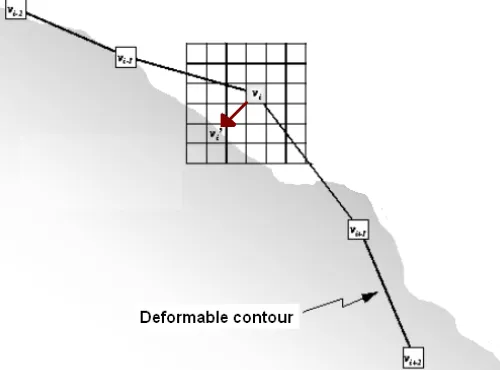
boundaries. Each point is moved to the point, corresponding to the
place of the minimum value in (figure 3.1). If the energy functions are
chosen precisely, the contour, should move towards, and stop at, the
object boundary.
If αcontrols the tension of the contour and β controls the rigidity of the
contour, a common option for internal energy function will be:
ds s C s C E L 2 " 2 0 '
int =
∫
α ( ) +β ( )(3.3)
The external energy function attracts the deformable contour to
interesting features, such as object boundaries, in an image.
∫
= E C c ds
Eext img( ( ))
(3.4)
A common option for edge attraction function is a function of image
gradient: R y x I G y x
Eimg Ω→
∇ = , ) , ( * 1 ) , ( σ λ (3.5)
Where Gσis a Gaussian smoothing filter and σ is its standard
deviation. Also λis a proper constant. To find the object boundary,
parametric curves are initialized within the image and are moved toward
the energy minima under the influence of both these forces. That is why
[He, 2008] refers to original snake as an interactive method which needs
expert guidance on the snake initialization and the choice of accurate
deformation parameters.
The classical snake limitations motivated other snake variations to be
introduced [Amini, 1990], [Cohen, 1991], [Zhu, 1996], [Xu, 1998],
[Giraldi, 2000], [McInerney, 2000], [Fenster, 2001], [Delingette, 2001],
and so on. Some of these limitations are as follows: since the magnitude
of the external force vanishes quickly as the contour diverges to the
boundaries and this makes the capture range of the snakes very small, the
contour is specified satisfactorily near the edges. Approximating a proper
location of initial contours without previous knowledge is usually a tricky
problem. In addition, snakes are very sensible to the noises in the image
can be easily distracted to wrong places. These were some drawbacks of
the original snakes but the most important flaw of classical snake is its
inability to adaptation of the model topology during the deformation. In
other words snakes maintain the same topology during the evolution
stage. That is, snakes cannot split to multiple boundaries or merge from
multiple initial contours.
In [Cohen, 1991] and [Xu, 1998] the focus is on reducing the
dependency on initial conditions by defining new external energy for
improving the snakes’ algorithm. Cohen et al. [Cohen, 1991] proposed a
new snake, called Balloon snake, and added a second external force
which shifts the contour out (inflation) or in (deflation) along its normal.
The new defined snake has resemblance to a balloon being inflated in 2D.
The balloon force enables the snake to be initialized inside the object in
addition to remove the necessity for the initial curve to be close to the real
edges. Comparing to the original snake by Kass [Kass, 1987], balloon
snake passes over relatively weak edges so has more stable results. Also,
if the object has a problematic shape, insertion a balloon inside the shape
and expanding its contour will locate the desired shape. However, balloon
snake has the problem with forcing the snake into concavities. Xu and
Prince [Xu, 1998] introduced gradient vector flow(GVF) snake which
increases the capture range and improve the snakes ability to move into
boundary concavities. It still has difficulties, however, forcing a snake
into lengthy, thin boundary indentations. Like the Cohen’s [Cohen,
vicinity. GVFs are vector fields derived from images by minimizing an
energy functional in a variational framework.
Both [McInerney, 2000] and [Delingette, 2001] try to help the
topology change during the evolution. In [McInerney, 2000]
topology-adaptive snakes or T-snakes are introduced for medical image
segmentation based on an affine cell image decomposition (ACID)
framework. The ACID provides a method for contour re-parameterization
and that allows T-snakes to split or merge; in other words adapting to the
topology of object. Yet only specific motions- inflating or deflating- is
applicable. Also re-parameterization is making the method complex and
expensive particularly in 3D. New physical constraints are introduced in
[Delingette, 2001] to control the contour deformation. In addition to
ability of splitting, the contours are kept separated by removing
overlapped snake areas. So that handling the topological changes plus
restoring contour separations as a procedure reduces the likelihood that
contours converge toward the boundaries of other object, are Delingette’s
[Delingette, 2001] method properties.
In [Fenster, 2001] first the shape of the object is achieved then the
shape information is used as constraint. The Contour evolves considering
this constraint so that the contour will not be captured by fake edges.
Region based features are used in [Zhu, 1996]. In this method boundary
deformation and region merging are done iteratively. Region based
information to the accompaniment of edge based data overcome the noise
in the image. But the problem in splitting the contour in multiple contours
still exists. Amini el al. [Amini, 1990] and Giraldi et al. [Giraldi, 2000]
used a dynamic programming approach instead of Kass’s [Kass, 1987]
estimation of higher order derivatives are omitted here and the numerical
stability is improved.
3.2
Level set methods
Geometric deformable models provide an elegant solution to address the
primary limitations of parametric deformable models. These models are
based on curve evolution theory and the level set method.
Level set method was first introduced in [Dervieux, 1980] and then
devised by Osher and Sethian [Osher, 1988]. For capturing moving fronts
in a wide range of problems, level set method has shown to be a robust
numerical option. Some fields using level set techniques are image
processing, computer vision and graphics. As mentioned by Tsai [Tsai,
2003], an implicit data representation of a hypersurface, set of PDEs that
govern how the surface moves, and the corresponding numerical methods
for implementing this on computers are building components of classical
level set method.
3.2.1Level set concept
The main idea of the Level set method can be described as follows. In an
open region Ω, Γ is a closed interface evolving with the velocity υ. The
goal is to analyze and compute the motion of the interface. Osher and
Sethian’s idea is to define an implicit smooth (Lipschitz continuous)
function φ(x, t) which represents the interface as the set where:
φ(x, t) = 0 if x∈ Γ
φ(x, t) <0 if x∈ Γin
Where Γin shows the area inside the interface and Γout shows the area
outside (figure 3.2).
Figure3.2 The construction of level set function
The evolution could be described by convecting the φ with the
velocity field υ on the interface:
+v.∇ =0
∂ ∂
φ φ
t (3.7)
If the normal component of v is υ N = v.
φ φ ∇ ∇
, where
∑
= = ∇ n i xi 1 2 φ
φ , the
equation (2.1) can be written using normal velocity:
+ ∇ =0
∂ ∂ φ φ N v
t (3.8)
These equations are Hamilton-Jacobi equations so that with suitable
restrictions the theory of viscosiy solutions [Crandall, 1983] picks out
unique Lipschitz continuous solution.
A useful property of this approach is that the level set function
remains a valid function while the embedded curve can change its
parametric active contours, such as computational simplicity and the
ability to change curve topology. Unlike the snake can start far from the
boundary and will converge to boundary concavities.
3.2.2Level set dictionary and technology
Key terms and some key technological advances in level set methods are
[Osher, 2003]:
1. The interface boundary Γ (t) is defined by
{
x φ(x, t) = 0}. The
region is bounded and its exterior is defined by
{
x φ(x, t) > 0}.
2. The unit normal N to Γ (t) is
N=
3. The mean curvature κ of Γ (t) is defined by
κ = -∇. ( φ φ
∇ ∇
)
4. The Dirac delta function concentrated on an interface is
φ φ δ( )∇
where δ(φ)is a one-dimensional delta function. 5. The characteristic function χof a region Ω(t) is
χ= H(-φ)
where H is a one-dimensional Heaviside function and
H(x) ≡ 1 if x>0
6. The surface (or line) integral of a function f over Γ is
( )
dx xf Φ ∇Φ
∫
Rn) ( δ
and The volume (or area) integral of f over Ω is
( )
dx H x f∫
Φ Rn ) (7. In many cases, φwill develop steep or flat gradients which cause
problems in numerical approximations. For preventing φ from
becoming too flat or too steep near the interface as well as keeping
the zero location unchanged, the distance reinitialization [Sussman,
1994] procedure reshapes a general level set function φ(x, t) by d(x,
t) which is the value of the distance from x to Γ (t), positive outside,
and negative inside.
Let d(x, t) be signed distance of x to the closest point on Γ. The
quantity d(x, t) satisfies∇d =1, d is positive outside and negative
inside and also is the steady state solution to
φt +sgn(φ0)(∇φ −1)=0,φ(x,τ =0)=φ0(x) (3.9)
Here φ0 shows the level set function before the reinitialization. For
most applications, the reinitialization is only needed for a
neighbourhood around the zero level set, and the diameter of this
neighbourhood depends on the discretization of the partial derivatives
in the PDE. This implies that only a few time steps in τare needed.
8. The basic level set method concerns a function φ which is defined
all over space. Obviously this is wasteful unless one only cares about
φ only near the zero level set. We may solve (3.7) in a
neighbourhood of Γ of widthm∆x, where m is usually 5 or 6. Points
outside this neighbourhood need not be updated by this motion. Thus,
this local method works easily in the existence of topological changes
and for multiphase flow.
3.2.3Numerics
Eq. (3.8) is Hamilton-Jacobi equation when normal velocity is dependant
of x, t and∇φ, Numerical methods should be used on uniform Cartesian
grid because of existence of singularities in solutions. The key ideas
involve monotonicity, upwind differencing, essentially non-oscillatory
(ENO) schemes, and weighted essentially non-oscillatory (WENO)
schemes [Osher, 1991] [Osher, 1988] [Jiang, 2000].
3.2.4Level set in segmentation
As mentioned before, level set method has been widely used because it
lets the contour to fit in angles, corners and topological changes. A
special case of the motion of the contour is based on mean curvature and
v is calculated with curvature of the curve. A basic version of the speed
functions that combine curvature and constant deformation were
proposed in [Caselles, 1993] and [Malladi, 1995]. A famous active
contour model based on mean curvature is introduced in [Caselles, 1993]
using the flowing equations:
(3.10)
Where is a constant pushing the curve when curvature becomes
curve moves with the speed ). And is
an edge dependent function so that the contour stops at desired boundary
where g disappears. Another formula for finding the zero level sets are
proposed in [Malladi, 1993].
(3.11)
Again is a constant. M1 and M2 are minimum and maximum value
of the magnitude of the gradient . When the speed vanishes the
evolving contour will stop and this happens at the highest gradients. Later
Caselles [Caselles, 1997] proved that the minimization of the contour
energy is even to the minimization of the contour length weighted by an
edge detection function in the Riemannian space. He integrated the curve
evolution methods with the classical energy minimization methods
(snakes). Other speed functions for evolving curves can be found in
[Siddiqi, 1998]. Often in level set methods the initial level set function is
frequently based on the signed distance. An efficient algorithm for
building of the signed distance function is called a fast marching method
[Malladi, 1996], [Malladi, 1998], [Sethian, 1999]. Applying the constant
deformation method may create sharp corners of the zero-level set
resultant in a vague normal direction. In that situation, the deformation
can be continued using an entropy condition [Sethian, 1982].
In classical geometric models, an evolution PDE for level set function
is originated from a certain evolution PDE of a parameterized curve. On
the other hand, in variational methods the evolution PDF of the level set
function is derived from minimizing the energy function defined on the
level set function. Comparing with classical methods, variational
In Zhao [Zhao, 1996] a variational level set method introduced.
Suppose there are disjoint regions Ωwith the boundaries Γso that the
common boundary between Ωiand ΩjisΓi,j. Energy function is described
as
2 1 E
E
E= + (3.12)
Where E1 is the energy of the interface and E2 is the bulk energy. The
normal velocity is positive multiple of curvature of the interface plus the
bulk differences. That can be written as
dx H E dx E n
j j j n
i i i
∑
∫
∑
∫
= = = ∇ = 1 2 1 1 ) ( ) ( φ γ φ φ δ γ (3.13)Where H is Heaviside Function, δis delta function. Now minimizing
E is the sloution.
Chan et al. [Chan, 2001] came with new variational method without a
stopping edge-function, unlike the other level set methods that use
gradient value to stop the curve evolution. The original formulation of
Chan et al. [Chan, 2001] developed for bimodal images. This was
afterwards extended to multiphase images [Chan, 2002]. In the bi-modal
model, it is supposed that an image I is formed of two approximately
piecewise-constant distinct intensity regions, and . If the region to be
segmented is represented by , then a curve C can be evolved to reach
the boundary of by minimizing the energy:
(3.14)
,
(3.15)
The variables c1 and c2 show the average intensities inside, and
outside the curve respectively. It can be easily represent that the
minimum of the above fitting term is the boundary. If the curve is outside
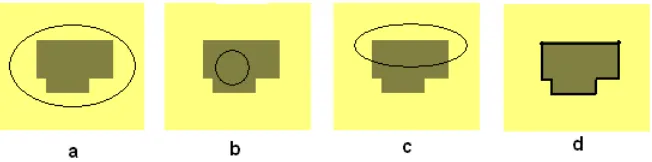
the region then F2 and F1 > 0(figure 3.3 a), If the curve is inside
the region then F1 and F2 > 0 (figure 3.3 b), If the curve is both
inside and outside the region , then F2 and F1 > 0 (figure 3.3 c).
The only case that the fitting energy is minimized is when the curve is
located on the boundary (figure 3.3 d).
Figure 3.3 showing all the cases for the Chan & Vese method.
Chan and Vese [Chan, 2001] added some terms to the explained
function and introduced their energy function as:
Here ν µ are fixed parameters. By writing the area
and volume in energy form and
(3.17)
And
(3.18)
the function becomes:
(3.19)
By keeping the φ fixed and minimizing the F with respect to c1
andc2, the values of c1and c2 are calculated. Then they regularized δ and
Hby two smooth functions δε and Hε to use Euler-Lagrange equation:
0 ] ) ( ) ( . )[
( 2 0 2 2
2 1 0
1 − − − =
+ + ∇ ∇ ∇ − =
∂ F v λ u c λ u c
φ φ µ φ δε φ (3.20)
A way to solve this minimization problem is using gradient descent
on eq. (3.20) so that∂tφ =−∂φF .
The advantage of the Chan-Vese active Contours is that it is able to
segment an image even if it has smooth boundaries. The evolution of the
curve does not depend on gradient information; as a result weak edges do
initialization problems. The result of segmentation is dependent on the
situation of the initial curve.
The level set function φ can develop shocks which makes additional
computation vastly imprecise. A way to avoid this problem is to initialize
the function φ as a singed distance function, before the evolution and
then reshape the function φ to be a singed distance function periodically
during the evolution. In [Li, 2005] by mentioning to reinitialization’s
flaws such as the displacement of the zero level set within the
reinitialization, an increase of the number of iterations, nonexistence of a
known single method for reinitialization, making the computation more
expensive and complex; a new formula for geometric active contours
using new variational method has been discussed so that the is no need to
re-initialize the function. They define an energy function which consists
of internal and external energy. In order to keep the level set function as
an approximate signed distance function they use special internal energy
that penalizes the deviation of the level set function from a signed
distance function so that the level set function will be always close to sign
distance function. Sign distance function has the property =1 and any
function satisfying =1 is signed distance function. The internal
energy is
(3.21)
So that it shows how close a function is to its distance function. The final
energy function is
(3.23)
External energy function uses gradient function; it means that the
contour will be attracted to the points where the gradient is high:
(3.24)
(3.25)
Li’s method [Li, 2005] is computationally efficient, stable results are
produced and the most important advantage is omitting the reinitialization
process.
The use of level set and PDEs in computer vision has been developed
in recent years. In image segmentation many algorithms has utilized the
level set method to find “a collection of non-overlapping regions” of a
given image. There are a large variety of applications where which
geometric deformable models were employed for segmenting the image.
Examples include a level set-based cortical unfolding method
[Hermosillo, 1999]; cell segmentation [Sarti, 1996] and [Yang, 2005];
cardiac image analysis [Niessen, 1998], [Angelini, 2004], [Lin, 2003];
tumor tracking [Li, 2007], Biomolecular surfaces construction [Bajaj,
2008], and many others.
3.3
Summary
In this chapter, we have described the fundamental concepts of both
parametric and geometric deformable models and shown that they can be