Malayalam Recognizer: A Learning to Write
Collaborator
Soumya Muraleedhara Menon1, Roopa Sree Mohan2, Deepa V. P.3, Navya T.4, Ganesh P.5
B.Tech Scholar, Dept. of CSE, Sreepathy Institute of Management and Technology, Palakkad, Kerala, India1
B.Tech Scholar, Dept. of CSE, Sreepathy Institute of Management and Technology, Palakkad, Kerala, India2
B.Tech Scholar, Dept. of CSE, Sreepathy Institute of Management and Technology, Palakkad, Kerala, India3
B.Tech Scholar, Dept. of CSE, Sreepathy Institute of Management and Technology, Palakkad, Kerala, India4
Head of Dept., Asst. Professor, Dept. of CSE, Sreepathy Institute of Management and Technology, Palakkad,
Kerala, India5
ABSTRACT: Handwriting recognition is an area under machine learning. Malayalam (Keralite language) gesture
recognition is a challenging process because of alphabet written in different ways which is more complex to write among Indian languages and the recognition task is quite difficult due to wide intrapersonal and interpersonal variation in human handwriting. Also recognition task on Malayalam language become multiplex since there are large number of classes with high similarities. Previous efforts of making Malayalam recognition more accessible have been through the inclusion of gesture recognizers through image processing. In this work, we propose a new model for handwriting gesture recognition in real time. The input of this model is a Malayalam alphabet. The aim of handwriting is to identify input gesture correctly then analysed to many process. This Malayalam recognizer averts image processing and makes use of a real time recognition technology. Nowadays this technology has more relevance in devices like mobile phones, for giving input by hand and does the recognition process on writing itself. Since development of learning to write is a sophisticated procedure in Malayalam, so we introduce our work as an application which breaks this berg. To enable novice programmers to incorporate gestures into their UI prototypes, we present a “Malayalam letter recognizer” that is easy, cheap, and usable, in which the user found to make interactions through a built in canvas.
KEYWORDS:$1 recognizer, unistroke, gesture, indicative angle, optimal cosine distance.
I. INTRODUCTION
Although $1 has limitations as a result of its simplicity, it offers excellent recognition rates for the types of symbols and strokes that can be useful in user interfaces.
The real time or dynamic has been used in place of online. Online handwriting recognition requires a transducer that captures the writing as it is written. The most common of these devices is the electronic tablet or digitizer. The various approaches for handwritten character recognition are string machine matching schemes, structural approach, template matching, using neural networks, etc. The central objective is demonstrating how Malayalam characters are recognized by using Artificial Neural Networks. Such networks can be fed the data from graphic analysis of the input data. And also can be trained to output characters on one or another form. Multilayer perceptron model is one such network. It uses Delta learning rule for adjusting weights. It will force the output to one of nearby values if a variation of input is fed into the network.
Optical Character Recognition plays an important role in Digital Image Processing and Pattern Recognition. Even though ambient study had been performed on foreign languages like Chinese and Japanese, effort on Indian script is still immature. OCR in Malayalam language is more complex as it is enriched with largest number of characters among all Indian languages. The challenge of recognition of characters is even high in handwritten domain, due to the varying writing style of each individual. This method uses Chain code and Image Centroid for the purpose of extracting features and a two layer feed forward network with scaled conjugate gradient for classification.
Content Based Image Retrieval is one of the prominent areas in Computer Vision and Image Processing. Recognition of handwritten characters has been a popular area of research for many years and still remains an open problem. This uses visual image queries for retrieving similar images from database of Malayalam handwritten characters. Local Binary Pattern (LBP) descriptors of the query images are extracted and those features are compared with the features of the images in database for retrieving desired characters.
Apart from these, our system allows only characters to be drawn by unistroke, as $1 recognizer. How well does $1 perform on user interface gestures compared to two more complex algorithms used in HCI? How does recognition improve as the number of templates or training examples increases? How do gesture articulation speeds affect recognition? How do recognizers scores degrade as when moved down their N best lists? Which gestures do users prefer? These are answered in this.
Character recognition is a fundamental, but most challenging in the field of pattern recognition with large number of useful applications. The technique by which a computer system can recognize characters and other symbols written by hand in natural handwriting is called handwriting recognition system.
Handwriting recognition is classified into offline handwriting recognition and online handwriting recognition. If handwriting is scanned and then understood by the computer, it is called offline handwriting recognition. In case, the handwriting is recognized while writing through touch pad using stylus pen, it is called online handwriting recognition. Here we are concentrating more on online recognizers. Online handwriting recognition requires a transducer that captures the writing as it is written. The most common of these devices is the electronic tablet or digitizer [1].
Handwritten recognition is divided into five phases, which are pre-processing, segmentation, feature extraction, classification and post processing [2].
An intelligent system for free hand entry of characters and words using light pen model is described. The developed system recognize the characters and words. The various approaches for handwritten character recognition are string machine matching schemes, structural approach, template matching, using neural networks, etc. The central objective is demonstrating how Malayalam characters are recognized by using Artificial Neural Networks. Network employs learning rules to update the weights between the nodes. Such networks can be fed the data from graphic analysis of the input data. And also can be trained to output characters on one or another form. Multilayer perceptron model is one such network. It uses Delta learning rule for adjusting weights. It will force the output to one of nearby values if a variation of input is fed into the network. The word is finally recognized by checking the database trained for, and the proximity issue is solved [3].
purpose of extracting features and a two layer feed forward network with scaled conjugate gradient for classification [4].
Content Based Image Retrieval is one of the prominent areas in Computer Vision and Image Processing. Recognition of handwritten characters has been a popular area of research for many years and still remains an open problem. The proposed system uses visual image queries for retrieving similar images from database of Malayalam handwritten characters. Local Binary Pattern (LBP) descriptors of the query images are extracted and those features are compared with the features of the images in database for retrieving desired characters. This system with local binary pattern gives excellent retrieval performance [5].
The neural network to recognize the character. In this work it is developed offline strategies for the isolated handwritten English character (A TO Z ) and (0 to 9). This method improves the character recognition method. Pre-processing of the Character is used binarization, thresholding and segmentation method. The proposed method is based on the use of feed forward back propagation method to classify the characters. The ANN is trained using the Back Propagation algorithm. In the proposed system, English numerical letter is represented by binary numbers that are used as input then they are fed to an ANN. Neural network followed by the Back Propagation Algorithm which compromises Training [6].
Variation in handwriting among different writers occurs since each writer possesses own speed of writing, different styles, sizes or positions for characters or text. Variation in handwriting styles also exists within individual person’s handwriting. This variation may take place due to: writing in various situations that may or may not be comfortable to writer; different moods of writer; style of writing same characters with different shapes in different situations or as a part of different words; using different kinds of hardware for handwriting [7].
II. OBJECTIVE
The world is turning to be a digitalized one. Nowadays, no one depends on any kind of books for some reference. So here, we are implementing a web application where anyone can easily learn to read and write Malayalam language. The application is simple and user-friendly. With each of the Malayalam alphabets, an audio button is provided where the learner can click to hear the pronunciation. There will be a canvas provided where the learner can write on it using unistroke and then the corresponding alphabet will be identified.
III.WORKAREA
The area of the work is Machine Learning. Machine Learning is the field of study that provides the system the ability to learn automatically and improve from experience without being explicitly programmed. The basic premise of machine learning is to build algorithms that can receive input data and use statistical analysis to predict an output while updating outputs as new data becomes available.
Machine learning algorithms are often categorized as supervised or unsupervised. Supervised algorithms require a data scientist or data analyst with machine learning skills to provide both input and desired output, in addition to furnishing feedback about the accuracy of predictions during algorithm training. Data scientists determine which variables, or features, the model should analyze and use to develop predictions. Once training is complete, the algorithm will apply what was learned to new data. Unsupervised algorithms do not need to be trained with desired outcome data. Instead, they use an iterative approach called deep learning to review data and arrive at the conclusion.
IV. SCOPEANDAPPLICATIONS
V. PROBLEMSTATEMENT
To develop a gesture recognition system. The application of system comes in different areas like learning, deaf people interface, etc. Here we elaborate the recognition system for Malayalam learning, which will recognize the Malayalam alphabets written on a canvas. Our primary objective in solving this problem is to have a minimal set of training data in order to quickly build a prototype system. Many number of coordinate points are taken and stored in the training set. When the alphabet is written on the canvas, it is compared with the corresponding points that are already stored.
VI. IMPLEMENTATION
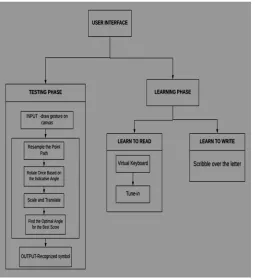
Consists of 2 modules: • Learning Phase • Recognition Phase
System architecture of Malayalam recognizer is shown in Fig. 6.1.
▪
Learning PhaseLearning Phase is the first module and it is divided into various sub-modules, such as: ● Learn to read.
➢ Virtual Keyboard.
➢ Tune-in.
●
Learn to write.➢ Scribble.
⮚ Virtual Keyboard
This portraits the effect of having a virtual keyboard. This keyboard consist of Malayalam letters as keys. Malayalam letters which includes both 24 Swaraksharam and Vyanjan Aksharam. These letters are placed as buttons as found in our normal Keyboard.
⮚ Tune-in
When buttons or keys of virtual keyboard are pressed an audio is generated such that it soundsthe respective letter. In short, this sub-module pronounces each letter when pressed.
⮚ Scribble
As the name indicates, user can scribble over the letter as much as he/she need to. After clicking the keys in virtual keyboard, a gif image, scribbling area, audio icon and a refresh button. Gif shows the user how to draw the particular letter, and at the same time the user can scribble it over the image displayed next to the gif. Also the image contains the path to draw. If he/she forgets how to pronounce the letter, then user can click on the audio icon displayed above the scribbling area. And also provided with refresh button, to refresh the page when scribbled roughly and to try again until the user is ready to claim.
▪
Testing PhaseHere, in this module, a canvas is built with default size. User can draw gestures (alphabet) over that canvas using single stroke only and provides the result on the top of the canvas. And if the user needs to try again, he /she can.
❏ Input
❏ Resample the Point Path
To make gesture paths directly comparable at different movement speeds, first resample the gestures such that the path defined by their original M points is defined by N equidistantly spaced points. To resample, we first calculate the total length of the M- point path. Dividing this length by (N1) gives the length of each increment, I, between N new points. Then the path is stepped through such that when the distance covered exceeds I, a new point is added through linear interpolation.
❏ Rotate Once Based on the Indicative Angle
The indicative angle is the angle formed between the centroid of the gesture (x, y) and the gestures first point. After finding the indicative angle we do rotate the gesture so that this angle is at 0.
❏ Scale and Translate
After rotation, the gesture is scaled to a reference square. By scaling to a square, we are scaling non-uniformly. This will allows us to rotate the candidate about its centroid and safely assume that changes in pair-wise point-distances between C and Ti are due only to rotation, not to aspect ratio. After scaling, the gesture is translated to a reference point. For simplicity, we choose to translate the gesture so that its centroid (x, y) is at (0,0).
❏ Find the Optimal Angle for the Best Score
A candidate C is compared to each stored template T i to find the average distance di between corresponding points:
= ( [ ] − [ ] ) + [ ] − [ ]
the path-distance between C and Ti . The template Ti with the least path-distance to C is the result of the recognition. This minimum path-distance di* is converted to a [0..1] score using:
= 1−
√ +
Fig. 6.1: System Architecture of Malayalam Recognizer.
❏ Recognition using protractor
In the recognition step we use the concept of Protractor. Protractor employs a nearest neighbour approach. For each gesture (either an unknown gesture or a training sample), Protractor pre-processes it into an equal-length vector. Given an unknown gesture (say g), Protractor searches for similar gesture templates by calculating an optimal angular distance between the unknown gesture and each of the stored templates (say t). The angular distance is the distance between two point objects, as viewed from a location different from either of these objects, is the angle of length between the two directions originating from the observer and pointing toward these two objects. For that Protractor uses the inverse cosine distance between their vectors, vt and vg, as the similarity score S of t to g.
( , ) = 1 . | |
Protractor uses a novel closed-form solution to calculate such a distance, which results in significant improvements in accuracy and speed. Protractor also recognizes gestures that are both invariant and sensitive to orientation, as well as gestures with different aspect ratios. Protractor then searches for templates that are similar to the unknown gesture. To do so, for each pair wise comparison between a gesture template t and the unknown gesture g.
VII. RESULT
Fig.7.1: Recognized image on canvas of “ക”, “പ” and “ട” respectively.
VIII. CONCLUSIONANDFUTUREWORK
Used a $1 recognizer that is easy, cheap, and usable as it includes only 100 lines of code. Involves only basic geometry and trigonometry. Offers excellent recognition rates for the types of symbols and strokes that can be useful in user interfaces. Single-stroke gesture recognizer that employs a novel closed-form solution for calculating the similarity between gestures.
REFERENCES
1. Charles C. Tappert, Ching Y. Suen, Toru Wakahara, "The state of the art in online handwriting recognition", IEEE Trans. Pattern Analysis &
Machine Int. 12 (8), 787-808, 1990.
2. Ayush Purohit, Shardul Singh Chauhan, ”A Literature Survey on Handwritten Character Recognition”, International Journal of Computer
Science and Information Technologies, Vol. 7 (1) , 2016.
3. Manoj Kumar, Sandeep Chandran, ”Handwritten Malayalam Word Recognition System using Neural Networks”, International Journal Of
Engineering Research and Technology, Volume 4, Issue 05, April-2015.
4. Jomy John, Pramod K. V, Kannan Balakrishnan, “Offline Handwritten Malayalam Character Recognition Based on Chain Code Histogram”,
2011
5. Simily Joseph, Jomy John, Kannan Balakrishnan, K. Pramod Vijayaraghavan, “Content Based Image Retrieval System for Malayalam
Handwritten Characters”, 2011.
6. Ankit Sharma, Dipti R Chaudhary, “Character Recognition Using Neural Network”, Volume-4 Issue-4, 2013.