Scholarship@Western
Scholarship@Western
Electronic Thesis and Dissertation Repository
4-19-2017 12:00 AM
Detection and Characterization of Extrasolar Planets through
Detection and Characterization of Extrasolar Planets through
Planet-Disk Dynamical Interactions
Planet-Disk Dynamical Interactions
Maryam Tabeshian
The University of Western Ontario
Supervisor
Prof. Paul A. Wiegert
The University of Western Ontario Graduate Program in Astronomy
A thesis submitted in partial fulfillment of the requirements for the degree in Doctor of Philosophy
© Maryam Tabeshian 2017
Follow this and additional works at: https://ir.lib.uwo.ca/etd
Part of the Other Astrophysics and Astronomy Commons
Recommended Citation Recommended Citation
Tabeshian, Maryam, "Detection and Characterization of Extrasolar Planets through Planet-Disk Dynamical Interactions" (2017). Electronic Thesis and Dissertation Repository. 4503.
https://ir.lib.uwo.ca/etd/4503
This Dissertation/Thesis is brought to you for free and open access by Scholarship@Western. It has been accepted for inclusion in Electronic Thesis and Dissertation Repository by an authorized administrator of
Structures observed in circumstellar disks may be caused by gravitational interaction with planetary or stellar companions. These perturbed disks are often signposts of planet birth in exoplanetary systems, and offer insights into the properties of both the disk and the perturbing planets. Therefore, structures observed in these disks provide a powerful tool for detecting and studying extrasolar planetary systems. In this work, we examine the link between disk structures and nearby/embedded planets using numerical simulations of both hypothetical and observed disk systems.
We demonstrate that gaps can be opened in dynamically cold debris disks at the mean-motion resonances (MMRs) of an orbiting planet. These gaps are opened away from the orbit of the planet itself, revealing that not all disk gaps need contain a planetary body. These gaps are large and deep enough to be detectable in resolved disk images for a wide range of reasonable disk-planet parameters. The gap location, shape, and size are diagnostic of the planet location, eccentricity and mass, and allow one to infer the existence of unseen planets, as well as calculate many important parameters of both seen and unseen planets in these systems. We suggest that the widths, locations, and shapes of the two most prominent resonances, the 2:1 and 3:1 MMRs, could be used to determine: 1) the position of any unseen planets for more efficient targeted searches, and 2) the mass, semimajor axis and eccentricity of the planetary perturber, and present an algorithm for doing so.
We apply our dynamical model of planet-disk interactions to the protoplanetary disk around the young pre-main sequence star HL Tauri which was observed recently in unprecedented detail by theAtacama Large Millimeter/submillimeter Array (ALMA). We determine that the disk structures that are likely sculpted by yet-to-be detected planets embedded in this gas-rich disk can be reproduced to a large extent using a simple particle-only model. For example, the number of planets in the HL Tau system remains a matter of debate; however, our results show that at least 5 of the observed gaps could be produced with only 3 planets in the system, where the additional gaps are due to mean-motion resonances. Our fitting of planetary masses and distances are also consistent with those in the literature. Therefore, we conclude that a particle-only treatment of gas-rich disks may be useful in understanding disk-planet dynamical interactions in some cases, and provide ‘low-cost’ initial parameter determinations which can ultimately be used as a starting point for investigating protoplanetary disks more thoroughly using computationally expensive hydrodynamic models.
In the present study, we show that numerical simulations of circumstellar disks provide a powerful tool for the study of planets and planetary systems which can ultimately help in understanding their formation and evolution.
Keywords: celestial mechanics circumstellar disks planets and satellites: detection -planets and satellites: fundamental parameters - planetdisk interactions - protoplanetary disks: individual (HL Tau)
This thesis dissertation contains adaptations from three papers that are either published in a peer-reviewed journal or soon will be. These include:
- Chapter 2: Detection and Characterization of Extrasolar Planets through Mean-Motion Resonances. I. Simulations of Hypothetical Debris Disks, published in the Astrophysical Jour-nal (Tabeshian, M. & Wiegert, P. A., 2016, ApJ, 818, 159);
- Chapter 3: Detection and Characterization of Extrasolar Planets through Mean-Motion Resonances. II. The Effect of the Planet’s Orbital Eccentricity on Debris Disk Structures, sub-mitted for publication in the Astrophysical Journal (Tabeshian, M. & Wiegert, P. A., 2017, ApJ (submitted));
- Chapter 4: Detection and Characterization of Extrasolar Planets: Applying a Particle-only Model to the HL Tau Disk, to be submitted for publication.
Contributions to these papers were made by myself as well as by my PhD supervisor, Dr. Paul Wiegert. The simulation codes using a numerical integrator based on the Wisdom-Holman algorithm were written by Dr. Wiegert in C. I ran the code and processed and analyzed the output using a code I wrote in Interactive Data Language (IDL). I then prepared the figures as well as the manuscripts while Dr. Wiegert provided guidance and suggestions on a regular basis. I also wrote a code in IDL which called the simulation code and implemented chi-squared minimization as well as Monte Carlo simulations and uncertainty calculations for the project described in Chapter 4.
To my family:
Since the day I set foot on this planet, I have been blessed with the most incredible family in the world! A mom and dad that have always gone above and beyond for my sister and I to make our dreams come true. Thank you both for raising me up to more than I could ever be and for every sacrifice you made for me to be where I am now. And of course a big thanks to an amazing big sister who has always been by my side, helping me reach for the stars. But how can I ever thank the three of you enough for having my back and for always being there for me, so lovingly, so unconditionally? Without your unwavering support, I could not have gone through the amazing journey that started with a decision a 9 year-old girl made, that one day she would become an astronomer! That journey is not coming to an end with a PhD degree in astronomy; this is just the beginning of a new chapter, and I am truly blessed to have all of you in this with me ...
To my friends:
I consider myself very lucky to have always been surrounded by an amazing support group of friends, some of whom I have long considered family. It is impossible to name all of you here and I only hope that I have been able to tell you how much every single one of you has given meaning to my life.
To my teachers:
Perhaps I need to go back, far back, to the person who first taught me how to read, and thank every single teacher I have had ever since for building the foundations of my humble knowledge. But I would like to especially thank Drs. Stan Metchev and Peter Brown at the University of Western Ontario (UWO) for sharing with me their vast knowledge of planets and planetary systems, as well as Drs. Neil Basescu, with whom I took my first ever astronomy course, and Bert Liberi at the State University of New York, Westchester Community College for their undeniable role in developing my knowledge in physics and in mathematics. Also, my sincere thanks to Dr. Jan Cami at UWO for his help and patience with my programming questions and the dilemmas I so often ran into with my code! And many thanks to Dr. Jamshid Ghanbari, a dear family friend and astronomy professor that my father took me to when I was very young and someone who played a great role in my growing interest in astronomy. Thank you all!
To my MSc. supervisor, Dr. Martin Houde:
When it comes to telling you how grateful I am for what you did for me, I always find myself at a loss for words. It has always been so heartwarming to know that you remained genuinely caring of my progress and wanted what was best for me that makes me incredibly grateful for having had you as my supervisor. Even though I will never be able to say this enough, but thank you for supporting me and my decision at a time that I needed it most. Your support led me to the path for success and gave me so much more that I can’t even begin to describe.
three years ago changed the course of things for me. Thank you for giving me the chance, the honor, the privilege of being your student, which I never took for granted. There are absolutely no words that would do justice in expressing the extent of my gratitude to you for all that you have done for me over the years and for the wealth of knowledge that you generously provided me with. Your support, your encouragement and the faith you have had in me are priceless and I will forever be indebted to you.
To my parents, for their never-ending love and support ...
Abstract
i
Co-Authorship Statement
ii
Acknowledgements
iii
Dedication
v
List of Figures
ix
List of Tables
xiii
List of Appendices
xiv
1 Prelude
1
1.1 Introduction . . . .
1
1.2 Protoplanetary and Pre-Transitional Disks . . . .
3
1.2.1 Observed Disk Structures: Annular Gaps . . . .
9
TW Hydrae . . . .
9
HL Tauri . . . .
11
1.2.2 Observed Disk Structures: Asymmetries . . . .
12
1.3 Transitional Disks . . . .
17
1.4 Debris Disks
. . . .
20
1.4.1 Dust Disks . . . .
25
Structure and Application to the Search for Exoplanets . .
25
1.4.2 Planetesimal Disks . . . .
29
Mean-Motion Resonance
. . . .
30
1.5 Summary . . . .
32
2 Planet-Disk Interactions via MMR I: Low Eccentricity Orbits
39
2.1 Introduction . . . .
39
2.3.1 The Method . . . .
47
2.3.2 Simulated Debris Disks . . . .
48
2.4 Results
. . . .
50
2.4.1 Interior Resonance . . . .
51
2.4.2 Exterior Resonance
. . . .
54
2.5 Discussion . . . .
57
2.5.1 Asymmetries in MMR Gaps . . . .
57
2.5.2 Minimum and Maximum Detectable Planet Masses
. . .
58
2.5.3 Libration Width vs. Planet Mass . . . .
60
2.5.4 Resonant Location Versus Planet Mass . . . .
63
2.5.5 Finding the Planet’s Semimajor Axis based on the
Ob-served Gap Width and Location . . . .
64
2.5.6 The E
ff
ect of Planet’s Orbital Eccentricity and Lindblad
Resonances . . . .
66
2.5.7 Disk Optical Depth and Gap Contrast . . . .
68
2.6 Summary and Conclusions . . . .
71
3 Planet-Disk Interactions via MMR II: The E
ff
ect of Eccentricity
76
3.1 Introduction . . . .
76
3.2 Disk Dynamics . . . .
83
3.2.1 Forced Eccentricity and Longitude of Pericenter . . . . .
83
3.2.2 Disk O
ff
set . . . .
84
3.2.3 The Importance of Radiation Forces in Debris Disks . . .
85
3.3 Simulations . . . .
89
3.3.1 The Method . . . .
89
3.3.2 Simulated Debris Disks . . . .
91
3.4 Results
. . . .
91
3.4.1 Interior Resonance . . . .
93
3.4.2 Exterior Resonance
. . . .
98
3.5 Discussion . . . 100
3.5.1 Locating an Unseen Planet from Asymmetries in MMR
Gaps . . . 100
3.5.2 Higher Order Resonances . . . 101
3.5.3 Determining Planetary Parameters . . . 102
Semimajor Axis from Multi-epoch Observations . . . 104
Mass . . . 105
3.5.4 Disk O
ff
set and Peri
/
Apocenter Glow . . . 108
3.5.5 Simulating ALMA Observations
. . . 109
3.6 Summary and Conclusions . . . 112
4 Applying a Particle-only Model to the HL Tau Disk
118
4.1 Introduction . . . 118
4.1.1 Hydrodynamic Studies of HL Tau to Date . . . 120
4.2 Method . . . 125
4.2.1 The HL Tau Disk Profile . . . 125
4.2.2 Simulations . . . 125
4.2.3 Fitting . . . 126
4.2.4 Uncertainties . . . 128
4.3 Results
. . . 129
4.3.1 MMR Gaps in the HL Tau Disk . . . 133
4.4 Summary and Conclusions . . . 135
5 Summary, Conclusions, and Future Prospects
141
5.1 Summary and Conclusions . . . 141
5.2 Future Prospects
. . . 145
A Orbital Elements
149
A.1 Semimajor Axis (
a
) . . . 149
A.2 Eccentricity (
e
) . . . 150
A.3 Inclination (
i
) . . . 151
A.4 Longitude of the Ascending Node (
Ω
) . . . 151
A.5 Argument of Pericenter (
ω
) . . . 152
A.6 True Anomaly (
ν
) . . . 152
Curriculum Vitae
155
1.1 Evolution of a circumstellar disk after the collapse of a giant
molecular cloud core. . . .
2
1.2 The Spectral Energy Distribution (SED) of the star FX Tau and
the IR excess from its circumstellar disk. . . .
4
1.3 Gaps in the SEDs of the disks around HK Tau, T Tau O, RY
Tau, and SU Aur, explained as being due to tidal e
ff
ects of a
companion star or a planet. . . .
6
1.4 ALMA’s high resolution images of disks around HL Tau and HD
163296, revealing a series of concentric gaps likely due to planets
sweeping up their orbits. . . .
7
1.5 Simulations showing the minimum mass of a planet around a 1.3
M
star that can open a gap in gas distribution and in mm dust. .
8
1.6 The planet-forming disk around the nearby star TW Hydrae
ob-served by HST and ALMA, showing gaps likely carved out by
planets. . . .
10
1.7 The observed polarized intensity profile of the disk around TW
Hydrae. . . .
11
1.8 ALMA’s high resolution image of the disk around HL Tauri,
re-vealing multiple gaps. . . .
12
1.9 Simulations of disks showing the e
ff
ect of disk inclination with
respect to the plane of the sky on gap structures, assuming the
disks are observed at the wavelength of 10
µ
m
.
. . . .
14
1.10 Same as Figure 1.9 but at
λ
=
0
.
1
mm
. . . .
15
1.11 Disk asymmetries observed in LkH
α
330, SR 21N, and HD 135344B
due to disk inclination and possible tidal e
ff
ects by unseen planets. 16
1.12 Evolution of a circumstellar disk from primordial to debris disk
via homologous depletion and inside-out clearing. . . .
18
may give clues to the presence of nearby planetary bodies. . . .
19
1.14 Schematic illustration of the Poynting-Robertson (PR) e
ff
ect. . .
22
1.15 Schematic illustration of the orbits of dust fragments of various
sizes.
. . . .
23
1.16 Clumpy structure observed in Fomalhaut’s disk, providing first
clues to the presence of a planet. . . .
26
1.17 HST image of the warped inner disk of
β
Pictoris, caused by a
planet inclined to the disk. . . .
27
1.18 Shadow cast by the warped inner disk of TW Hydrae caused by
an inclined planet. . . .
28
1.19 Distribution of Solar System’s Main Belt asteroids in
semima-jor axis, showing the Kirkwood gaps at mean-motion resonances
with Jupiter. . . .
30
1.20 Conceptual illustration of the three planetesimal belts around the
star
β
Pictoris. . . .
32
2.1 Orbits of known Solar System asteroids at or interior to Jupiter’s
as of June 2015, showing that MMR gaps may not be revealed
through a telescopic image of
some
disks due to the smearing
e
ff
ects of asteroid eccentricities. . . .
44
2.2 Maximum libration widths for 2:1, 3:2, and 3:1 Main Belt
reso-nances with Jupiter. . . .
46
2.3 Simulation showing interior resonance structures at 2:1 MMR
(double arc) formed by interactions of planetesimals in the disk
with a 4
.
0
M
Jplanet on a circular orbit and particle distributions
in heliocentric distance. . . .
52
2.4 Same as Figure 2.3 but with planet’s eccentricity increased to
e
=
e
J=
0
.
0489. An extra gap appears at the 3:1 MMR. . . .
53
2.5 Structures formed by exterior resonance interactions of
planetes-imals with a 4
.
0
M
Jplanet on a circular orbit interior to the disk.
The gap formed at esterior 2:1 MMR is a single arc. . . .
55
2.6 Same as Figure 2.5 but with planet’s eccentricity increased to
e
=
e
J=
0
.
0489. An extra gap appears again at 3:1 MMR with
the planet. . . .
56
orbit exterior to the disk. The gaps are too narrow to be observed
in the simulated disk and can only be revealed when a histogram
of particle distributions is made. . . .
59
2.8 Comparison of analytical and simulated libration widths versus
planet mass for interior and exterior 2:1 resonance with a planet
having
e
=
0
.
0 and
e
=
0
.
0489. . . .
60
2.9 The e
ff
ect of planet’s mass and eccentricity on the resonant
loca-tion for the 2:1 interior and exterior MMR.
. . . .
63
2.10 The shift in gap location versus the planet’s mass for the 2:1
in-terior and exin-terior MMR with planet eccentricities
e
=
0
.
0 and
e
=
0
.
0489. . . .
65
2.11 Spiral patterns formed in simulated disks with planet on a
non-circular orbit. These may be forced eccentricity waves
originat-ing at Lindblad resonances. . . .
67
2.12 MMR gap contrast vs. planet’s mass for 2:1 interior and exterior
resonances. . . .
68
2.13 Same as Figure 2.3(a) for interior resonance except that particles
in
x
and
y
are binned and assigned a color based on the total
emission from each bin, normalized to the peak intensity . . . .
70
2.14 Same as Figure 2.13 but for the case of exterior resonance. The
same disk is shown in Figure 2.5(a). . . .
70
3.1 Comparison of the Poynting-Robertson inspiral timescales to the
collisional lifetimes of dust particles in a debris disk. . . .
89
3.2 Simulation result illustrating interior 2:1 and 3:1 MMRs with a
single planet of mass
M
=
3
.
0
M
Jand eccentricity
e
=
0
.
1. . . .
95
3.3 Distribution of particles shown by Figure 3.2 but in semimajor
axis instead of heliocentric distance. . . .
96
3.4 Interior resonance gaps formed by interaction of disk particles
with a planet of mass
M
=
1
.
0
M
Jand
e
=
0
.
3 and particle
trapping at 3:2 MMR. . . .
97
3.5 Same as Figure 3.4 but with
M
=
6
.
0
M
Jand
e
=
0
.
1. . . .
98
3.6 Same as Figure 3.2 with mass
M
=
3
.
0
M
Jand eccentricity
e
=
0
.
1 but with the perturber interior to the disk. . . .
99
and the formation of a higher order (4:1) MMR gap. . . 102
3.8 Change in MMR libration width with planet mass for 2:1 and 3:1
resonance with a planet exterior to the disk (i.e. interior resonance).106
3.9 Same as Figure 3.8 but for exterior resonance. . . 107
3.10 CASA simulated observations of disks shown by Figures 3.2(a)
and 3.6(a). . . 111
3.11 Surface brightness profile of the disk shown in Figure 3.10(a)
along the major axis. . . 112
4.1 Comparison between the radial profile of the HL Tau disk
ob-served by ALMA and our simulation using a single power-law
profile in dust density distribution. . . 130
4.2 Same as Figure 4.1 but with two di
ff
erent power-law indices for
dust surface density distribution with a slope break beyond the
orbit of the outermost planet. . . 131
4.3 Uncertainty calculations at 2
σ
confidence level for the masses of
the three planets in the HL Tau disk. . . 131
4.4 Comparison between ALMA’s (deprojected) image of the HL
Tau disk with a CASA simulated image drawn from our best-fit
parameters. . . 135
A.1 Orbital elements describing the size, shape, and orientation of
any Keplerian orbit. . . 153
3.1 Equations relating the mass of a perturber having various orbital
eccentricities to the observed width of a gap at the 2:1 and 3:1
interior and exterior MMR drawn from our measurements of gap
widths.
. . . 107
4.1 Estimated locations and masses of possible planets forming HL
Tau’s 5 major gaps found in the literature. . . 124
4.2 The best-fit parameters and uncertainties obtained using the
down-hill simplex method for the semimajor axes and masses of the
three planets that are likely responsible for sculpting the
promi-nent gaps of the HL Tau disk as well as the range of values
pro-posed by others. . . 132
Appendix A Orbital Elements . . . 149
Prelude
1.1
Introduction
Planets form from the same cloud of gas and dust that gives birth to a star. While the bulk of
the gas falls into the central stellar body, conservation of angular momentum forces some of the
material into orbit around it, and it is in this circumstellar disk that planet formation takes place.
Circumstellar disks are typically depleted over time but can persist around stars to different
degrees throughout their lifetimes. This has led to studies of the structure and evolution of
these disks at every stage in the hopes of better understanding planet formation. This thesis has
as its primary goal to illuminate the link between circumstellar disks and planets.
These disks are dominated by gas and sub-micron size dust at the early stages of star
for-mation. The small dust particles continually collide to form larger grains which eventually
seed planets. As the star is born at the center of the swirling cloud of gas and dust that once
collapsed under its own gravity, the gas is blown away by the strong stellar winds. This
impor-tant process turns the disk from a gas-rich ‘protoplanetary disk’, into a ‘pre-transitional’ and
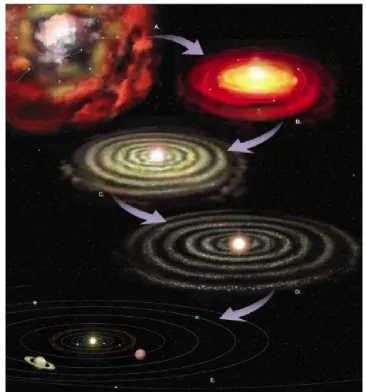
then a ‘transitional’ disk, and finally into a gas-poor but dust-rich ‘debris disk’ (see Figure 1.1).
Though the present work focuses mostly on this final stage, understanding how we know what
we know about circumstellar disks in general as well as the structures observed in
tary disks, as the precursors of debris disks, is essential in our study of structures in gas-poor
disks.
Figure 1.1: Evolution of a circumstellar disk after the collapse of a giant molecular cloud core. The disk evolves from being gas-rich to gas-poor over the course of∼a billion years. Credit: Pearson Prentice Hall Inc.
Therefore, we start in this chapter by outlining structures formed in circumstellar disks
at each stage. Sections 1.2.1 and 1.2.2 review observational signatures of annular gaps and
azimuthal asymmetries for a few protoplanetary disks as well as simulations that attempt to
illustrate geometrical effects as one possible source of the observed asymmetry in the disk
structure. Next comes a brief discussion of the disk as it transitions from being rich to
get to the last stage in which little or no gas remains (Section 1.4).
Once we establish what is already known about disk structures, in the subsequent chapters
we shift our focus to structures formed in debris disks via a mechanism known as
“Mean-Motion Resonance” (MMR) and how such structures could be useful to not only detect but
also characterize extrasolar planets. This is what will be outlined in Chapters 2 and 3 where we
examine the gravitational perturbation of the disk by a planet on a nearly circular (zero or low
eccentricity)1orbit and one in which the planet has a range of moderate orbital eccentricities. In
each case, we will present a means of determining the mass as well as some orbital parameters
of the planetary perturber from the disk structure and illustrate how detection of MMR gaps
can be used in the study of planets beyond our Solar System.
Finally in Chapter 4, we take our dynamically simple model of gap formation in debris disks
and apply it to structures in a protoplanetary disk, HL Tauri, in order to address the question
of whether such simple models can inform the study of these systems or if a complicated
hydrodynamic model is required. A summary and conclusions are provided in Chapter 5 along
with some outstanding questions for future research.
1.2
Protoplanetary and Pre-Transitional Disks
Stars spend most of their lives in a stable state, a condition referred to as being ‘on themain sequence’, after an earlier turbulent phase of gravitational collapse from an interstellar gas cloud. It is now well established that protoplanetary disks form around most pre-main sequence
(PMS) stars, and that these disks are the birthplace of planets. Earliest indirect observational
clues to the existence of disks around PMS stars came from detecting excess infrared and
submillimeter emission in the Spectral Energy Distributions (SEDs) of sources observed with
near- and mid-infrared photometry (see Figure 1.2). The star itself produces a black-body
spectrum peaked at optical wavelengths, but is much fainter in the infrared. The ‘excess’
1‘Eccentricity’ is one of theorbital elementsused to describe the orbits of particles around a central body. A
infrared flux observed comes from the reprocessing of optical photons by dust near the star.
A study by Strom et al. (1989) revealed that at least 60% of the Solar-type stars in their
sample of 83 PMS stars exhibit significant near-IR excess emission. Their findings were later
confirmed when in 1993 a team led by Robert O’Dell of Rice University used the Hubble Space
Telescope (HST) to directly image stars in the Orion Nebula, and revealed that nearly half of
those stars are surrounded by circumstellar disks of gas and dust (O’dell et al., 1993).
Figure 1.2: The IR excess in the Spectral Energy Distribution of the star FX Tau was identified as being due to the presence of a circumstellar disk around this young T-Tauri star whose blackbody emission is shown by the dashed curve. The excess IR emission at the right of the figure cannot be explained by the star itself. Credit: Strom et al. (1989).
Following the discovery of disks around PMS stars by Strom et al. in 1989, Skrutskie
et al. (1990) combined fluxes measured using the Infrared Astronomical Satellite (IRAS) and
NASA’s Infrared Telescope Facility (IRTF) to reveal inner disk holes and outer gaps in these
disks. This suggested that some disks were undergoing a transitional phase from being optically
thick to a state in which most of the disk has been dissipated, possibly due to agglomeration
disks’ — optically thick disks that have optically thin gaps — have since been confirmed
ob-servationally, with some even being directly imaged at near-IR and millimeter/submillimeter
wavelengths.
A year before first protoplanetary disks were directly imaged by HST in 1993, SED analysis
of these disks had also indicated the presence of gaps. In a study by Marsh & Mahoney in 1992,
the authors observed what they described as “a range of ‘missing’ temperatures” in the SEDs
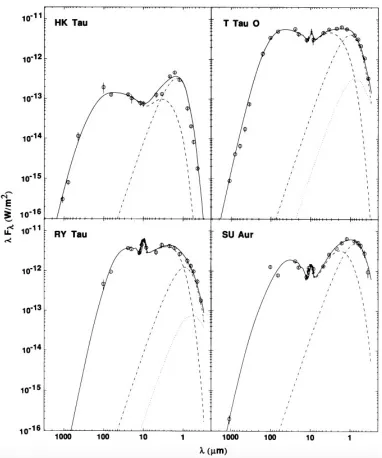
of HK Tau, T Tau O, RY Tau, and SU Aur (see Figure 1.3) consistent with sculpting of the
disks by companion stars or planets (Marsh & Mahoney, 1992). This reinforced the notion that
protoplanetary disks are indeed the cradles of planets, as their name suggests.
Planet formation does not always result in the removal of disk material and gap formation,
but can sometimes trigger density enhancements in the disks and appear as complex features
such as spiral patterns and dust traps. The spiral arms observed in some protoplanetary disks
are explained as being driven by spiral density waves due to gravitational perturbations of a
massive planet or a stellar companion (e.g. Muto et al., 2012; Brown et al., 2009). On the other
hand, some protoplanetary disks such as IRS 48 show asymmetric concentration of dust grains
on one side of the disk which is likely due to a companion triggering an azimuthal gas pressure
bump that results in trapping the dust particles (van der Marel et al., 2013). Understanding the
origin and evolution of such density enhancements is also important in the context of planet
formation and evolution; however, the present study intends to focus on the scenarios that
explain theremovalof disk material and the development of gaps in disks, particularly as they relate to disk-planet interactions. Note that gaps developed in circumstellar disks by interaction
with planets are not necessarily caused by theremovalof disk particles, but can be the result of a significant change in the particles’ orbits. We will return to this in Chapter 3.
As technology advances, gaps in protoplanetary disks are now frequently revealed. These
gaps are often found to be azimuthally symmetric and are believed to have been formed as the
newly formed planets sweep up the material in their neighborhood while orbiting the star at the
made by theAtacama Large Millimeter/submillimeter Array(ALMA) and released in Novem-ber 2014, shown by the left panel of Figure 1.4, is by far the best example showing gap
struc-tures (likely induced by planets) in a protoplanetary disk and can help better understand the
processes that go into formation and evolution of planetary systems (see NRAO, 2014). More
recently in December 2016, ALMA released the image of another protoplanetary disk also with
ring-like structures around the star HD 163296, shown by the right panel of Figure 1.4, that
are believed to be sculpted by two Saturn-mass planets currently forming in the disk (NRAO,
2016b). Considering how young HL Tau and HD 163296 are believed to be (1 and 5 million
years, respectively), images like these have surprised astronomers as planet formation was not
expected to begin at such an early stage after the formation of protoplanetary disks since it
had previously been expected that planets typically take a few tens of million years to form
(see Encrenaz et al., 2004). We note that the planets themselves are not visible in the images,
but are inferred from the structures they produce in the disk; the idea that disks may encode
information about planets that are otherwise too faint to detect is one we will return to.
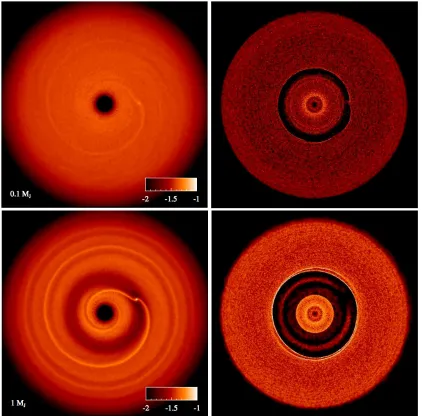
A recent study by Price et al. (2017) shows that a planet with mass as low as 0.1
Jupiter-mass (MJ) can change the distribution of dust in a protoplanetary disk by pushing dust particles away which could get trapped in mean-motion resonances and form bright rings around a dark
gap in dust emission. However, the same study suggests that a gas gap can only develop in the
disk if the planetary mass is at least 1MJ (see Figure 1.5).
Figure 1.5: Simulations showing the minimum mass of a planet around a 1.3 Solar-mass (M)
In addition to symmetric gaps, observations have also revealed that asymmetric structures
are common features of gaps in protoplanetary disks and are interpreted as being either due
to density perturbations of a stellar or planetary companion or have a geometric nature as
will be discussed in Section 1.2.2. This thesis is particularly concerned with the formation of
asymmetric structures in circumstellar disks, and the multitude of information that they reveal
about planets near them. As a result, we will introduce in some detail the different phenomena
which can affect the distribution of gas and/or dust within disks, and particularly gap formation,
at different stages of their evolution. Thus we will start the next section by discussing two
protoplanetary disks imaged in the recent years that show very detailed structures potentially
made by planets before we turn to a discussion of the observed asymmetries in protoplanetary
disks.
1.2.1
Observed Disk Structures: Annular Gaps
Dynamical clearing by a giant planet or a low mass stellar companion has been proposed as
a mechanism that likely explains the presence of gaps in protoplanetary disks. Here we will
discuss two examples of symmetric gaps observed in disks around TW Hydrae and HL Tauri
that are likely indicative of planet formation in these disks.
TW Hydrae
Multi-wavelength observations of the young (∼ 10 million year-old) pre-main sequence star,
TW Hydrae have revealed a disk extending to∼ 150− 230 AU around this M2 star (see for
instance, Weinberger et al., 2002; Apai et al., 2004; Qi et al., 2004; Roberge et al., 2005;
Andrews et al., 2012) with a gap approximately 2 AU wide which has also been imaged using
Hubble Space Telescope’s high contrast direct imaging (see left panel of Figure 1.6) and was
found to be likely due to a sub-Saturn mass planet (Debes et al., 2013). In March 2016 the
National Radio Astronomy Observatory (NRAO) released an image of the TW Hya disk taken
in this image 20 and 40 AU from the star. ALMA’s unprecedented image of this protoplanetary
disk also revealed an inner gap as close as 1 AU from the star, making TW Hydrae strikingly
similar to a young Solar System with 3 potential planets at distances similar to those from
Uranus, Pluto and the Earth to the Sun.
Figure 1.6: The planet-forming disk around the nearby star TW Hya (∼175 light-years away) as seen in 2005 by HST (left) and in 2016 with ALMA (right). ALMA’s high resolution image shows three gaps in the disk, likely formed by the gravitational clearing of at least three planets around this red dwarf star. The innermost gap (zoomed-in) is believed to be as close to the star as the Sun-Earth distance. Credit: NASA, ESA, and Debes et al. (2013) (the HST image) and NRAO (2016a) (the ALMA image).
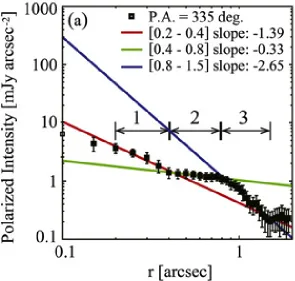
Using a new high-contrast H-band (1.6µm) polarized intensity (PI) image of the TW Hy-drae disk, Akiyama et al. (2015) had also been able to detect the gap at 20 AU which appeared
as a clear ring-like PI depression (see Figure 1.7). The authors proposed that the gap is likely
formed by a planet in the disk, though again we note that in none of these images has the planet
Figure 1.7: The observed PI profile of the disk around TW Hydrae. Three major zones have been defined as step transitions: Zone 1 (0.002 ≤ r ≤ 0.004), Zone 2 (0.004 ≤ r ≤ 0.008), and Zone 3 (0.008 ≤ r ≤ 1.005) with power-law fits in each zone shown in red, green, and blue, respectively. The change in slope at∼0.004 could be the result of a planet-induced gap at∼20
AU. The change in slope around 0.008 is explained by Apai et al. (2004) as possibly being due to a change in the disk’s surface density or the change in the flaring angle. Credit: Akiyama et al. (2015).
HL Tauri
ALMA’s recent image of the disk around HL Tau, which was made as part of its science
verification process and was released in November 2014, is undoubtedly the most detailed
observational evidence of gaps in a protoplanetary disk ever obtained (see NRAO (2014) and
Figure 1.8). Tamayo et al. (2015) argued that the concentric gaps revealed in the ALMA
image of HL Tau are most likely carved out by planets as they sweep up their orbits of the
remaining gas and dust. They also put constraints on the masses of the planets that form the
most prominent gaps seen in the ALMA image (labeled 1 through 5 in Figure 1.8) and found
mean-motion resonance, otherwise, the authors showed that the planets can reach at least the
mass of Saturn. We will revisit the HL Tau disk in more details in Chapter 4.
Figure 1.8: Detailed structure of the disk around HL Tau released by ALMA in late 2014. The most prominent gaps are labeled 1 through 5 by Tamayo et al. (2015). Credits: ALMA (NRAO/ESO/NAOJ); C. Brogan, B. Saxton (NRAO/AUI/NSF).
1.2.2
Observed Disk Structures: Asymmetries
Studying the structure of protoplanetary disks revealed that gaps are not always azimuthally
symmetric; rather azimuthal asymmetries turned out to be a common feature of such disks and
gaps with asymmetric azimuthal profiles such as those having horseshoe morphologies have
been observed.
A planet that is in the process of accreting mass is thought to be one mechanism that
ex-plains the observed asymmetries in protoplanetary disks. As accretion happens onto a planet,
the planet pulls the disk material from the surface of the disk to the disk’s mid-plane,
com-pressing the disk in the vertical direction. This can produce a shadow in the scattered light and
that a close stellar-mass companion can also distort the disk and form asymmetries.
Asymmetries in protoplanetary disks could also be due to geometric effects. An annular gap
in a protoplanetary disk may show a non-axisymmetric structure depending on the disk’s angle
of inclination (with respect to the line of sight) as well as the wavelength with which it is
ob-served. This is demonstrated by Jang-Condell & Turner (2013) who used simulations to show
how the observed protoplanetary disk structures depend on the viewing angle as well as the
wavelength of observation. They simulated images of protoplanetary disks at a range of
wave-lengths (1, 10, 30, 100, 300, and 1000µm) and varying inclination angles (0◦,30◦,45◦,60◦). Their results indicated that disks that have ring-like gaps when viewed at 0◦ inclination (i.e.
face-on), start to show horseshoe shaped gaps when they are tilted at various angles, making
the near side of the disk to appear brighter in scattered light compared to the far side of the
disk. However, the apparent asymmetry starts to diminish as the wavelength is increased to
0.1mmand longer since optical depth decreases with increasing wavelength. This is shown by Figure 1.9 (forλ=10µm) and Figure 1.10 (forλ= 0.1mm).
In both figures, the top panels show simulations of disks without gaps while the middle and
bottom panels show disks with gaps carved out by a planet of 70M⊕and 200M⊕, respectively,
where M⊕denotes Earth’s mass. Starting with 0◦ inclination in the left panels and moving to
the right, the upper part of the disks is tilted away from the observer at 30◦,45◦,and 60◦. Gaps
start to become horseshoe-shaped as the disk is tilted in each case; however, comparison of the
two figures at different wavelengths shows that the horseshoe morphology is more prominent
when the disk is viewed using shorter wavelengths due to wavelength dependence of the disk’s
Figure 1.9: Simulated images at λ = 10µmof disks without gaps (top) and with gaps due to a planet at 10 AU with M = 70 M⊕that opens a gap 0.56 deep and 1.1 AU wide (middle) and
M = 200 M⊕ having a depth of 0.84 and width of 1.7 AU (bottom). The inclination angle is
Figure 1.10: Same as Figure 1.9 but atλ=0.1mmand contour spacing is by a factor of two in brightness. The horseshoe shape of the gap is less prominent when the wavelength is increased. Credit: Jang-Condell & Turner (2013).
The authors then applied their model to the pre-transitional disk around the T-Tauri star
LkCa 15 that has already been found through its SED to have a gap between 5 and 46 AU
(Espaillat et al., 2007). The disk’s inner cavity has been directly imaged both in scattered light
(Thalmann et al., 2010) and by radio interferometry (Andrews et al., 2011). More recently a
protoplanet has even been directly imaged at a distance of∼ 20 AU (Kraus & Ireland, 2012)
from LkCa 15. The discovered planet is too far from the outer wall of the cavity at 46 AU to be
responsible for gas and dust depletion; however, some authors speculate the possibility of one
(or more) planetary-mass companions of 5 Jupiter-mass (MJ) farther out that is responsible for shaping the cavity’s outer wall (e.g. Espaillat et al., 2008; Bonavita et al., 2010). When their
the shape of the gap from direct observations of the disk with a disk that is inclined at 52◦.
Brown et al. (2009) also reported asymmetries they observed in disks around HD 135344B,
SR 21N and LkHα330 (shown in Figure 1.11) as being mostly due to inclinations of the disks
with additional contributions possibly from gravitational perturbations of a giant planet or a
binary stellar companion.
In addition to the factors mentioned here that result in azimuthal asymmetries in disks, we
will show in the chapters that follow that disk-planet gravitational interactions through
mean-motion resonances could also form azimuthally asymmetric gaps.
1.3
Transitional Disks
Transitional disks are a relatively short-lived phase that bridge the gap between gas-rich,
op-tically thick disks and the less luminous, opop-tically thin debris disks that are free (or almost
free) of gas. Unlike pre-transitional disks that show gaps between optically thick inner and
outer parts, the central cavity of a transitional disk is almost completely devoid of gas and dust,
though the outer regions are still optically thick. With stellar accretion coming to a halt, much
of the disk’s remaining gas at this point is either accreting onto the cores of what will
eventu-ally become gaseous planets or is about to be blown out by radiation from the newly born star.
As photoevaporation starts to remove gas from the vicinity of the star, sub-micron sized dust
particles quickly drain onto the star, creating an inner gas- and dust-free cavity that shows up
as a dip in its SED.
As the small grains remain coupled to the gas and are removed from the disk, some could
still survive if there is a planet of a few times Jupiter’s mass or larger that is still accreting
a gaseous envelope, according to a study by Owen (2014). The radiation pressure from the
accreting planet that has already opened a gap in its surrounding would create a pressure bump,
holding back some small dust grains in the outer disk. At slightly larger sizes, micron and
mm-sized dust can also get trapped in the gas pressure bumps, resulting in a so-called “dust
filtration” that is used to explain the observed asymmetries in dust distribution of transitional
disks (see for instance, Rice et al., 2006).
Their short lifetime of only a few hundred thousand years (Espaillat et al., 2014) makes
observations of these disks challenging. However, using their characteristic SEDs that exhibit
wavelengths, a number of such disks have been identified (e.g, Hughes et al., 2007, 2009;
Andrews et al., 2009, 2011; Balog et al., 2016). Using data from Spitzer Space Telescope,
Balog et al. (2016) were able to identify 8 such disks that are undergoing a transitional phase
in the open stellar cluster IC 2395. Combining their data from this open cluster with that
from 19 other young (< 18Myr) clusters and associations, the authors concluded that though transitional disks are not as frequently found as disks around accreting T-Tauri stars and debris
disks due to their short lifespan, their proportion depends on the age of the cluster and increases
from (8.4±1.3)% at∼3 Myr to (46±5)% at∼10 Myr.
Also using the Spitzer data, a previous study by Currie (2009) suggested two different paths
for disks to transition from primordial protoplanetary disks to debris disks. According to these
authors, after only 2 to 5 Myr, depending on stellar mass, protoplanetary disks start showing
signs of gas and dust dispersal via either an inside-out clearing by developing an inner hole or
their gas is “homologously depleted”, meaning that the clearing occurs at various locations in
the disk. This is shown schematically by Figure 1.12.
Despite their short lifetime, some transitional disks have been observed directly in
scat-tered light, such as the disk around SAO 206462 (see Figure 1.13). In addition to an inner
cavity, this transitional disk exhibits two spiral arms, possibly excited by hidden planet(s) in
the disk (see Muto et al., 2012). Using hydrodynamic and radiative transfer models, Fung &
Dong (2015) argued that the mass of the planet that could be launching such spiral patterns in
the SAO 206462 disk may be constrained from the azimuthal separation of the two arms and
found it to be∼6MJ.
Figure 1.13: Spiral patterns revealed in the transitional disk of SAO 206462 in near-IR scattered light using the Subaru telescope may be explained as density variations due to the presence of planetary bodies in the disk. The mass of a planet that could have potentially formed these spiral arms is estimated by Fung & Dong (2015) to be∼ 6 MJ. Credit: NAOJ, Subaru, and Muto et al. (2012).
‘Giant planets’ like Jupiter, Saturn, Uranus and Neptune in our Solar System, are formed
from large amounts of hydrogen and helium gas. This gas starts dissipating in a transitional
disk, marking the end of the giant planet formation phase. Studying their structures and the
how and when giant planet formation stops. They would also hold the key to the missing piece
of the disk evolution just as it transitions from being gas-rich to a gas-poor disk. In the next
section, we shall briefly go over this final stage in the disk evolution before we discuss in detail
how the present study attempts at using structures in such disks to glean information about
planets beyond the Solar System.
1.4
Debris Disks
Debris disks represent a later stage of disk evolution, about 10 Myr after the collapse of the
molecular cloud core, in which most, if not all, of the gas in the disk is blown away by stellar
radiation, leaving behind a disk of solid material that range in size from dust grains of a few
micrometer in radius through large planetesimals whose radii reach hundreds of kilometers, to
full-fledged planets.
First evidence of the existence of a debris disk outside the Solar System came in 1983 when
analysis of the SED of the main-sequence star Vega using IRAS revealed a strong infrared excess beyond 12 µmwhich was explained as originating from thermal radiation from solid particles larger than 1mm(Aumann et al., 1984). This finding was observationally confirmed a year later when Smith & Terrile (1984) directly imaged a debris disk around the young main
sequence star, β Pictoris with more discoveries of extrasolar debris disks made in the years
that followed. More than a decade later, a study by Plets & Vynckier (1999) also usingIRAS
showed that about 13% of all main sequence stars within 25 parsec (pc) of the Sun display the
“Vega phenomenon”, meaning that they harbor debris disks, with radial extents of tens to even
hundreds of astronomical units and overall masses of 0.01−0.1 M.
Debris disks are often observed through the infrared radiation emitted by dust. The smaller
dust is either blown out of the system by radiation pressure (sub-micron sizes) or spirals into
the star due to Poynting-Robertson (PR) drag on short timescales, effects that will be described
of the larger bodies. For instance, the lifetime of the dust particles in the debris disk around
Vega is in the order of about 1 Myr, which is much shorter than the age of this star (∼350 Myr)
(Habing et al., 1999). Therefore, the presence of small dust grains in debris disks implies that
they are constantly resupplied. This is thought to be mostly through collisions among the larger
bodies and/or evaporation of comets (Li & Greenberg, 1998; Grun et al., 1985; Habing et al.,
1999). Thus debris disks are often called “second generation disks” for this reason.
Stellar radiation has two main effects on dust. Very small particles are pushed out of the
system by its pressure. On the other hand, larger particles remain bound to the star, but a
relativistic effect called ‘Poynting-Robertson drag’ causes them to spiral inwards towards the
star, eventually destroying them, unless the particle is larger than∼1mm, in which case it can retain a stable orbit.
Radiation pressure, sometimes also referred to as photon pressure, is the radial component
of the radiation force of a star. It is often quantified by, β, a dimensionless parameter that
gives the ratio of the radiation force to the force of gravity. Because both gravity and radiation
pressure have a 1/r2 dependence, with r being the radial distance to the star, theβparameter is a constant for a particular body regardless of its distance. βgoes roughly as the surface area
to volume of the body, and thus small particles have largerβ, that is, they are relatively more
affected by radiation pressure than larger particles. The definition ofβis (Burns et al., 1979):
β= Frad
Fg =
3L?QPR
16πcGM?ρs
≈0.57 ρ
1 g cm−3
!−1
s
1µm
!−1
, (1.1)
whereL? and M? are the luminosity and mass of the star,cis the speed of light in vacuum,ρ
and sare the density and size of the dust, and QPR is a dimensionless quantity called the Mie Scattering coefficient which is of order unity for a perfectly absorbing particle. Equation 1.1 is
independent of the distance to the particle and only depends on the properties of the star and
the particle. This equation implies that particles are not gravitationally bound ifβ >1, in which
case radiation force overcomes the force of gravity and the result is that the particle leaves the
Radiation pressure is most effective on sub-µmparticles and removes them over timescales of less than several tens of years (Artymowicz, 1988). While the radiation pressure pushes
small (∼< 1 µm) dust away from the star, another effect, called the Poynting-Robertson (PR)
drag, makes particles with 1µm∼< s∼< 1 mm slowly migrate toward the star. This is a relativis-tic effect caused by the fact that in the frame of reference of the star, the dust in orbit around the
star preferentially re-emits radiation more in the forward direction than in the direction of the
star. The result is that the particle loses angular momentum and starts spiraling inward. This is
illustrated by Figure 1.14.
Therefore, the spatial distribution and the ultimate fate of circumstellar particles of various
sizes are determined by theβ parameter such that the dust particle is blown out of the system
ifβ > 0.5 but its orbit decays otherwise. The orbits of particles of variousβvalues are shown
schematically by Figure 1.15.
Figure 1.15: Schematic illustration showing a parent body, P, initially in circular orbit (shown with a thick circle) around a star, S, that has fragmented into a range of smaller bodies of various sizes. Depending on their β parameter, the fragments take on different orbits. Those withβ = 0 are entirely unaffected by the radiation pressure and retain the orbit of the parent body. As β approaches 0.5, the fragments take on more and more eccentric orbits but their pericenter distance remains the same as that of the parent body. Finally, any fragment with
β >0.5 is unbound and leaves the star on a hyperbolic orbit. Credit: Wyatt et al. (1999).
However, Wyatt et al. (1999) suggests that the effect of the PR drag in removing dust from
debris disks can be overlooked since particles get destroyed in a collisional cascade before they
move far from where they are produced. In this scenario collisions between dust particles grind
them down to smaller sizes (and largerβ), which are removed by radiation pressure even before
frequently in dusty disks that are detectable in thermal emission in order to produce high dust
surface densities. The PR decay time as well as the collisional time of dust particles are given
by Equations 1.2 and 1.3, respectively (Wyatt et al., 1999):
tpr =400(M/M?)[(r1/a⊕)2−(r2/a⊕)2]/β , (1.2)
which gives the time (in years) that it takes the orbit of a particle to decay from a radial distance
ofr1tor2, where distances are in AU (a⊕ = 1 AU). On the other hand, the collisional lifetime
of dust is:
tcoll= P
4πτe f f(r)
, (1.3)
where τe f f is the wavelength-dependent optical depth of the disk which is a measure of its
surface density, Pis the mean orbital period of the particle (in years) given by Kepler’s third law as:
P= p(a/a⊕)3(M/M?). (1.4)
According to Wyatt et al. (1999), the PR drag does not influence the evolution of the
ob-served dust disks since in order for these disks to be detectable in thermal emission, they
must have high surface densities which would consequently result in frequent collision among
their constituent dust particles, hence making tPR > tcoll. This would mean that τe f f(r) >
10−4√(M/M
?)(r/a⊕) (or βpr > 0.5) for the observed disks. Therefore, dust does not get a
chance to decay onto the star before it gets collisionally broken up and blown out by radiation
pressure. We will return to this idea and explore it in more details in Section 3.2.3.
Despite its continuous regeneration, the lifetime of dust disks is short, in the order of 0.5
Gyr (see the next section), while planetesimal disks can survive throughout the lifetime of their
system. Although the term “debris disks” is used interchangeably to refer to both dust disks
1.4.1
Dust Disks
In this section, we will address disks formed by the smallest (sub-mm) solid particles that are
left after the primordial disk disappears. In particular, we will address how structures and
asymmetries observed in dusty disks have been used in the search for planets beyond the Solar
System.
Structure and Application to the Search for Exoplanets
One of the goals of this thesis is to connect disk structures to their causes, where here the focus
is on structures caused by planets. Observations of dust disks often reveal significant and
non-axisymmetric structures. Some examples include dust disks around Vega, Fomalhaut, and
Eridani.
For instance, using the James Clerk Maxwell Telescope (JCMT), sub-millimeter observa-tions at 850 µm by Holland et al. (1998) of the young (200 Myr) A3V star Fomalhaut that is located 7.7 pc from the Sun revealed two clumps in the north and south, both of which are
offset from the star by 1000(∼ 80AU) (see Figure 1.16). A more recent study by Holland et al. (2003), also using theJCMT but at 450µm, confirmed the existence of at least one clump with about 5% the total flux in Fomalhaut’s disk. The clumpy structure was explained by Wyatt &
Dent (2002) to possibly be either due to a localized collision of larger bodies producing the
dust which can remain close to the parent bodies for up to 700 dynamical periods (that is if
the collision is non-catastrophic) or be the result of the temporary trapping of dust particles in
external 2:1 mean-motion resonance with an unseen planet at 80 AU as it migrates outward
(see Chapter 2 for a detailed description of the mean-motion resonance).
If the clumpy structure seen in dust disks such as Fomalhaut, Vega, and Eridani are in
fact due to resonant trapping of particles by planets, this can be used to trace unseen planets
in exoplanetary systems (see for instance Greaves et al., 1998; Liou & Zook, 1999; Liou et
al., 2000; Ozernoy et al., 2000). This would be analogous to the trapping of dust and the
orbit (Dermott et al., 1994) and can be extended to extrasolar debris disks in the search for
signatures of exoplanets. For instance, using numerical simulations of dust traps in a planet’s
external MMR, Ozernoy et al. (2000) obtained structures that resemble remarkably those seen
in Vega andEridani. They were also able to reproduce the horseshoe-shaped features detected
in Fomalhaut’s disk with a 0.3 MJ planet that traps dust in 1:1 MMR, the so-called “Trojan” companions. In a similar manner, the planets that are believed to have caused the clumpy
structures in Vega and Eridani are estimated, on the basis of numerical simulations of their
effect on their disks, to have masses of 3 MJ (Wilner et al., 2002) and 0.1−0.2MJ (Quillen & Thorndike, 2002; Ozernoy et al., 2000), respectively.
In addition to forming clumpy structures, a planet can also warp the disk (see Burrows et
al., 1995; Augereau et al., 2001) as well as offset its center of symmetry from the star (see
Wyatt et al., 1999; Kalas et al., 2005). Warps may be caused by a planet that is inclined to the
disk and was first noted in the edge-on disk aroundβPictoris (Burrows et al., 1995) as a∼ 5◦
tilt in the its inner (< 80AU) component of larger bodies (planetesimals) with respect to the outer main disk of particles that extends to thousands of AU (see Figure 1.17). Observations
by Lagrange et al. (2010) later confirmed that there is, indeed, a planet a few times Jupiter’s
mass 9 AU fromβ Pic and that its orbit is inclined to the main disk by∼ 1◦ (Lagrange et al.,
2012). This provides a good example of how the study of disk structures can lead the way to
planet discoveries.
Similar effects have been observed in protoplanetary disks as well. Recently Debes et al.
(2017) noted a shadow sweeping across the TW Hya disk which is believed to be cast by a
warped inner disk that precesses due to an unseen planet (see Figure 1.18).
Figure 1.18: One of the consequences of the planet-disk dynamical interaction is the warping of the disk which was shown by Debes et al. (2017) to cast a shadow moving across the disk as the orbit of the innermost planet around the protoplanetary disk TW Hya precesses. This is illustrated schematically by the figure on the right and was observed by comparing two HST images of the disk taken one year apart (top left panels) which becomes even more evident when the images are enhanced (bottom left panels). Credit: NASA, ESA, A. Feild (STScI) and J. Debes (STScI).
Whereas a planet on an inclined orbit to a disk can be revealed through its signature warping
of the disk, a planet on an eccentric orbit can also leave its imprint on the disk by offsetting its
center from the star. We will leave discussion of disk offset to Section 3.2.2 where we outline
the effect of a planetary perturber that has non-circular orbit.
The fact that most systems with excess infrared emission have non-axisymmetric structures,
with some even showing warps and offsets, suggests that they have at least one planet embedded
in or near their dusty disks. Therefore, perturbed disks can be used to infer presence of planets
whose parameters can be determined through numerical simulations. In addition to providing
clues to the existence of planets, dust is often used to probe planetesimals in extrasolar systems.
1.4.2
Planetesimal Disks
Planetesimals are large pieces of rock and/or ice that are believed to be remnants of the
primor-dial cloud that formed the stars and planets. The planetesimals coagulated from smaller solid
particles that condensed from the cooling gas of the protoplanetary disk. The Solar System has
two of such planetesimal disks, the Main Asteroid Belt located between the orbits of Mars and
Jupiter, as well as the Kuiper Belt that starts just around Pluto’s mean distance from the Sun.
Unlike dust particles that have short lifetimes as discussed earlier, planetesimals are long-lived
dynamically and less active geologically. This makes them pristine sources of information that
offer clues to the formation and evolution of planetary systems. Due to their relatively large
sizes (compared to dust), planetesimals are insensitive to radiation and drag forces (β << 1)
and are dominantly affected by the gravitational force of the central star.
It is not unreasonable to expect to find extrasolar debris disks that resemble our own Main
Belt and Kuiper Belt, though it would require high resolution facilities and advanced adaptive
optics to observe them directly in scattered light. Instead, we expect to more easily observe
dust produced by the inevitable collision of planetesimals, and thus observations of dust in
thermal emission can be used to study planetesimal disks.
Observations of thermal emission in mm and sub-mm wavelengths are sensitive to
de-tecting emission from dust that is comparable in size to the wavelength with which it is
ob-served. Therefore, dust particles are often used as tracers of larger, planetesimal-size bodies
from which they are believed to be originated. For instance, using 10 µm spectroscopic ob-servations with Subaru, Okamoto et al. (2004) noticed three peaks at 6, 16, and 30 AU in the
spatial profile of 0.1µmdust grains aroundβPictoris which they interpreted as recent fragmen-tation from larger bodies from a nearby belt of planetesimals. The multiple ring system points
to multiple planets aroundβPic that have sculpted its circumstellar disk. They also observed
an asymmetry in the innermost belt, suggesting that it is inclined to the other two disks and
which is in line with earlier findings by Burrows et al. (1995) of the dynamical signature of an
Mean-Motion Resonance
One important feature of the Solar System’s asteroid belt is structures formed through
mean-motion resonances of disk particles with, primarily, Jupiter. This was shown for the first time
in 1867 by Daniel Kirkwood who noted regions that are almost devoid of asteroids when he
plotted the number of asteroids that were known at the time as a function of their semimajor
axis (another of the orbital elements, see Appendix A) (Kirkwood, 1867). This is illustrated
by Figure 1.19. He was also able to pinpoint that the semimajor axes where the gaps occurred
were not independent of Jupiter’s. In fact, the ratio of the semimajor axis of each gap to that
of Jupiter turned out to be a simple fraction, bringing particles with those semimajor axes into
periodic conjunctions with Jupiter in a so-called “mean-motion resonance” configuration.
Figure 1.19: Histogram showing distribution of the Solar System’s Main Belt asteroids in semimajor axis. Gaps occur at mean-motion resonances with Jupiter while some resonances (such as 1:1 and 3:2) trap particles and form the Trojan and Hilda family of asteroids. Credit: Murray & Dermott (1999).
Two particles are said to be in mean-motion resonance if their orbits are commensurable,
p+qorbits, where pandqare positive integers. MMRs often result in destabilization and the consequent removal of the less massive particle from its orbit over the course of a few orbital
periods, forming gaps in particle distributions. In some cases, the particles may not actually be
removed but they go into orbits with larger eccentricities which would mean that they spend
more time near apoastron, causing gaps to show in their distribution.
Resonances are not always destructive and can sometimes trap particles and form stable
configurations similar to the Trojan and Hilda family of asteroids in the Main Belt that are
in 1:1 and 3:2 MMR with Jupiter, respectively. What exactly makes resonances destructive
or constructive is not well understood. We shall focus on the scenario that results in gap
formation, either via resonant removal of particles, or by sending them into high eccentricity
orbits. We establish a method that uses MMRs to look for and characterize planets beyond the
Solar System which will be discussed in Chapters 2 and 3.
Studies have been done to address azimuthal asymmetries in extrasolar debris disks and
their relation to planets in these systems, but when it comes to structures formed by possible
MMRs with unseen planets, they are mostly related to particle trappings in resonances.
There-fore, a discussion of the structures formed by the resonant gap formation in extrasolar debris
disks, and how they can be used to identify and study unseen planets in these systems is largely
missing from the literature. There are, however, a few exceptions, though they do not
pro-vide a comprehensive picture for the characterization of extrasolar planets through MMRs. For
instance, a numerical simulation of resonant structures formed in a planetesimal disk by a
non-migrating planet by Reche et al. (2008) produced gaps that are strikingly similar to what we
will discuss in this work; however, the authors did not address these gaps in detail, neither did
they discuss how they can be used to characterize the planet causing them. Another example
is the work done by Okamoto et al. (2004) in which the authors explained the outer and inner
edges of the innermost ring of planetesimals aroundβPictoris as being sculpted by the 2:1 and
the 4:1 MMR with an unseen exterior planet. They attempted to determine the location of a
planet that had been thought to have caused the warping of the inner disk. They placed the
po-tentialβPic planet at 12 AU, also putting it in a 3:2 resonance with the middle belt. The planet
was later found through observations made by Lagrange et al. (2010) to have a semimajor axis
of∼9 AU.
Figure 1.20: Conceptual illustration of the three planetesimal belts around the starβ Pictoris, believed to be the sources of smaller particles found from the thermal emission of dust. If the outer and inner edges of the innermost belt at 6.4 AU are defined by the 2:1 and 4:1 MMR with an exterior planet, that planet must have a semimajor axis of 12 AU. Credit: Okamoto et al. (2004).
1.5
Summary
Planet-disk interactions during the early stages of planet formation are believed to play a crucial
role in disk evolution as well as the formation and evolution of planetary systems. At later
times, the gas dissipates, leaving a long-lived debris disk that is able to survive scattering by
planets and which persists around at least 15% of main-sequence stars (Habing et al., 1999,
2001; Lagrange et al., 2001).
Planets cause, or are suspected to cause, a variety of structures in debris disks. Since the
disks are both larger and (often) brighter than any embedded planets, studies of disks offer the