Abstract
The paper presents results of the investigation of structure relaxation and thermal properties of PE-80 and PE-100 polyethylene hot-tool butt welds. It was found that a weld with the re-crystallized crystalline structure is formed during the welding of dissimilar types of polyethylene. It is shown that within a long period (1 year) the relaxation occurs not only in amorphous but also in the crystalline phase (crystallineα-form transforms into mixedαβ-form), with respective changes in polyethylene properties.
Keywords:Polyethylene, PE-80, PE-100, Butt fusion, Welding, Relaxation PACS:81.20.Vj, 81.05.Lg, 81.07.-b
Background
Progress in the modern material science has caused wide expansion of thermoplastics application in various indus-tries: chemical, construction, medical, radio-technical, electronic, foodstuff etc. [1–6].
Welding process for thermoplastic polymers happens with activation of welded surfaces either before bringing these surfaces in contact (hot tool, hot gas, or IR-radiation welding) or with activation of surfaces simul-taneous with bringing surfaces in contact (friction or ultrasonic welding) [7].
Along the cooling of joint, the super-molecular struc-ture is formed in the weld; such welds have the respect-ive stress fields which are relaxing with time [8]. These competing processes determine the final properties of the welded joints. The technological goal is to receive the joint with the properties as close as possible to the properties of the parent raw material.
Various physical and chemical transformations occur in the joint—melt fluidity is changing, orienta-tion crystallizaorienta-tion, re-crystallizaorienta-tion, and even partial destruction occur, and as a result we receive hetero-geneous structure of the welded joint [9].
Thereby, the goal of this work is a complex investiga-tion of structure and property relaxainvestiga-tion behavior in welded joints of dissimilar types of polyethylene, using the methods of wide- and small-angle X-ray scattering, differential scanning calorimetry, and thermal analysis.
Methods
Materials and processing
The following two types of high-density polyethylene (HDPE) specimens with different long-term minimum required strength (MRS, within 50 years at 20 °C) have been used for welding experiments and further struc-tural, thermal, and field performance data investigations: PE-80 (MWbimodal 300,000 g/mol, density 0.953 g/cm3, MRS 8 MPa) and PE-100 (MWbimodal 300,000 g/mol, density 0.960 g/cm3, MRS 10 MPa).
Hot-tool butt welding experiments have been carried out on pipes with 63-mm outside diameter and 6-mm wall thickness, with the following welding parameters: hot tool temperature 200 °C, upsetting pressure 0.2 MPa within 60 s, with dwell time 3 s and cooling time 6 min. Serial SAT-1 hot-tool butt welding device produced by E.O.Paton Electric Welding Institute’s factory has been used for the welding experiments. Figure 1 represents the photo of PE-80 with PE-100 welded joint.
* Correspondence:[email protected] 1
Plastics Welding Department, E.O.Paton Electric Welding Institute, National Academy of Sciences of Ukraine, B.8, 11, Kazymyra Malevycha Str., 03680 Kyiv-150, Ukraine
2Institute of Macromolecular Chemistry, National Academy of Sciences of Ukraine, 48 Kharkivske Av., 02160 Kiev, Ukraine
Equipment and measurements
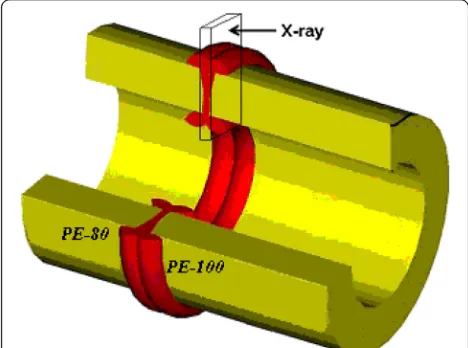
The amorphous and amorphous-crystalline structure peculiarities of 80 and 100 specimens, as well as PE-80/PE-100 welds (Fig. 2) have been investigated by wide-angle X-ray scattering (WAXS) method using DRON-4-07 diffractometer (Burevestnik, Saint Petersburg, Russia), whose X-ray optical scheme was used to “pass” primary-beam radiation through samples.
The heterogeneous structuring of these polymeric systems (at the nanometer level) was studied via small-angle X-ray scattering (SAXS) with a CRM-1 camera (Orel scientific equipment factory, Russia), having a slit collimator of the primary irradiation beam made via the Kratky method. The geometric parameters of the camera satisfied the condition of infinite height of the primary beam [10].
All X-ray structural investigations have been carried out using CuКα-emission monochromated by using
Ni-filter, at temperatureT= 20 ± 2 °C.
One millimeter thick specimens have been cut out of the welded joint as it is shown on Fig. 3. Such speci-mens have been investigated in their original plate
shape (PE-80/PE-100) as well as in crushed to 1 × 1 mm size pieces mode (PE-80/PE-100 randomized). Structural organization of the initial polyethylene types PE-80 and PE-100 have been investigated in various directions, and diffraction patterns identical to each other were observed.
Thermal properties of the welds have been explored by means of differential scanning calorimetry (DSC) with TA Instruments DSC Q2000 (USA) in the inert nitrogen atmosphere under temperatures from 40 to 200 °C with linear heating rate 20 °C/min.
Thermal stability and thermal-oxidative degradation of welds have been investigated using TA Instruments TGA Q50 (USA) in dry air environment at temperatures from 30 to 700 °C with linear heating rate 20 °C/min. Thermomechanical behavior and deformation character-istics of welds have been investigated using TA Instru-ments TMA Q400 EM (USA) in dry air environment at 5 °C temperature modulation regime with heating rate 10 °C/min at temperatures from 30 to 250 °C. Measure-ments have been carried out in thermal expansion mode. Cylinder-shaped indenter with 2.8 ± 0.01 mm diameter has been used with loading on the specimen (10–1MPa). All the devices from TA Instruments have been certified according to the international standard ISO 9001:2000.
All investigations were repeated two times with differ-ent specimens for each time to enhance an accuracy of the measurements.
Results and discussion
Previously, it was reported [9] that WAXS diffraction analysis of PE-80, PE-100, and PE-80/PE-100 welds showed that all of them have amorphous-crystalline structure (Fig. 3), and the welding of dissimilar types of polyethylene gives a joint with texturized crystalline
Fig. 1Welded joint of PE-80 and PE-100 polyethylene pipe types
Fig. 2Scheme of welded joint of PE-80/PE-100 polyethylene pipe types with position of a sample for X-ray study
[image:2.595.304.538.88.259.2] [image:2.595.57.293.88.211.2] [image:2.595.56.290.524.698.2]Effective size (L) of the polymer systems crystallites has been evaluated using Scherer’s method [12]:
L¼ Kλ βð cosθmaxÞ−1;
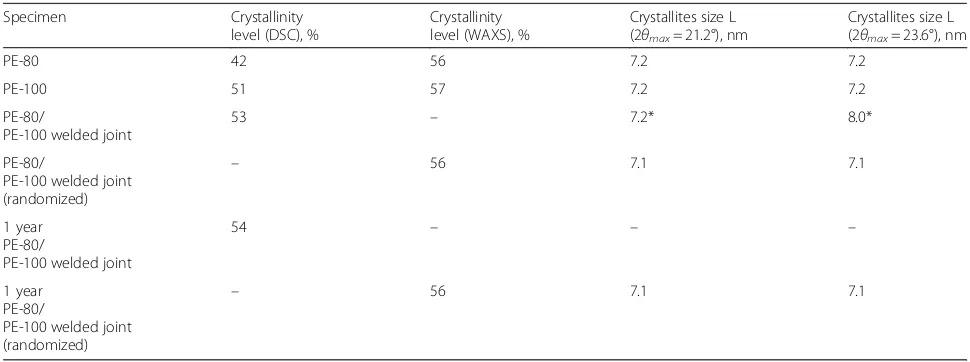
where К is the constant depending on the crystallites shape (if the shape is not determinedК= 0.9), andβthe is angular half-width (width on the half of height) of dif-fraction maximum. This evaluation has shown that the average value forLis 7.2 nm for PE-80 and PE-100, and 7.1 and 7.6 nm for systems (PE-80/PE-100 randomized) and (PE-80/PE-100), respectively. For the PE-80/PE-100 randomized welded joints studied after 1 year, L is 7.1. These calculated sizes of crystallites at different diffrac-tion maxima for each specimen are presented in Table 1. For detailed analysis of PE-80/PE-100 welded joint structural organization, the experimental X-ray diffracto-gram has been compared with calculated diffractodiffracto-gram of mechanical mixture of PE-80 and PE-100 specimens (in the absence of interaction between them) [9]. The calculation was done assuming that components (both types of polyethylene) have additive effect on the diffrac-tion pattern:
both types of polyethylene in PE-80/PE-100 welded joint.
Using Matthews’s method [13], the relative level of crystallinity (Xcr) has been evaluated:
Xcr¼QcrðQcrþQamÞ1⋅100;
where Qcr—area of diffraction maxima characterizing the crystalline structure of polymers; Qcr+Qam—total area of diffraction pattern in the interval of scattering angles (2θ1÷2θ2), in which amorphous-crystalline struc-ture of polymer is revealed. The relative level of crystal-linity has been also calculated from the DSC curves using the following equation:
Xcr¼ΔΔHm
Hm⋅
100%;
whereΔH°m—enthalpy of melting for completely crystal-lized polymer (for polyethylene ΔH°m= 286.7 J/g);
ΔHm—enthalpy of melting of polymer, experimentally obtained from DSC curve.
[image:3.595.55.540.543.724.2]This evaluation has shown that for both types of poly-ethylene as well as for the randomized specimen of welded joint the crystallinity level is practically the same (Table 1).
Table 1Structural characteristics of PE-80 and PE-100 polyethylene and of PE-80/PE-100 welded joint
Specimen Crystallinity
level (DSC), %
Crystallinity level (WAXS), %
Crystallites size L (2θmax= 21.2°), nm
Crystallites size L (2θmax= 23.6°), nm
PE-80 42 56 7.2 7.2
PE-100 51 57 7.2 7.2
PE-80/
PE-100 welded joint
53 – 7.2* 8.0*
PE-80/
PE-100 welded joint (randomized)
– 56 7.1 7.1
1 year PE-80/
PE-100 welded joint
54 – – –
1 year PE-80/
PE-100 welded joint (randomized)
– 56 7.1 7.1
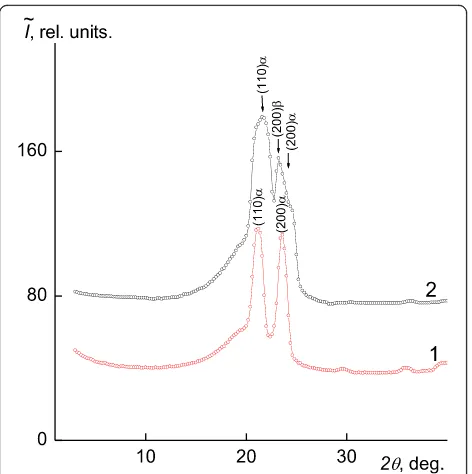
WAXS analysis of welded joints X-ray diffraction patterns made immediately after the welding process and 1 year later shows that relaxation process occurs in the welded joint crystalline structure (Fig. 4). Under this process, the α-form crystalline modification transforms into mixed αβ-form. This process is revealed on the welded joint diffraction pattern with three diffraction maxima at 2θm= 21.50°, 23.17°, and 23.90°, inherent to orthorhombic and monocline structure of polyethylene systems [14].
Detected peculiarities of PE-80 and PE-100 types of polyethylene and of PE-80/PE-100 welded joint are of interest for investigation of their structure heterogeneity. Analyzing the SAXS profiles of PE-80, PE-100, and PE-80/PE-100 welded joint (presented in Fig. 5 as Ĩ dependence on q, as well ass3Ĩ ons3, in accordance to works [15, 16], whereĨis the scattering intensity without consideration of collimation correction, andqis equal to (4π/λ)sinθ= 2πs), it was determined that all these speci-mens are characterized with heterogeneous structure,
Fig. 4WAXS diffraction patterns of PE-80/PE-100 welds, received immediately after the welding process (1) and in 1 year after the welding (2)
Fig. 5SAXS intensity profiles for PE-80, PE-100, and PE-80/PE-100 welded specimens, received immediately after the welding process and in 1 year after the welding
a
b
[image:4.595.57.293.86.323.2] [image:4.595.303.540.90.322.2] [image:4.595.58.542.534.715.2]PE-80, PE-100, and PE-80/PE-100 profiles of intensity of welds specimens (Fig. 5). Average valueDof alterna-tion (in the volume of polymer) of heterogeneity areas with similar density (distance between the nearest centers of area with similar density), according to Bragg equation (considering “sinus law” for small angles (2sinθ=sin2θ=2θ) [11]:
D¼λ=2θm;
for the welded joint is equal to approximately 27 nm. Evaluation of effective size of existing areas of hetero-geneity in the volume of PE-80, PE-100, and PE-80/PE-100 welded specimens was performed by calculating of such a structural parameter as the range of heterogen-eity lp [15, 16]. This parameter is directly connected to the average diameter of areas of heterogeneity in two-phase system (<l1>i<l2>):
lp¼φ2<l1>¼φ1<l2> ;
whereφ1, φ2—volume parts of micro-areas (φ1+φ2= 1). It was detected thatlpvalue in the PE-80/PE-100 welded joint (lp= 20 nm) is bigger comparing with pure PE-80 (lp=16 nm) and PE-100 (lp=18 nm) specimens. In addition, it was found that heterogeneous structure of PE-80/PE-100 weld has not changed after 1 year (Fig. 5).
nical (Fig. 7) analysis.
Temperature of oxidation degradation (Td) and maximum of oxidation degradation intensity (Td max.) of 1-year old PE-80/PE-100 welded joint (Table 2) have been defined from the thermogravimetric curves. It is clear that thermal stability decreases with time, most probably, due to the relaxation of the texturized area formed during the welding and to the transfer of the polymer material in this area to the initial status of pipe materials.
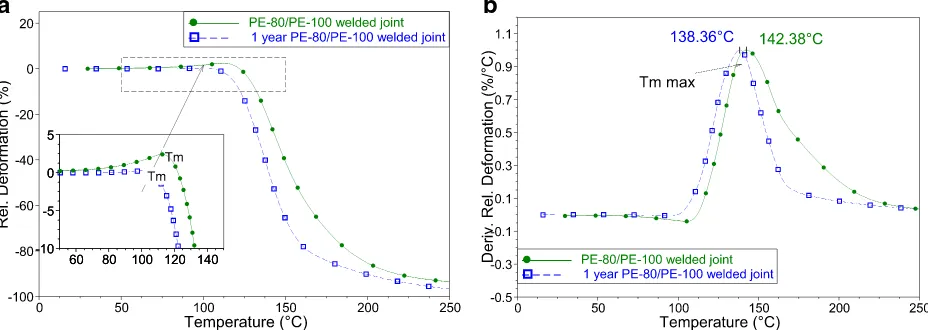
Thermomechanical behavior of the initial and aged welded joints is similar. The deformation of specimens is a result of polymer melting and the features of melting (described by deformation curves) reflect the changes of crystalline phase occured during welding and further aging. As it is seen from Fig. 7, the onset temperature (Tm) intensive deformation, as well as the maximum (Tm
max.) of intensive deformation of PE-80/PE-100 weld de-crease with time (Table 2). Tm and Tm max are parame-ters of the melting process of polymer at heating during TMA experiment, the specimen deformation occurs with melting of polymer. The differences in values ofTm and Tm max exists due to relaxation in time of polymer in the textured zone of the welded joint, and, probably, to transfer of its structure to the equilibrium state.
a
b
[image:5.595.305.538.98.150.2] [image:5.595.66.530.550.715.2]Conclusions
The paper presents results of the investigation of struc-ture relaxation and thermal properties of 80 and PE-100 polyethylene hot-tool butt welds. It was found that during the welding of dissimilar types of polyethylene a process of re-crystallization of crystalline phase of the weld structure is observed. It is shown that within a long period (one-year) not only amorphous but also the crystalline phase relaxes (crystalline α-form transforms into mixedαβ-form). These features become apparent in relaxation of thermal and thermomechanical properties as well. Decreasing of the oxidative degradation onset and temperature maximum with time, as well as inten-sive deformation onset conditioned by polymer melting are revealed.
Acknowledgements
Submitted results were obtained during the fulfillment of the budget supported project in the Plastics Welding Department of the E.O.Paton Electric Welding Institute of the NAS of Ukraine.
Authors’contributions
VD and MI wrote the manuscript. VD fulfilled the WAXS and the SAXS investigations and analysis of the WAXS and the SAXS data. MI and AS provided valuable discussions and contributed in results analysis comparing to the structural peculiarities of the samples. AG performed butt fusion welding of PE pipes. All authors read and approved the final manuscript.
Authors’information
VD is PhD in Polymer Physics, staff researcher at the Plastics Welding Department of the E.O.Paton Electric Welding Institute of the NAS of Ukraine and at the Institute of Macromolecular Chemistry of the NAS of Ukraine. MI is Doctor in Physics, Head of Department, Plastics Welding Department of the E.O.Paton Electric Welding Institute of the NAS of Ukraine, and senior staff scientist at the Institute of Macromolecular Chemistry of the NAS of Ukraine. AS is PhD in Technical Sciences, staff researcher at the Plastics Welding Department of the E.O.Paton Electric Welding Institute of the NAS of Ukraine. AG is the leading engineer at the Plastics Welding Department of the E.O.Paton Electric Welding Institute of the NAS of Ukraine.
Competing interests
The authors declare that they have no competing interests.
Publisher’s Note
Springer Nature remains neutral with regard to jurisdictional claims in published maps and institutional affiliations.
Received: 29 December 2016 Accepted: 7 April 2017
References
1. Yuhnevsky PI, Shirokii GT (2004) Building materials and products: Schoolbook. UP «Tehnoprint», Minsk, in Russian
2. Galchun A, Korab N, Kondratenko V, Demchenko V, Shadrin A, Anistratenko V, Iurzhenko M (2015) Structural features and thermal characteristics of welded joints of technical polyethylenes. Polym J 37:242–248, in Ukrainian 3. Alpern VD (2002) What shoud be known about the pipes’polyethylene. Eng
Netw Made Polym Mater 2:5–9, in Russian
4. Ryzhov V, Kalugina Y, Biserova N, Kazakov Y (2011) Polyethylene of pipe types. Structure and properties. Polymeric pipes 34:56–60, in Russian 5. Gorilovskiy M, Gvozdev I (2008) Pipe type of polyethylene PE 100 main
technical requirements and their development. Polymeric Pipes 22:47–50, in Russian
6. Pipe polyethylene import to Ukraine market review 2013. Polymeric pipes– Ukraine (2013) 29:18–22, in Russian
7. Volchenko VN (1991) Welding and weldable materials. Metallurgy, Moscow (in Russian)
8. Volkov SS, Ya CB (1987) Welding of plastics. Chemistry, Moscow, in Russian 9. Galchun A, Korab N, Kondratenko V, Demchenko V, Shadrin A, Anistratenko
V, Iurzhenko M (2015) Nanostructurization and thermal properties of polyethylenes’welds. Nanoscale Res Lett 10:138–149
10. Kratky O, Pilz I, Schmitz PJ (1966) Absolute intensity measurement of small-angle x-ray scattering by means of a standard sample. J Colloid Interface Sci 21:24–34
11. Lipatov YS, Shilov VV, Gomza YP, Kruglyak NE (1982) Radiographic methods of investigations of polymers. Naukova Dumka, Kiev, in Russian
12. Gin’e A (1961) X-Ray Diffraction of Crystals. Theory and Practice. Fizmatgiz, Moscow, in Russian
13. Shtompel’VI, Yu K (2008) Structure of Linear Polyurethanes. Naukova dumka, Kiev, in Russian
14. Russell KE, Hunter BK, Heyding RD (1997) Monoclinic polyethylene revisited. Polymer 38:1409–1414
15. Ruland W (1971) Small-angle scattering of two-phase systems:
determination and significance of systematic deviations from Porod’s law. J Appl Cryst 4:70–73
16. Perret R, Ruland W (1971) Eine verbesserte Auswertungsmethode fur die Rontgenkleinewin-kelstreuung von Hochpolymeren. Kolloid Z–ZPolymere 247:835–843
Submit your manuscript to a
journal and benefi t from:
7 Convenient online submission
7Rigorous peer review
7 Immediate publication on acceptance
7Open access: articles freely available online
7 High visibility within the fi eld
7Retaining the copyright to your article