International Journal of Emerging Technology and Advanced Engineering
Website: www.ijetae.com (ISSN 2250-2459, ISO 9001:2008 Certified Journal, Volume 9, Issue 2, February 2019)
118
A Review on Digital Video Watermarking for Hardware
Implementation
Pendli Pradeep
1, Krishnabhart
21,2
Assistant Professor & SNIST
Abstract— A video sequence consists of a series of consecutive and equally time-spaced still images. Video watermark imposes real or near real-time watermarking system Water Marking techniques are divided into three different types first one is visible, second one is invisible robust and finally invisible fragile. The watermark can be detected or extracted later to claim the authenticity of the media content. The watermarking techniques are suitable for real time video digital Water Marking implemented using
software and hardware platforms, The hardware
implementation offers few distinct advantages over the software implementation in terms of less area usage, reliability and low power consumption. It features real time
capabilities and compact implementations.
Keywords— Watermarking, DCT,
I. INTRODUCTION
About Digital watermarking was explained at the end of the 20th century to provide the enforcing copyright data i.e. audio, text and video Protection once the use.
In a few years ago it was explained there is exist a complex interchange in-between three parameters watermarking (digital): data payload, fidelity and robustness. The data payload is a collection of information, i.e. the number of bits that is encoded by the watermarking. The fidelity is a property that watermark is told about: the distortion, which the watermarking process was bound to introduce, should remain difficult to a human observer. Finally, the robustness of a digital watermarking scheme is explained about the ability of the detector to get the hidden watermark from some remain watermarked data. The robustness is often calculated via the survival of the watermarking after attacks. Those three parameters are warfare and a difficult has to be found.
The digital watermarking very important and it is the process of collecting of an additional, identifying information in the multimedia object, such as text information, audio information, image information, or video information. By adding a transparent watermark to a multimedia collection, it is only possible thing when needed to detect hostile alterations, and is used to check the integrity and the ownership of the digital multimedia.
Now a days, digital video Water marking technique is widely used in different video applications. For video authentication, Water Marking tells that the true information has not been neutered. Water Marking is used in fingerprinting applications to trace back user and also in a copy control system with Water Marking capability to avoid unauthorized copying. Because it is important in commercial applications, present digital Water Marking techniques have concentrated on media data and particularly on video information. Over the decade years, researchers have investigated the integrating the process of a visible or invisible digital watermark into raw digitalized video, uncompressed digitalized video using both software and hardware platform. Reverse to still image Water Marking techniques, latest problems and new challenges have gained in video Water Marking applications. Shoshan presented an overview of the various existing video Water Marking techniques and showed the features and specific requirements, possible applications, benefits, and drawbacks.
II. PREVIOUS WORK ON VIDEO WATERMARKING A. Robustness Level of WM for Video
International Journal of Emerging Technology and Advanced Engineering
Website: www.ijetae.com (ISSN 2250-2459, ISO 9001:2008 Certified Journal, Volume 9, Issue 2, February 2019)
119
[15] Rafiullah Chamlawi, Asifullah Khan, Adnan Idris, and Zahid Munir has proposed A secure Semi-Fragile Watermarking Scheme for Authentication and Recovery of Images based on Wavelet Transform we propose a secure semi-fragile watermarking, with a choice of two watermarks to be embedded. This technique operates in integer wavelet domain and makes use of semi fragile watermarks for achieving better robustness. A self-recovering algorithm is employed, that hides the image digest into some Wavelet sub bands to detect possible malevolent object manipulation undergone by the image (object replacing and/or deletion). The Semi-fragility makes the scheme tolerant for JPEG lossy compression as low as quality of 70%, and locate the tempered area accurately. In addition, the system ensures more security because the embedded watermarks are protected with private keys. The computational complexity is reduced using parameterized integer wavelet transform. Experimental results show that the proposed scheme guarantees the safety of watermark, image recovery and location of the tempered area accurately[16] Andrew Rukhin, Juan Soto, James Nechvatal, Miles Smid, Elaine Barker, Stefan Leigh, Mark Levenson, Mark Vangel, David Banks, Alan Heckert, James Dray, San Vo has proposed A statistical test suite for random and pseudorandom number generators for cryptographic applications discusses some aspects of selecting and testing random and pseudorandom number generators. The outputs of such generators may be used in many cryptographic applications, such as the generation of key material. Generators suitable for use in cryptographic applications may need to meet stronger requirements than for other applications. In particular, their outputs must be unpredictable in the absence of knowledge of the inputs. Some criteria for characterizing and selecting appropriate generators are discussed in this document. The subject of statistical testing and its relation to cryptanalysis is also discussed, and some recommended statistical tests are provided. These tests may be useful as a first step in determining whether or not a generator is suitable for a particular cryptographic application. However, no set of statistical tests can absolutely certify a generator as appropriate for usage in a particular application, i.e., statistical testing cannot serve as a substitute for cryptanalysis.
b. Past Research on Video Watermarking
In the last few years ago, research effort has been concentrated on efficient Water Marking system implementation using hardware and software platforms. For example, Strycker proposed a well-known video Water Marking technique, called just another watermarking system (JAWS), for TV broadcast monitoring and implemented the system on a Philips’s Trimedia TM-1000 very long instruction word (VLIW) processor. The experimental results showed the feasibility of WM in a TV broadcast monitoring system. Mathai presented an ASIC implementation of the JAWS WM algorithm using 1.8 V, 0.18-μm CMOS technology for real-time video stream embedding. With a core area of 3.53 mm2 and an operating frequency of 75 MHz, that chip implemented WM of raw digital video streams at a peak pixel rate of over 3 Mpixels/s while consuming only 60mW power. A new real-time WM VLSI architecture for spatial and transform domain was presented by Tsai and Wu. Maes presented the millennium WM system for copyright protection of DVD video information and some specific issues, such as watermark detect location and copy generation control, were also explained in their work.
An easy way to comply with the conference paper formatting requirements is to use this document as a template and simply type your text into it.
III. DIFFERENT METHODS FOR VIDEO WATERMARKING
Watermarking System
International Journal of Emerging Technology and Advanced Engineering
Website: www.ijetae.com (ISSN 2250-2459, ISO 9001:2008 Certified Journal, Volume 9, Issue 2, February 2019)
[image:3.612.69.262.148.308.2]120
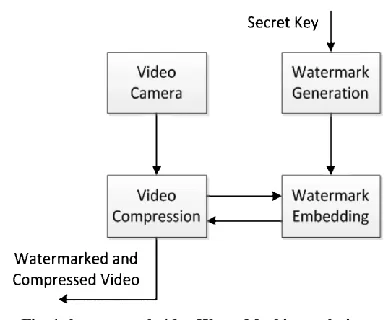
a. Video compressionFig. 1.the proposed video Water Marking technique
Fig.1 shows the hardware implementation of the invisible semifragile WM system for video information authentication. The main theme here is to integrate the video information WM system with a surveillance camera with video recorder for real-time WM in the source end. This work is the first semifragile watermarking section for video information streams with hardware architecture. Tsung-Li Wu and S. Felix Wu has proposed a technique with MPEG (ISO Moving Picture Expert Group) is a compression for video processing and this is commonly used in media application, e.g. VOD (video on demand), HDTV (High Definition Television), and DVD (Digital Video Disk). Two things Confidentiality [MS95, AG96] and Copyright protection [HG96] are security-related issues that tells how it is recently brought more attentions, specially when the MPEG bit streams are transmitted on the public Internet. Well-known selective watermarking technique is MPEG bit streams. Selective encryption and decryption approach are proposed and it avoids encrypting the complete MPEG bit-stream
b. Watermark generation
According to the recommendations by Dittman et al. in [11] for the feature scope of a digital video information watermarking, a primitive video information watermark pattern can define as a meaningful identifying sequence for every video frame.
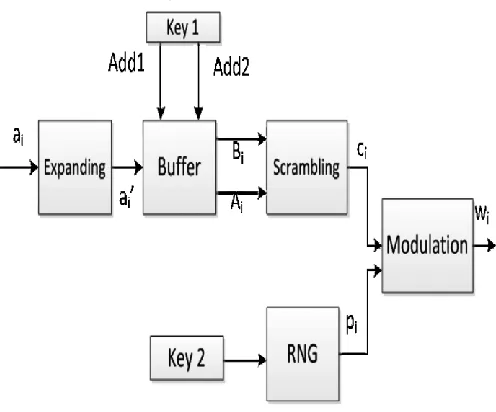
[image:3.612.327.561.428.622.2]As shown in Fig. 3, the unique meaningful watermarking data information for each video frame contain the time information, date information, camera ID information, and frame serial number (that is related to its creation) information. It will be establishing a unique relationship of the digital video information stream frames with the time instant, the specific video camera as well as the frame number. Any manipulation, such as frame exchange, cut, and substitution, will be detected by the specific watermarking. The corresponding N-bit (64-bit) binary valued pattern, can be used as a primitive watermarking sequence. it would generate a different digital watermark for every frame (time-varying) because of the instantaneously changing serial number information and time information. The block diagram of the proposed novel digital watermarking generator is displayed in Fig. 4. A secure watermarking pattern is generated by well performing expanding, scrambling, and modulation on a primitive watermarking sequence. There are two types of digital secret keys present: Key 1 is used for do scrambling and Key 2 is used to generate the random number generator (RNG) module that generates a pseudorandom sequence. Key 1 initiates the scrambling process by two different addresses (Add1 and Add2) of the buffer for having the XOR operation in between both
International Journal of Emerging Technology and Advanced Engineering
Website: www.ijetae.com (ISSN 2250-2459, ISO 9001:2008 Certified Journal, Volume 9, Issue 2, February 2019)
[image:4.612.50.298.130.336.2]121
Fig. 3. Block diagram of the proposed WM.
The watermark embedding approach technique is designed to be performed in the DCT domain Compression is divided into three elementary phases: DCT transformation, quantization, and Huffman encoding This Water Marking algorithm, it is capable of inserting a semi fragile invisible watermarking in a compressed image in the DCT frequency domain, was modified and then applied in watermarking of a video stream. In general, for each DCT lock of a video frame, N cells need to be identified as ―watermark able‖ and modulated by the watermark sequence. The chosen cells contain nonzero DCT coefficient values and are found in the mid-frequency range. This algorithm was detailed by Shoshan the proposed Water Marking algorithm along with MPEG-2 video encoding standard is presented as a flow chart This can be described as follows.
IV. PROPOSED ALGORITHM FOR VIDEO WATERMARKING
1) Split I frame and watermarking data bit stream into 8 × 8 blocks.
2) For each 8×8 block (both watermarking data and I frame), perform DCT, quantization, and zig–zag scan to generate quantized DCT coefficients.
3) Identify N watermarkable cells for each block of it and calculate the modification value for each selected cell. 4) Modify the identified watermarkable DCT coefficients according to required modification values.
5) Perform inverse DCT and inverse quantization for each and every 8 × 8 block watermarked coefficient to reconstruct the original I pixel values.
6) Buffer the reconstructed watermarked I frame.
7) Perform motion estimation for B/P frames to obtain the motion vector.
8) Using the motion vector and reconstructed watermarked and I frame motion compensation is done.
9) Difference between the motion-compensated prediction frame and the watermarked reference frame I is the prediction error
10) Perform DCT, quantization, and zig–zag scan on the prediction error.
11) Perform entropy coding for the blocks of the different frames.
12) Generate compressed and watermark embedded video steam.
13) To avoid heavy computationally demanding operations and to simplify the hardware implementation, watermarking can be done with MJPEG standard video compressing unit. Since watermark is only embedded on, I frames, the steps stated above will be the same for the MJPEG video standard except for the motion estimation and motion compensation.
[image:4.612.322.575.460.639.2]International Journal of Emerging Technology and Advanced Engineering
Website: www.ijetae.com (ISSN 2250-2459, ISO 9001:2008 Certified Journal, Volume 9, Issue 2, February 2019)
122
V. CONCLUSIONMany techniques are existing to implement hardware systems for video watermarking In this paper the operation, pros and cons of several software and hardware implementations are proposed among these two implementation hardware implementation is best suited over the software implementation because it has some advantages in terms of low power consumption, less area usage and reliability. Three main categories of Water Marking can be identified: Fragile, Semi-fragile and Robust. A fragile Water Marking is a user wishes to directly authenticate that the image information he is observing is exactly the same as it was when the Water Marking was first embedded. This may be the case in applications where raw data is mostly used as efficient to use a semi-fragile algorithm which is designed to withstand certain legitimate modifications, but to detect malicious ones. Video authentication is application of video watermarking and purpose these is Insuring that the original content has not been altered. The implementation of hardware WM is usually done on custom-designed circuitry, i.e. application specific integrated circuits (ASICs) or field programmable gate arrays (FPGAs). In this we use compressed standards in hardware implementations of WM techniques demand the flexibility of implementation both in the computation and design complexity. The algorithm must be carefully designed, minimizing any unexpected deficiencies and JAWS is a well-known video WM algorithm and because it works on uncompressed real time video data, the author was allowed to concentrate on the watermark process and not on the compression issues.
REFERENCES
[1] A. D. Gwenael and J. L. Dugelay, ―A guide tour of video watermarking,‖
[2] Signal Process. Image Commun., vol. 18, no. 4, pp. 263–282, Apr. 2003.
[3] Y. Shoshan, A. Fish, X. Li, G. A. Jullien, and O. Yadid-Pecht, ―VLSI watermark implementations and applications,‖ Int. J. Information Technol. Knowl., vol. 2, no. 4 pp. 379–386, Jun. 2008. [4] X. Li, Y. Shoshan, A. Fish, G. A. Jullien, and O. Yadid-Pecht,
―Hardware implementations of video watermarking,‖ in International Book Series on Information Science and Computing, no. 5. Sofia, Bulgaria: Inst. Inform. Theories Applicat. FOI ITHEA, Jun. 2008, pp. 9–16 (supplement to the Int. J. Inform. Technol. Knowledge, vol. 2, 2008)
[5] A. Shan and E. Salari, ―Real-time digital video watermarking,‖ in Proc. Dig. Tech. Papers: Int. Conf. Consumer Electron., Jun. 2002, pp. 12–13.
[6] N. J. Mathai, A. Sheikholesami, and D. Kundur, ―Hardware implementation perspectives of digital video watermarking algorithms,‖ IEEE Trans. Signal Process., vol. 51, no. 4, pp. 925– 938, Apr. 2003.
[7] N. J. Mathai, A. Sheikholesami, and D. Kundur, ―VLSI implementation of a real-time video watermark embedder and detector,‖ in Proc. Int. Symp. Circuits Syst., vol. 2. May 2003, pp. 772–775.
[8] M. Maes, T. Kalker, J. P. Linnartz, J. Talstra, G. Depoyere, and J. Haitsma, ―Digital watermarking for DVD video copy protection,‖ IEEE Signal Process. Mag., vol. 17, no. 5, pp. 47–57, Sep. 2000. [9] I. E. G. Richardson, H.264 and MPEG-4 Video Compression.
Chichester, U.K.: Wiley, 2003.
[10] A. ANITHA RANI &A. KIRTHIKA,’’ A Novel Digital VideoWatermarking Algorithm for Video Authentication‖, International Journal of Scientific & Engineering Research, Volume 4, Issue 5, May-2013 ISSN 2229-5518.
[11] J. Dittmann, T. Fiebig, R. Steinmetz, S. Fischer, and I. Rimac, ―Combined video and audio watermarking: Embedding content information
[12] in multimedia data,‖ in Proc. SPIE Security Watermarking Multimedia Contents II, vol. 3971. Jan. 2000, pp. 455–464. [13] F. Petitcolas, R. J. Anderson, and M. G. Kuhn, ―Information hiding:
a survey,‖ Proc. IEEE, vol. 87, no. 7, pp. 1062–1078, 1999. [14] S. P. Mohanty, ―A secure digital camera architecture for integrated
realtime digital rights management,‖ J. Syst. Architecture, vol. 55, nos. 10– 12, pp. 468–480, Oct.–Dec. 2009.
[15] S. P. Mohanty and E. Kougianos, ―Real-time perceptual watermarking architectures for video broadcasting,‖ J. Syst. Softw., vol. 84, no. 5, pp. 724–738, May 2011.
[16] Mustafa Osman Ali and Rameshwar Rao,‖Digital Image Watermarking Basics, and Hardware Implementation,‖ International Journal of Modeling and Optimization, Vol. 2, No. 1, February 2012. [17] Rafiullah Chamlawi, Asifullah Khan, Adnan Idris, and Zahid Munir,‖ A Secure Semi-Fragile Watermarking Scheme for Authentication and Recovery of Images based onWavelet Transform,‖ World Academy of Science, Engineering and Technology 23 2008
[18] Andrew Rukhin, Juan Soto, James Nechvatal, Miles Smid, Elaine Barker, Stefan Leigh, Mark Levenson, Mark Vangel, David Banks, Alan Heckert, James Dray, San Vo,‖ A statistical test suite for random and pseudorandom number generators for cryptographic applications,‖ NIST Special Publication 800-22 (with revisions dated May 15, 2001.