Munich Personal RePEc Archive
Social policies and trust in the social
security system
Tamilina, Larysa
Independent Research
1 January 2012
Online at
https://mpra.ub.uni-muenchen.de/96519/
SOCIAL POLICIES AND TRUST IN THE SOCIAL SECURITY SYSTEM
Larysa Tamilina
Independent Research
Diakogianni Str. 7
Marousi Athens
15126 Greece
Phone: +30 210 7777640
E-mail: [email protected]
2012
Author Note
Correspondence concerning this paper should be addressed to Larysa Tamilina (E-mail:
1. Data source and method of analysis
This extended analysis investigates the relationship between social policies and only one
element of institutional trust, namely trust in social security systems. The main scope of this
investigation consists in comparing the patterns of the relationship with relevant social spending
between institutional trust and trust towards social security systems. The data come from the
European Quality of Life Survey which was launched by the European Foundation for the
Improvement of Living and Working Conditions in 2003.
The survey covers a range of questions mainly aimed at assessing quality of life in 28
European countries from a different perspective. The survey examines the quality of life in core
life domains covering a broad spectrum of circumstances in the surveyed countries. Generally
speaking, the EQLS explores both subjective and objective aspects of quality of life in major areas
that shape living conditions and opportunities for individuals. This survey also contains a
traditional question on generalized trust and a question on the trust of individuals towards social
security systems. We include in the sample only those countries which are present in the previous
analysis. Moreover, the choice of countries is stipulated by the availability of data on different
aspects of welfare state development. The final sample includes Austria, Belgium, Denmark,
Finland, France, Germany, the United Kingdom, Ireland, Italy, the Netherlands and Sweden with
the total amount of observations equal to 11,149.
The main research method used for the analysis is an ordered multilevel logit of the
following form: ologit = β0 + β1 Xij + β2 Zj , where X are the individual-level characteristics and Z
are country-level characteristics. The final model will take the following form wthat again will
Where X is the set of individual-level control variables and Welfare_State is the main
independent variable at the second level that again will sequentially include measures of all three
dimensions of the proposed multidimensional approach to describing welfare state development.
Operationalization of the dependent variables in the EQLS is done in the following way.
Institutional trust is limited to trust towards social security systems and measured with the relevant
question, with answers based on a four point scale, ranging from ‘great deal’ to ‘no trust at all’.
As in the previous case, we control for individual level characteristics that are selected
based on the theory about social trust determinants provided in subchapter 2.2. as well as on the
data availability in the EQLS. The final list of individual-level control variables includes gender,
employment status, volunteering, religiousness, socializing, education level, income, age,
optimism level, and the perception of safety in the living area.
To control for gender, we include a male dummy that takes a value of 1 if the respondent
is male and 0 if female. Employment status reflects whether the respondent is unemployed or not.
It takes a value of 1 if he or she is unemployed at the moment the survey was conducted and 0 if
the respondent is employed. The education variable measures the highest degree of education the
respondent has and is grouped into three categories: ‘primary’, ’secondary’, and ‘university’.
Religiosity is defined on the basis of the self-rated frequency of church attendance ranging from 1
as ‘more than once a week’ to 7 as ‘never’. Optimism is operationalized on the basis of the self
perception of an individual about his or her optimism level. The answers range from ‘agree
completely’ to ‘disagree completely’. Socializing reflects how often an individual meets with
friends and ranges from ‘more than once a day’ to ‘less than several times per year’. Volunteering
is operationalized on the basis of a question about the time spent on volunteer activities and varies
from ‘too much’ to ‘too little’. The age variable reflects the actual age of the respondent at the
time the survey was conducted and is combined into three categories: ‘16 –29’, ‘30 –44’, ‘45 and
more’. The income variable is grouped into four quintiles of OECD equivalent household incomes.
As in the previous case, we distinguish between the three dimensions formed around
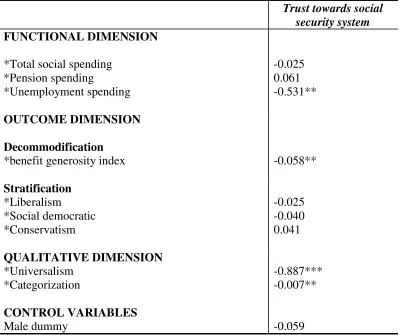
functional, outcome, and qualitative axes. The results of the analysis are summarized in the table
[image:5.612.108.507.383.718.2]below.
Table 1.: The effects of welfare states on trust towards social security systems in a multidimensional approach.
Trust towards social security system
FUNCTIONAL DIMENSION
*Total social spending *Pension spending *Unemployment spending -0.025 0.061 -0.531** OUTCOME DIMENSION Decommodification
*benefit generosity index -0.058**
Stratification *Liberalism *Social democratic *Conservatism -0.025 -0.040 0.041 QUALITATIVE DIMENSION *Universalism *Categorization -0.887*** -0.007** CONTROL VARIABLES
Unemployed dummy 0.000
Volunteering -0.066
Religiousness 0.066***
Socializing 0.059***
Education Low Middle Higher Ref/category 0.022 -0.288*** Income 1st quintile 2nd quintile 3rd quintile 4th quintile
Ref/category -0.075
-0.135** -0.084
Age 16 – 29 30 – 44 44 and more
Ref/category 0.238*** -0.150**
Optimism 0.456***
Safe 0.178***
Before proceeding to the analysis of the dimensions, one should say that the inclusion in
the model of the proposed measures of welfare state development helps explain only a small
portion of the total variance. This is possibly due to the fact that there is a small variance of social
trust levels at the second level compared to the first level. More specifically, only 3.6 percent of
the total variance is attributed to the country level, while the rest of the variation occurs at the
individual (first) level. However, controlling for welfare state development helps reduce variance
When analyzing the proposed three dimensions, a straightforward conclusion is that
welfare states are rather neutral in their influence on trust in social security systems since most of
the coefficients on the measures of welfare state development are not statistically significant.
However, this should be taken with some caution since the small number of cases at the second
level, namely the number of countries included in our analysis, may contribute to the failure of
their significance test. We hence refer to the coefficients’ sign and values regardless of their
significance level.
2. The functional dimension
The analysis of the functional dimension supports the plausibility of policy specific
effects to some extent. Relating total social spending to trust in social security systems among the
whole population points out that in general, crowding-in effects can be expected. Hence, social
policy can be expected to generate confidence is social security systems. The support of an
individual’s wellbeing through a social security system tends to generate positive feelings not only
among its direct recipients but also among the whole population. The redistributive effect of
welfare state activities leads to less inequality and hence more trust towards such systems.
Likewise, the replacement of lost sources of income by social provisions plays a crucial role in
defining trust levels compared to the negative effects expected of from the traditional assumption
about erosion of trust through volunteering.
When limiting the sample only to pensioners, the results partially support the idea about
policy specific effects, although the significance test fails to prove them. Relating spending on
that the state supports retired people through providing them with a source of income does not
generate higher regards about the state or higher confidence in social security systems. The nature
of these effects remains however unexplained while the negative mechanism of pension spending
on social trust formation still constitutes a ‘black box’. The recent instability in pension systems,
especially in countries with high pension spending, the constant curtailment of pension funds, and
a gradual shift to a multi-pillar system with an increasingly residual role for public pensions mostly
likely undermines the level of trust in social security systems. It is hence possible to argue that
recent changes in pension policy are the main reasons for the negative effects of pension spending
on people’s confidence in social security systems since pension reforms are more often discussed
and implemented in the countries where pension spending is higher.
As far as unemployment spending is concerned, the results advocate for the presence of
crowding-in effects which are also statistically significant. The fact that the state supports
individuals when they have difficulties might play a crucial role in forming trust levels among the
unemployed. Even recent changes in unemployment systems aimed at tightening entitlement
conditions, reducing replacement rates, and shortening the period of payment for unemployment
benefits do not negatively affect confidence of in the welfare state. The positive effect probably
comes as well from the fact that the state does not simply try to reduce unemployment spending
but rather focuses on reducing the duration of unemployment spells by replacing the traditional
passive payment of unemployment benefits with active labor market policies.
The analysis of the functional dimension provides results that advocate for the presence
of policy specific effects. Although the analysis on the basis of different data sources creates some
controversy about the impact of total social spending on social trust among the whole population,
pension spending may be detrimental to general trust in institutions and to trust in social security
systems in particular, whereas unemployment policy tends to enhance trust levels among the
unemployed.
3. The outcome dimension
The analysis of the outcome dimension provides results that differ slightly from what is
found before. Decommodification tends to positively correlate with trust in social security systems.
Moreover, the results are statistically significant, allowing for a statistical inference about the
effects of decommodification on trust in social security systems. The results suggest that welfare
state efforts increase confidence of people in social security systems.
The stratification function of welfare states is found to be rather neutral towards trust in
social security systems since the case of statistical significance is not seen at all. Although the
coefficients are not statistically significant, their signs and the values are in line with the effects of
institutional trust in general. More specifically, preserving existing class structures tends to erode
trust in social security systems. A universal approach aimed at guaranteeing individuals’
independence enhances trust levels. The same impact is seen in liberalism with its stigmatizing
approach to organizing welfare provision.
The analysis based on the EQLS advocates the positive impact that the level of
decommodification and stratification may have on social trust. The supportive attitude of the state
regardless of the type of stratification tends to enhance trusting behavior in society. These results
4. The qualitative dimension
The qualitative dimension again supports the results obtained for institutional trust in
general. More specifically, the positive effects are present for both forms of the institutional design
of benefits schemes. They enhance trust in social security systems regardless of whether they are
non means-tested or means-tested. The positive effects are however stronger for non means-tested
social spending compared to means-tested spending.
The analysis of the qualitative dimension therefore provides results that advocate the
prevalence of crowding-in effects over crowding-out effects. Moreover, these results are consistent
with the previous findings based on the WVS for institutional trust. It is hence possible to say that
trust in social security systems shows a lot of conformity and consistency with institutional trust.
The effects of the different measures of welfare state development on trust in social security
systems are always in line with what is found for institutional trust.
As far as the individual-level control variables are concerned, we find results that are
completely in line with the theory. More religious people tend to have higher scores on trust.
Socializing with friends is also found to enhance trust levels. Education seems to have a strong
impact on trust scores. Less educated and moderately educated people show almost the same levels
of trust. Highly educated people have higher trust in social security systems. Income tends to have
non-linear effects on trust. The effects tend to first increase as income goes up, reaching its peak
in the third quintile and slowing down afterwards. Optimism can also be regarded as a determinant
of trust: optimistic people show more trusting behavior towards social security systems. Trust is
also influenced by the safety level in the area the respondent lives in. High regards of safety are
associated with higher trust levels. Volunteering is found to have no impact on trust in social
variable. Employment status is found to have no effect on trust is social security systems. Gender
has a certain influence on trust: men show more trust in social security systems than women,
although this effect is not statistically significant.
5. Overview and concluding remarks
The main objective of this paper is to analyze the effects of welfare states on trust in social
security systems. The analysis is based on estimating the effects of all three dimensions on one
specific element of institutional trust. The analysis thus demonstrates that there is strong
conformity in the direction and the size of the effects of social policies between institutional trust
and trust in social security systems. Both forms of trust develop the same pattern of relations with
different measures of welfare state development. Trust in institutions can be considered a good
proxy for trust in social security systems. Although it is a synthetic construct, institutional trust
approximates possible changes in levels of trust in social security systems as the result of state
intervention in society in the form of social policies. However, institutional trust must be regarded
as a wider concept compared to trust in social security systems since it is based on confidence in
various public welfare state institutions while including trust in social security systems as one of
BIBLIOGRAPHY
Adelantado, J. and Cuevas, E.C. (2006), “Globalization and the welfare state: the
same strategies for similar problems?”, Journal for European Social Policy, Vol. 16, No. 4,
pp. 374 – 386.
Agresti, A. (1996), An Introduction to Categorical Data Analysis. University of
Florida Press.
Alesina, A. and La Ferrara, E. (2002), “Who trusts others?”, Journal of Public
Economics, Vol. 85. No. 2, pp. 207- 234.
Alesina, A., Devleeschauwer, A., Easterly, W. and Kurlat, S. (2003),
“Fractionalization”, Journal of Economic Growth, Vol. 8, pp. 155-194.
Allport, G. (1961), Pattern and Growth in Personality. New York: Holt, Rinehart
and Winston.
Aust, A. and Arriba, A. (2005), “Towards activation? Social assistance reforms and
discourses”, In: P. Taylor-Gooby (ed) Ideas and Welfare State Reform in Western Europe,
Palgrave Macmillian, pp. 100 - 123.
Babchuk, N. and Booth, Al. (1969), “Voluntary association membership: a
longitudinal analysis”, American Sociological Review, Vol. 34, No. 1, pp. 31-45.
Bambra, C. (2006), “Decommodification and the worlds of welfare revisited”,
Journal of European Social Policy, Vol. 16, No 1, pp. 73-68.
Bannink, D. and Hoogenboom, M. (2007), “Hidden changes: disaggregation of
welfare state regimes for greater insight into welfare state change”, Journal of European
Barber, B (1983), The logic and Limits of Trust. New Brunswick, NJ: Rutgers
University Press.
Bianchi, S., Milkie, M., Sayer, L. and Robinson, J. (2000), “Is anyone doing the
housework? Trends in the gender division of household labor”, Social Forces, Vol. 79, No.
1, pp. 191-228.
Billiet, J. and Cambree, B. (1999), “Social capital, active membership in voluntary
associations and some aspects of political participation”, In: J. Van Deth, M. Maraffi, K.
Newton and P. Whiteley (Eds.), Social capital and European democracy, London:
Routledge, pp. 240-262.
Bjornskov, Ch. (2005), The determinants of trust. Working paper of University of
Aarhus.
Blomberg, H. and Kroll, C. (2002), “Who wants to preserve the ‘Scandinavian
service state’? Attitudes to welfare services among citizens and local government elites in
Finland 1992-1996”, In: S. Svallfors and P. Taylor-Gooby (eds) The End of the Welfare
State? Responses to State Retrenchment, Routledge London and New York, pp. 52 – 86.
Bode, I. (2006), “Disorganized welfare mixes: voluntary agencies and new
governance regimes in Western Europe”, Journal of European Social Policy, Vol. 16, No.
4, pp. 346 – 359.
Boiix, C. and Posner, N. (2005), “Social capital: explaining its origins and effects on
government performance” (on-line: http://www.socialcapitalgateway.org/index.htm).
Bonein, A. and Serra, D. (2007), “Gender bias in trustworthiness”. MPRA Paper No.
Bönker, F. (2005), “Changing ideas on pensions: accounting for differences in the
spread of the multi-pillar paradigm in five EU social insurance countries”, In: P.
Taylor-Gooby (ed) Ideas and Welfare State Reform in Western Europe, Palgrave Macmillian, pp.
81 - 99.
Bonoli, G. (2001), “Classifying welfare states: a two-dimensional approach”,
Journal of Social Policies, Vol. 26, pp. 351 – 372.
Bonoli, G. (2004), “Modernizing post-war welfare states. Explaining diversity in
patterns of adaptation to new social risks”, Paper presented at the 2nd ESPAnet annual
conference, Oxford, September, 2004.
Booth, A. (1972), “Sex and social participation”, American Sociological Review,
Vol. 37, No. 2, pp. 183-193.
Booth, J. and Richard, P. (2001), “Civil society and political context in Central
America”, In: R. Edwards, M. W. Foley and M. Diani, (eds), Beyond Tocqueville: Civil
Society and Social Capital Debate in Comparative Perspective. Tufts University Press, pp.
43 -55.
Bouckaert, G. and Van de Walle, S. (2003), “Comparing measures of citizens trust
and user satisfaction as indicators of good governance: difficulties in linking trust and
satisfaction indicators”, International Review of Administrative Sciences, Vol. 69, pp. 329-
343.
Bourdieu, P. (1980), “Le capital social”. Acte de la recherche en Science Sociales,
Bourdieu, P. (1986), “The forms of capital”, In: Johm G. Richardson (ed.):
Handbook of theory and research for the sociology of education. New York: Greenwood
Press, pp. 241-258.
Branas-Garza, P., Rossi, M. and Zaclicever, D. (2006), “Individual’s religiosity
enhances trust: Latin American evidence for the puzzle”, DECON Working Paper, No.
05/06, 25 p.
Breen, R. and Cook, L. (2005) “The persistence of the gendered division of domestic
labor”, European Sociological Review, Vol. 21, No. 1, p. 43-57.
Brehm, J. and Rahn, W. (1997), “Individual Level Evidence for the Causes and
Consequences of Social Capital”, American Journal of Political Science, Vol. 41, No. 3, pp.
999-1023.
Brines, J. (1994), “Economic dependency, gender, and the division of labor at
home”, American Journal of Sociology, Vol. 100, pp. 652-88.
Buchan, N., Croson, R. and Solnick S. (2003), “Trust and gender in the investment
game”. Working paper, March 2003.
Burrows, R. and Loader, B. (1994), Towards a post-Fordist welfare state?
Routledge, London.
Bussemaker, J. and van Kersbergen, K. (1994), “Gender and Welfare states: some
theoretical reflections”, In: Sainsbury, D. (edit), Gendering Welfare States, Sage
publications, London.
Camoes, P. (2003), “Political Trust, Democratic Institutions, and Vote Intentions: a
Cross-National Analysis of European Democracies”, NEAPP Series III(7).
Chaudhuri, A. and Gangadharan, L. (2002), “Gender differences in trust and
reciprocity”, Paper presented at Annual Meeting of the Economic Science Association,
Boston, 2002.
Christoforou, A. (2004), “On the determinants of social capital in countries of the
European Union”, Paper prepared for the ESPAnet Conference, Oxford, England,
September 9th– 11th, 2004.
Christoforou, A. (2005), “On the determinants of social capital in Greece compared
to countries of the European Union”, Working paper.
Coleman, J. (1982), “Systems of trust: a rough theoretical framework”, Angewandte
Sozialforschung, Vol. 10, No. 3, pp. 277-299.
Coleman, J. (1990), Foundations of Social Theory. Cambridge, M.A.: Harvard
University Press.
Costa, D. and Kahn, M. (2003), “Understanding the American decline in social
capital, 1952-1998.”, Kyklos, Vol.56, No. 1, pp. 17-46.
Croson, R. and Buchan, N. (1999), “Gender and Culture: International experimental
evidence from trust games”, The American Economic Review, Vol. 89, No. 2, pp. 386 – 391.
Daniszewski, K. (2004), A Dewian social capital development theory. Preliminary
dissertation draft. 89 p.
De Hart, J. and Dekker, P. (1999), “Civic engagement and volunteering in the
Netherlands”. In: J. Van Deth & M. Maraffi & K. Newton & P. Whiteley (Eds.), Social
capital and European democracy. London: Routledge, pp. 75-107.
de Swaan, A. (1988), In Care of the State: Health Care, Education and Welfare in
Delhey, J. and Newton, K. (2003), “Who trusts? The origins of social trust in seven
societies”, European Societies, Vol. 5, No. 2, pp. 93-137.
Delhey, J. and Newton, K. (2005), Predicting Cross-National Levels of Social Trust:
Global Pattern or Nordic Exceptionalism? European Sociological Review, Vol. 21, No. 4,
pp. 311-327.
Deutsch, M. (1958), “Trust and Suspicion”, Journal of Conflict Resolution, Vol. 2,
pp. 187 – 197.
Doney, P., Cannon, J. and Mullen, M. (1998), “Understanding the influence of
national culture on the development of trust”, The Academy of Management Review, Vol.
23, No. 3, pp. 601 – 620.
Edlund, J. (2002), “Progressive taxation farewell? Attitudes to income redistribution
and taxation in Sweden, Great Britain and the United States”, In: S. Svallfors and P.
Taylor-Gooby (eds) The End of the Welfare State? Responses to State Retrenchment, Routledge
London and New York, pp. 106 – 134.
Edlund, J. (2006), “Trust in the Capability of the Welfare State and General Welfare
State Support: Sweden 1997-2002”, Acta Sociologica, Vol 49, No. 4, pp. 365-389.
Erikson, E. (1950), Childhood and Society, New York: Norton.
Espinal, R., Hartlyn, J. and Kelly, J. (2006), “Performance still matters: explaining
trust in government in the Dominican Republic”, Comparative Politcial Studies, Vol. 39,
No. 2, pp. 200-233.
Esping – Andersen, G. (1990), The three words of welfare capitalism, Cambridge:
Esping-Andersen, G. (1996), Welfare States in transition, national adaptations in
global economies, Sage, London.
Esping-Andersen, G. (2001), Why we need a new welfare state, Oxford: Oxford
University Press.
Etzioni, A. (1995), The spirit of community. London: Fontana Books.
Evans, P. (1996), “Government Action, Social Capital and Development: Reviewing
the Evidence on Synergy”, World Development, Vol. 24, No. 6, pp. 1119-1132.
Farell, H. (2005), “Trust and political economy”, Comparative Political Studies,
Vol. 38, No. 5, pp. 459 – 483.
Fedderke, J., Dekadt, R. and Luiz, J. (1999), “Economic growth and social capital”,
Theory and society, Vol. 28, No. 5, pp. 709 – 745.
Fisher, C. and Oliker S. (1982), “A research note on friendship, gender and the life
cycle”, Social Forces, Vol. 62, No. 1, pp. 124 – 133.
Flaquer, L. (2000), Family policy and welfare state in southern Europe. University
de Barcelona.
Flora, P. (1986), Introduction to growth to limits. The European Welfare States Since
World War II, Berlin: De Grueter.
Forma, P. (2002),”Welfare state opinions among citizens, MP candidates and elites:
Evidence from Finland”, In: S. Svallfors and P. Taylor-Gooby (eds) The End of the Welfare
State? Responses to State Retrenchment, Routledge London and New York, pp. 87 – 105.
Forma, P. and Kangas, O. (2002), “Need, citizenship or merit: public opinion on
The End of the Welfare State? Responses to State Retrenchment, Routledge London and
New York, pp. 161 – 189.
Fox, J. (1996), “How Does Civil Society Thicken? The Political Construction of
Social Capital in Rural Mexico”, World Development, Vol. 24, No. 6, pp. 1089 – 1103.
Frane, A. (2008), “Mapping social capital across Europe: findings, trends and
methodological shortcomings of cross national surveys”, Social Science Information, Vol.
47, No. 2, pp. 159 – 186.
Freitag, M. (2001), “Das Soziale Kapital der Schweiz: vergleichende Erzählungen
zu Aspekten des Vertrauens und der sozialen Einbindung“, Schweizerische Zeitschrift für
Politikwissenschaft, Vol. 7, pp. 87-117.
Freitag, M. (2003), “Social capital in (dis)similar democracies: the development of
generalized trust in Japan and Switzerland”, Comparative Political Studies. Vol. 36, No.8.
pp. 936-966.
Fukuyama, F. (2000), “Social capital and civil society”. Washington: IMF working
paper, 00/74.
Glaeser, E., Laibson, D., Scheinkman, J. and Soutter, C. (2000), “Measuring trust”,
The Quarterly Journal of Economics, Vol. 115, No. 3, pp. 811-846.
Gooding R. (1993), “Moral atrophy in the welfare state”, Policy sciences, No. 26,
pp. 63-78
Gornick, J. and Meyers, M. (2004), “Welfare regimes in relation to paid work and
care.”, In J. Zollinger Giele and E. Holst. (eds) Changing life patterns in western Industrial
Goul Andersen, J. (2002), “Changing labour market, new social divisions and
welfare state support: Denmark in the 1990s”, In: S. Svallfors and P. Taylor-Gooby (eds)
The End of the Welfare State? Responses to State Retrenchment, Routledge London and
New York, pp. 13 – 33.
Haas, D. and Deseran, F. (1981), “Trust and symbolic exchange”, Social Psychology
Quarterly, Vol. 44, No. 1, pp. 3-13.
Hackl, F., Halla, M., and Pruckner, G. (2009), “Volunteering and the State”,
Working paper No. 0901. Austrian Center for Labor and Welfare State.
Hall, P. (1999), “Social capital in Britain”, British Journal of Political Science, Vol.
29, No. 3, pp. 417-461.
Hardin, R. (2001), “Conceptions and explanations of trust”, In: Cook, K.S (ed.) Trust
in Society, New York: Russell Sage Foundation, pp. 2-39.
Hardin, R. (2006), Trust. Polity Press: Cambridge.
Held, V. (1968), “On the meaning of trust”, Ethics, Vol. 78, No.2, pp.156 – 159.
Heller, P. (1996), “Social capital as a product of class mobilization and state
intervention: industrial workers in Kerala, India”, World Developemnt, Vol. 24, No. 6, pp.
48 – 84.
Helliwell, J. and Putnam, R. (1999), “Education and social capital”, Working paper
7121. National bureau of economic research, 25 p.
Henriksen, L., Koch-Nielse, I., and Rosdahl, D.(2006), “Formal and informal
volunteering in a state friendly society”, Paper presented at CINEFOGO conference on the
Herreros, F. and Criado, H. (2008), “The state and the development of social trust”.
International Political Science Review, Vol. 29, No. 1, pp. 53-71.
Hosmer, L.T. (1995), “Trust: the connecting link between organizational theory and
philosophical ethics”, Academy of Management Review, Vol. 20, pp. 379 – 403.
Huinink J. and Schröder, T. (2008) Sozialstruktur Deutschlands, UVK
Verlagsgesellschaft mbH, Konstanz.
Inglehart, R. (1999), “Trust, well-being and democracy”, In: M. Warren (ed.),
Democracy and Trust, Cambridge University Press, New York & Cambridge.
Innocenti, A. and Pazienza, M-G. (2006), “Altruism and gender in the trust game”,
Working Paper, University of Siena, NO, 5/2006.
Jamal, A. (2007), “When is social trust a desirable outcome?” Comparative Political
Studies, Vol. 40, No. 11, pp. 1 – 22.
Jones, K. (1996), “Trust as an affective attitude”, Ethics, Vol. 107, No. 1, pp.4-25.
Kananen, J. (2005), “Current employment policy paradigms in the UK, Sweden and
Germany”, In: P. Taylor-Gooby (ed) Ideas and Welfare State Reform in Western Europe,
Palgrave Macmillian, pp. 124 - 144.
Kawachi, I., Kennedy, B., Lochner, K. and Prothrow, D. (1997), “Social capital,
income inequality and mortality”, American Journal of Public Health, Vol.87, No. 9, pp.
1491 - 1498.
Khodyakov, D. (2007), “Trust as a process: a three-dimensional approach”,
Sociology, Vol. 41, No.1, pp. 115-132.
Knack, S. (2002), “Social Capital and the Quality of Government: Evidence from
Knack, S. and Keefer, P. (1997), “Does social capital have an economic pay-off? A
cross-country investigation”, The Quarterly Journal of Economics, Vol. 25, No. 3, pp.
1251-1288.
Knack, S. and Zak, P. (2001), “Building Trust: Public Policy, Interpersonal Trust,
and Economic Development”, Supreme Court Economic Review, Vol. 12, pp. 134-151.
Kolberg, J. and Uusitalo, H.(1992), “The interface between the economy and the
welfare state: a sociological account”, In: Z.Ferge and J. Kolberg (eds) Social policy in a
changing Europe, Campus Verlag: Frankfurt, pp. 77-94.
Kumlin, S. and Rothstein, B. (2007), “Making and breaking Social Capital: The
Impact of Welfare State Institutions”, Comparative Political Studies. Vol. 38, No. 4, pp. 339
– 365.
Kvist, J. and Ploug, N. (2003), “Active labour market policies when do they work –
and where do they fail”. Paper to be presented at the RC 19 annual conference ‘New
challenges for welfare state reserach’, University of Toronto, August 21-24, 2003.
Kwak, N., Shah, D. and Lance Holbert, R. (2004), “Connecting, trusting, and
participating: the direct and interactive effects of social associations”, Political Research
Quarterly, Vol. 57, No. 4, pp. 643 – 652.
La Porta, R., Lopez de Silanes, F., Schleifer, F. and Vishny, R. (1999), “The quality
of government”, Journal of Law and Economics, Vol. 15, No. 3, pp. 222-228.
Ladd, E. (1996), “The data just don't show erosion of America's social capital”,
Larsen, T. (2005), “The myth of an adult worker society: new policy discourses in
European welfare states”, In: P. Taylor-Gooby (ed.) Ideas and Welfare State Reform in
Western Europe, Palgrave Macmillian, pp. 54-80.
Lewicki, R.J., McAllister, D.J. and Bies, R.J. (1998), “Trust”,The Academy of
Management Review, Vol. 23, No. 3, pp. 438 – 458.
Lewis, D. and Weigert, A. (1985), “Trust as a social reality”, Social Forces, Vol. 63,
No. 4, pp. 967 – 985.
Lewis, J. (1992), “Gender and the development of welfare regimes”, Journal of
European Social Policy, Vol. 3, pp. 159 – 173.
Li, Y., Pickles, A. and Savage, M. (2005), “Social capital and social trust”, European
Sociological Review, Vol. 21, No. 2, pp. 109 – 123.
Lin, N. (2000a), “Gender inequality in social capital: theory and research”. Paper
presented at the International Sunbelt Social Network Conference, Vancouver, Canada,
13-17 April.
Lin, N. (2000b), “Inequality in social capital”, Contemporary Sociology, Vol. 29,
No. 6, pp. 785-795.
Lin, N., Ensel, W. and Vaughn, J. (1981), “Social resources and strength of ties:
structural factors in occupational status attainment”, American Sociological Review, Vol.
46, No. 4, pp. 393-405.
Lowndes, V. (2000), “Women and social capital”, British Journal of Political
Science, Vol. 30, No. 3, pp. 533 – 537.
Luhmann, N. (1979), Trust and Power: Two works by Niklas Luhmann. Chichester:
Luke, D. A. (2004), Multilevel Modeling. Series in Quantitative Applications in the
Social Sciences, Sage Publications, Inc.
Mandel, H. (2005), “A welfare state paradox: state intervention and women’s
employment opportunities in 22 countries”. Paper presented at the ISA Research Committee
on Social Stratification and Mobility, August 2005, Los Angeles.
Matheson, G. and Wearing, M. (2002), “Within and without: Labour force status and
political views in four welfare states”, In: S. Svallfors and P. Taylor-Gooby (eds) The End
of the Welfare State? Responses to State Retrenchment, Routledge London and New York,
pp. 135 – 160.
Mayer, R., Davis, J. and Schoorman, F. (1995), “An integrative model of
organizational trust”, The Academy of Management Review, Vol. 20, No. 3. pp. 709 – 734.
McPherson, J. M. and Smith-Lovin, L. (1982), “Women and weak ties: differences
by sex in the size of voluntary organizations”, The American Journal of Sociology, Vol. 87,
No. 4, pp. 883 – 904.
McPherson, J. M. and Smith-Lovin, L. (1986), “Sex segregation in voluntary
associations”, American Sociological Review, Vol. 51, No. 1, pp. 61-79.
Mellinger, G.D. (1956), “Interpersonal trust as a factor in communication”, Journal
of Abnormal Social Psychology, Vol. 52, pp. 304 – 309.
Mihaylova, D. (2004), “Social capital in Central and Eastern Europe. A critical
assessment and literature review”. Centre for Policy study. Central European University,
167 p.
Miller, A. and Mitamura, T. (2003), “Are surveys on trust trustworthy?”, Social
Mishler, W. and Rose, R. (2001), “What are the origins of political trust? Testing
institutional and cultural theories in post-communist societies”, Comparative Political
Studies, Vol. 34, No. 1, pp. 30-62.
Mishler, W. and Rose, R. (2005), “What are the political consequences of trust? A
test of cultural and institutional theories in Russia”, Comparative Political Studies, Vol. 38,
No. 9, pp. 1050 -1078.
Misra, J. (2000), “Women as agents in welfare state development: a cross national
analysis of family allowance adoption”. SADRI Working paper series, June 2000.
Mizrachi, N., Drori, I. and Anspach, R. (2007), “Repertoires of trust: the practice
of trust in a multinational organization amid political conflict”, American Sociological
Review, Vol. 72, No. 1, pp. 143 – 165.
Möllering, G. (2005), “Rational institutional and activetrust: just do it”, In: Katinka
Bijlsma-Frankema and Rosalinde Klein Woolthuis (eds) Trust under Pressure: empirical
investigations of trust and trust building in uncertain circumstances, Edward Elgar, pp.
17-36.
Möllering, G. (2006), Trust: Reason, Routine, Reflexivity. Elsevier Ltd.
Molm, L.D., Takahashi, N. and Peterson, G. (2000), “Risk and trust in social
exchange: an experimental trust of classical proposition”, The American Journal of
Sociology, Vol. 105, No. 5, pp. 1396 – 1427.
Moore, G. (1990), “Structural determinants of men's and women's personal
networks”, American Sociological Review, Vol.550, No. 5, pp. 726-735.
Moreno, L. (2002), “Mediterranean Welfare and Superwomen”, Working Paper 02
Moreno, L. and Palier, B. (2005), “The Europeanization of welfare: paradigm shifts
and social policy reforms”, In: P. Taylor-Gooby (ed) Ideas and Welfare State Reform in
Western Europe, Palgrave Macmillian, pp. 145 - 175.
Murphy, J. (2006), “Building trust in economic space”, Progress in Human
Geography, Vol. 30, No. 4, pp. 427-450.
Myles, J. and Quadagno, J. (1991), States, Labor markets and the future of old-age
policy, Temple University press, Philadelphia.
Naldini, M. (1999), Evolution of Social Policy and the Institutional Definition of
Family Models. The Italian and Spanish cases in Historical and Comparative Perspective.
Ph.D. thesis. Florence: European University Institute.
Newton, K. (1999a), “Social trust and democracy in modern Europe”, In: J. van
Deth, M. Maraffi, Ken Newton and P. Whiteley (eds) Social Capital and European
Democracy, London: Routledge, pp. 3-24.
Newton, K. (1999b), “Social and political trust in established democracies”, In: P.
Norris (ed.), Critical citizens: Global support for democratic government. Oxford: Oxford
Univeristy Press.
Newton, K. (2001), “Trust, Social Capital, Civil Society, and Democracy”,
International Political Science Review, Vol. 22, No. 2, pp. 201 - 214.
Newton, K. and Norris, P. (2000), “Confidence in public institutions: faith, culture
or performance?”, In: S.J. Pharr and R.D. Putnam (Eds), Disaffected democracies: What’s
troubling the trilateral countries. Princeton, NJ: Princeton University Press, pp. 52 – 73.
Nooteboom, B. (2006), “Social trust, institutions and trust”, CentER working paper
Orloff, A. S. (1993), “Gender and the social rights of citizenship: the comparative
analysis of gender relations and welfare states”, American Sociological Review, Vol. 58, No.
3, pp. 303 – 328.
Orloff, A. S. (1993), “Gender and the social rights of citizenship: the comparative
analysis of gender relations and welfare states”, American Sociological Review, Vol. 58, No.
3, pp. 303 – 328.
Orloff, A. S. (1996), “Gender in the Welfare State”, Annual Review of Sociology,
Vol. 22, pp. 51 – 78.
Orloff, A. S. (1996), “Gender in the Welfare State”, Annual Review of Sociology,
Vol. 22, pp. 51 – 78.
Orloff, A. S. (2002) “Women’s employment and welfare regimes: globalization,
export orientation and social policy in Europe and North America”, Program paper No. 12.
United nations research institute for social development.
Orren, G. (1997), “Fall from grace: the public’s loss of faith in government”, In: Why
Americans mistrust government, Cambridge, Mass: Harvard University Press.
Orsini, K. (2006), “Tax benefits reform and the labour market: evidence from
Belgium and other EU countries”, Working paper, KU Leuven.
Oyen, E. (2002), “Social capital formation as a poverty reducing strategy”, In: Social
capital and poverty reduction: which role for the civil society organizations and the state?
UNESCO publication, pp. 11-14.
Patulny, R. (2005), “Social Rights and Social Capital: Welfare and Co-operation in
Paxton, P. (1999), “Is social capital declining in the United States? A multiple
indicator assessment”, American Journal of Sociology, Vol. 105, No. 1, pp. 88-127.
Paxton, P. (2002), “Social capital and democracy: an interdependent relationship”,
American Sociological Review, Vol. 67, No. 2, pp.254 – 277.
Pierson, P. (1996), “The new politics of the welfare state”, World politics, Vol. 48,
pp. 143 – 179.
Platt, L. (2006), “Social participation: how does it vary with illness, caring and ethnic
group?” ISER Working Paper, No. 2006 – 18, 32 p.
Portes, A. (1998), “Social capital: Its origins and applications in modern sociology”,
Annual Review of Sociology, Vol. 24, pp. 1-24.
Portes, A. (2000), “Social capital: promise and pitfalls of its role in development”,
Journal of Latin American Studies, Vol. 32, No. 2, pp. 529 – 547.
Putnam, R. (1993), Making Democracy Work: Civic Traditions in Modern Italy.
Princeton, N.J.: Princeton University Press.
Putnam, R. (1995), “Bowling alone: America's declining social capital”, Journal of
Democracy, Vol. 6, No. 1, pp. 65-78.
Putnam, R. (2000), Bowling alone. New York: Simon & Schuster.
Read, W.H. (1962), “Upward communication in industrial hierarchies”, Human
Relations, Vol. 15, No. 3, pp. 3 -15.
Rosenberg, M. (1956), “Misanthropy and political ideology”, American Sociological
Review, Vol. 21, pp. 690- 695.
Rosenberg, M. (1957), “Misanthropy and attitudes towards international affairs”,
Rotenberg, K. (2007), “The socialization of trust: parents’ and children’s
interpersonal trust”, International Journal of Behavioural Development, Vol. 18, No. 4, pp.
713-726.
Rothstein, B. (1998), Just institutions matter: the moral and political logic of the
universal welfare state, Cambridge university press, pp. 144-170.
Rothstein, B. (2000), “Trust, social dilemmas and collective memories”, Journal of
Theoretical Politics, Vol. 12, No. 4, pp. 477- 501.
Rothstein, B. (2001), “Social capital in the social democratic welfare state”, Politics
& Society, Vol.29, No. 2, pp. 207 - 241.
Rothstein, B. and Stolle, D. (2001), “Social capital and street-level bureaucracy: an
institutional theory of generalized trust”. Paper prepared for “Trust in Government
Conference” at the Centre for the Study of Democratic Politics, Princeton University,
November 30, 2001.
Rothstein, B. and Stolle, D. (2002), “How political institutions create and destroy
social capital: an institutional theory of generalized trust”. Paper prepared for the 98th
meeting of the American Political Science Association in Boston, MA, August 29 –
September 2, 2002.
Rothstein, B. and Stolle, D. (2003), “Introduction: Social capital in Scandinavia”,
Scandinavian Political Studies, No. 26, pp. 1-26.
Rothstein, B. and Uslaner, E. (2006), “All for All: Equality and Social Trust”,
Working paper Series No. 117, Center for European Studies.
Runkel, P.-J. (1959), “The social-psychological basis for human relations”, Review
Rus, A. (2005), “Trust and performance: institutional, interpersonal and network
trust”, In: Katinka Bijlsma-Frankema and Rosalinde Klein Woolthuis (eds) Trust under
Pressure: empirical investigations of trust and trust building in uncertain circumstances,
Edward Elgar, pp. 80-104.
Schuller, T., Baron, S. and Field, J. (2001), “Social capital: a review and critic”, In:
Stephen Baron, John Field and Tom Schuller (eds) Social Capital: critical perspectives.
Oxford University Press.
Scott, J. (1957), “Membership and participation in voluntary associations”,
American Sociological Review, Vol. 22, No. 3, pp. 315-326.
Scruggs, L. and Allan, J. (2006a), “Social Stratification and welfare regimes for the
21st century: revisiting ‘The three worlds of welfare capitalism’”, Paper prepared for
delivery at the 15th international conference of Europeanists, Chicago, March 30 – April 1,
2006.
Scruggs, L. and Allan, J. (2006b), “Welfare state decommodification in eighteen
OECD countries: a replication and revision”, Journal of European Social Policy, Vol. 16,
No. 1, pp. 55 – 72.
Seligman, A. B. (1997), The Problem of Trust. Princeton, Princeton University Press.
Seligson, A. (1999), “Civic association and democratic participation in Central
America: a test of the Putnum thesis”, Comparative Political Studies, Vol. 32, No.3, pp. 342
– 362.
Sell, P. (1999), “The transformation of the voluntary sector in Norway”, In: Jan van
Deth, Marco Maraffi, Ken Newton and Paul Whiteley (eds) Social Capital and European
Shapiro, S. (1987), “The social control of impersonal trust”, The American Journal
of Sociology, Vol. 93, No. 3, pp. 623 – 658.
Shaver, S. (1998), “Extension amidst retrenchment: Gender and welfare state
restructuring in Australia and Sweden”, SPRC Discussion paper No.92. Social Policy
Research Center.
Siisiainen, M. (1999), Voluntary associations and social capital in Finland”, In: J.
Van Deth & M. Maraffi & K. Newton & P. Whiteley (Eds.), Social capital and European
democracy. London: Routledge, pp. 120-143.
Simpson, B. (2006), “The poverty of trust in the Southern United States”, Social
Forces, Vol. 84, No. 3, pp. 1625 – 1638.
Slemrod, J. and Katuscak, P. (2005), “Do trust and trustworthiness pay off?”, The
Journal of Human Resources, Vol. 40, No. 3, pp. 621 – 646.
Soroka, S., Johnston, R. and Banting, K. (2003), “Ethnicity, trust and the welfare
state”, Paper presented at the conference ‘Social Cohesion and the Policy Agenda: Canada
in international perspective’ at Kingston, Ontario, August 2002.
Stark, B. (2003), A connection between social capital and political ideology?
Minnesota: Report of the Minnesota Social Capital Research Project.
Stier, H. and Lewin-Epstein, N. (2001), “Welfare regimes, family-supportive
policies and women’s employment along life-course”, American Journal of Sociology, Vol.
106, No. 6, pp. 1731-60.
Stolle, D. and Rochon, T. (1999), “The Myth of American Exceptionalism: A Three
Marraffi, K. Newton and P. Whiteley (eds.), Social Capital and European Democracy,
London, Routledge, pp. 192 – 209.
Svallfors, S. (1997), “Worlds of Welfare and Attitudes to Redistribution: A
Comparison of Eight Western Nations”, European Sociological Review, Vol. 13, pp. 283 –
304.
Svallfors, S. (2002), “The middle class and welfare state retrenchment: attitudes to
Swedish welfare policies”, In: S. Svallfors and P. Taylor-Gooby (eds) The End of the
Welfare State? Responses to State Retrenchment, Routledge London and New York, pp.
34-51.
Szreter, S. (2002), “The state of social capital: bringing back in power, politics and
history”, Theoryand society, Vol. 31, No. 5, pp. 573 – 621.
Taylor-Gooby, P. (2002), “Hollowing out versus the new interventionism: public
attitudes and welfare future”, In: S. Svallfors and P. Taylor-Gooby (eds) The End of the
Welfare State? Responses to State Retrenchment, Routledge London and New York, pp.
1-12.
Taylor-Gooby, P. (2005a), “Ideas and policy change”, In: P. Taylor-Gooby (ed)
Ideas and Welfare State Reform in Western Europe, Palgrave Macmillian, pp. 1 – 11.
Taylor-Gooby, P. (2005b), “Paradigm shifts, power resources and labour markets
reform”, In: P. Taylor-Gooby (ed) Ideas and Welfare State Reform in Western Europe,
Palgrave Macmillian, pp. 12-29.
Thomas, C. (1998), “Maintaining and restoring public trust in government agencies
Tillmar, M. and Lindkvist, L. (2007), “Cooperation against all odds: finding reasons
for trust where formal institutions fail”, International Sociology, Vol. 22, No. 3, pp. 343 -
366.
Tonkiss, F. and Passey, A. (1999), “Trust, confidence and voluntary organizations:
between values and institutions”, Sociology, Vol. 33, No. 2, pp. 257-274.
Torcal, M. and Montero, J.R. (1999), “Facets of social capital in new democracies”,
In: J. Van Deth, M. Maraffi, K. Newton, and P. Whiteley, (eds.), Social capital and
European Democracy. London, Routledge, pp. 167 -191.
Trampusch, Ch. (2006), “Industrial relations and welfare states: the different
dynamics of retrenchment in Germany and the Netherlands”, Journal of European Social
Policy, Vol. 16, No. 2, pp. 121 – 133.
Tschannen-Moran, M. and Hoy, W. (2000), “A multidisciplinary analysis of the
nature, meaning, and measurement of trust”, Review of Educational Research, Vol. 70, No.
4, pp. 547 – 593.
Uslaner, E. (2000), “Trust, Democracy and Governance”. Working paper prepared
for the European Consortium for Political Research (ECPR) Workshop 13 on ‘Voluntary
Associations, Social Capital and Interest Mediation: Forging the Link’, April 2000,
Copenhagen, Denmark.
Uslaner, E. (2000-2001), “Producing and Consuming Trust”, Political Science
Quarterly, Vol. 115, No. 4, pp. 569 – 590.
Uslaner, E. (2002a), The moral foundations of trust. Cambridge: Cambridge
Uslaner, E. (2002b), “The moral foundation of trust”. Paper prepared for the
symposium, ‘Trust in the knowledge society’, University of Jyvaskyla, Jyvaskyla, Finland,
20September 2002.
Uslaner, E. (2004), “Political Parties and Social Capital”, In: R. Katz and W. Crotty
(eds) Handbook of Political Parties, London, Sage Publications.
Van Oorschot, W. (2003), “Welfare State Effects on Social Capital and Informal
Solidarity in Europe: Evidence From the 1999/2000 European Values Study”, Paper
presented at the RC19 Annual Conference ‘New Challenges for Welfare State Research’,
University of Toronto, Canada, 21-24 August, 2003.
Van Oorschot, W. and Arts, W. (2005), “The social capital of European welfare
states: The crowding out hypothesis revisited”, Journal of European Social Policy, Vol. 15,
No. 1, pp. 5-26.
Vyrastekova, J. and Onderstal, S. (2005), “The trust game behind the veil of
ignorance: a note on gender differences” Working paper, Tilburg University, ISSN 0924
-7815, No. 2005-96, 14 p.
Walby, S. (2001), “From gendered welfare state to gender regimes: national
differences, convergence or re-structuring?”. Paper presented to Gender and Society Group,
Stockholm University, January 2001.
Whiteley, P. (1999), “The origins of social capital”, In: Jan van Deth, Marco Maraffi,
Ken Newton and Paul Whiteley (eds) Social Capital and European Democracy, London:
Routledge, pp. 25 – 44.
Wolfe, A. (1989), Whose keeper? Social science and moral obligation. San
Woolcock, M. (1998), “Social capital and economic development: towards a
theoretical synthesis and policy framework”, Theory and Society, Vol. 27, No. 2, pp. 151 –
208.
Woolcock, M. (2002), “Social capital in theory and practice: reducing poverty by
building partnership between states, markets and civil society”, In: Social capital and
poverty reduction: which role for the civil society organizations and the state? UNESCO
publication. pp. 20-44.
Yamagishi, T., Cook, K. and Watabe, M. (1998), “Uncertainty, trust and
commitment formation in the United States and Japan”, The American Journal of Sociology,
Vol. 104, No. 1, pp. 165 – 194.
You, J. (2005a), “A Study of Social Trust in South Korea”. Paper prepared for
delivery at 100th Annual Meeting of the American Sociological Association, Philadelphia,
13-16August 2005.
You, J. (2005b), “Corruption and Inequality as Correlates of Social Trust: Fairness
Matters More Than Similarity”. Paper prepared for the 100th annual meeting of the