0095-1137/06/$08.00⫹0 doi:10.1128/JCM.44.3.819–826.2006
Copyright © 2006, American Society for Microbiology. All Rights Reserved.
Correlation of MIC with Outcome for
Candida
Species Tested against
Voriconazole: Analysis and Proposal for Interpretive Breakpoints
M. A. Pfaller,
1* D. J. Diekema,
1J. H. Rex,
2A. Espinel-Ingroff,
3E. M. Johnson,
4D. Andes,
5V. Chaturvedi,
6M. A Ghannoum,
7F. C. Odds,
8M. G. Rinaldi,
9D. J. Sheehan,
10P. Troke,
11T. J. Walsh,
12and D. W. Warnock
13University of Iowa College of Medicine, Iowa City, Iowa1; AstraZeneca, Macclesfield, Cheshire, United Kingdom2; VCU Medical Center,
Richmond, Virginia3; HPA Centre for Infections, Kingsdown, Bristol, United Kingdom4; University of Wisconsin, Madison, Wisconsin5;
New York State Department of Health, Albany, New York6; Case Western Reserve University, Cleveland, Ohio7; University of
Aberdeen, Aberdeen, Scotland, United Kingdom8; University of Texas Health Science Center, San Antonio, Texas9; Pfizer,
Inc., New York, New York10; Pfizer Global Research and Development, Sandwich, Kent, United Kingdom11;
National Cancer Institute, Bethesda, Maryland12; and Centers for Disease Control and
Prevention, Atlanta, Georgia13
Received 24 October 2005/Accepted 20 December 2005
Developing interpretive breakpoints for any given organism-drug combination requires integration of the MIC distribution, pharmacokinetic and pharmacodynamic parameters, and the relationship between the in vitro activity and outcome from both in vivo and clinical studies. Using data generated by standardized broth microdilution and disk diffusion test methods, the Antifungal Susceptibility Subcommittee of the Clinical and
Laboratory Standards Institute has now proposed interpretive breakpoints for voriconazole and Candida
species. The MIC distribution for voriconazole was determined using a collection of 8,702 clinical isolates. The
overall MIC90was 0.25g/ml and 99% of the isolates were inhibited at<1g/ml of voriconazole. Similar
results were obtained for 1,681Candidaisolates (16 species) from the phase III clinical trials. Analysis of the
available data for 249 patients from six phase III voriconazole clinical trials demonstrated a statistically
significant correlation (P ⴝ0.021) between MIC and investigator end-of-treatment assessment of outcome.
Consistent with parallel pharmacodynamic analyses, these data support the following MIC breakpoints for
voriconazole andCandidaspecies: susceptible (S),<1g/ml; susceptible dose dependent (SDD), 2g/ml; and
resistant (R),>4g/ml. The corresponding disk test breakpoints are as follows: S,>17 mm; SDD, 14 to 16
mm; and R,<13 mm.
Voriconazole is a triazole antifungal agent that is structur-ally related to fluconazole, and, like other azoles, it acts by inhibiting the cytochrome P450-dependent 14-␣-lanosterol de-methylase enzyme, resulting in disruption of fungal ergosterol synthesis (7, 12, 16, 40). The drug is available for oral admin-istration as film-coated tablets (50 or 200 mg) or as a powder for oral suspension, and as an intravenous formulation (200 mg) using sulfobutyl ether-cyclodextrin sodium as the solu-bilizing agent.
Voriconazole is administered as an initial loading dose (6 mg/kg of body weight intravenously every 12 h twice) followed by maintenance dosing (3 mg/kg to 4 mg/kg intravenously or 200 mg by mouth every 12 h). If patient response is inadequate, the oral maintenance dose may be increased from 200 to 300 mg every 12 h.
In May 2002, the Food and Drug Administration approved voriconazole for treatment of invasive aspergillosis and for serious infections caused byFusariumspp. and by
Scedospo-rium apiospermumin patients who are intolerant of or
refrac-tory to other antifungal agents (15, 26). In November 2003, an additional indication for the treatment of esophageal candidi-asis was added (1) and in January 2005, an indication for
primary treatment of invasive candidiasis (including candi-demia) in nonneutropenic patients was approved (17). In Eu-rope, voriconazole has been approved by the European Med-icines Agency (EMEA) for treatment of invasive aspergillosis, serious infections caused by Fusarium spp. and S. apiosper-mum, and fluconazole-resistant serious invasiveCandida infec-tions (including those due toC. krusei) (14). The EMEA has also recently adopted an extension to the indications for vori-conazole to include the treatment of candidemia in nonneu-tropenic patients (EMEA press release, 25 October 2004).
There is now a very broad experience testing voriconazole againstCandidaspecies using the broth microdilution (BMD) and disk diffusion methods standardized and recommended by the Clinical and Laboratory Standards Institute (CLSI, for-merly the National Committee for Clinical Laboratory Stan-dards) (5, 9, 10, 23, 25, 27–29, 31, 34, 35, 41). In addition to standardized testing methods, the CLSI Antifungal Subcom-mittee has approved quality control limits for both MIC and disk test methods with voriconazole (20, 22).
During their January 2005 meeting, the CLSI Antifungal Subcommittee used the accumulated microbiological and clin-ical data to propose interpretive breakpoints for MIC and disk testing of voriconazole against Candida spp. The analytical model followed that used previously for fluconazole (38) and as outlined for all types of antimicrobial testing in CLSI doc-ument M23-A2 (19), the committee considered the MIC dis-tribution profile, pharmacokinetic and pharmacodynamic (PK/ * Corresponding author. Mailing address: Medical Microbiology
Di-vision, C606 GH, Department of Pathology, University of Iowa Col-lege of Medicine, Iowa City, IA 52242. Phone: (319) 384-9566. Fax: (319) 356-4916. E-mail: [email protected].
819
on May 16, 2020 by guest
http://jcm.asm.org/
PD) parameters, and the relationship between in vitro activity (MIC) and clinical outcome, as determined by the investigators in a total of six phase III efficacy studies. These analyses are summarized below.
MATERIALS AND METHODS
Organisms.All isolates ofCandidaspp. used to generate the MIC distribution
profiles, the disk zone diameter histograms, and MIC-versus-zone diameter scattergrams were obtained from the ARTEMIS Global Antifungal Surveillance Program sponsored by Pfizer, Inc. (13, 29, 31, 32, 34, 35). A total of 8,702 isolates ofCandidaspp. (14 different species from 91 study centers), collected from blood and normally sterile body sites, were sent to the ARTEMIS central reference laboratory (University of Iowa) for identification and susceptibility testing by CLSI BMD MIC (M27-A2) and disk diffusion (7,301 isolates tested according to CLSI M44-A) methods. An additional 75,809 clinical isolates ofCandidaspp. (16 different species), representing all clinically significant isolates, regardless of body source, were tested by CLSI M44-A disk diffusion methods at individual ARTEMIS participating sites (115 study centers in 35 countries) during 2001 through 2003 (34). Cross-resistance studies with fluconazole and voriconazole were performed at the University of Iowa using a collection of 13,338 clinical isolates ofCandidaspp. from more than 200 medical centers worldwide.
In addition to the isolates noted above, allCandidaspp. isolated from subjects with definite infections in voriconazole phase III primary or salvage/compassion-ate therapy studies (numbers 608, 603, 309/604, and 301/606) were identified and tested by CLSI BMD MIC methods in either of two mycology reference labo-ratories located in the United States (Medical College of Virginia) and the United Kingdom (HPA Centre for Infections). A total of 1,681 isolates of Candidaspp. (16 different species) were obtained from the phase III clinical trials, of which 249 represented baseline isolates from subjects eligible for this analysis.
Antifungal susceptibility testing.All isolates were tested using CLSI
recom-mended methods (20, 22). MIC testing of voriconazole (and fluconazole to determine cross-resistance) was performed exactly as outlined in CLSI document M27-A2 (20) using RPMI 1640 broth, an inoculum of 0.5 to 2.5⫻103
CFU per ml, incubation at 35°C for 48 h, and MIC endpoint criteria of prominent (⬃50% or MIC-2) inhibition of growth relative to the growth control.
Disk diffusion testing was performed exactly as outlined in CLSI document M44-A (22) using Mueller-Hinton agar supplemented with 2% glucose and 0.5 g of methylene blue per ml (MH-MB). The inoculum was standardized to the turbidity of a 0.5 McFarland standard and streaked evenly over the MH-MB agar plates (150-mm diameter and 4-mm deep). Voriconazole disks (1g; supplied by Becton Dickinson, Sparks, MD) were placed onto the surface of the inoculated agar plates, which were then incubated at 35°C for 18 to 24 h. The zones of inhibition surrounding the voriconazole disks were read with the BIOMIC Vision Image Analysis system (Giles Scientific Inc., www.biomic.com) using endpoint criteria of 80% inhibition (29, 32, 34, 35).
Quality control.Quality control for both MIC and disk testing of voriconazole
was performed using CLSI recommended strainsCandida parapsilosisATCC 22019 (disk and MIC testing),C. kruseiATCC 6258 (disk and MIC testing), and Candida albicans90028 (disk testing only).
Phase III clinical trials.The clinical trial data (patient outcomes and baseline
isolates) used in this analysis included data from studies 608 (Global Candidemia Study), 603 (Empirical Therapy Study [data from subjects with baseline infec-tions confirmed by the study’s blinded review committee were used]), 309/604 (Global Rare and Refractory Studies), 301 (Compassionate Use Protocol), and 606 (Emergency Use Protocol-U.S. and Canada). These were all multi-institu-tional studies, the details of which are described elsewhere (17, 26, 42) (Pfizer data on file). In each study, voriconazole was administered intravenously with a loading dose of 6 mg/kg every 12 h for the first 24 h, followed by either 3 mg/kg (studies 603 and 608) or 4 mg/kg every 12 h forⱖ3 days, after which patients were given 200 mg by mouth twice daily. If oral therapy was administered initially, a loading dose of 400 mg every 12 h on day 1 was followed by a maintenance dose of 200 mg twice daily thereafter. Response to voriconazole therapy was determined by the investigator at the end of therapy as either cured, improved, or failed. A cured or improved response was classified as success and all other responses as failure.
In vivo correlation.Clinical outcomes as determined by the investigators at the
end of therapy were compared to the voriconazole MIC for each baseline Can-didaisolate. Where more than one baseline pathogen was identified per patient, the isolate for which the MIC was highest was used. The analysis incorporated the voriconazole MICs of allCandidaisolates from the study and, in
voricon-azole-treated patients, logistic modeling with SAS version 8.2 assessed the rela-tionship between voriconazole baseline MIC and therapeutic response. Sensitiv-ity analyses also examined the influence of various parameters, including age, sex, race, site of infection, and mean voriconazole plasma concentration.
Development of MIC interpretive breakpoints.The MIC interpretive
break-points for voriconazole andCandidaspp. were developed by taking into account the available microbiologic data, animal modeling data, pharmacokinetic and pharmacodynamic data, and human clinical data as described previously for fluconazole (38). Important observations included formal PK data in volunteers documenting serum levels above 1g/ml throughout the dosing interval (11, 24, 36, 37; voriconazole package insert), MIC distribution data showing that the MIC for 99% of isolates wasⱕ1g/ml (27), consideration of cross-resistance between voriconazole and fluconazole (27, 31), and a PD target for therapeutic success of a free drug 24-h area-under-the-curve (AUC)/MIC ratio of 20 (3, 4). The clinical data analysis, in addition to the results of the logistic modeling described above, also considered the previously described “90/60 rule” in establishing the resistant breakpoint (39). In addition to susceptible (S) and resistant (R) categories, a category of susceptible dose dependent (SDD) was included similar to that of fluconazole (38), to reflect both the nonlinear PK and dosing flexibility of vori-conazole (11, 24; vorivori-conazole package insert).
Development of disk interpretive breakpoints.The diameters of the zones of
inhibition surrounding the voriconazole disks at 18 to 24 h of incubation for 7,301 isolates ofCandidaspp. were plotted against their respective BMD MICs read at 48 h (6). The interpretive breakpoints for the voriconazole disk diffusion test were assigned using the error rate-bounded method (18) whereby the number of discrepancies between the zone diameter and MIC categories was minimized. The overall categorical agreement between the disk diffusion and BMD MIC results was determined for voriconazole using the MIC interpretive categories as the reference (29). Major errors were identified as a classification of resistant by the disk diffusion test and susceptible by BMD, very major errors were identified as a classification of susceptible by the disk diffusion method and resistant by BMD, and minor errors occurred when the result of one of the tests was susceptible or resistant and that of the other test was susceptible dose dependent.
RESULTS AND DISCUSSION
Voriconazole MIC distribution profile forCandidaspecies.
The cumulative percentage of isolates for each species of Can-dida inhibited at each concentration throughout the BMD dilution series is shown in Table 1. These results were all determined in a single reference laboratory using CLSI-rec-ommended BMD methods. This large data set represents re-cent (2001 to 2004), clinically important (blood and normally sterile site) isolates from 91 different medical centers through-out the world. The overall MIC90for voriconazole was 0.25 g/ml and 99% of the 8,702 isolates tested were inhibited by ⱕ1g/ml of voriconazole.
The MIC90forCandida glabrata(1g/ml) was considerably higher than that observed for all other species (range, 0.015 to 0.25g/ml) with the exception ofC. krusei(0.5g/ml). Nev-ertheless, 92% of C. glabrataand 100% of C. krusei isolates were inhibited byⱕ1g/ml, a concentration that, in phase I volunteer subjects, is exceeded throughout the dosing interval at standard doses of voriconazole (11, 24, 36, 37; voriconazole package insert). As noted previously (27, 31, 33), 99% of the isolates ofC. glabratafor which voriconazole MICs were ⱖ4 g/ml were resistant to fluconazole (data not shown). These data, including the species distribution rank order (Table 1), are highly representative of those published in numerous in vitro studies (5, 8, 9, 10, 23, 24, 27, 29, 31, 34, 41).
Voriconazole MICs for Candidaspp. isolated in phase III
clinical trials.A total of 1,681 isolates of 16Candidaspp. were
obtained from clinical specimens from more than 400 subjects during the six phase III clinical trials. The five major species (1,630 isolates) from these studies are identical to those shown
on May 16, 2020 by guest
http://jcm.asm.org/
in Table 1 and in other large surveys (Table 2) (23). Among these five species (1,630 isolates), the relative susceptibility to voriconazole was similar to that shown in Table 1, with C.
albicans,C. parapsilosis, andC. tropicalisrepresenting the most
susceptible species (MIC90, 0.06 to 0.25g/ml) andC. glabrata the least susceptible (MIC90, 4g/ml).
Although the modal MIC for each species was either iden-tical to or within one twofold dilution of that shown in Table 1, higher MICs were observed for a few isolates of each species tested in the phase III trials. This can be attributed to the fact that four of the six trials were either salvage therapy or com-passionate-use studies, in which the patients enrolled had al-ready failed one or more prior courses of antifungal therapy. The MIC90values for fluconazole were also higher for these isolates compared to those in Table 1 (data not shown). Given these comparative data, the isolates obtained from phase III clinical trials represent a rigorous challenge to the therapeutic efficacy of voriconazole.
Cross-resistance between fluconazole and voriconazole.
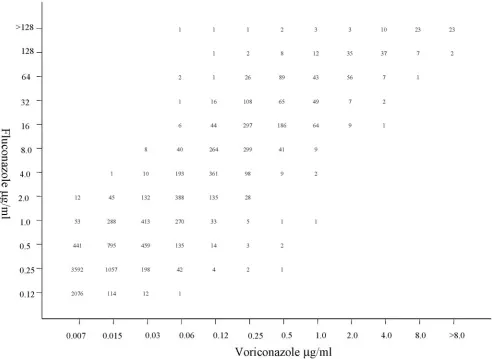
Pre-vious in vitro studies have suggested that the MICs for vori-conazole may be elevated against isolates of Candida with reduced susceptibility to fluconazole, suggesting that cross-resistance may occur with voriconazole and other azole com-pounds (9, 23, 27, 28, 30, 31). Figure 1 demonstrates the rela-tionship between fluconazole and voriconazole MICs for a collection of 13,338 clinical isolates ofCandida (18 different species) collected from more than 200 different medical cen-ters between 1992 and 2003. Although the MICs for voricon-azole were at least 16- to 32-fold lower than the corresponding fluconazole MICs for each isolate tested, there was strong positive correlation (R ⫽0.9) between voriconazole and flu-conazole MICs. Among all isolates tested against both agents, 100% of fluconazole-susceptible (12,087 isolates), 98% of flu-conazole-susceptible dose-dependent (836 of 855 isolates), and 48.5% (192 of 396 isolates) of resistant isolates were suscepti-ble to voriconazole at a concentration ofⱕ1g.
The extent of cross-resistance varies considerably with the species ofCandida. It is most prominent withC. glabrata(33) and appears to be negligible with most other species of Can-dida(23, 24, 37, 41). Among 1,966 isolates ofC. glabrata, the voriconazole MICs wereⱕ1g/ml for 100% of fluconazole-susceptible isolates (1,217 isolates) and 98% (557 of 568 isolates)
of fluconazole-SDD isolates. Among the 181 fluconazole-resis-tant isolates ofC. glabrata, the MICs for voriconazole wereⱕ1 g/ml for 30 isolates (17%), 2g/ml for 79 isolates (44%), andⱖ4 g for 72 isolates (39%).
In particular contradistinction to the susceptibility pattern noted with fluconazole, 99% (310 of 312 isolates) of the C.
kruseiisolates tested were inhibited byⱕ1g voriconazole per
ml. Thus, despite a strong positive correlation between the fluconazole and voriconazole MICs, the majority (1,028 of 1,251, 82%) of isolates that were nonsusceptible (MICsⱖ16 g/ml) to fluconazole were inhibited by concentrations of vori-conazole (ⱕ1g/ml) that can be achieved clinically using rec-ommended doses of voriconazole.
As voriconazole is only 58% protein bound (4, 11, 24) and in vitro studies show only a minimal effect of added protein, a comparison of unadjusted human plasma concentrations with MIC data was considered reasonable at this stage of the anal-ysis; a pharmacodynamic analysis that uses free drug concen-trations is discussed below. In previously published clinical studies, 17 of 22 patients (77%) infected with fluconazole-resistantC. albicansand seven of nine patients (78%) infected with fluconazole-resistant non-C. albicans Candidaspecies re-sponded to voriconazole, suggesting that from a clinical per-spective, the impact of cross-resistance was minimal (14, 26).
In vivo correlation of in vitro data.A total of 249 patients
[image:3.585.47.542.80.216.2]enrolled in the phase III clinical trials were infected with Can-didaspp., received voriconazole therapy, and were character-ized as treatment successes or failures at the end of therapy by TABLE 1. Susceptibility ofCandidaspecies to voriconazole by MIC: ARTEMIS Global Antifungal Surveillance Program, 2001 to 2004a
Species (no. of isolates tested)
Cumulative % of strains at MIC (g/ml):
0.007 0.015 0.03 0.06 0.12 0.25 0.5 1 2 4 8
C. albicans(4,701) 80 94 98 99 99 99 99 99 99 100
C. glabrata(1,183) 1 1 3 14 40 70 86 92 95 99 100 C. parapsilosis(1,253) 19 61 81 90 95 98 99 99 99 99 100 C. tropicalis(963) 9 27 64 93 99 99 99 99 99 99 100
C. krusei(243) 1 13 61 95 100
C. lusitaniae(110) 70 92 94 97 98 98 99 100
C. guilliermondii(128) 6 15 66 93 98 99 99 100 C. kefyr(38) 47 87 97 100
C. pelliculosa(28) 4 4 64 93 100
Candidaspp. (55)b 18 40 51 80 89 98 98 100
AllCandidaisolates (8,702) 48 64 75 82 88 94 98 99 99 99 100
aBroth microdilution MICs determined in accordance with CLSI M27-A2.
bIncludesC. dubliniensis(4 isolates),C. famata(16 isolates),C. lipolytica(8 isolates),C. rugosa(13 isolates), andC. zeylanoides(7 isolates).
TABLE 2. Voriconazole MIC results for 1,630Candidaisolates from phase III clinical studiesa
Species No. of isolates tested
MIC (g/ml)b
Range 50% 90%
C. albicans 886 0.004–16 0.008 0.25 C. glabrata 285 0.008–16 0.5 4 C. tropicalis 240 0.004–16 0.06 0.25 C. parapsilosis 178 0.004–0.125 0.03 0.06 C. krusei 41 0.125–1 0.25 1
aBroth microdilution MICs determined in accordance with CLSI M27-A2. b50% and 90%, MIC encompassing 50% and 90% of isolates tested, respec-tively.
on May 16, 2020 by guest
http://jcm.asm.org/
[image:3.585.300.541.618.700.2]the site investigators. The geometric mean MICs for the base-line isolates of each species ofCandidaand the percentage of cases in which voriconazole treatment was judged to be suc-cessful are shown in Table 3. The geometric mean MIC for each of these species is consistent with that shown in Table 1:
C. albicanswas the most susceptible species andC. glabratawas
the least susceptible to voriconazole. The clinical efficacies of voriconazole were comparable for all of the species (72 to 92% success) with the exception ofC. glabrata(55%).
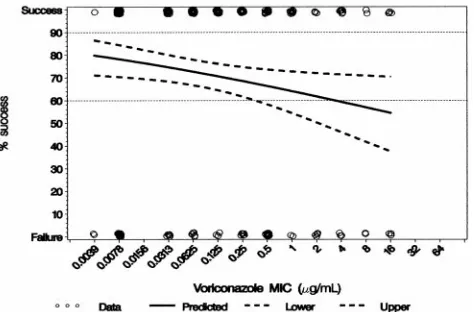
The logistic analysis of these data shows a significant rela-tionship between the MIC of the baseline isolates and the investigator end-of-therapy assessment of efficacy (Fig. 2). The linear logistic model in Fig. 2 indicates that the predicted slope is significantly different from zero (P ⫽ 0.02) and the 60% response rate is at a voriconazole MIC of 4g/ml. The signif-icance of the linear log MIC term in the logistic model of investigator response is largely due to MIC differences among species, particularlyC. glabrata. When species differences in MIC are included (P⫽0.0310), the addition of the log MIC term (standing for within-species MIC differences) is no longer significant. Thus, knowledge of the species is also useful be-cause of the differences in MICs among species. However, as is the case in most infectious diseases (2), the more that is known
about each subject in regard to other predictive factors (e.g., age and underlying diseases), the less important the MIC or species of the infecting organism becomes; the two become statistically nonsignificant.
Development of MIC interpretive breakpoints. Given the
[image:4.585.47.539.75.434.2] [image:4.585.303.541.624.707.2]MIC distributions shown in Tables 1 and 2 and the clinical correlation between MIC and efficacy, what are the possible interpretive breakpoints for BMD MIC testing ofCandidaand voriconazole? Consideration of the overall MIC distribution FIG. 1. Scatterplot showing the relationship between fluconazole and voriconazole MICs obtained with 13,338 isolates ofCandidaspecies.
TABLE 3. Candidaspecies, geometric mean MICs, and investigator-assessed response to voriconazole therapya
Species No. of isolates tested
Geometric mean
MIC (g/ml) % Success
C. albicans 96 0.0164 72 C. parapsilosis 34 0.0266 85 Candidaspp. 12 0.0712 92 C. tropicalis 51 0.1283 73
C. krusei 9 0.3650 78
C. glabrata 47 0.7937 55
aBroth microdilution MICs were determined in accordance with CLSI M27-A2. Baseline isolates from studies 603, 608, 309/604, and 301/606 were used.
on May 16, 2020 by guest
http://jcm.asm.org/
(Table 1), the cross-resistance data (Fig. 1), the PK of the drug and the relationship between MIC and clinical outcome (Fig. 2 and Table 3) allows the reasonable assignment of an MIC breakpoint ofⱖ4g/ml as resistant. It is clear thatCandida
isolates for which voriconazole MICs are ⱖ4 g/ml (i) are predominantlyC. glabrata(93%), 99% of which are also resis-tant to fluconazole, (ii) represent a concentration of voricon-azole that cannot be maintained over the dosing interval with the currently recommended doses, and (iii) are significantly less likely to respond clinically to voriconazole therapy (Fig. 2). The 60% clinical response rate at a voriconazole MIC ofⱖ4 g/ml constitutes a reasonable resistance breakpoint when ap-plying the 90/60 rule (39).
Regarding the category of susceptible, breakpoints at 0.25, 0.5, and 1g/ml were considered. In this context, a consider-ation arises related to the MIC distributions of various popu-lations of organisms (43): whenever possible, breakpoints that bisect a large population of organisms should be avoided. It is clear from the data presented in Table 1 that breakpoints below 1.0 g/ml would bisect the population of C. glabrata
isolates, creating a situation in which a one-dilution change in MIC (within the error of the test) would frequently result in a categorical change in reporting. Given the importance and
frequency of isolation ofC. glabrata, these breakpoints would be problematic at best.
In support of a susceptibility breakpoint of ⱕ1 g/ml, plasma concentrations of 1g/ml or greater are routinely ob-served throughout the dosing interval when voriconazole is administered at recommended doses to phase I volunteers (11, 24, 36, 37; voriconazole package insert). Likewise, an MIC of ⱕ1g/ml encompasses 99% of all clinical isolates ofCandida
and is at least two dilutions removed from the modal MIC of
C. glabrata(Table 1). The clinical success associated with this
MIC breakpoint is also significantly different from that of the resistant category (Table 4).
Finally, a susceptible breakpoint of ⱕ1g/ml can be sup-ported by pharmacodynamic data (3, 4). In a murine model of disseminated candidiasis, the AUC/MIC ratio was the PK-PD parameter most strongly predictive of treatment outcomes (4). As with other azoles (3), a free drug 24-h AUC/MIC ratio of 20 was predictive of efficacy (4). Given the plasma protein binding (58%) of voriconazole, it is necessary to use free drug AUCs rather than total drug when considering PD targets (4).
If one considers the kinetics of voriconazole in humans, either an oral dose of 200 mg to 300 mg or an intravenous dose of 4 mg/kg every 12 h would produce free drug AUCs of approximately 20 g · h/ml (4, 36; voriconazole package in-sert). Given a PD target of a free drug AUC/MIC ratio of 20, one could predict that these voriconazole dosing regimens could successfully be used for treatment of infections due to
Candidaspp. for which MICs are as high as 1g/ml (4). Thus,
a susceptible breakpoint of ⱕ1 g/ml for voriconazole and
Candidais supported by the MIC population distribution, by
PK-PD parameters, by analysis of cross-resistance, and by cor-relation with an in vivo outcome.
Consistent with what has been done with fluconazole (38), we have designated the category between S and R (i.e., isolates with an MIC of 2g/ml) as susceptible dose dependent to take into account both the nonlinear pharmacokinetics and the dos-ing flexibility of voriconazole (Table 4). Such a category im-plies that an infection due to the isolate may be appropriately FIG. 2. Binomial data and logistic fit for investigator outcome
[image:5.585.47.284.71.227.2]ver-sus baseline MICs forCandidaspecies in primary and salvage therapy studies 603, 608, 309/604, and 301/606 (n⫽249;P⫽0.021).
[image:5.585.302.540.520.692.2]FIG. 3. Voriconazole zone diameter distribution for allCandida species (75,809 isolates). Isolates were obtained from 115 institutions in 35 countries from 2001 through 2003.
TABLE 4. Investigator assessment of efficacy versus baseline MIC forCandidaspecies in primary and salvage therapy studies
603, 608, 309/604, and 301/606
MIC breakpoint (g/ml)
Interpretive
category No. of isolates % Success
ⱕ0.25 S 189 77
0.5–2 SDD 39 54
ⱖ4 R 21 62
ⱕ0.5 S 211 73
1–2 SDD 17 65
ⱖ4 R 21 62
ⱕ1 S 221 74
2 SDD 7 43
ⱖ4 R 21 62
on May 16, 2020 by guest
http://jcm.asm.org/
FIG.
4.
Scatterplot
showing
the
relationship
between
voriconazole
MICs
and
zone
diameters
for
7,301
isolates
of
Candida
.
The
proposed
interpretive
breakpoints
for
each
test
method
are
indicated
by
the
horizontal
and
vertical
lines.
on May 16, 2020 by guest
http://jcm.asm.org/
[image:6.585.86.485.106.673.2]treated in body sites where the drug is physiologically concen-trated or when a high dosage of the drug can be used (38, 43). Analogous to that seen with antibacterial testing, it may also serve as a “buffer zone” to prevent small, uncontrolled tech-nical factors from causing major discrepancies in interpreta-tions (21, 43).
Development of disk interpretive breakpoints.The CLSI has
standardized agar disk diffusion test methods for both flucon-azole and voriconflucon-azole and Candida spp. (22). Preliminary data have shown good correlation between voriconazole BMD MICs and disk diffusion test zone diameters (27, 32, 35). Both fluconazole and voriconazole disk tests have been used to great advantage in conducting antifungal resistance surveillance in the ARTEMIS DISK Global Antifungal Surveillance Study (13, 34). Previously, we have documented that voriconazole disk testing can be performed with a high degree of accuracy as part of routine laboratory testing (35).
Voriconazole disk diffusion testing has been performed in more than 115 laboratories in 35 countries as part of the ARTEMIS program between 2001 and 2003 (34). The frequency distribution of voriconazole zone diameters for 75,809 isolates ofCandidaspp. is shown in Fig. 3. The frequency distribution of zone diameters is very similar to that of the MIC distribution (Table 1), with the vast majority of isolates showing large zones (⬎17 mm), indicative of susceptibility to voriconazole.
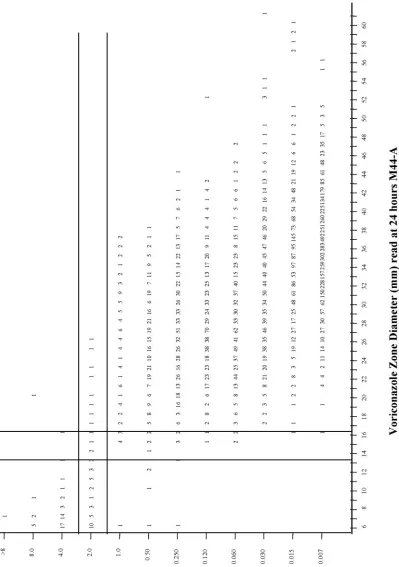
The relationship between voriconazole MICs and zone di-ameters is shown in Fig. 4 for 7,301 clinical isolates ofCandida. These isolates represent the same species distribution as that shown in Table 1. Using the MIC breakpoints ofⱕ1, 2, andⱖ4 g/ml for voriconazole to represent the S, SDD, and R cate-gories, respectively, one can then assign zone diameter break-points such that discrepancies between the MIC and disk dif-fusion test categories are minimized (Fig. 4 and Table 5). Using zone diameter breakpoints ofⱖ17 mm (S), 14 to 16 mm (SDD), andⱕ13 mm (R), the overall categorical agreement between the disk diffusion test results and the MIC test results was excellent (99.0%), with very few very major or major errors (Table 5). On the basis of these findings, it appears that the disk diffusion test is a useful method for testing the activity of voriconazole againstCandidaspp.
In summary, we have established a susceptible MIC (zone diameter) breakpoint of ⱕ1g/ml (ⱖ17 mm), a susceptible dose-dependent breakpoint of 2g/ml (14 to 16 mm), and a resistant breakpoint ofⱖ4g/ml (ⱕ13 mm) for voriconazole
andCandidaspecies. These interpretive breakpoints are
sup-ported by (i) analyses of the MIC population distribution, (ii) consideration of cross-resistance patterns, (iii) analysis of pa-rameters associated with success in pharmacodynamic analy-ses, and (d) the results from clinical efficacy studies. The strength of the correlation of these breakpoints with the clin-ical outcome is consistent with that from other antifungal and antibacterial infections: a result of S is associated with a higher success rate than a result of R, but host factors also influence outcome.
ACKNOWLEDGMENTS
Linda Elliott provided excellent support in the preparation of the manuscript. We also acknowledge the contributions of David Gibbs and Giles Scientific.
This work is supported in part by Pfizer, Inc., Pfizer Global Phar-maceuticals, New York, N.Y.
REFERENCES
1.Ally, R., D. Schurmann, W. Kreisel, G. Carosi, K. Aguirrebenogoa, and B.
Dupont.2001. A randomized, double-blind, double-dummy, multicenter trial
of voriconazole and fluconazole in the treatment of esophageal candidiasis in immunocompromised patients. Clin. Infect. Dis.33:1447–1454.
2.Amsterdam, D.2005. Susceptibility testing of antimicrobials in liquid media,
p. 61–143.InV. Lorian (ed.), Antibiotics in laboratory medicine, 5th ed. Lippincott Williams & Wilkins, Philadelphia, Pa.
3.Andes, D.2003.Invivo pharmacodynamics of antifungal drugs in treatment
of candidiasis. Antimicrob. Agents Chemother.47:1179–1186.
4.Andes, D., K. Marchillo, T. Stamstad, and R. Conklin.2003. In vivo
pharmacokinetics and pharmacodynamics of a new triazole, voriconazole, in a murine candidiasis model. Antimicrob. Agents Chemother.47:3165– 3169.
5.Barry, A. L., and S. D. Brown.1996. In vitro studies of two triazole antifungal
agents (voriconazole [UK-109,496] and fluconazole) againstCandida spe-cies. Antimicrob. Agents Chemother.40:1948–1949.
6.Barry, A. L., M. A. Pfaller, R. P. Rennie, P. C. Fuchs, and S. D. Brown.2002.
Precision and accuracy of fluconazole susceptibility testing by broth microdi-lution, Etest, and disk diffusion methods. Antimicrob. Agents Chemother.
46:1781–1784.
7.Chandrasekar, P. H., and E. Manavathu.2001. Voriconazole: a
second-generation triazole. Drugs Today37:135–148.
8.Clark, T. A., and R. A. Hajjeh.2002. Recent trends in the epidemiology of
invasive fungal infections. Curr. Opin. Infect. Dis.15:569–574.
9.Cuenca-Estrella, M., T. M. Diaz-Guerra, E. Mellado, A. Monzo´n, and J. L.
Rodriguez-Tudela.1999. Comparative in vitro activity of voriconazole and
itraconazole against fluconazole-susceptible and fluconazole-resistant clini-cal isolates ofCandidaspecies from Spain. Eur. J. Clin. Microbiol. Infect.
18:432–435.
10.Espinel-Ingroff, A.1998. In vitro activity of the new triazole voriconazole
(UK-109,496) against opportunistic filamentous and dimorphic fungi and common and emerging yeast pathogens. J. Clin. Microbiol.36:198–202.
11.Florea, N. R., J. L. Kuti, and R. Quintiliani.2002. Voriconazole: a novel
azole antifungal. Formulary37:389–399.
12.Ghannoum, M. A., and D. M. Kuhn.2002. Voriconazole–better chances for
patients with invasive mycoses. Eur. J. Med. Res.7:242–256.
13.Hazen, K. C., E. J. Baron, A. L. Colombo, C. Girmenia, A. Sanchez-Sousa,
A. del Palacio, C. de Bedont, D. L. Gibbs, and the Global Antifungal
Sur-veillance Group.2003. Comparison of the susceptibilities ofCandidaspp. to
fluconazole and voriconazole in a 4-year global evaluation using disk diffu-sion. J. Clin. Microbiol.41:5623–5632.
14.Heneger, P., P. F. Troke, G. Fatkenheuer, V. Diehl, and M. Ruhnke.1998.
Treatment of fluconazole-resistant candidiasis with voriconazole in patients with AIDS. AIDS12:2227–2228.
15.Herbrecht, R., D. W. Denning, T. F. Patterson, J. E. Bennett, R. E. Greene,
J. W. Oestmann, et al.2002. Voriconazole versus amphotericin B for primary
therapy of invasive aspergillosis. N. Engl. J. Med.347:408–415.
16.Hoffman, H. L., and R. C. Rathbun.2002. Review of the safety and efficacy
of voriconazole. Expert Opin. Investig. Drugs11:409–429.
17.Kuhlberg, B. J., J. D. Sobel, M. Ruhnke, P. G. Pappas, C. Viscoli, J. H. Rex,
J. D. Cleary, E. Rubinstein, L. W. Church, J. M. Brown, H. T. Schlamm,
I. T. Oborsha, F. Hilton, and M. R. Hodges.2005. Voriconazole versus a
regimen of amphotericin B followed by fluconazole for candidemia in non-neutropenic patients: a randomized non-inferiority trial. Lancet366:1435– 1442.
18.Metzler, C. M., and R. M. DeHaan.1974. Susceptibility tests of anaerobic
bacteria: statistical and clinical considerations. J. Infect. Dis.130:588–594.
TABLE 5. Categorical agreement between voriconazole broth microdilution MIC and disk test result for 7,301 clinical
Candidaisolates
Methoda
% of isolates by interpretive
categoryb % Agreement
% Errorc
S SDD R VME ME M
BMD 98.7 0.6 0.7
Disk 98.4 0.4 1.2 99.0 0.01 0.09 0.9
a
BMD and disk diffusion testing were performed in accordance with CLSI M27-A2 and M44-A, respectively.
b
Interpretive categories: S, susceptible, MICⱕ1g/ml (ⱖ17 mm); SDD, susceptible dose dependent, MIC⫽2g/ml (14 to 16 mm); R, resistant, MICⱖ4 g/ml (ⱕ13 mm).
c
VME, very major error; ME, major error; M, minor error.
on May 16, 2020 by guest
http://jcm.asm.org/
19.National Committee for Clinical Laboratory Standards.2001. Development of in vitro susceptibility testing criteria and quality control parameters; ap-proved guideline, 2nd ed., M23-A2. National Committee for Clinical Labo-ratory Standards, Wayne, Pa.
20.National Committee for Clinical Laboratory Standards.2002. Reference
method for broth dilution antifungal susceptibility testing of yeasts; approved standard, 2nd ed., M27-A2. National Committee for Clinical Laboratory Standards, Wayne, Pa.
21.National Committee for Clinical Laboratory Standards.2003. Methods for
dilution antimicrobial susceptibility tests for bacteria that grow aerobically; approved standard, 6th ed., M7-A6. National Committee for Clinical Labo-ratory Standards, Wayne, Pa.
22.National Committee for Clinical Laboratory Standards.2004. Methods for
antifungal disk diffusion susceptibility testing of yeasts; approved guideline M44-A. National Committee for Clinical Laboratory Standards, Wayne, Pa.
23.Ostrosky-Zeichner, L., J. H. Rex, P. G. Pappas, R. J. Hamill, R. A. Larsen,
H. W. Horowitz, W. G. Powderly, N. Hyslop, C. A. Kauffman, J. Cleary, J. E.
Mangino, and J. Lee.2003. Antifungal susceptibility survey of 2,000
blood-stream Candidaisolates in the United States. Antimicrob. Agents Che-mother.47:3149–3154.
24.Pearson, M. M., P. D. Rogers, J. D. Cleary, and S. W. Chapman.2003.
Voriconazole: a new triazole antifungal agent. Ann. Pharmacother.37:420– 432.
25.Pelletier, R., L. Loranger, H. Marcotti, and E. Carolis.2002. Voriconazole
and fluconazole susceptibility ofCandidaisolates. J. Med. Microbiol.51:479– 483.
26.Perfect, J. D., K. A. Marr, T. J. Walsh, R. N. Greenberg, B. DuPoint, J. de
la Torre-Cisneros, G. Just-Nubling, H. T. Schlamm, I. Lutsar, A.
Espinel-Ingroff, and E. Johnson.2003. Voriconazole treatment for less-common,
emerging, or refractory fungal infections. Clin. Infect. Dis.36:1122–1131.
27.Pfaller, M. A., S. A. Messer, R. J. Hollis, R. N. Jones, and D. J. Diekema.
2002. In vitro activities of ravuconazole and voriconazole compared with those of four approved systemic antifungal agents against 6,970 clinical isolates ofCandidaspp. Antimicrob. Agents Chemother.46:1723–1727.
28.Pfaller, M. A., and D. J. Diekema.2002. Role of sentinel surveillance of
candidemia: trends in species distribution and antifungal susceptibility. J. Clin. Microbiol.40:3551–3557.
29.Pfaller, M. A., D. J. Diekema, S. A. Messer, L. Boyken, and R. J. Hollis.2003.
Activities of fluconazole and voriconazole against 1,586 recent clinical iso-lates ofCandidaspecies determined by broth microdilution, disk diffusion, and Etest methods: report from the ARTEMIS Global Antifungal Suscep-tibility Program, 2001. J. Clin. Microbiol.41:1440–1446.
30.Pfaller, M. A., and D. J. Diekema.2004. Twelve years of fluconazole in
clinical practice: global trends in species distribution and fluconazole sus-ceptibility of bloodstream isolates of Candida. Clin. Microbiol. Infect.
10(Suppl. 1):11–23.
31.Pfaller, M. A., S. A. Messer, L. Boyken, R. J. Hollis, C. Rice, S. Tendolkar,
and D. J. Diekema.2004. In vitro activities of voriconazole, posaconazole,
and fluconazole against 4,169 clinical isolates ofCandidaspp. and
Crypto-coccus neoformanscollected during 2001 and 2002 in the ARTEMIS global antifungal surveillance program. Diagn. Microbiol. Infect. Dis.48:201–205.
32.Pfaller, M. A., K. C. Hazen, S. A. Messer, L. Boyken, S. Tendolkar, R. J.
Hollis, and D. J. Diekema.2004. Comparison of results of fluconazole disk
diffusion testing forCandidaspecies with results from a central reference laboratory in the ARTEMIS Global Antifungal Surveillance Program. J. Clin. Microbiol.42:3607–3612.
33.Pfaller, M. A., and D. J. Diekema.2004. Rare and emerging opportunistic
fungal pathogens: concerns for resistance beyondCandida albicansand As-pergillus fumigatus. J. Clin. Microbiol.42:4419–4431.
34.Pfaller, M. A., D. J. Diekema, M. Rinaldi, R. Barnes, J. Bijie, A. Veselov, N.
Tiraboschi, E. Nagy, D. L. Gibbs, and the Global Antifungal Surveillance
Group.2005. Results from the ARTEMIS DISK Global Antifungal
Surveil-lance Study: a 6.5-year analysis of the worldwide susceptibility of yeasts to fluconazole and voriconazole using standardized disk diffusion testing. J. Clin. Microbiol.43:5848–5859.
35.Pfaller, M. A., L. Boyken, S. A. Messer, S. Tendolkar, R. J. Hollis, and D. J.
Diekema.2005. Comparison of results of voriconazole disk diffusion testing
forCandidaspecies with results from a central reference laboratory in the ARTEMIS Global Antifungal Surveillance Program. J. Clin. Microbiol.43:
5208–5213.
36.Purkins, L., N. Wood, P. Ghahramani, K. Greenhalgh, and M. J. Allen.2002.
Pharmacokinetics and safety of voriconazole following intravenous-to-oral dose escalation regimens. Antimicrob. Agents Chemother.46:2546–2553.
37.Purkins, L., N. Wood, K. Greenhalgh, M. D. Eve, and S. D. Oliver.2003. The
pharmacokinetics and safety of intravenous voriconazole-a novel wide spec-trum antifungal agent. Br. J. Clin. Pharmacol.56(Suppl. 1):2–9.
38.Rex, J. H., M. A. Pfaller, J. N. Galgiani, M. S. Bartlett, A. Espinel-Ingroff,
M. A. Ghannoum, M. Lancaster, M. G. Rinaldi, T. J. Walsh, and A. L. Barry.
1997. Development of interpretive breakpoints for antifungal susceptibility testing: conceptual framework and analysis of in vitro-in vivo correlation data for fluconazole, itraconazole, andCandidainfection. Clin. Infect. Dis.
24:235–247.
39.Rex, J. H., and M. A. Pfaller.2002. Has antifungal susceptibility testing come
of age? Clin. Infect. Dis.35:982–989.
40.Sheehan, D. J., C. A. Hitchcock, and C. M. Sibley. 1999. Current and
emerging azole antifungal agents. Clin. Microbiol. Rev.12:40–79.
41.Swinne, D., M. Watelle, M. Van der Flaes, and N. Nolard.2004. In vitro
activities of voriconazole (UK-109, 496), fluconazole, itraconazole, and amphotericin B against 132 non-albicansbloodstream yeast isolates (CANARI study). Mycoses47:177–183.
42.Walsh, T. J., P. Pappas, D. J. Winston, H. M. Lazarus, F. Petersen, and J.
Raffalli.2002. Voriconazole compared with liposomal amphotericin B for
empirical antifungal therapy in patients with neutropenia and persistent fever. N. Engl. J. Med.346:225–234.
43.Wikler, M. A., and R. G. Ambrose.2005. The breakpoint, p. 1–7.InV. Lorian
(ed.), Antibiotics in laboratory medicine, 5th ed. Lippincott Williams & Wilkins, Philadelphia, Pa.