ScholarWorks @ Georgia State University
ScholarWorks @ Georgia State University
Communication Sciences and Disorders
Dissertations Department of Communication Sciences and Disorders
Fall 1-6-2012
Sources of Support and Family Quality of Life of Grandmothers
Sources of Support and Family Quality of Life of Grandmothers
Raising Grandchildren With and Without Disabilities
Raising Grandchildren With and Without Disabilities
Karen E. Kresak Georgia State University
Follow this and additional works at: https://scholarworks.gsu.edu/epse_diss
Part of the Educational Psychology Commons, and the Special Education and Teaching Commons
Recommended Citation Recommended Citation
Kresak, Karen E., "Sources of Support and Family Quality of Life of Grandmothers Raising Grandchildren With and Without Disabilities." Dissertation, Georgia State University, 2012.
https://scholarworks.gsu.edu/epse_diss/79
This dissertation, SOURCES OF SUPPORT AND FAMILY QUALITY OF LIFE OF
GRANDMOTHERS RAISING GRANDCHILDREN WITH AND WITHOUT DISABILITIES, by KAREN ELIZABETH KRESAK, was prepared under the direction of the candidate’s
Dissertation Advisory Committee. It is accepted by the committee members in partial fulfillment of the requirements for the degree of Doctor of Philosophy in the College of Education, Georgia State University.
The Dissertation Advisory Committee and the student’s Department Chair, as representatives of the faculty, certify that this dissertation has met all standards of excellence and scholarship as determined by the faculty. The Dean of the College of Education concurs.
_______________________________ _________________________________ Peggy A. Gallagher, Ph.D. Catherine Cadenhead, Ph.D.
Committee Chair Committee Member
_______________________________ ________________________________ Susan R. Easterbrooks, Ed.D. Susan J. Kelley, Ph.D.
Committee Member Committee Member
_______________________________ Elizabeth A. Steed, Ph.D.
Committee Member
_______________________________ Date
_______________________________ Gwen Benson, Ph.D.
Interim Chair, Department of Educational Psychology and Special Education
________________________________ R. W. Kamphaus, Ph.D.
By presenting this dissertation as a partial fulfillment of the requirements for the advanced degree from Georgia State University, I agree that the library of Georgia State University shall make it available for inspection and circulation in accordance with its regulations governing materials of this type. I agree that permission to quote, to copy from, or to publish this
dissertation may be granted by the professor under whose direction it was written, by the College of Education’s director of graduate studies and research, or by me. Such quoting, copying, or publishing must be solely for scholarly purposes and will not involve potential gain. It is understood that any copying from or publication of this dissertation which involves potential financial gain will not be allowed without my written permission.
All dissertations deposited in the Georgia State University library must be used in accordance with the stipulations prescribed by the author in the preceding statement. The author of this dissertation is:
Karen Elizabeth Kresak 1559 Twin Courts Lane
Marietta, GA 30008 The director of this dissertation is:
Dr. Peggy Ahrenhold Gallagher
Department of Educational Psychology and Special Education College of Education
Karen Elizabeth Kresak
ADDRESS: 1559 Twin Courts Lane
Marietta, GA 30008
EDUCATION:
Ph.D. 2011 Georgia State University
Education of Students with Exceptionalities
2003 Georgia State University
Preschool Special Education Endorsement
M.Ed. 1990 Georgia State University School Psychometry
M. A. 1988 Assumption College Counseling Psychology
B. A. 1984 Georgia State University Psychology
PROFESSIONAL EXPERIENCE:
2003-Present Preschool Special Education Teacher Marietta City Schools, Marietta, Georgia
1995-2003 Teacher EBD (Grades K-4)
Marietta City Schools, Marietta, Georgia
1991-1995 Teacher SEBD (Grades K-5)
Northwest Georgia Psychoeducational Program, Rome, Georgia
PRESENTATIONS AND PUBLICATIONS:
Kresak, K., & Gallagher, P. A. (2011, November). Sources of support and family quality of life
of grandmothers raising grandchildren: Lessons for teachers of students with disabilties.
Poster presented at Teacher Education Division Annual Conference, Austin, TX.
Kresak, K., & Gallagher, P. A. (2011, November). Sources of support and family quality of life
of grandmothers raising grandchildren. Poster presented at Division for Early Childhood
Annual International Conference, National Harbor, MD.
Gallagher, P. A., Kresak, K., & Rhodes, C. A. (2010). Perceived needs of grandmothers of children with disabilities. Topics in Early Childhood Special Education, 30, 56-64. Kresak, K., & Gallagher, P. A. (2010, February). Perceived needs of grandmothers of
grandchildren with disabilities. Poster presented at the biennial Conference on Research
Conference, Atlanta, GA.
Kresak, K., Gallagher, P. A., & Rhodes, C. A. (2009). Siblings of infants and toddlers with disabilities in early intervention. Topics in Early Childhood Special Education, 29, 143-154.
Kresak, K., & Coleman, M. B. (2008). Brothers and sisters: A special part of exceptional families (3rd ed.). [Review of the book]. Physical Disabilities: Education and Related
Services, 26, 55-57.
Kresak, K. (2008). Playing to get smart. [Review of the book]. IPA/USAQuarterly.
www.ipausa.org/IPAUSA2008Sum.pdf
Kresak, K., Rhodes, C. A., & Gallagher, P. A. (2008, March). Grandparents of young children
with special needs. Paper presented at Institute for the Study of Disadvantage and
Disability (ISDD) Break the Cycle II, Atlanta, GA.
Rhodes, C. A., Gallagher, P. A., & Kresak, K. (2008, October). What do grandparents say?
Understanding their needs and concerns as caregivers. Poster presented at Division for
Early Childhood Annual International Conference, Minneapolis, MN.
Rhodes, C. A., Gallagher, P. A., & Kresak, K. (2007, October). Grandparents of young children
with special needs. Poster presented at Division for Early Childhood Annual International
Conference, Niagara Falls, Ontario.
PROFESSIONAL SOCIETIES AND ORGANIZATIONS: 2004-Present Council for Exceptional Children (CEC) 2004-Present Division for Early Childhood (DEC)
ABSTRACT
SOURCES OF SUPPORT AND FAMILY QUALITY OF LIFE OF GRANDMOTHERS RAISING GRANDCHILDREN
WITH AND WITHOUT DISABILITIES by
Karen Kresak
Researchers have examined sources of support as well as family quality of life of parents
raising children with disabilities (Brown, MacAdam-Crisp, Wang, & Iarocci, 2006; Darling &
Gallagher, 2004; Davis & Gavidia-Payne, 2009; Zuna, Turnbull, & Summers, 2009). Scant
research on grandparents raising grandchildren with disabilities has been conducted; an
examination of sources of support and family quality of life of grandparents raising
grandchildren is lacking in the literature. This study examined the sources of support and quality
of life of 50 grandmother-headed families, approximately half of whom were raising
grandchildren with disabilities and approximately half of whom were raising grandchildren
without disabilities. Comparative analyses revealed that there were significant differences
between grandmothers raising grandchildren with and without disabilities in regard to sources of
support and family quality of life. Informal support was significantly higher for grandmothers
raising grandchildren without disabilities. In addition, grandmothers raising grandchildren
without disabilities rated satisfaction with all aspects of family quality of life except parenting as
significantly higher than grandmothers raising grandchildren with disabilities. Correlational
analyses showed a moderate correlation between sources of support and family quality of life for
both groups of grandmothers. While total informal social support was significantly correlated
with satisfaction ratings of family quality of life for both groups of grandmothers, total formal
support was significantly correlated with satisfaction ratings of family quality of life only for
were used to test the relationship among four predictor variables (age of grandmother,
educational level of grandmother, age of grandchild, and presence of child disability) and two
criterion variables (total score on sources of support rating and total score on family quality of
life rating). Results showed that there was a significant relationship between presence of child
disability and satisfaction ratings of family quality of life. No significant relationship was found
SOURCES OF SUPPORT AND FAMILY QUALITY OF LIFE OF GRANDMOTHERS RAISING GRANDCHILDREN
WITH AND WITHOUT DISABILITIES by
Karen Elizabeth Kresak
A Dissertation
Presented in Partial Fulfillment of Requirements for the Degree of
Doctor of Philosophy in
Education of Students with Exceptionalities in
the Department of Educational Psychology and Special Education in
the College of Education Georgia State University
Copyright by Karen E. Kresak
ii
ACKNOWLEDGEMENTS
I want to express thanks to my family—
To my husband without whose love and support I could not have earned this degree.
To my children who motivated me to keep going by their sense of pride in my accomplishments. To my dad for his constant encouragement and lifelong support of my dreams.
I am grateful to Dr. Peggy Gallagher, my advisor and committee chairperson, for her support and guidance throughout my program and this dissertation process. I truly appreciate the knowledge you have bestowed upon me and the opportunities you have given me.
I thank my committee members, Dr. Catherine Cadenhead, Dr. Susan Easterbrooks, Dr. Susan Kelley, and Dr. Elizabeth Steed. Your expertise and invaluable feedback have made this dissertation a successful research study.
I appreciate the grandparent support group leaders and coordinators of the Local AAAs for helping find grandmothers. I could not have done it without you.
iii
Page
List of Tables ……….. v
Chapter 1 STATEMENT OF THE PROBLEM ……….. 1
Introduction ……….. 1
Significance of the Problem ……….... 2
Research Questions ………... 5
Research Question One ……….. 5
Research Question Two ………. 5
Research Question Three ………... 5
Research Question Four ………. 6
Hypotheses ……….. 6
Hypothesis for Research Question One ………. 6
Hypothesis for Research Question Two ……….... 6
Hypothesis for Research Question Three ……….. 6
Hypothesis for Research Question Four ……….... 6
2 REVIEW OF THE LITERATURE ……….... 7
Importance of Families ……….. 7
Theoretical Foundation ……….. 8
Custodial Care ……….... 9
Characteristics of Custodial Grandparents ………. 10
Consequences of Custodial Grandparenting ……….. 13
Characteristics of Grandchildren Raised by Grandparents ….... 16
Grandparents Raising Grandchildren with Disabilities ………. 17
Sources of Support ………. 19
Family Quality of Life ………... 23
Summary ……….... 26
3 METHODOLOGY ………... 28
Statement and Operational Definitions of Independent Variables... 28
Statement and Operational Definitions of Dependent Variables... 28
Demographic Information... 33
Research Design and Rationale... 34
Participants... 34
Recruitment... 35
Implementation... 36
Setting... 37
iv
Data Analyses ………. 38
Supports and Family Quality of Life Reported by Families... 38
Demographic Data…... 39
Relationship Between Supports and Quality of Life... 40
Factors Predictive of Supports and Quality of Life... 40
4 RESULTS... 41
Demographics... 41
Grandmother Characteristics... 44
Caregiver Situation... 46
Grandchildren Characteristics... 47
Disability of Grandchildren... 49
Results of Research Questions... 49
Research Question One... 49
Results of Question One... 49
Research Question Two... 50
Results of Question Two... 50
Research Question Three... 52
Results of Question Three... 52
Research Question Four... 53
Results of Question Four... 54
5 DISCUSSION………. 57
Conclusions... 57
Implications... 61
Limitations... 64
Suggestions for Future Research... 67
References ………... 71
v
LIST OF TABLES
Table Page
1 Individual items of the Family Support Scale subcategories... 30
2 Items included in each subscale domain of the Family Quality of
Life scale... 32
3 T-test analysis of demographic data between grandmothers raising
grandchildren with and without disabilities………... 42
4 Chi square analysis of demographic data between grandmothers
raising grandchildren with and without disabilities………... 42
5 Association between income and presence of disability... 43
6 Association between gender of grandchild and presence of
disability... 44
7 Characteristics of grandmothers raising grandchildren with and
Without disabilities... 45
8 Characteristics of the caregiving situation... 47
9 Disability categories and level of severity for grandchildren... 48
10 Comparison of means for family support composite and subscales
by presence of disability... 50
11 Comparison of means for family quality of life composite and
subscales by presence of disability... 51
12 Correlations between sources of support and quality of life of
grandmothers raising grandchildren with disabilities... 53
13 Correlations between sources of support and quality of life of
grandmothers raising grandchildren without disabilities... 54
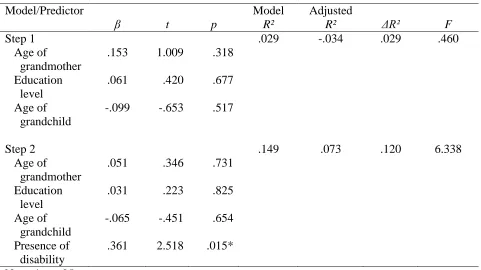
14 Summary of the hierarchical regression analysis for variables
predicting family quality of life... 55
15 Summary of the hierarchical regression analysis for variables
1 CHAPTER 1
STATEMENT OF THE PROBLEM
Introduction
Grandparents raising grandchildren is a growing phenomenon that affects 5.8 million
children in the United States (U.S. Bureau of the Census, 2003). Presently, there are 1.3 million
children living in grandparent-headed households with no biological parent present (U. S. Bureau
of the Census, 2003). Additionally, one in ten grandparents will take on the role of primary
caretaker to a grandchild for at least six months before the child is age 18 (Burnette, 1997;
Silverstein & Vehvilainen, 2000). A majority of these grandchildren are with grandparents
through informal arrangements among family members, which often results in limited or no
institutional support as the grandparents may not have legal guardianship. Grandparents often
have difficulty obtaining health insurance coverage, public financial assistance, and housing as
well as gaining legal rights to make decisions regarding their grandchildren’s education and
medical care (Chalfie, 1994; Minkler & Roe, 1993; Minkler, Roe, & Price, 1992). Many of the
grandchildren living with grandparents are at risk of having or have developmental, cognitive,
neurological, behavioral, and/or emotional problems (Brown, Neikrug, & Brown, 2000;
Dowdell, 1995; Pinson-Millburn, Fabian, Schlossberg, & Pyle, 1996; Shore & Hayslip, 1994;
Smith & Palmieri, 2007; Whitley & Kelley, 2008). This may be due, for example, to their
prenatal and/or early life experiences, which may have involved drug/alcohol exposure,
neglect/abuse, poor nutrition, lack of preventive medical/dental care, and inconsistent and/or
dangerous living conditions (Smith & Dannison, 2008).
Empirical evidence suggests that regardless of their racial status, grandparents raising
2
social and economic well-being, psychological stress, and physical health (Burton, 1992;
Dowdell, 1995; Kelley, 1993; Minkler & Roe, 1993). Kelley and colleagues (2000) found that
fewer family resources, less social support, and poorer physical health were related to greater
levels of psychological distress among grandmothers raising grandchildren. Likewise, studies of
the long term effects of grandparent caregiving report high rates of depression, poor self-rated
health and/or frequent presence of chronic health problems, especially among grandmothers
(Burton, 1992; Dowdell, 1995; Minkler & Roe, 1993; Minkler, Fuller-Thomson, Miller, &
Driver, 1997). Both grandparents and grandchildren may face significant problems with respect
to emotional adjustment and activities of daily living when these families are formed, often
because these new living arrangements are typically borne of extremely stressful circumstances
(Edwards, 1998; Fuller-Thomson, Minkler, & Driver, 1997). Those grandparents raising
grandchildren whom they perceive as having neurological, physical, emotional, or behavioral
difficulties are the least likely to seek and receive counseling and/or medical services for
themselves (Shore & Hayslip, 1994). The distress experienced by custodial grandparents can
have a serious effect on parenting and child outcomes often resulting in negative grandparent and
grandchild outcomes (Campbell & Miles, 2008).
Significance of the Problem
Researchers have determined the presence of two distinct groups of grandparent
caregivers: (a) grandparents with difficulties that stem from the demands of the parenting role,
and (b) grandparents with difficulties related to a grandchild with disabilities (Hayslip &
Kaminski, 2005b). Grandparents raising grandchildren with developmental disabilities often face
unique and ongoing challenges that can influence various aspects of family life (Guralnick, 1997;
3
McGrew, & Nelson, 2003). The demands of assuming a parental role later in life are exacerbated
by raising a grandchild who is experiencing physical, emotional, or behavioral difficulties
(Grant, 2000; Hayslip, Shore, Henderson, & Lambert, 1998; Sands & Goldberg-Glen, 2000). The
nature of the disability of the child can produce different challenges and stresses in relation to
family lifestyles as well (Hastings, 2002; Hayes, 1996; Kraus, Seltzer, & Jacobson, 2005).
Consequently, children with disabilities typically require more time and attention than children
without disabilities (Hughes, 1999; Roach & Orsmond, 1999). The drain on grandparents’ time
and energy causes fatigue and makes them more vulnerable to stress, depression, and physical
health problems. The persistence and strength of these negative effects can compromise positive
coping and enjoyment of daily life (Bailey et al., 2006). How well a family copes with stress
influences family functions, satisfaction, feelings of efficacy, and children’s life outcomes
(Zeitlin & Rosenblatt, 1985). While effective coping fosters family quality of life, ineffective
coping with family-related stress impairs parenting skills (Fiedler, Simpson, & Clark, 2007).
In order to cope with the stress of raising grandchildren, especially those with disabilities,
grandparents often rely upon social supports such as family and extra-familial resources, spiritual
support, and formal support, which includes the use of community and professional resources
(Seligman & Darling, 2007). Theoretically, social support is seen as the resource that buffers the
relationship between caregiver stress and well-being (Crowther & Rodriguez, 2003).
Grandparent caregivers consistently report the need for a support network of people who are
experiencing circumstances that are similar to their own (Burton, 1992; Turbin, 1993). Gerard
and colleagues (2006) found that grandparents dealing with numerous child health problems and
frequent stressors related to common parenting tasks benefitted from receiving formal support,
4
grandparents responded positively to assistance in the form of support groups, health services,
legal and social services, as well as to recreational programs for their grandchildren.
However, sources of both informal and formal support are often limited or unavailable.
Studies of custodial grandparents have identified social isolation and inadequate social support
networks as key problems for these grandparents (Hayslip & Kaminski, 2005a). Social networks
and the social support they provide lessen stress, promote well-being, and enhance the use of
coping strategies (Crnic, Friedrich, & Greenberg, 1983; McCubbin, et al., 1980), all of which
increase a family’s quality of life. The extent to which the emotional and psychological support
needs of grandparents are addressed will influence the overall functioning of the grandchild and
the family (Schalock & Alonso, 2002). Custodial grandparents will need greater support from
family, friends, community services, and professionals from many disciplines to help them cope
with the physical and emotional challenges of providing care to their grandchildren (Roberto &
Qualls, 2003). Therefore, examining the mediating effects of social support on familial
well-being or quality of life may help professionals in increasing sources of support for all
grandparent caregivers.
Over the course of the last several decades, several researchers have focused their efforts
on defining the rapidly growing population of grandparent-headed families (Fuller-Thomson &
Minkler, 2000a, 2000b; Fuller-Thomson & Minkler, 2001; Hayslip et al., 1998; Pruchno, 1999)
as well as examining the physical and emotional effects of raising grandchildren (Janicki,
McCallion, Grant-Griffin, & Kolomer, 2000; Kelley, Yorker, & Whitley, 1997; Minkler & Roe,
1993; Minkler, Fuller-Thomson, Miller, & Driver, 2000; Sands & Goldberg-Glen, 1998, 2000;
Silverstein & Vehvilainen, 2000). While much research has looked at grandparents raising
5
disabilities in particular (Emick & Hayslip, 1999; Force, Botsford, Pisano, & Holbert, 2000;
Kolomer, McCallion, & Janicki, 2002). Because these grandchildren have, or are at risk of
having, developmental delays which may interfere with family functioning and quality of life,
there is a need to examine this unique group of grandparents.
Research Questions
This study investigated the sources of support and satisfaction ratings of family quality of
life for grandmothers raising grandchildren with and without disabilities. The study also
examined the potential impact of four family characteristics: (a) age of grandmother, (b)
educational level of grandmother, (c) age of grandchild, and (d) presence of child disability on
sources of support and family quality of life.
Research Question One
What sources of supports are reported by grandmothers raising grandchildren with
disabilities compared to grandmothers raising grandchildren without disabilities?
Research Question Two
What satisfaction ratings of family quality of life are reported by grandmothers raising
grandchildren with disabilities compared to grandmothers raising grandchildren without
disabilities?
Research Question Three
Are grandmothers raising grandchildren with disabilities different from grandmothers
raising grandchildren without disabilities with respect to various types of support and family
6 Research Question Four
What factors predict family supports and quality of life of grandmothers raising
grandchildren with disabilities compared to grandmothers raising grandchildren without
disabilities?
Hypotheses
Hypothesis for Research Question One
It is hypothesized that the support from various sources (family members, neighbors,
community organizations, and service providers) would be the same for grandmothers raising
grandchildren with and without disabilities.
Hypothesis for Research Question Two
It is hypothesized that the satisfaction ratings of family quality of life would be the same
for grandmothers raising grandchildren with and without disabilities.
Hypothesis for Research Question Three
It is hypothesized that supports and family quality of life are not inter-correlated.
Hypothesis for Research Question Four
It is hypothesized that there are no predictive factors, individually or in combination, that
9 CHAPTER 2
REVIEW OF THE LITERATURE
Importance of Families
The family is regarded as the primary and most powerful system to which a person
belongs (Seligman & Darling, 2007). The family is composed of several different subsystems
that reciprocally influence one another (Stoneman & Brody, 1984). These subsystems include the
spouse/partner subsystem, the sibling subsystem, and/or the parent-child subsystem. Changes in
any one subsystem are assumed to influence other family subsystems (Bronfenbrenner, 1979;
Turnbull & Turnbull, 2005; Whitechurch & Constantine, 1993). The needs and experiences of all
members can affect the other members of the family. For example, the family affects the
development of the child and the child influences family functioning (Bronfenbrenner, 1979),
especially if that child has a disability. This ecological model focuses on the interaction between
the family and the environment with the primary assumption being that the individual and the
environment are inseparable and must be considered jointly (Bronfenbrenner, 1979; Hartman &
Laird, 1987).
The traditional family constellation has gradually changed over the years. No longer is
the ―traditional‖ family considered the norm. Factors such as economic hardship, divorce,
teenage pregnancy, child abuse and neglect, and substance abuse have changed the makeup of
the family. Family composition has taken many forms: single parents, same gender parents,
grandparent(s) with adult child and grandchild, and grandparents with grandchildren. No matter
the makeup, family has been defined as ―two or more people who regard themselves as a family
and who carry out functions that families typically perform‖ (Turnbull, Turnbull, Erwin, &
9
units. Custodial grandparenting also has assumed a variety of forms: co-parenting with an adult
child, acting as sole custodial parent, or dual parenting with a spouse (Hayslip & Kaminski,
2008). A disproportionate number of grandparent-headed families are raising grandchildren with
learning, behavioral, and/or developmental disabilities because of the prenatal and/or postnatal
experiences of the grandchildren, which could include drug exposure, abuse/neglect, and
inadequate care (Brown & Boyce-Mathis, 2000; Silverstein & Vehvilainen, 2000). These
second-time parents play a central role in determining the developmental outcomes of the
children in their care, whether the children have disabilities or not (Hayslip & Kaminski, 2008).
Theoretical Foundation
This study is based upon the theoretical foundation of family systems theory
(Bronfenbrenner, 1979; Turnbull & Turnbull, 2005). Family systems theory recognizes the
interrelatedness of family members and the importance of acknowledging the needs of all family
members (Brown, Nolan, & Davies, 2001; Carpenter, 1997; Dunst, Trivette, & Johanson, 1994;
Turnbull, Blue-Banning, Turbiville, & Park, 1999). Family systems theory is rooted in the
ecological theory of Uri Bronfenbrenner (1979). Bronfenbrenner proposed that a child’s life
should be conceptualized as occurring across an ecological system which includes micro and
macro subsystems that simultaneously affect a child’s ongoing development. He noted that the
family and the home are the primary contexts in which development occurs and that these
primary contexts affect the child’s progress in other settings. From this perspective, individuals
can best be understood within the context of the family.
The family systems model builds upon a systems framework. Each component of the
framework affects the other components either positively or negatively. Components of the
9
interaction (ongoing process of family relationships responsive to individual and family needs),
family function (tasks performed by the family to meet individual and collective needs of its
members), and family life cycle (developmental and non-developmental changes that families
pass through) (Turnbull et al., 2006). The purpose of the family systems model is to understand
how the beliefs, behaviors, characteristics, and functioning of family members influence the lives
and decision making of other members (Goldenberg & Goldenberg, 1990; Minuchin, 1974;
Turnbull & Turnbull, 1990). The focus then becomes the whole family rather than an individual
with the goal being to identify and build on family strengths. In light of this, professionals need
to clearly understand the unique circumstances of custodial grandparents and their grandchildren
in order to assist families in promoting continued growth and enrichment of the family (Racicot,
2003).
Custodial Care
Grandparents assumefull-time custodial care of their grandchildren for a multitude of
reasons. Usually it occurs in the context of some family trauma and can be a highly stressful
process (Jendrek, 1994; Minkler & Roe, 1993; Shore & Hayslip, 1994). Researchers have
identified maternal substance abuse and the resulting child maltreatment as the primary reason
grandparents assume responsibility of parenting their grandchildren (Burton, 1992; Dowdell,
1995; Jendrek, 1994; Kelley, 1993; Minkler & Roe, 1993; Minkler et al., 1992; Pruchno, 1999).
Other contributing factors include: (a) parental death (Fuller-Thompson & Minkler, 2000a;
Pruchno, 1999); (b) incarceration of the biological mother (Dowdell, 1995; Fuller-Thompson &
Minkler, 2000a; Kelley, 1993; Pruchno, 1999); (c) mental illness of a parent (Dowdell, 1995;
Kelley, 1993); (d) abandonment (Pruchno, 1999); and (e) teen pregnancy (Hayslip & Kaminski,
9
The assumption of care can be unanticipated and involuntary, often resulting from
unforeseen circumstances. The custodial relationship may be permanent (e.g., through the death
of a parent) or temporary depending upon the circumstances of assuming care (Burnette, 1999;
Minkler & Roe, 1993). Despite the possibility of indefinite custody, many of the grandparents
assume responsibility for the grandchildren because they believe they are the only person who
can keep the child out of the public foster care system (Cox, 2000; Goodman & Silverstein,
2002) or they believe they can provide better care than the parent (Hayslip & Kaminski, 2005a).
Grandparents also may feel compelled by moral or religious beliefs to assume care (Burton,
1992). In addition, grandparents offer to care for their grandchildren in order to help their own
adult children in times of crisis (Hayslip et al., 1998). The common thread among grandparent
caregivers appears to be the commitment to the well-being of their grandchildren (Erhle & Day,
1994; Jendrek, 1994; Minkler & Roe, 1993).
Characteristics of Custodial Grandparents
Custodial grandparents or grandparent caregivers are adults who have primary
responsibility for their grandchildren younger than 18 years of age on a full-time basis (Hayslip
& Kaminski, 2005b; Shore & Hayslip, 1994; U. S. Bureau of the Census, 2003). According to
the Pew Research Center (2010) analysis of the U. S. Census Bureau data, approximately 2.9
million grandparents have primary responsibility for their grandchildren. Of these grandparents,
840,000 (or 39%) have been caring for their grandchildren for five or more years (U. S. Bureau
of the Census, 2003). Forty-nine percent of children being raised by grandparents also live with a
single parent (Pew Research Center, 2010). However, for forty-three percent of children being
raised by grandparents, there is no parent in the household (Pew Research Center, 2010). These
9
neither parent present, have become the most rapidly increasing living arrangement among
contemporary families (Bryson & Casper, 1999; Fuller-Thompson & Minkler, 2000a).
Custodial grandparenting appears to have no ethnic or socioeconomic boundaries. All
groups have been impacted by the assumption of the parenting role. In examining
grandparent-headed households by ethnicity/race, 54% are Caucasian, 31% are African American, and 11%
are Hispanic/Latino (U.S. Bureau of the Census, 2005-2007). Proportionally, grandparent
caregivers are over-represented within African American (4.3%) and Latino (2.9%) households
when compared to Caucasian (1%) households (Fuller-Thompson & Minkler, 2000a; Minkler et
al., 1992; U. S. Bureau of the Census, 2001b). In a national study, Minkler and Fuller-Thompson
(1999) found that African Americans had 83% higher odds of being grandparent caregivers than
other ethnic groups. Likewise, additional researchers found that almost 30% of African
American grandmothers and 14% of African American grandfathers reported being the primary
caregiver for a grandchild for at least six months (Szinovacz, 1998) compared to 10.9% of all
grandparents (Fuller-Thompson et al., 1997). However, there has been a 19% increase in the
number of Caucasian grandparents caring for their grandchildren over the last decade (Pew
Research Center, 2010).
Income issues. Many grandparent-headed households live at or below the poverty level.
According to the U. S. Bureau of the Census (2001a), the percentage of grandparent caregivers
living below the poverty level (19%) is greater than that for other types of families with children
(14%). Fuller-Thompson and colleagues (1997) found that grandparent caregivers are 60% more
likely to live in poverty than grandparents not raising grandchildren with grandmother-headed
households being the most impoverished. Two-thirds of those children living in
9
over 78% of grandparent caregivers reported facing financial hardships while 52% reported not
having resources to meet the needs arising out of caregiving. Likewise, Kelley (1993) found that
56% of grandparents studied reported financial difficulty related to child-rearing.
Work issues. Employment issues often arise when grandparents begin raising their
grandchildren. Grandparents who are employed may have to give up working outside the home
in order to raise their grandchildren, thus losing much needed income and putting their own
future economic well-being at risk (Hayslip & Goldberg-Glen, 2000; Musil, Schrader, &
Mutikani, 2000). For retired grandparents, whose income is already limited, the lack of adequate
assistance from government agencies and the increased expenditures force many to either draw
from their retirement or savings accounts, cash in life insurance policies, or return to the work
force (Beverly, 1995; Burton, 1992; Minkler & Roe, 1993). Providing for the family becomes
even more difficult with multiple caregiving demands (Beverly, 1998) or when there are
grandchildren with disabilities within the family. In addition, lack of financial stability may
compound other difficulties faced by these families (Hayslip & Goldberg-Glen, 2000).
Gender and age of grandparents. The majority (63%) of all grandparent families are
headed by grandmothers (Burnette, 1997; Dressel & Barnhill, 1994; Simmons & Dye, 2003; U.
S. Bureau of the Census, 2003). In analyzing data from the National Survey of Families and
Households (NSFH), Fuller-Thompson and colleagues (1997) found that 77% of the
grandparents were grandmothers. Similarly, in a nationally representative longitudinal study,
Fuller-Thompson and Minkler (2000b) found that more than three-quarters (77%) of all
caregiving grandparents were women. The ages of custodial grandparents have been reported to
range between 35 and over 80 years with the average age being in the mid 50’s (Beverly, 1995;
9
20% of custodial grandparents are over the age of 65 (Fuller-Thompson & Minkler, 2000a; U. S.
Bureau of the Census, 2003).
Consequences of Custodial Grandparenting
Positive consequences. Despite the difficulties of assuming care of their grandchildren,
grandparents report positive aspects of taking on this parental role. Grandparents receive
pleasure from their close relationship with their grandchildren (Ehrle & Day, 1994; Hayslip &
Kaminski, 2005b) and feel intrinsically rewarded to care for a child (Giarrusso, Silverstein, &
Feng, 2000). Caregiving can provide a meaningful new role for the grandparent leading to the
grandparent feeling more useful and productive (Emick & Hayslip, 1996, 1999). Grandparents
feel good that they are able simultaneously to help their adult child and their grandchild (Burton,
1992). The caregiving role may afford grandmothers a second chance at successful parenting
(Ehrle & Day, 1994; Gatti & Musatti, 1999). These grandmothers believe that they can learn
from previous experiences and improve upon past negative parenting behaviors.
Merriwether-deVries and colleagues (1996) reported the rewards of custodial grandparenting, which included
the ability to nurture family legacies and traditions through the lives of their grandchildren and
the receipt of unconditional love and supportive companionship of the child. In a study by
Minkler and Roe (1993), grandmothers stated that the positive aspects of custodial
grandparenting included knowing their grandchildren were safe and given a better chance to
succeed. Grandmothers also were relieved and grateful at having the chance to do something
positive for the family.
Negative consequences. One of the main disadvantages of raising grandchildren is the
risk of illness and/or disability for the caregiver. The normal declines in health related to aging
9
Chronic health conditions such as arthritis and heart disease may affect the grandparent’s ability
to perform those tasks associated with caregiving (Cox, 2003). Longitudinal data from the Health
and Retirement Study (HRS) revealed that custodial grandparents were 80% more likely to
report physical health problems and a decline in physical health over the previous year than were
traditional grandparents (Hayslip, Temple, Shore, & Henderson, 2006). Minkler and Roe (1993)
also found that 39% of grandparent caregivers reported deteriorating health after beginning to
care for their grandchildren. However, grandparents often will deny their own health problems
for fear of having their grandchildren removed from their care.
Another disadvantage of custodial caregiving is the risk of mental health problems
resulting from the stresses of the caretaking role, aging, illness, socioeconomic status, and the
grandchild’s health (Burton, 1992; Kelley et al., 1997). Grandparents experience symptoms of
anxiety, but the most common concern is heightened symptoms of depression (Sands &
Goldberg-Glen, 1998). Studies have shown that grandparents raising grandchildren have higher
than expected rates of depression (DeToledo & Brown, 1995; Musil, 1998). Results from a
national study showed that grandparent caregivers have close to twice the rates of depression of
other grandparents (25.1% vs. 14.5%; Minkler et al., 1997). Caring for grandchildren with
developmental or other disabilities may increase the risk for symptoms of depression. In a study
of inner-city African American grandparents caring for at least one child with a developmental
disability, Janicki and colleagues (2000) found that more than 50% of grandparents reported
elevated symptoms of depression on the Center for Epidemiologic Studies Depression Scale
(CES-D). Burnette (2000) found similarly high rates of depressive symptoms among inner city
9
In addition to depression, grandparent caregivers may express various other feelings and
emotions in regards to assuming custodial care. Feelings of shame, guilt, and anxiety over their
own child’s drug addiction, incarceration, or death due to AIDS are fairly common (Roe,
Minkler, Saunders, & Thompson, 1996; Waldrop & Weber, 2001). Feelings of anger and
resentment are also common as a result of assuming this unexpected and unwanted role (Minkler
& Roe, 1993; Waldrop & Weber, 2001). Some grandparents may experience guilt when they
cannot spend quality time with their other noncustodial grandchildren (Emick & Hayslip, 1996).
Many experience grief over the various losses that have placed them in the caregiving role,
especially the loss of their own child (Baird, 2003; Pinson-Millburn et al., 1996). As
grandparents age, they must deal with the fear for their grandchild’s well-being should they
become unable to provide care due to physical or mental incapacitation or if they should die
(Bullock, 2004; Pinson-Millburn et al., 1996; Shore & Hayslip, 1994).
Relationships with other family members and friends are affected when assuming care of
grandchildren. In general, grandparents raising grandchildren have fewer and lower quality
relationships than their peers who are not raising grandchildren (Solomon & Marx, 2000).
Minkler, Roe, and Price (1992) found that grandmothers’ marital relationships were negatively
affected by the assumption of the caregiver role. Jendrek (1993) found that declines in marital
satisfaction were four times more likely among grandparent caregivers than in two comparison
groups of noncustodial grandparents. Decreased socialization with friends as a consequence of
grandparent caregiving has also been observed (Burton, 1992; Jendrek, 1993, 1994; Minkler &
Roe, 1993; Minkler, Roe, & Robertson-Berkeley, 1994). Shore and Hayslip (1990) found that
almost 40% of custodial grandparents felt isolated from friends due to becoming caregivers.
9
were currently raising children (Bullock, 2004; Dowdell, 1995; Kelley et al., 1997; Minkler &
Roe, 1993; Strom & Strom, 2000). As a consequence of raising grandchildren, custodial
grandparents no longer ―fit‖ into their traditional peer group or into the parent peer group of their
grandchildren’s peers (Beverly, 1998). In addition, the everyday tasks of childrearing prevent
them from engaging in activities they once enjoyed or plans they had for this stage of their lives
(Jendrek, 1994). Feelings of isolation are compounded when grandparents must raise
grandchildren with disabilities. Children with behavioral, developmental, and/or physical
disabilities often require specialized health care. Often, grandparents have no friends or family
members who will provide assistance or respite care for these children with disabilities. The
absence of regular and dependable respite has been reported as a major concern for grandparents
who are isolated or who are facing the most demanding caregiving concerns (Burton, 1992;
Minkler et al., 1992).
Characteristics of Grandchildren Raised by Grandparents
Custodial grandchildren often have or are at risk of having physical, behavioral, and/or
emotional problems stemming from circumstances that occurred prior to the grandparents
assuming care. These circumstances include abuse or neglect by the biological parent, substance
abuse by a parent, poor nutrition, insufficient cognitive stimulation in the early years, poverty,
and inadequate health care (Ghuman, Weist, & Shafer, 1999; Janicki et al., 2000; Landry-Meyer,
1999; Smith & Palmieri, 2007; Williamson, Softas-Nall, & Miller, 2003). Children raised by
grandparents experience higher levels of behavioral and emotional problems when compared to
children living with their biological parents (Smith & Dannison, 2008). Silverstein and
Vehvilainen (2000) found that 42% of the grandchildren in their study had special needs,
9
In a large-scale investigation of children in kinship care, Dubowitz and colleagues (1994)
found that 26% of children exhibited severe behavior problems, 30% received special education
services, and 66% experienced two or more medical problems simultaneously including asthma,
anemia, dental and vision problems, and stunted physical growth. Whitley and Kelley (2008)
completed developmental screenings on young grandchildren of grandparents participating in an
interdisciplinary intervention program. Those children with ―suspect scores‖ on the screening
instrument were given a full evaluation. Results of the study showed that nearly one-third of
grandchildren had a diagnosis of fetal alcohol syndrome and another one-third of grandchildren
had unspecified developmental delay. Hayslip and colleagues (1998) examined the impact of
raising grandchildren on custodial grandparents and found that about half of their sample of
custodial grandparents reported caring for a grandchild with at least mild behavioral, emotional,
school-related, or neurological problems. The disabilities and/or delays exhibited by custodial
grandchildren often result in challenges for the grandparents who are striving to maintain family
structure and function as effective caregivers (Smith & Dannison, 2002).
Grandparents Raising Grandchildren with Disabilities
Grandparents raising grandchildren with disabilities often face unique challenges. The
demands of assuming custodial care are exacerbated by raising a grandchild with physical,
emotional, or behavioral difficulties or delays (Emick & Hayslip, 1999; Hayslip et al., 1998).
Custodial grandparents are at greater risk for depression (Burnette, 2000; Fuller-Thompson et al.,
1997; Janicki et al., 2000) and experience more stress (Force et al., 2000; Grant, 2000),
especially if they are dealing simultaneously with their own health issues (Burton, 1992) and the
pressures of raising their grandchildren. Because caring for a child with disabilities requires
9
(Bowers & Myers, 1999; Hayslip et al., 1998; Sands & Goldberg-Glen, 2000). However,
grandparents may underreport levels of emotional distress for fear of being viewed as incapable
of raising grandchildren (Force et al., 2000; Janicki, et al., 2000).
Hayslip and colleagues (1998) examined the impact of raising grandchildren with
physical, emotional, or behavioral problems on custodial grandparents. Results showed that
custodial grandparents had higher levels of personal distress than their peers raising
grandchildren without significant problems. In a similar study, Emick and Hayslip (1999) found
that grandparents raising grandchildren with neurological, physical, emotional, or behavioral
problems exhibited the most distress, the most disruption of roles, and the most deteriorated
grandparent-grandchild relationships. Researchers also report that custodial grandparents of
grandchildren with mental retardation/developmental delay experience greater stress than their
peers whose grandchildren do not have mental retardation/developmental delay (McCallion,
Janicki, Grant-Griffin, & Kolomer, 2000). Additional research documents increased depressive
symptomatology among grandparent caregivers to grandchildren with mental
retardation/developmental delay (Janicki et al., 2000).
Evidence suggests that grandparent caregivers of children with disabilities experience
both the same and heightened needs as other grandparent caregivers (McCallion, Janicki, &
Kolomer, 2004). In a study involving grandparent families with and without children with
disabilities, McCallion and colleagues (2000) found that grandparents caring for a child with a
disability received less social support than did other family caregivers. Grandparents also
reported experiencing higher levels of role strain, financial strain, and life disruption than either
custodial grandparents raising grandchildren without problems or traditional grandparents
9
of children with disabilities confirmed that grandmothers had unique needs including
informational needs, respite needs, and needs for strategies to deal with issues related to their
grandchild’s disability (Gallagher, Kresak, & Rhodes, 2010).
Sources of Support
Families need both formal and informal resources and support in order to handle the
day-to-day activities of family life. Often, social support is found to be a mediator of stress in parents
(Crnic & Greenberg, 1990; Hayslip & Hicks Patrick, 2006). By assuming the parental role,
grandparents may find themselves isolated as a result of their new responsibilities. Established
support networks may be disrupted due to the assumption of the parental role, thus making
grandparents vulnerable to stress (Cox, 2003; Minkler et al., 1994). The number, age, and gender
of grandchildren as well as any behavioral and/or health problems the grandchildren have may
increase the need for social support (Hayslip & Hicks Patrick, 2006). Whitley and colleagues
(2001) found that without support to help with daily routines, grandmothers may have difficulty
in meeting the physical demands of parenting on a long-term basis. Consequently, inadequate
social support and social isolation can affect the physical and mental health of custodial
grandparents, as well as their parenting ability due to increased psychological distress (Emick &
Hayslip, 1999, Fuller-Thompson & Minkler, 2000b; Kelley, Whitley, Sipe, & Yorker, 2000;
Solomon & Marx, 2000), placing custodial grandparents at risk for depression (Musil, 1998) and
lowered self-esteem (Giarrusso, Silverstein et al., 2000).
On the other hand, adequate social support can mitigate the effects of the numerous
stressors custodial grandparents face (Giarrusso, Feng, Silverstein, & Marenco, 2000; Hayslip &
Shore, 2000; Kolomer et al., 2003; Landry-Meyer, 1999). Through collaborative efforts,
9
and services required by the family which would likely improve the family’s quality of life
(Dunst & Bruder, 2002). Researchers have found that increased levels of emotional (e.g.,
friendships, empathy) and instrumental (e.g., respite, child care) support have been associated
with less depression, less parental role strain, and better self-rated health among custodial
grandmothers (Emick & Hayslip, 1999; Musil & Ahn, 1997). Emick and Hayslip (1999) found
that well-being was related to overall social support from one’s children and from one’s friends
whereas more effective parental coping was associated with support from relatives. In a similar
study, Hayslip and colleagues (1998) found that among grandparents raising grandchildren with
neurological, physical, emotional, or behavioral problems, more overall social support and more
support provided by grandparents’ own children were associated with increased tolerance of a
grandchild’s disruptive or irritating behavior.
Sources of support can be thought of as varying along a continuum beginning with the
family and moving outward and progressively more distant from individual family members
(Bronfenbrenner, 1979). Social support often is differentiated as either ―formal‖ or ―informal‖.
Formal support is described as professionally delivered, specific social services which are
available to custodial grandparents in order to meet their instrumental or emotional needs (Musil
et al., 2000). Informal support often comes from family, friends, neighbors, or church
organizations and includes both instrumental and emotional support. Both types of social support
refer to individuals having or feeling a sense of assistance (Landry-Meyer, Gerard, & Guzell,
2005).
Often, accessing formal and informal support is difficult for custodial grandparents.
Many grandparents may not have access to social services which are currently available to them.
9
barriers to accessing community interventions among grandparent caregivers. Hayslip and Shore
(2000) discovered that many grandparents do not use formal services because they lack
awareness of available services, lack time or transportation, cannot afford the expense of such
help, or require more specialized services. Even if grandparents are aware of available services,
they may avoid seeking assistance due to the stigma associated with the reasons for becoming
custodial grandparents in the first place (Fuller-Thompson & Minkler, 2000a; Porterfield,
Dressel, & Barnhill, 2000) or for fear of being perceived as incompetent caregivers (Gerard,
Landry-Meyer, & Roe, 2006).
When grandparents assume caregiving responsibilities, there are changes in their
informal social supports, which can affect the support they receive. A large social network does
not necessarily guarantee that grandparents will receive assistance or support. Burton (1992)
found that 97% of the grandparents and great grandparents in her study did not receive consistent
and reliable support from family members. Grandparents often report losing friends when they
take on the parenting role because their friends are no longer raising children of their own (Wohl,
Lahner, & Jooste, 2003). Finding support and friendship among active parents may be difficult
due to the age difference between custodial grandparents and traditional parents who are often
much younger. Barrera (1986) noted that some stressful events elicit shunning responses from
family and friends. A highly demanding or troubled grandchild might lead some friends or
family members to avoid the grandparent. Likewise, grandparents who experience high amounts
of daily parenting hassles may rely too heavily on particular friends or family, thus exhausting
their resources (Gerard et al., 2006).
Where a family resides can influence the support and services they receive. Grandparents
9
service agencies, transportation concerns, and geographic isolation (Cohen & Pyle, 2000; Cuellar
& Butts, 1999). Grandparents in rural areas may experience more social isolation than
grandparents in urban areas due to the remote geography and the greater physical distance
between neighboring families (Roberto, Richter, Bottenberg, & MacCormack, 1992). However,
in their study examining the needs and supports of caregivers of young children with disabilities,
Darling and Gallagher (2004) found evidence to the contrary. Urban caregivers reported
receiving less overall support and feeling more isolated than their rural counterparts, despite
living in a more densely populated area. Even though it may be assumed that grandparents living
in urban areas may have more access to supports, this may not always be the case.
In addition to formal and informal support, the perception of social support plays an
important role in how grandparents handle the stressors of raising grandchildren. Perceived
social support is defined as an individual’s appraisal of the availability and adequacy of one’s
social support network (Gerard et al., 2006; Landry-Meyer et al., 2005). Research has
documented that the nature and amount of perceived support from both formal and informal
sources correlate highly with successful coping (Crnic, Greenberg, & Slough, 1986; Dunst,
Trivette, & Deal, 1994). Musil (1998) found that greater perceived support was associated with
less depression in custodial grandparents. On a similar note, Giarrusso, Feng, and colleagues
(2000) found that greater perceived support lessened the negative effect of stress on the
self-esteem among custodial grandparents. However, grandparents’ estimates of the support they
receive from others or from formal social services agencies may differ from the actual degree of
support offered (Kolomer et al., 2003; Landry-Meyer, 1999). Few grandparents perceive
themselves as receiving reliable support from families and friends necessary to fulfill their
9
Minkler & Roe, 1993). Appraisals of low social support from significant others can undermine
grandparents’ well-being, especially when paired with the demands of their grandchildren’s
problems and the everyday hassles of caregiving (Kolomer et al., 2003).
Research has shown that social support has direct, mediational, and moderating
influences on the behavior and development of children with disabilities (Bruder, 2000).
Informal support, in particular, has shown the strongest relationship to both family and child
outcomes. However, grandparents caring for a child with a disability report receiving less
support than either custodial grandparents raising children without problems or grandparents
who are not raising grandchildren, thus placing the families at risk for negative outcomes (Baker,
2000; Emick & Hayslip, 1999; McCallion et al., 2000; Shore & Hayslip, 1994). It may be
expected then that family supports and services will have an impact on general family well-being
(Mannan, Summers, Turnbull, & Poston, 2006). King and colleagues (1999) have noted that the
presence of social support was a predictor of parental well-being as characterized by less
depression and stress in families of children with disabilities. Likewise, Davis and
Gavidia-Payne (2009) found that support from family and friends enhances the emotional well-being of
families of children with disabilities.
Family Quality of Life
Families of children with disabilities are often confronted with ongoing challenges that
can impact various aspects of family life (Guralnick, 1997; Lecavalier et al., 2006; Werner et al.,
2009). These challenges have been associated with increased feelings of burden, stress,
depressive symptoms, and lower levels of family well-being (Baker et al., 2003). Researchers
have expressed an interest in a more global construct to reflect family well-being, namely family
9
Family quality of life has been defined as ―conditions where the family’s needs are met, and
family members enjoy their life together as a family and have a chance to do things which are
important to them‖ (Park et al., 2003; p. 368). Family quality of life extends beyond the
individual with a disability and encompasses the needs of all family members, as well as the
strengths of the family unit (Smith-Bird & Turnbull, 2005; Zuna, Turnbull, et al., 2009). An
important point to make, however, is that there is no standard family quality of life. The family
decides what ―quality‖ means to them (Park, Turnbull, & Turnbull, 2002). By enhancing their
quality of life, families of children with disabilities may more nearly function as other families
who have typically developing children. It has been noted that families that function well and
have meaningful quality of life are seen as a social resource, including families of children with
disabilities (Werner et al., 2009). Based on a national survey exploring valued outcomes, Dunst
and Bruder (2002) reported that family satisfaction and improved family quality of life were the
most valued outcomes as determined by practitioners and parents. Therefore, leaders in the
disability field have called for family quality of life as a valued outcome of policies and services
(Bailey et al., 1998, Dunst & Bruder, 2002; Turnbull, Brown, & Turnbull, 2004).
Family quality of life studies have attempted to explore how various domains of life are
impacted when there is a child with a disability (Brown et al., 2006). In addition, these studies
have examined the perceptions of the family members about family life in general. Researchers
have begun to focus on the impact of family characteristics on quality of life (Scorgie, Wilgosh,
& McDonald, 1998; Wang et al., 2004). For example, family income has been shown to
influence home environment and emotional well-being of all family members (Park et al., 2002;
Yau & Li-Tang, 1999). Scorgie and colleagues (1998) conducted a meta-analysis with 25
9
that those families with higher incomes tended to report greater emotional well-being and
parenting satisfaction. Likewise, Wang and colleagues (2004) found that maternal satisfaction
ratings of family quality of life increased as a function of family income. Turnbull, Summers,
Lee, and Kyzar (2007) reviewed studies of family outcomes of families with a child with
disabilities and concluded that lower socioeconomic status of families predicted lower family
well-being, adaptation, and family functioning. Turnbull and Turnbull (2005) pointed out that
families with higher socioeconomic status have more resources available to deal with issues
related to their child’s disabilities.
The severity of a child’s disability and the presence of behavior problems also have been
shown to be associated with lower levels of family well-being (Baker et al., 2003; Floyd &
Gallagher, 1997; Hastings, Daley, Burns, & Beck, 2006; Zuna, Summers, Turnbull, Hu, & Xu,
2009). In a study examining parental satisfaction, Wang and colleagues (2004) found that
severity of disability was negatively associated with satisfaction ratings of family quality of life
for both fathers and mothers. Satisfaction with family quality of life decreased as a function of
the severity of the child’s disability. Challenging behaviors have been associated with feelings of
stress and depression in parents of children with disabilities. Research has shown that higher
levels of depression and stress are negatively associated with family quality of life as well (Baker
et al., 2003; Zuna, Summers et al., 2009). Because custodial grandparents are at risk for both
stress and depression and are more likely to be raising a child with a disability, it is important
that custodial grandparents and their families receive the supports they need in order to improve
their quality of life.
Providing family support and delivering services using the family-centered approach are
9
Family supports and services should be targeted on ameliorating negative and strengthening
positive impacts of raising a child with disabilities (Summers et al., 2005). The emphasis on
quality of life is highly consistent with the commitment to family-centered services. King and
colleagues (1999) found that a higher level of family-centered support was predictive of greater
satisfaction with services, less stress, and better overall well-being. Similarly, in a study of
families of children with intellectual disabilities, these families regarded supportive and
respectful care as vital in improving their quality of life (Knox, Parmenter, Atkinson, &
Yazbeck, 2000). Ultimately, a positive family quality of life should be a desired outcome of
policies and services (Bailey et al., 1998). By examining family quality of life, professionals may
be better able to identify possible challenges which families face, especially grandparents raising
grandchildren, and the supports necessary for them to have true quality of life (Purcell, Turnbull,
& Jackson, 2006).
Summary
Families have a powerful impact on their children’s development. As the definition of a
family continues to expand to include others besides biological parents, researchers and
practitioners must broaden their views of what constitutes a family as well. This broadened view
must include grandparents as primary caregivers of children with, and without, disabilities. Since
grandparent caregiving has been linked to negative outcomes such as decreased peer-network
interaction and social isolation, depression, and lowered life satisfaction (Burton, 1992;
Fuller-Thomson & Minkler, 2000b; Kelley et al., 2000), it is important to identify social support
resources that may facilitate positive development among grandparent caregivers (Landry-Meyer
et al., 2005). Families who do not have the necessary resources and supports may not be able to
9
heightened well-being are more likely to interact with their children in positive and supportive
ways (Dunst & Trivette, 1988), which has positive effects on child and family outcomes.
Heightened well-being is often the result of having the supports and resources necessary to carry
out childrearing responsibilities. A family’s social networks can provide these supports and
resources and are an essential component for positive adaptation in the family system (Dunst,
2000; Ylven, Bjorck-Akesson, & Granlund, 2006). Therefore, the availability of adequate social
support may be an important factor in contributing to the success of grandparent-headed
households (Hayslip, King, & Jooste, 2008). As more grandparents assume the parental role,
they will need greater support from community services, educators, practitioners, and clinicians
to assist them in providing for their grandchildren and to help them cope with the physical and
emotional challenges brought on by an altered family life (Roberto & Qualls, 2003).
Understanding the specific social support needs of grandparents raising grandchildren will be
particularly important for the development of public policy advocating for grandparent
CHAPTER 3
METHODOLOGY
This study investigated the sources of support and satisfaction ratings of family quality of
life for fifty grandmothers, approximately half of whom were raising grandchildren with
disabilities and approximately half of whom were raising grandchildren without disabilities. The
study also examined the potential impact of four family characteristics: (a) age of grandmother,
(b) educational level of grandmother, (c) age of grandchild, and (d) presence of child disability
on sources of support and family quality of life.
Statement and Operational Definitions of Independent Variables
There were four independent or predictor variables in this study. Two of the predictor
variables were characteristic of the grandmother: (a) age of grandmother, and (b) educational
level of grandmother. For the purposes of this study, grandmother referred to a grandmother or
great grandmother who was raising one or more grandchildren. Two predictor variables were
characteristic of the grandchild: (a) age of grandchild, and (b) presence or absence of child
disability. A child with a disability was defined as an individual who currently received services
under Public Law 108-446, the Individuals with Disabilities Education Improvement Act of 2004
(IDEA 2004), Americans with Disabilities Act (ADA, 1990), or Section 504 of the
Rehabilitation Act (1973) and had an Individualized Education Plan (IEP) or 504 Plan.
Statement and Operational Definitions of Dependent Variables
There were two dependent or criterion variables examined in this study: (a) family
sources of support, and (b) family quality of life. Family support was measured by the Family
Support Scale (FSS; Dunst, Jenkins, & Trivette, 1986). The Family Support Scale (FSS) is a