1041
IMPACT ASPECTES OF IT FLEXIBILITY SPECIFIC TO
CLOUD COMPUTING ADOPTION ON IT EFFECTIVENESS
1SALAMEH A. ALMJLAE, 2ZARINA MOHAMAD,3WAN SURYANI
1Department of Computer Science, Zarqa University Collage, Balqa Applied University, Jordan.
2, 3Department of Computer Science, Universiti Sultan Zainal Abidin, Kampus Besut, Malaysia.
E-mail: 1[email protected], 2[email protected],3[email protected]
ABSTRACT
Against the background of recent economic realities, certainly one of the bigger forces that is affecting businesses worldwide is cloud computing technology, whose advantages consist of agility, Cost savings, time to market, Competitive edge, time to capability,Flexibility, Sustainability, etc. The purpose of this study was to add to the body of knowledge that Might be implemented through researchers, IT organizations and businesses, alike to attain best results through focusing on factors of IT flexibility (connectivity, modularity, and compatibility) specific to cloud based services and solutions. The study findings provided statistical evidence that factors of IT flexibility (connectivity, modularity, and compatibility) specific to cloud computing have strong positive correlations on IT effectiveness. Also, the combination of three factors of IT flexibility, precise to cloud computing, explained 67% of the variance of IT effectiveness. The Connectivity factor predicted of IT effectiveness the most while the compatibility the less contribute to the prediction of IT effectiveness.
Keywords: Cloud Computing, (CC), IT Effectiveness (ITE), IT Flexibility (ITF)Small And Medium Enterprises (SMES)
1. INTRODUCTION
Information technology (IT) is changing the manner in which organizations work, the way toward making services and products to their clients, and in the manner in which they contend [1]. The present IT challenges looked by Technical staff and Chief Information Officers (CIOs) incorporate security, retrieval from recession, absence of agility, cost weight, and to empower new services & products [2]. Cloud computing innovation can conceivably change a widely held of the IT industry inside services oriented IT companies or simply ITaaS (IT as a Service), changing the method hardware and software are designed and purchased. Cloud computing technology gets from a long history of investigation and improvement on different approaches to deal with IT outsourcing, in which customers derive from a cloud service provider’s pool of capacity on a pay-as-you-go premise as another option to managing with their own IT foundation and infrastructure [3] [4].
Cloud computing technology is a result from many years of research in different subject field
including distributed computing, virtualization [5], software services, and networking [6]. utility computing [7][8], Some of the key features of cloud computing technology are scalable, shared, service based, incorporates developed technologies as virtualization, metered billing and flexible [9]. In any case, there are numerous challenges that come related with cloud computing concept, main of them being security issue, availability and performance despite the fact that speed and cost of adoption stay the best advantages of cloud computing technology [10].
1042 adoption (a include of private and public clouds developing in hybrid and communityclouds) as a methods for accomplishing IT effectiveness.
Pierce examined the relation among strategic alignment, business strategy, IT strategy, return on business performance, and IT investment, and provided empirical evidence on the impact of alignment among IT strategies and business by estimating return on business performance and IT investment [12].Tallon and Kraemer utilizing the theory of dynamic capabilities analyzed the relationships between strategic alignment, IT flexibility and IT business value to evaluate whether capabilities about flexibility can allow companies to understand better payoffs from IT investment [13].
Ness analyzed the relationships among strategic alignment, IT flexibility and IT effectiveness to give empirical evidence on the power of these relations and confirmed through evidence that IT flexibility has more effect on IT effectiveness than does strategic alignment on large IT associations [14].Chebrolu analyzed the relationships between strategic alignment, cloud computing adoption, and IT effectiveness within all IT organizations independent of their size and type to give empirical evidence that adoption of cloud computing technology does positively influence IT effectiveness than does strategic alignment [15].
Lawal analyzed the relationships between aspect of IT flexibility as cloud computing, and IT effectiveness to give empirical evidence that adoption of cloud computing does positively influence on IT effectiveness inside Small and medium enterprises(SMEs) [16]. This study is an extension of Lawal. Research, In This paper has attempted to examine relationship between three dimensions of IT flexibility (compatibility connectivity, modularity), specific to cloud computing, and their measures on IT effectiveness within IT Companies. This study also measured the influence of each of the three IT flexibility aspects as cloud on their respective parent constructs as well as on IT effectiveness as a whole
2. PROBLEM OF STATEMENT
Expanded competitive weights upon organizations as a result of worldwide competition [17], increased economic and complexity uncertainty [18] and new dynamism in the marketplace [19] are proceeding to generating,
escalate the essential for higher productivity and efficiency among IT companies. In planning for economic retrieval from the newest global recession which happening in 2007, numerous IT companies have been evaluating their management performs and improving their business models [20].
IT spending plans will be leaner, business models more specific and management discipline strict. The practice of removing additional expenditures from the IT portfolio and evaluating sectors of strategic investment is necessary in a limited economy [20]. Revolutions in technology-based services and solutions are dynamic frequent, fast, and unexpected changes in business strategies besides the consequent demand upon IT for its support necessary to accomplish continued competitive advantage [21].
While implementation of cloud technology gives part of advantages including real-time provisioning, pay-as-you-go billing which could line up with business policy in IT companies, it has its own share some of the complexities and issues in terms of security, integration, accessibility, performance, and challenges [22]. It is not clear how many of those IT organizations which adopted cloud based services and solutions are more effective than what they were before the cloud adoption and which factors of IT flexibility specific to cloud computing really helped those IT organizations the most.
In particular, based on the literature reviewed, there was a lack of sufficient evidence demonstrating the value of cloud adoption as a proxy to IT flexibility and IT effectiveness. In this study is the need to examine the relationship between three factors of IT flexibility, specific to cloud computing, and IT effectiveness inside IT Companies within SMEs.
3. ASSUMPTIONS AND LIMITATIONS
1043 associations. Also, the outcomes would represent participants from various business types, and hence, the outcomes ought not to be interpreted as representing any specific particular sector, size or type.
4. LITERATURE REVIEW:
4.1 Cloud Computing
From a technical viewpoint, cloud computing technology mostly focuses on virtualization of both software and hardware and service oriented architecture (SOA) [22][23].Cloud technology offers enhanced flexibility, reduced information technology overhead for the client or customers, , reduced Total Cost of Ownership, enhanced productivity, and on-demand services [24]. Economic advantages, convenience and simplification of the way computing system services are delivered seem to be the key drivers to accelerate the adoption of cloud technology [25]. Cloud technology adoption quick tracks the cost decrease, ultimately generates a competitive, and improves efficiency benefit in any marketplace [26].
There are lot of application types where cloud computing has been adopted including content distribution services [27]. higher education [28][29][30], storage capacity on demand [31], solutions for human resources [26], web 2.0 based collaborative applications [32], software testing [33], and data back-up or archive services [34], New use approaches and cases, taking benefit of cloud computing are as a rule effectively proposed in the industry, for instance, architecture and implementation courses at graduate level in the cloud [35].market oriented allocation of resources [36], e-government solutions[37], hard discrete optimization problems [38], software testing as a service [39], defending financial infrastructures against attacks and frauds using intelligence in the cloud [40], Various cloud agnostic middleware is mushrooming up to augment the functionality provided by cloud providers [22]. Data mining algorithms and predictive analytics [41] [42], collaborative business intelligence [43], Cloud brokers are expanding the adoption of cloud technology for different IT organizations by addressing reliable integration and secure requirements.
The developing approach of utilizing cloudadapters which use APIs targeting various
clouds and hide the complication could assistance cloud computing adoption further. There are some research openings in cloud computing technology that are currently being pursued in the areas of workflow management and cloud process, various fee structures and classification and quantification of the execution costs on cloud [44]. Meta-data management, efficient indexing for data management on cloud [45], service portability, security [6], enterprise grade cloud computing [46], Cloud computing technology suggests extremely interesting research opportunities and questions, specifically in the areas of distributed systems, automated control in terms of decoupling,granularity, and feedback [22]. Power management, management technologies and service-oriented architectures [2][47], inter-cloud communication protocols, and virtualization architectures, There are several challenges of cloud computing technology like data ownership and control, privacy trust, which trade-off with the cloud computing advantages like, ease management and deployment, and scalability [48].
Numerous issue of security essential to be addressed by cloud computing solutions and cloud computing service providers to growth the cloud computing adoption [23][24][43][49][50][51]. On the other hand, there are some cloud computing providers contend that their security processes and methods are more advanced than those of an IT organization, regular which recommends that the security status of services or applications will be better with the adoption of cloud computing. Strykowski and Cellary [36] expressed that the expert security staff working at a cloud computing provider will be able to guarantee higher security of software and hardware than the consistent security personnel working in multiple smaller IT company. The ability to become smarter through the using cloud computing is the key differentiator that will sufficiently improve security issue to make sure widespread adoption [12].
1044 immediate intrusion response and malware detection to mitigate the effect [49]. Incidence management should be thoroughly considered and coordinated into service life cycle management including design, deployment and maintenance of services on the cloud model.Because of pay-as-you-go flexibility assurance and the cost structure, the adoption of cloud computing services may be more appropriate for small and medium(SEMs) scale companies and cash-strapped educational institutions which are frequently used to comparable outages caused by their own in-house IT systems in the past [29]. But, current research propose that even large companies are in fact at present utilizing certain varieties of cloud computing services as storage services and infrastructure and their cloud computing adoption is only going to growth in future [52].
Enterprises will begin building private clouds to leverage current infrastructure, that away making cost effective use of earlier investment. Some different enterprises are adopting hybrid cloud as they build private clouds while as yet utilizing public clouds as resources to complement their in-house capacity [53][54]. The ever increasing number of the applications move onto the cloud, the to an ever increasing extent, the requirements return to connect back to the systems (e.g. email servers, databases) that are located at other cloud providers or remaining on- premise [55]. Despite the fact that information security is a common issue for public cloud computing adoption, around 75 to 80 percent of intellectual breaches are a result of attacks originating in the company, which would not affect a choice to use clouds one approach or other [56].
4.2 IT Effectiveness
IT effectiveness is regularly considered with regards to how the technology advantages the organization in an unmistakable way [57]. Review of current literature recommends that IT effectiveness is possible if businesses can align strategic business objectives and IT objectives [58]. Ness’ (2005) study advanced offering views about IT effectiveness by outcome a positive relationship between IT effectiveness and IT flexibility. A few researchers explored and evaluated the result of IT flexibility on IT effectiveness, and struggled that IT flexibility has a superior outcome on expanding IT effectiveness [14][59]. Endeavors to assess the adoption of cloud technology have consistently established that economic issues are a critical factor for the expanding adoption of the technology in
many organizations[60].A brief review of the literature about IT effectiveness demonstrated that some researchers have operationalized and conceptualized this idea in a wide range of ways [57][61] [62].
In the framework of the association, IT effectiveness is regularly considered with regards to how the technology advantages the organization in an unmistakable way [57]. While this usually take account of the cost reduce that can be created as a result of applying a specific technology, IT effectiveness can also be estimated in terms of reducing team needs, enhancing employee productivity [57]. Research also demonstrated that IT effectiveness can be comprehended in terms of learning results for laborers [61].In the event that workers are adept to become more computer literate and implantation a precise technology in used, the particular part of technology can be regarded successful.Based on this evaluation, it becomes obvious that while financial and economic considerations are important to describing IT effectiveness, there are a host of other areas in which IT effectiveness can be measured [63]. Be that as it may, most of the assessments of IT effectiveness do seem to focus on tangible results that can in some way be estimated [64].
1045
4.3 IT Flexibility
Leaders makers in SMEs endeavor to allocate financial resources that will enhance IT flexibility and technological processes, maximize IT effectiveness, and control financial risksinside their companies. exposed technical features of the IT flexibility infrastructure dimension constructs as compatibility, modularity, and connectivity as a measure of IT flexibility[70]. These concepts served as the groundwork for following studies lead by Byrd and Turner [71] Tallon and Kraemer [60]and Ness [14].In their study, Byrd and Turner defined IT flexibility as the ability of an organization to implement procedures that can maximize development of the organization. Tallon and Kraemer based upon earlier investigation by Byrd and Turner, and contended that IT flexibility reflects the ability of organizations to easily and quickly present new sources of IT to help business processes. In help of this start, Ness examined the relationships between IT effectiveness, and strategic alignment, IT flexibility.In Nessresearch, IT flexibility is measured as the groundwork of business transformation.
IT flexibility is additionally defined as the quick utilization of technology elements as enabled through a company’s IT infrastructure. Chebrolu [15]extended Ness study by suitably using cloud computing adoption as a replacement for IT flexibility. The findings from Chebrolu’s study established that cloud computing adoption was an appropriate surrogate for IT Flexibility. Cloud computing represents the pinnacle of information technology (IT) options currently available for organizations [15]
.
In short, cloud technology may drive IT effectiveness rather than efforts to create strategic alignment in information technology services. As noticed by Duncan [70]. A company’s IT infrastructure might be viewed flexible if new strategic business processes are empowered. As indicated by Tallon and Kraemer [60].IT flexibility included the ability of an organization to quickly and effectively present new sources of IT support for the business strategy. Fink and Newmann [72]proposed that an organization’s IT infrastructure ought to be flexible enough to suit an expanding changing environment. In anticipation of conveyance of necessary economic rate for business, cloud technology can be portrayed as another business computing model extending IT Flexibility and enhancing IT
capabilities through pervasive provisioning of IT services [4].
5. METHODOLOGY
5.1 Research Design
Study was to examine the relationship between variable of IT flexibility, specific to cloud computing: and IT effectiveness which can be measured and published. This study contributed to the knowledge about the significance of IT flexibility and its relationship with IT effectiveness especially in IT organizations within SMEs. To achieve optimal results through adoption of cloud based services and solutions.
5.2 The Research Questions
Q1. To what extent, if any, does the connectivity factor of information technology flexibility, precise to cloud computing, predict information technology effectiveness inside IT SMEs?
Q2. To what extent, if any, does the modularity factor of information technology flexibility, precise to cloud computing, predict information technology effectiveness inside IT SMEs?
Q3. To what extent, if any, does the compatibility factor of information technology flexibility, precise to cloud computing, predict information technology effectiveness inside IT SMEs?
Q4. To what extent, if any, does the combination of three factors of information technology flexibility, precise to cloud computing, predict information technology effectiveness inside IT SMEs?
1046 with their survey formats, were utilized as a means to accomplish construct instrumentation and measurement.
Three variables of information technology flexibility (connectivity, modularity, and compatibility) are the independent (predictor) variables, and information technology effectiveness is the dependent (outcome) variable. Existing instrument developed by Chebrolu [15], which was reputed to be valid and reliable, is administrated to gather and measure the independent and dependent variables for the purpose of constructing the model for this study. In this investigation to accomplish generally construct correlation, validity, and reliability between dimensions IT flexibility and IT effectiveness. Pearson’s correlation was executed to determine the correlations between three information technology flexibility factors and information technology effectiveness. A multiple regression analysis was performed to determine the indicator power of the three indicator factors against the criterion variable.
5.3 Conceptual Model
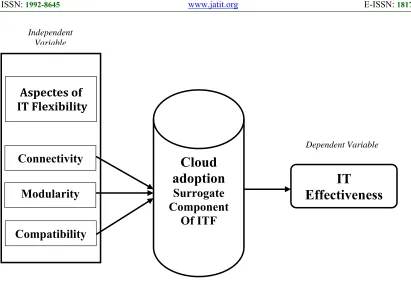
This study’s conceptual model is shown in Figure 1. It is expansions of Chebrolu’s [11] study, drilling down to study the impact of factors IT flexibility, specific to cloud computing on IT effectiveness.
5.4 Operational Definition Of Variables
The factors from previous research by Tallon and Kraemer [13], Ness [14] and Chebrolu [15] were used to measure the construct of IT effectiveness, while the factors used to measure the construct of IT flexibility were used to measure the construct of cloud computing adoption. This way of measurement assisted to make sure reliability and validity among this study and prior research. Cloud computing adoption had various survey questions that were used to assess each factor to IT effectiveness built on a 7-point Likert-type scale. The primary factors belonging to each of the three concepts on this research were as follows:
IT Flexibility, the three elements are
connectivity, modularity, and compatibility, specific to cloud computing. The research instrument questions to measure IT flexibility used by Tallon and Kraemer [13], Ness [14] and Chebrolu [15]. Were all built on a 7-point
Likert-type scale, representing ordinal data.
IT Effectiveness,The main elements and the
specific research instrument questions to measure the IT effectiveness construct was obtained from previous research by Chebrolu [15]. Were all built on a 7-point Likert-type scale, representing ordinal data.
This study was reliable with the earlier researchers in expressions of methodology and thus a 7-point Likert-type scale was utilized as the base for data gathered and analysis. A 7-point Likert-type scale ordinal data represents data components in an ordered scale proportional to quality or size [73]. In regression-analysis, it is verified that independent variables in the gathered data have a typicaldistribution before testing.
Sample
1047
5.5 Instrumentation / Measures
The survey instrument contained of questions that were intended to gather data from the members on cloud computing adoption and information technology effectiveness. The major method for collecting the quantitative data for this research was a validated survey instrument that was utilized by Chebrolu [15] togather data about cloud computing adoption, strategic alignment, and IT effectiveness. The survey questions for information technology flexibility were adjusted insignificantly to apply for cloud computing adoption (which is a factor of IT flexibility as mentioned previous). This instrument was selected because it was utilized to measure a number of constructs related with cloud computing adoption that are applicable to this study. Compatibility, modularity, and Connectivity were each factor has five questions assessed on an ordinal 7- point Likert-type scale. The layout and format of the instrument was retained to archive its reliability and validity. In Chebrolu’sstudy [15], an overall value of Cronbach’s alpha score of 0.805 was intended from research [78] [78].Moreover, Chebrolu used statistical approaches such as regression analysis, and chi-squared that confirmed previous research [12][13][14], Thus increasing reliability and validity.
5.6 Data Collection and Analysis
Data was gathered through an online survey instrument. Online survey link was spread to the possible participants sending by e-mail, which pointed participants to the survey questionnaire hosted at the services of Google Forms. The targeted participants in this survey were IT staff in various departments inside IT SMEs. A total of 142 participants had responded to the survey questionnaire within the timeframe allotted for statistical analysis from among 1200 eligible participants, but only 142 participants provided answers to at least one question.
[image:7.612.89.500.74.361.2]The survey results in the form of a zip file containing Microsoft Excel spreadsheet was downloaded from services of Google Forms. The gathered data was moved to an SPSS document to analyze. In order to examination the four hypotheses and answer the four research questions, (multiple regression analysis) & (Pearson’s correlation) were utilized to explore the relationship between information technology flexibility factors, precise to cloud computing technology Figure 1: Conceptual Model.
Cloud
adoption
Surrogate
Component
Of ITF
IT
Effectiveness
Compatibility
Connectivity
Modularity
Aspectes
of
IT
Flexibility
Independent Variable
1048 (compatibility, modularity, and connectivity), and information technology effectiveness inside IT SMEs. Pearson’s correlation was executed to determine the correlations between three information technology flexibility factors and information technology effectiveness. A multiple regression analysis was performed to determine the indicator power of the three indicator factors against the criterion variable.
5.7 Validity and Reliability
According to Holton and Swanson [74], there are three basic kinds of validity: construct validity, criterion validity and content validity. A construct is something that can't be directly observed or measured like IT effectiveness. A construct can be analyzed and measured quantitatively statistically, which is what this study incorporated. Indicating to Cooper and Schindler [75], a measure is reliable to the extent that it supplies reliable outcomes. Reliability is an essential contributor to validity but is not an enough condition for validity. The reliability of a study implies that the processes of the study can be repeated with similar outcomes.
6. FINDINGS
According to the G*Power 3 post hoc power analyses, a sample size of 119 was suggested to achieve the statistical power needed to prove thevalidity of this research. The survey sample gathered by docs.google.com/forms totaled 149 and also a total Cronbach’s Alpha score of 0.805 was calculated from standardized factor that substantiated the internal constancy for this research. Norusis [76] suggested a Cronbach’s Alpha score of at least 0.5 to achieve the reliability of a study’s instruments. These statistical tests have exposed that the data operated in this research are both reliable and valid. Only 132 participants answered all 18 questions, the power of F test of (Multiple Regression Analysis) with three factors is .98. This aggregates of 132 usable respondents adequate the original least sample size of 119.
In terms of company size (number of employees), and as shown in Table 1, data containing frequencies of company size showed that companies with 100 or more employees encompassed 38.6% of the sample. Companies with employees between 50 and 99 consisted of 25%. Companies with employees between 20 and 49 consisted of 18.9%, and companies with less than 19 comprised 17.4% of the sample.
Normality Test of Dependent Variable, before
performing parametric tests, normality check of the dependent variable was conducted. Both statistical and graphical tests were used. First, the mean and the 5% trimmed mean of the IT effectiveness were compared. The descriptive statistics of the dependent variable as shown in Table 2 suggested that the mean and the 5% trimmed mean of the IT effectiveness variable was slightly different (5.01and 5.08), indicating that there were no extreme scores. The skewness and kurtosis values of the IT effectiveness variable were also within range from-1.96 to + 1.96, and therefore, the assumption of normality of the variable was not violated.
Table 3 displays the descriptive statistics of the variables. The descriptive statistics showed that the mean of IT effectiveness was 5.01. It means that the quality of service, user’s satisfaction with IT, and helpfulness of IT staff to users is above average. The mean of connectivity was 4.92, the mean of modularity was 4.78, and the mean of compatibility was 4.69. This means that the adequacy of their systems to connect to each other inside or outside the traditional confines of the companies, together with the ability to use technical components such as data, applications, and infrastructure to improve efficiency, as well as the ability to share, use, or connect to a variety of platforms to improveefficiency of the system in the IT SMEs is above average.
Q1. To what extent, if any, does the connectivity factor of IT flexibility, precise to cloud computing, predict IT effectiveness inside IT SMEs?
H10. The connectivity factor of IT flexibility, precise to cloud computing, does not significantly correlate to IT effectiveness inside IT SMEs H1a. The connectivity factor of IT flexibility, precise to cloud computing, significantly correlate to IT effectiveness inside IT SMEs
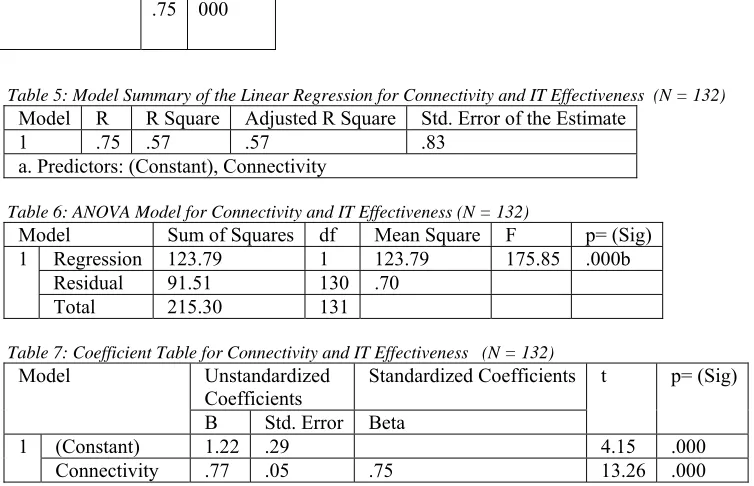
A linear regression was conducted to test the null hypothesis 1 and answer research question 1. Table 4 displays the Pearson correlation of connectivity and IT effectiveness. Results of the correlation coefficient showed that the correlation between the connectivity factor of IT flexibility, precise to cloud computing, and IT effectiveness was significant (r =.75, p < .001).
1049 linear regression analysis. The connectivity factor of IT flexibility, precise to cloud computing, explained 57% of the variance of IT effectiveness, R2 = .57, F= 175.85, p < .001 (see Table 5 and Table 6). This suggested that the connectivity factor of IT flexibility, precise to cloud computing, significantly predicted IT effectiveness (B =.77, beta = .75, t = 13.26, p < .001) (see Table 7). The regression model of connectivity and IT effectiveness is: IT effectiveness = 1.22+.77*connectivity. The null hypothesis that the connectivity dimension of IT flexibility, specific to cloud computing, does not significantly correlate to IT effectiveness inside IT SMEs was rejected. The alternative hypothesis that the connectivity dimension of IT flexibility, precise to cloud computing, significantly correlated to IT effectiveness inside IT SMEs, was supported. The connectivity factor of IT flexibility, precise to cloud computing, significantly predicted IT effectiveness inside IT SMEs.
Q2. To what extent, if any, does the modularity factor of IT flexibility, precise to cloud computing, predict IT effectiveness inside IT SMEs?
H20. The modularity factor of IT flexibility, precise to cloud computing, does not significantly correlate to IT effectiveness inside IT SMEs. H2a. The modularity factor of IT flexibility, precise to cloud computing, significantly correlate to IT effectiveness inside IT SMEs
A linear regression was conducted to test the null hypothesis 2 and answer research question 2. Table 8 displays the Pearson correlation of modularity and IT effectiveness. Results of the correlation coefficient showed that the correlation between the modularity factor of IT flexibility, precise to cloud computing, and IT effectiveness was significant (r = .77, p < .001).The null hypothesis 2 was also tested using the model summary and the ANOVA model of the linear regression analysis. The modularity factor of IT flexibility, precise to cloud computing, explained 59% of the variance of IT effectiveness, R2 = .59, F(1, 130) = 192.27, p <.001 (see Table 9 and Table 10). This suggested that the modularity factor of IT flexibility, precise to cloud computing, significantly predicted IT effectiveness (B = .86, beta = .77, t = 13.86, p < .001) (see Table 11). The regression model of modularity and IT effectiveness is: IT effectiveness = .87+.86*modularity. The null hypothesis that the modularity factor of IT flexibility, precise to cloud computing, does not significantly correlated to IT effectiveness inside IT SMEs was rejected. The
alternative hypothesis that the modularity factor of IT flexibility, precise to cloud computing, significantly correlate to IT effectiveness inside IT SMEs was supported, The modularity factor of IT flexibility, precise to cloud computing, significantly predicted IT effectiveness inside IT SMEs.
Q3. To what extent, if any, does the compatibility factor of IT flexibility, precise to cloud computing, predict IT effectiveness inside IT SMEs?
H30. The compatibility factor of IT flexibility, precise to cloud computing, does not significantly correlate to IT effectiveness inside IT SMEs. H3a. The compatibility factor of IT flexibility, precise to cloud computing significantly correlate to IT effectiveness inside IT SMEs
A linear regression was conducted to test the null hypothesis 3 and answer research question 3. Table 12 displays the Pearson correlation of modularity and IT Effectiveness. Results of the correlation coefficient showed that the correlation between the compatibility factor of IT flexibility, precise to cloud computing, and IT effectiveness was significant (r = .74, p < .001).
The null hypothesis 3 was also tested using the model summary and the ANOVA model of the linear regression analysis. The compatibility factor of IT flexibility, precise to cloud computing, explained 55% of the variance of IT effectiveness, R2 = .55, F(1, 130) = 158.73, p = .001 (see Table 13 and Table 14). This suggested that the compatibility factor of IT flexibility, precise to cloud computing, significantly predicted IT effectiveness (B = .80, beta = .74, t = 12.59, p = .001) (see Table 15). The regression model of compatibility and IT effectiveness is: IT effectiveness = 1.21+.80*compatibility. The null hypothesis that the compatibility factor of IT flexibility, precise to cloud computing, does not significantly correlate to IT effectiveness inside IT SMEs was rejected. The alternative hypothesis that the compatibility factor of IT flexibility precise to cloud computing, significantly correlated to IT effectiveness inside IT SMEs was supported. The compatibility factor of IT flexibility, precise to cloud computing, significantly predicted ITeffectiveness inside IT SMEs.
1050 H40. The combination of three factors of IT flexibility, precise to cloud computing, does not significantly correlate to IT effectiveness inside IT SMEs.
H4a. The combination of three factors of IT flexibility, precise to cloud computing, significantly correlates to IT effectiveness inside IT SMEs.
A multiple regression analysis was performed to test the null hypothesis 4 and answer research question 4. The assumptions of outliers, normality, linearity, homoscedasticity, and independence of the residuals were checked by testing the normal probability plot (P-P) of the regression standardized residuals and the scatterplot. The normal P-P plot showed that the points were in a reasonably straight diagonal line, suggesting that there were no major deviations from normality. In the scatter plot of the standardized residuals presented the residuals were roughly rectangularly distributed, with most of the scores concentrated in the center, which also supported the normality of residuals. The presence of outliers was checked from the scatter plot with standardized residual values of more than 2.2 or less than –4.4. The residual statistics for IT effectiveness was also tested with two values, Mahalanobis distance and Cook’s distance to assess for outliers. The critical value of Mahalanobis distance for three predictor variables is 16.27 [77].
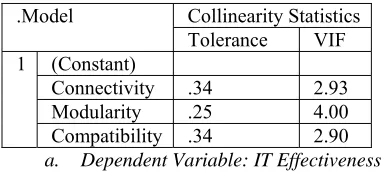
The maximum value of Mahalanobis distance for IT effectiveness was 12.00 that is less than the critical value of 16.27, suggesting there was no outlier. Further, the maximum Cook’s distance was .11 that is less than 1, suggesting that there was no problem with outlier.Collinearity diagnostics was also conducted to test the assumption of multicollinearity of the independent variables with two values, tolerance and VIF. If tolerance value is less than .10 and VIF value is greater than 10, there is a possibility of multicollinearity[77].Table 17 displays the Collinearity statistics of the independent variables. The tolerance values are greater than .10 and the VIF values were less than 10. Therefore, the multicollinearity assumption was not violated.
Next, a multiple regression analysis was performed to determine whether the combination of three factors of IT flexibility, precise to cloud computing, predict IT effectiveness inside IT SMEs. The model summary and the ANOVA model of the multiple regression analysis were used to test the null hypothesis 4. The combination of three factors of IT flexibility, precise to cloud
computing, explained 67% of the variance of IT effectiveness, R2 = .67, F= 89.24, p <.001. This suggested that the combination of three factors of IT flexibility, precise to cloud computing, significantly predicted IT effectiveness inside IT SMEs. The Connectivity factor predicted IT effectiveness the most (B = .33, beta = .33, t = 3.87, p < .001) while the compatibility the less contribute to the prediction of IT effectiveness (B =.30, beta =.27, t = 3.22, p < .005). The regression model is: IT effectiveness = .41+ .33*connectivity+ 31*modularity+.30*compatibility. The results of multiple regression analysis suggested that the null hypothesis that the combination of three factors of IT flexibility, precise to cloud computing, does not significantly correlate to IT effectiveness inside IT SMEs was rejected. The alternative hypothesis that the combination of three factors of IT flexibility, precise to cloud computing, significantly correlated to IT effectiveness inside IT SMEs was supported, The combination of three factors of IT flexibility, precise to cloud computing, significantly predicted IT effectiveness inside IT SMEs.
Research Q1 findings: To what extent, if any,
does the connectivity factor of IT flexibility, precise to cloud computing, predict information technology effectiveness inside IT SMEs? The variable construct connectivity contains how technological elements link individuals, applications in enterprises to improve resource sharing and communication throughout a company and functional areas internal or external of the customary confines of the organization. The results showed high rates for electronic links to outside parties, and the ease in which users can access enterprise resources. High rates were for the connection to remote offices and interconnectivity.
The results implied that users inside IT SMEs trust that cloud deployed systems are flexible sufficient to use by outside users, and that open systems are not obligatory to enhance the connectivity conveyed by cloud computing systems. This in turn, appears that clients are connected to and share information seamlessly throughout the enterpriseFunctional areas and can work.
1051 and Kraemer [13], Ness [14], Chebrolu [15], Lawal [16] and Byrd and Turner[71].
Research Q2 findings: To what extent, if any,
does the modularity factor of IT flexibility, precise to cloud computing, predict IT effectiveness inside IT SMEs? The variable construct modularity contains how quickly technological elements can be removed, modified or added to meet new organizational situations [70].
Results showed closely related significant rates for reusable software modules deployed in the cloud system, regardless of whether legacy systems inside clouds hampers the improvement of new IT applications, and the ease in which functionality can be added based on user demands. The similarity also displays that solutions deployed in the cloud enable wide measure of flexibility to users or client, and are adequately easy to deploy as users needed resources. This research results were reliable with previous studies which determined that a positive correlation exists between IT flexibility and IT effectiveness Tallon and Kraemer [13], Ness [14], Chebrolu [15], Lawal [16] and Byrd and Turner[71].
Research Q3 findings: To what extent, if any,
does the compatibility factor of IT flexibility, precise to cloud computing, predict IT effectiveness inside IT SMEs? The factor construct compatibility contains the ability to use, share, or connect to any kind of data across any technological element [70]. And also the new technology willbe integrated with current work.
The values got for the compatibility factor of IT flexibility, showed that compatibility significant in cloud deployed systems. The lowest average values were gotten with respect to cloud based systems deployed enterprise to accomplish integration, regardless of whether companies are limited by their decision of operating systems (OS), and whether software applications can be effortlessly transported and utilized platforms or across several cloud providers. The findings showed that cloud based systems avoid users from choosing their favored operating system, or transferring their software application among cloud based systems, and that cloud based systems delay access to outside users, which in thusly make cloud implementation more compatible. This research results were reliable with previous studies which determined that a positive correlation exists between IT flexibility and IT effectiveness Tallon
and Kraemer [13], Ness [14], Chebrolu [15], Lawal [16] and Byrd and Turner[71].
Research Q4 findings: To what extent, if any,
does the combination of three factors of IT flexibility, precise to cloud computing, predict IT effectiveness inside IT SMEs? Leaders in IT SMEs endeavor to allot financial resources that will enhance technological procedures and IT flexibility, control financial risks, and maximize IT effectiveness within their enterprises. As appeared in this research, IT SMEs that have implemented cloud computing based new solutions believe that their organizations were able to rapidly present new sources (cloud based solutions) to help enterprise procedures. As exposed by Duncan [70].The three factors of IT flexibility (compatibility, modularity, and connectivity) are the main factors used to describe IT flexibility incomplex systems. These builds served as the groundwork for following studies conducted byTallon and Kraemer [13], Ness [14], Chebrolu [15], Lawal [16] and Byrd and Turner[71].
Results got displayed high rates for helpfulness of IT personnel, users’ satisfaction, and overall quality of service. The outcomes are similar with previous research lead by numerous researchers who explained and measured IT flexibility by using the factors of compatibility, modularity, and connectivity, and confirmed that there is a positive correlation between IT flexibility and IT effectiveness Tallon and Kraemer [13], Ness [14], Chebrolu [15], Lawal [16] and Byrd and Turner[71].
7. SUMMARY
1052 this study filled in information gap in the literature because it focused on the impact of three various factors of IT flexibility specific to cloud and included IT company within small and medium business.
8. IMPLICATIONS
By deciding the predominance and prioritization of three factors of IT flexibility (connectivity, modularity, and compatibility) precise to cloud computing for IT effectiveness, IT managers and IT executives could more efficiently decide which, how and where factors of IT flexibility precise to cloud technologies to allocate financial resources for the implementation, deployment and maintenance of their complex IT systems in their organizations.
The regression testing in this research presented that modularity of IT flexibility specific cloud computing is more dominant than connectivity of IT flexibility specific cloud computing which in turn is more dominant than compatibility of IT flexibility specific cloud computing for IT effectiveness.
The implication of this study finding is that IT managers and IT executives ought to assign more financial resources towards application and software modularity within cloud technology than resources to cloud connectivity or software and systems compatibility within cloud technology in order to enhance their IT effectiveness. The findings from this study represented only firms in the Hashemite Kingdom of Jordan.
Finally, the findings did reflect information that could have been got from end-users or lower managers. The research findings in this research have advanced the existing knowledge of the relationships between factors of IT flexibility (connectivity, modularity, and compatibility) specific cloud computing and IT effectiveness for IT SEMs.
The findings addressed the advantages of adoption of cloud technology and the impact of factors of IT flexibility specific cloud on IT effectiveness and would improve the decision making process for IT managers when considering the adoption of cloud computing and its business paradigm.
9. RECOMMENDATIONS
The research’s recommendations are that IT managers and IT executives ought to assign more financial resources towards application and software modularity within cloud technology than resources to cloud connectivity or software and systems compatibility within cloud technology in order to enhance their IT effectiveness. Recommendations for Further Research: that this study be repeated using qualitative approach
on
popular cloud providers (CSP) and platforms such as Salesforce.com, Amazon’s EC2, Cisco’s WebEx, Google’s App Engine and Microsoft’s Azure, etc about how their cloud computing based solutions influence IT effectiveness. And suggest that this study be repeated with an alike quantitative correlative research to analyze the same variables to other sector or type business like government organizations or educational, etc. In addition, the authors recommend that this research be repeated with a quantitative approach with the same variables by more specificon how a specific
Type of deployment model
community/private/public/hybrid or how type of cloud service model (SaaS /PaaS/IaaS) would impact IT effectiveness. Authors hope that
IT
managers and IT executives usage this new knowledge when assigning their human andfinancial resources to enhancing their IT effectiveness and bring solutions to the business in a dynamic marketplace.REFRENCES:
[1] Armbrust, M., Fox, A., Griffith, R., Joseph, A.D.,Katz, R., Konwinski, A.,…Zaharia, M. (2009). Above the clouds: A Berkeley view of
cloud computing. Retrieved from December
14, 2009, from
http://www.eecs.berkeley.edu/Pubs/TechRpts/ 2009/EECS-2009-28.pdf
[2] Demirkan, H., Kauffman, R. J., Vayghan, J. A., Fill, H., Karagiannis, D., &Maglio, P. P. (2008).Service-oriented technology and management: Perspectives on research and
practice for the coming decade.
Electron.Commer.Rec.Appl., 7(4), 356-376. doi: 10.1016/j.elerap.2008.07.002
[3] Lim, H. C., Babu, S., Chase, J. S., & Parekh, S. S (2009). Automated control in cloud
computing: Challenges and opportunities.
1053 Automated Control for Datacenters and
Clouds,
Barcelona,Spain.13-18.doi:10.1145/1555271.1555275
[4] Sultan, N. (2010). Cloud computing for
education: A new dawn? International Journal
of Information Management, 30(2), 109. Retrieved from ABI/INFORM Global.
[5] Kroeker, K. L. (2009). The evolution of
virtualization. Communications of the ACM,
52(3), 18-20. doi: 10.1145/1467247.1467253 [6] Vouk, M.A. (2008). Cloud computing – Issues,
Research and Implementations. Paper
presented at the ITI 2008: Proceedings of the 30th International Conference on Information Technology Interfaces, Cavtat, Croatia. 31-40. [7]Feeney, G. J., Hilton, R. D., Johnson, R. L.,O'Rourke, T. J., & Kurtz, T. E. (1974).
Utility computing: A superior
alternative?Paper presented at the AFIPS '74:
Proceedings of the may 6-10,1974, National Computer Conference and Exposition, Chicago, Illinois. 1003-1003. doi:10.1145/1500175.1500370
[8] Ross, J. W., &Westerman, G. (2004). Preparing for utility computing: The role of IT architecture and relationship
management.IBM Systems Journal, 43(1), 5.
Retrieved December 20, 2009, from ABI/INFORM Global.
[9] Perez, J., Germain-Renaud, C., Kegl, B., & Loomis, C. (2009). Responsive elastic computing.Paper presented at the GMAC '09: Proceedings of the 6th International Conference Industry Session on Grids Meets
Autonomic Computing, Barcelona, Spain. 55-
64. doi: 10.1145/1555301.1555311
[10] Gens, F. (2009, December 15). New IDC IT cloud services survey: Top benefits and
challenges [Web log message]. Retrieved
from http://blogs.idc.com/ie/?p=730
[11] Pettey, C. (2009, October). Gartner identifies
the top 10 strategic technologies for 2010.
Retrievedfromhttp://www.gartner.com/it/page. jsp?id=1210613
[12] Pierce, A.C. (2002). The effect of business and information technology strategic alignment on information technology investment returns
and corporate performance. From ProQuest
Dissertations & Theses database. (No. AAT3058558)
[13] Tallon, P. P., & Kraemer, K. L. (2003). Using flexibility to enhance the alignment between information systems and business strategy:
Implications for IT business value. Center for
Research on Information Technology and
Organizations (CRITO), University of California,Irvine. Retrieved May 31, 2010, from
http://misrc.umn.edu/workshops/2003/spring/ Tallo n_042503.pdf
[14] Ness, L. R. (2005). Assessing the relationships among information technology flexibility, strategic alignment, and information
technology effectiveness. From ProQuest
Dissertations & Theses database. (No.AAT 3178531).
[15] Chebrolu, S. B. (2010). Assessing the relationships among cloud adoption, strategic
alignment and information
technologyeffectiveness. From ProQuest
Dissertations & Theses database. (No.AAT 3426510)
[16] Lawal, HildaLyn. Information Technology Flexibility and Effectiveness, Specific to Cloud Computing Adoption within Small and
Medium Enterprises.Northcentral University,
2014.
[17] Watson, R.T., Kelly, G.G., Galliers, R.D., &Brancheau, J.C. (1997, Spring). Key issues in information systems management: An
international perspective. Journal of
Management Information Systems, 13(4), 91-115.
[18] Kanungo, S., Duda, S., &Srinivas, Y. (1999, Nov/Dec). A structured model for evaluating
information systems effectiveness. Systems
Research and Behavioral Science, 16(6), 495-518.
[19] Brown, D.H. (2004, April). Webspherebusines integration server foundation v5.1: Building and eploying service-oriented applications
that extend and integrate existing IT assets. A
D.H. Brown Associates white paper prepared for IBM.
[20] Howard, C. (2009, December). Q4 Executive
Brief 2010 Trends. Burton Group Confluence,
3(6), 1-4.
[21] Ness, L. R. (2005). Assessing the relationships among information technology flexibility, strategic alignment, and information
technology effectiveness. From ProQuest
Dissertations & Theses database. (No.AAT 3178531).
[22] Maximilien, E. M., Ranabahu, A., Engehausen, R.,& Anderson, L. C. (2009).
Toward cloud-agnostic middlewares. Paper
1054 Orlando,Florida,USA.619-626.doi:
10.1145/1639950.1639957
[23] Kaufman, L. M. (2009). Data security in the
world of cloud computing. IEEE Security &
Privacy, 7(4),
61-64. doi: 10.1109/MSP.2009.87
[24] Wei, J., Zhang, X., Ammons, G., Bala, V., &Ning,P. (2009). Managing security of virtual
machine images in a cloud environment.
Paper presented at the CCSW '09: Proceedings of the 2009 ACM Workshop on Cloud Computing Security, Chicago,Illinois, USA. 91-96. doi:10.1145/1655008.1655021
[25] Erdogmus, H. (2009). Cloud computing: Does
Nirvana hide behind the Nebula. IEEE
Software,26(11), 4-6. Retrieved from IEEE database.
[26] Farah, S. (2010). Cloud computing or software as a service-which makes the most sense for
HR?Employment Relations Today, 36(4), 31.
Retrieved May 3, 2010, from ABI/INFORM Global.
[27] Fortino, G., Mastroianni, C., Pathan, M., &Vakali, A. (2009). Next generation content networks: Trends and challenges. Paper presented at the UPGRADE-CN '09:
Proceedings of the 4th Edition of the UPGRADE-CN Workshop on use of P2P,GRID and Agents for the Development of Content Networks, Garching, Germany. 49-49. doi:10.1145/1552486.1552516
[28] Suess, J., &Morooney, K. (2009). Identity management & trust services: Foundations
for cloud computing. EDUCAUSE Review,
44(5), 24. Retrieved December 20, 2009, from ABI/INFORM Global. (Document ID: 1865415041).
[29] Sultan, N. (2010). Cloud computing for education: A new dawn? International Journal of Information Management, 30(2), 109. Retrieved from ABI/INFORM Global.
[30] Wheeler, B., & Waggener, S. (2009). Above campus services: Shaping the promise of
cloud computing for higher education.
EDUCAUSEReview, 44(6), 52. Retrieved December 20, 2009,from ABI/INFORM Global.
[31] Kraska, T., Hentschel, M., Alonso, G., &Kossmann, D. (2009). Consistency rationing
in the cloud: Pay only when it matters.
Proc.VLDB Endow., 2(1), 253-264.
[32] Orr, B. (2008). Will IT of the future have its feet firmly planted in the "cloud"? American
Bankers Association. ABA Banking Journal,
100(9), 50.Retrieved December 20, 2009, from ABI/INFORM Global.
[33] Babcock, C. (2009a, November). Ready for this? InformationWeek, (1250),
22-30.Retrieved December 20, 2009, from ABI/INFORM Global.
[34] Treese, W. (2008). Movin' to the cloud.
NetWorker,12(4), 13-15.
doi:10.1145/1461981.1461985
[35] Holden, E. P., Kang, J. W., Bills, D. P., &Ilyassov, M. (2009). Databases in the cloud:
A work in progress. Paper presented at the
SIGITE '09:Proceedings of the 10th ACM Conference on SIG Information Technology Education, Fairfax,Virginia, USA. 138-143. doi:10.1145/1631728.1631765
[36] Buyya, R., Yeo, C.S., &Venugopal, S. (2009).
Market-oriented cloud computing: Vision, hype, and reality of delivering IT services as
computing utilities. Paper presented at the
10th IEEE International Conference on High
Performance Computing and
Communications, 5-13.
[37] Cellary, W., & Strykowski, S. (2009). e-government based on cloud computing and
service- oriented architecture. Paper presented
at the ICEGOV '09: Proceedings of the 3rd International Conference on Theory and Practice of Electronic Governance, Bogota,
Colombia. 5-10.
doi:10.1145/1693042.1693045
[38] Li, Z., Wang, Y., Olivier, K. K. S., Chen, J., & Li, K. (2009). The cloud-based framework for ant colony optimization. Paper presented at
the GEC '09: Proceedings of the First
ACM/SIGEVO Summit on Genetic and
Evolutionary Computation,
Shanghai,China.279-286.doi: 10.1145/1543834.1543872
[39] Ciortea, L., Zamfir, C., Bucur, S., Chipounov, V.,&Candea, G. (2009). Cloud9: A software
testing service. SIGOPS Oper.Syst.Rev.,
43(4), 5-10. doi:10.1145/1713254.1713257 [40] Lodi, G., Querzoni, L., Baldoni, R., Marchetti,
M.,Colajanni, M., Bortnikov, V., Chockler, G., Dekel, E., Laventman, G., &Roytman, A. (2009). Defending financial infrastructures through early warning systems: The
intelligence cloud approach. Paper presented
at the CSIIRW '09: Proceedings of the 5th Annual Workshop on Cyber Security and Information Intelligence Research, Oak Ridge,
Tennessee. 1-4. doi:
1055 [41] Guazzelli, A., Stathatos, K., & Zeller, M.
(2009).Efficient deployment of predictive analytics through open standards and cloud
computing. SIGKDD Explor.Newsl., 11(1),
32-38. doi:10.1145/1656274.1656281
[42] Zeller, M., Grossman, R., Lingenfelder, C.,Berthold, M. R., Marcade, E., Pechter, R., Hoskins, M., Thompson, W., &Holada, R. (2009). Open standards and cloud computing:
KDD-2009 panel report. Paper presented at
the KDD '09: Proceedings of the 15th ACM SIGKDD International Conference on Knowledge Discoveryand Data Mining, Paris, France. 11-18. doi:10.1145/1557019.1557027 [43] Mowbray, M., & Pearson, S. (2009). A client-based privacy manager for cloud computing. Paper presented at the COMSWARE '09:
Proceedings of the Fourth International ICST Conference on COMmunication System softWAre and middlewaRE, Dublin, Ireland. 1-8. doi:10.1145/1621890.1621897
[44] Deelman, E., Singh, G., Livny, M., Berriman, B., & Good, J. (2008). The cost of doing
science on the cloud: The montage example.
Paper presented at the SC '08: Proceedings of the 2008 ACM/IEEE Conference on Supercomputing, Austin, Texas. 1-12.
[45] Zhang, X., Ai, J., Wang, Z., Lu, J., &Meng, X.(2009). An efficient multi-dimensional index
for cloud data management. Paper presented
at the CloudDB '09: Proceeding of the First International Workshop on Cloud Data Management, Hong Kong, China. 17-24. doi:10.1145/1651263.1651267
[46] Murray, P. (2009). Enterprise grade cloud computing. Paper presented at the WDDM '09: Proceedings of the Third Workshop on
Dependable Distributed Data Management, Nuremberg, Germany. 1-1. doi: 10.1145/1518691.1518692
[47] Birman, K., Chockler, G., & van Renesse, R. (2009). Toward a cloud computing research
agenda. SIGACT News, 40(2), 68-80. doi:
10.1145/1556154.1556172
[48] Erdogmus, H. (2009). Cloud computing: Does Nirvana hide behind the Nebula. IEEE Software,26(11), 4-6. Retrieved from IEEE database.
[49] Christodorescu, M., Sailer, R., Schales, D. L.,Sgandurra, D., & Zamboni, D. (2009).
Cloud security is not (just) virtualization
security: A short paper. Paper presented at the
CCSW '09:Proceedings of the 2009 ACM Workshop on Cloud Computing Security,
Chicago, Illinois, USA. 97-102. doi: 10.1145/1655008.1655022
[50] Pearson, S. (2009). Taking account of privacy
when designing cloud computing services.
Paper presented at the CLOUD '09: Proceedings of the 2009 ICSE Workshop on Software Engineering Challenges of Cloud
Computing, 44-52.
doi:10.1109/CLOUD.2009.5071532
[51] Wang, W., Li, Z., Owens, R., &Bhargava, B. (2009). Secure and efficient access to
outsourced data. Paper presented at the
CCSW '09:Proceedings of the 2009 ACM Workshop on Cloud Computing Security, Chicago, Illinois, USA. 55-66. doi: 10.1145/1655008.1655016
[52] Golden, B. (2009). Forrester bucks
conventional wisdom on cloud computing.
CIO. Retrieved
fromhttp://www.cio.com/article/496213/Forre ster_Bucks_Conventional_Wisdom_on_Cloud _Computing
[53] Babcock, C. (2009b, September). Hybrid
Clouds. InformationWeek, (1240),
15-19.Retrieved December 20, 2009, from ABI/INFORM Global.
[54] Fraser, S., Biddle, R., Jordan, S., Keahey, K.,Marcus, B., Maximilien, E. M., & Thomas, D. (2009). Cloud computing beyond objects:
Seeding the cloud. Paper presented at the
OOPSLA '09: Proceeding of the 24th ACM SIGPLAN Conference Companion on Object Oriented Programming Systems Languages and Applications, Orlando,Florida, USA. 847-850. doi:10.1145/1639950.1640043
[55] Woods, D., &Pattabhiram, C. (2009, June).Integration: The critical path to cloud computing. Cast Iron Systems white paper on
Cloud Integration. Retrieved on March 29,
2010, from
http://www.castiron.com/docs/whitepaper/Clo ud_Integration.pdf
[56] Creeger, M. (2009). Cloud computing: An
overview. ACM Queue, 7(5), 3-4.
doi:.1145/1538947.1554608
[57] Saleem, Irfan. "Role of Information and Communicational Technologies in perceived
Organizational Performance: An Empirical
Evidence from Higher Education Sector of Pakistan." (2011).
[58] Navedo-Samper, Teresita, Edgar Ferrer, and Isabel Rivera-Ruiz. "Moderating effects of human factors on IT-business alignment and
IT effectiveness in modern firms." Scientific
1056 [59] Fink, Lior, and Seev Neumann. "Exploring the
perceived business value of the flexibility enabled by information technology
infrastructure." Information&Management 46.
2 (2009): 90-99.
[60] Bulchand-Gidumal, Jacques, and Santiago Melián-González. "Maximizing the positive influence of IT for improving organizational
performance." The Journal of Strategic
Information Systems 20.4 (2011): 461-478. [61] Lam, Patrick TI, Franky WH Wong, and
Kenny TC Tse. "Effectiveness of ICT for construction information exchange among
multidisciplinary project teams." Journal of
Computing in Civil Engineering 24.4 (2009): 365-376.
[62] Thamodaran, Varadaraju, and Mahalingam Ramesh. "Effectiveness of information communication technology in rural
insurance." Business & Economic
Horizons 2.2 (2010).
[63] Bradley, Randy V., et al. "Enterprise architecture, IT effectiveness and the mediating role of IT alignment in US
hospitals." Information Systems Journal 22.2
(2012): 97-127.
[64] Hsu, J. "Effectiveness of technology transfer
measures in improving SME productivity: An
empirical study of Taiwan." The Journal of American Academy of Business 15.2 (2010): 206-211.
[65] Beheshti, Hooshang M., and Cyrus M. Beheshti. "Improving productivity and firm performance with enterprise resource
planning." Enterprise Information Systems 4.4
(2010): 445-472.
[66] Armbrust, Michael, et al. "A view of cloud
computing." Communications of the
ACM 53.4 (2010): 50-58.
[67] Misra, S. C., &Mondal, A. (2011).
Identification of a company’s suitability for the adoption of cloud computing and modelling its corresponding return on investment. Mathematical and Computer
Modelling, 53(4), 504-520.
doi:10.1016/j.mcm.2010.03.037
[68] Marston, S., Li, Z., Bandyopadhyay, S., Zhang, J., &Ghalsasi, A. (2011). CC — The business perspective. Decision Support
Systems, 51(1), 176-189.
doi:10.1016/j.dss.2010.12.006
[69] Nkhoma, M., & Dang, D. (2013).
Contributing factors of cloud computing
adoption: a
technology-organisation-environment framework approach. International Journal of Information Systems and Engineering (IJISE), 1(1), 38-49.
Retrieved from
http://researchbank.rmit.edu.au/view/rmit:221 96
[70] Duncan, N. B. (1995). Capturing flexibility of information technology infrastructure: A study of resource characteristics and their
measure.Journal of Management Information
Systems, 12(2), 37. Retrieved from http://www.jmis-
web.org/issues/Fall_1995/index.html
[71] Terry Anthony Byrd, Douglas E. Turner. "Measuring the flexibility of information
technology infrastructure: Exploratory
analysis of a construct." Journal of Management Information Systems 17.1 (2000): 167-208
[72] Fink, Lior, and Seev Neumann. "Exploring the perceived business value of the flexibility enabled by information technology
infrastructure." Information &
Management 46.2 (2009): 90-99.
[73] Aczel, A. D., &Sounderpandian, J. (2002).
Complete business statistics (5th ed.). New
York: McGraw-Hill.
[74] Swanson, R. A., & Holton, E. F., III. (Eds.). (2005). Research in organizations:
Foundations and methods of inquiry.San
Francisco: Berrett-Koehler.
[75] Cooper, C. R., & Schindler, P. S. (2008).
Business research methods (10th ed.). Boston:
McGraw-Hill.
[76] Norusis, M. (2008b). SPSS Statistics 17.0
Statistical Procedures Companion. Upper
Saddle-River, N.J.: Prentice Hall.
[77] Pallant, J. (2011). SPSS Survival Manual: A step by step guide to data analysis using the SPSS program (4th ed.). New York, NY: McGraw-Hill.
[78] Hwang, Mark I., and HongjiangXu. "A structural model of data warehousing success." Journal of Computer Information Systems 49.1 (2008): 48-56.
[79] Vogt, W. P., & Johnson, R. B. (2011).
Management Dictionary of statistics &
1057
[image:17.612.78.494.62.754.2]SPSS TABLS
Table 1: Descriptive Statistics for Company Size (N = 132)
Frequency Percent Valid 19 or less 23 17.4
20-49 25 18.9
50-99 33 25.0
Over 100 51 38.6
[image:17.612.88.487.229.333.2]Total 132 100.0
Table 2: Descriptive Statistics for IT Effectiveness
Statistic Std. Error
IT Effectiveness Mean 5.01 .11
95% Confidence Interval for Mean Lower Bound 4.79 Upper Bound 5.23
5% Trimmed Mean 5.08
Std. Deviation 1.28
Skewness -.83- .21
Kurtosis .58 .41
Table 3: Descriptive Statistics of IT Effectiveness, Connectivity, Modularity, and compatibility (N=132) Construct Mean Std. Deviation
IT Effectiveness 5.01 1.28 Connectivity 4.92 1.26 Modularity 4.78 1.14 Compatibility 4.69 1.17
Table 4: Pearson Correlation of Connectivity and IT Effectiveness (N = 132)
Table 5: Model Summary of the Linear Regression for Connectivity and IT Effectiveness (N = 132) Model R R Square Adjusted R Square Std. Error of the Estimate
1 .75 .57 .57 .83
a. Predictors: (Constant), Connectivity
Table 6: ANOVA Model for Connectivity and IT Effectiveness (N = 132)
Model Sum of Squares df Mean Square F p= (Sig)
1 Regression 123.79 1 123.79 175.85 .000b
Residual 91.51 130 .70
Total 215.30 131
Table 7: Coefficient Table for Connectivity and IT Effectiveness (N = 132)
Model Unstandardized
Coefficients Standardized Coefficients t p= (Sig) B Std. Error Beta
1 (Constant) 1.22 .29 4.15 .000
Connectivity .77 .05 .75 13.26 .000
[image:17.612.88.465.472.715.2]1058
Table 8: Pearson Correlation of Modularity and IT Effectiveness (N = 132)
Table 9: Model Summary of the Linear Regression for Modularity and IT Effectiveness (N = 132)
Model R R Square Adjusted R Square Std. Error of the Estimate
1 .77 .59 .59 .81
a. Predictors: (Constant), Modularity
Table 10: ANOVA Model for Modularity and IT Effectiveness (N = 132)
Model Sum of Squares df Mean Square F Sig.
1 Regression 128.45 1 128.45 192.27 .000b
Residual 86.85 130 .66
Total 215.30 131
a. Dependent Variable: IT Effectiveness
[image:18.612.87.477.346.400.2]b. Predictors: (Constant), Modularity
Table 11: Coefficient Table for Modularity and IT Effectiveness (N = 132)
Model Unstandardized Coefficients Standardized Coefficients t Sig.
B Std. Error Beta
1 (Constant) .87 .30 2.83 .005
Modularity .86 .06 .77 13.86 .000
Table 12: Pearson correlation of Compatibility and IT Effectiveness (N = 132)
Table 13: Model Summary of the Linear Regression for Compatibility and IT Effectiveness (N = 132)
Model R R Square Adjusted R Square Std. Error of the Estimate
1 .74 .55 .54 .86
[image:18.612.95.412.598.652.2]a. Predictors: (Constant), Compatibility
Table 14: ANOVA Model for Compatibility and IT Effectiveness (N = 132)
Model Sum of Squares df Mean Square F Sig.
1 Regression 118.36 1 118.36 158.73 .000b
Residual 96.93 130 .74
Total 215.30 131
a. Dependent Variable: IT Effectiveness b. Predictors: (Constant), Compatibility
Pearson correlation R p= (Sig) .77 000