KALMAN STABILIZATION UNDER CHANNEL DIVERSITY
IN MIMO-OFDM SYSTEM
G. RAJENDER, Dr. T. ANILKUMAR, Dr. K. SRINIVASA RAO
1.
Research Scholar, JNTUH, University, Hyderabad, Telangana, India-500075
2.
Professor ECE Department, MVSR Engineering College, Hyderabad, Telangana, India
3.
Professor & Principal TRR College of Engineering, Hyderabad, Telangana, India-502319 E-Mail:1. [email protected], 2. [email protected], [email protected]
ABSTRACT
Signal estimation and its performance has always remained a challenge for wireless communication society. New methods to consider channel diversity and spectrum usage were proposed in past. This paper present a new approach to interference controlling, With a proposal for control of resources, to achieve the goal of increasing performance in the allocation system, using the interference conditions. Approach to control overlap in the framework of coordination and indiscriminate accessing for multiple users communication is proposed. The proposed approach develops a correlation method for resource allocation in on a multi path interference condition for faded channel condition based on the space frequency and non-stationary domain estimation.
Keywords: Kalman stabilization, MIMO-OFDM, channel diversity.
1. INTRODUCTION
Wireless channel are getting diverse in nature. Channel deviation in communication process has been effective in channel estimation, which is dependent on the channel uncertainty. the retrieval of signal under channel imperfect conditions. In different approach of estimation, feedback estimators are used as a optimal estimation logic, where a feedback error is propagated to get the estimation, The estimation
logic work using a Where the channel estimation
is being carried out and updated to obtain an estimate. In the MIMO-OFDM system, the estimation using However, with the approach of increasing communication and services, we need the traditional models of the communication of the data exchange to improve. To achieve the
best performance of this system, different
methods were developed in recent past. Under the channel imperfection condition in [1] a frequency selective logic is developed, where a pilot base estimation approach is developed to estimate the signal under multipath condition.
Filter operates for channel tracking in the
communication system and encoding
demonstration gives a flexible approach. The analysis
is a cumulative evaluation of the channel gain and phase in the communication system such as
coding of a channel estimator is concerned with the channel consideration. For the estimation of signal, in [7] an impulse response of channel effect is used, where correlation logic is developed for a correlative approach for transmit and receive antenna. An approach of integrated wiener filter is used for the optimization of channel estimation in a time frequency domain. The estimation performance under highly varying mobile units for Time dependent channel effect. For the improvement of estimation performance in MIMO-OFDM system, a symmetric approach was outlined in [9]. The estimation approach is defined to minimize the MSE, power and interference based on DFT approach. The estimation of channel effect using symmetrical estimation model was used for the MSE and power loss minimization. In [10] to estimate the SCM channel for MIMO-OFDM systems with zero-fill is defined with a distinctive attributes. State verification is very simple and the most relaxed of the column is distributive mode. it can be applied to the case of transmission antennas in particular cases. Through the evaluation of simulation, the error rate performance is observed in the retrieved bits are low to medium in estimation zone. To determine path closer to the best estimation in [11] a second round of the CFO and advances in putting OFDM system is suggested. Rounding provides first-class replication algorithm to fit to estimate the excellent track that the traditional method of the comparison scale. It works in the second round rounding way in improving the frequencies and channels to track estimation as compared to the first form. In [12] channeling long-term estimator attributes is computed through a sub domain mapping algorithm through space-time patterns in the channel. On the other hand, variable fading can be tracked using the techniques used for temporal fade channel coherence. In particular, It was chosen in MIMO-OFDM based on a BISM equation Turbo reference model for performance evaluation in terms of bit-error rate. In [13] scheme has been put to coincide with the semi-blind scheme to estimate the time channels for systems and modules based on vectors. In semi-blind coding, the operation was performed through three operative phases, (1) calculating the time difference between the maximum gain in
multiple-channel fading, (2) minute
sedimentation time algorithm to find a location in the channels, and (3) Reach of the channel response. In this work, a new methodology is
proposed to evaluate the performance of the MIMO-OFDM systems through optional and overlapping variable frequency channels. Results are measured on the basis of probable error bits when the coded is exchanged over the channel. We focus on the form of coding system for most channel criteria based on OFDM with BISM technology. The analysis based on the approach of the channel diversity is used and can be extended to any of the blocks size.
2. MIMO COMMUNICATION SYSTEM
Future wireless systems demands for high data to be delivered to achieve the demanded goal. it is
observed that in traditional systems of
interference based on the coincidence between the symbol approach, due to the selective frequency in the radio channel. To achieve high productivity data exchange with minimal system interference. By sending data in parallel with the larger code periods, OFDM systems to prevent significant Iossy overlap measure is taken. To get a high data rate, OFDM-MIMO systems were
used with improved technology of
communication. MIMO offers additional parallel channels in the spatial region to increase data rate. Therefore, the MIMO-OFDM is a sophisticated approach to the high rate of data exchange in future wireless systems. The multi-input and multi-output (MIMO) a combination of the most promising technologies in the field of high data services in next generation services. Performance evaluation of multicellular systems is crucial for the implementation of transmission standards such as WiMAX and 3GPP.
A. Communication model
can be improved by using information throughout. In each cell, the base station (Bs)
equipped with symbols and each
subcarrier station (SS) an array elements
of antenna is used. It transmits the data based on the logical frame data, whereas the transmitters are referred to the OFDM successive sub-slot neighbors. Within each cell, multiple accesses to separate the logical frame data in the frequency
and time zones of the subcarrier × is used. The
base station may send one or more data for each region designated as SS. The Multi-user coding approach gives the base mapping of the logical frame to the actual provider of the formation of the real-time frame. Since some of the sub-carriers may remain unassigned, η≤1 traffic load seems to refer to the number of active sub-carriers in the total. Depending on the degree of cooperation between the base station and the payload, it could observe that each data area up
to NI overlapping or fixed over the capacity of
the entire data area. With the exception of a
coordinated approach, used for special
randomization, the interference policy exchanged cellular operation of the equipments of a OFDM system before drawing the logical sides in material resources for the purpose of interfering minimization with the overlap within each region of The data areas. This paper examines each of the randomized scheduling policy and the randomness of the communication scenario in the uplink phase. Here it is noteworthy that for the previous policy, you can program the improvement in the dynamic allocation of some data to reduce the overlap area of each base station. However, optimization of subsequent scheduling is perhaps optimized for timing in the form of data areas, for the cell to be considered free of charge and to be independent of the cell.
B. channel modeling
In Frequency Selective coding with NR×NT with
Channel Response , given by:
(1)
Mean power is the power of each path, NR × NT
fades capacity. GK is the duration of the
transmitter and receiver on the inert frequency response of the filter, reflecting the fading capacity considered to be consistent with the broad unregulated stable dispersion model given as,
(2)
Fade channel calculations to match spatial
product exhibits a Kronecker product of RTx with
Rrx. Spatial cooperation between sending antenna
and destinations
Following the same logic, we see two different models with respect to antenna arrays which are in line with the geometrical shape of the various assumptions: beam-forming antenna arrays of different model elements around the varied and varied elements of the set which is used for the K model away. If the interference is a different correlator, then co-matrix (1) is structured and multi-beam optimized antenna forming a
connective strategy to reduce inter-cell
interference can benefit from this knowledge. Intercellular interference is placed by making the filtration beam here with the tabulation policy, interference in the spatial structure remains the same volume of data (eg, the noise branch can be estimated with high accuracy). On the other hand, the imbalanced interference, diversity model, space diversity / Time / intervention in favor of greater estimated with random scheduling approach. Even if the subcarrier-power of noise (2) is estimated by changing the actual sub-receiver's average power noise within
the data segment which is
the interference level used in soft decoding. Based on these considerations, we define two typical scenarios:
C. Coordinative channel effect
In a coordinated strategy, the data areas in all cells are referred to the neighboring sub
neighbors or that the entire data area, ,
for is a constant variation on the formation
of constant interference patterns and the exact difference of the Q, which can be used efficiently The possibility of continuous overlap is allowed to reduce the overlap to estimate. MIMO system OFDM provides amplitude that can be used to reduce the overlap: area frequency provided by spatial domain OFDM signal and array processing. To increase the ability to overlap, we adopt a linear array antenna uniform adoption (ULA) separate distance and form processing package, each sub-carrier wave. Percent change
SINR . The signal approach
and each sub-carrier to adopt the SINR beam
formation method. . Channel
differences about Kashmir depending on where the field of data differs with the interference
pattern. , Assuming the right to know, in
combination the signals contained in different antennas issued the minimum distortion variance in the receiver, by adding the following generation SINR output. Changes depending on the channel above where the interference pattern does not differ with the data area. At least a deformation of a combination of signals coming on different antennas variables, full knowledge
of , less than the future, yielding on these
production of SINR,
(3)
D.Uncoordinated channel effect
The case was referred to the maximum provided by channel volatility and inefficiency both aimed at benefiting from a variety. A variety of multi-user went started to approach the random access code that provides overlapping interference. In this case, due to the uncertainty of the formation of caries to reduce interference cannot be estimated (ie, the difference is very uneven cannot be reliably predicted). The MIMO channel delivers a channel diversity influence, and relied on OSTBC with sufficient gap antennas. The maximum receiver reception probability (ML) OSTBC is based on the detection of the presence of a Viterbi data decoder (conventional decoder) on the average
noise power is used. In this case, SINR to be
used in decoding
(4)
For reference minimum performance, we also consider the current variation in this decoder
SINR for the current noise power on each
Sub carrier using the idea of optimal decoding,
(5)
This channel overlaps for modeling and evaluation purposes, it is better to mention SINR as a function of the carrier frequency channel
NTNR× 1 standard,
(6)
When the overlap variation scenario, for
the random, , which is done with
decoding of traditional coded and decoder device specified with a coordinator. The SINR is reduces to:
(7)
This equivalent channel space properties
spatial and temporal multi-channel diffusion
channel MIMOs and variance fluctuations
interconnection between cells generated by the ability of multiple access policy depends on
performance evaluation (ie differences of ℸk),
depending on the dispersion of spatial overlap According to the models in the sections.
3. KALMAN ESTIMATION & STABILIZATION
Kalman filter technique is a repeated estimation for the error estimation algorithm in real time to deal with random signals, which is the best way to guess on the basis of the lowest average in the window. It is the state space model of the adoption signal and noise and estimates the state variable by estimating the present value of the previous value and measurement. State Update
Time Equation and Equation Update
Measurement: Therefore, it can be divided into two phases.
The time updation Equation is considered as an improvement equation that can be updated from the equation of predicting the measurement can be updated in the form of correct predictive performance in the order of actual measurable idea. Then use the measured value to eliminate the random overlap and update the system.
a) Under Coordinated Channel effect
In a KF system the desired signal R(n) that originates from an unknown linear system is defined by,
(8)
Where an unknown column vector is determined
with an adaptive filter N(i) with zero arithmetic
noise, and X(n) is defined respectively which the length of the input vector K is not specified.
(9)
In the process of convergence, it has been suggested to approach [8] to estimate. In this approach, the signal of partition is de-channeled by D (N) and reference director Y (N) H0 Analysis Filters (Z) to estimate the impulse effect. The signals channel steps to demonstrate the desired range in the resulting low rate sample relative and the signal is the turn of the original signal D (N) of K signal, and every prediction of the candidates of the channels in the destructive know came out on it:
Pi,D(k) = Xi(k)WT(k) (10)
Where, Xi(k) is a 1 x K row such that,
and
denotes the estimated weight value and the decimated channel estimation error is then defined by,
(11)
Where is the desired signal.
In the process of NCAF the weight optimization is defined as,
(12) Where µ is the step size.
This weight is used to improve the selection of a signal selection; it takes a large cost to concentrate for improvement. [1] Solving this problem in the proposal to improve existing weight on MSD. In this approach, it is used to track the biggest drop of MSD between continuous repetition and then an error weight
vector, is defined. As
the optimal weight determination,
(13) Using this weight vector and taking the expectation a MSD is computed which satisfies the absolute expectation as,
E (14)
A difference of MSDs between two successive iterations is then defined by given as,
(15)
However the convergence is optimized taking consideration of two successive observations only. In the process of signal estimation the disturbance v(i) is randomly distributed over the whole signal and two successive observation may not extract the overall impact over the whole period. This leads to the residual errors in the estimates due to current observation X(k) over X(k+1)…. X(n). This is more effective in randomized channel model. Hence to achieve this objective a Randomized coding approach is proposed.
b) Under uncoordinated channel effect
under a randomized channel inference model, the process of defining Randomized estimation approach, the estimate is observed over a period of ‘n’ sub channel data, hence the absolute estimation is then defined as,
(16)
When appreciation is integrated, observation period 'N' channel assessment 'N' is beyond estimates. The frequency response of the channel 'N' estimate is defined by that, they (f), n = 0,1,
..., n-1 and n sub signals, given by An =
[A0(T),A1(T),………,AN-1(T)] , which is taken at
one time at a given time Defines a set where F = 1 / T is the dispersion rate.
(17)
Where signals are varying from the original frequency from one aspect of QTC to estimate the channels in the variant, ‘Tc' period is the sum
of all scattered signals.
Then the updation factor determined as,
(18)
where∆i,n is defined as the observatory factor,
and Z(kTc) is the multipath signal defined with
Xn frequency response with Tc delay factor. The
Randomized estimates over the n-sub channels are then used for signal estimates for direct sequence (DS) to recover the filter output. The recursive comparison of the weight updated signal are fed to estimator with lower MSD is evaluated. The estimated error components are processed to retrieve the original information. The system is evaluated for variant noise density and iteration counts. The obtained experimental results are as outlined below.
4. SIMULATION RESULTS
The proposed channel estimation coding for
successive and randomized estimates is
[image:6.612.327.552.186.392.2]evaluated for different noise density. The frequency response of such filter is observed in Figure 1.
nnel
0 100 200 300 400 500 600 700 800 900 1000
-2 -1.5 -1 -0.5 0 0.5 1 1.5 2
Time
m
a
g
n
it
u
d
e
[image:6.612.100.300.503.661.2]Test sample
Figure 1. Test Sample
A test sample in a sinusoidal format is taken, at a frequency of 5.5 KHz, with 1024 samples. The observed input sample is as shown in figure 5. This input signal is process with additive Gaussian noise, and adaptive filtrations are
applied to estimate the signal. The measuring parameter of Mean square deviation (MSD) and convergence time is computed. The developed approach is evaluated over different values of channel parameters.
The original test signal is propagated via 4 multipath channels, reveling each frequency resolution isolate. To evaluate the estimation efficiency of the two channel model (coordinated and random), Normalized MSD is computed. The obtained MSD for the two methods is as outlined in figure 2.
0 20 40 60 80 100 120 140 160 180 200 -50
-45 -40 -35 -30 -25 -20 -15 -10 -5 0
iteration
N
o
rm
a
liz
e
d
M
e
a
n
q
u
a
re
D
e
v
ia
ti
o
n
(
d
B
)
Normalized Mean square deviation plot
Cordinated interference Random interference Uncordinated
Figure 2. Normalized MSD For N =4, At Σ = 0.8
The normalized MSD for the two methods DS and R-DS is presented in figure 8. The noise variance is fixed to 0.8 and the estimation iteration is carried out for 200, at a updating step size of 1.0. The obtained observation illustrates that the Normalized MSD are almost in equality, and a minor decrement of MSD is observed. As the number of bands processing is 4, the probability of selecting optimal band is almost equal in both the cases, leading to very near values.
1 2
0 1 2 3 4 5 6 7 8 9x 10
-3
Methods
C
o
n
v
e
rg
e
n
c
e
t
im
e
(
S
e
c
)
Convergence Time plot
[image:6.612.337.521.544.705.2]Cordinated interference Random interference
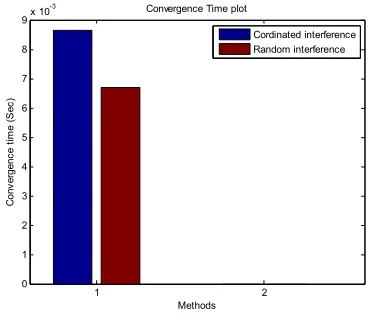
The process of estimation, however takes lower
convergence time due to faster error
minimization, as the estimation is distributed over a range of bands. Though the Proposed estimation approach iterates over all K-iterations, the convergence time taken for the proposed method is less, due to the fact that the iteration terminates once the limiting factor is achieved. In the case of Randomized approach as all bands are processed, a more probability of optimal selection is achieved than the uncoordinated approach.
0 200 400 600 800 1000 1200
-1.5 -1 -0.5 0 0.5 1 1.5
Time
M
a
g
n
it
u
d
[image:7.612.333.544.113.288.2]e
Figure 4. Channel Estimation Decomposed Signal For Noise Free Sample At N=8
A similar test is carried out for higher noise effect with number of channel N=8. The original signal without Noise effect is shown in figure 4.
0 200 400 600 800 1000 1200
-1.5 -1 -0.5 0 0.5 1 1.5
Subband Signals
Time
M
a
g
n
it
u
d
e
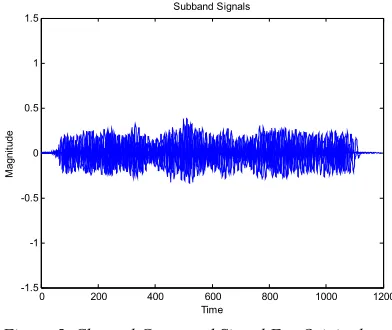
Figure 5. Channel Corrupted Signal For Original Sample At Var = 0.8, N=8
For the estimation of the original signal, the noise affected sample is considered for 8 channel. The density of noise affected bands is shown in figure 5. In the case of noise affected signal, the decomposed bands consist more magnitudal distortion, than the original sample. In reference to these bands estimation is carried
out. The Obtained observation for this case is outlined in figure 6, 7.
0 20 40 60 80 100 120 140 160 180 200
-50 -45 -40 -35 -30 -25 -20 -15 -10 -5 0
iteration
N
o
rm
a
li
z
e
d
M
e
a
n
q
u
a
re
D
e
v
ia
ti
o
n
(
d
B
)
Normalized Mean square deviation plot
[image:7.612.97.299.245.382.2]DS-NSAF R-DS-NSAF Average
Figure 6. Normalized MSD For The Two Methods At N=8, Σ = 0.8
The normalized MSD for the two methods at N=8 is as outlined in figure 12. It could be observed that, with the increase in the value of ‘N’, the MSD is decremented for the Randomized approach. As the estimation in such case is carried over all bands, the error probability will be less. However in the case of DS, the estimation is carried out over two successive bands only.
‘
1 2
0 0.005 0.01 0.015 0.02 0.025 0.03
Methods
C
o
n
v
e
rg
e
n
c
e
t
im
e
(
S
e
c
)
Convergence Time plot
DS-NSAF R-DS-NSAF
Figure 7 Convergence Time For The Two Methods At N=8, Σ = 0.8
[image:7.612.328.512.438.590.2] [image:7.612.98.294.453.618.2]0 20 40 60 80 100 120 140 160 180 200 -60 -50 -40 -30 -20 -10 0 iteration M e a n q u a re D e v ia ti o n ( d B )
Mean square deviation plot
[image:8.612.335.527.75.242.2]DS-NSAF-var=0.2 DS-NSAF-var=0.5 DS-NSAF-var=0.7 DS-NSAF-var=1.0 R-DS-NSAF-var=0.2 R-DS-NSAF-var=0.5 R-DS-NSAF-var=0.7 R-DS-NSAF-var=1.0
Figure 8. Normalized MSD Over Iteration For Noise Variance Of 0.2, 0.5, 0.7, 1.0
To evaluate the performance of developed approach over variant of noise factor, the developed approach is tested for different values of noise variance. A randomly distributed additive noise with given variance is generated and is added to the processing signal, to give the impact of medium effect. For the developed approaches the MSD is computed, and the obtained observation is presented in figure 14. The MSD for the R-DS is observed to be less than the DS approach. The MSD is observed to get linear, at an iteration of 120. For the increase in noise variance the proposed method estimates
more accurately in comparison to the
conventional DS approach.
1 2 0 0.005 0.01 0.015 0.02 0.025 0.03 0.035 Methods C o n v e rg e n c e t im e ( S e c )
Convergence Time plot
DS-NSAF-var=0.2 R-DS-NSAF-var=0.2 DS-NSAF-var=0.5 R-DS-NSAF-var=0.5 DS-NSAF-var=0.7 R-DS-NSAF-var=0.7 DS-NSAF-var=1 R-DS-NSAF-var=1
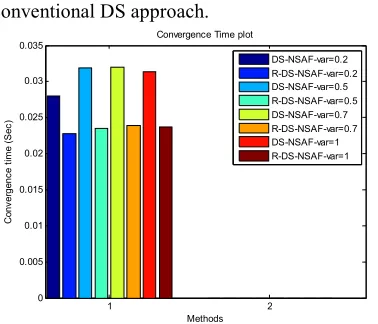
Figure 9 Convergence Time Plot For DS And R-DS For Noise Variance Of 0.2, 0.5, 0.7, 1.0
In the case of R-DS approach, the convergence time is comparatively lower due to higher error estimation probability and faster error limiting. However in comparison for different values of noise variance, the computation time increases in few fractions, due to rise in noise density for R-DS approach.
0 20 40 60 80 100 120 140 160 180 200
-60 -50 -40 -30 -20 -10 0 iteration M e a n q u a re D e v ia ti o n ( d B )
Mean square deviation plot
[image:8.612.328.526.425.586.2]DS-NSAF-mu=0.4 DS-NSAF-itr-mu=0.6 DS-NSAF-mu=1.0 R-DS-NSAF-mu=0.4 R-DS-NSAF-itr-mu=0.6 R-DS-NSAF-mu=1.0
Figure 10. Normalized MSD For The Two Methods At µ = 0.4, 0.6, 1.0
To test the effect of updating step ‘µ’ on the estimation process, a case study for different values of µ is carried out. The value of µ is set to 0.4, 0.6 and 1.0 for the two methods. The
estimation accuracy for the Randomized
approach is much higher than the DS method for different values of µ. It is also observed that for lower value to step size µ= 0.2, the estimation accuracy is higher in case of R-DS approach. As the updating step size lowers the weight optimization is observed to be faster than the higher step values.
1 2 0 0.005 0.01 0.015 0.02 0.025 0.03 0.035 Methods C o n v e rg e n c e t im e ( S e c )
Convergence Time plot
DS-NSAF-mu=0.4 R-DS-NSAF-mu=0.4 DS-NSAF-itr-mu=0.6 R-DS-NSAF-itr-mu=0.6 DS-NSAF-mu=1.0 R-DS-NSAF-mu=1.0
Figure 11. Convergence Time Plot For Variation In Step Size
[image:8.612.94.283.441.603.2]5. CONCLUSION
This paper presented an approach for faster convergence of DS based channel filtration approach. In the process of estimation, convergence optimization is obtained by
Randomized consideration of n-multipath.
Wherein the estimation is achieved by the process of successive band consideration in conventional coding approach, the proposed R-DS approach considers lower order bands also. The usage of Randomized signals, results in optimized MSD estimation, due to distributed noise density over multiple bands. The
optimization of MSD results in faster
convergence of estimates for signal estimation.
REFERENCES
[ 1] MingFei Siyau, Tiancheng Li, Javier Prieto,
Juan Corchado, Javier Bajo, “A Novel Pilot Expansion Approach for MIMO Channel Estimation and Tracking”, IEEE,ICUWB, pp.1-5, 2015.
[ 2] Hani Mehrpouyan, Ali A. Nasir, Steven D.
Blostein, Thomas Eriksson, George K. Karagiannidis, and Tommy Svensson, “Joint Estimation of Channel and Oscillator Phase
Noise in MIMO Systems”, IEEE
Transactions on Signal Processing,
Vol.60,(9),pp.4790 – 4807, 2014.
[ 3] Movahedian.A, McGuire, M., “Efficient and
Accurate Semi blind Estimation of
MIMO-OFDM Doubly-Selective Channels”, 80th
IEEE,VTC Fall, pp.1-5, 2014.
[ 4] Shijie Zhang, Dan Wang and Jun Zhao “A
Kalman Filtering Channel Estimation Method Based on State Transfer Coefficient Using Threshold Correction for UWB Systems”, International Journal of Future Generation Communication and Networking, Vol.7, No.1, pp.117-124, 2014.
[ 5] Vinod Gutta, Kamal Kanth Toguru Anand,
Teja Sri Venkata Saidhar Movva, Bhargava Rama Korivi, Santosh Killamsetty, and Sudheesh padmanabhan, “Low Complexity Channel Estimation using Fuzzy Kalman Filter for Fast Time Varying MIMO-OFDM Systems”, IEEE, ICACCI, pp. 1771 – 1774, 2015.
[ 6] Takahiro Natori, Nari Tanabe and Toshihiro
Furukawa, “a MIMO–OFDM channel
estimation algorithm for high–speed
movement environments”, IEEE, ISCCSP, pp.348 – 351, 2014.
[ 7] Jinesh P. Nair and Ratnam V. Raja Kumar,
“Optimal Superimposed Training Sequences for Channel Estimation in MIMO-OFDM Systems”, Hindawi Publishing Corporation, EURASIP Journal on Advances in Signal Processing, pp.13, Springer, 2010.
[ 8] Ke Zhong, Xia Lei, Binhong Dong and
Shaoqian Li, “Channel estimation in OFDM systems operating under high mobility using Wiener filter combined basis expansion model”, EURASIP Journal on Wireless Communications and Networking, Vol.186, Springer, 2012.
[ 9] YiWang, Lihua Li, Ping Zhang, and Zemin
Liu, “DFT-Based Channel Estimation with Symmetric Extension for OFDMA Systems”, Hindawi Publishing Corporation, EURASIP Journal on Wireless Communications and Networking, pp.8, Springer, 2009.
[ 10]Yi-Sheng Chen and Jwo-Yuh Wu, “Statistical
covariance-matching based blind channel estimation for zero-padding MIMO–OFDM systems”, EURASIP Journal on Advances in Signal Processing , Vol.139, Springer, 2012.
[ 11]Rainfield Y Yen, Hong-Yu Liu and
Chia-Sheng Tsai, “Iterative joint frequency offset and channel estimation for OFDM systems using first and second order approximation algorithms”, EURASIP Journal on Wireless Communications and Networking, Vol.341, Springer, 2012.
[ 12]Marcello Cicerone, Osvaldo Simeone, and
Umberto Spagnolini, “Channel Estimation for
MIMO-OFDM Systems by Modal
Analysis/Filtering”, IEEE transactions on communications, vol. 54, no. 11, IEEE, 2006.
[ 13]Te-Lung Kung and Keshab K Parhi, “Semi
blind frequency-domain timing
Synchronization and channel estimation for OFDM systems”, EURASIP Journal on Advances in Signal Processing, Springer, 2013.
[ 14]Erol ¨ Onen,1 AydınAkan
(EURASIPMember),1 and Luis F. Chaparro, “Time-Frequency Based Channel Estimation for High-Mobility OFDM Systems–Part
I:MIMO Case”, Hindawi Publishing
Corporation, EURASIP Journal on Advances in Signal Processing, pp.8, Springer, 2010.
[ 15]Kyeong Jin Kim, Jiang Yue, Ronald A. Iltis,
and Jerry D. Gibson, “A QRD-M/Kalman
Filter-Based Detection and Channel
[ 16]C Anjanaa, S Sundaresana, Tessy Zachariaa, R Gandhirajb, K P Soman, “An Experimental
Study on Channel Estimation and
Synchronization to Reduce Error Rate in OFDM Using GNU Radio”, International
Conference on Information and
Communication Technologies, Procedia